
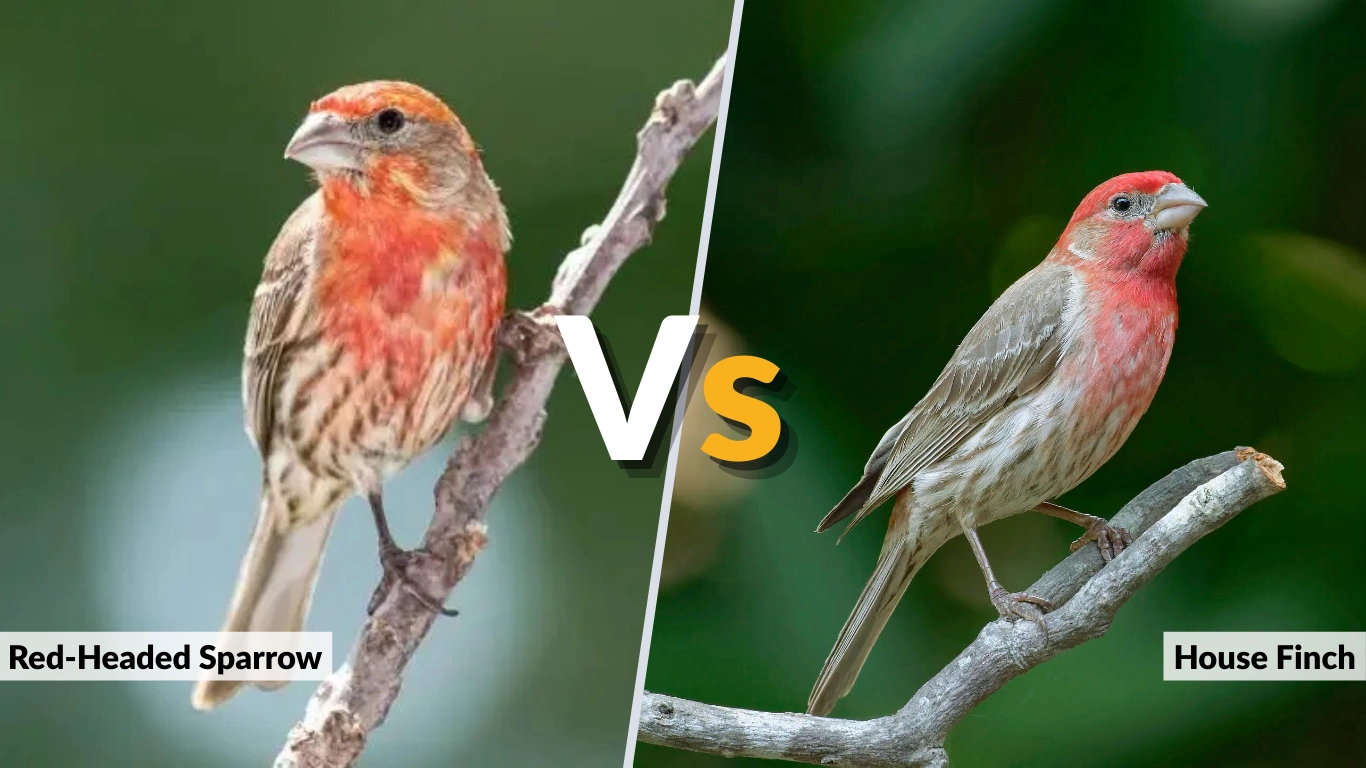
Backyard birdwatchers often confuse the so-called “red-headed sparrow” with the much more common House Finch. This mix-up usually happens because both birds are small, brown, and streaked, and the finch’s red plumage can resemble a sparrow with unusual coloring. Understanding the differences matters for accurate identification, since each bird has its own distinct behavior, habitat preferences, and vocal patterns. This guide explores seven major distinctions and provides clear identification tips, making it easier to tell them apart with confidence.
Identification
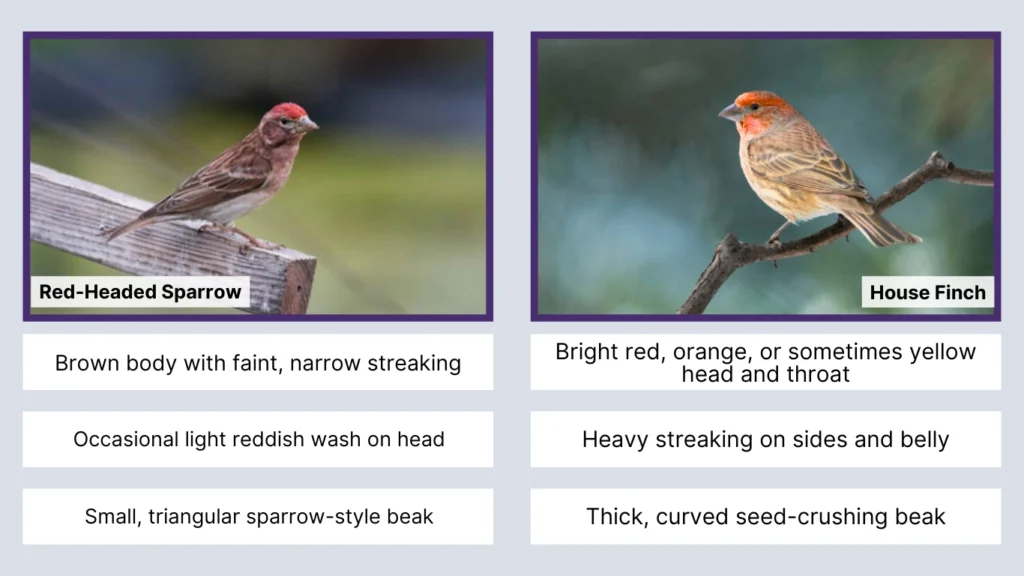
- “Red-Headed Sparrow”
- Brown body with faint, narrow streaking
- Occasional light reddish wash on head or chest (not bright)
- Small, triangular sparrow-style beak
- Subtle face pattern with minimal contrast
- Brown body with faint, narrow streaking
- House Finch
- Bright red, orange, or sometimes yellow head and throat
- Heavy streaking on sides and belly
- Thick, curved seed-crushing beak
- Rounder head profile with more visual contrast
- Bright red, orange, or sometimes yellow head and throat
Head Color & Pattern
Many people report seeing a “red-headed sparrow,” but in most cases, the bird is actually a House Finch. House Finches display bold red plumage that ranges from deep crimson to orange or even yellow depending on diet. The red typically covers the crown, face, throat, and upper chest, giving them a vibrant appearance that stands out immediately.
Sparrows, by contrast, rarely show true red pigmentation. At most, a sparrow may exhibit a faint pinkish or rusty wash, but nothing close to the solid, saturated red of a finch. Their coloration stays mostly brown, with light streaking and subtle facial markings. This difference alone is often the quickest way to separate the two species in good lighting.
Another helpful clue is pattern contrast. House Finches tend to have a more defined face pattern due to the interaction of red plumage and darker streaking. Sparrows maintain a muted, blended look with fewer bold contrasts. When viewed up close, the difference in facial detail becomes even more obvious.
Body Shape & Size
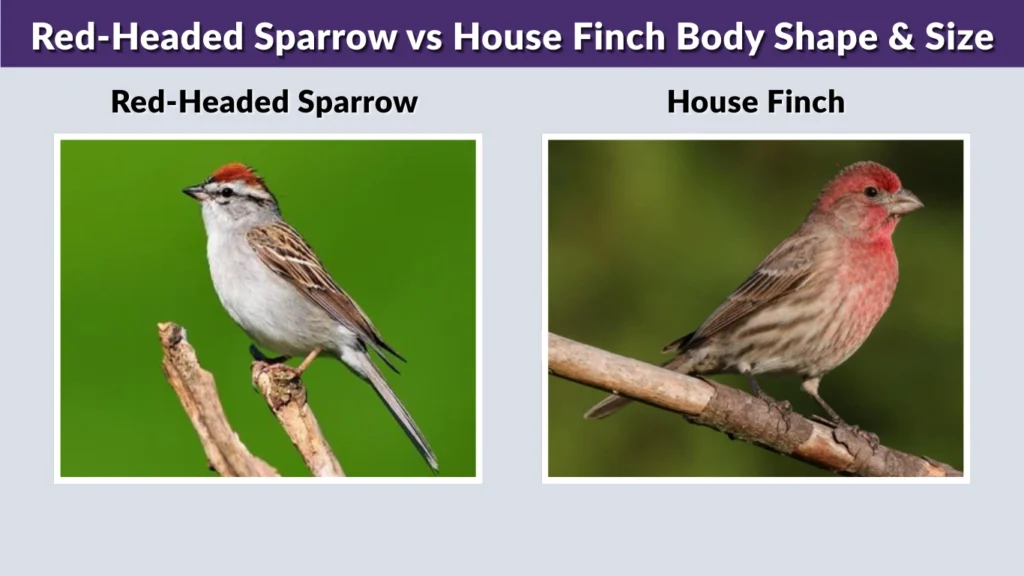
Body shape greatly improves field identification, especially when color isn’t easily visible. House Finches have a slightly larger, fuller build, giving them a round-bodied, almost “chunky” appearance. Their chest looks wide and their head appears more rounded, creating a compact but substantial silhouette.
Sparrows, meanwhile, tend to look leaner and more angular. Their bodies appear slimmer with a more streamlined posture, and their tails can seem longer in proportion to their size. Even though the size difference is small, the overall structure can be noted when birds are perched side-by-side or observed for more than a few seconds.
Wing shape also plays a role. House Finches have broader wings and often look stockier during flight, while sparrows display quicker, more agile wingbeats. This subtle difference becomes clearer with practice but helps refine identification for frequent birdwatchers.
Beak Shape
Beak shape is one of the most reliable distinctions between these two birds. House Finches have a thick, curved, and noticeably bulky beak designed for cracking hard seeds. This beak shape gives them a powerful bite and a rounded facial profile that is easy to identify once you know what to look for.
Sparrows, on the other hand, possess a smaller, sharper, triangular beak. It’s still conical, but not nearly as heavy or curved as a finch’s bill. The sparrow’s beak is well-suited for grasping insects and softer seeds, giving them more versatility in their diet. When comparing birds at a feeder, the finch’s larger, robust beak stands out clearly.
Chest & Belly Markings
Both birds display streaking, which is why many observers confuse them. However, the type and density of streaks differ significantly. House Finches have thick, bold streaking along the flanks and belly, creating a strong contrast against their lighter undersides. These streaks appear darker and more defined, often forming distinct lines.
“Red-headed sparrows” (which are typically standard sparrows with slight coloration) show finer, narrower streaks. Their underparts are more uniformly brown or buff-colored with lighter, more delicate patterns. Sparrows lack the strong flank streaking that is characteristic of House Finches. This makes their overall chest area appear smoother and less patterned.
Song & Calls
Vocal differences are extremely helpful for identification. House Finches produce long, rolling warbles that rise and fall in a cheerful, musical sequence. Their song is one of the most variable and vibrant among backyard birds, often continuing for several seconds and consisting of many rapid syllables.
Sparrows vocalize differently. Their calls tend to be shorter, sharper, and more repetitive. Many species produce simple chips or trills rather than long complex warbles. A sparrow’s song is more mechanical sounding, while a finch’s is fluid and melodic. If you hear a long, bubbly warble from a perch, it is almost certainly a House Finch.
Habitat & Range
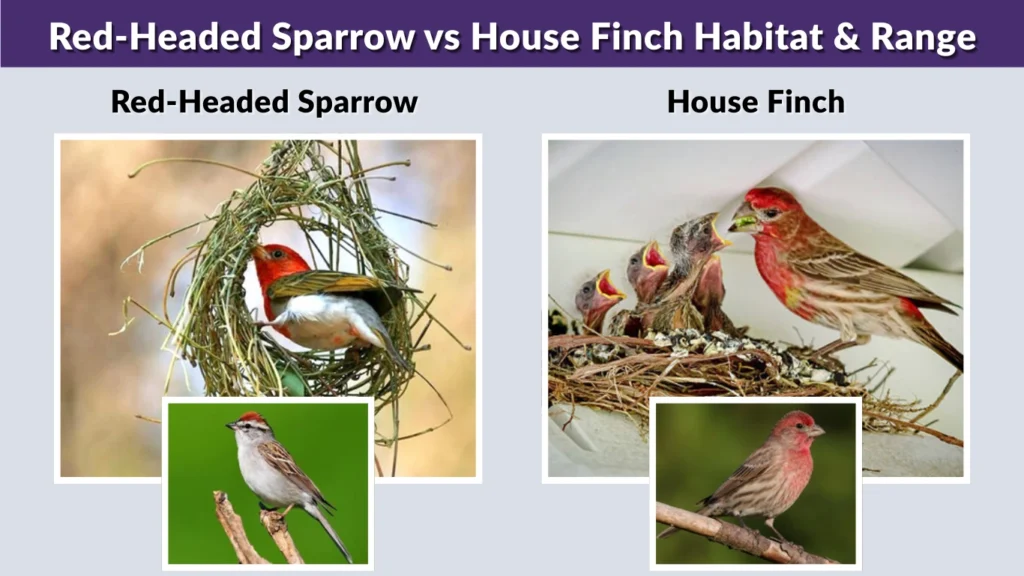
House Finches are widespread across North America and thrive in both urban and rural areas. They frequently visit bird feeders, perch on telephone wires, and nest on buildings and porches. Their adaptability has made them one of the most common backyard birds.
Sparrows (when labeled as “red-headed”) are usually basic brown sparrows found in fields, shrubs, thickets, and open grassy areas. They prefer lower vegetation and spend more time foraging on the ground. While both birds can appear in suburban settings, sparrows lean toward natural cover, whereas finches excel near human structures and feeders.
Feeding Behavior
Feeding behavior offers another strong clue. House Finches almost always feed from elevated positions—hanging feeders, perches, branches, and wires. They readily consume black oil sunflower seeds, safflower, and millet, and their thick beaks allow them to crush tough shells easily.
Sparrows spend more time on the ground, scratching and hopping as they search for seeds or small insects. They will visit feeders, but usually prefer platform or tray-style feeders where seeds spill. Their feeding posture is more horizontal, while finches maintain an upright stance when eating.
Comparison Table: Red-Headed Sparrow vs House Finch
| Feature | “Red-Headed Sparrow” | House Finch |
| Head Color | Brown/light wash | Bright red/orange/yellow |
| Beak | Small, triangular | Thick, curved |
| Chest Markings | Fine, faint streaks | Bold, heavy streaks |
| Song | Short chips/trills | Long musical warbles |
| Habitat | Fields, shrubs | Urban & suburban |
| Size | Slightly smaller | Slightly larger |
| Feeding Style | Ground foraging | Feeder perching |
Range
House Finches occupy almost all of North America, especially in populated regions. Sparrows are globally widespread, and many species exist across a variety of habitats. Because “red-headed sparrow” is not a true species, the birds misidentified under this name may come from different sparrow groups, but all share similar brown coloration and subtle markings.
Habitat
House Finches thrive near people and are commonly found in gardens, patios, and city parks. They prefer accessible food sources and visible perches. Sparrows are more secretive, sticking to bushes, tall grass, and ground-level cover. Spotting their different habitat choices often helps determine which bird you’re seeing.
Behavior
Finches display social, perching behavior and are frequently seen in small flocks visiting feeders. Their flight is undulating and steady. Sparrows move quickly through low vegetation, appear more nervous, and frequently scratch at the ground. Observing posture, movement, and feeding style can provide quick confirmation of species.
FAQ
Is a red-headed sparrow a real species?
No—there is no official species called a “red-headed sparrow.” Most sightings use this label when a House Finch is mistaken for a sparrow. The red coloration almost always belongs to a finch, since sparrows rarely display true red pigment beyond faint, rusty tones.
Why do people confuse sparrows and finches?
Their similar size, brown coloration, and streaked patterns make them easy to mix up at a distance. The confusion grows when a finch’s red plumage appears dull in shade, causing it to resemble a sparrow with unusual coloring. Key differences in beak shape and vocalizations help clarify the distinction.
Do both birds visit backyard feeders?
Yes, though they use them differently. House Finches perch directly on feeders and crack seeds vigorously. Sparrows prefer flat surfaces or spilled seed on the ground. A bird feeding upright on a hanging feeder is more likely a finch, while a bird hopping below is probably a sparrow.
Which one sings more?
House Finches are the more musical species, producing long, cheerful warbles throughout the day. Sparrows vocalize, but their sounds are shorter and more mechanical, usually limited to chips, trills, or simple repetitive patterns. If you hear a flowing, bubbly song, that’s a finch.
How do I quickly tell them apart in the field?
Look first at the beak and head color. A thick, curved beak and bright red plumage indicate a House Finch. A slimmer beak and muted brown tones point to a sparrow. Behavior also helps: finches perch high at feeders, while sparrows forage low to the ground.
