
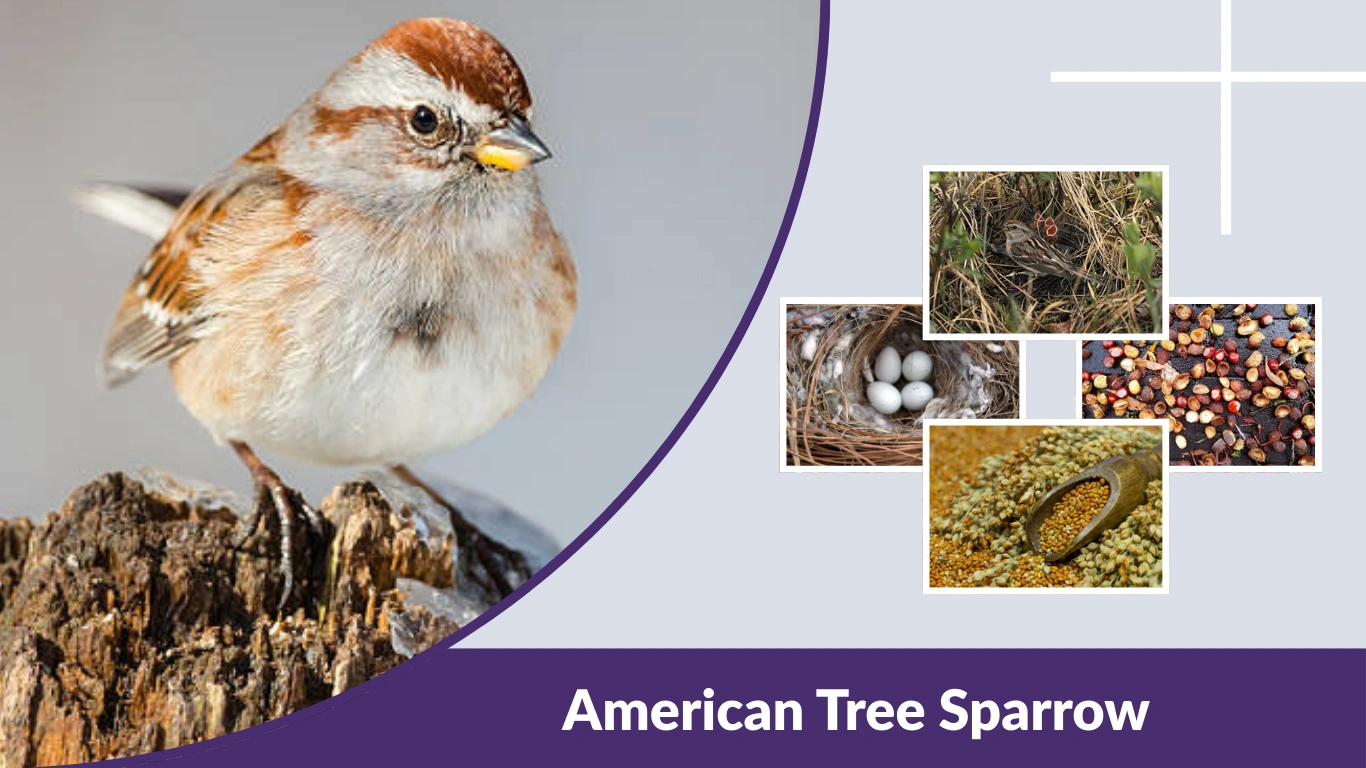
The American Tree Sparrow is a familiar winter visitor across the northern United States and southern Canada. Despite its name, this species spends little time in trees and does not breed in forests. Instead, it nests in the open tundra of arctic Alaska and Canada, returning south only during the coldest months. Its warm reddish crown, soft gray face, and distinct central breast spot make it a favorite among winter birders. Known for its gentle behavior and tinkling songs, the American Tree Sparrow brings energy and color to snowy fields and feeders. Understanding its identification, behavior, and ecological patterns deepens appreciation for this hardy migratory sparrow.
Identification & Appearance
Key Identification Features
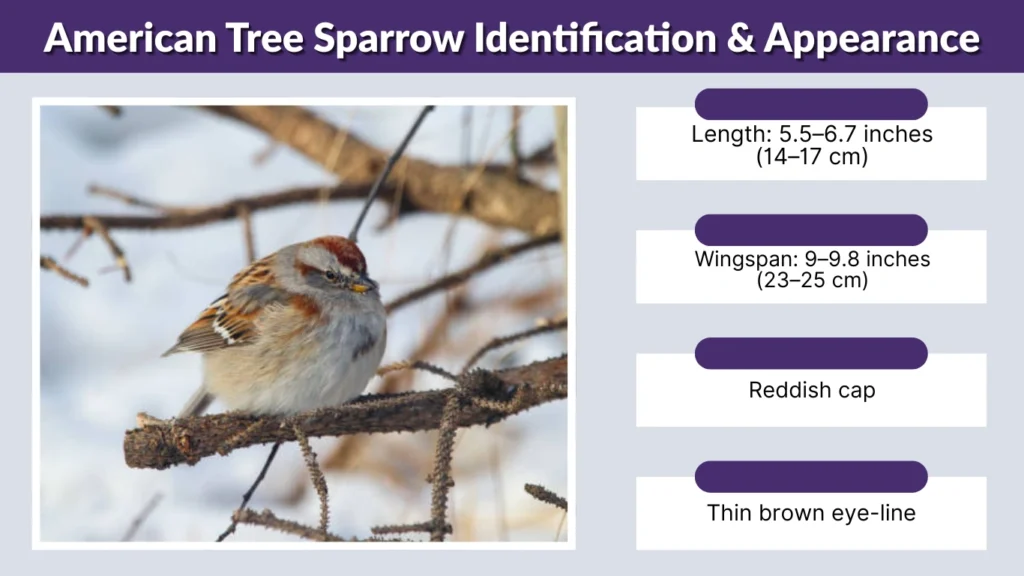
Identifying the American Tree Sparrow becomes easy with a few key visual markers. The bird has a warm rufous cap that stands out against its cool gray face. A thin brown line extends behind the eye. The two-toned bill—dark above and yellow below—is one of the most reliable identifiers. A small, round, dark spot in the middle of the breast provides another key clue.
Male vs. Female
Males and females appear very similar. Males may show slightly brighter rufous tones during the breeding season, but the difference is subtle. Both sexes share the same head markings, soft brown wings with white wing bars, and unstreaked grayish underparts.
Size & Measurements
The American Tree Sparrow is medium-small for a sparrow:
- Length: 5.5–6.7 inches (14–17 cm)
- Wingspan: 9–9.8 inches (23–25 cm)
- Weight: 0.5–0.8 ounces (13–22 g)
Its relatively long tail and slightly rounded body distinguish it from similar species.
Juvenile vs. Adult
Juveniles appear more muted than adults, lacking the strong reddish crown and clear breast spot found in older birds. Their face pattern appears softer, with weaker contrast between gray and brown tones.
Quick ID Checklist
- Reddish cap
- Thin brown eye-line
- Gray face with pale eyebrow
- Unstreaked underparts
- Dark central breast spot
- Bicolored bill
- Brown wings with two clear wing bars
Behavior & Life History
Daily Behavior Patterns
American Tree Sparrows spend much of the day foraging on the ground. They scratch through snow, dried grasses, and fallen seeds using quick double-kicks. They frequently flick their wings and tails in short bursts while feeding. During winter, they travel in groups of 6–20 birds, often mixed with juncos or other sparrows.
Flight Pattern
Their flight is energetic and slightly bouncy, consisting of rapid wingbeats followed by short glides. When moving between feeding patches, they fly low to the ground in loose lines or small groups.
Growth Stages
Their life stages include:
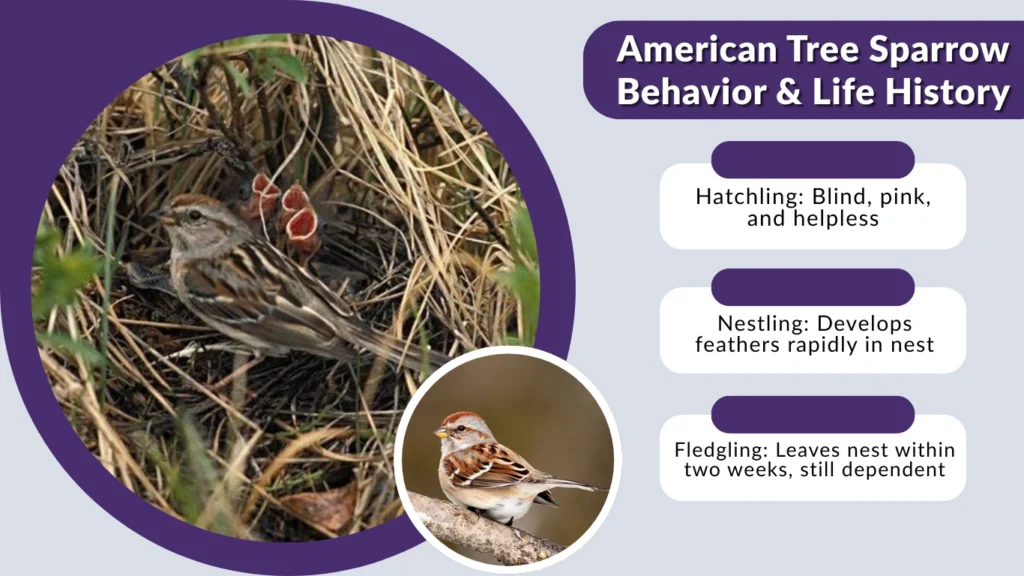
- Hatchling: Blind, pink, and helpless
- Nestling: Develops feathers rapidly in nest
- Fledgling: Leaves nest within two weeks, still dependent
- Juvenile: Gains full independence by late summer
They are altricial, meaning chicks hatch helpless and require extensive parental care.
Life Cycle Traits
American Tree Sparrows are long-distance migrants. They breed in the far north, raise one brood per year, and begin moving south by late summer. Many individuals return to the same wintering areas year after year, demonstrating strong site fidelity.
Notable Behavior Traits
- Forages mainly on the ground
- Often feeds in flocks
- Uses rapid wing flicking
- Very tolerant of cold climates
- Known for soft, musical winter calls
Sounds & Vocalizations
Primary Song
The American Tree Sparrow’s song is a sweet, musical series of clear, tinkling notes. It resembles a softer, more delicate version of the Chipping Sparrow’s trill. Because they sing mostly on breeding grounds, winter visitors are more often heard calling than singing.
Calls
Their typical call is a clear, bell-like “teew” or “tseet”. This call is frequently heard as birds fly between shrubs or forage in flocks. The alarm call is sharper and quicker, used when predators approach or when the flock becomes startled.
Seasonal Vocal Changes
During winter, vocal activity consists mostly of chip calls and soft contact notes. By contrast, in the Arctic breeding season, males become more vocal, singing from shrub tops or exposed perches.
Vocalization Types
- Soft musical song (breeding grounds)
- Clear flight call
- Contact chip notes
- Sharp alarm call
Habitat, Range & Ecology
Breeding Habitat
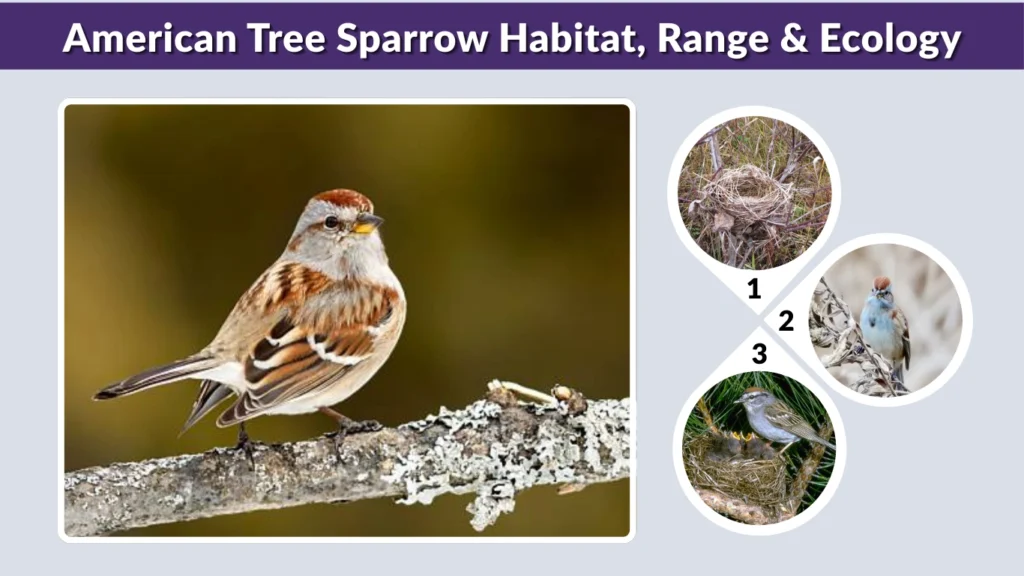
American Tree Sparrows breed in the far northern tundra of Alaska and Canada. Their preferred nesting areas include low shrubs, dwarf willow patches, mossy tundra, and open stretches of grasses. Because the Arctic summer is brief, these habitats provide insects, shelter, and sunlight-rich feeding opportunities during the short breeding window.
Winter Habitat
In winter, they move into southern Canada and the northern United States, occupying open fields, brushy thickets, marshy edges, and rural farmlands. They also frequent backyard feeders, especially in regions with snow cover. Areas rich in weed seeds—such as abandoned lots or overgrown roadsides—are especially attractive to them.
Range Summary
- Summer: Alaska, northern Canadian territories, and high-latitude tundra
- Migration: Across the Prairies, Great Lakes, and northeastern regions
- Winter: Northern and central United States, southern Canada
They rarely travel into the deep southern states except during unusually harsh winters.
Abiotic Factors
Tree Sparrows are influenced by:
- Snow cover: Determines seed accessibility
- Temperature: Impacts daily energy demands
- Daylight: Controls feeding duration
- Wind exposure: Affects roosting choices
Habitat Preferences
- Open, shrubby landscapes
- Grasslands and field edges
- Wetland margins
- Seed-rich roadside vegetation
Nesting & Reproduction
Nest Structure & Placement
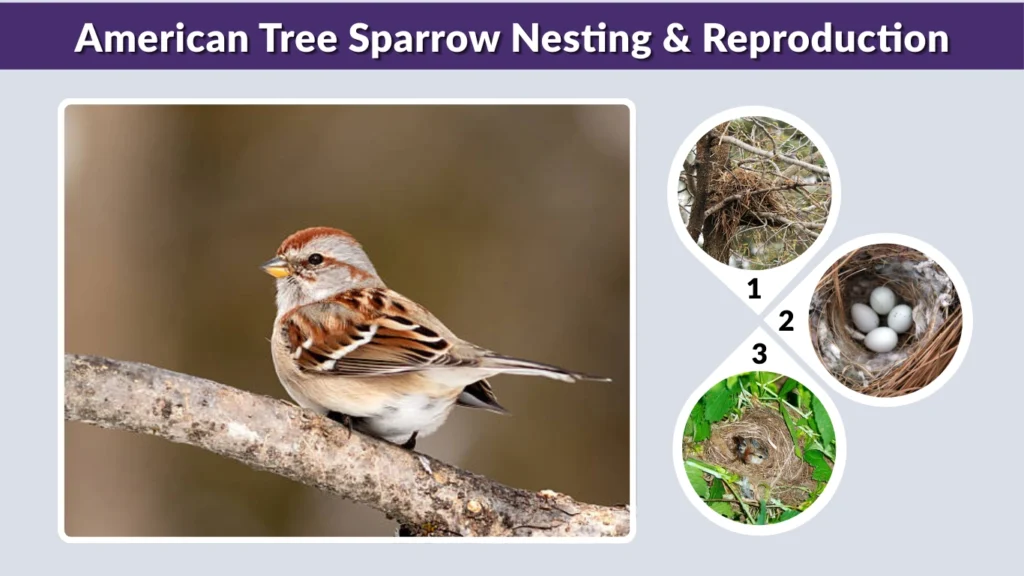
American Tree Sparrows build their nests low to the ground, often tucked within a small shrub, willow clump, or grass mound. Nests are constructed from dried grasses, small twigs, moss, and lined with feathers or soft plant material, providing insulation against harsh Arctic winds.
Eggs
A typical clutch contains 4–6 eggs, pale blue to greenish with brown speckling. The female handles most of the incubation, which lasts around 12–14 days. The eggs are well-camouflaged, blending easily with their tundra surroundings.
Parental Behavior
While the female incubates, the male provides food and guards the territory. Once hatched, both parents feed the nestlings a diet rich in insects. Because the Arctic summer is short, the chicks grow quickly, and the parents maintain an intense feeding pace.
Young Development
Nestlings leave the nest at roughly 8–10 days old, long before they can fly well. During this fledgling stage, the parents continue providing food and protection. By late summer, young Tree Sparrows gain independence and begin preparing for migration.
Geographic Distribution by Region
Midwest
States such as Indiana, Michigan, and Ohio host American Tree Sparrows throughout winter. They often gather around farmlands, tall grasses, and frozen marsh edges.
Northeast
In New York, Maine, Rhode Island, and New Brunswick, Tree Sparrows are common winter birds. They frequent coastal fields, forest edges, and backyard feeders.
Central & West
American Tree Sparrows winter in Missouri, Kansas, and Colorado, especially in open agricultural areas. Even farther west, they appear in limited numbers in parts of California, mostly during migration or in the northern regions.
Southern Winter Visitors
Small numbers reach East Texas during exceptionally cold winters or food-scarce years farther north.
Where They Are Most Common
- Northern United States
- Southern Canada
- Prairie and Great Lakes regions
- Northeastern coastal states
Comparison With Similar Species
American Tree Sparrow vs. Chipping Sparrow
Chipping Sparrows have a crisp black eye-line and lack the Tree Sparrow’s dark breast spot. Their bill is entirely dark, not bicolored. Chippers also prefer trees and open woods in summer, unlike the tundra-breeding Tree Sparrow.
American Tree Sparrow vs. House / English Sparrow
House Sparrows are bulkier with a thicker bill and bold facial patterns. Tree Sparrows have slimmer bodies, a more delicate appearance, and a distinct chest spot lacking in House Sparrows.
American Tree Sparrow vs. Song Sparrow
Song Sparrows display heavy streaking across the breast and flanks, while Tree Sparrows have clean gray underparts with only a single central spot.
American Tree Sparrow vs. Field Sparrow
Field Sparrows have a pink bill, plain face, and no breast spot. Their song differs strongly as well, featuring a sweet, whistled accelerating trill.
American Tree Sparrow vs. Carolina Wren
Carolina Wrens are larger, warmer-colored, and have a bold white eyebrow. Their shape, behavior, and habitat are distinctly different, making confusion unlikely once observed closely.
Differences to Look For
- Chest spot: Tree Sparrow has one, others typically do not
- Bill: Two-toned, unlike most similar species
- Cap: Reddish, setting it apart from many winter sparrows
- Face pattern: Soft gray with brown eye-line
- Underparts: Clean gray, nearly unstreaked
Feeding & Foraging
Diet Overview
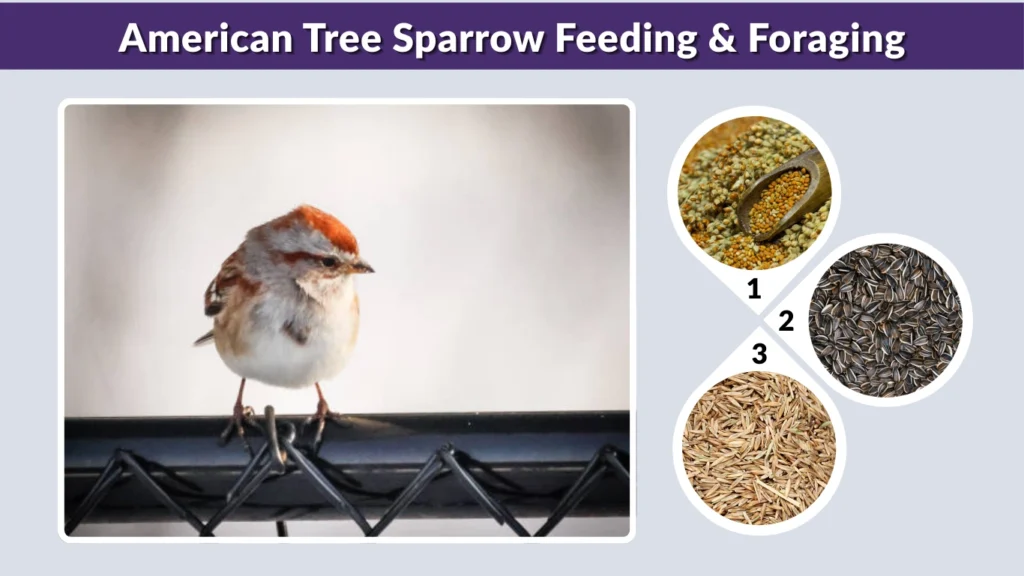
American Tree Sparrows eat a mix of seeds and insects. Insects dominate the summer diet, providing protein for nestling growth. In winter, seeds become essential, especially from grasses and weeds.
Feeding Behavior
They forage actively on the ground, scratching through snow and debris. They often feed in loose flocks for safety, relying on multiple pairs of eyes to detect predators.
Seasonal Diet Changes
- Summer: Mostly insects, spiders, beetles, caterpillars
- Winter: Grass seeds, weed seeds, grains, and feeder offerings
Foods Commonly Eaten
- Millet
- Sunflower chips
- Grass and weed seeds
- Small insects in breeding season
FAQs
1. What is the scientific name of the American Tree Sparrow?
The American Tree Sparrow’s scientific name is Spizelloides arborea, a species once grouped with Chipping Sparrows but now recognized in its own genus.
2. How do you distinguish it from a Chipping Sparrow?
Look for the bicolored bill, the gray face, and the dark central breast spot—features the Chipping Sparrow lacks. Chippers also show a sharper black eye-line.
3. Do American Tree Sparrows migrate long distances?
Yes. They migrate between Arctic breeding grounds and wintering areas in the northern United States, traveling thousands of miles each year.
4. What do they primarily eat during winter?
They eat seeds from grasses and weeds, along with grain and small seeds at backyard feeders. Insects make up only a small portion of their winter diet.
5. Where are American Tree Sparrows most commonly found?
They are most common in southern Canada and the northern United States during winter, especially in grasslands, fields, brushy edges, and rural farmlands.
