
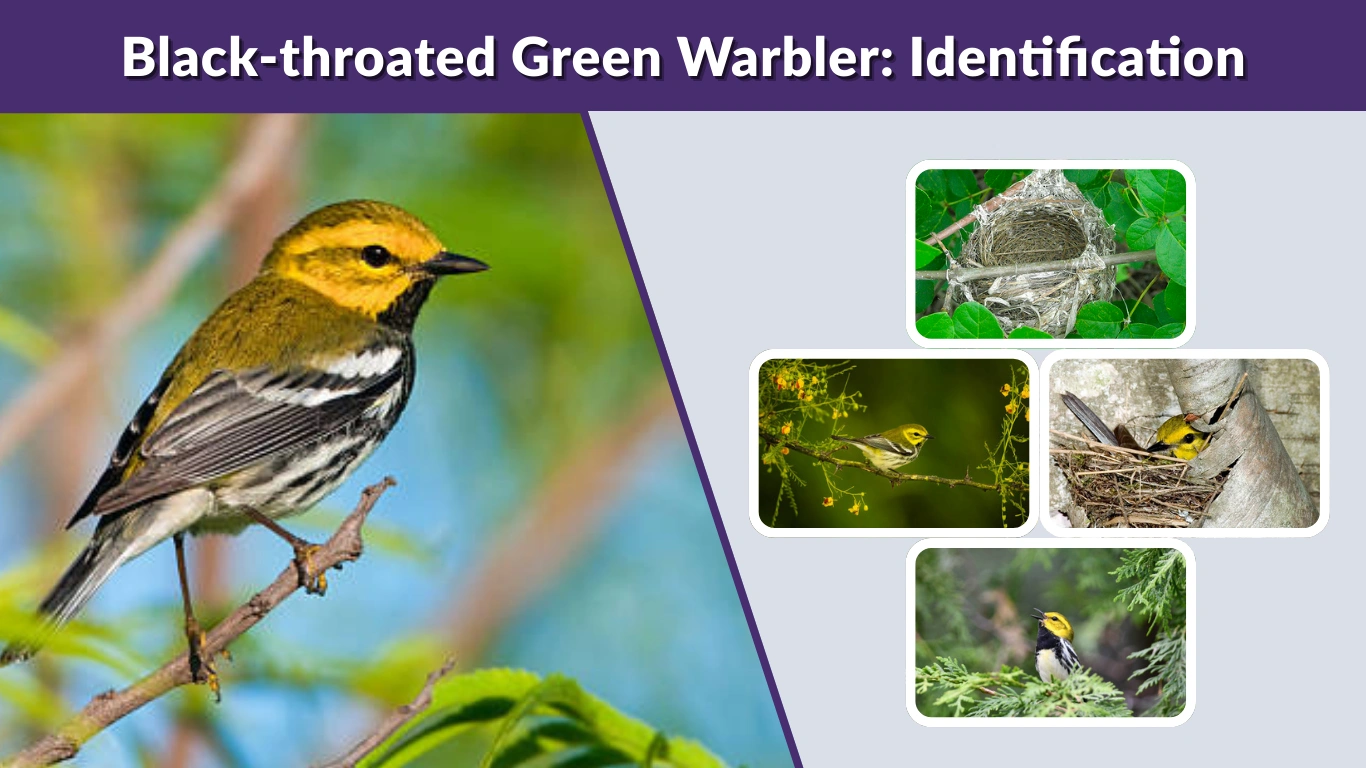
The Black-throated Green Warbler (Setophaga virens) is a small but striking songbird found across eastern North America. Known for its bright yellow face and bold black throat, this energetic wood-warbler is often heard before it is seen. Its buzzy song echoes through coniferous forests in spring and early summer, making it a favorite among birdwatchers. Despite its tiny size, this neotropical migrant travels thousands of miles each year between its breeding and wintering grounds.
Black-throated Green Warbler Identification Guide
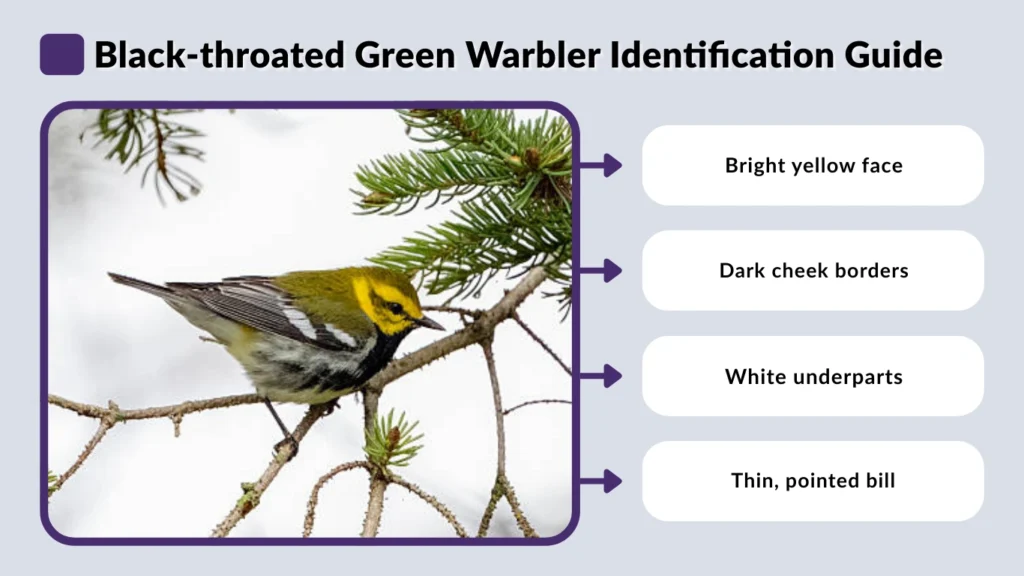
Correctly identifying a Black-throated Green Warbler can be easier than with many other warblers, thanks to its strong facial pattern and contrasting throat coloration. However, lighting conditions and seasonal plumage changes can sometimes create confusion.
Male Identification Features
Adult males are the most distinctive. They have a bright yellow face that contrasts sharply with a bold black throat and upper chest, often described as a “black bib.” The back is olive-green, blending smoothly with darker wings marked by two white wing bars. The underparts below the throat are mostly white with faint streaking along the sides.
In good light, the male’s facial pattern is especially clear: yellow cheeks framed by darker auricular markings. During the breeding season, the black throat patch is at its darkest and most defined.
Female and Juvenile Differences
Females look similar to males but are generally less bold in coloration. Instead of a fully black throat, females may show a reduced black patch, a dusky smudge, or sometimes no black at all. Their plumage tends to appear slightly duller overall.
Juveniles resemble females but often have even softer markings and less contrast. The throat may be pale with minimal dark coloring, making them slightly more challenging to identify at first glance.
Key Field Marks to Watch For
When observing this species in the field, focus on these reliable features:
- Bright yellow face
- Dark cheek borders
- White underparts
- Olive back
- Thin, pointed bill
Black-throated Green Warblers are also active and agile. They frequently move through the mid to upper canopy, hopping along branches and gleaning insects from leaves. Their constant motion and tail flicking can help draw attention to them.
Similar Species Comparison
One of the most commonly confused species is the Townsend’s Warbler. While both have yellow faces and dark throats, Townsend’s Warbler typically has more extensive black on the face and heavier streaking on the sides. Additionally, Townsend’s Warblers are more common in western North America, while Black-throated Green Warblers are primarily eastern breeders.
The Black-throated Blue Warbler is another potential source of confusion, but it has a deep blue back in males rather than olive-green.
Habitat and Range
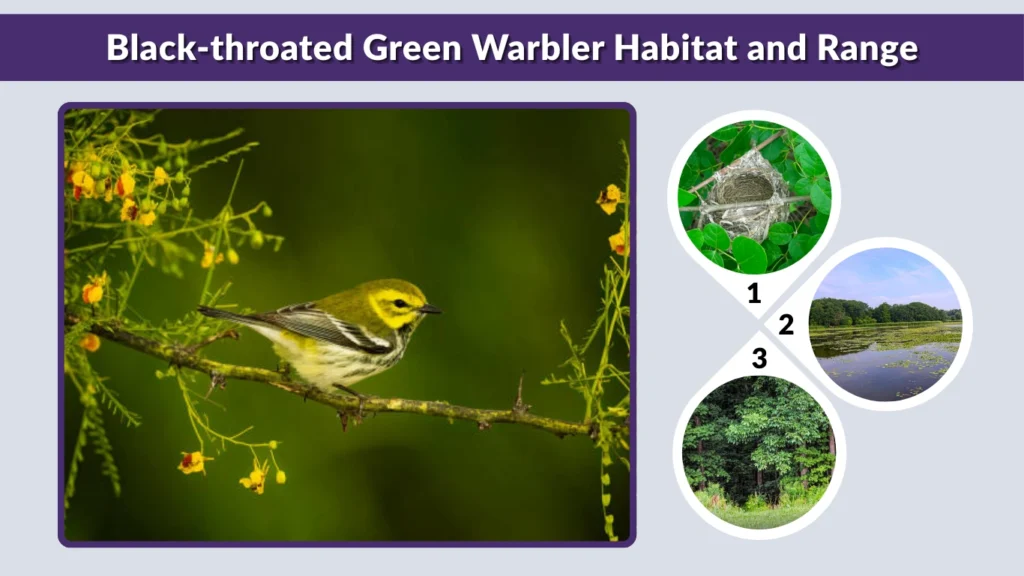
The Black-throated Green Warbler prefers forested environments and is strongly associated with coniferous and mixed woodlands. Its distribution shifts seasonally, covering a large geographic area throughout the year.
Breeding Habitat
During the breeding season, this species is most often found in boreal and mixed forests across northeastern North America. It favors areas dominated by spruce, fir, hemlock, and other evergreen trees. These dense forests provide protection and an abundant supply of insects.
In the United States, breeding populations are common in the Northeast, the Great Lakes region, and parts of the Appalachian Mountains. Farther north, they extend well into eastern Canada’s boreal forest.
Winter Habitat
In winter, the Black-throated Green Warbler migrates south to warmer regions. Its winter range includes the southeastern United States, the Gulf Coast, Mexico, the Caribbean, and parts of Central America.
During this time, it occupies a variety of wooded habitats, including forest edges, secondary growth, and tropical woodlands. While still active in the canopy, it may forage at slightly lower levels than during breeding season.
Geographic Range Overview
Overall, this species breeds primarily in eastern North America and winters in the southeastern U.S. and farther south into the tropics. During migration, it can be spotted in many eastern states as it travels between seasonal habitats.
Because of its broad migratory route, birdwatchers have good chances of encountering this warbler in spring and fall, particularly in forested parks and woodland preserves.
Migration Patterns and Seasonal Movements
The Black-throated Green Warbler is a neotropical migrant, meaning it breeds in North America and winters in Central America and the Caribbean. Despite weighing less than half an ounce, it undertakes an impressive long-distance journey twice each year.
Spring migration typically begins in April, with birds arriving on breeding grounds by May. Males often arrive first to establish territories. Fall migration generally occurs from late August through October, when birds gradually move southward.
During migration, these warblers rely on stopover habitats rich in insects to refuel. Coastal woodlands, river corridors, and forest patches serve as critical resting and feeding areas. Weather patterns, especially wind and storms, can strongly influence migration timing and visibility to observers.
Song and Vocalizations
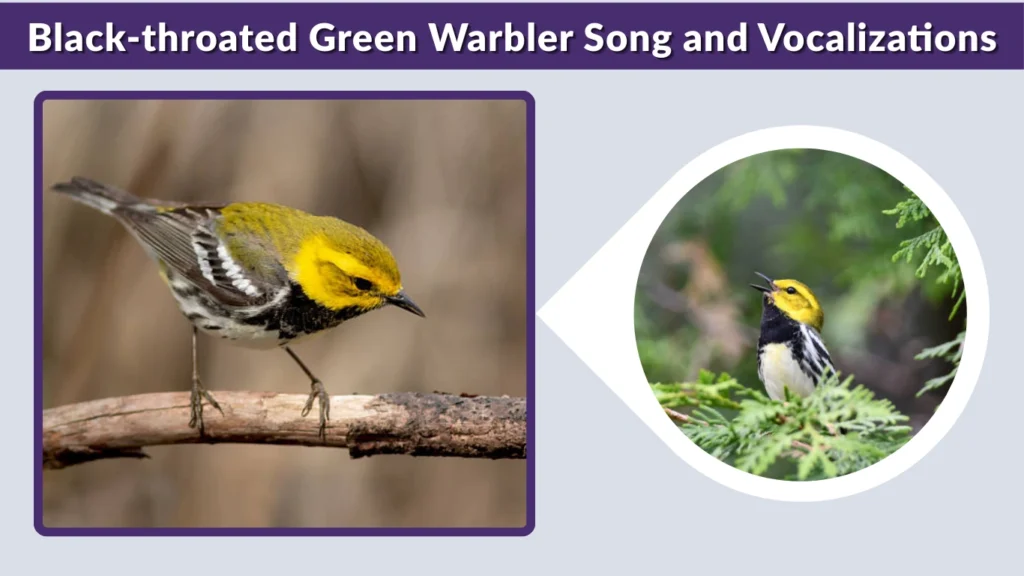
The Black-throated Green Warbler is often easier to hear than to see. Its clear, buzzy song carries through dense forest, especially during the breeding season when males sing persistently to defend territory and attract mates.
Primary Song Description
The most commonly described song sounds like “zee-zee-zee-zoo-zee” or sometimes “trees, trees, murmuring trees.” It consists of a series of high-pitched, slightly buzzy notes that end in a distinct change in tone. The rhythm is steady and repetitive, making it recognizable once learned.
Interestingly, there can be subtle regional variations in song pattern and pitch. Experienced birders often rely on this vocalization as the first clue that a Black-throated Green Warbler is nearby.
Calls and Communication
In addition to its song, this warbler uses short call notes for communication. The most typical call is a sharp “tsip” sound, often given while foraging. Alarm calls may be slightly harsher and more urgent.
Because the species spends much of its time in the upper canopy, learning its song and call notes greatly increases your chances of locating one in the field.
Diet and Feeding Behavior
The Black-throated Green Warbler is primarily insectivorous. During the breeding season, it feeds heavily on small insects such as caterpillars, beetles, flies, and spiders. These protein-rich prey items are especially important for raising nestlings.
This species forages by gleaning insects from leaves and twigs. It moves methodically along branches, inspecting foliage and occasionally making short aerial sallies to catch flying insects. Though most active in the canopy, it may descend to lower levels during migration.
In late summer and fall, small berries may supplement its diet, particularly during migration when insects are less abundant in some areas.
Nesting and Breeding Behavior
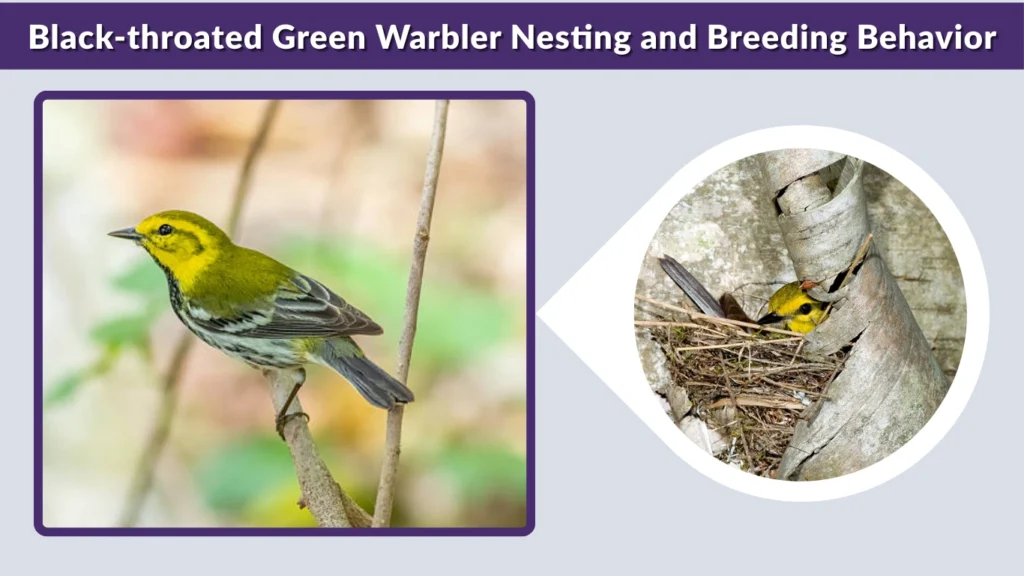
Breeding season typically begins in late spring once birds arrive on their northern breeding grounds. Males quickly establish territories and sing frequently to defend them from rivals.
Breeding Season
Courtship involves song displays and short chases. Once paired, the female takes on most of the nest-building duties while the male guards the territory. Breeding generally occurs from May through July, depending on latitude.
Nest Placement and Structure
Nests are usually built in conifer trees, often on horizontal branches close to the trunk. They may be placed at low to mid-level heights, sometimes surprisingly close to the ground in dense evergreen stands.
The nest itself is a compact, cup-shaped structure made of plant fibers, bark strips, moss, and spider silk. It is carefully camouflaged among needles and foliage.
Eggs and Parental Care
A typical clutch contains 3 to 5 eggs. The female incubates them for about 12 days. After hatching, both parents help feed the nestlings, bringing a steady supply of insects.
Young birds usually fledge within 8 to 10 days after hatching. Even after leaving the nest, fledglings continue to depend on their parents for food and protection for a short period.
Lifespan, Predators, and Conservation Status
In the wild, Black-throated Green Warblers typically live several years, though many face natural hazards early in life. Predators include snakes, jays, squirrels, and small hawks. Nest predation is one of the primary risks during the breeding season.
Habitat loss due to logging and development can impact local populations, particularly in breeding forests. Climate change may also influence future distribution patterns, especially in boreal regions.
Despite these challenges, the Black-throated Green Warbler is currently considered a species of low conservation concern, with a stable overall population trend across much of its range.
Birdwatching Tips for Spotting a Black-throated Green Warbler
To increase your chances of spotting this species, plan outings during spring migration or early breeding season when males are singing frequently. Early morning is often the most productive time.
Listen carefully before scanning treetops. Once you identify the song, focus on mid to upper canopy branches in coniferous or mixed forests. A good pair of binoculars is essential, as these birds often stay high in the trees.
Migration hotspots such as wooded parks, forest edges, and coastal woodlands can also provide excellent viewing opportunities.
Interesting Facts About the Black-throated Green Warbler
- The species was first described by American ornithologist Alexander Wilson.
- Despite its small size, it migrates thousands of miles annually.
- Males may return to the same breeding territory year after year.
- Its song has inspired creative mnemonics among birders for generations.
FAQs
What does a Black-throated Green Warbler look like?
It is a small songbird with a bright yellow face, olive-green back, white underparts, and—on males—a bold black throat. Females have a paler or reduced black throat patch. White wing bars and an active, energetic foraging style are also key identification features.
Where does the Black-throated Green Warbler live?
It breeds in coniferous and mixed forests across northeastern North America and eastern Canada. During winter, it migrates to the southeastern United States, Mexico, the Caribbean, and parts of Central America, favoring wooded habitats and forest edges.
What does its song sound like?
Its song is a high-pitched, buzzy series of notes often described as “zee-zee-zee-zoo-zee.” The steady rhythm and distinctive tonal shift at the end make it recognizable. Many birders use the mnemonic “trees, trees, murmuring trees” to remember it.
Is the Black-throated Green Warbler rare?
No, it is not considered rare. The species maintains a stable population across much of its range and is listed as a species of low conservation concern. However, habitat protection remains important for sustaining healthy breeding populations.
