
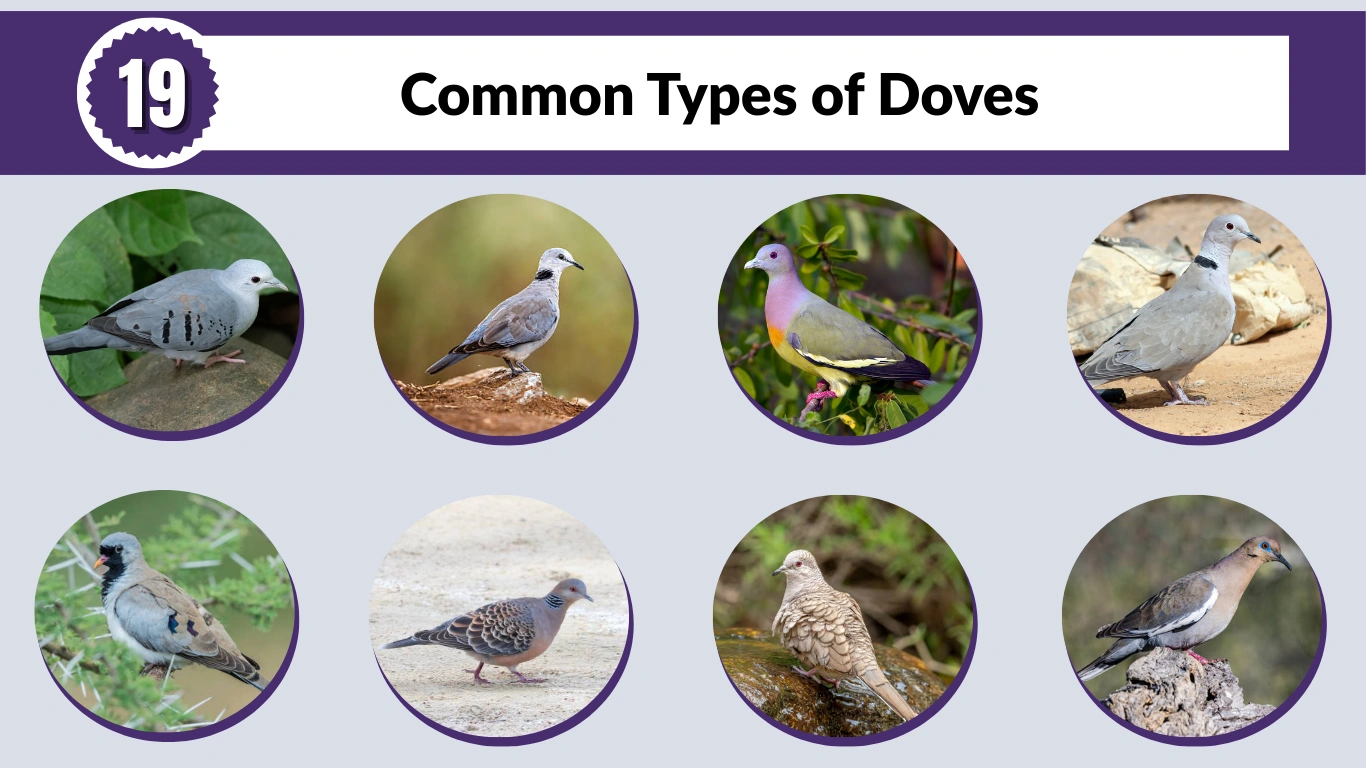
Doves are gentle, graceful birds found in nearly every part of the world, admired for their soft calls, calm behavior, and symbolic meaning. From bustling city pigeons to shy forest-dwelling species, doves display remarkable diversity in size, color, and habitat. They play an important role in ecosystems by dispersing seeds and maintaining ecological balance. This guide explores 19 common types of doves, highlighting their identification, habitats, behaviors, and diets to help bird enthusiasts, students, and nature lovers better understand and appreciate these fascinating birds.
1. Rock Dove (Columba livia)
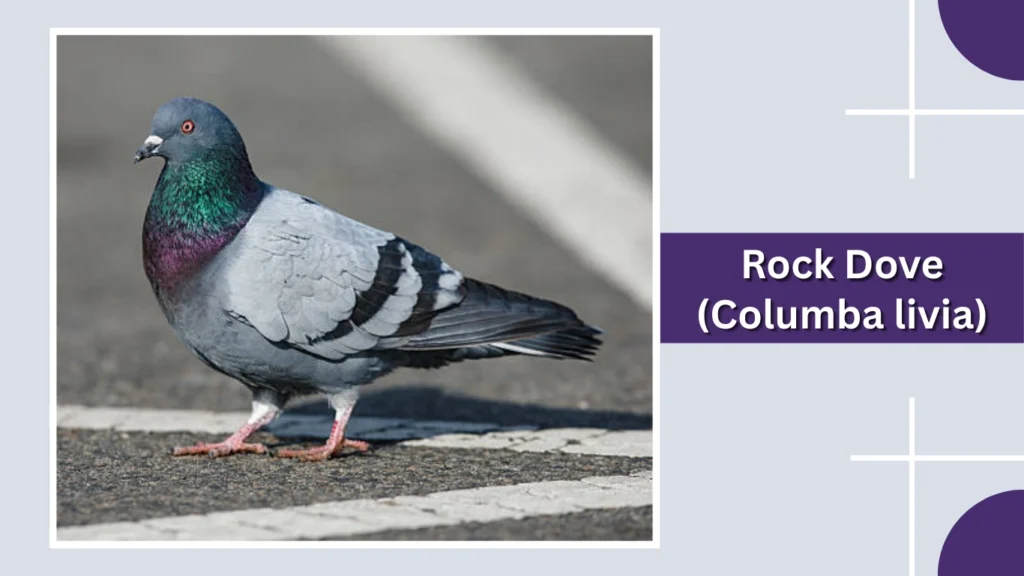
The Rock Dove is one of the most widespread and familiar dove species worldwide. Often called the feral pigeon, it has successfully adapted to human-dominated landscapes and is commonly seen in cities, towns, and agricultural areas. Its ability to thrive in diverse environments has made it one of the most studied and recognized birds globally.
Identification
- Medium-sized, stocky-bodied dove
- Bluish-gray overall plumage
- Two distinct black bars on each wing
- Iridescent green and purple feathers on the neck
- Red to orange eyes with a pale eye ring
- Short, rounded tail with a dark band at the tip
Habitat
Originally, Rock Doves inhabited sea cliffs, rocky coastlines, and caves. Today, they are most commonly found in urban environments, including buildings, bridges, warehouses, and city ledges, which closely resemble their natural cliff habitats. They also occur in rural farmlands and open country, especially where grain is readily available. Their adaptability allows them to live in nearly every continent except Antarctica.
Behaviors
Rock Doves are highly social birds and usually gather in large flocks. They are strong, fast fliers and are well known for their excellent homing abilities. These doves form strong pair bonds and often mate for life. They are active during the day and spend much of their time walking and foraging on the ground.
Diet and Lifespan
Their diet mainly consists of seeds, grains, and cereals, but they readily consume human food scraps in urban areas. Rock Doves forage primarily on the ground. In the wild, their average lifespan is around 3–5 years, though individuals in captivity or protected environments may live much longer.
2. Mourning Dove (Zenaida macroura)
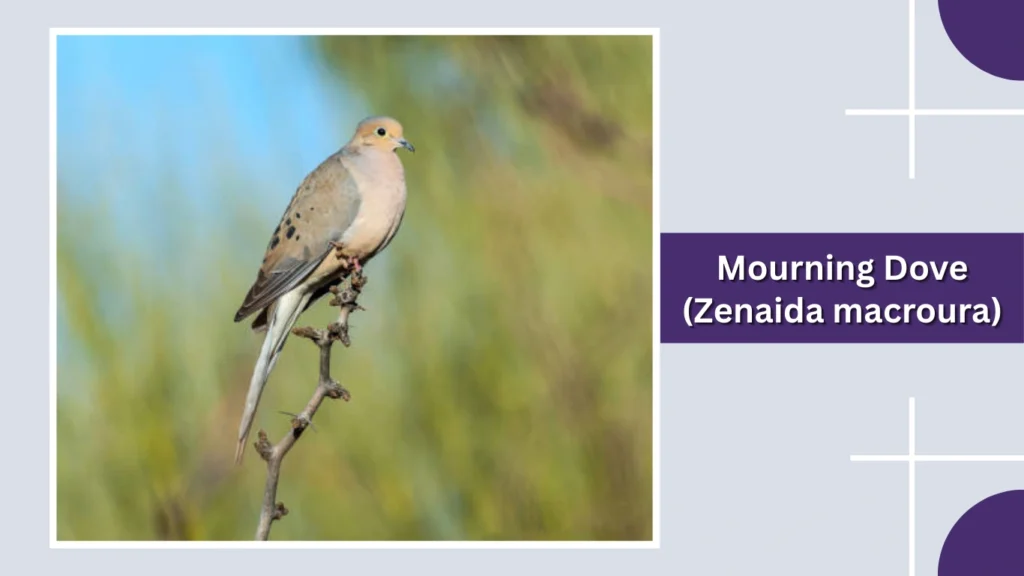
The Mourning Dove is a slender, graceful bird widely found across North America. Known for its soft, mournful cooing call, this species is often seen perched on wires or foraging quietly on the ground. It is one of the most abundant and recognizable doves in its range.
Identification
- Medium-sized, slim-bodied dove
- Light brown to grayish-tan plumage
- Black spots on the wings
- Long, pointed tail with white edges
- Small head with dark eyes
- Subtle pinkish tone on the chest
Habitat
Mourning Doves occupy a wide variety of open and semi-open habitats. They are commonly found in grasslands, farmlands, wood edges, suburbs, parks, and gardens. While they avoid dense forests, they adapt well to human-altered environments. Their nests are often built in trees, shrubs, or on building ledges.
Behaviors
These doves are usually seen alone or in pairs, though they may gather in flocks outside the breeding season. Their flight is swift and direct, marked by rapid wingbeats and occasional whistling sounds. Mourning Doves are monogamous and may raise multiple broods each year.
Diet and Lifespan
Mourning Doves feed primarily on seeds, including grasses, weeds, and cultivated grains. They forage almost exclusively on the ground. Their average lifespan in the wild is about 1–3 years, though some individuals can live significantly longer under favorable conditions.
3. Eurasian Collared-Dove (Streptopelia decaocto)
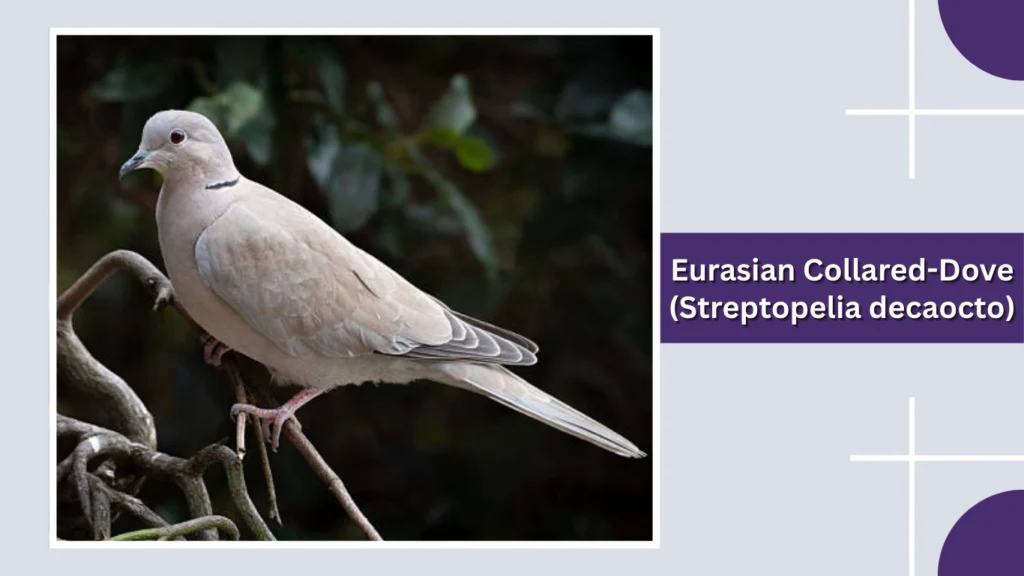
The Eurasian Collared-Dove is a pale, medium-sized dove known for its rapid range expansion across Europe, Asia, and North America. Its calm demeanor and adaptability have allowed it to thrive in both rural and urban settings, often near human habitation.
Identification
- Medium-sized dove with a slender body
- Pale gray to buff-colored plumage
- Distinct black collar edged with white on the back of the neck
- Dark eyes with a subtle eye ring
- Long, squared tail with white outer edges
- Black wing tips visible in flight
Habitat
This species favors open landscapes with scattered trees and easy access to food. Common habitats include farmlands, villages, suburban neighborhoods, parks, and gardens. Eurasian Collared-Doves often nest in trees, utility poles, or building ledges and are frequently seen near grain stores or feeding areas.
Behaviors
Eurasian Collared-Doves are generally calm and tolerant of human presence. They are often seen perched openly on rooftops or power lines. Their flight is steady and direct. These doves form monogamous pairs and may breed multiple times a year, even outside traditional breeding seasons.
Diet and Lifespan
Their diet consists mainly of seeds, grains, and cereals, with occasional consumption of berries. They forage on the ground in open areas. In the wild, Eurasian Collared-Doves typically live around 3–6 years, depending on environmental conditions and predation pressures.
4. Ring-necked Dove (Streptopelia risoria)
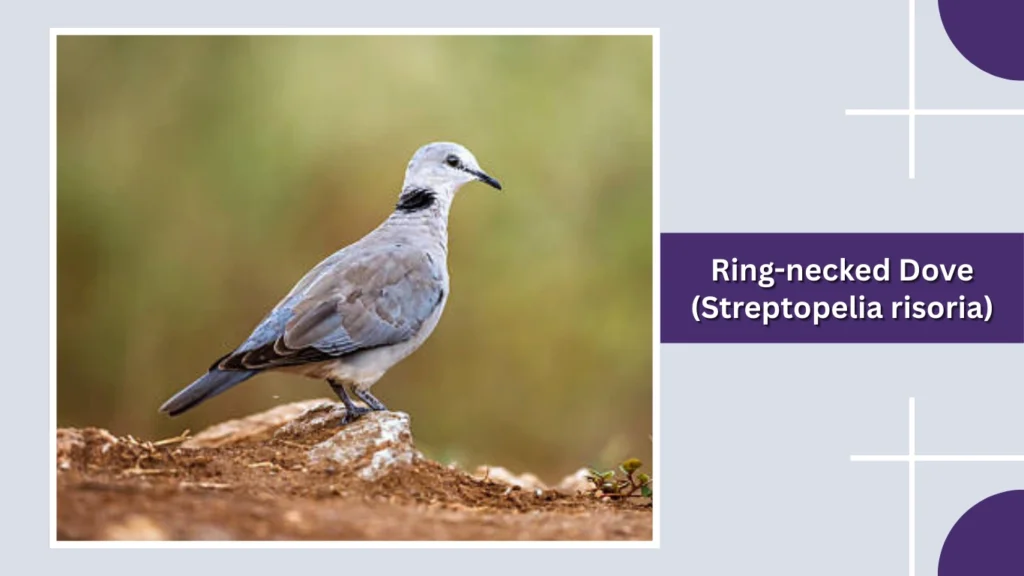
The Ring-necked Dove is a gentle, attractive dove commonly associated with human settlements. Often kept as a domestic or ornamental bird, it is closely related to wild collared-dove species and is admired for its calm nature and soft cooing calls.
Identification
- Medium-sized dove with a slim body
- Light cream, fawn, or white plumage
- Distinct black ring on the back of the neck
- Dark eyes with a soft expression
- Long, narrow tail
- Smooth, rounded head shape
Habitat
In domestic settings, Ring-necked Doves live in aviaries, homes, and gardens. In semi-wild or feral situations, they are found around towns, villages, farms, and parks. They prefer open areas with access to perches, nesting sites, and food, and they avoid dense forests.
Behaviors
Ring-necked Doves are calm, social, and highly tolerant of people. They are often seen in pairs and form strong bonds with their mates. Their flight is steady and graceful rather than fast. Males are known for their repetitive, gentle cooing used in courtship and territory display.
Diet and Lifespan
Their diet mainly includes seeds, grains, and small legumes, often supplemented with commercial bird feed in captivity. They forage on the ground. With proper care, Ring-necked Doves can live 10–15 years, significantly longer than many wild dove species.
5. Spotted Dove (Spilopelia chinensis)
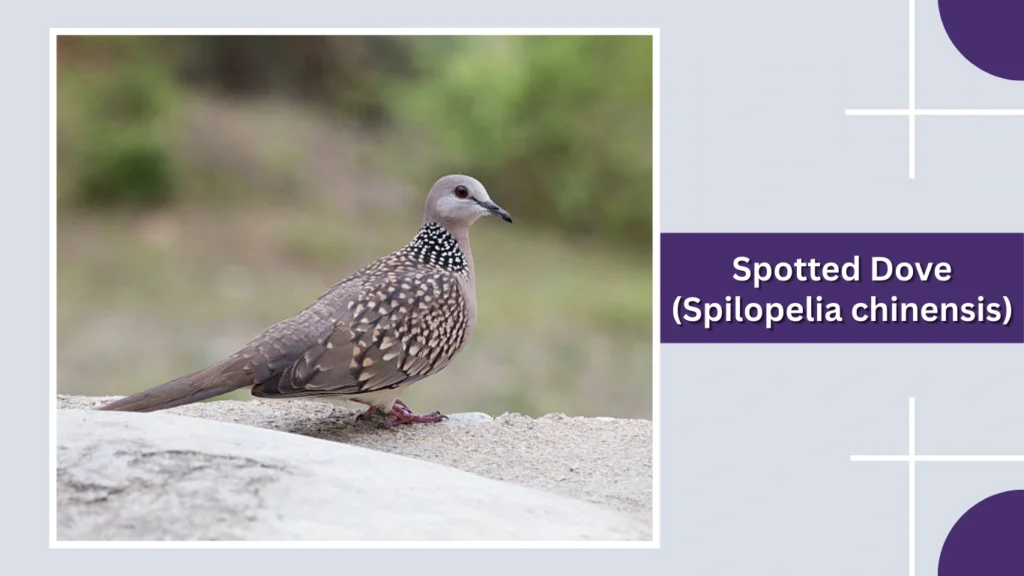
The Spotted Dove is a striking and familiar dove species found across Asia and parts of Australia. It is easily recognized by the distinctive black-and-white spotted collar on its neck and is commonly seen near human habitation.
Identification
- Medium-sized dove with a slender body
- Pinkish-brown to gray plumage
- Black neck collar covered with white spots
- Long tail with white outer edges
- Reddish eyes with pale eye ring
- Soft gray head and chest
Habitat
Spotted Doves prefer open woodlands, farmlands, villages, gardens, and urban parks. They are strongly associated with human-modified environments and often nest in trees, shrubs, or building structures. They avoid dense forests and favor areas with open ground for feeding.
Behaviors
These doves are usually seen alone or in pairs, sometimes forming small groups. They spend much of their time walking on the ground while foraging. Their flight is swift and direct, and their call is a low, rhythmic coo often heard in the early morning.
Diet and Lifespan
Spotted Doves feed mainly on seeds, grains, and small fruits. They forage on the ground, occasionally visiting feeding areas near homes. In the wild, they typically live around 5–7 years, though lifespan can vary based on habitat quality and predation.
6. White-winged Dove (Zenaida asiatica)
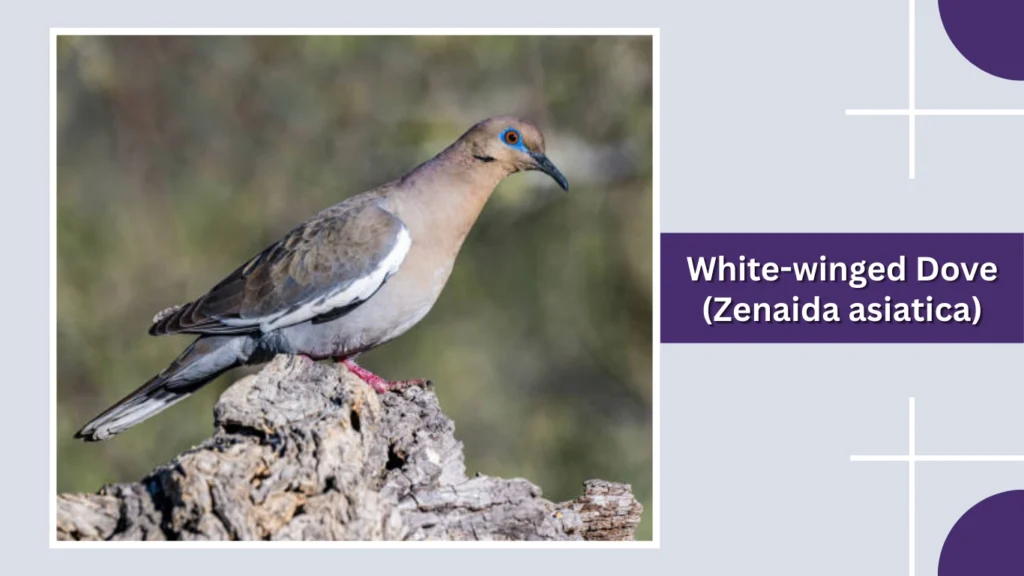
The White-winged Dove is a large, robust dove commonly found in the southwestern United States, Mexico, and Central America. It is well known for the bold white wing patches that are highly visible during flight and make the species easy to identify.
Identification
- Large, heavy-bodied dove
- Grayish-brown overall plumage
- Prominent white stripe along the wings
- Dark eyes with blue skin around the eye
- Square-shaped tail with pale tips
- Thick neck and broad chest
Habitat
White-winged Doves occupy deserts, open woodlands, agricultural lands, and suburban areas. They are especially common in desert regions where flowering cacti and trees are available. Nests are typically built in trees, shrubs, or large cacti, providing protection from predators and heat.
Behaviors
These doves are often seen in pairs or small flocks and may gather in large numbers during migration or at feeding sites. Their flight is strong and direct, accompanied by a noticeable wing whistle. They are active during the day and often rest in shaded areas during extreme heat.
Diet and Lifespan
Their diet consists mainly of seeds, grains, fruits, and nectar, especially from cactus flowers. White-winged Doves forage both on the ground and in trees. In the wild, they generally live around 5–10 years, depending on environmental conditions and food availability.
7. Inca Dove (Columbina inca)
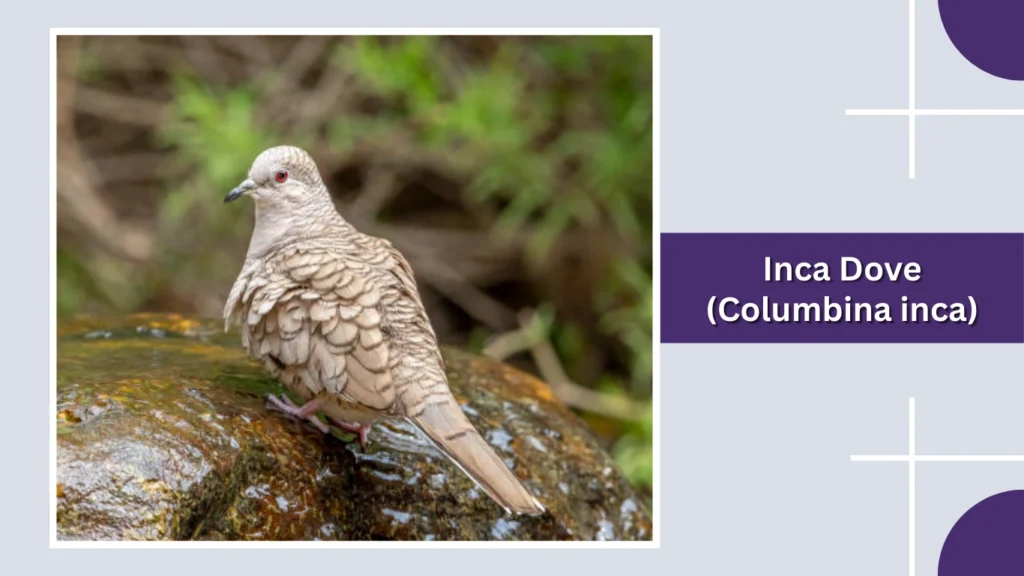
The Inca Dove is a small, delicate-looking dove commonly found in the southwestern United States, Mexico, and Central America. Despite its small size, it is well adapted to warm climates and is often seen in urban and suburban areas.
Identification
- Small, slim-bodied dove
- Grayish-brown plumage with a scaly pattern
- Long, narrow tail with white edges
- Dark eyes with no prominent eye ring
- Short, slightly curved bill
- Compact head and body shape
Habitat
Inca Doves favor open, dry habitats such as deserts, scrublands, grasslands, and urban neighborhoods. They are frequently seen in towns, gardens, parks, and along roadsides. Nests are usually placed in trees, shrubs, or on building ledges, often at low heights.
Behaviors
These doves are typically seen in pairs or small groups. They are known for their unique behavior of sunning themselves, spreading their wings to absorb warmth. Their flight is quick and low, and they spend much of their time foraging on the ground.
Diet and Lifespan
Inca Doves primarily feed on small seeds and grains. They forage almost entirely on the ground, often near human settlements. In the wild, their average lifespan is about 3–5 years, though some individuals may live longer under favorable conditions.
8. Zebra Dove (Geopelia striata)
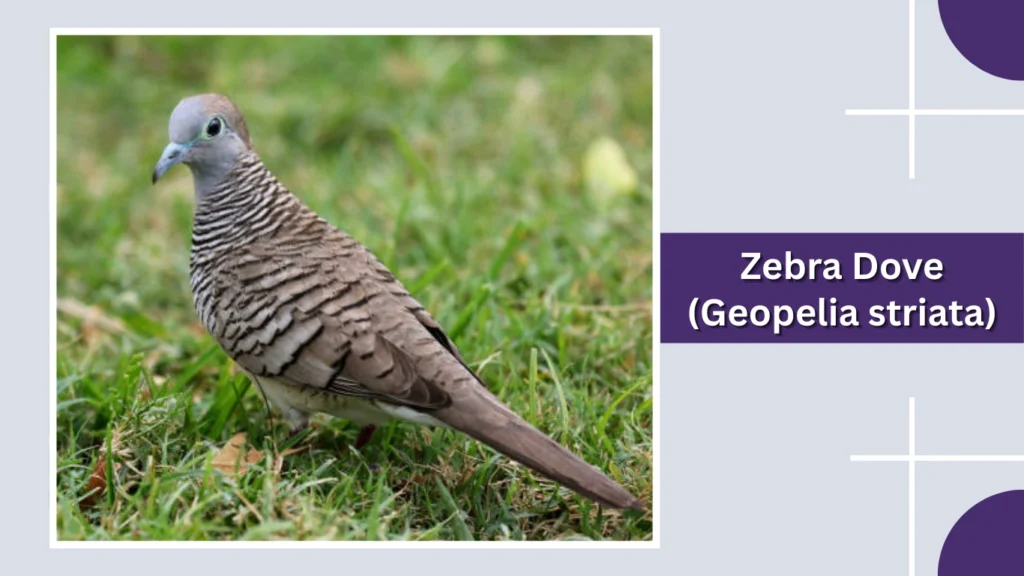
The Zebra Dove is a small, elegant dove named for the fine black-and-white barring across its neck and breast. It is widely distributed in Southeast Asia and has been introduced to several other regions, where it is admired for its gentle appearance and soft, musical calls.
Identification
- Small, slender-bodied dove
- Light brown to gray plumage
- Fine black-and-white barring on neck and chest
- Pale blue skin around the eyes
- Long tail with white-tipped edges
- Slim, slightly curved bill
Habitat
Zebra Doves are commonly found in open grasslands, farmland edges, parks, gardens, and villages. They adapt well to human-altered landscapes and often forage in open areas with short vegetation. Nests are built in low trees, shrubs, or man-made structures.
Behaviors
These doves are usually seen alone or in pairs and occasionally in small groups. They are active during the day and spend considerable time walking on the ground while feeding. Their call is a soft, rhythmic coo that is often repeated in long sequences.
Diet and Lifespan
Zebra Doves feed mainly on small seeds and grains, occasionally consuming insects. They forage on the ground in open areas. In the wild, their lifespan typically ranges from 5–7 years, depending on habitat conditions and predation.
9. Diamond Dove (Geopelia cuneata)
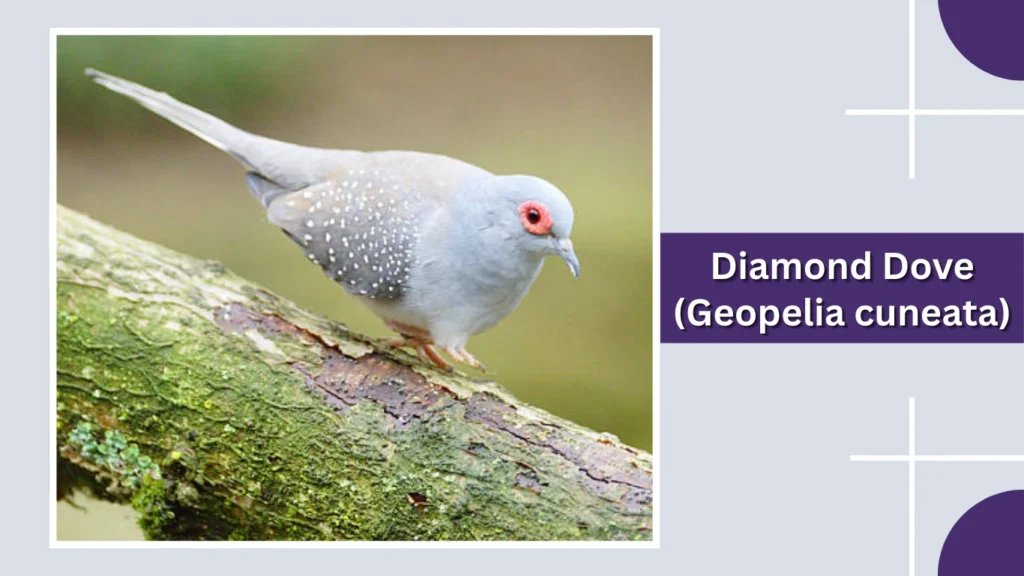
The Diamond Dove is a small, delicate dove native to Australia and is admired for its fine markings and gentle appearance. It is one of the smallest dove species and is often kept as an aviary bird due to its calm nature and attractive looks.
Identification
- Very small, slim-bodied dove
- Soft gray to bluish-gray plumage
- White spots (“diamond” markings) on wings
- Bright red eye ring
- Long, narrow tail with dark tip
- Petite head and fine bill
Habitat
Diamond Doves inhabit open woodlands, grasslands, savannas, and semi-arid regions. They are commonly found near water sources, especially in dry environments. Nests are usually built in shrubs or low trees. In captivity, they adapt well to aviaries and enclosed gardens.
Behaviors
These doves are quiet, gentle, and non-aggressive. They are usually seen in pairs or small groups and spend much of their time foraging on the ground. Their flight is low and fast. Diamond Doves form strong pair bonds and are attentive parents.
Diet and Lifespan
Their diet consists mainly of grass seeds, small grains, and occasionally insects. They forage almost entirely on the ground. In the wild, Diamond Doves typically live 5–10 years, while individuals in captivity may live even longer with proper care.
10. Laughing Dove (Spilopelia senegalensis)
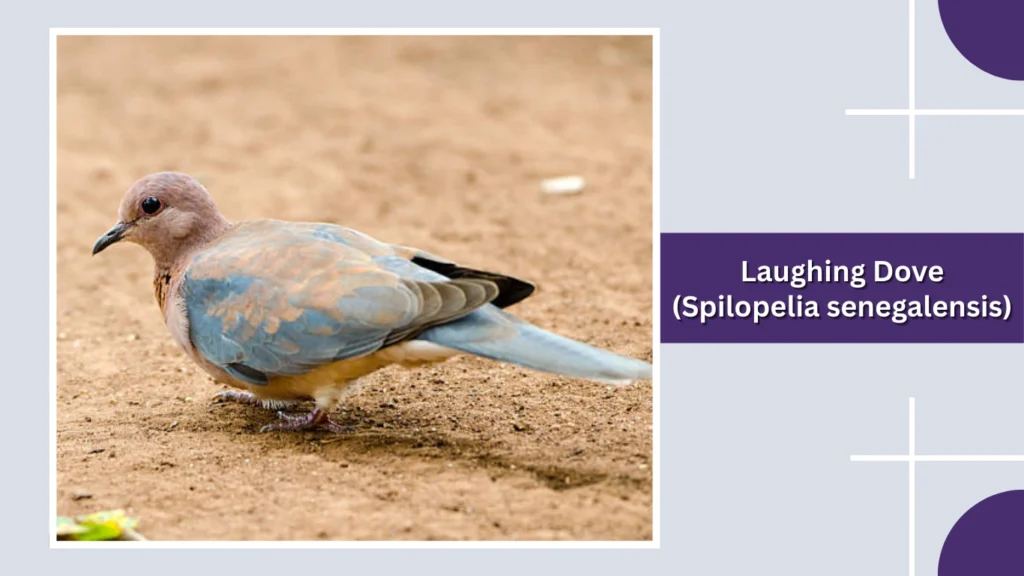
The Laughing Dove is a small, warm-toned dove best known for its distinctive, chuckling call that resembles soft laughter. It is widely distributed across Africa, the Middle East, and South Asia, and is commonly seen near human settlements.
Identification
- Small to medium-sized dove
- Pinkish-brown to rufous plumage
- Distinct black, spotted patch on the side of the neck
- Pale gray head and underparts
- Long tail with dark central feathers
- Dark eyes with subtle eye ring
Habitat
Laughing Doves favor open and semi-open habitats such as savannas, farmlands, gardens, villages, and city parks. They are strongly associated with human habitation and often nest in trees, shrubs, or building structures. They avoid dense forests and very cold regions.
Behaviors
These doves are usually seen alone or in pairs and occasionally in small flocks. They are active during the day and spend much time feeding on the ground. Their flight is quick and direct. The soft, repetitive cooing call is commonly heard throughout the day.
Diet and Lifespan
Laughing Doves feed mainly on seeds, grains, and small fruits. They forage primarily on the ground. In the wild, they typically live around 4–6 years, though lifespan may vary depending on environmental conditions and predation.
11. Oriental Turtle-Dove (Streptopelia orientalis)
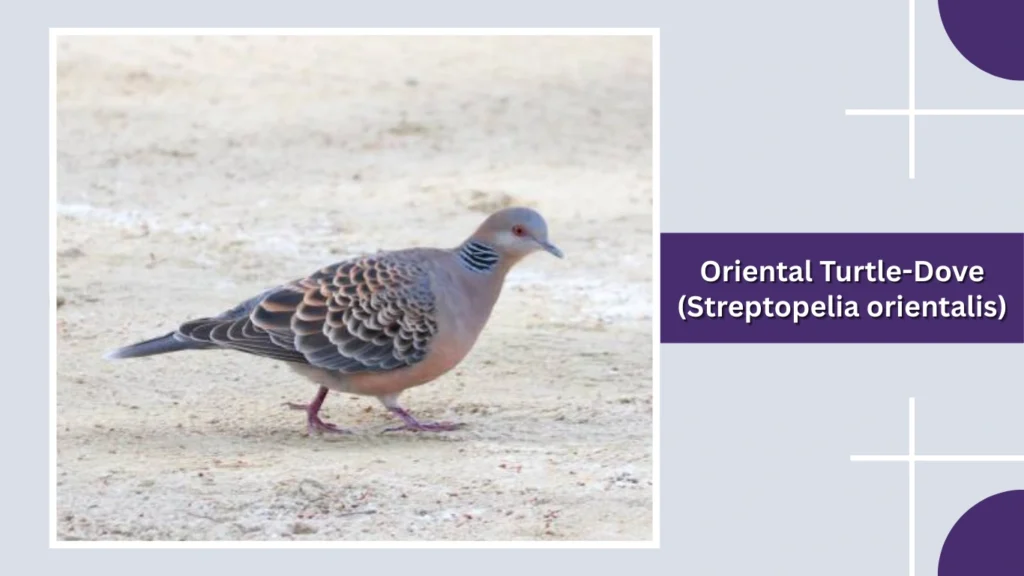
The Oriental Turtle-Dove is a medium-sized dove found across East Asia and parts of Southeast Asia. It is known for its beautifully patterned plumage and calm presence, often seen perched quietly in wooded and semi-open areas.
Identification
- Medium-sized dove with a sturdy body
- Brownish-gray plumage with scaled pattern
- Black and white striped patch on the side of the neck
- Reddish-brown wings with dark markings
- Dark eyes with subtle eye ring
- Long, rounded tail
Habitat
Oriental Turtle-Doves inhabit woodlands, forest edges, farmlands, and suburban areas. They prefer areas with a mix of trees and open ground for feeding. Nests are usually built in trees, often well concealed among foliage. Some populations migrate seasonally depending on climate.
Behaviors
These doves are generally shy and less tolerant of close human presence compared to other dove species. They are often seen alone or in pairs. Their flight is strong and direct, and their call is a deep, rhythmic coo heard mainly during the breeding season.
Diet and Lifespan
Their diet mainly includes seeds, grains, berries, and occasionally small insects. They forage on the ground or in low vegetation. In the wild, Oriental Turtle-Doves typically live around 5–8 years, depending on habitat quality and environmental pressures.
12. African Collared-Dove (Streptopelia roseogrisea)
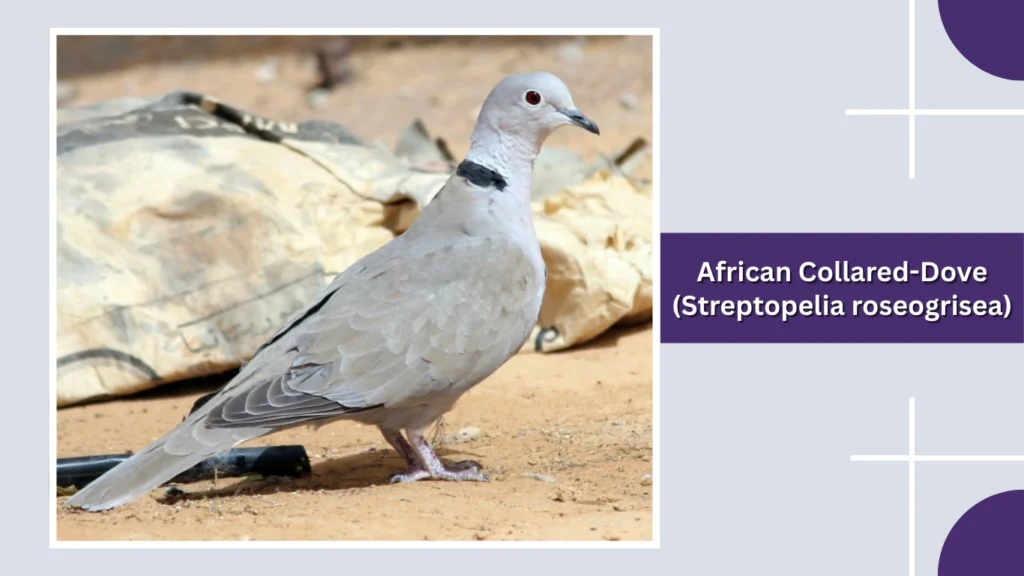
The African Collared-Dove is a pale, graceful dove native to sub-Saharan Africa. It is closely related to the Eurasian Collared-Dove and is well known as the wild ancestor of the domesticated Ring-necked Dove.
Identification
- Medium-sized dove with a slim body
- Pale gray to sandy-colored plumage
- Distinct black collar on the back of the neck
- Dark eyes with subtle eye ring
- Long, slightly squared tail with pale edges
- Smooth, rounded head
Habitat
This species prefers dry, open habitats such as savannas, semi-deserts, scrublands, and open woodlands. It is often found near water sources and human settlements, including villages and farms. Nests are built in trees, shrubs, or occasionally on man-made structures.
Behaviors
African Collared-Doves are calm and social birds, usually seen in pairs or small groups. They are strong fliers and often perch in exposed locations. These doves form monogamous pairs and may breed multiple times a year when conditions are favorable.
Diet and Lifespan
Their diet consists mainly of seeds and grains, with occasional consumption of berries. They forage primarily on the ground. In the wild, African Collared-Doves typically live around 5–7 years, while individuals in captivity may live longer.
13. Namaqua Dove (Oena capensis)
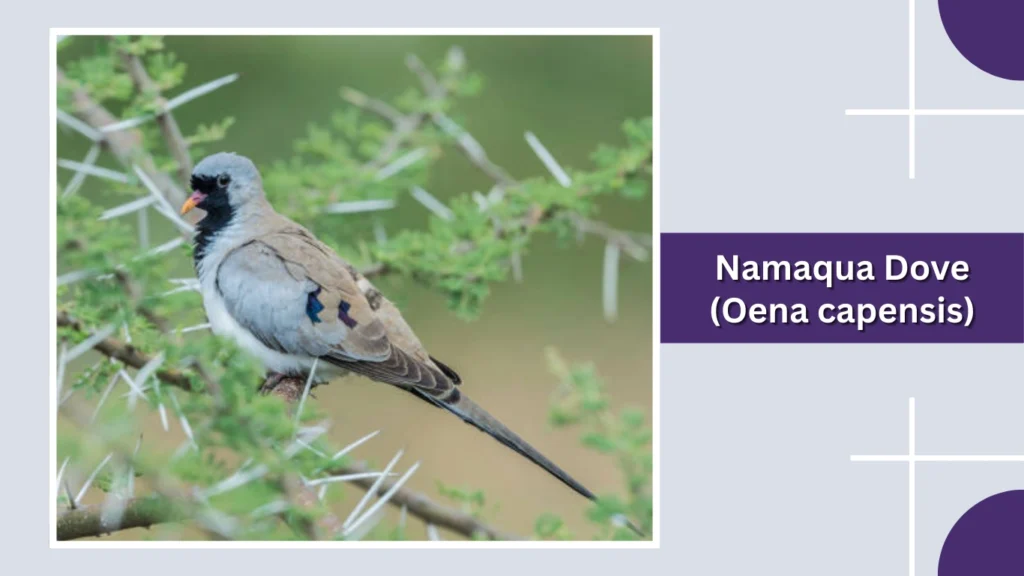
The Namaqua Dove is a small, slender dove native to Africa, easily recognized by its long, pointed tail and delicate build. It is one of the most distinctive doves on the continent and is often seen in pairs in dry, open landscapes.
Identification
- Small, slim-bodied dove
- Long, tapering tail that extends well beyond the body
- Gray to brown plumage
- Male has a black face and throat
- Female has a plain gray face
- Dark eyes and fine, short bill
Habitat
Namaqua Doves inhabit arid and semi-arid regions, including savannas, scrublands, deserts, and open woodlands. They are frequently found near water sources and are well adapted to dry environments. Nests are typically built low in shrubs, trees, or occasionally on rocky ledges.
Behaviors
These doves are usually seen alone or in pairs rather than large flocks. Their flight is fast and direct, often low over the ground. Namaqua Doves are relatively quiet and unobtrusive, spending much of their time foraging on the ground in open areas.
Diet and Lifespan
Their diet mainly consists of small seeds and grains. They forage almost exclusively on the ground and visit water sources regularly. In the wild, Namaqua Doves generally live around 4–6 years, depending on environmental conditions and predation.
14. Emerald Dove (Chalcophaps indica)
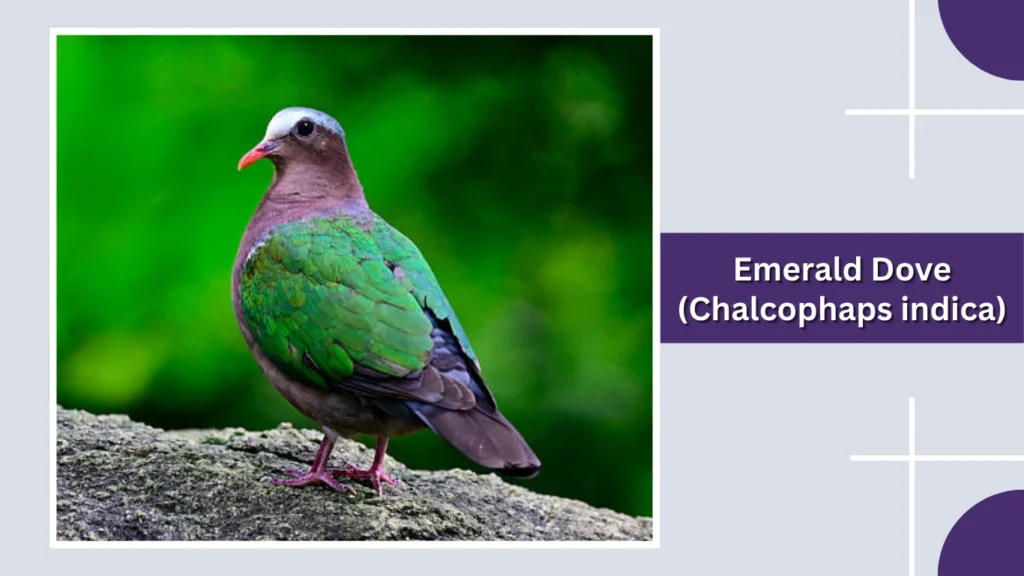
The Emerald Dove is a beautifully colored dove known for its shimmering green wings and peaceful forest-dwelling nature. It is widely distributed across South and Southeast Asia and is often seen walking quietly along forest floors.
Identification
- Medium-sized dove with a compact body
- Bright emerald-green wings with metallic sheen
- Maroon to chestnut-colored body and head
- Pale gray forehead and crown
- Dark eyes with bluish eye ring
- Short, rounded tail
Habitat
Emerald Doves primarily inhabit dense forests, woodlands, and forest edges. They prefer moist, shaded environments and are often found near streams or thick undergrowth. Unlike many other doves, they avoid open or heavily urbanized areas.
Behaviors
This species is generally shy and secretive, spending much of its time walking on the forest floor rather than flying. When disturbed, it takes off quickly with a sudden burst of wingbeats. Emerald Doves are usually seen alone or in pairs and remain quiet for long periods.
Diet and Lifespan
Emerald Doves feed mainly on fallen fruits, seeds, berries, and small invertebrates. They forage on the ground, especially in leaf litter. In the wild, their lifespan is estimated at around 5–8 years, though exact figures vary due to limited long-term studies.
15. Pink-necked Green Pigeon (Treron vernans)
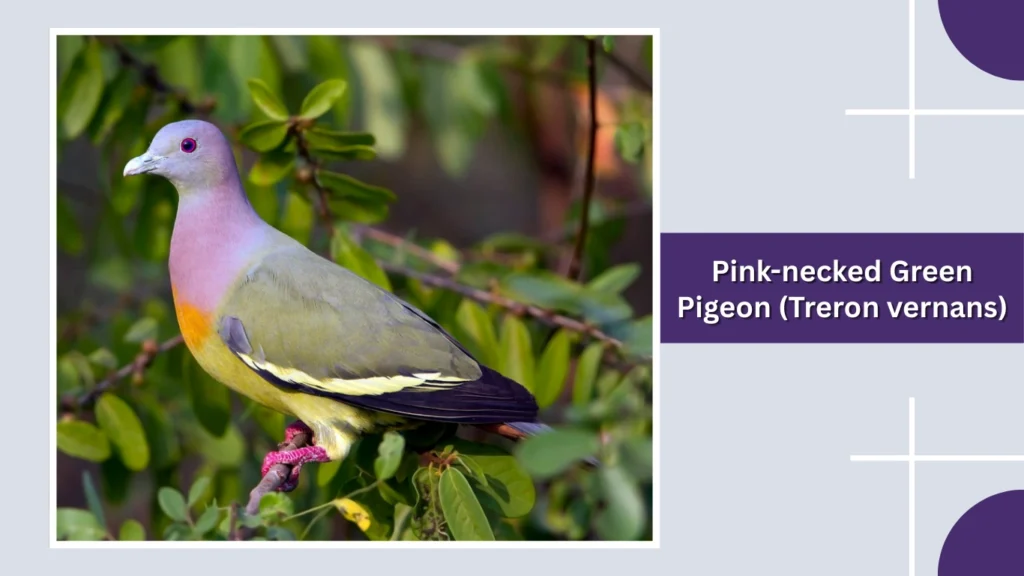
The Pink-necked Green Pigeon is a colorful, medium-sized pigeon known for its vibrant green body and soft pink neck markings. Common in Southeast Asia, it is often seen perched high in trees and is a familiar sight in parks and wooded urban areas.
Identification
- Medium-sized pigeon with a stout body
- Bright green plumage covering most of the body
- Soft pink neck and upper chest (more vivid in males)
- Pale bluish-gray head
- Yellow-edged wings visible in flight
- Short, square-shaped tail
Habitat
This species inhabits forests, mangroves, woodlands, plantations, and urban parks. It adapts well to human-altered landscapes as long as fruiting trees are available. Nests are usually built in tall trees, providing safety and easy access to food sources.
Behaviors
Pink-necked Green Pigeons are often seen in pairs or small flocks. They are strong fliers and frequently move between fruiting trees. These birds are generally calm but alert, spending long periods perched quietly before flying off swiftly when disturbed.
Diet and Lifespan
Their diet consists mainly of fruits and berries, especially figs, supplemented occasionally with seeds. They forage almost entirely in trees rather than on the ground. In the wild, Pink-necked Green Pigeons typically live around 5–10 years, depending on habitat quality and food availability.
16. White-tipped Dove (Leptotila verreauxi)
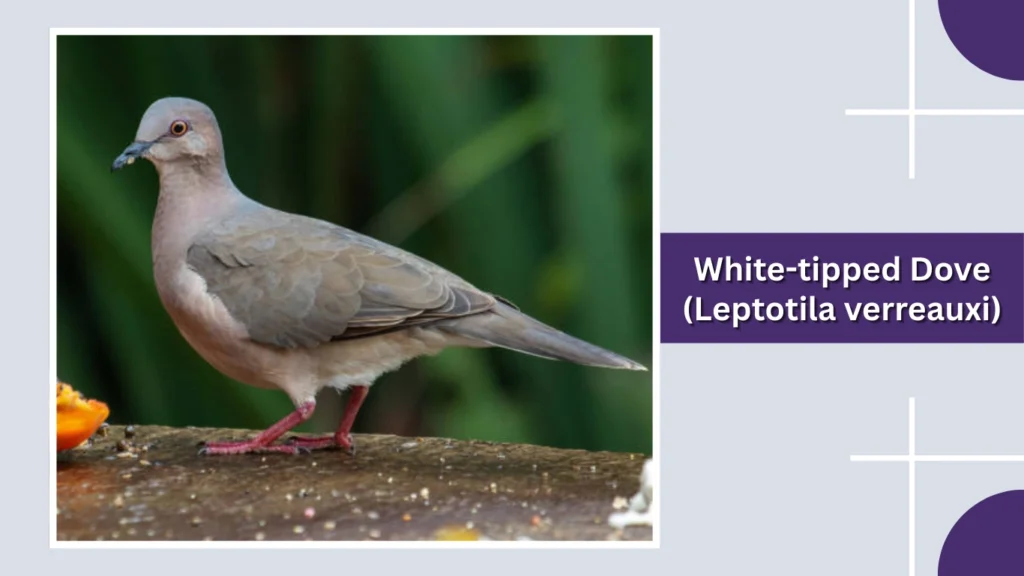
The White-tipped Dove is a medium-sized, ground-foraging dove commonly found in Central America, South America, and parts of the Caribbean. It is known for its gentle appearance and the distinct white tips on its tail feathers.
Identification
- Medium-sized dove with a rounded body
- Brownish-gray to olive-brown plumage
- Pale gray head and chest
- White tips on outer tail feathers
- Dark eyes with bluish skin around the eye
- Short, slightly curved bill
Habitat
This species prefers forest edges, secondary forests, woodland clearings, and overgrown gardens. It is often found in shaded, humid environments and avoids open, treeless areas. Nests are usually built in low trees or shrubs, often well concealed by foliage.
Behaviors
White-tipped Doves are usually seen alone or in pairs and spend much of their time walking quietly on the ground. They are shy and tend to flush suddenly when approached. Their call is a soft, repetitive coo that is often heard before the bird is seen.
Diet and Lifespan
Their diet mainly includes seeds, fruits, and berries, with occasional small invertebrates. They forage primarily on the forest floor. In the wild, White-tipped Doves typically live around 4–6 years, depending on habitat quality and predation levels.
17. Ruddy Ground-Dove (Columbina talpacoti)
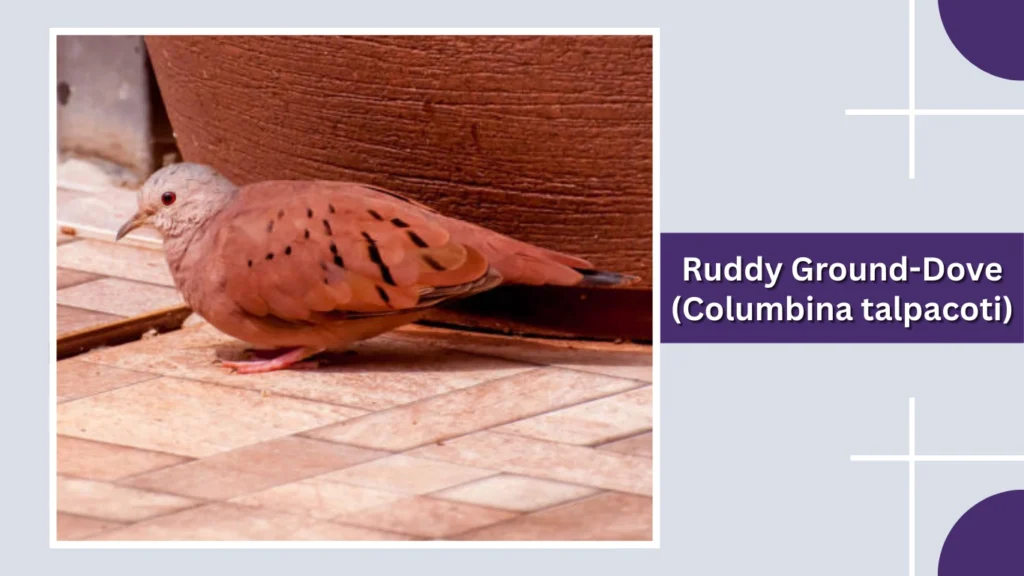
The Ruddy Ground-Dove is a small, compact dove widely distributed across Central and South America. It is easily recognized by its warm reddish tones and is often seen walking on the ground in open areas near human settlements.
Identification
- Small, short-bodied dove
- Reddish-brown plumage, brighter in males
- Blue-gray crown on males
- Scaled pattern on wings
- Short, square tail
- Dark eyes with faint eye ring
Habitat
Ruddy Ground-Doves inhabit open and semi-open environments such as grasslands, farmlands, roadsides, gardens, and city edges. They adapt well to disturbed habitats and are commonly found near towns and villages. Nests are built in shrubs, low trees, or sometimes on man-made structures.
Behaviors
These doves are usually seen alone or in pairs, occasionally forming small groups. They spend most of their time walking on the ground while feeding. Their flight is fast and low, with rapid wingbeats. They are generally tolerant of human presence.
Diet and Lifespan
Their diet consists mainly of small seeds and grains. They forage almost entirely on the ground in open areas. In the wild, Ruddy Ground-Doves typically live around 3–5 years, though lifespan may vary depending on environmental conditions.
18. Common Ground-Dove (Columbina passerina)
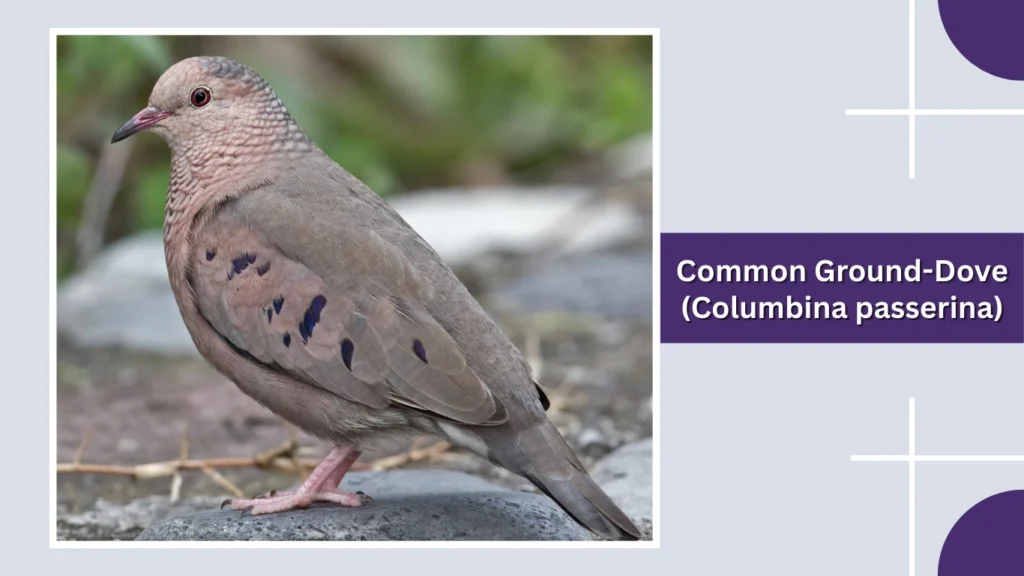
The Common Ground-Dove is one of the smallest dove species and is widely distributed across the southern United States, Central America, and the Caribbean. Its subtle coloring and low, fast flight make it a distinctive presence in open landscapes.
Identification
- Very small, compact-bodied dove
- Brownish-gray plumage with a scaly appearance
- Pinkish tones on the chest
- Short, square tail with dark center
- Dark eyes with faint eye ring
- Short, slender bill
Habitat
Common Ground-Doves inhabit open and semi-open habitats such as grasslands, coastal scrub, savannas, farmlands, and suburban areas. They prefer areas with sparse vegetation and bare ground for feeding. Nests are usually placed in low shrubs or small trees.
Behaviors
These doves are often seen alone or in pairs and sometimes in small flocks. They spend much of their time walking on the ground while foraging. Their flight is low, rapid, and direct, often covering short distances before landing.
Diet and Lifespan
Their diet mainly includes small seeds and grains. They forage almost entirely on the ground. In the wild, Common Ground-Doves typically live around 3–5 years, depending on habitat conditions and predation pressure.
19. Blue Ground-Dove (Claravis pretiosa)
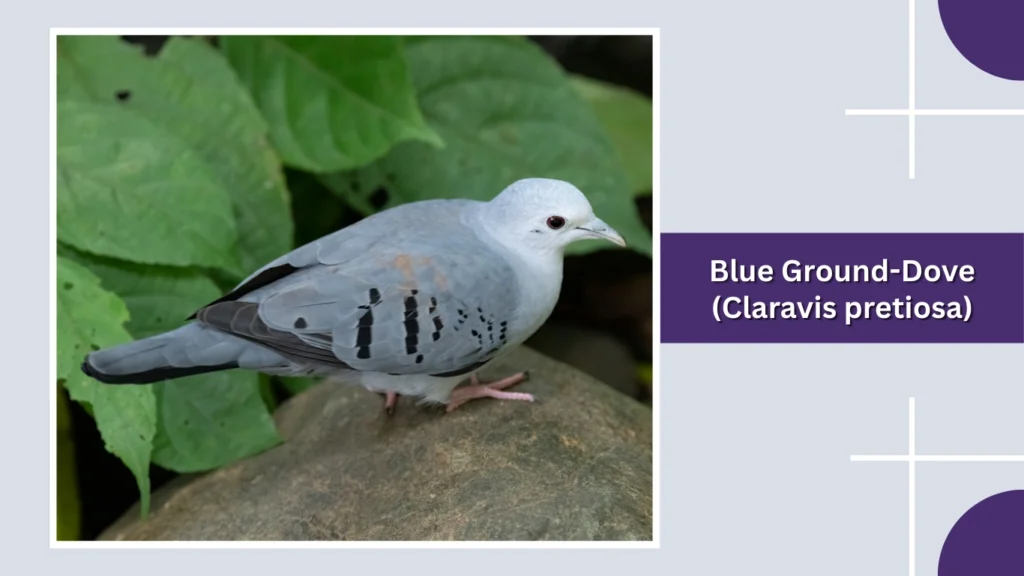
The Blue Ground-Dove is a small, striking dove known for its soft blue-gray coloration, especially in males. Native to Central and South America, it is a shy species that is more often heard than seen, usually staying close to dense ground cover.
Identification
- Small, compact dove
- Male has bluish-gray plumage
- Female is brownish with subtle scaling
- Dark eyes with thin eye ring
- Short tail with pale edges
- Slender, dark bill
Habitat
Blue Ground-Doves inhabit tropical and subtropical forests, forest edges, secondary growth, and bamboo thickets. They prefer dense, shaded environments with thick ground vegetation. This species avoids open areas and is rarely found far from cover. Nests are typically placed low in shrubs or dense plants.
Behaviors
These doves are shy, secretive, and usually seen alone or in pairs. They spend most of their time walking quietly on the forest floor. When disturbed, they fly low and quickly into dense vegetation. Their soft, low cooing call is often the best clue to their presence.
Diet and Lifespan
Their diet mainly consists of small seeds, especially from grasses and bamboo, along with occasional fruits. They forage almost entirely on the ground. In the wild, Blue Ground-Doves are estimated to live around 4–6 years, though detailed lifespan data is limited.
FAQs
What is the most common type of dove worldwide?
The Rock Dove is the most common and widespread dove species in the world. Often known as the feral pigeon, it lives closely alongside humans and can be found in cities, towns, farms, and rural areas across almost every continent except Antarctica.
Are doves and pigeons the same?
Yes, doves and pigeons belong to the same bird family, Columbidae. The names are used interchangeably, though “dove” is often used for smaller or lighter-colored species, while “pigeon” usually refers to larger or urban-adapted birds.
What do most doves eat?
Most doves primarily eat seeds and grains. Some species also consume fruits, berries, and occasional insects. Many doves forage on the ground, while fruit-eating species, like green pigeons, feed mainly in trees.
Where do doves usually live?
Doves live in a wide range of habitats, including forests, grasslands, deserts, farmlands, and urban areas. Their adaptability allows different species to thrive in both natural environments and human-modified landscapes around the world.
How long do doves usually live?
In the wild, most doves live between 3 and 8 years, depending on the species and environmental conditions. Some doves kept in captivity or protected environments can live significantly longer due to reduced predation and stable food sources.