
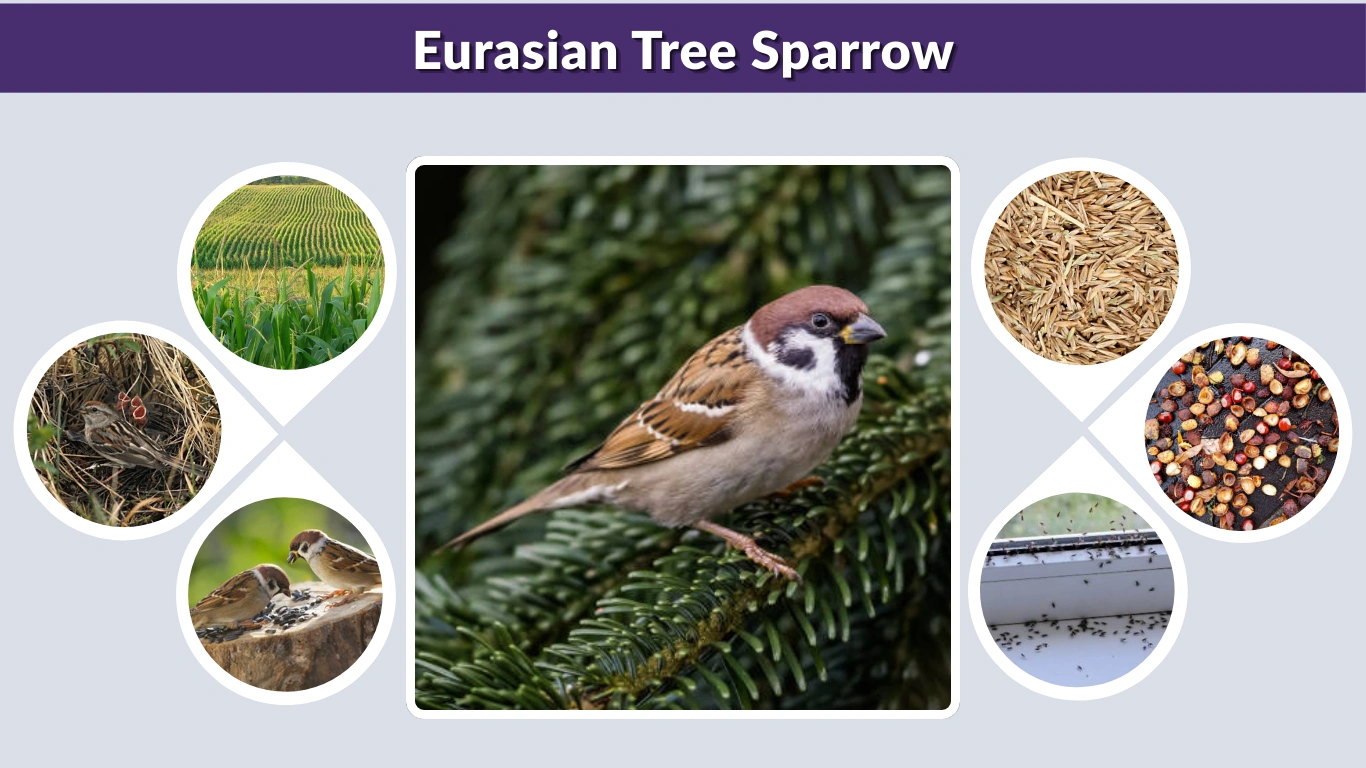
The Eurasian Tree Sparrow is a small, charismatic bird recognized for its chestnut head and bold cheek spot. Common across Europe and Asia and introduced to parts of North America, it thrives near farms, gardens, and bustling city spaces. Its adaptability, distinctive calls, and energetic personality make it a favorite among birdwatchers. This guide explores its appearance, habitat, diet, behavior, range, nesting habits, and the key differences between it and the House Sparrow.
Identification
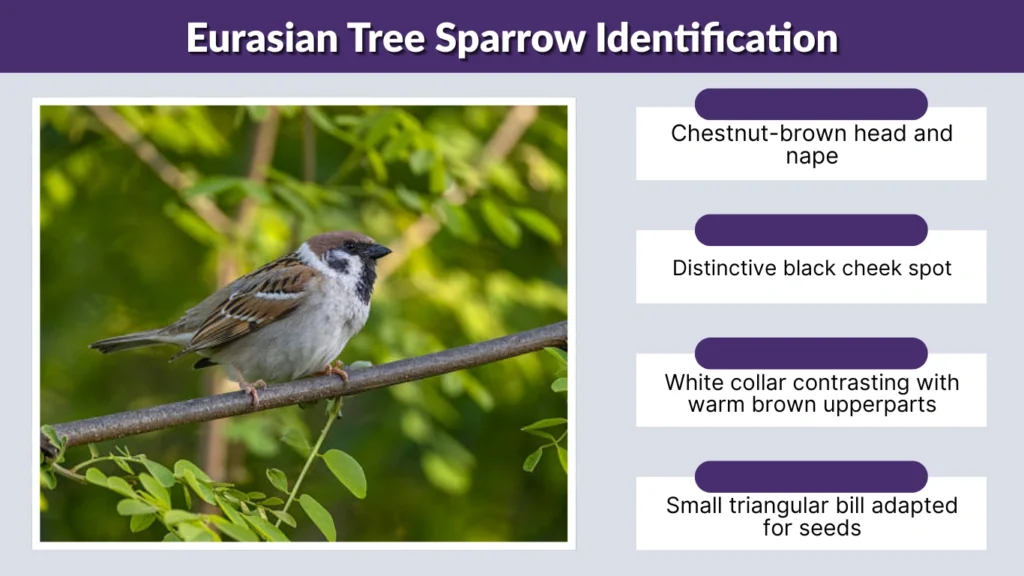
- Chestnut-brown head and nape
- Distinctive black cheek spot
- White collar contrasting with warm brown upperparts
- Small triangular bill adapted for seeds
- Black bib beneath the beak
- Agile posture and quick, darting movements
These characteristics make the Eurasian Tree Sparrow one of the easiest small passerines to recognize, especially in regions where it coexists with House Sparrows.
Size, Weight & Wings
- Length: 12–14 cm
- Weight: 20–30 grams
- Wingspan: 20–22 cm
Though slightly smaller than the House Sparrow, the Eurasian Tree Sparrow is compact and brisk in flight. Its rapid wingbeats allow it to maneuver through tight branches and urban structures with ease.
Scientific Name & Bird Code
- Scientific name: Passer montanus
- Four-letter code: EUTS
This species is part of the family Passeridae and shares many characteristics with other sparrows, yet its facial markings remain unique among them.
Range & Distribution
The Eurasian Tree Sparrow’s native range stretches from Western Europe across Russia and Asia to Japan and Southeast Asia. It is abundant in countries such as Malaysia, the Philippines, Singapore, China, and Japan.
In North America, its population is much more limited. A small group introduced in the 1870s persisted only around the Midwest—especially St. Louis, Missouri, and parts of Iowa and Illinois—making it a regional specialty for birders.
A dedicated section for the full range map will expand further in the second half of the article.
Habitat
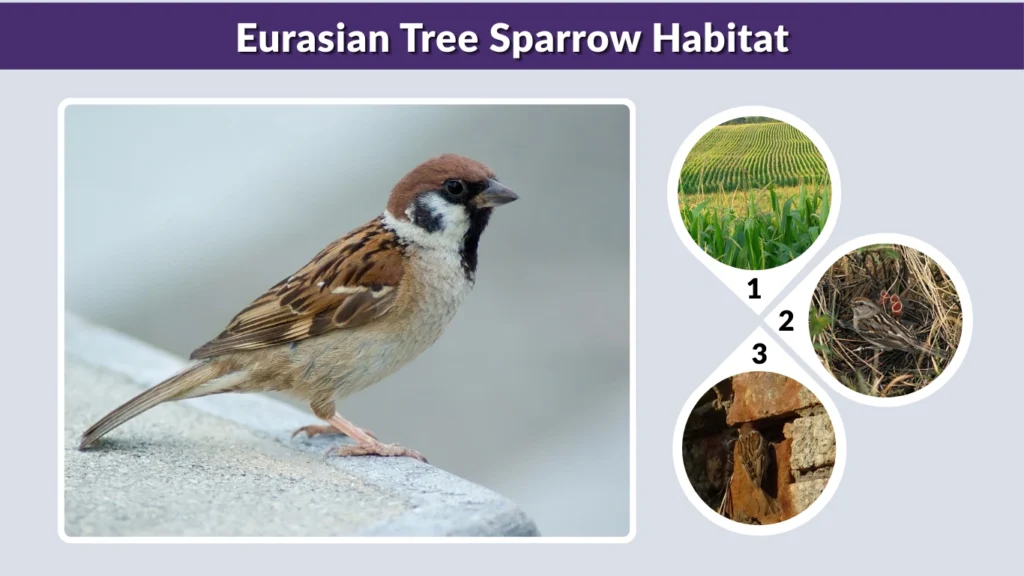
This sparrow thrives in a variety of human-linked environments. It frequents:
- Farmlands and crop fields
- Suburban gardens
- City parks and building edges
- Rural villages and open woodlots
- Roadside shrubs and hedges
Unlike some woodland species, the Eurasian Tree Sparrow rarely ventures into deep forest. Instead, it prefers edges and open spaces where seeds and insects are easy to find.
Behavior
Eurasian Tree Sparrows are highly social. Outside the breeding season, they gather in flocks that move rapidly between feeding sites. Their flight is fast and direct, often accompanied by constant chattering.
They are active ground foragers, hopping quickly between grasses and low vegetation. Their alert posture and quick reactions help them avoid predators in busy urban landscapes.
During winter, groups often crowd around feeders, where they compete vigorously yet remain less aggressive than House Sparrows.
Calls, Song & Sounds
Their call is a sharp, metallic “chip-chip”, often repeated in short bursts. Compared with the House Sparrow’s deeper “chirp,” the Eurasian Tree Sparrow’s voice is higher and crisper.
Their song consists of short, chattery notes used during courtship and territory defense. Flocks keep in contact with frequent soft calls, especially when feeding or flying.
Diet & Feeding
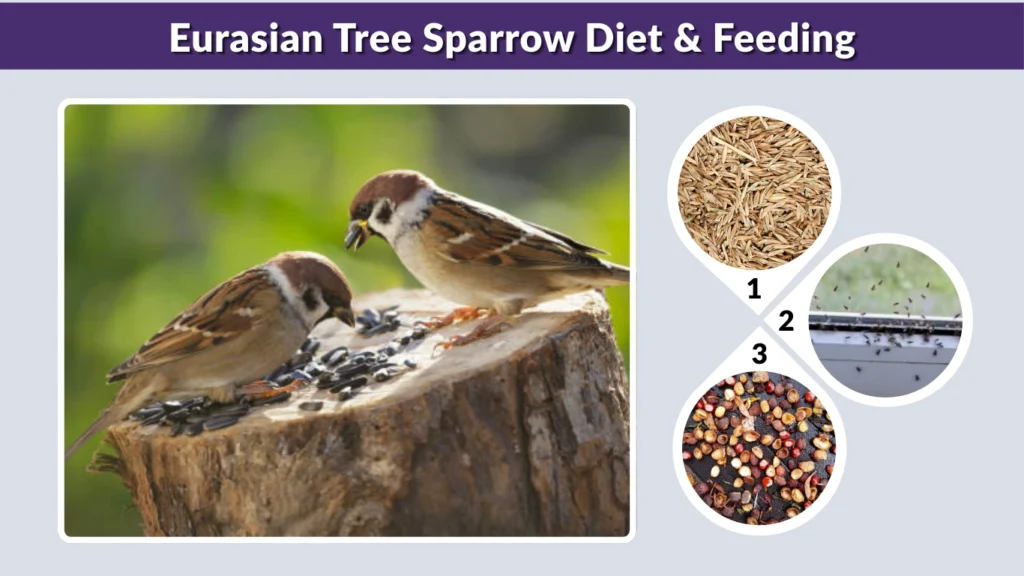
The Eurasian Tree Sparrow primarily eats:
- Seeds
- Grains
- Grass kernels
- Small insects
- Buds and soft plant parts
During the breeding season, insects become especially important as parents feed caterpillars, beetles, and other protein-rich prey to their chicks. In city environments, they readily consume crumbs and scraps, though natural foods remain their preference.
Life Cycle & Age
Eurasian Tree Sparrows live an average of 3–5 years in the wild, though some survive longer in stable environments. Their reproductive cycle begins in spring when pairs form and select cavities. After mating, the female lays 5–6 speckled eggs, incubating them for about two weeks. Both parents feed the chicks, which fledge roughly 14–16 days after hatching. Juveniles show duller, softer facial markings compared to adults.
Breeding Season & Nesting
Breeding usually occurs from late spring into summer, though in warmer climates they may have multiple broods. They nest inside:
- Tree cavities
- Roof openings
- Old woodpecker holes
- Birdhouses or nest boxes
Their nests are constructed from grass, straw, feathers, and plant fibers, forming a comfortable cup. Providing nest boxes with a small entrance hole (around 32 mm) can attract breeding pairs in gardens. Parents remain attentive and cooperative, often raising two or three broods per year.
Male vs Female
Unlike the strongly dimorphic House Sparrow, the Eurasian Tree Sparrow has minimal visible sex differences. Both sexes share the chestnut head, cheek spot, and bib. Females may appear slightly duller, with a softer-edged bib and lighter cheek contrast, but these differences are subtle. Behaviorally, both participate in raising young, though males more actively defend small territories.
Eurasian Tree Sparrow vs House Sparrow
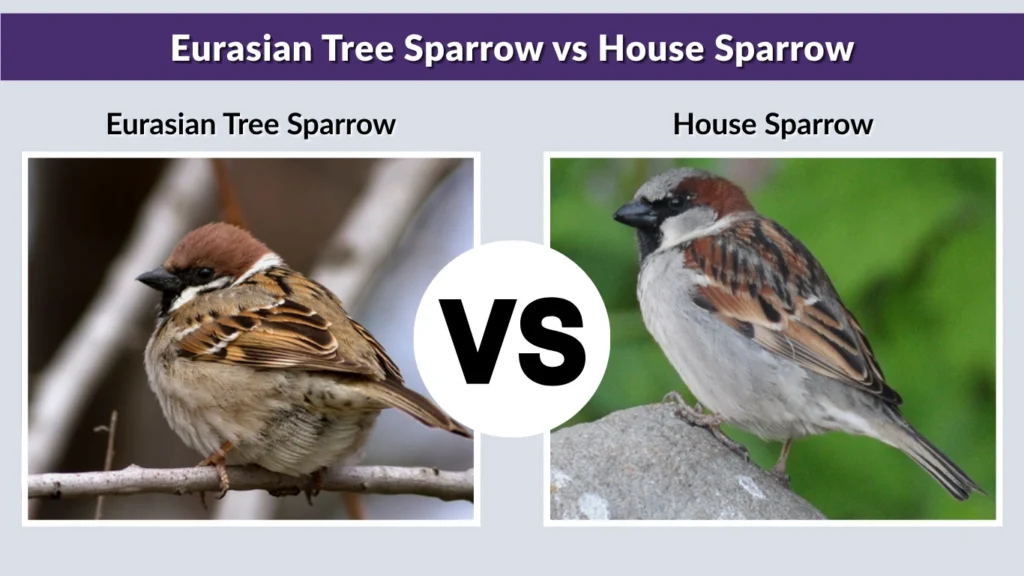
| Feature | Eurasian Tree Sparrow | House Sparrow |
| Head | Chestnut with black cheek spot | Gray crown, no cheek spot |
| Size | Smaller (12–14 cm) | Larger (14–16 cm) |
| Sexual dimorphism | Very low | High (males striking) |
| Call | Higher-pitched “chip-chip” | Deeper “chirp” |
| Behavior | Less aggressive | Highly aggressive |
| U.S. presence | Localized (Midwest only) | Widespread |
Are Eurasian Tree Sparrows Invasive?
While native across Eurasia, the species is considered locally invasive where introduced. In the United States, for example, the population that established in Missouri and nearby states originates from a small 19th-century release. Their spread has been slow, far more limited than the House Sparrow. Although they compete with native cavity-nesting species, their overall ecological impact is mild in comparison.
Regional Presence
Malaysia
Abundant in urban areas, markets, villages, and farmlands. A familiar sight near food stalls and gardens.
Singapore
Common across parks and housing estates. Often seen foraging in groups around open lawns and eateries.
Philippines
One of the country’s most widespread urban birds. They thrive in cities, provinces, and farmland landscapes.
China
A native species historically targeted during the “Four Pests Campaign.” Populations rebounded significantly afterward.
Japan
Very common in rural towns, shrines, and suburban neighborhoods.
United States (St. Louis, Iowa, Illinois)
Restricted to the Midwest, especially St. Louis—the center of the original introduction. Small but stable populations persist.
Conservation Status
The Eurasian Tree Sparrow is listed as Least Concern by the IUCN. Its global population remains stable and widespread. Adaptability to human-shaped environments, diverse food sources, and flexible nesting habits contribute to its long-term success. Conservation concerns arise mainly in areas where they compete for nesting cavities, but these issues are localized and manageable.
Fascinating Facts
- Targeted for extermination during China’s 1950s Four Pests Campaign, leading to unintended ecological consequences.
- A favorite subject among eBird users, especially in Southeast Asia.
- Sometimes symbolically associated with simplicity and humility in Asian folklore.
- Juveniles lack the bold cheek spot, making them easy to misidentify at first glance.
Drawing & Artistic Notes
Artists often focus on the bird’s cheek spot, rounded head shape, and compact posture. Common drawing poses include perched on a twig or feeding on the ground. When depicted in flight, note the rapid wingbeats and short rounded wings.
FAQs
What do Eurasian Tree Sparrows eat?
Eurasian Tree Sparrows primarily eat seeds, grains, and small insects. In cities they also consume crumbs, grass seeds, and garden plants. During the breeding season, adults switch to insects to meet the protein needs of chicks, making them helpful for pest control in farmland and gardens.
Are Eurasian Tree Sparrows invasive?
In their native range they are not invasive, but in regions where they were introduced—such as St. Louis, Missouri—they can be considered a localized invasive species. Their spread, however, is far slower and more limited than the House Sparrow, and they pose less ecological threat overall.
How can you tell a Eurasian Tree Sparrow from a House Sparrow?
The Eurasian Tree Sparrow has a chestnut head and distinct black cheek spot, while the House Sparrow has a gray crown and no cheek spot. Tree Sparrows are also slightly smaller and show little sexual dimorphism, unlike the more strongly marked male House Sparrow.
What is the lifespan of a Eurasian Tree Sparrow?
Most Eurasian Tree Sparrows live 3–5 years in the wild, though some individuals may survive longer in ideal conditions. Their survival is influenced by predators, habitat quality, and harsh winters, especially in northern temperate regions.
Where can you find Eurasian Tree Sparrows in North America?
In the U.S., they are mostly restricted to the Midwest, especially around St. Louis, Missouri, parts of Iowa, Illinois, and nearby regions. They originated from a small introduction in the late 1800s and have spread slowly compared to the more adaptable House Sparrow.
