
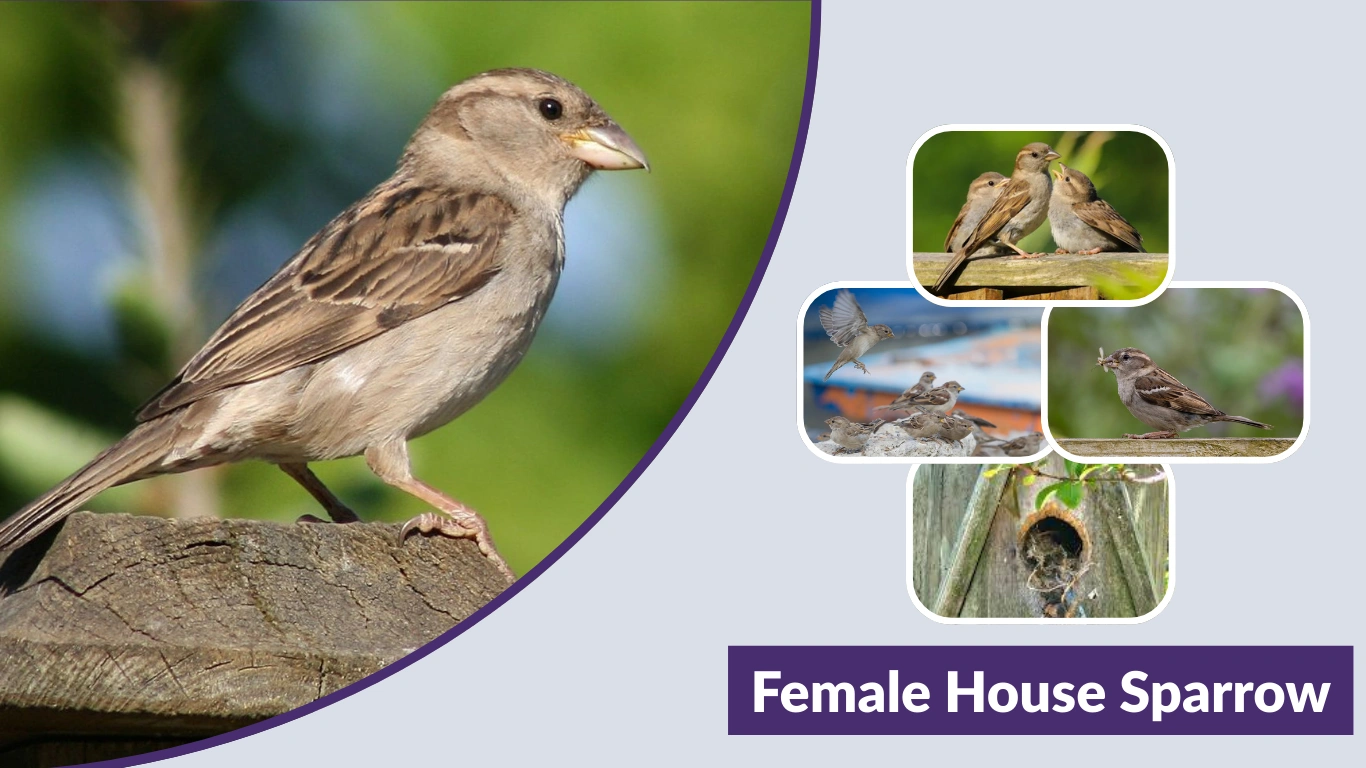
House Sparrows (Passer domesticus) are among the most familiar birds across cities, farms, and suburbs. Because they are abundant, fast-moving, and often mixed with other brown-streaked birds, identifying females—especially when comparing them to males, House Finches, or Song Sparrows—can be challenging. This guide explains what female House Sparrows look like, how they differ from males, how to distinguish them from similar species, and how their behavior and calls help confirm identification.
Female House Sparrow: Identification Guide
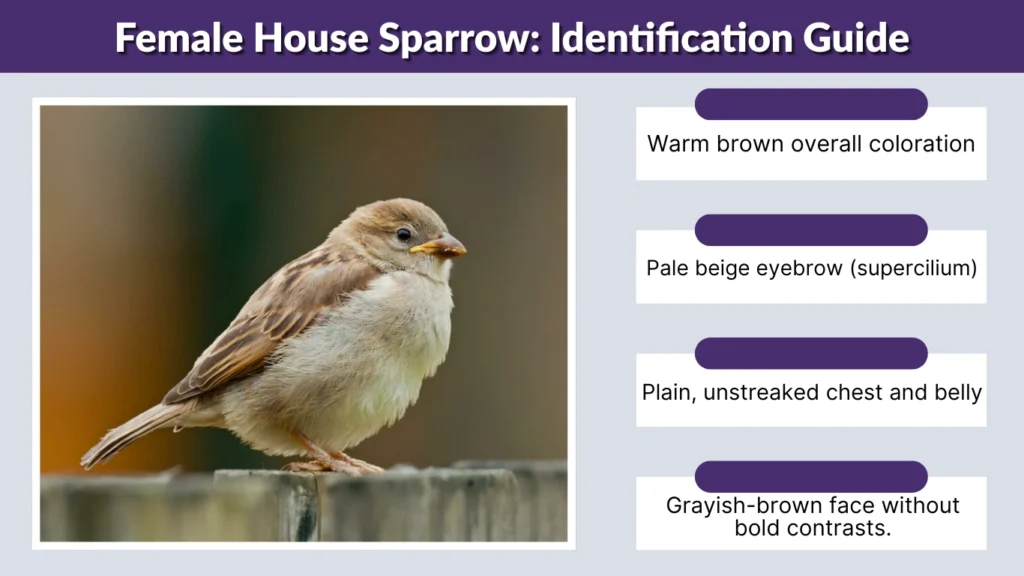
Female House Sparrows possess a subtle beauty that is easy to overlook due to their muted colors. While males are known for their rich black bibs and chestnut crowns, the female’s appearance is more understated and blends easily into many environments.
Key Physical Features
Female House Sparrows share several consistent traits:
- Warm brown overall coloration with minimal streaking compared to many sparrows.
- Pale beige eyebrow (supercilium) that runs from the bill to behind the eye.
- Plain, unstreaked chest and belly—an important ID feature.
- Grayish-brown face without bold contrasts.
- Stout conical bill, which varies from yellowish-brown in winter to darker gray in breeding season.
- Rounded head and thick neck, giving a somewhat chunky appearance.
These traits help differentiate them from similarly sized birds that have more streaking or patterned faces.
Regional Variations
While female House Sparrows remain fairly consistent globally, minor differences appear in various regions:
- North America: Females here show slightly paler underparts.
- United Kingdom/England: Slightly warmer tones on the back and wings.
- Alaska: Some individuals have heavier feathering and duller coloration suited for colder climates.
- New Zealand populations: Often exhibit lighter overall shading due to environmental adaptation.
- Pennsylvania and Ohio: Subtle differences in tone occur but remain within the typical female variation range.
Such variations are small but useful for birders who observe local populations closely.
Age-Related Identification
Telling the age and sex of young birds is often more difficult than identifying adults.
Juvenile and young female traits include:
- Buffier, softer overall coloration
- A more yellowish bill
- Slight streaking on the wings without the crispness of adults
- A thinner, more delicate appearance
Fledglings, whether male or female, often appear:
- Fluffier, with downy feathers
- Less alert or coordinated
- With gape coloration remaining around the bill edge
Determining whether a baby or fledgling is male or female is often impossible until molting occurs.
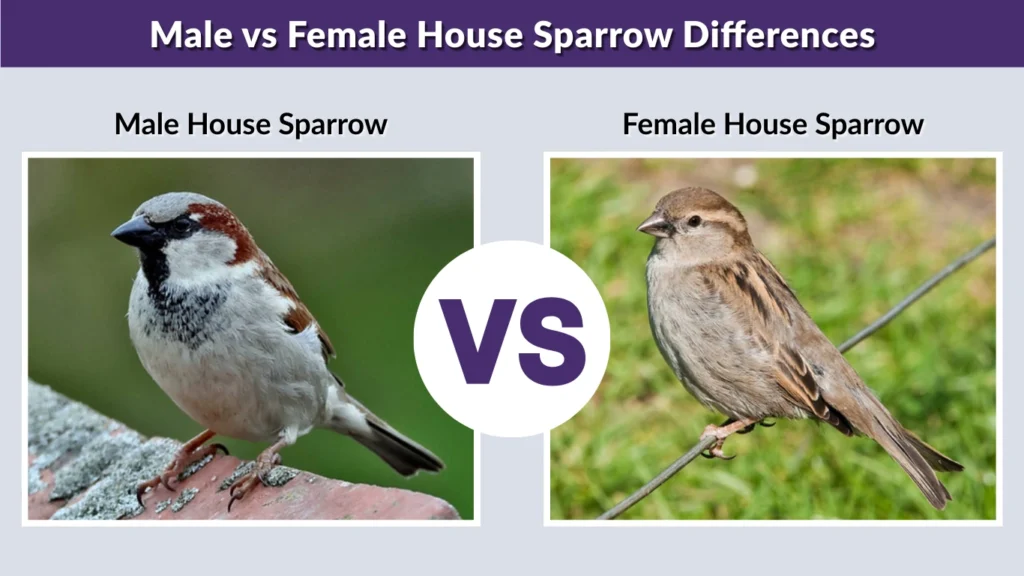
Male vs Female House Sparrow Differences
| Feature | Male House Sparrow | Female House Sparrow |
| Head Pattern | Gray crown with rich chestnut sides | Plain brown head with pale eyebrow (supercilium) |
| Throat/Bib | Prominent black bib on throat and chest | No black bib, plain beige throat |
| Cheeks | Bright white cheeks | Soft gray-brown cheeks |
| Body Color | More contrast: blacks, grays, chestnut | Warm brown, uniform and plain |
| Breast & Belly | Grayish and may have slight shading | Unstreaked pale beige belly |
| Wing Pattern | Strong markings; white wing bars distinct | Softer wing bars, less contrast |
| Bill Color (Breeding) | Dark black bill | Dull grayish or yellow-brown bill |
| Bill Color (Non-Breeding) | Yellowish-brown | Yellowish-brown (similar to male) |
| Size | Slightly larger and bulkier | Slightly smaller and slimmer |
| Posture | Upright, more alert/territorial | More relaxed, often lower to ground |
| Behavior | Vocal, sings and guards territory | Quieter, focuses on foraging and nesting |
| Juvenile Appearance | Young males may show early dark throat patches | Young females stay uniformly pale and unstreaked |
Behavior of the Female House Sparrow
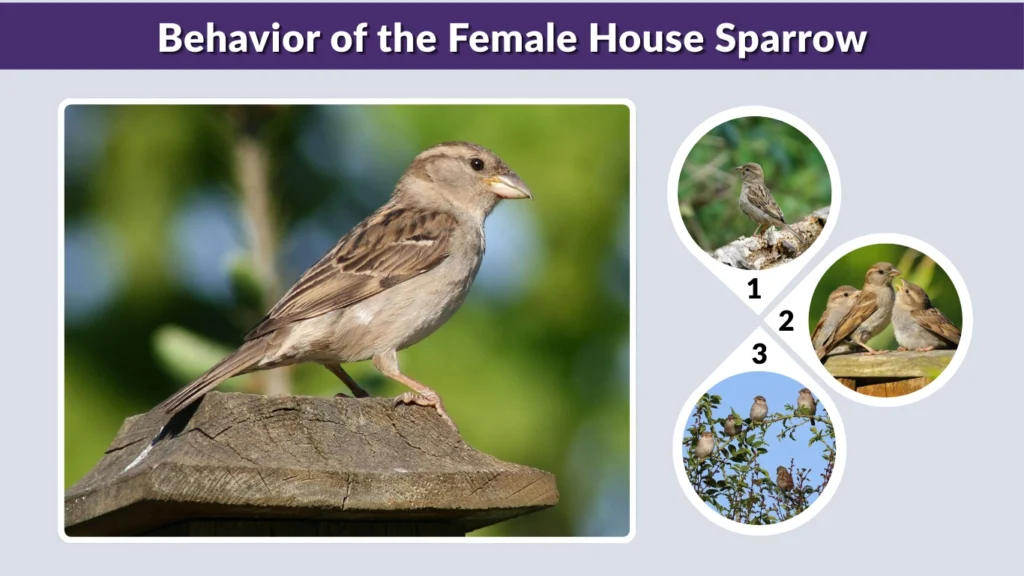
Behavioral clues often confirm identification when visual differences seem unclear. Female sparrows tend to be more cautious, more focused on foraging, and less showy than males, which are more vocal and territorial.
General Behavior Traits
Female House Sparrows:
- Spend more time foraging quietly
- Stick to edges of flocks rather than leading
- Show less aggressive territorial display
- Approach feeders more cautiously than males
They are quick ground foragers and often work methodically through leaf litter or grass.
Nesting and Reproduction
Females play a critical role in nest-building and reproduction. While males often choose the nesting site, females make most of the structural decisions, lining the nest with grasses, feathers, and soft materials.
Key behaviors include:
- Inspecting multiple nest cavities
- Forming a cavity or cup inside a provided nest box
- Laying 3–7 eggs
- Taking long incubation shifts
- Brooding chicks in their first days of life
Female House Sparrows lay eggs primarily in late spring and early summer but may have multiple broods per season.
Flight, Movement & Unusual Behaviors
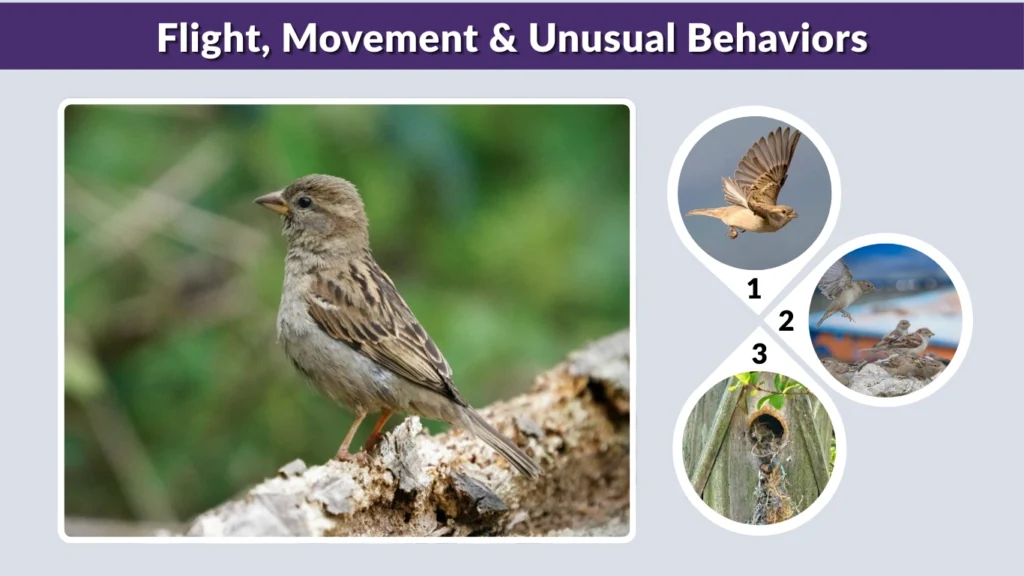
Female House Sparrows often appear more delicate in flight than males. Their flight is direct and quick, with rapid wingbeats and short glides. While males frequently chase or display during flight, females generally fly for practical purposes—food collection, nest visits, or flock movement. They tend to stay low to the ground and make short trips between shrubs, feeders, and buildings.
Occasionally, people notice female sparrows attempting to enter houses. This behavior usually relates to searching for nesting cavities, investigating reflections, or responding to indoor birds or sounds. In rare cases, confused behavior may appear “agitated,” which some interpret as unusual, but it is typically related to hormones during nesting season.
Calls, Songs & Sounds of Female House Sparrows
While males are the primary singers, females also produce a variety of sounds. Their vocalizations are softer, shorter, and more conversational.
Female calls include a sharp “cheep” used to communicate with mates and fledglings, a quiet trill for nest interactions, and a short alarm call that alerts nearby birds to predators. During the breeding season, females may produce rapid, repetitive chirps while begging males for food or while soliciting nesting help.
These calls are essential for flock coordination and are especially noticeable when females are near their nests. Though females don’t sing long territorial songs like males, their vocal patterns carry specific meanings, helping birders distinguish them in the field.
Diet and Ecology of Female House Sparrows
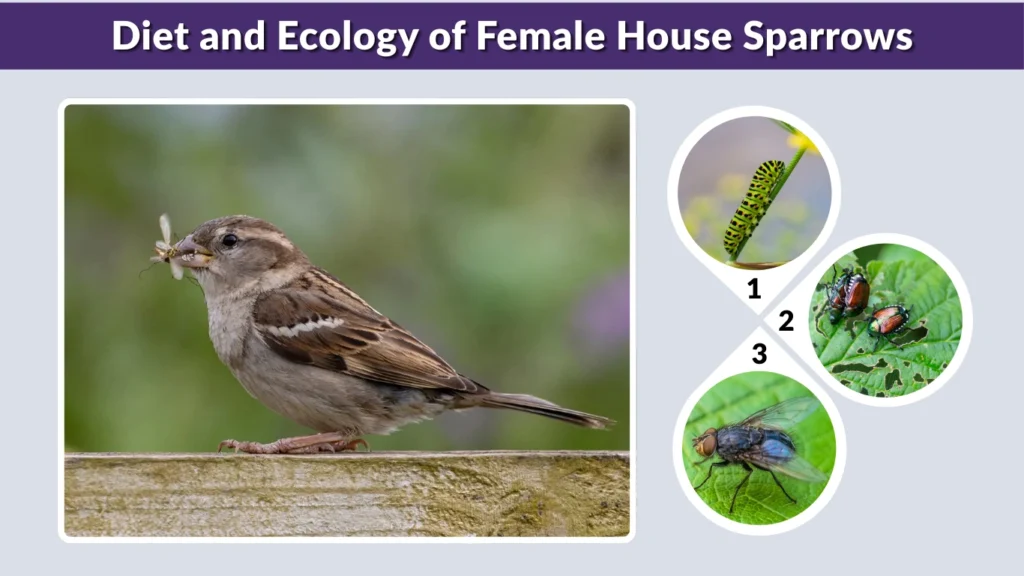
Female House Sparrows have a flexible diet that shifts according to season, availability, and reproductive needs. During breeding months, they consume more protein-rich insects such as caterpillars, beetles, and flies to support egg production and chick development. Outside the breeding season, their diet consists largely of seeds, grains, and small plant matter.
In urban areas, females adapt easily to human presence. They forage around outdoor restaurant seating, gardens, cracks in sidewalks, and backyards. Their ability to exploit human environments has made them one of the world’s most successful small birds. Competition with House Finches and native sparrows is common, particularly around feeders and nesting sites.
Female House Sparrow vs Female House Finch
This is one of the most common identification challenges in North America. Both birds are small, brown, and frequently visit feeders, yet distinct differences exist.
Key Differences (List Section 1)
- Female House Sparrows are plain-faced, while female House Finches have streaked breasts and blurry facial markings.
- House Sparrow bills are thicker and more triangular, whereas House Finch bills are slightly curved.
- Finch females are more streaked all over, including the flanks and chest; sparrow females have a clean, unstreaked belly.
Behavior also differs. Female finches sit more upright and often travel in pairs or small groups. Female sparrows move in mixed flocks and spend more time on the ground. Understanding these distinctions ends most misidentifications quickly.
Female House Sparrow vs Song Sparrow & Other Sparrows
Song Sparrows are heavily streaked with a large central breast spot—features absent in House Sparrows. Their faces are patterned with bold stripes and a longer tail. In contrast, female House Sparrows have a uniform chest and shorter, square tail.
Chipping Sparrows, another common comparison, have a rusty crown in summer and clean facial lines that the female House Sparrow lacks. Field Sparrows are lighter, with a distinct pink bill, while Dunnocks (in Europe) are slimmer with slate-gray faces. While all these birds share a muted brown color scheme, their patterns, bills, and behaviors offer clear differences for careful observers.
Geographic Variations in Female House Sparrows
Geography subtly influences appearance and behavior. North American females are slightly paler than their European counterparts. Birds in Alaska are bulkier with denser feathering to withstand the cold, while those in New Zealand often appear washed-out due to local climate and diets.
Females in the Ohio–Pennsylvania region remain typical of eastern populations, showing normal brown and buff tones. Though minor, these regional differences help experienced birders understand local populations and migration influences.
Life Cycle of the Female House Sparrow
The female House Sparrow’s life cycle revolves around survival, reproduction, and flock integration. Juveniles emerge from the nest with duller plumage and gradually develop the adult coloration that makes sexing easier. Females typically breed in their first year and may raise up to four broods in favorable conditions.
Nest-building begins early in the season, with females selecting soft interior materials while males bring structural items. After laying 3–7 eggs, females incubate them for 10–14 days and continue brooding chicks until they regulate their own temperature. Once fledged, young sparrows follow the female for food and guidance. Through autumn and winter, females join mixed flocks, conserving energy and preparing for the next breeding cycle.
FAQs
What does a female House Sparrow look like?
A female House Sparrow is a warm, brown, plain-looking bird with a pale eyebrow stripe, unstreaked belly, and thick seed-eating bill. Unlike the male, she lacks bright plumage or a black bib. Her subtle patterns help her blend into vegetation and urban settings.
How can you tell male from female House Sparrows?
Males have a black bib, gray crown, chestnut head bands, and white cheeks. Females have no black, no gray crown, and no stark facial patterns. Females also appear softer and plainer overall, with a beige eyebrow and brown body.
Do female House Sparrows sing?
Females do not sing long territorial songs like males. Instead, they use short chirps, trills, and alarm calls. These quieter sounds help communicate with mates and young birds, especially during nesting season.
How do female House Sparrows behave during nesting?
Females select nesting materials, incubate eggs, and brood the young. They show high site fidelity and may reuse nests. Their behavior becomes more secretive and cautious around the nest to avoid drawing attention from predators.
What’s the difference between a female House Finch and a female House Sparrow?
Female House Finches are streaky everywhere, especially on the chest and sides. Female House Sparrows have a clean, pale belly, plainer face, and thicker, more triangular bill. Comparing breast patterns usually provides the fastest ID.
