
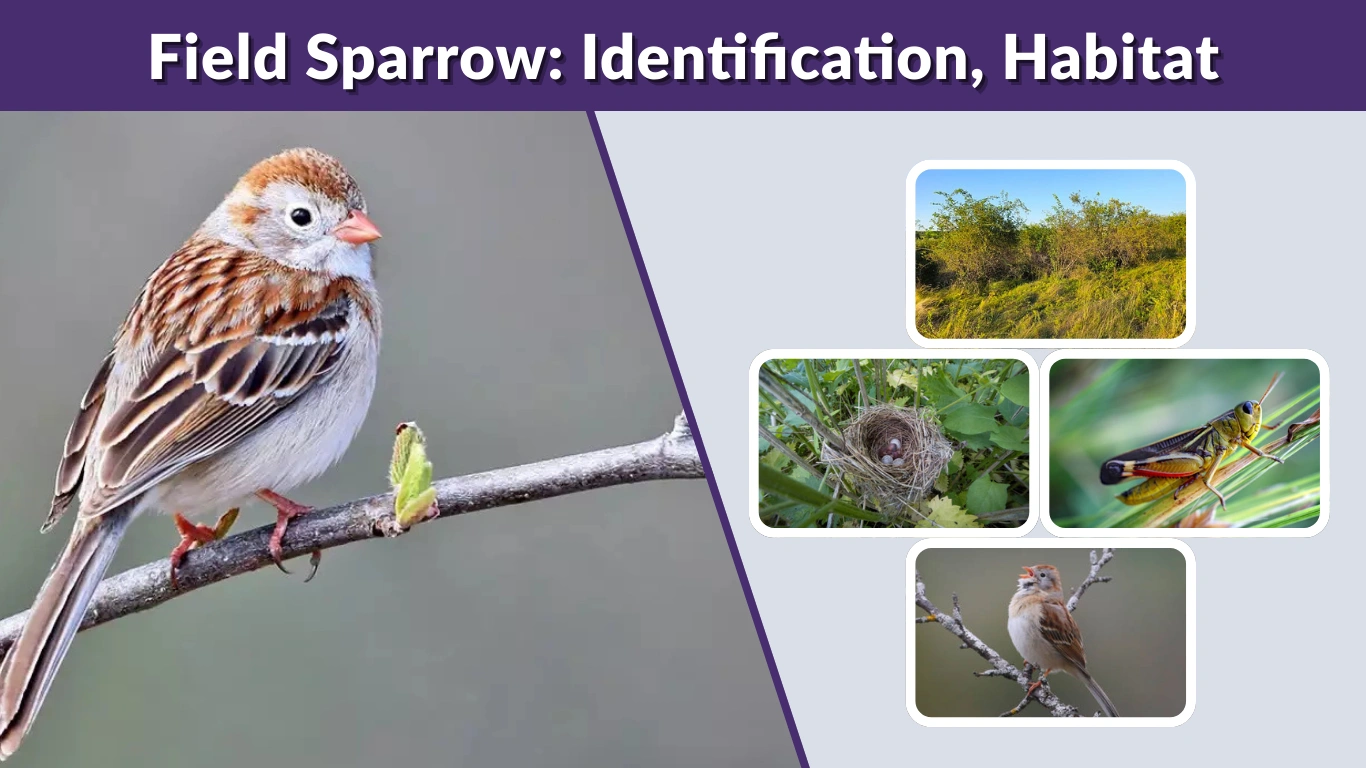
The field sparrow is a small, soft-colored songbird commonly found in brushy fields and overgrown meadows across eastern and central North America. Though modest in appearance, this sparrow is best known for its sweet, accelerating song that echoes through open countryside in spring. Birdwatchers often recognize it by its pink bill and clean, unstreaked breast. In this guide, you’ll learn how to identify the field sparrow, understand its habitat, and recognize its distinctive song.
What Is a Field Sparrow?
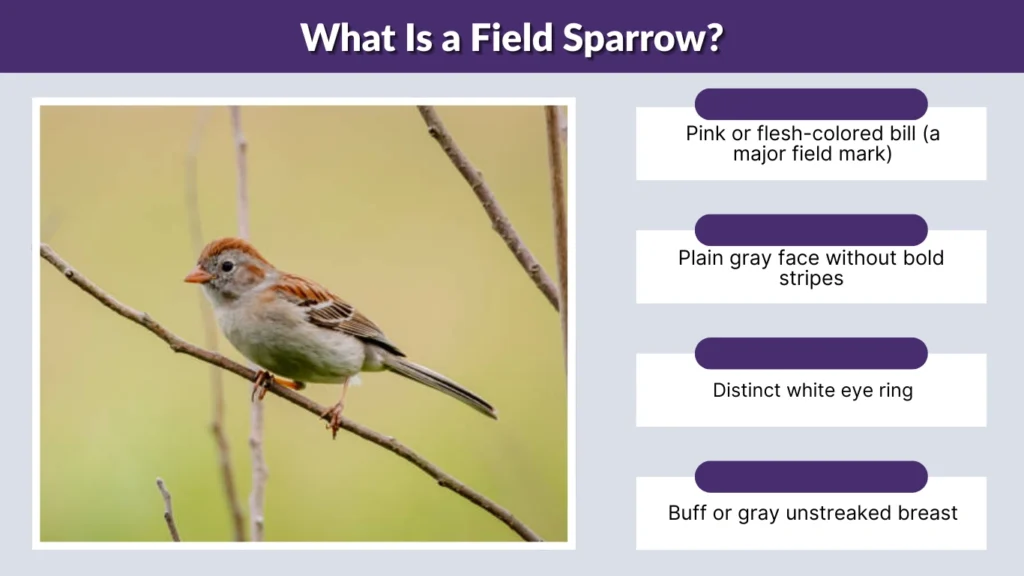
The field sparrow (Spizella pusilla) is a small New World sparrow belonging to the family Passerellidae. It is native to North America and thrives in open areas with scattered shrubs and grasses. Despite its simple brown and gray coloring, it has several distinctive features that make identification easier once you know what to look for.
Scientific Classification and Background
- Scientific name: Spizella pusilla
- Family: Passerellidae
- Common name origin: Named for its preference for open fields and brushy landscapes
Field sparrows are considered typical “LBJs” (little brown jobs) among birders, but they stand out thanks to their gentle expression and musical voice. They are migratory in the northern parts of their range but may remain year-round in southern regions.
Physical Appearance and Key Identification Features
The field sparrow is small and slim, measuring about 4.7 to 5.9 inches in length with a wingspan of around 7.9 inches. It has a rounded head, long tail, and a relatively delicate build compared to bulkier sparrows.
Key identifying features include:
- Pink or flesh-colored bill (a major field mark)
- Plain gray face without bold stripes
- Distinct white eye ring
- Reddish-brown crown
- Buff or gray unstreaked breast
Unlike many sparrows, the field sparrow lacks heavy streaking on its chest, giving it a cleaner, softer look. Its overall coloration blends beautifully with dry grasses and brush.
Field Sparrow vs. Similar Species
Field sparrows are sometimes confused with other small brown sparrows, especially the Song Sparrow and Chipping Sparrow.
Field Sparrow vs. Song Sparrow:
Song sparrows are larger and heavily streaked across the breast, often with a central dark spot. Field sparrows have a plain chest and a noticeable pink bill.
Field Sparrow vs. Chipping Sparrow:
Chipping Sparrows have a brighter reddish cap, a bold black eye line, and lack the strong white eye ring typical of field sparrows.
Learning these subtle differences helps birdwatchers confidently identify the field sparrow in mixed flocks.
Field Sparrow Habitat
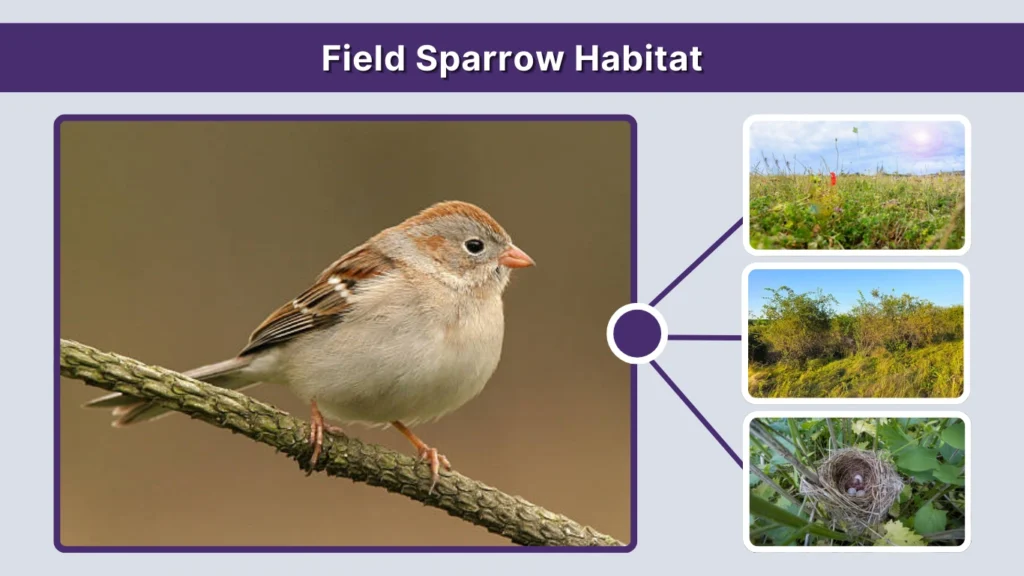
Understanding field sparrow habitat is key to spotting one in the wild. These birds prefer open landscapes that provide both ground foraging areas and low shrubs for nesting and shelter.
Preferred Natural Habitat
Field sparrows are most commonly found in:
- Brushy fields
- Overgrown pastures
- Shrubby meadows
- Woodland edges
- Abandoned farmland
- Early successional forests
They favor habitats that are not fully mature forests but also not completely open grasslands. Areas with scattered shrubs and tall grasses provide the ideal balance of cover and feeding opportunities.
Because they depend on this type of transitional habitat, they often thrive in places that are allowed to grow naturally without frequent mowing.
Seasonal Habitat Changes
During the breeding season, field sparrows prefer brushy fields with dense vegetation for nesting. Males establish territories in these areas and sing frequently from low perches.
In winter, they may move slightly southward if they breed in northern regions. Winter habitat often includes weedy fields, roadside thickets, and brushy edges. In colder areas, they may form loose flocks and forage together.
Some populations are short-distance migrants, while others in the southern United States remain year-round.
Geographic Range in North America
Field sparrows are widely distributed across:
- Eastern United States
- Central United States
- Southern parts of Canada (breeding season)
- Southeastern and south-central U.S. (wintering range)
They are absent from most of the western U.S., where different sparrow species dominate similar habitats.
Their range overlaps with many other sparrows, making habitat and physical traits especially important for accurate identification.
Field Sparrow Song and Vocalizations
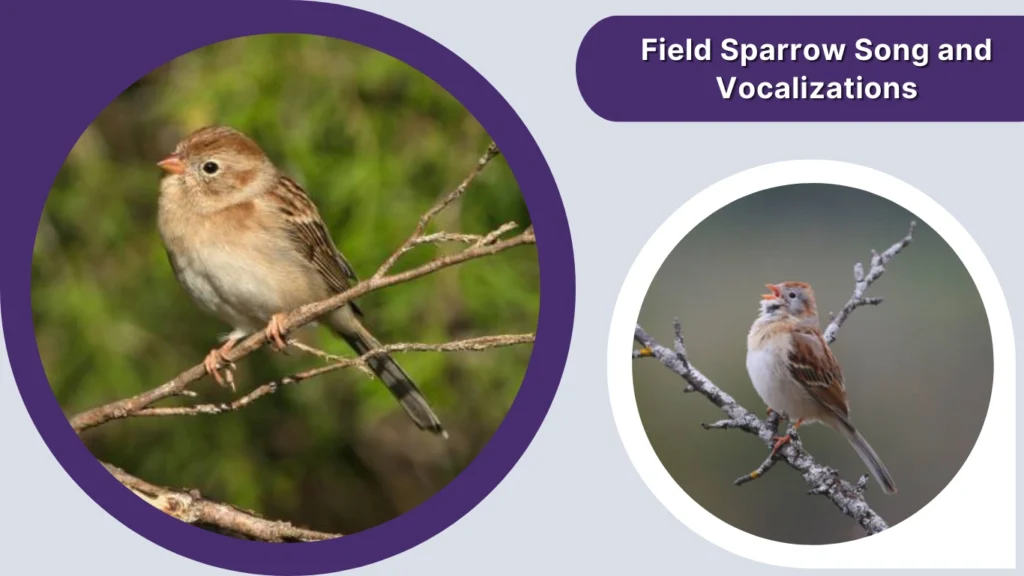
The field sparrow song is one of its most charming and recognizable features. Though the bird may appear plain, its voice is anything but ordinary.
What Does a Field Sparrow Song Sound Like?
The classic field sparrow song is often described as a series of clear whistles that accelerate into a rapid trill. Many birders refer to it as a “bouncing ball” song because the tempo speeds up as it progresses.
It typically begins with slow, spaced-out notes and gradually becomes faster, ending in a lively flourish. The sound is sweet, high-pitched, and carries well across open fields.
Once learned, the song is one of the easiest ways to detect a field sparrow hidden in brushy vegetation.
When Do Field Sparrows Sing?
Field sparrows sing most actively during the spring and early summer breeding season. Males sing to:
- Establish territory
- Attract mates
- Warn rival males
They often choose exposed but low perches, such as shrubs or fence posts, to broadcast their song. Early morning is typically the most active singing period, though they may continue throughout the day.
Calls vs. Songs
In addition to their melodic breeding song, field sparrows produce short, sharp calls. These calls are used for communication between mates or as alarm signals when predators are nearby.
Unlike the musical song, these calls are brief and less noticeable, often heard as subtle chips from dense vegetation.
Field Sparrow Nesting Behavior
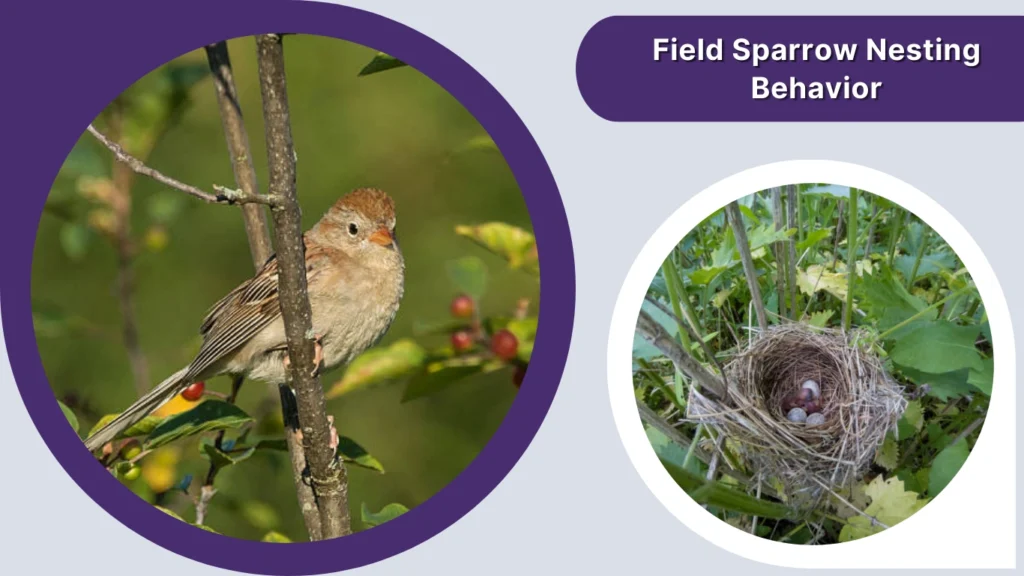
Field sparrows are ground-oriented birds that rely heavily on low vegetation for nesting. Their nesting habits are closely tied to their preference for brushy, early successional habitats where shrubs and tall grasses provide concealment from predators.
Where Do Field Sparrows Build Their Nests?
A field sparrow nest is usually placed low to the ground, often within:
- Dense shrubs
- Small saplings
- Blackberry or bramble thickets
- Tall grasses
- Weedy field edges
Most nests are built within 1 to 3 feet of the ground, though some early-season nests may be constructed directly on the ground in thick grass. As vegetation grows taller later in the season, nests are more commonly placed slightly higher in shrubs.
The female selects the nest site, typically choosing a well-hidden location that offers protection from predators and weather.
Nest Structure and Materials
The field sparrow builds a small, neat, cup-shaped nest. It is carefully woven and surprisingly sturdy for its delicate appearance.
Common materials include:
- Fine grasses
- Plant stems
- Rootlets
- Weed fibers
The inside of the nest is lined with softer materials such as animal hair or finer grasses to provide insulation and comfort for the eggs and nestlings.
The nest blends almost perfectly into its surroundings, making it very difficult to spot unless you see the parent bird entering or leaving.
Breeding Season Timeline
The breeding season typically begins in late spring and continues into mid-to-late summer. In much of their range, field sparrows raise:
- Two broods per season
- Occasionally three in favorable conditions
After pairing, the female builds the nest and lays her eggs. The male often remains nearby, singing and defending the territory. Both parents contribute to feeding the young once they hatch.
Field Sparrow Eggs and Development
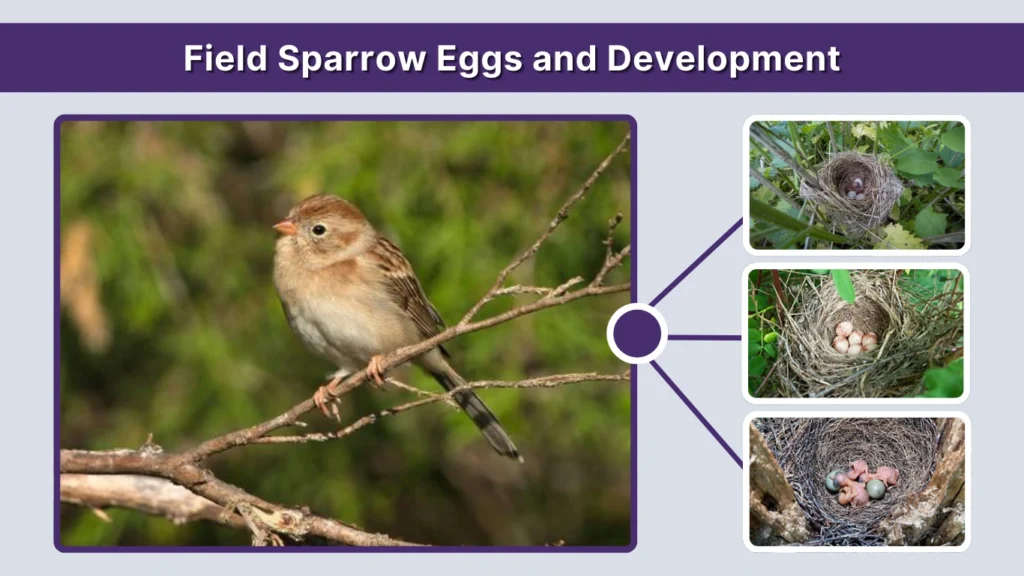
Field sparrow eggs are small but beautifully marked, and their coloration helps them blend subtly with the nest materials.
What Do Field Sparrow Eggs Look Like?
Field sparrow eggs are typically:
- Pale blue
- Greenish-white
- Light bluish-green
They are often speckled with reddish-brown or purplish markings, usually concentrated toward the larger end of the egg.
A typical clutch contains 2 to 5 eggs, with 3 or 4 being most common.
Clutch Size and Incubation
Once the eggs are laid, incubation lasts about 10 to 12 days. The female performs most or all of the incubation duties, while the male continues defending the territory and may bring food to the female.
The eggs hatch nearly simultaneously, and the chicks are born blind and mostly featherless, relying entirely on their parents for warmth and food.
Hatchlings and Fledging
After hatching, nestlings grow quickly. Both parents feed them a steady diet of insects, which provide the protein necessary for rapid development.
Young field sparrows typically leave the nest about 7 to 9 days after hatching. Even after fledging, they remain dependent on their parents for several more days as they learn to forage and avoid predators.
Because nests are built low to the ground, predation from snakes, mammals, and other birds is a constant risk. This is one reason multiple broods are common during the breeding season.
Diet and Feeding Habits
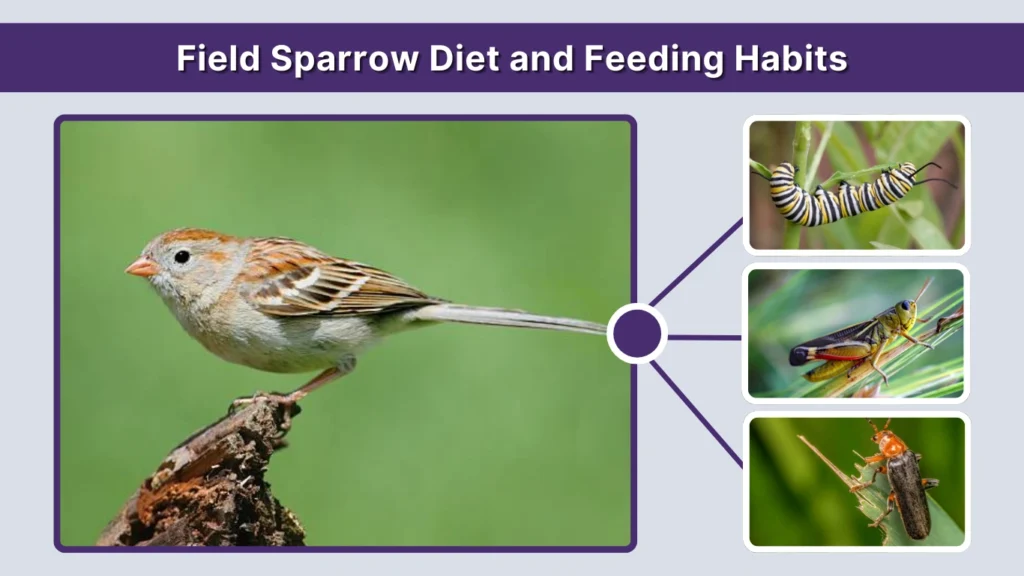
The field sparrow’s diet changes with the seasons, shifting between insects and seeds depending on availability.
During the breeding season, their diet consists largely of insects such as:
- Caterpillars
- Grasshoppers
- Beetles
- Spiders
Insects provide essential nutrients for growing chicks.
In the fall and winter, field sparrows switch primarily to seeds. They feed on:
- Weed seeds
- Native grasses
- Small grains
They typically forage on the ground, hopping through grasses and scratching lightly in leaf litter. Unlike some feeder-friendly sparrows, field sparrows are more likely to stay in brushy areas than visit backyard feeders.
Conservation Status and Threats
Although field sparrows are still considered relatively common, their populations have experienced gradual declines in some areas.
The primary threat to field sparrows is habitat loss. As farmland is developed or forests mature beyond the shrubby stage they prefer, suitable habitat decreases. Modern landscaping and intensive agriculture also reduce brushy field edges that once supported healthy populations.
Because they depend on early successional habitats, conservation efforts often focus on:
- Maintaining shrublands
- Allowing natural field growth
- Managing land to prevent complete forest maturation
Homeowners can help by planting native shrubs, reducing frequent mowing, and preserving brushy corners of properties where birds can nest safely.
FAQs
Is the field sparrow rare?
Field sparrows are not considered rare, but their populations have declined in some regions due to habitat loss. They remain fairly common in areas where brushy fields and shrubby habitats are preserved.
How can I attract field sparrows to my yard?
To attract field sparrows, create a natural, brushy environment. Plant native shrubs, allow some areas of tall grass to grow, and avoid excessive mowing. They are less attracted to feeders and more drawn to protective vegetation.
How do I identify a field sparrow by sound?
Listen for a clear, whistled song that speeds up into a rapid trill. The accelerating “bouncing ball” rhythm is one of the best ways to recognize a field sparrow hidden in thick vegetation.
Do field sparrows migrate?
Some field sparrows migrate short distances, especially those breeding in northern regions. Southern populations may remain year-round, while northern birds move south during winter.
Conclusion
The field sparrow may appear simple at first glance, but its delicate features and beautiful song make it a standout species in open-country habitats. From its low-built nest hidden in shrubs to its pale blue speckled eggs, every aspect of this bird reflects its close relationship with brushy landscapes. Protecting early successional habitats ensures that future generations can continue to enjoy the gentle whistle of the field sparrow across fields and meadows each spring.
