
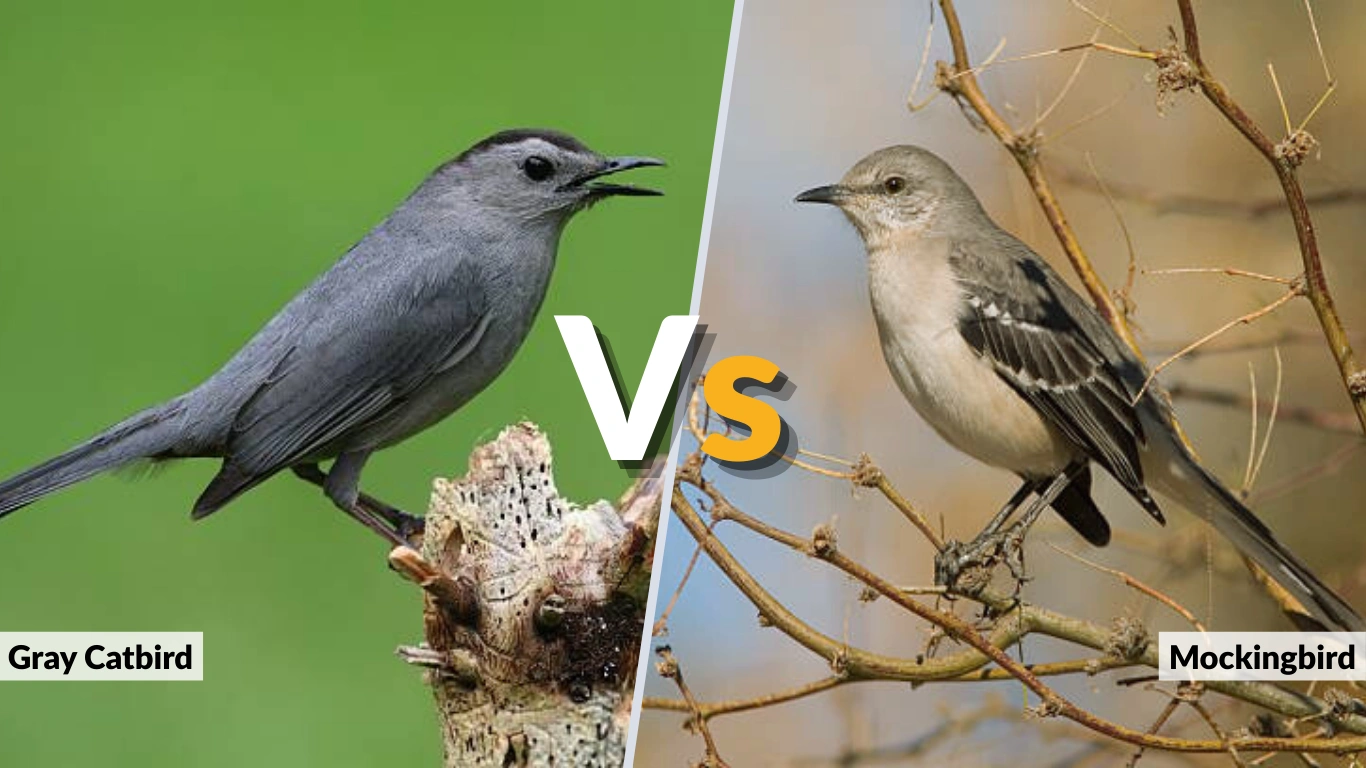
The gray catbird and the northern mockingbird are two well-known songbirds in North America that are often confused with one another. Both belong to the Mimidae family and are famous for their vocal abilities, particularly their talent for mimicry. Despite these similarities, gray catbirds and mockingbirds differ in appearance, song style, behavior, and habitat preferences. Understanding these differences makes it easier for birdwatchers and nature enthusiasts to identify each species and appreciate their unique traits.
Overview of Gray Catbird and Mockingbird
The gray catbird (Dumetella carolinensis) is a medium-sized songbird with subtle coloration and a preference for dense vegetation. It is named for its distinctive cat-like “mew” call and is more often heard than seen. The northern mockingbird (Mimus polyglottos), on the other hand, is bolder, more visible, and widely recognized for its loud and repetitive songs.
Both species belong to the Mimidae family, which includes birds known for vocal mimicry and intelligence. While they share this family connection, their lifestyles and behaviors differ in noticeable ways, making careful observation essential for accurate identification.
Physical Appearance Comparison
Size and Body Shape
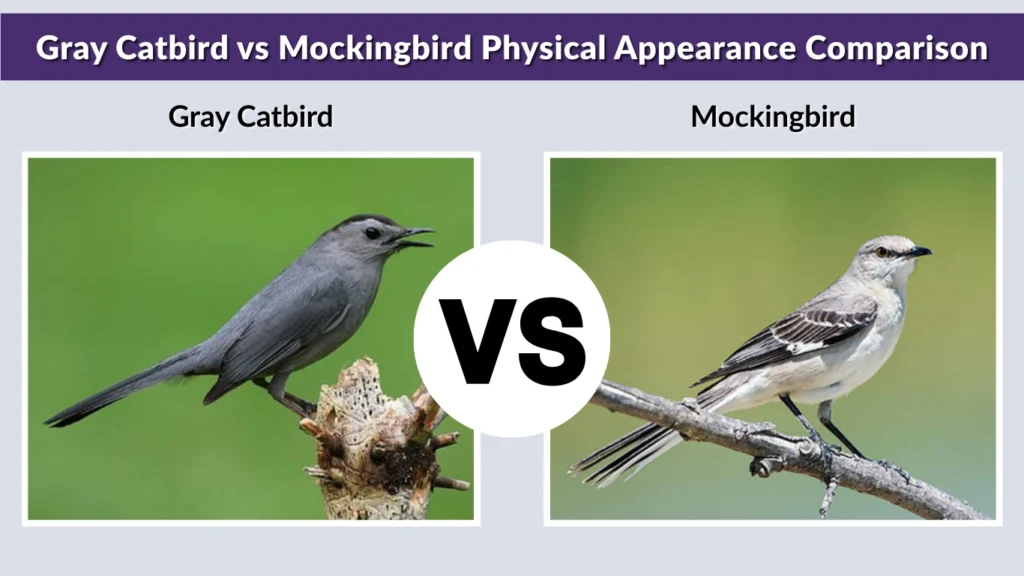
Gray catbirds and mockingbirds are similar in size, but mockingbirds are slightly larger overall. Gray catbirds typically measure about 8.5 to 9 inches in length, while mockingbirds range from 9 to 11 inches. Mockingbirds also have a broader wingspan and a more upright posture.
Catbirds appear sleeker with a long, rounded tail and a smooth body profile. Mockingbirds tend to look more robust and are often seen perched prominently in open areas, whereas catbirds usually remain hidden in shrubs.
Plumage and Color Patterns
Plumage is one of the easiest ways to distinguish between the two species. Gray catbirds are uniformly slate gray, with a black cap on the head and rusty undertail coverts that are visible when the tail is raised or flicked.
Northern mockingbirds are light gray to gray-brown on the upperparts and paler below. Their most distinctive feature is the bold white wing bars and white outer tail feathers, which are especially noticeable in flight. Unlike catbirds, mockingbirds lack a black cap.
Tail and Wing Features
The tail of the gray catbird is long and dark, blending seamlessly with the rest of its body. Catbirds frequently flick or fan their tails, revealing the rusty undertail feathers.
Mockingbirds also have long tails, but their tails display white outer edges that contrast sharply with darker central feathers. Their wings are broader and show prominent white patches that flash when the bird takes flight, making them easier to spot from a distance.
Song and Vocalization Differences
Gray Catbird Song Characteristics
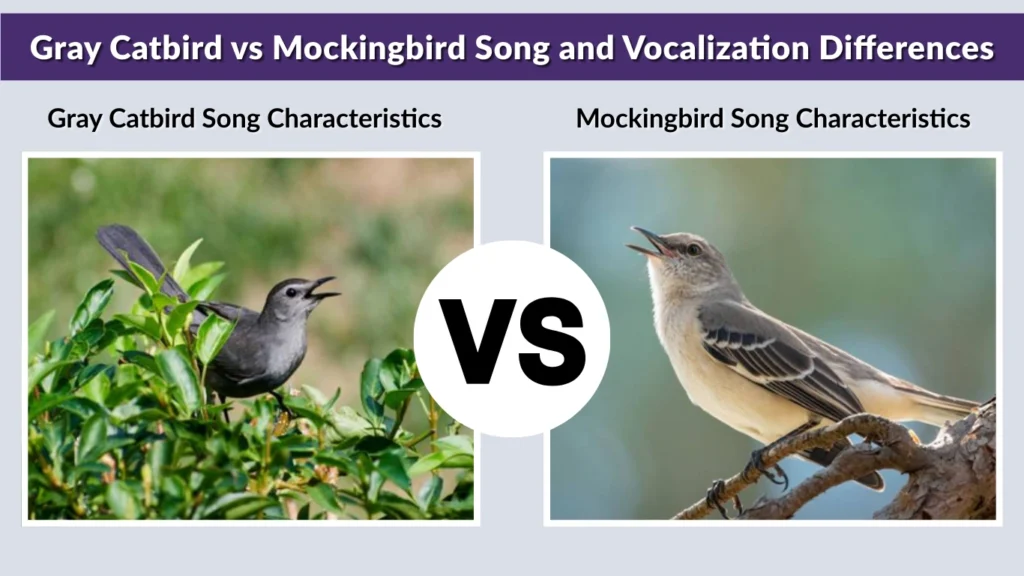
Gray catbirds are accomplished singers, producing long, rambling songs made up of many different sounds. Their songs often include mimicry of other birds, frogs, and mechanical noises. Unlike mockingbirds, catbirds rarely repeat phrases, creating a continuous, unpredictable stream of sound.
One of the catbird’s most distinctive vocalizations is its nasal, cat-like “mew,” which is used as a contact or warning call and is unique among North American songbirds.
Mockingbird Song Characteristics
Northern mockingbirds are among the most famous singers in the bird world. Their songs are loud, persistent, and highly repetitive. A mockingbird typically repeats each phrase several times before moving on to the next, making its song easier to recognize.
Mockingbirds have an exceptionally large vocal repertoire and can mimic dozens of bird species, as well as artificial sounds such as car alarms and whistles. They often sing from exposed perches and may even sing at night.
Which Bird Is the Better Mimic?
Both birds are excellent mimics, but they differ in style. Mockingbirds are generally considered the more extensive mimics due to their large and repetitive song libraries. Gray catbirds, however, produce more fluid and varied songs without repetition, giving their vocalizations a more improvisational quality.
Behavior and Personality
Territorial and Aggressive Behavior
Behavioral differences between gray catbirds and mockingbirds are often noticeable. Mockingbirds are famously aggressive, especially during breeding season, and will attack much larger birds, animals, and even humans to defend their territory.
Gray catbirds can also be territorial, but their aggression is usually limited to chasing away nearby birds rather than open confrontation. Catbirds prefer to retreat into dense cover rather than remain exposed.
Daily Activity Patterns
Mockingbirds are bold and highly visible throughout the day. They often perch on rooftops, fences, or treetops, singing loudly and scanning their territory. Their confidence and constant movement make them easy to spot, even in busy urban areas.
Gray catbirds, in contrast, are far more secretive. They spend much of their time foraging low in shrubs and dense vegetation, rarely exposing themselves for long periods. While active during daylight hours, catbirds are more likely to stay hidden and rely on cover for protection.
Habitat and Geographic Range
Preferred Habitats
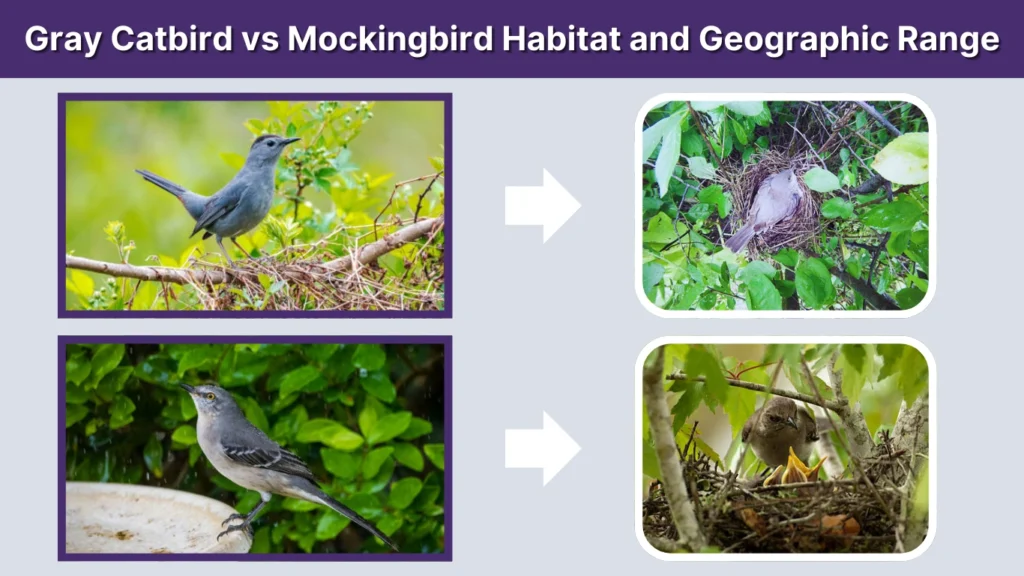
Gray catbirds favor dense, shrubby habitats such as forest edges, hedgerows, wetlands, and overgrown fields. They thrive in areas with thick undergrowth that provides both food and concealment.
Northern mockingbirds prefer more open environments. They are commonly found in suburban neighborhoods, parks, farmland edges, and open woodland. Mockingbirds tolerate human activity well and often choose areas with scattered trees and open ground.
Range and Migration
Gray catbirds are migratory birds. They breed across much of the eastern and central United States and southern Canada, then migrate south in fall to the southeastern U.S., Mexico, the Caribbean, and Central America.
Mockingbirds are mostly non-migratory. Many populations remain in the same area year-round, especially in the southern United States, though some northern birds may move short distances during winter.
Diet and Feeding Behavior
Both gray catbirds and mockingbirds eat a mix of insects and plant material, but their feeding styles differ. Gray catbirds forage quietly within shrubs, feeding on insects, spiders, and berries. During fall, fruit becomes a major part of their diet.
Mockingbirds are more opportunistic and often forage in open areas. They eat insects, fruits, and seeds and are more likely to visit bird feeders. Mockingbirds may also aggressively defend food sources from other birds.
Breeding and Nesting Differences
Nest Location and Structure
Gray catbirds typically build their nests low in dense shrubs or vines, usually within a few feet of the ground. Their nests are well hidden and constructed from twigs, grass, leaves, and rootlets.
Mockingbirds build nests higher off the ground, often in trees, tall shrubs, or even man-made structures. Their nests are bulkier and placed in more exposed locations compared to catbird nests.
Parental Roles
In both species, males and females share parental responsibilities. Gray catbird parents work together to feed and protect their chicks, though females handle most incubation duties. Mockingbird parents are equally attentive but tend to be more aggressive in defending their nests.
Gray Catbird vs Mockingbird Comparison Table
| Feature | Gray Catbird | Northern Mockingbird |
| Scientific Name | Dumetella carolinensis | Mimus polyglottos |
| Family | Mimidae (mimic thrush family) | Mimidae (mimic thrush family) |
| Average Size | 8.5–9 inches | 9–11 inches |
| Overall Color | Uniform slate gray | Gray-brown with lighter underparts |
| Head Markings | Black cap | No black cap |
| Wing Markings | No wing bars | Bold white wing bars |
| Tail Features | Dark tail with rusty undertail coverts | Long tail with white outer feathers |
| Song Style | Long, rambling, non-repeating phrases | Loud, repetitive phrases |
| Mimicry Ability | Strong mimic, less repetition | Extremely strong mimic, high repetition |
| Signature Sound | Cat-like “mew” call | Loud, varied whistles and phrases |
| Behavior | Secretive, prefers dense cover | Bold, highly visible |
| Aggression Level | Moderately territorial | Very aggressive, especially near nests |
| Habitat Preference | Shrubs, thickets, forest edges | Open areas, suburbs, parks |
| Migration | Migratory | Mostly non-migratory |
| Nest Placement | Low in dense shrubs | Higher in trees or structures |
| Ease of Identification | Often heard before seen | Easily spotted |
How to Tell a Gray Catbird from a Mockingbird
The easiest way to identify these birds is by combining visual and behavioral clues. Look for white wing bars and bold, exposed perching behavior to identify a mockingbird. If the bird is mostly gray, stays hidden in dense shrubs, and produces a cat-like “mew,” it is likely a gray catbird.
Listening carefully can also help. Repeated song phrases usually indicate a mockingbird, while a continuous, varied song without repetition points to a catbird.
Why Gray Catbirds and Mockingbirds Are Often Confused
Confusion arises because both birds belong to the same family and share similar vocal mimicry skills. They also overlap in range and habitat, especially in suburban areas. Without close observation, their similar size and gray coloration can make quick identification difficult.
FAQs
Are gray catbirds and mockingbirds related?
Yes. Gray catbirds and northern mockingbirds belong to the same bird family, Mimidae, which includes birds known for vocal mimicry and intelligence. Despite this relationship, they are different species with distinct behaviors, appearances, and song styles.
How can you tell a gray catbird from a mockingbird?
The easiest way is by looking at markings and behavior. Gray catbirds are uniformly gray with a black cap and rusty undertail coverts and tend to stay hidden in shrubs. Mockingbirds have bold white wing bars, perch in open areas, and are far more visible and vocal.
Which bird sings more, the gray catbird or the mockingbird?
Mockingbirds sing more frequently and loudly than gray catbirds. Their songs repeat phrases multiple times and can be heard throughout the day and even at night. Gray catbirds sing complex songs as well, but they are less repetitive and usually delivered from dense cover.
Which is more aggressive, a gray catbird or a mockingbird?
Northern mockingbirds are significantly more aggressive. They are known to attack other birds, animals, and even humans when defending their nests. Gray catbirds can be territorial, but they usually rely on concealment rather than direct confrontation.
Do gray catbirds and mockingbirds live in the same habitats?
Yes, their habitats often overlap, especially in suburban areas. However, gray catbirds prefer dense shrubs and thickets, while mockingbirds favor open spaces with scattered trees, parks, and residential areas. This habitat difference is a helpful identification clue.
