
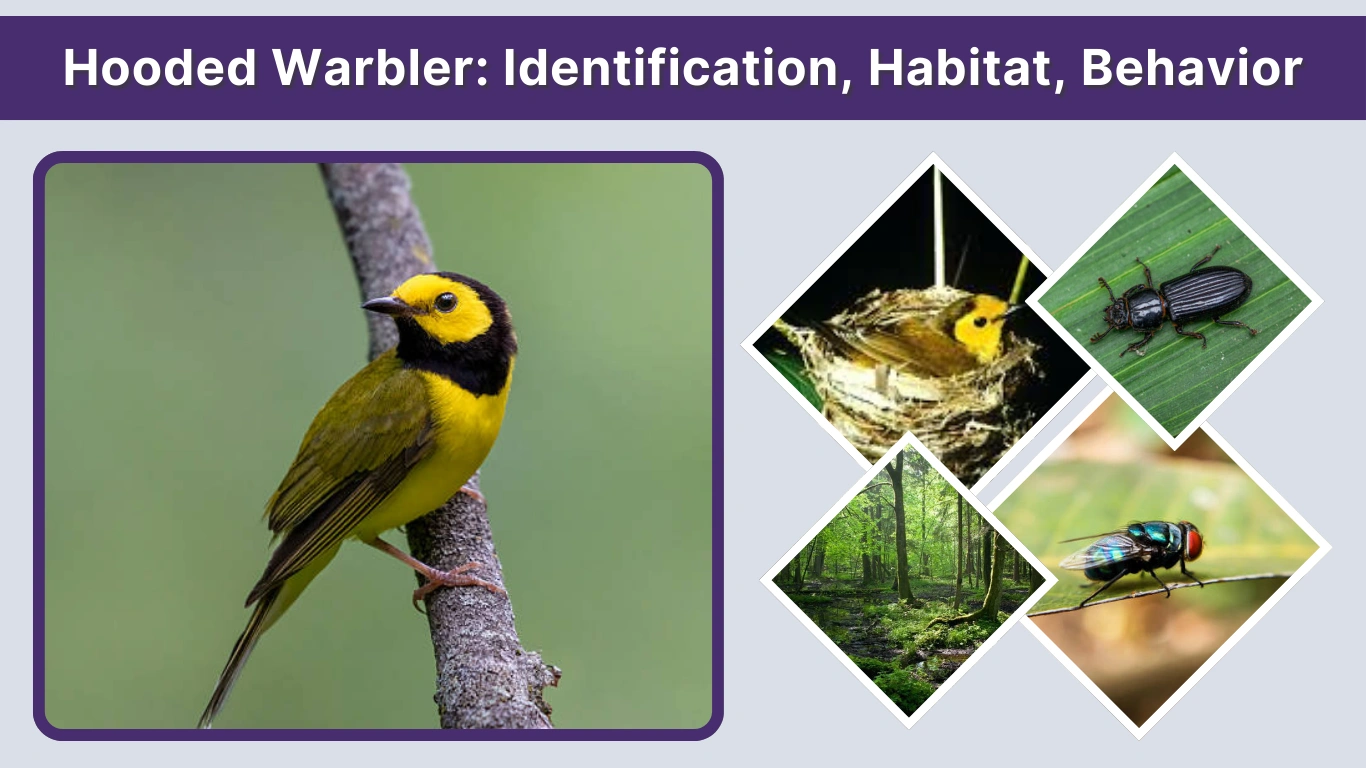
The hooded warbler is one of the most striking songbirds found in eastern North America. With its bold black hood, bright yellow face, and energetic personality, this small forest bird easily captures the attention of birdwatchers each spring. Though compact in size, it plays an important role in woodland ecosystems and is admired for its clear, ringing song. In this guide, you’ll learn how to identify the hooded warbler, where it lives, how it behaves, and what makes it such a fascinating species to observe.
What Is a Hooded Warbler?
The hooded warbler (Setophaga citrina) is a small migratory songbird belonging to the New World warbler family, Parulidae. It breeds primarily in the eastern United States and migrates to Central America and parts of the Caribbean for the winter.
Measuring about 5 inches (13 cm) in length, the hooded warbler is relatively small even among warblers. Despite its size, its bold coloration makes it surprisingly easy to identify during the breeding season. This species prefers mature deciduous forests with a dense understory, where it spends much of its time foraging close to the ground.
Birdwatchers value the hooded warbler not only for its striking appearance but also for its predictable habitat preferences and musical song. In healthy forests, it can be a regular and rewarding sight each spring and summer.
How to Identify a Hooded Warbler
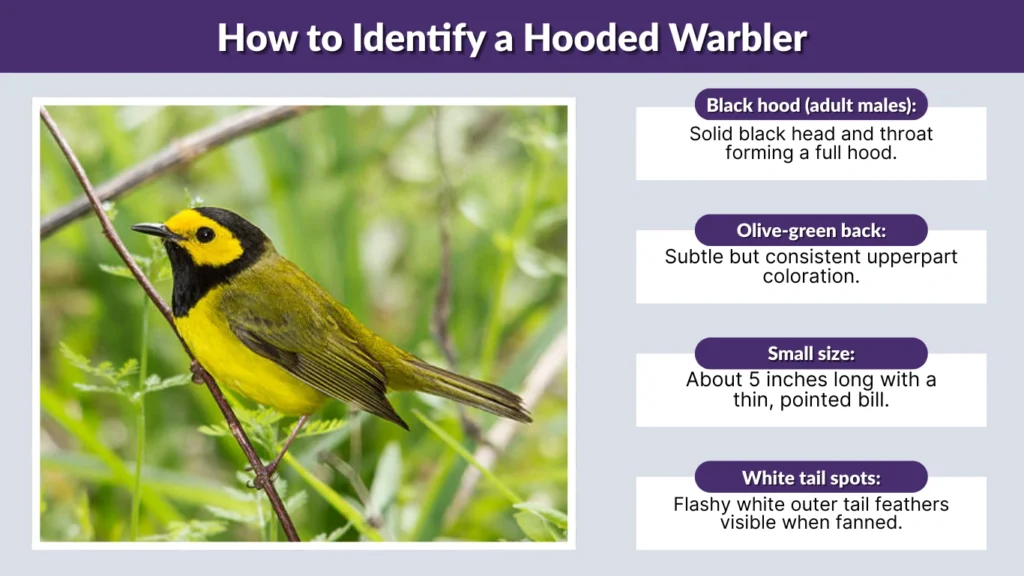
Identifying a hooded warbler becomes much easier once you know its bold facial pattern and preferred habitat. While many warblers share yellow plumage, this species stands out thanks to its dramatic black hood (in males), bright underparts, and active tail-flicking behavior. Observing a combination of plumage, behavior, and location will help you confidently distinguish it from similar species.
Key Identification Features
- Black hood (adult males): Solid black head and throat forming a full hood.
- Bright yellow face and underparts: Strong contrast against the dark hood.
- Olive-green back: Subtle but consistent upperpart coloration.
- White tail spots: Flashy white outer tail feathers visible when fanned.
- Small size: About 5 inches long with a thin, pointed bill.
- Active tail flicking: Frequently spreads and flashes its tail while foraging.
- Low forest habitat: Most often seen in dense understory shrubs.
Female and Immature Clues
- Partial or no black hood: Olive crown instead of solid black.
- Softer facial contrast: Throat usually yellow or lightly marked.
- Same white tail spots: Helpful field mark for both sexes.
By focusing on the hood pattern, tail flashes, and understory behavior, birdwatchers can reliably identify the hooded warbler even in dense woodland settings.
Hooded Warbler Habitat and Range
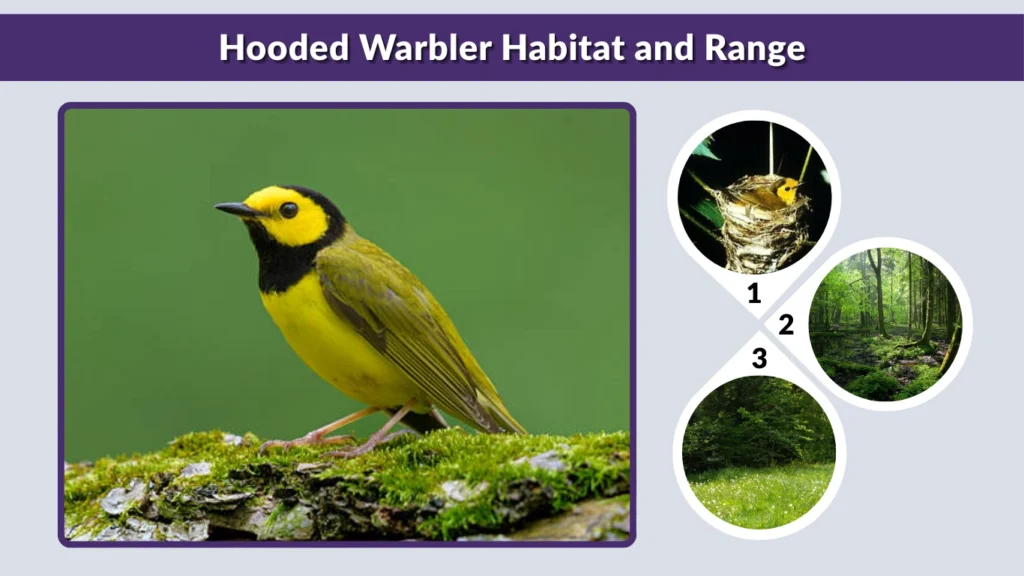
Understanding habitat is one of the easiest ways to narrow down identification. The hooded warbler has specific preferences that make it strongly associated with certain forest types.
Breeding Range
During the breeding season, hooded warblers are found throughout much of the eastern United States. Their range extends from the Midwest and Great Lakes region down through the southeastern states.
They prefer mature deciduous forests with a well-developed understory. Shrubs, saplings, and dense leafy growth are essential, as they provide both nesting sites and feeding opportunities. Unlike some warblers that forage high in the canopy, hooded warblers typically stay low, often just a few feet above the ground.
This preference for thick understory vegetation makes them especially common in forests that have experienced small natural disturbances, such as tree falls, which create openings for new plant growth.
Winter Range
After the breeding season ends, hooded warblers migrate south to spend the winter in Central America and parts of the Caribbean. Countries such as Mexico, Belize, Guatemala, and Panama host wintering populations.
In these tropical regions, they inhabit similar forested environments, favoring dense understory growth in both primary and secondary forests. Maintaining suitable winter habitat is essential for the species’ long-term survival, as migratory birds depend on healthy ecosystems in multiple countries throughout the year.
Migration Patterns
Migration is a crucial part of the hooded warbler’s annual cycle. As a long-distance migrant, it travels between breeding grounds in North America and wintering habitats in Central America.
In spring, hooded warblers begin moving north as early as April, with peak arrivals in many parts of the eastern United States occurring in late April through May. Males typically arrive first to establish territories before females follow shortly afterward.
Fall migration usually begins in late August and continues through September. During this period, the birds may be seen in a wider range of habitats, including woodland edges, parks, and even well-vegetated suburban areas. Stopover sites with dense shrubs and abundant insect life are critical for refueling during their journey.
Because they migrate at night, hooded warblers are most often detected during migration by their calls at dawn or by sudden appearances in suitable habitat.
Behavior and Feeding Habits
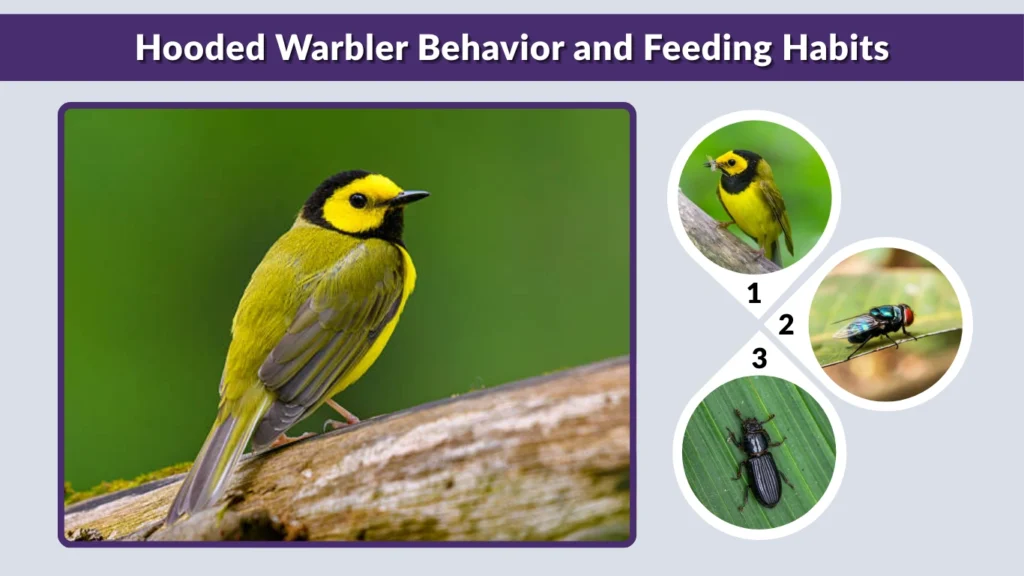
The hooded warbler is an energetic and active species, constantly moving through the understory in search of food.
Foraging Style
Unlike canopy-dwelling warblers, hooded warblers usually forage low in shrubs and saplings. They hop along branches and dart quickly between leaves, carefully scanning foliage for insects.
One distinctive behavior is tail flicking. The bird frequently spreads or flashes its tail, revealing bright white outer tail feathers. While the exact purpose of this behavior is not fully understood, it may help startle insects into movement, making them easier to catch.
Their movements are quick but deliberate, and patient observers can often follow them by watching for motion rather than relying solely on plumage color.
Diet
Hooded warblers are primarily insectivorous. Their diet consists of caterpillars, beetles, flies, ants, spiders, and other small arthropods. They pick prey directly from leaves and branches rather than catching insects midair.
During migration, they may occasionally consume small berries to supplement their energy needs. However, insects remain their main food source throughout the year.
By feeding heavily on insects, hooded warblers help control forest pest populations and contribute to ecosystem balance.
Territorial Behavior
During the breeding season, males become highly territorial. They sing frequently from exposed perches within the understory to declare ownership of their chosen area.
If another male enters the territory, aggressive displays may follow, including chases and vocal confrontations. Maintaining a secure territory ensures access to food resources and increases the chances of attracting a mate.
Nesting and Reproduction
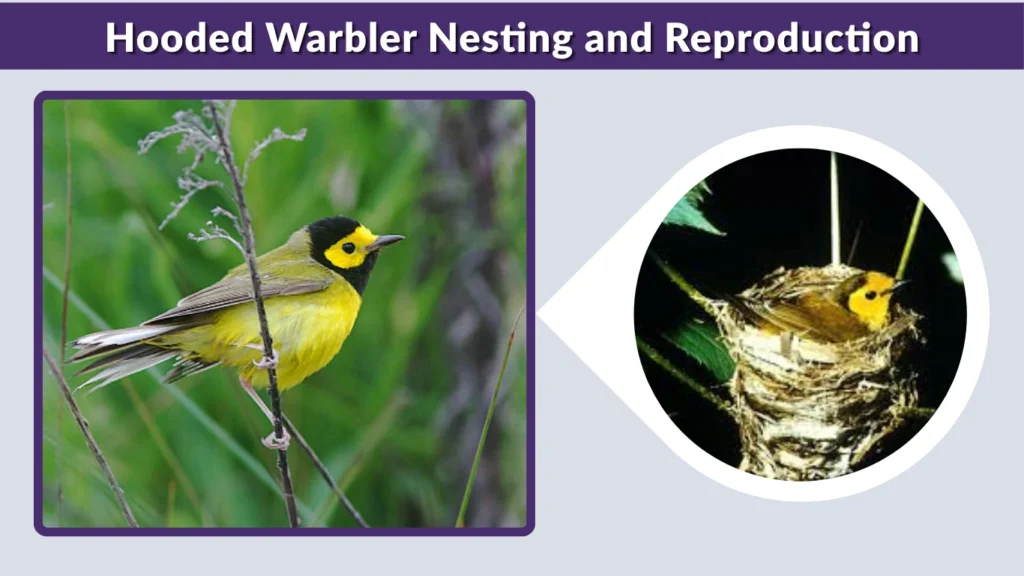
Breeding begins shortly after arrival on the breeding grounds in spring.
Female hooded warblers build cup-shaped nests, typically positioned in low shrubs or saplings about 1 to 4 feet above the ground. The nest is constructed from bark strips, leaves, grasses, and spider silk, forming a sturdy but well-camouflaged structure.
A typical clutch contains 3 to 5 eggs. The female is primarily responsible for incubation, which lasts around 12 days. After hatching, both parents participate in feeding the nestlings.
Young birds usually leave the nest about 8 to 9 days after hatching, although they continue to depend on their parents for food and protection for a short period afterward.
Placing nests low in shrubs makes them vulnerable to predators such as snakes, raccoons, and larger birds. As a result, dense understory vegetation is essential for providing concealment and protection.
Hooded Warbler Song and Calls
The hooded warbler’s song is one of its most recognizable features. The male sings a clear, ringing tune often described with the mnemonic “weeta-wee-tee-o” or “ta-wit ta-wit ta-wit tee-o.”
The song is repeated frequently throughout the breeding season, especially in the early morning hours. Singing serves two primary purposes: attracting a mate and defending territory.
In addition to its full song, the hooded warbler produces shorter call notes used for communication between mates or as alarm signals. Learning to recognize its song can greatly increase your chances of locating this otherwise partially hidden bird in dense vegetation.
Similar Species Comparison
Correct identification sometimes requires comparing the hooded warbler to similar birds.
Hooded Warbler vs Wilson’s Warbler
Wilson’s warbler also displays yellow plumage and a dark cap. However, the black on Wilson’s warbler is limited to the crown and does not extend down around the face and throat like a full hood. Additionally, Wilson’s warblers typically breed farther north and west.
Hooded Warbler vs Common Yellowthroat
The male common yellowthroat has a black mask across the face rather than a full hood. Its throat remains yellow, unlike the black throat of a male hooded warbler. Habitat can also help distinguish them, as common yellowthroats are more often found in marshes and wetland edges.
Conservation Status and Threats
The hooded warbler is currently classified as a species of Least Concern, and overall population numbers are considered stable. In some areas, populations have even increased due to forest regeneration.
However, habitat fragmentation remains a concern. Because hooded warblers rely on large tracts of mature forest with dense understory, excessive clearing and development can reduce suitable breeding areas.
Climate change may also alter migration timing and habitat conditions across both breeding and wintering ranges. Continued conservation of healthy forest ecosystems in North America and Central America is vital for ensuring the long-term stability of this species.
Conclusion
The hooded warbler is a vibrant and energetic songbird that brings color and music to eastern forests each spring. From its bold black hood and bright yellow plumage to its ringing territorial song, it is a rewarding species for birdwatchers to observe and identify. By understanding its habitat needs, behavior, and migration patterns, we gain a deeper appreciation for the delicate balance required to support migratory birds. Protecting forest ecosystems ensures that future generations can continue to enjoy the presence of this remarkable woodland warbler.
