
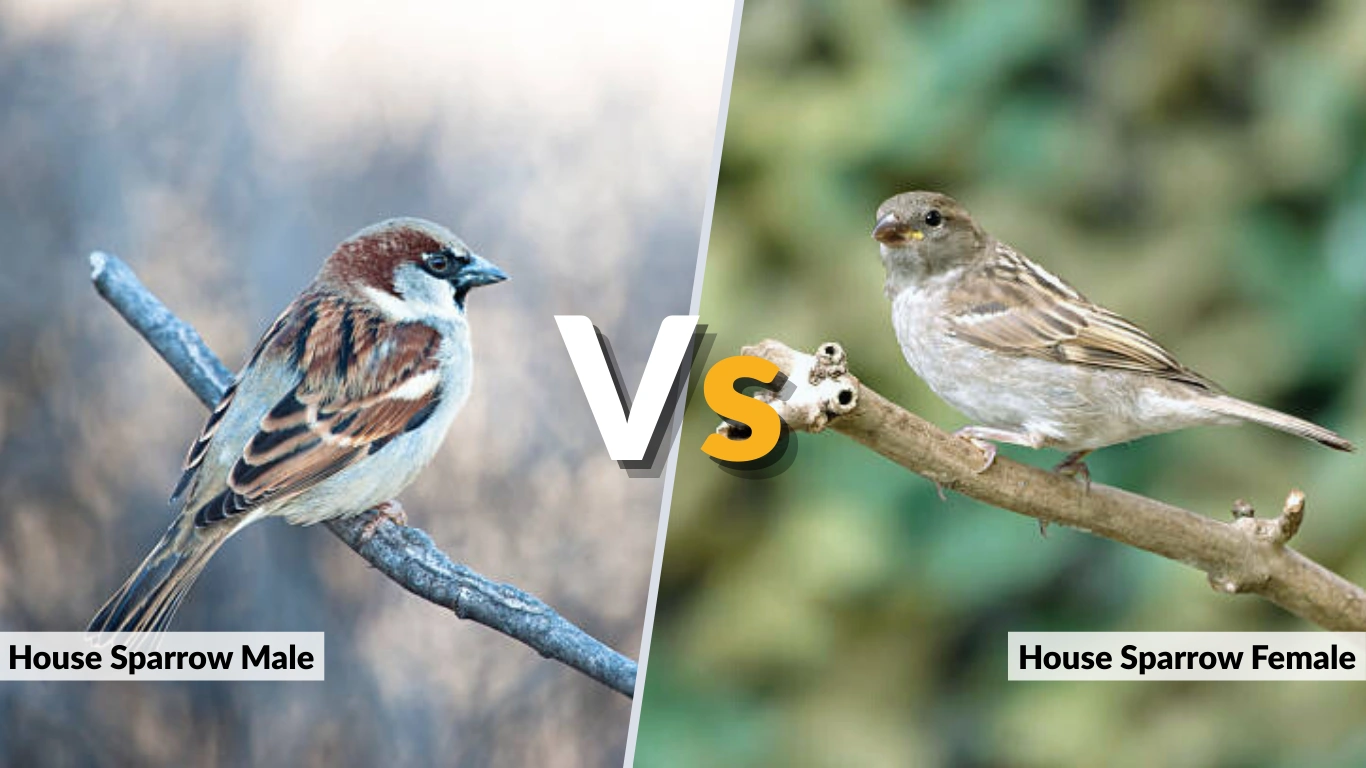
House sparrows (Passer domesticus) are among the most widespread birds on Earth, thriving in cities, villages, and farmland. Although incredibly common, many people struggle to distinguish males from females—especially because they flock together and constantly move. Fortunately, sexual dimorphism (distinct differences between sexes) in this species is strong enough that, once you know what to look for, identifying them becomes fast and reliable.
Below is a detailed, ~1000-word guide using clear H1, H2, and H3 headings to help you master the differences.
Identification
House sparrows share the same compact body shape but differ noticeably in plumage, head markings, and bill color. Males typically appear bolder and brighter, while females blend into their surroundings with softer tones. These differences serve ecological purposes—males display for mates and defend territories, while females benefit from camouflage around nests.
7 Key Differences Between Male & Female House Sparrows
1. Plumage Brightness and Overall Coloration
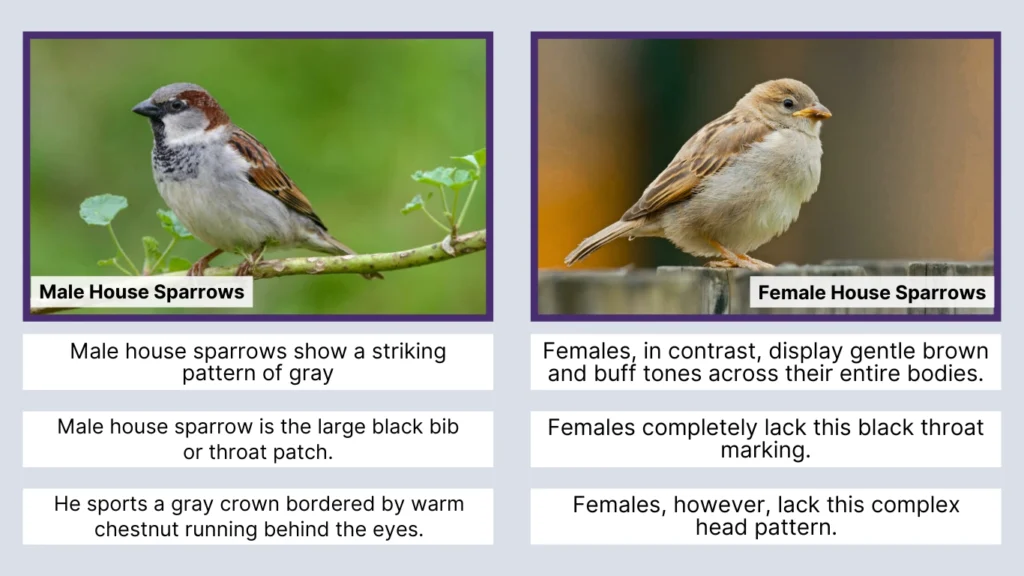
Male house sparrows show a striking pattern of gray, chestnut, black, and white. Their colors appear sharper and more contrasting, especially during the breeding season when their plumage is in peak condition. The gray crown atop the male’s head contrasts with chestnut patches along the sides, creating a visually bold appearance that stands out even from a distance.
Females, in contrast, display gentle brown and buff tones across their entire bodies. These muted colors help them blend into branches, thatched roofs, and nesting cavities, offering natural protection from predators. Their uniform coloring also makes them less conspicuous while feeding on the ground.
2. Presence or Absence of the Black Bib
One of the easiest ways to identify a male house sparrow is the large black bib or throat patch. This feature varies seasonally and socially—dominant males tend to have larger, darker bibs, which serve as a status signal to other sparrows. During the breeding season, the bib appears especially vibrant.
Females completely lack this black throat marking. Their chest remains clean and pale, which makes this a highly reliable field mark. If you spot a sparrow with a dark throat patch, it is almost certainly a male.
3. Head Cap and Crown Coloration
The male’s head is beautifully patterned. He sports a gray crown bordered by warm chestnut running behind the eyes. This coloration creates a strong visual contrast that birdwatchers quickly learn to recognize.
Females, however, lack this complex head pattern. Instead, they have a smooth brown crown that blends seamlessly with the rest of the upper body. This simple, uniform coloring is one of the reasons females can appear easily overlooked in a busy flock.
4. Eye Stripe and Facial Markings
Female house sparrows have a distinctive buff or beige eyebrow stripe that runs from the beak across the eye. This stripe is one of the clearest identifiers for females, giving their face a gentle, soft look. The cheeks are lighter, sometimes almost creamy.
Males do not have this pronounced eyebrow. Their faces are dominated by bold blocks of color: black around the beak, gray on the crown, and chestnut along the sides. This difference makes facial markings one of the most reliable features for distinguishing sexes, especially during quick sightings.
5. Wing and Back Pattern Differences
Both sexes have streaked brown-and-black backs, but males display stronger contrast. Their wing coverts show richer chestnut tones framed by black streaks, making them appear more vibrant.
Females appear much plainer. Their back and wing feathers have softer brown tones and gentler streaking. While both sexes have the classic “sparrow” look, males look sharper, and females more subdued.
6. Bill Color (Especially Seasonal Change)
Males undergo noticeable bill color changes depending on the season. During breeding months, their bills turn a striking black. Outside the breeding season, the bill fades to a horn or yellowish tone.
Females maintain a pale brown or yellowish bill year-round. This stability makes bill color especially useful in spring and early summer: a bird with a black bill is almost certainly male.
7. Behavioral Differences
Males are more vocal and dominant. They often perch in visible spots to sing their chirping calls, defend small territories, or court females. During breeding season, males may hop or flutter around females, showing off their bib and bright plumage.
Females behave more quietly and cautiously. They spend more time inspecting nest sites, searching for food, and evaluating potential mates. While both sexes stay in flocks during much of the year, males tend to be more active and conspicuous.
Comparison Table: Male vs Female House Sparrow
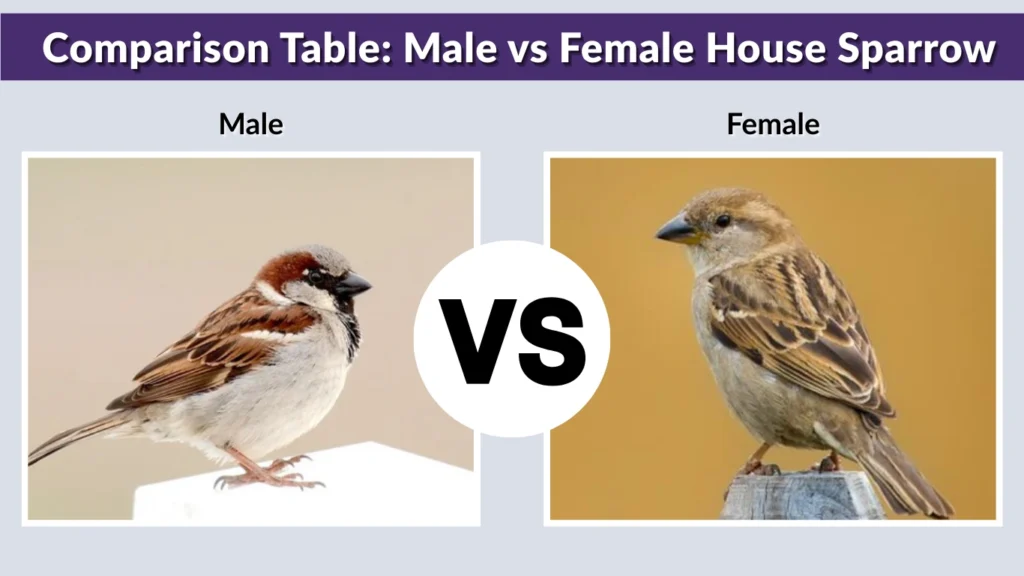
| Feature | Male | Female |
| Plumage Brightness | High contrast, bold | Muted brown and buff |
| Black Bib | Present, large in breeding season | Absent |
| Head Cap | Gray crown with chestnut sides | Brown, uniform |
| Eye Stripe | Minimal | Prominent buff eyebrow |
| Bill Color | Black in breeding season | Pale year-round |
| Back/Wing Pattern | Strong contrast | Subdued streaking |
| Behavior | Vocal, territorial | Quieter, selective |
Size
Both male and female house sparrows share similar measurements, averaging 14–16 cm (5.5–6.3 in) in length. Weight ranges between 24–39 grams. Although they look alike in size, males can appear slightly bulkier due to posture and plumage, especially when showing off their bib.
Range
House sparrows are native to Europe, Asia, and parts of North Africa but have been introduced worldwide. They now thrive in North America, Australia, South America, and many island regions. Their close association with human settlements makes them one of the most globally successful bird species.
Habitat
House sparrows are highly adaptable. They live in cities, farms, suburban neighborhoods, and rural villages. They nest in cavities—under roof tiles, inside building crevices, in nest boxes, or within vines and holes in walls. Their habitat preference doesn’t differ by sex, but females are more selective about nesting sites while males defend territories nearby.
Behavior
Males are known for loud chirping, wing-fluttering courtship displays, and defending small territories near nests. They frequently perch in open areas to broadcast their calls.
Females show more cautious, deliberate behavior. During breeding season they judge males based on bib size, territory quality, and persistent courtship. Outside of breeding months, both sexes join mixed-age flocks for feeding and roosting.
FAQs
How can you quickly tell a male from a female house sparrow?
Look for the black bib and bold head pattern. Males have a gray crown and chestnut sides of the head, while females show a buff eyebrow stripe and lack any black throat patch.
Do juvenile males look like females?
Yes. Young males resemble females initially, lacking the black bib and showing plain brown plumage. After molting, their adult markings develop.
Does season affect their appearance?
Mostly in males. Their bills turn black during breeding season and lighter afterward. The bib may also expand or fade slightly. Females stay consistent year-round.
Are males more vocal than females?
Yes. Males chirp frequently to defend territory and attract mates. Females vocalize less and usually respond rather than initiate calls.
Can both sexes thrive in urban environments?
Absolutely. Both male and female house sparrows easily adapt to cities, feeding on grains, insects, human food scraps, and nesting in available structures.