
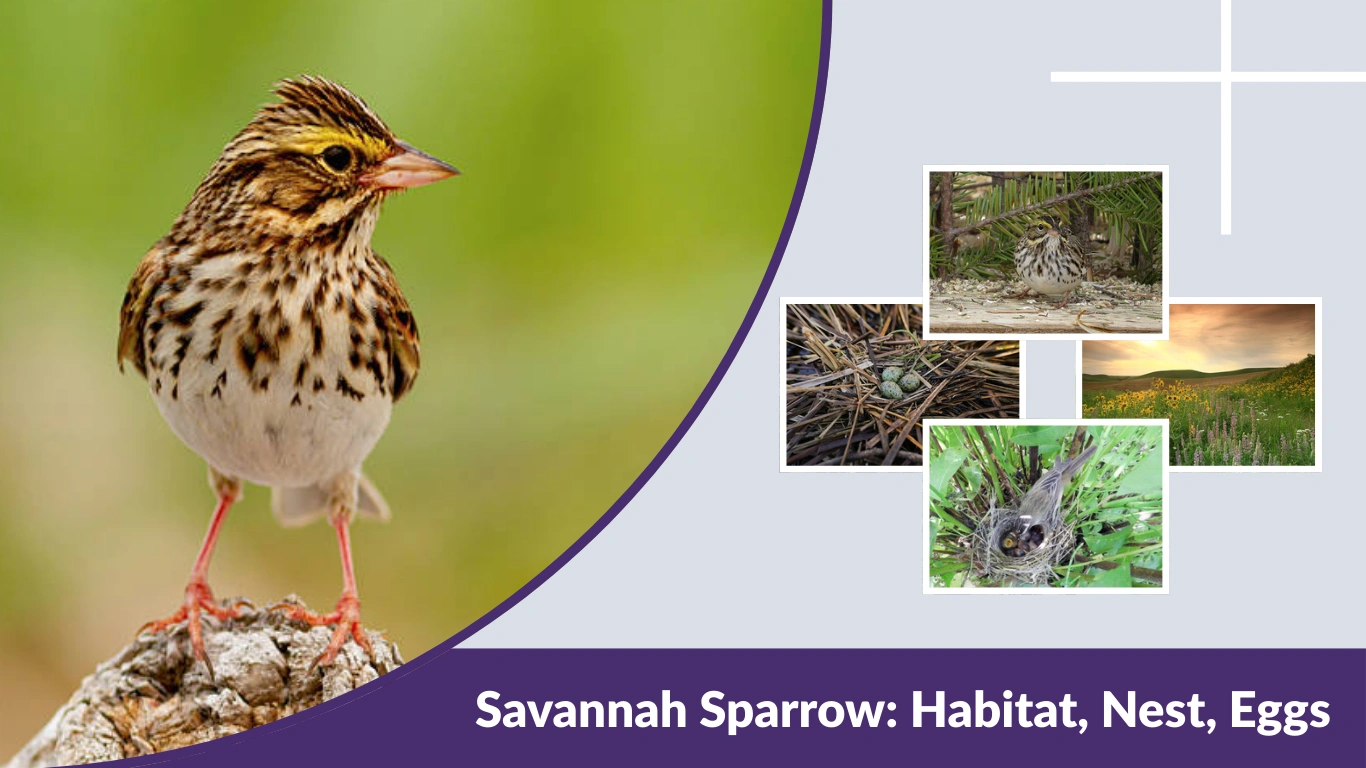
The Savannah sparrow is a small, streaked songbird commonly found in open grasslands, coastal marshes, and agricultural fields across North America. Though it may appear plain at first glance, this sparrow has a distinctive yellow eyebrow and a sharp, insect-like song that help set it apart. Known for nesting on the ground and adapting to a wide range of habitats, the Savannah sparrow is one of the most widespread grassland birds. Here’s a closer look at its identification, habitat, and nesting behavior.
What Is a Savannah Sparrow?
The Savannah sparrow (Passerculus sandwichensis) is a small New World sparrow that breeds across much of Canada and the northern United States. It winters in the southern U.S., Mexico, and parts of Central America.
Despite its name, the bird was not named after the savanna habitat but after Savannah, Georgia, where it was first described scientifically. It is especially associated with open areas rather than forests, preferring grassy fields, prairies, and coastal meadows.
Savannah sparrows are often seen running low through tall grass or perched briefly on fence posts. While they may look similar to other brown sparrows, a few key features make them easier to identify in the field.
Savannah Sparrow Identification
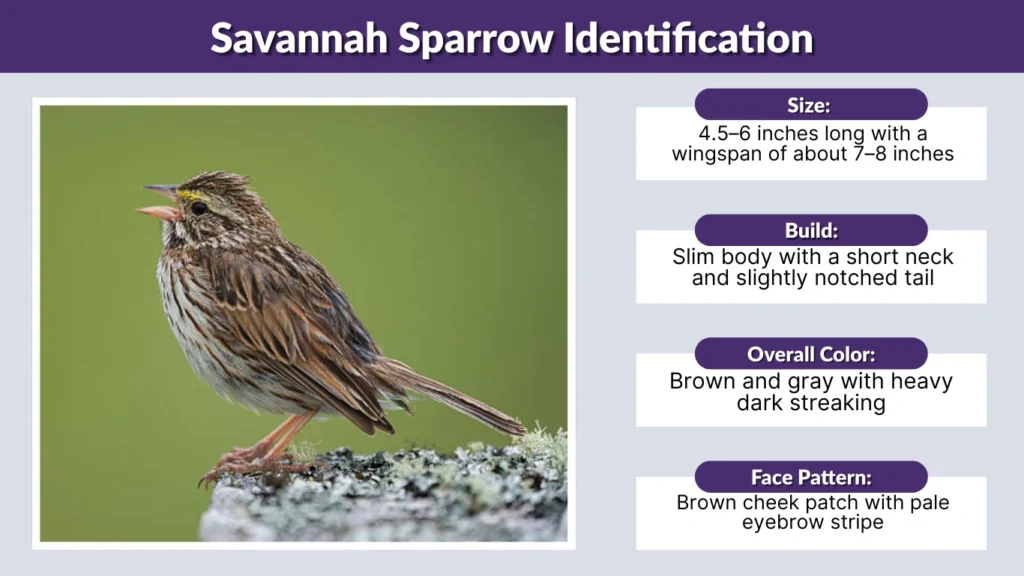
The Savannah sparrow is a small, streaked grassland bird that can be easy to overlook at first glance. Its brown and buff coloration blends well with dry grasses, making it highly camouflaged in open fields and coastal marshes. However, a few key field marks—especially the faint yellow eyebrow—make identification much easier once you know what to watch for.
Here are the main identification features:
- Size: 4.5–6 inches long with a wingspan of about 7–8 inches
- Build: Slim body with a short neck and slightly notched tail
- Overall Color: Brown and gray with heavy dark streaking
- Breast Pattern: Streaked chest, usually without a bold central spot
- Eyebrow (Supercilium): Faint yellow or yellowish wash above the eye (key field mark)
- Face Pattern: Brown cheek patch with pale eyebrow stripe
- Back: Dark streaks over brown and buff tones
- Bill: Short and conical, suited for seeds and insects
- Song: Short, buzzy, insect-like trill
- Behavior Clue: Often runs low through grass rather than perching in open view
Juveniles look similar to adults but may appear duller with slightly heavier streaking. Observing habitat, behavior, and the subtle yellow eyebrow is usually the fastest way to confirm a Savannah sparrow in the field.
Savannah Sparrow Habitat
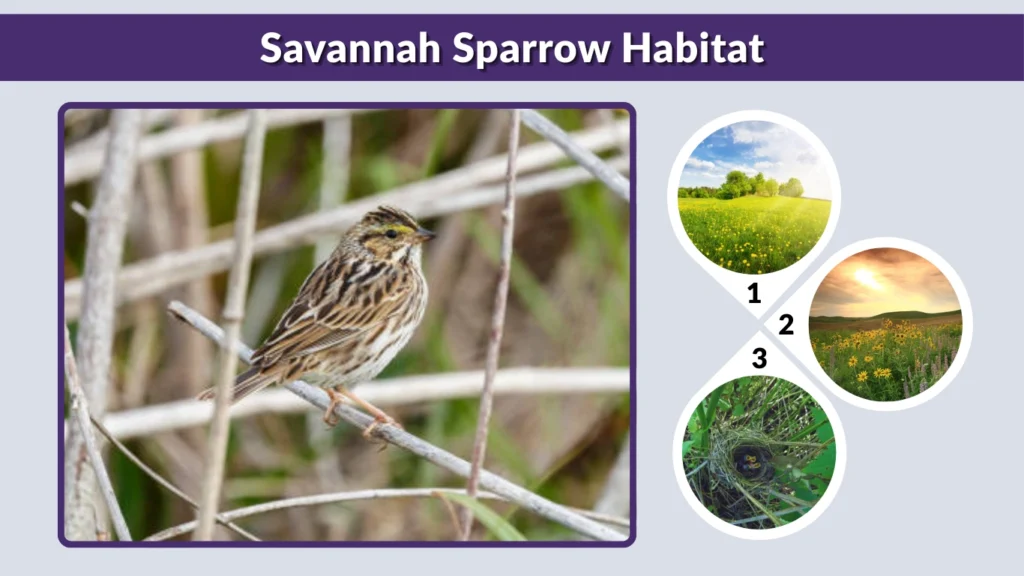
Savannah sparrows are strongly associated with open landscapes and grassy terrain.
Preferred Habitats
They are most commonly found in grasslands, prairies, agricultural fields, and coastal marshes. In northern regions, they also breed in tundra habitats.
Unlike woodland sparrows, Savannah sparrows avoid dense forests. They prefer wide, open areas where tall grasses or low vegetation provide cover while allowing visibility.
Coastal populations often inhabit salt marshes and dunes, while inland birds favor dry grasslands and farmland.
Geographic Range
The Savannah sparrow has a broad breeding range that stretches across much of Canada, Alaska, and the northern United States. During migration, they travel south to wintering grounds in the southern United States, Mexico, and parts of Central America.
Some coastal populations remain year-round residents in milder climates.
Seasonal Habitat Changes
During the breeding season, Savannah sparrows establish territories in open grasslands. In winter, they become less territorial and may gather in loose flocks while feeding in fields and along roadsides.
Their ability to use both natural prairies and human-modified farmland has helped maintain stable populations in many areas.
Savannah Sparrow Nest
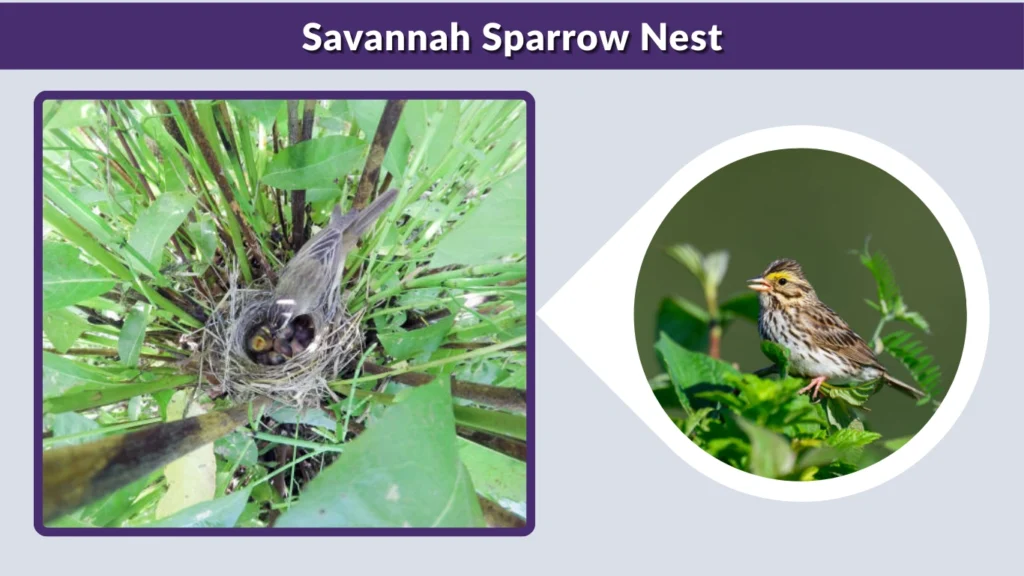
One of the most distinctive aspects of the Savannah sparrow is its ground-nesting behavior.
What Does a Savannah Sparrow Nest Look Like?
The nest is a small, cup-shaped structure built primarily from grasses, weeds, and fine plant stems. It is lined with softer materials such as fine grass or sometimes animal hair.
Because the nest is built on the ground, it blends carefully into the surrounding vegetation.
Nest Placement
Savannah sparrow nests are typically placed directly on the ground, often in a shallow depression. The female chooses a site hidden beneath tall grasses or low shrubs to reduce visibility from predators.
The surrounding vegetation often arches over the nest, providing natural concealment from above. This careful placement is essential for protecting eggs and chicks in open habitats.
Nest Protection and Camouflage
Camouflage plays a major role in nest survival. The streaked plumage of the female helps her blend into the grass while incubating eggs. If threatened, adults may quietly slip away from the nest rather than drawing attention to its location.
Despite these strategies, ground nests remain vulnerable to predators such as snakes, mammals, and larger birds.
Savannah Sparrow Eggs
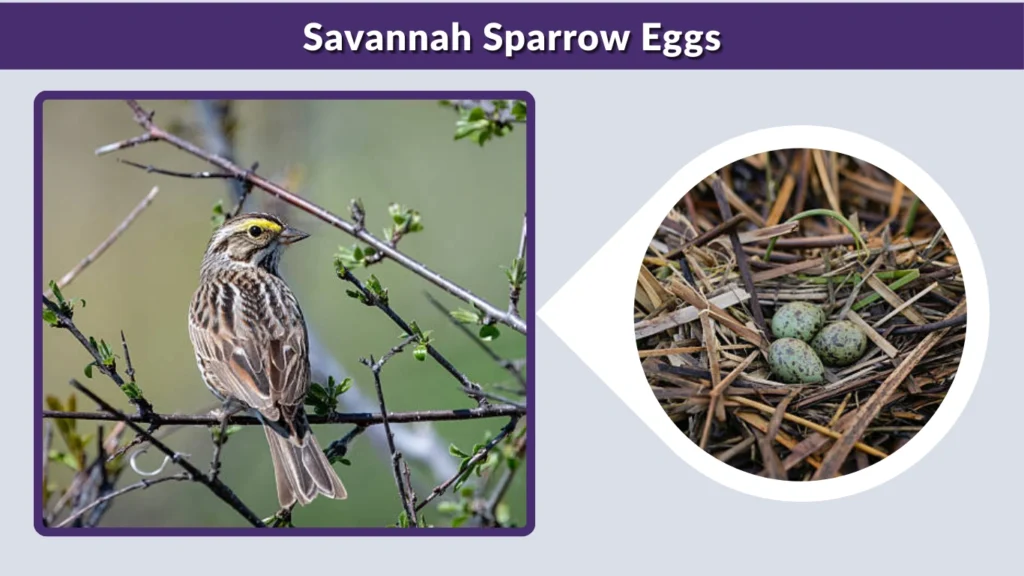
Once the nest is complete, the female begins laying eggs.
Egg Appearance
Savannah sparrow eggs are small and oval-shaped. They are typically pale greenish, creamy, or slightly bluish in color. Brown or gray speckles are scattered across the shell, often more concentrated at the larger end.
This speckled pattern helps camouflage the eggs within the grassy nest lining.
Clutch Size and Incubation
A typical clutch consists of three to five eggs. The female is responsible for incubating the eggs, which usually takes about 11 to 13 days. During this time, the male may remain nearby to defend the territory.
After hatching, both parents assist in feeding the young.
Nestling and Fledging Stage
After the eggs hatch, Savannah sparrow chicks grow quickly. The nestling period typically lasts about 8 to 11 days. During this time, both parents bring a steady supply of insects to the nest, including grasshoppers, beetles, caterpillars, and spiders. This protein-rich diet supports rapid development.
Because the nest is on the ground, the young often leave at a relatively early age. Once they fledge, the chicks stay hidden in nearby vegetation while continuing to be fed by their parents. Within a couple of weeks, they begin foraging independently and gradually transition to a more seed-based diet.
Savannah Sparrow Diet
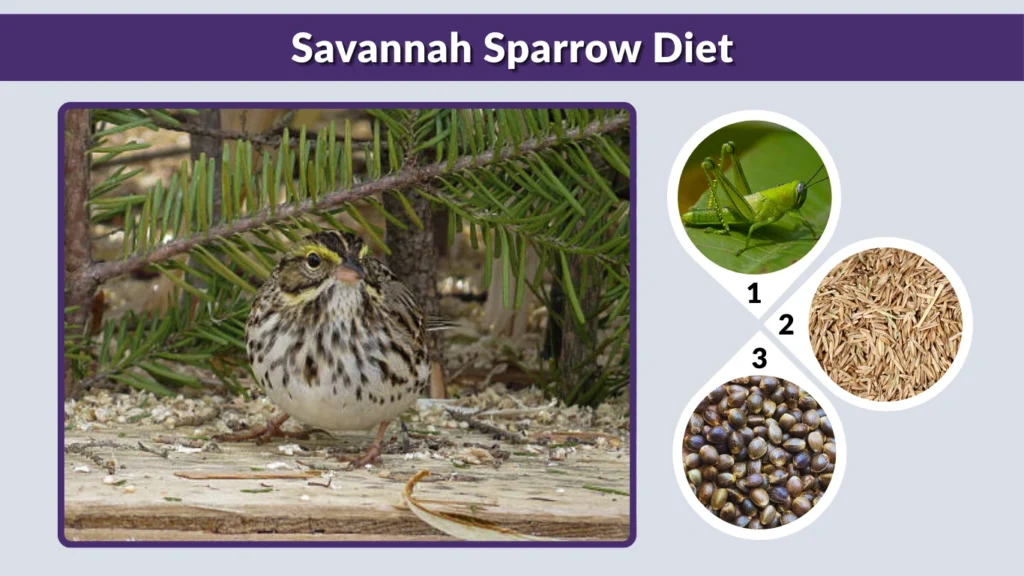
The Savannah sparrow diet changes with the seasons and availability of food.
Summer Diet
During the breeding season, insects make up the majority of their diet. They feed on grasshoppers, beetles, caterpillars, flies, and spiders. Insects are especially important for feeding nestlings, as they provide essential nutrients for growth.
Savannah sparrows typically forage on the ground, walking or running through grass to flush insects. They may also make short flights to capture prey.
Winter Diet
In fall and winter, their diet shifts primarily to seeds. They consume grass seeds, weed seeds, and agricultural grains. In open fields and along roadsides, they can often be seen searching for fallen seeds.
This seasonal flexibility allows them to survive in colder months when insects are scarce.
Foraging Behavior
Savannah sparrows are active ground feeders. They move quickly through tall grass and may pause to scan for predators before continuing to feed. Their plumage blends well with dry vegetation, providing protection while foraging in open landscapes.
In winter, they may feed in loose flocks, especially in areas where food is abundant.
Savannah Sparrow Behavior and Breeding Habits
During the breeding season, male Savannah sparrows establish territories in suitable grassland habitats. They sing from low perches such as fence posts, shrubs, or tall grass stems to announce their presence and attract mates.
Courtship involves song displays and short flights near the female. Once paired, the female builds the nest and lays the eggs, while the male defends the territory.
Savannah sparrows often raise one to two broods per season, depending on climate and food availability. If a nest fails due to predation or disturbance, the pair may attempt to nest again.
Outside the breeding season, Savannah sparrows become less territorial. During migration and winter, they may gather in small flocks and share feeding areas with other sparrow species.
Interesting Savannah Sparrow Facts
Savannah sparrows are named after Savannah, Georgia, where one of the first recorded specimens was collected. They are not named after the savanna habitat, despite the similarity in spelling.
There are numerous subspecies of Savannah sparrow across North America, with some coastal populations appearing darker and slightly larger than inland birds.
They are considered one of the most widespread grassland sparrows and play an important role in controlling insect populations in agricultural fields.
Their adaptability to both natural prairies and farmland has helped them maintain relatively stable populations compared to some other grassland birds.
FAQs
Do Savannah sparrows migrate?
Most Savannah sparrows migrate. Birds breeding in Canada and the northern United States travel south for winter, while some coastal populations remain year-round residents in milder climates.
Where do Savannah sparrows build their nests?
Savannah sparrows build their nests on the ground, usually hidden in tall grass or low vegetation. The nest sits in a shallow depression and is carefully concealed for protection.
What do Savannah sparrow eggs look like?
Savannah sparrow eggs are pale greenish, creamy, or slightly bluish with brown or gray speckles. The speckles are often heavier at one end of the egg.
What do Savannah sparrows eat in winter?
In winter, Savannah sparrows primarily eat seeds, including grass and weed seeds. They may forage in open fields or agricultural areas where grains are available.
Are Savannah sparrows common?
Yes, Savannah sparrows are generally common across much of North America, especially in grassland habitats. However, like many grassland birds, they can be affected by habitat changes.
