
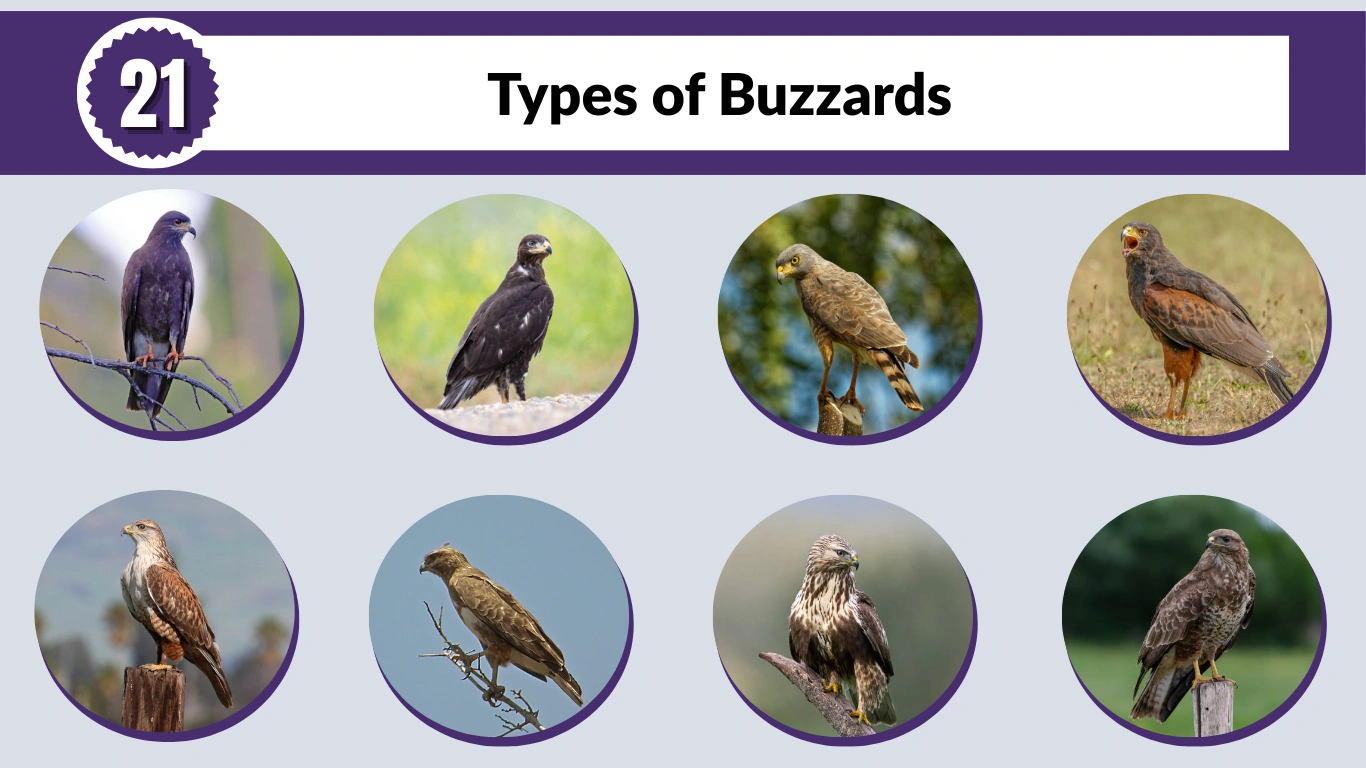
Buzzards are powerful and adaptable birds of prey found across much of the world, known for their broad wings, keen eyesight, and soaring flight. Belonging mainly to the genus Buteo, these raptors occupy a wide range of habitats, from forests and grasslands to deserts and farmlands. While their appearance and behavior vary by species, buzzards generally play a vital role in maintaining ecological balance by controlling prey populations. This guide explores different types of buzzards, highlighting their key features, habitats, and lifestyles.
1. Common Buzzard (Buteo buteo)
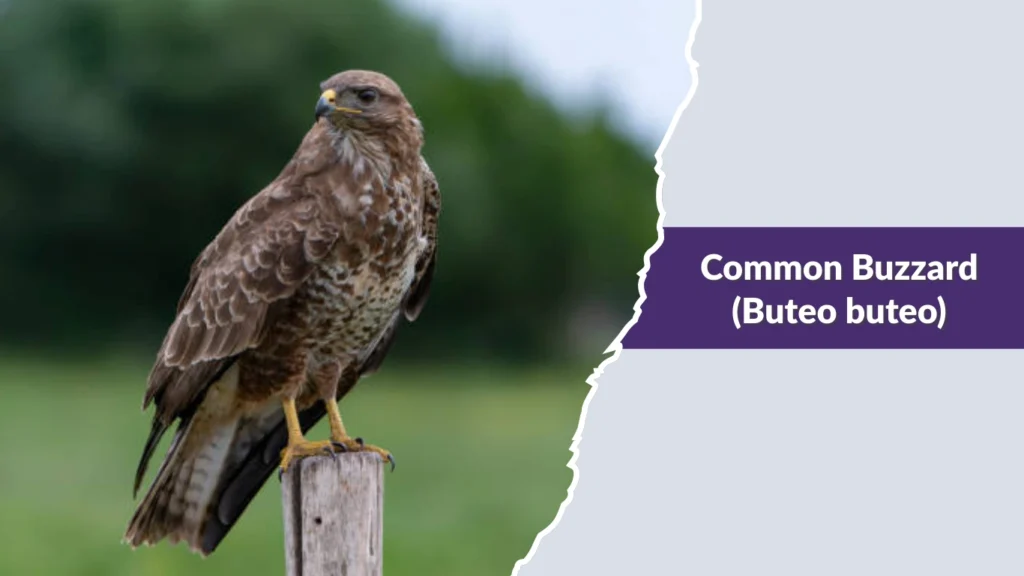
The Common Buzzard is one of the most widespread birds of prey in Europe and parts of Asia. It is highly adaptable and can survive in a wide range of environments, from rural farmland to forested regions. Due to its variable coloration, it is often mistaken for other raptors, but its broad wings and soaring flight make it distinctive. This buzzard is frequently seen circling high in the sky or perched patiently while scanning for prey.
Identification
- Medium to large-sized raptor with broad, rounded wings
- Plumage varies greatly, from dark brown to pale or nearly white
- Short neck and rounded tail
- Often shows a pale chest band or mottling
- Slow, soaring flight using thermal air currents
Habitat
The Common Buzzard occupies diverse habitats including woodlands, forest edges, farmland, grasslands, and open countryside. It prefers areas where trees are available for nesting and roosting, combined with open land for hunting. This adaptability allows it to thrive even near human settlements, as long as disturbance is limited.
Behaviors
Common Buzzards are often seen gliding or circling high above the ground, using thermals to conserve energy. They are mostly solitary but become territorial during the breeding season. Their call is a distinctive, high-pitched, mewing sound, often compared to a cat’s cry. They may also perch for long periods while watching for prey.
Diet
Their diet is varied and opportunistic. Small mammals such as voles, mice, and rabbits form the core of their diet, but they also consume birds, reptiles, amphibians, insects, and carrion when available.
Lifespan
In the wild, Common Buzzards usually live between 12 and 15 years. Some individuals can live longer if they avoid threats such as habitat loss, poisoning, and collisions.
2. Rough-legged Buzzard (Buteo lagopus)
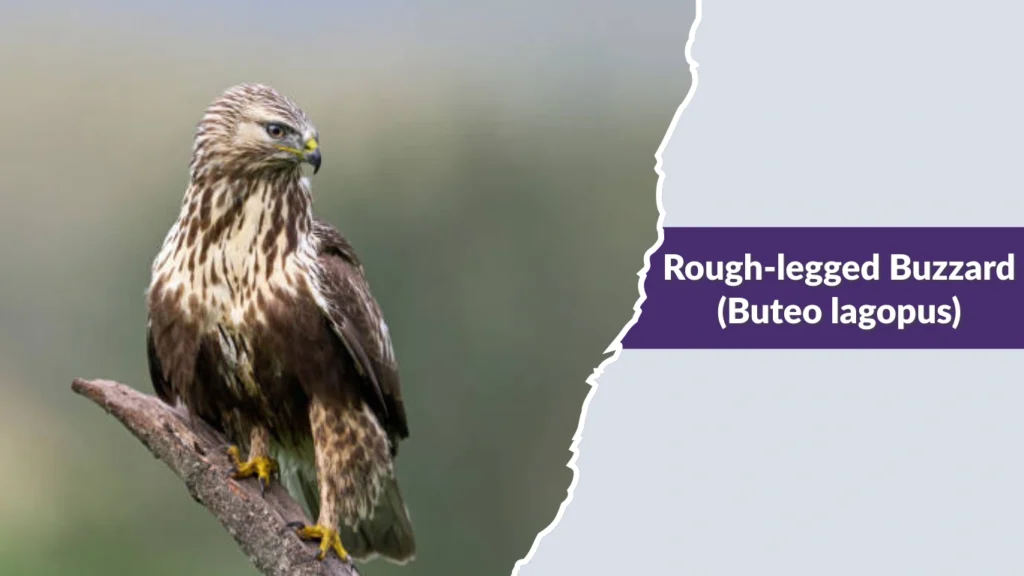
The Rough-legged Buzzard is a large raptor best known for its feathered legs, an adaptation that helps it survive cold northern climates. It breeds in Arctic and subarctic regions and migrates south during winter. This species is often seen hovering while hunting, a behavior that makes it stand out among other buzzards. Its striking plumage patterns and long wings give it a graceful appearance in flight.
Identification
- Large buzzard with long, broad wings
- Feathered legs extending to the toes
- Dark belly patch contrasting with a pale body
- Tail usually pale with a dark terminal band
- Wings show dark carpal patches when viewed from below
Habitat
Rough-legged Buzzards breed in open tundra and treeless Arctic landscapes. During winter, they move to open fields, grasslands, marshes, and agricultural areas. They prefer wide, open spaces where prey is easy to spot from the air or elevated perches.
Behaviors
This species is known for its ability to hover in place while searching for prey, similar to a kestrel. It is generally solitary outside the breeding season and becomes territorial when nesting. Rough-legged Buzzards rely heavily on soaring and gliding to conserve energy during long migrations.
Diet
Their diet mainly consists of small mammals, especially lemmings and voles. When these are scarce, they may hunt birds or feed on carrion. Prey availability strongly influences their breeding success.
Lifespan
Rough-legged Buzzards typically live around 10–15 years in the wild. Survival rates depend on food availability, harsh weather conditions, and human-related threats.
3. Long-legged Buzzard (Buteo rufinus)
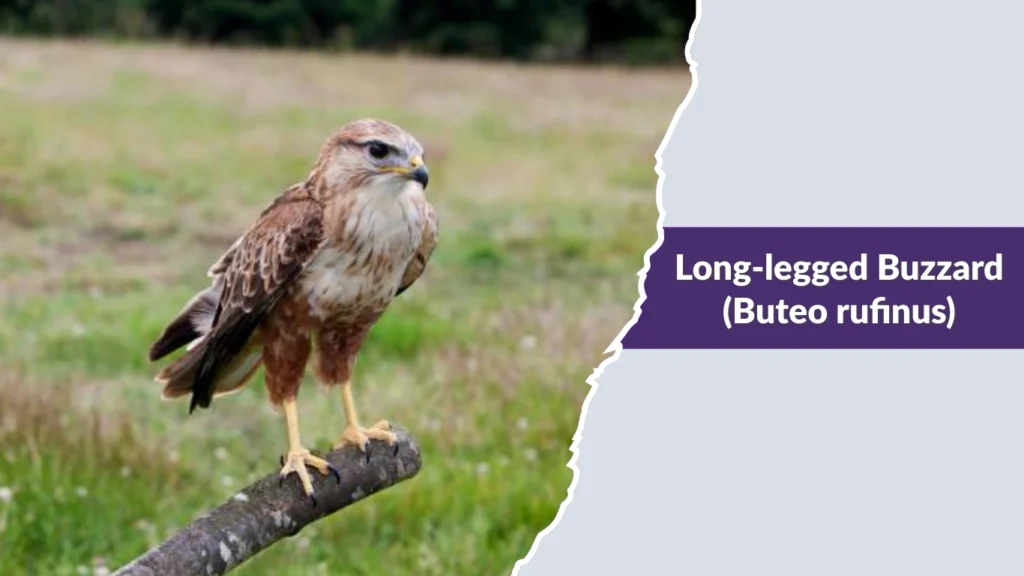
The Long-legged Buzzard is a large and powerful raptor found across southeastern Europe, North Africa, the Middle East, and Central Asia. It is known for its long legs, broad wings, and pale overall appearance compared to many other buzzards. Often seen soaring high or perched on rocks and utility poles, this species favors open landscapes where it can easily spot prey.
Identification
- Large buzzard with long legs and broad wings
- Plumage usually pale brown, rufous, or sandy-colored
- Head and underparts often lighter than wings
- Tail pale with fine barring
- Strong, heavy bill suited for larger prey
Habitat
Long-legged Buzzards prefer open and semi-arid habitats such as steppes, deserts, grasslands, and open hillsides. They are also found in rocky terrain and mountainous regions, often nesting on cliffs, rocky outcrops, or occasionally trees where available.
Behaviors
This species spends much of its time soaring on thermals or perched in elevated positions while scanning the ground. It is usually solitary or seen in pairs during the breeding season. Long-legged Buzzards are territorial around nesting sites and may aggressively defend them from intruders.
Diet
Their diet mainly consists of small to medium-sized mammals, including rodents and hares. They also prey on reptiles, birds, and large insects, adapting their hunting strategy to local prey availability.
Lifespan
In the wild, Long-legged Buzzards typically live between 12 and 18 years, depending on environmental conditions and human impact.
4. Upland Buzzard (Buteo hemilasius)
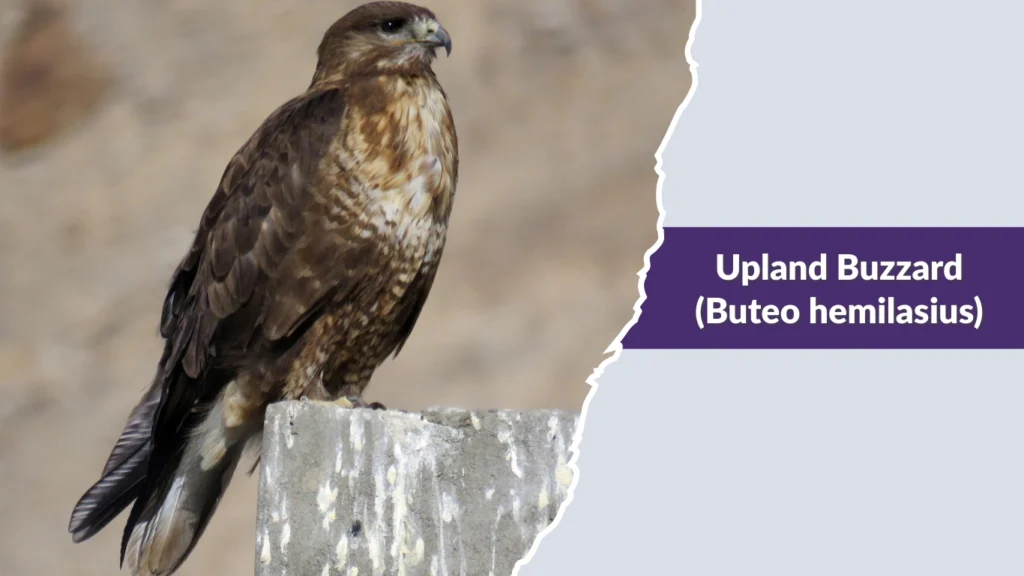
The Upland Buzzard is one of the largest buzzard species and is native to Central and East Asia. It is well adapted to high-altitude environments and open landscapes, where it dominates as a top predator. With its massive size and broad wings, this buzzard is an impressive sight, often seen soaring slowly over plains and plateaus or perched on rocky outcrops.
Identification
- Very large and bulky buzzard with broad wings
- Plumage varies from dark brown to pale buff
- Thick legs and strong talons
- Tail relatively short and broadly banded
- Heavy head and powerful bill
Habitat
Upland Buzzards inhabit open grasslands, steppes, plateaus, and mountainous regions, often at high elevations. They are commonly found in sparsely populated areas with wide open spaces, which provide ideal conditions for hunting and nesting. Nests are typically built on cliffs, rocky ledges, or occasionally on the ground or artificial structures.
Behaviors
This species spends much of its time soaring at low altitudes or perched while scanning for prey. It is generally solitary, except during the breeding season. Upland Buzzards are known for their boldness and may aggressively defend their nests against intruders, including much larger animals.
Diet
Their diet consists mainly of small to medium-sized mammals such as pikas, marmots, and rodents. They may also hunt birds and reptiles when available, adjusting their feeding habits to seasonal prey abundance.
Lifespan
Upland Buzzards are believed to live around 15–20 years in the wild, though exact lifespan data is limited due to their remote habitats.
5. Steppe Buzzard (Buteo buteo vulpinus)
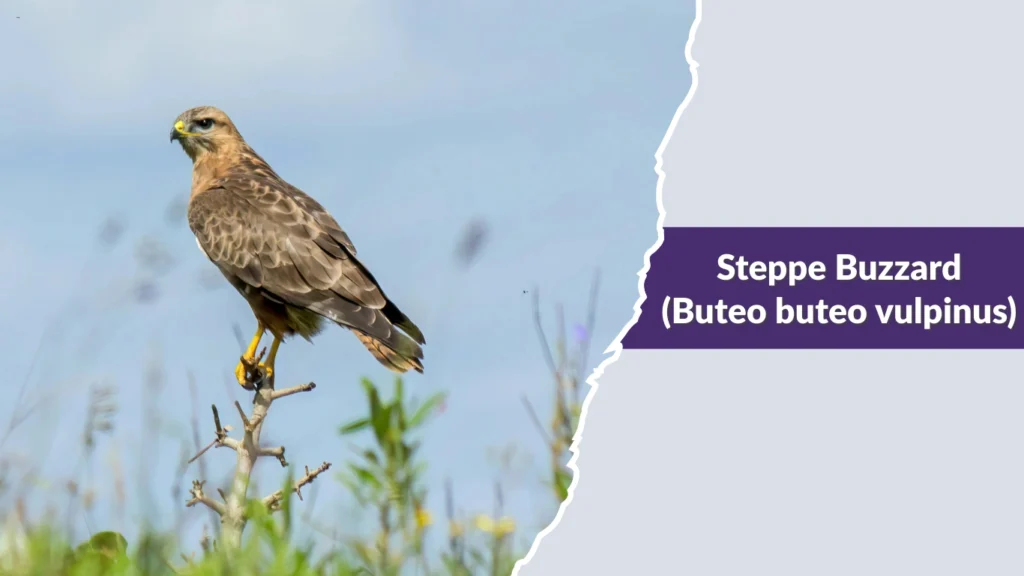
The Steppe Buzzard is a migratory subspecies of the Common Buzzard, breeding across eastern Europe and western Asia and wintering in Africa. It is well known for its long-distance migrations and slightly slimmer build compared to the nominate Common Buzzard. During migration, large numbers can be seen soaring together, making it a familiar sight along major flyways.
Identification
- Medium-sized buzzard with relatively long wings
- Plumage often shows warm brown or rufous tones
- Underparts usually lighter with fine streaking
- Tail may appear slightly longer than that of Common Buzzard
- Broad wings with darker trailing edges
Habitat
During the breeding season, Steppe Buzzards inhabit open woodlands, forest edges, and steppe regions. In winter, they occupy savannas, open grasslands, and agricultural areas in Africa. Their ability to use a wide range of habitats contributes to their successful migrations.
Behaviors
Steppe Buzzards are strong soarers and rely heavily on thermal currents during migration. They are usually solitary when feeding but may gather in large flocks while migrating. Territorial behavior is most evident during the breeding season, when pairs defend nesting areas.
Diet
Their diet consists mainly of small mammals such as rodents, but they also feed on birds, reptiles, insects, and carrion. In wintering grounds, insects and small reptiles can form a significant part of their diet.
Lifespan
The average lifespan of a Steppe Buzzard in the wild is estimated at 10–15 years, with survival influenced by migration hazards and habitat conditions.
6. Forest Buzzard (Buteo trizonatus)
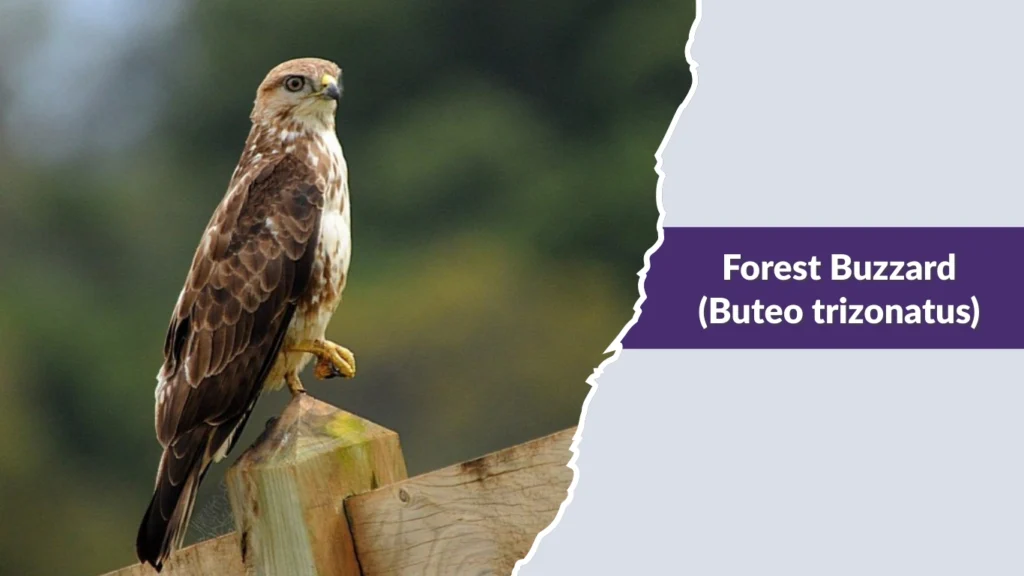
The Forest Buzzard is a distinctive bird of prey native to southern Africa. Unlike many other buzzards that prefer open landscapes, this species is closely associated with forested environments. It is often secretive and less frequently seen, making it one of the more elusive buzzards within its range.
Identification
- Medium-sized buzzard with broad wings
- Dark brown upperparts and heavily streaked underparts
- Prominent white throat patch
- Tail shows several narrow dark bands
- Yellow legs and cere
Habitat
Forest Buzzards are mainly found in indigenous forests, forest edges, and well-wooded hillsides. They prefer dense tree cover for nesting and roosting, while nearby clearings provide hunting opportunities. This reliance on forests makes them sensitive to deforestation and habitat fragmentation.
Behaviors
This species is generally shy and spends much of its time perched quietly within forest canopies. It becomes more vocal during the breeding season, producing loud calls to defend territory. Forest Buzzards are usually solitary or seen in pairs and are rarely observed soaring in open skies.
Diet
Their diet primarily consists of small mammals and birds. They may also take reptiles and large insects, hunting mostly from concealed perches within the forest.
Lifespan
Forest Buzzards are believed to live around 10–14 years in the wild, though limited studies exist due to their secretive nature.
7. Himalayan Buzzard (Buteo refectus)
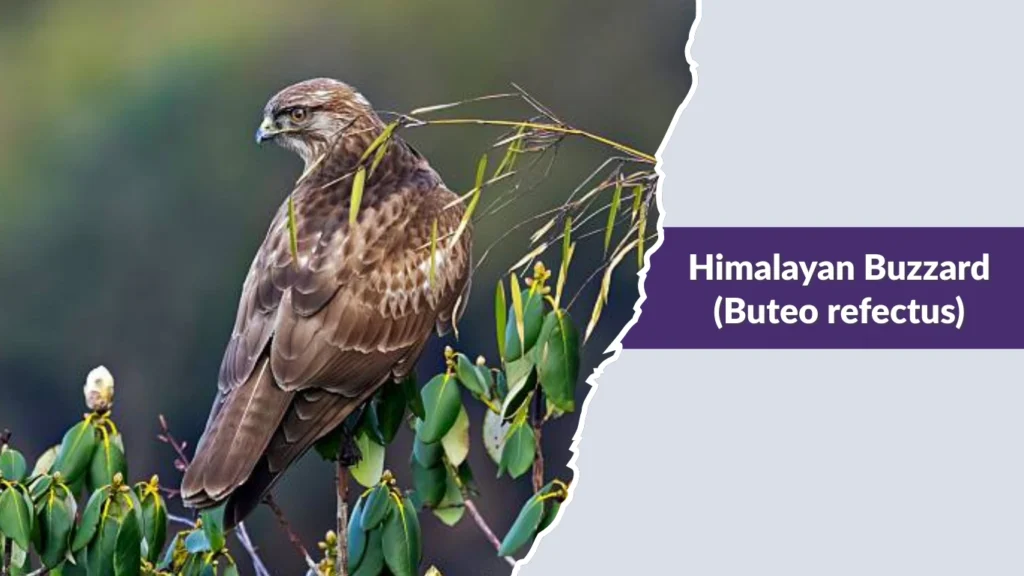
The Himalayan Buzzard is a high-altitude bird of prey found across the Himalayan region and parts of Central Asia. Long considered a subspecies of the Common Buzzard, it is now often treated as a separate species due to differences in plumage, size, and range. It is well adapted to mountainous terrain and colder climates.
Identification
- Medium to large buzzard with broad wings
- Dark brown upperparts with paler underparts
- Heavy streaking on chest and belly
- Tail shows multiple dark bands
- Strong, stocky build
Habitat
Himalayan Buzzards inhabit mountain forests, alpine meadows, valleys, and high-altitude plateaus. They are often found at elevations much higher than most other buzzards, nesting in trees or on rocky cliffs. Seasonal movements may occur in response to harsh winter conditions.
Behaviors
This species is commonly seen soaring over valleys and ridgelines, using rising air currents. It is generally solitary or seen in pairs during the breeding season. Himalayan Buzzards are territorial around nesting sites and may call loudly to ward off intruders.
Diet
Their diet mainly includes small mammals such as rodents and pikas. They also prey on birds, reptiles, and large insects when available, adapting to seasonal food supplies.
Lifespan
The Himalayan Buzzard is thought to live approximately 12–16 years in the wild, though detailed lifespan data is limited.
8. Eastern Buzzard (Buteo japonicus)
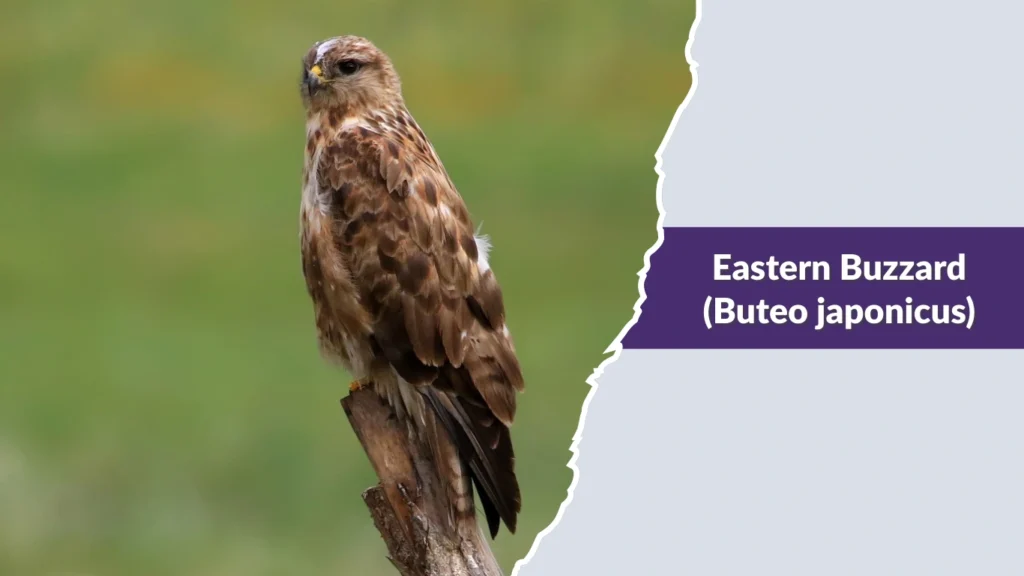
The Eastern Buzzard is a widespread raptor found in East Asia, including China, Korea, Japan, and parts of Russia. Formerly treated as a subspecies of the Common Buzzard, it is now recognized as a separate species. It is a versatile bird of prey, commonly seen soaring above open landscapes or perched quietly while searching for food.
Identification
- Medium-sized buzzard with broad, rounded wings
- Plumage highly variable, from dark brown to pale forms
- Underparts often streaked or mottled
- Tail shows multiple dark bands
- Compact, stocky appearance
Habitat
Eastern Buzzards occupy a variety of habitats such as forest edges, farmland, grasslands, wetlands, and open countryside. They breed in wooded areas but often hunt in nearby open spaces. During migration and winter, they may move to lower elevations and warmer regions.
Behaviors
This species is frequently observed soaring on thermals or gliding at moderate heights. It is mostly solitary outside the breeding season and becomes territorial when nesting. Eastern Buzzards are vocal during courtship and territory defense, producing sharp, piercing calls.
Diet
Their diet is diverse, consisting of small mammals, birds, reptiles, amphibians, insects, and carrion. This adaptability allows them to thrive in both natural and human-altered landscapes.
Lifespan
Eastern Buzzards typically live around 10–15 years in the wild, depending on environmental conditions and food availability.
9. Mountain Buzzard (Buteo oreophilus)
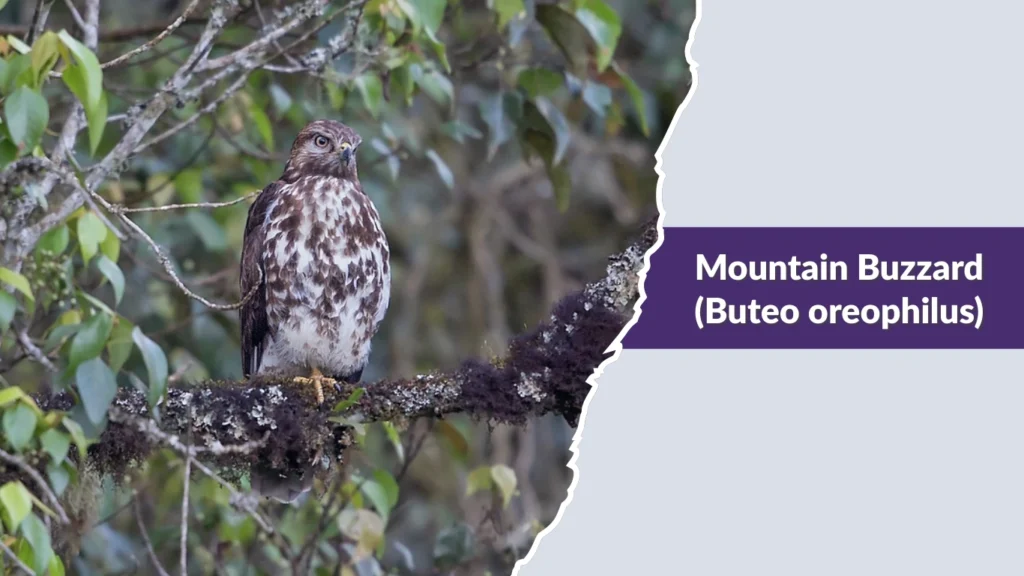
The Mountain Buzzard is a little-known bird of prey native to eastern and southern Africa. It is closely associated with highland regions and rugged terrain, where it hunts and breeds. Due to its preference for remote mountainous areas, it is less frequently observed than many other buzzard species.
Identification
- Medium-sized buzzard with broad wings
- Dark brown upperparts and paler underparts
- Heavy streaking on the chest and belly
- Tail shows narrow dark bands
- Yellow legs and cere
Habitat
Mountain Buzzards inhabit montane forests, highland grasslands, and rocky slopes. They favor elevated regions with a mix of wooded areas for nesting and open spaces for hunting. These habitats are often cool and less disturbed by human activity.
Behaviors
This species is usually seen soaring along mountain ridges or perched on high vantage points. It is generally solitary, except during the breeding season. Mountain Buzzards are territorial and may vocalize loudly when defending their nesting areas.
Diet
Their diet consists mainly of small mammals such as rodents, along with birds, reptiles, and large insects. Hunting typically occurs from perches or during slow, soaring flights.
Lifespan
Mountain Buzzards are believed to live approximately 10–15 years in the wild, though detailed lifespan information remains limited.
10. Madagascar Buzzard (Buteo brachypterus)
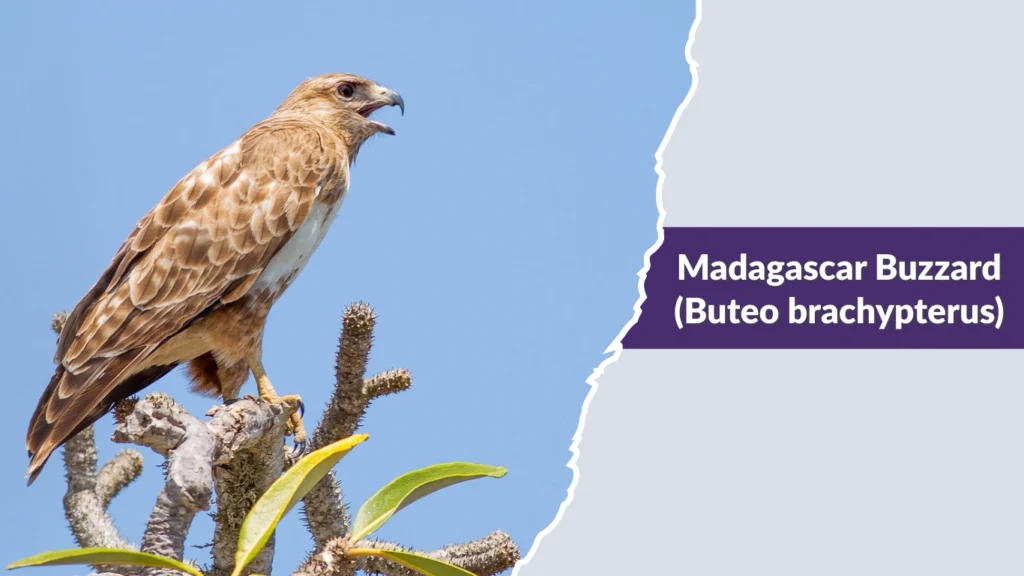
The Madagascar Buzzard is an endemic bird of prey found only on the island of Madagascar. It is one of the most common raptors on the island and shows a high level of adaptability to different environments. Despite its limited range, this species thrives in both natural and human-modified landscapes, making it an important part of Madagascar’s ecosystems.
Identification
- Medium-sized buzzard with relatively short wings
- Plumage varies from dark brown to paler forms
- Underparts often streaked or barred
- Short, rounded tail with dark bands
- Yellow legs and cere
Habitat
Madagascar Buzzards occupy a wide range of habitats, including forests, woodland edges, savannas, agricultural land, and open countryside. They are often seen near villages and farmland, where prey is abundant. Nesting usually takes place in tall trees.
Behaviors
This species is commonly observed soaring over open areas or perched conspicuously while scanning for prey. It is mostly solitary but may be seen in pairs during the breeding season. Madagascar Buzzards are vocal and use loud calls to communicate and defend territories.
Diet
Their diet is diverse, consisting of small mammals, birds, reptiles, amphibians, insects, and carrion. This opportunistic feeding behavior allows them to survive in varied environments.
Lifespan
In the wild, Madagascar Buzzards typically live around 12–15 years, though some individuals may live longer under favorable conditions.
11. African Buzzard (Buteo auguralis)
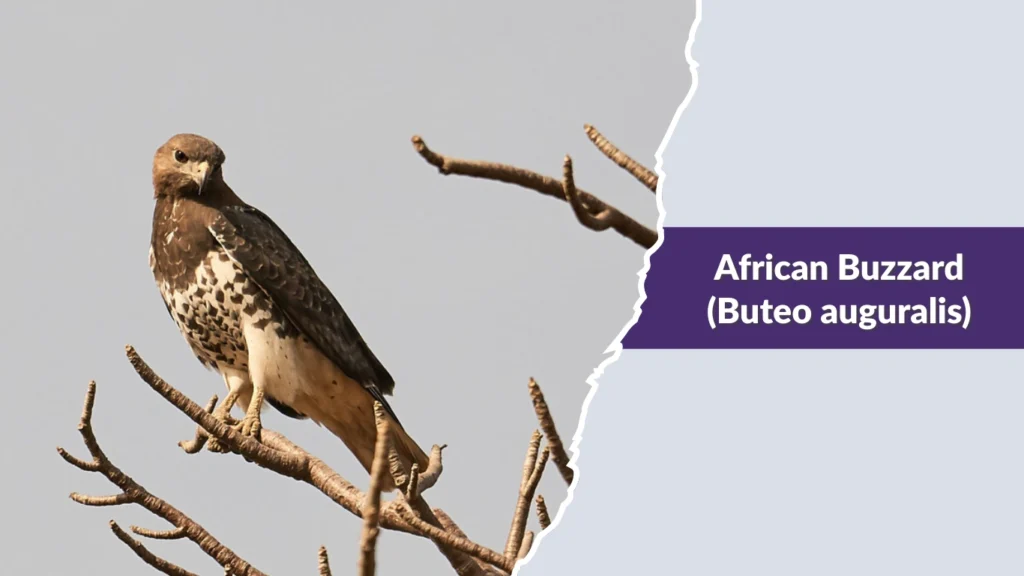
The African Buzzard is a medium-sized bird of prey found across parts of western and central Africa. It is known for its bold coloration and strong presence in open and semi-open landscapes. Often seen soaring high or perched on exposed branches, this buzzard plays an important role as a predator within its ecosystem.
Identification
- Medium-sized buzzard with broad wings
- Dark brown upperparts with a rufous tail
- Underparts pale with dark streaking
- Tail bright rufous, especially noticeable in flight
- Yellow legs and cere
Habitat
African Buzzards inhabit open woodlands, forest edges, savannas, and agricultural areas. They prefer regions that provide both elevated perches and open ground for hunting. Nesting usually occurs in tall trees or on cliff ledges.
Behaviors
This species is often observed soaring on thermals during the day. It is generally solitary but becomes territorial during the breeding season. African Buzzards are vocal birds and frequently call while in flight or near their nests.
Diet
Their diet mainly consists of small mammals, birds, reptiles, and large insects. They may also feed on carrion when available, showing a degree of dietary flexibility.
Lifespan
African Buzzards are believed to live around 12–16 years in the wild, depending on habitat quality and food availability.
12. Red-tailed Buzzard (Buteo jamaicensis)
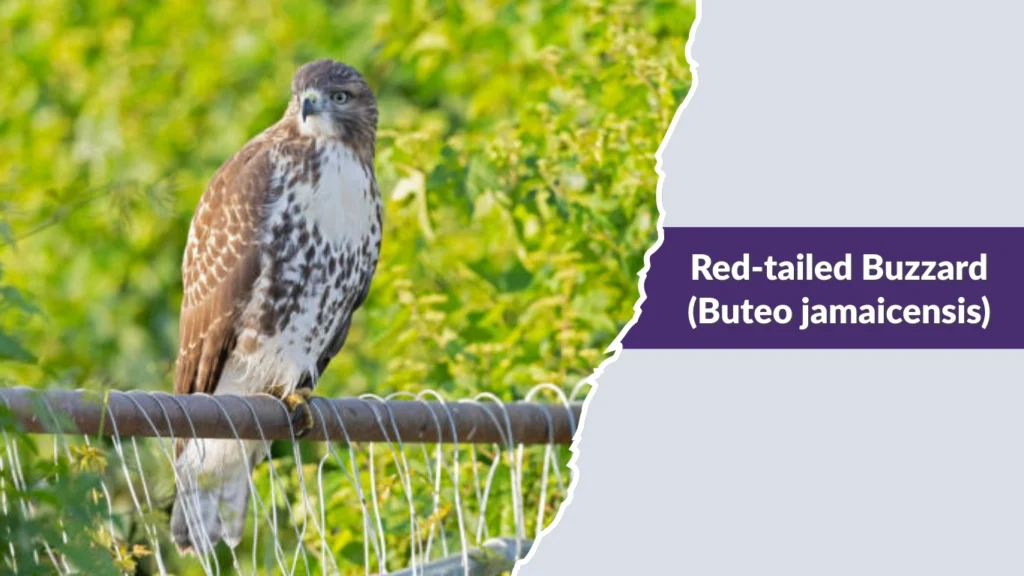
The Red-tailed Buzzard is one of the most recognizable birds of prey in North America. It is widespread and highly adaptable, thriving in a variety of environments from deserts to urban outskirts. Known for its iconic reddish tail and powerful presence, this buzzard is often seen soaring high or perched along roadsides and open fields.
Identification
- Large buzzard with broad, rounded wings
- Distinctive brick-red tail in adults
- Pale underparts with a dark belly band
- Dark head and upperparts
- Strong, bulky build
Habitat
Red-tailed Buzzards occupy a wide range of habitats including open fields, grasslands, deserts, forests, farmland, and suburban areas. They require elevated perches such as trees, poles, or cliffs for hunting and nesting. Their adaptability has allowed them to remain common even in human-dominated landscapes.
Behaviors
This species is frequently seen soaring on thermals or perched while scanning the ground for prey. It is generally solitary and strongly territorial during the breeding season. Red-tailed Buzzards are known for their loud, raspy scream, often used in films to represent raptor calls.
Diet
Their diet mainly includes small to medium-sized mammals such as rodents and rabbits. They also prey on birds, reptiles, and occasionally feed on carrion.
Lifespan
In the wild, Red-tailed Buzzards typically live around 15–20 years, with some individuals reaching older ages under favorable conditions.
13. Ferruginous Buzzard (Buteo regalis)
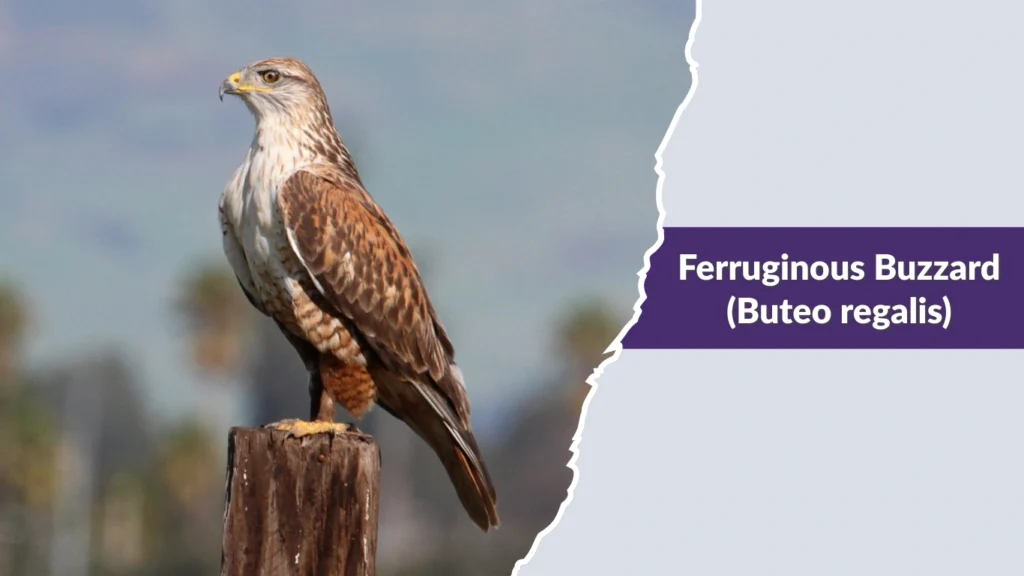
The Ferruginous Buzzard is the largest buzzard in North America and is easily recognized by its pale plumage and rust-colored markings. It is strongly associated with open landscapes and is considered a species of conservation concern in some parts of its range due to habitat loss.
Identification
- Very large buzzard with long, broad wings
- Pale underparts with rust-colored (ferruginous) markings
- Rusty leg feathers forming a “trousered” appearance
- Large head and heavy bill
- Wings show pale flight feathers in contrast to darker body
Habitat
Ferruginous Buzzards primarily inhabit open grasslands, prairies, shrublands, and semi-desert regions. They prefer areas with minimal tree cover and often nest on cliffs, rocky outcrops, or man-made structures such as utility poles.
Behaviors
This species often hunts by soaring low over open ground or perching while scanning for prey. It is generally solitary and highly territorial during the breeding season. Ferruginous Buzzards are less vocal than many other buzzards but may display aggressive behavior near their nests.
Diet
Their diet consists mainly of small to medium-sized mammals such as ground squirrels, prairie dogs, and rabbits. They may also take birds and reptiles when available.
Lifespan
Ferruginous Buzzards typically live around 12–20 years in the wild, depending on environmental conditions and human impact.
14. Harris’s Buzzard (Parabuteo unicinctus)
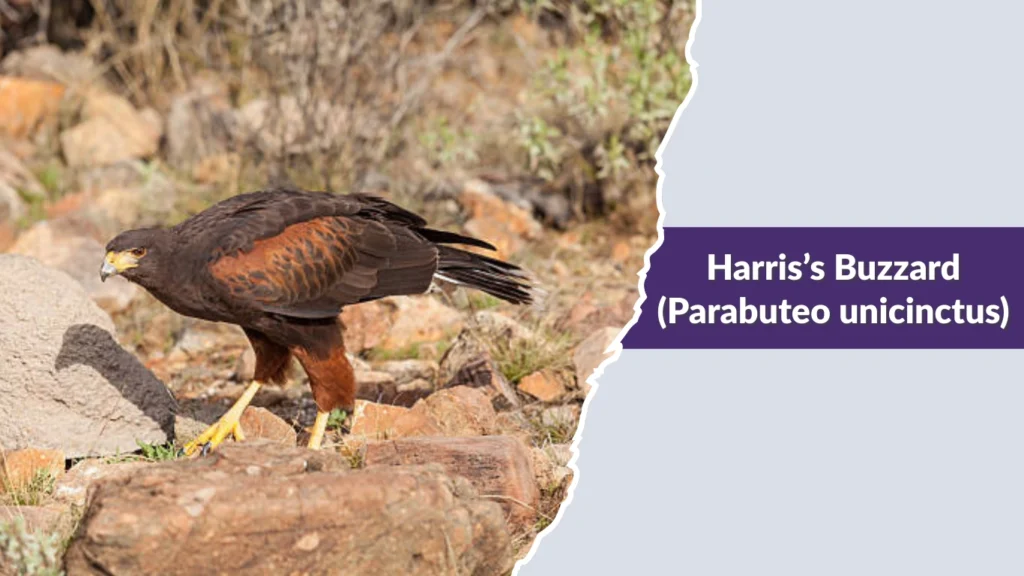
Harris’s Buzzard is a distinctive and highly social bird of prey native to the Americas. Unlike most buzzards, it is well known for hunting cooperatively in groups, making it one of the most intelligent and behaviorally complex raptors. Its striking plumage and bold behavior make it a favorite among birdwatchers and falconers.
Identification
- Medium to large buzzard with broad wings
- Dark brown to blackish plumage
- White patch at the base of the tail
- Chestnut markings on shoulders and legs
- Long legs and tail
Habitat
Harris’s Buzzards are found in deserts, scrublands, savannas, and open woodlands. They favor arid and semi-arid regions with scattered trees or cacti that provide nesting and perching sites.
Behaviors
This species is famous for its cooperative hunting, often working in family groups to flush and capture prey. It is highly social, frequently seen perched together. Harris’s Buzzards are territorial and use a variety of vocalizations to communicate within the group.
Diet
Their diet mainly includes small mammals, birds, and reptiles. Group hunting allows them to take larger or more agile prey than solitary buzzards.
Lifespan
In the wild, Harris’s Buzzards typically live around 10–15 years, though individuals in protected environments may live longer.
15. White-tailed Buzzard (Geranoaetus albicaudatus)
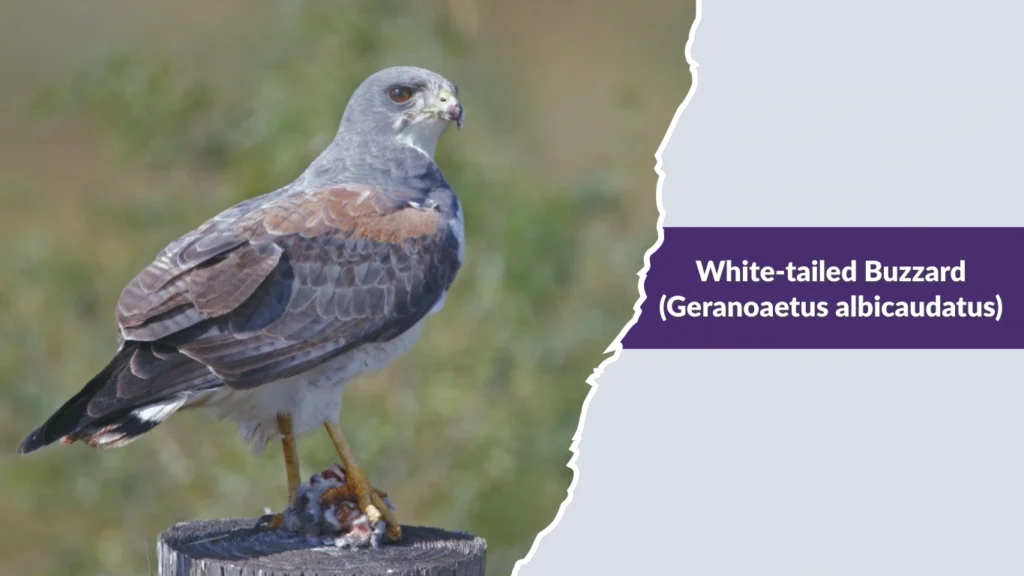
The White-tailed Buzzard is a large and striking bird of prey found in parts of Central and South America. It is easily recognized by its contrasting plumage and bold flight pattern. This species favors open landscapes and is often seen soaring high or perched prominently while surveying its surroundings.
Identification
- Large buzzard with broad wings
- White tail with a distinct dark terminal band
- Dark gray to blackish upperparts
- Pale underparts with fine barring
- Strong, heavy build
Habitat
White-tailed Buzzards inhabit open grasslands, savannas, scrublands, and agricultural areas. They prefer regions with scattered trees or elevated perches for nesting and hunting. Nests are usually built in tall trees or occasionally on cliffs.
Behaviors
This species is commonly observed soaring at great heights or perched on exposed branches and poles. It is generally solitary or seen in pairs during the breeding season. White-tailed Buzzards are territorial and may aggressively defend their nesting areas.
Diet
Their diet consists mainly of small mammals, birds, reptiles, and large insects. They may also feed on carrion, especially in open landscapes where food sources are unpredictable.
Lifespan
White-tailed Buzzards are believed to live around 12–18 years in the wild, depending on environmental conditions.
16. Roadside Buzzard (Rupornis magnirostris)
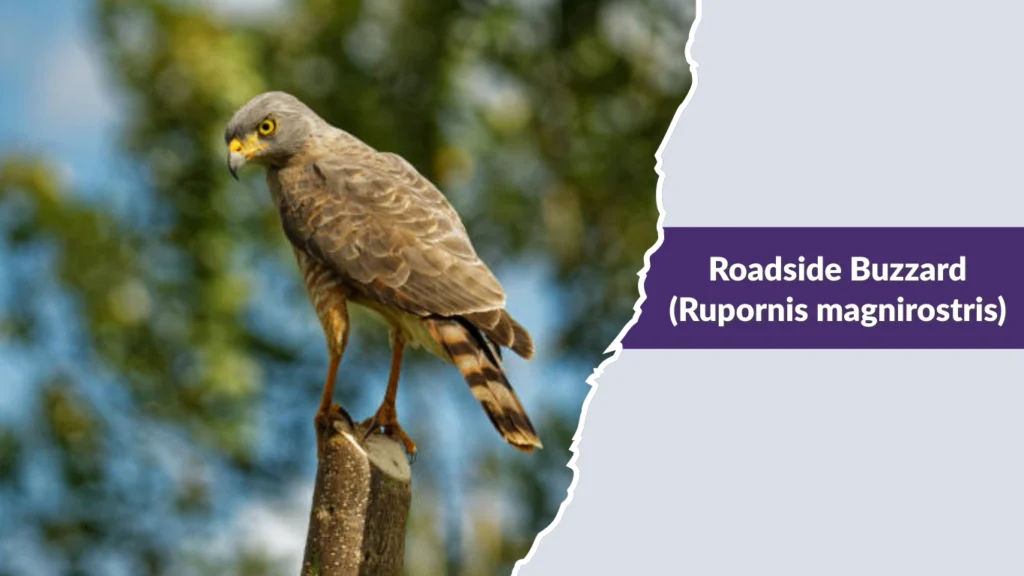
The Roadside Buzzard is one of the most common and adaptable buzzards in Central and South America. It gets its name from its frequent habit of perching along roadsides, fence posts, and utility poles. Highly tolerant of human presence, this species is often the first raptor noticed in towns, farms, and suburban areas.
Identification
- Small to medium-sized buzzard with short, broad wings
- Brown upperparts with heavily barred underparts
- Tail shows several narrow dark bands
- Yellow legs and cere
- Compact, stocky appearance
Habitat
Roadside Buzzards occupy a wide variety of habitats including open woodlands, forest edges, savannas, farmland, and urban areas. They thrive in disturbed landscapes and are commonly found near roads, fields, and settlements where prey is easily accessible.
Behaviors
This species is typically seen perched conspicuously while watching the ground for prey. It is mostly solitary but may form pairs during the breeding season. Roadside Buzzards are vocal and often announce their presence with loud, repeated calls.
Diet
Their diet is highly varied, consisting of small mammals, birds, reptiles, amphibians, insects, and carrion. This opportunistic feeding behavior contributes to their success in diverse environments.
Lifespan
In the wild, Roadside Buzzards usually live around 10–14 years, though lifespan can vary depending on habitat quality and human-related threats.
17. Gray-lined Buzzard (Buteo nitidus)
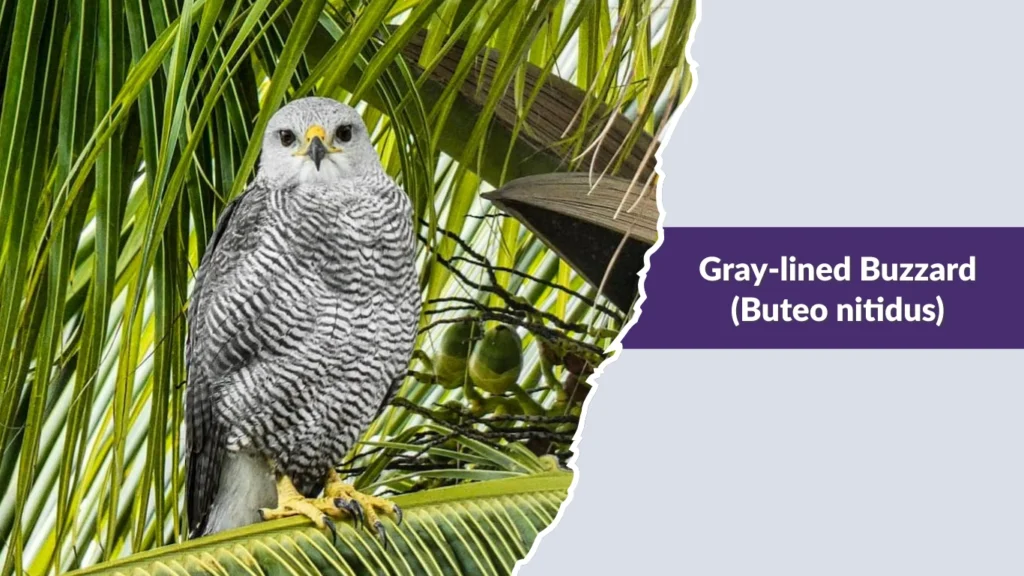
The Gray-lined Buzzard is a sleek and medium-sized raptor found from Mexico through Central America and into parts of South America. It is known for its clean, contrasting plumage and agile flight. This species is often associated with wooded areas near open spaces, where it hunts efficiently.
Identification
- Medium-sized buzzard with relatively slim build
- Gray upperparts with finely barred underparts
- Distinct dark eye stripe
- Tail shows narrow dark bands
- Yellow legs and cere
Habitat
Gray-lined Buzzards inhabit forest edges, open woodlands, savannas, and lightly wooded agricultural areas. They prefer habitats that provide both tree cover for nesting and open ground for hunting. During migration, they may also be seen in more open landscapes.
Behaviors
This species is commonly observed soaring at moderate heights or perched quietly within trees. It is generally solitary outside the breeding season and becomes territorial when nesting. Gray-lined Buzzards are migratory in the northern parts of their range and resident farther south.
Diet
Their diet consists mainly of small mammals, birds, reptiles, and large insects. They hunt from perches or by making short, direct flights to capture prey.
Lifespan
Gray-lined Buzzards typically live around 10–15 years in the wild, depending on environmental conditions and food availability.
18. Broad-winged Buzzard (Buteo platypterus)
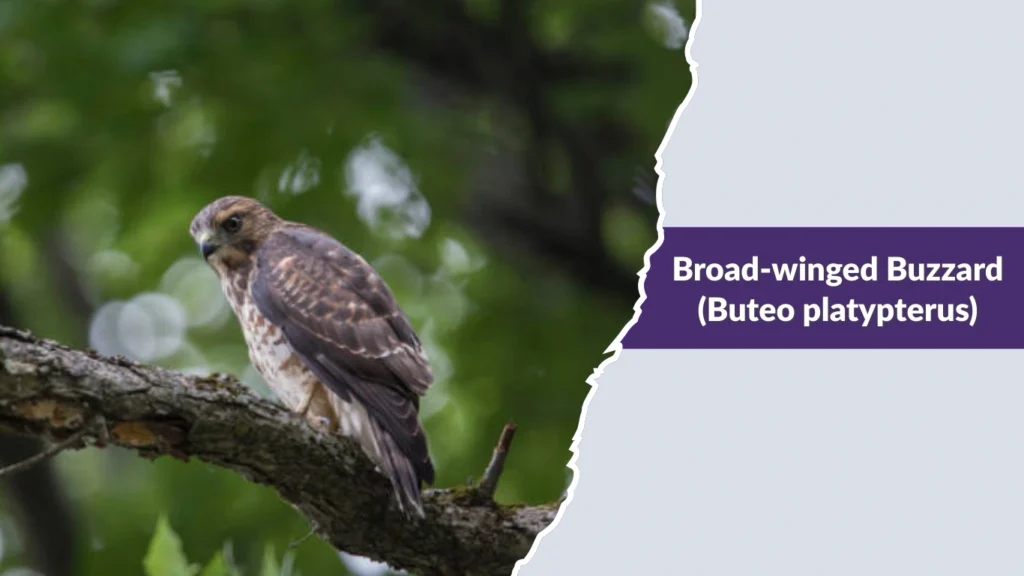
The Broad-winged Buzzard is a compact and migratory bird of prey best known for its massive migration flocks, often called “kettles.” It breeds in North America and winters in Central and South America. Though usually secretive during the breeding season, it becomes highly visible during migration.
Identification
- Small to medium-sized buzzard with broad wings
- Dark brown upperparts and pale underparts
- Heavy barring across the chest and belly
- Short, square tail with bold black-and-white bands
- Compact body and short neck
Habitat
During the breeding season, Broad-winged Buzzards inhabit deciduous and mixed forests, often near clearings or water sources. In winter, they occupy tropical forests, forest edges, and wooded lowlands. Dense tree cover is important for nesting and roosting.
Behaviors
This species is usually quiet and elusive while breeding, staying within forest canopies. During migration, thousands may soar together using thermal currents. Broad-winged Buzzards are strongly territorial around their nests but otherwise non-aggressive.
Diet
Their diet includes small mammals, reptiles, amphibians, birds, and large insects. Frogs and snakes are particularly important prey during the breeding season.
Lifespan
Broad-winged Buzzards typically live around 12–16 years in the wild, though migration hazards can affect survival rates.
19. Short-tailed Buzzard (Buteo brachyurus)
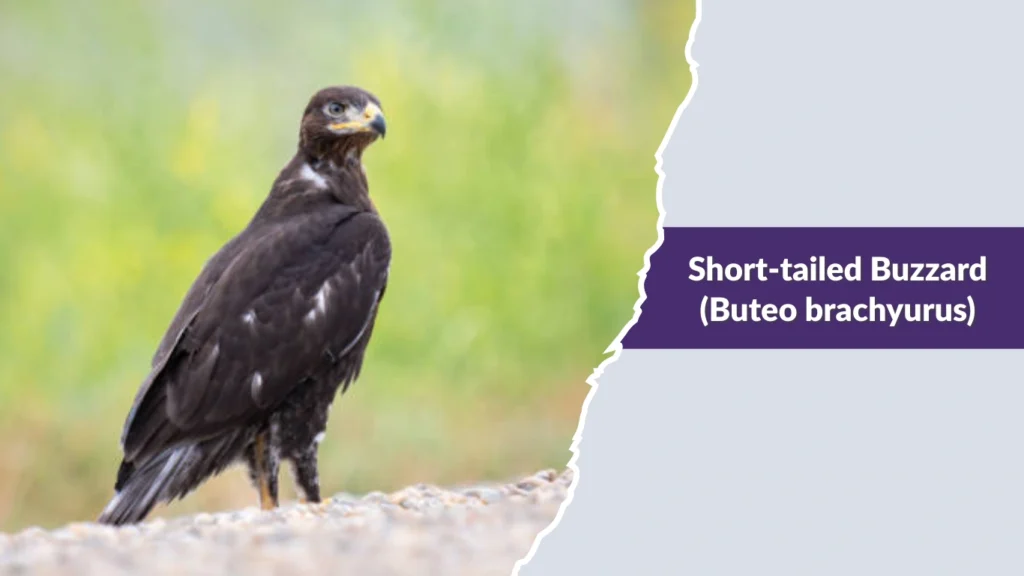
The Short-tailed Buzzard is a distinctive raptor found mainly in the Americas, especially in tropical and subtropical regions. It is known for its unusually short tail and variable plumage, appearing in both light and dark color forms. This species is often seen soaring high above forests and open areas.
Identification
- Medium-sized buzzard with very short tail
- Broad wings adapted for soaring
- Two main color morphs: pale and dark
- Pale morph shows light underparts with dark edging
- Dark morph appears uniformly dark
Habitat
Short-tailed Buzzards inhabit forest edges, open woodlands, savannas, and tropical lowlands. They are often associated with forested areas but require nearby open spaces for hunting. Nests are usually built high in trees.
Behaviors
This species is frequently observed soaring at great heights, using thermals for extended periods. It is generally solitary or seen in pairs during the breeding season. Short-tailed Buzzards are territorial and may perform aerial displays when defending nesting areas.
Diet
Their diet mainly consists of birds, which they often capture in midair or from treetops. They may also feed on small mammals, reptiles, and insects.
Lifespan
Short-tailed Buzzards are believed to live around 12–15 years in the wild, depending on environmental conditions.
20. Zone-tailed Buzzard (Buteo albonotatus)
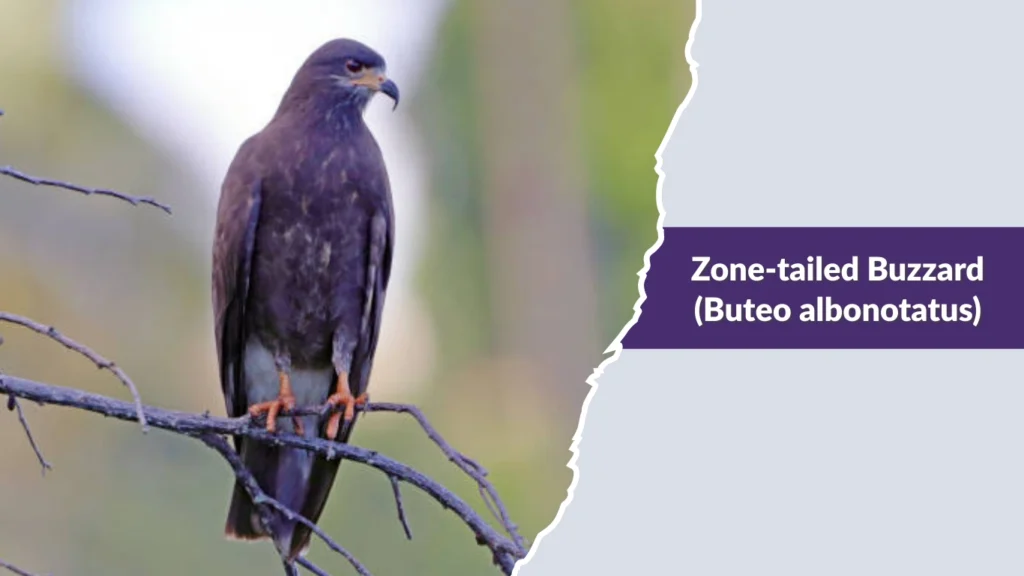
The Zone-tailed Buzzard is a clever and distinctive raptor found in parts of the Americas. It is famous for mimicking the flight style of vultures, which helps it approach prey unnoticed. With its dark plumage and banded tail, this species is often overlooked or mistaken for a vulture at first glance.
Identification
- Medium-sized buzzard with long, broad wings
- Mostly black or very dark brown plumage
- Tail shows bold white bands (“zones”)
- Wings held in a shallow V during flight
- Long tail compared to body size
Habitat
Zone-tailed Buzzards inhabit deserts, canyons, open woodlands, forest edges, and mountainous regions. They are often found near cliffs, rocky terrain, or river valleys, which provide suitable nesting and hunting opportunities.
Behaviors
This species is best known for soaring among vultures to disguise itself while hunting. It is usually solitary or seen in pairs and becomes territorial during the breeding season. Zone-tailed Buzzards rely heavily on soaring and gliding rather than active flapping.
Diet
Their diet includes small mammals, birds, reptiles, and amphibians. The element of surprise gained through mimicry allows them to capture prey more easily.
Lifespan
Zone-tailed Buzzards typically live around 12–18 years in the wild, though lifespan varies with habitat quality and human disturbance.
21. Swainson’s Buzzard (Buteo swainsoni)
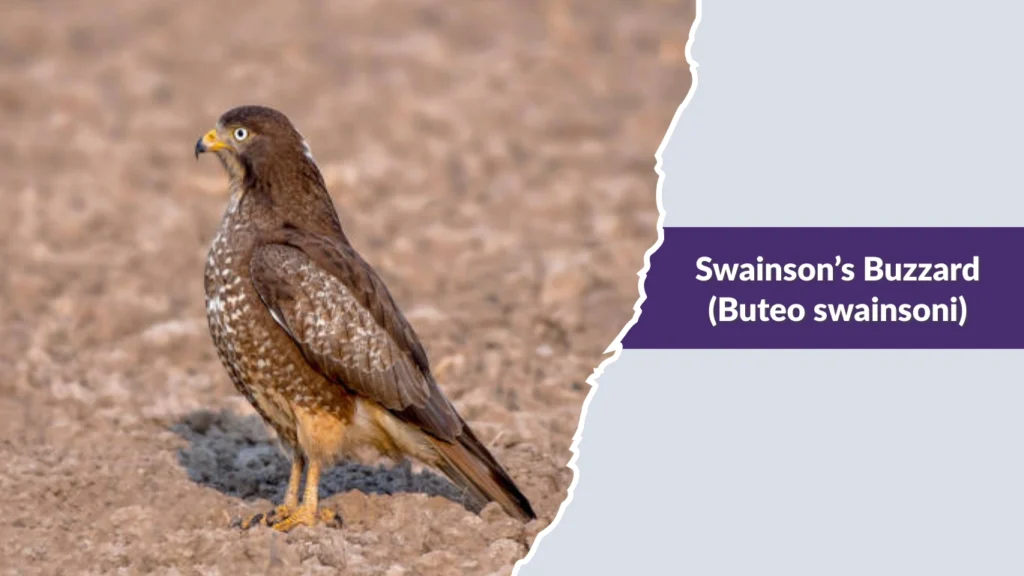
Swainson’s Buzzard is a long-distance migratory raptor best known for its impressive journey between North and South America. It breeds across western North America and spends the non-breeding season in South America. This species is highly adapted to open landscapes and is often seen in large groups during migration.
Identification
- Medium-sized buzzard with long, narrow wings
- Slim body compared to other buzzards
- Plumage varies from light to dark morphs
- Dark bib on the chest in light morph individuals
- Long tail and pointed wing tips
Habitat
Swainson’s Buzzards favor open grasslands, prairies, farmland, and shrublands. They require scattered trees or elevated structures for nesting and perching. During winter, they occupy open plains and agricultural areas in South America.
Behaviors
This species is highly migratory and often travels in large flocks, using thermal currents to cover vast distances. Outside the breeding season, Swainson’s Buzzards are less territorial and may gather in large communal roosts.
Diet
Their diet shifts seasonally. During the breeding season, they feed mainly on small mammals, while in winter they consume large numbers of insects, especially grasshoppers and crickets.
Lifespan
Swainson’s Buzzards typically live around 12–20 years in the wild, depending on migration risks and environmental conditions.
FAQs
What is a buzzard?
A buzzard is a medium to large bird of prey belonging mainly to the genus Buteo. Buzzards are known for their broad wings, soaring flight, and adaptability to different habitats. In Europe, “buzzard” commonly refers to Buteo species, while in North America they are often called hawks.
Are buzzards and hawks the same?
Buzzards and hawks are closely related and often belong to the same genus (Buteo). The difference is mostly regional naming. In Europe, these birds are called buzzards, while in North America, the same or similar species are typically referred to as hawks.
What do buzzards eat?
Buzzards have a varied and opportunistic diet. Most species feed on small mammals such as rodents, but they also eat birds, reptiles, amphibians, insects, and carrion. Their diet often changes depending on season, habitat, and prey availability.
Where do buzzards live?
Buzzards are found on every continent except Antarctica. They inhabit a wide range of environments including forests, grasslands, mountains, deserts, farmland, and open countryside. Many species are highly adaptable and can live close to human settlements.
Are buzzards endangered?
Most buzzard species are not globally endangered, but some face local population declines. Habitat loss, poisoning, hunting, and collisions with vehicles or power lines are common threats. Conservation status varies by species and region.