
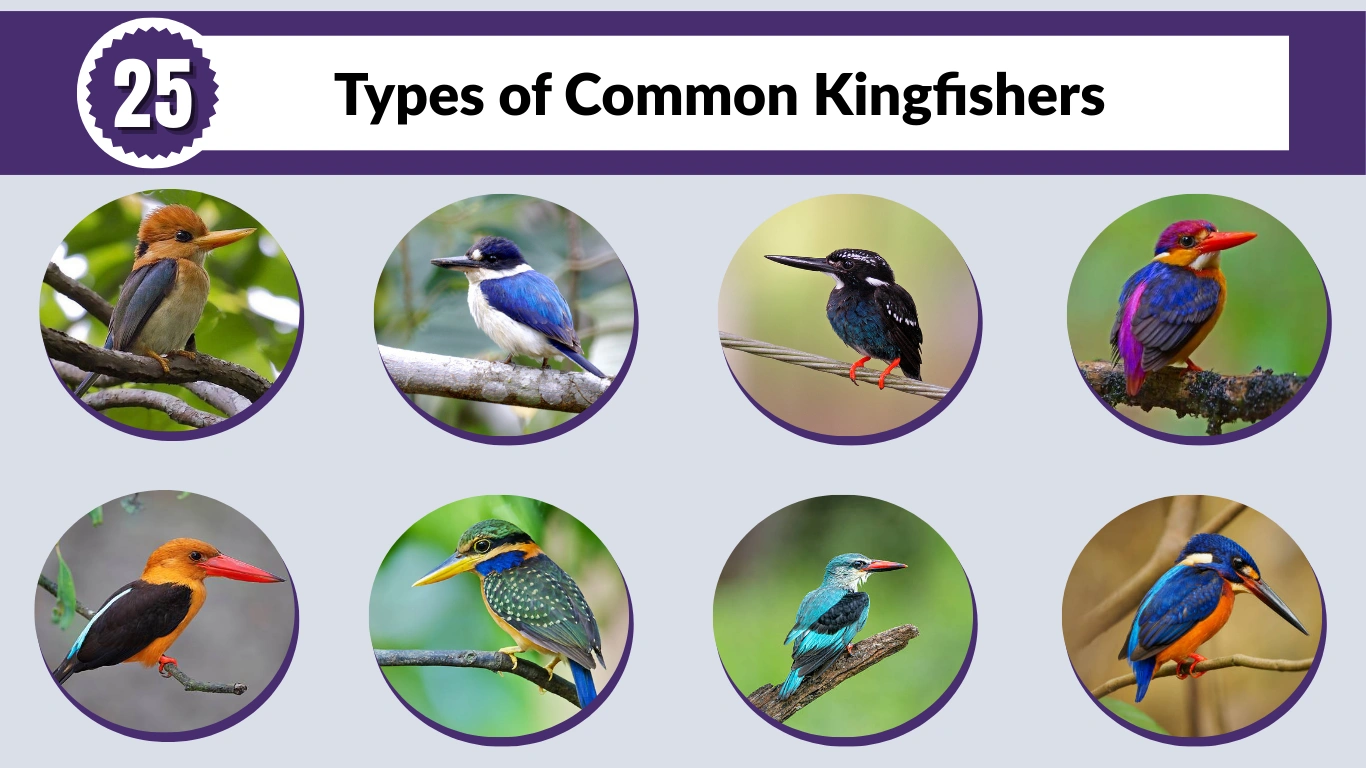
Kingfishers are among the most colorful and fascinating birds in the world, admired for their vibrant plumage, sharp bills, and remarkable hunting skills. Found across rivers, lakes, forests, and coastal regions, these birds play an important role in maintaining healthy ecosystems. While many kingfishers are famous for diving into water to catch fish, others specialize in hunting insects, reptiles, and small animals on land. With over 90 species worldwide, kingfishers display an incredible variety of sizes, behaviors, and habitats, making them a favorite subject for birdwatchers and nature enthusiasts alike.
1. Common Kingfisher

The Common Kingfisher is a small yet strikingly colorful bird that is widely distributed across Europe, Asia, and parts of North Africa. Despite its small size, it is one of the most recognizable freshwater birds due to its brilliant blue upperparts and bright orange underparts. The species is often seen as an indicator of healthy aquatic ecosystems, as it depends on clean, fish-rich waters for survival. Its rapid flight, sharp calls, and precise hunting skills make it a favorite among birdwatchers and wildlife photographers.
Identification
- Small, compact body with a short tail
- Bright blue and turquoise upperparts
- Rich orange chest and belly
- Long, straight, pointed black bill
- Short legs with reddish feet
Habitat
Common Kingfishers are closely tied to freshwater habitats. They inhabit rivers, streams, lakes, canals, ponds, and slow-moving waterways with clear water. Suitable perching spots such as branches, reeds, or rocks are important for hunting. They nest in burrows dug into sandy or muddy riverbanks, often choosing quiet areas with minimal disturbance. Habitat quality directly affects their breeding success and population stability.
Behavior
These birds are typically solitary and highly territorial. They hunt by perching above water and diving headfirst to catch prey with remarkable accuracy. Common Kingfishers are fast, direct fliers, usually flying low over the water while emitting sharp, high-pitched calls to signal their presence or defend territory.
Diet and Lifespan
The Common Kingfisher feeds mainly on small fish, along with aquatic insects, crustaceans, and tadpoles. In the wild, its average lifespan is 5–7 years, though many individuals do not survive their first winter due to harsh weather or food shortages.
2. Belted Kingfisher
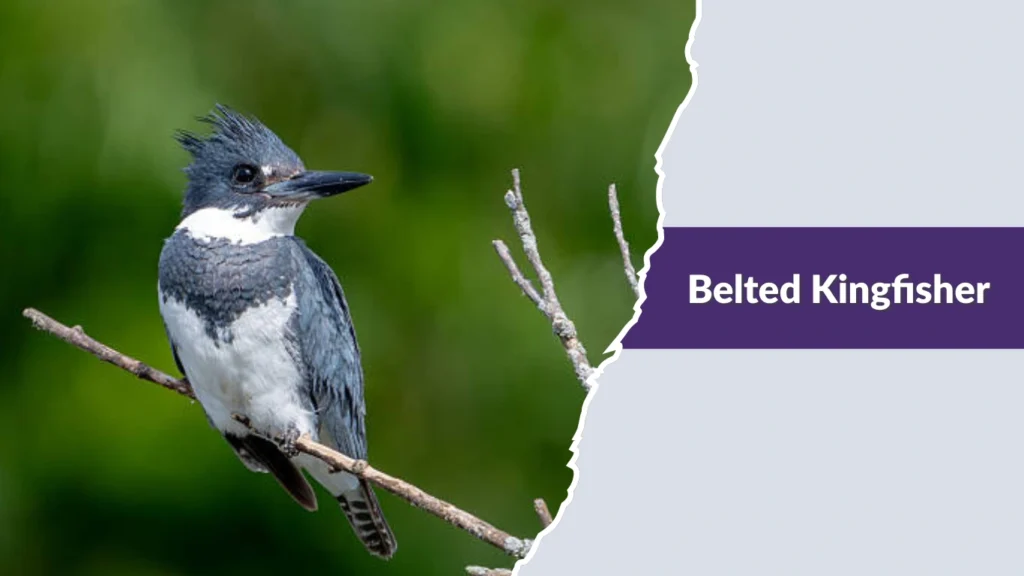
The Belted Kingfisher is a robust and easily recognized kingfisher species native to North America. Known for its shaggy crest and loud rattling call, this bird is often seen hovering above water before diving to catch prey. Unlike many bird species, the female Belted Kingfisher is more brightly colored than the male, making it especially interesting from a biological perspective.
Identification
- Medium-sized, stocky body with a large head
- Blue-gray upperparts and white underparts
- Prominent shaggy crest on the head
- Broad white collar and chest band
- Long, thick, pointed bill
Habitat
Belted Kingfishers are strongly associated with aquatic environments. They inhabit rivers, streams, lakes, ponds, estuaries, and coastal shorelines. Clear or moderately clear water with abundant fish is essential. They prefer areas with steep, sandy, or earthen banks, which they use for nesting by excavating long burrows. These birds are adaptable and can live in both freshwater and saltwater habitats.
Behavior
This species is often solitary and territorial, especially during the breeding season. Belted Kingfishers are known for their hovering hunting technique, where they pause midair before plunging into the water. Their loud, rattling calls are commonly heard as they fly along waterways, announcing territory or signaling alarm.
Diet and Lifespan
Belted Kingfishers primarily feed on small fish but also eat crustaceans, aquatic insects, frogs, and occasionally small reptiles. In the wild, they typically live 6–10 years, though survival depends on habitat quality, food availability, and environmental conditions.
3. Pied Kingfisher
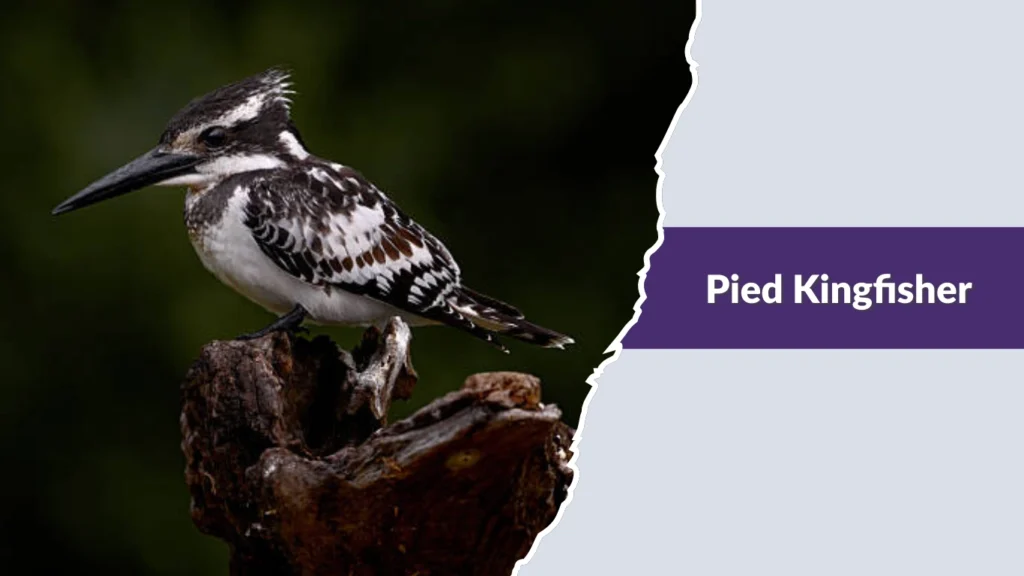
The Pied Kingfisher is a striking black-and-white kingfisher widely distributed across Africa and parts of Asia. It is especially known for its exceptional hovering ability, which allows it to hunt efficiently over open water. Its bold plumage and active hunting style make it one of the most easily recognizable kingfishers in its range.
Identification
- Medium-sized kingfisher with slim build
- Black-and-white plumage with spotted wings
- White face and underparts
- Long, pointed black bill
- Short tail and long wings adapted for hovering
Habitat
Pied Kingfishers are closely tied to water bodies and are found around lakes, rivers, ponds, reservoirs, estuaries, and coastal lagoons. They prefer open water with good visibility and nearby perches such as branches, poles, or reeds. Unlike many other kingfishers, they can thrive in both freshwater and marine environments, provided fish are abundant.
Behavior
This species is highly active and often seen hovering above water while searching for prey. Once a target is spotted, it dives straight down with precision. Pied Kingfishers are social compared to other kingfishers and may be seen in small groups. Their calls are sharp and repetitive, especially during flight and territorial displays.
Diet and Lifespan
Pied Kingfishers feed mainly on small fish, but they also consume aquatic insects, crustaceans, and occasionally tadpoles. In the wild, they generally live 6–8 years, with survival closely linked to water quality and food availability.
4. White-throated Kingfisher
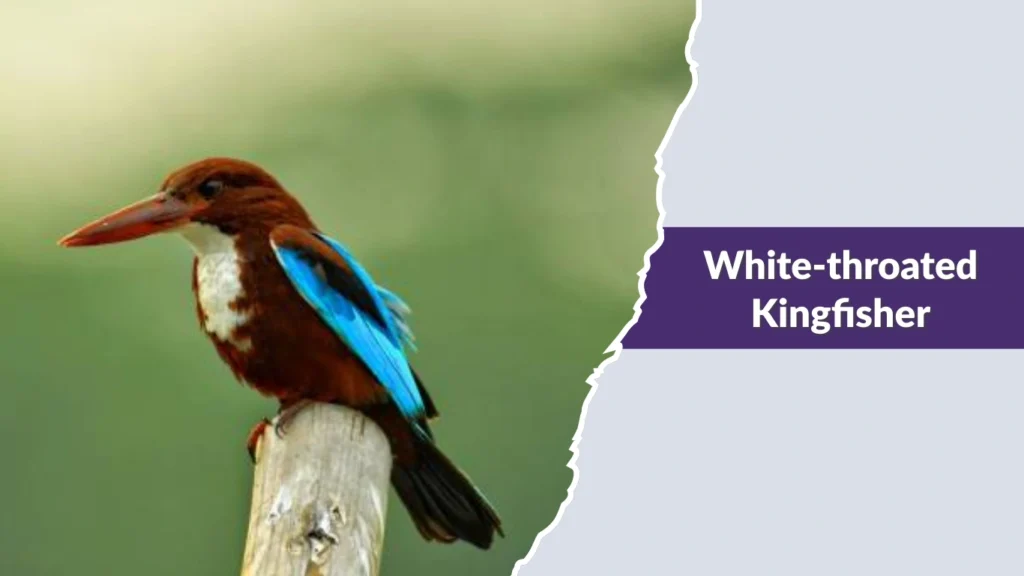
The White-throated Kingfisher is a large, boldly colored kingfisher commonly found across South and Southeast Asia. Unlike many other kingfishers, it is not strictly tied to water and is often seen in open countryside, farmlands, and even urban areas. Its loud calls and striking plumage make it easy to identify.
Identification
- Large kingfisher with sturdy body
- Bright blue wings and back
- Rich chestnut-brown head and underparts
- Distinct white throat and breast patch
- Long, strong red bill
Habitat
White-throated Kingfishers are highly adaptable and occupy a wide range of habitats. They are found near rivers, lakes, canals, ponds, and wetlands, but also frequent agricultural fields, gardens, mangroves, and dry open areas. Nesting usually occurs in earthen banks, termite mounds, or sandy ground, often far from water.
Behavior
This species is usually solitary or seen in pairs. It is bold and aggressive when defending territory. White-throated Kingfishers hunt from exposed perches, swooping down to capture prey on land or in water. Their loud, harsh calls are commonly heard at dawn and dusk.
Diet and Lifespan
White-throated Kingfishers are omnivorous predators. Their diet includes fish, insects, earthworms, lizards, snakes, frogs, rodents, and even small birds. In the wild, they typically live 7–10 years, depending on habitat conditions and human disturbance.
5. Blue-eared Kingfisher
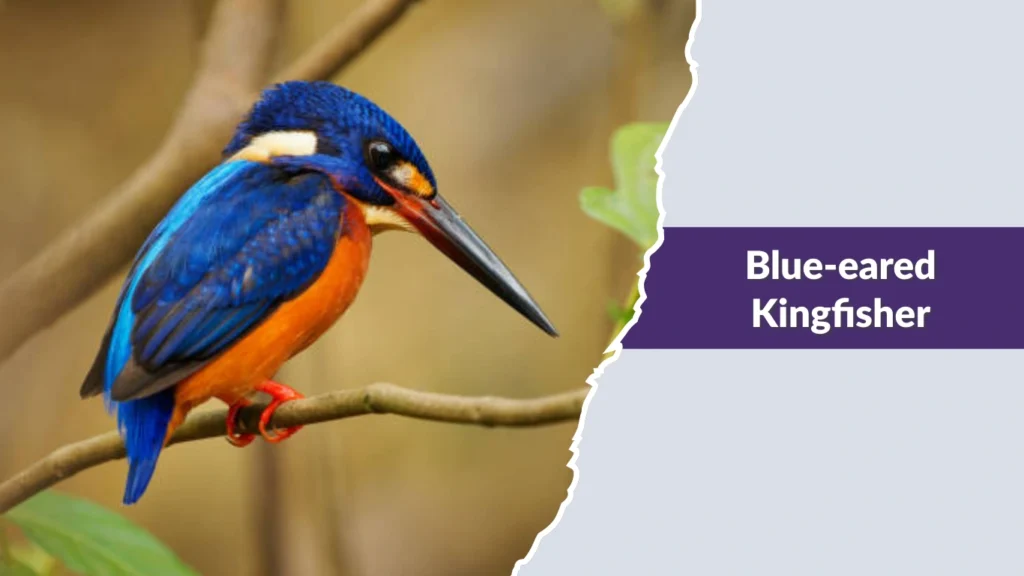
The Blue-eared Kingfisher is a small and brilliantly colored species found mainly in Southeast Asia. Often confused with the Common Kingfisher, it is distinguished by deeper blue tones and its preference for shaded forest waterways. Its shy nature makes it less frequently observed despite its vivid appearance.
Identification
- Small kingfisher with compact body
- Deep cobalt-blue upperparts
- Bright orange underparts
- Blue ear coverts instead of orange
- Long, straight black bill
Habitat
Blue-eared Kingfishers inhabit lowland forests, mangroves, forest streams, rivers, and swampy areas. They prefer quiet, shaded waterways with dense vegetation, which provide cover and suitable hunting perches. The species is more closely tied to forested habitats than many other kingfishers and is less common in open or urban areas.
Behavior
This kingfisher is generally solitary and secretive. It hunts by perching quietly near water before making a rapid dive to catch prey. Its flight is swift and direct, usually low over the water. Blue-eared Kingfishers are less vocal than some other species, producing soft, high-pitched calls.
Diet and Lifespan
The Blue-eared Kingfisher feeds mainly on small fish, aquatic insects, crustaceans, and occasionally tadpoles. In the wild, it typically lives 5–7 years, with survival closely linked to intact forest habitats and clean waterways.
6. Stork-billed Kingfisher
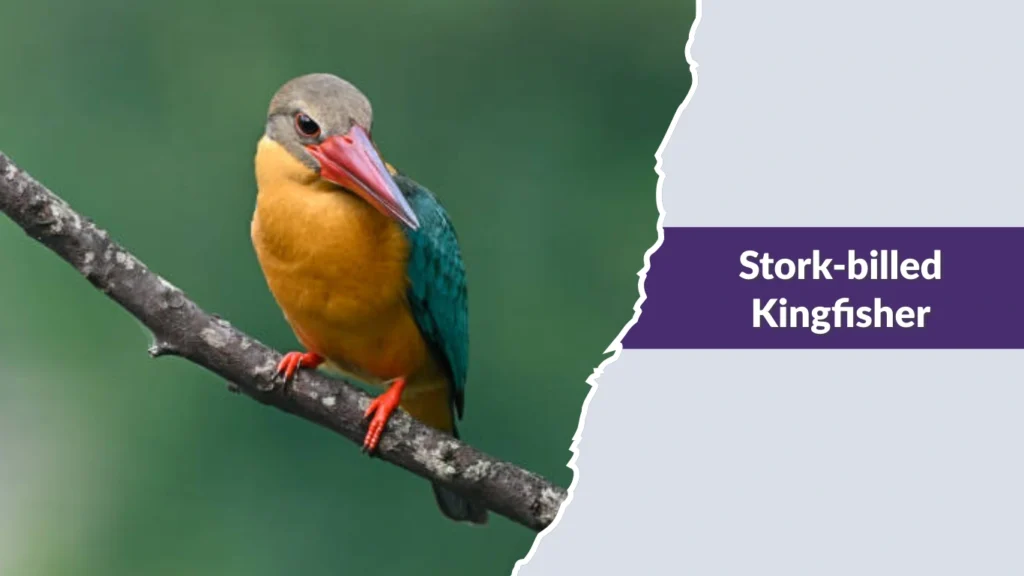
The Stork-billed Kingfisher is one of the largest kingfisher species, easily recognized by its massive bill and bold coloration. Found across South and Southeast Asia, it is an impressive bird often seen along large rivers and wetlands.
Identification
- Very large kingfisher with heavy build
- Bright blue wings and back
- Creamy white head and underparts
- Exceptionally large, thick red bill
- Short tail and strong legs
Habitat
Stork-billed Kingfishers prefer large freshwater bodies such as rivers, lakes, estuaries, mangroves, and coastal wetlands. They are often seen near slow-moving or still water with abundant fish. Tall trees, branches, or poles near water are used as hunting perches. Nesting usually takes place in riverbanks or earthen embankments.
Behavior
This species is typically solitary or seen in pairs. It hunts by sitting on a high perch and making powerful dives to catch prey. Compared to smaller kingfishers, it is less agile but very effective. Its calls are loud and resonant, often heard echoing along riverbanks.
Diet and Lifespan
Stork-billed Kingfishers mainly feed on fish, but they also eat frogs, crabs, reptiles, insects, and small mammals. In the wild, they generally live 10–15 years, benefiting from their size and reduced number of natural predators.
7. Collared Kingfisher
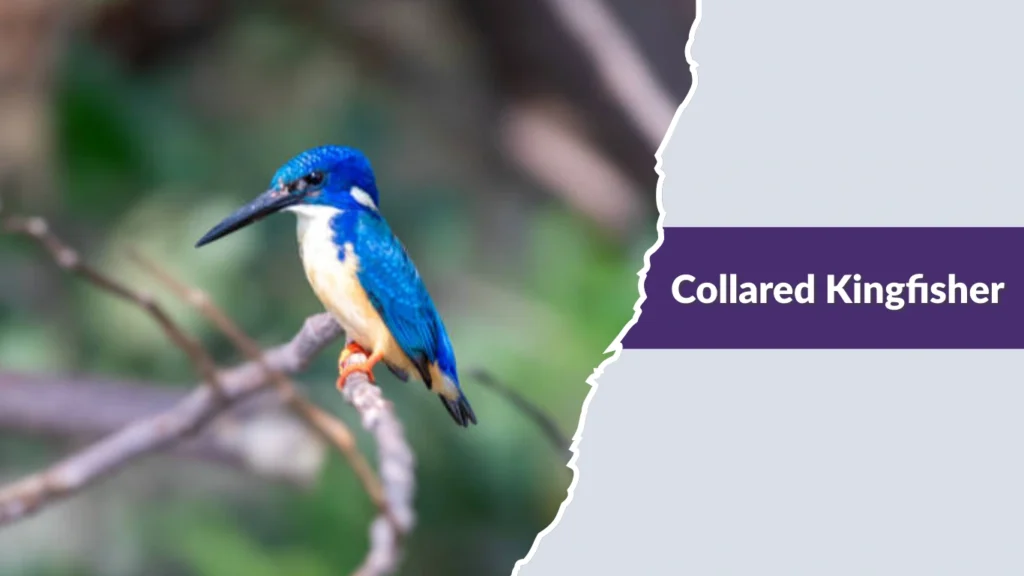
The Collared Kingfisher is a widespread and adaptable species found across coastal regions of Asia, Australia, and the Pacific islands. Known for its loud calls and tolerance of human presence, it is often seen near beaches, mangroves, and even urban areas.
Identification
- Medium-sized kingfisher with sturdy build
- Blue-green upperparts and wings
- White head, collar, and underparts
- Broad, strong black bill
- Short tail and long wings
Habitat
Collared Kingfishers are strongly associated with coastal and island environments. They inhabit mangroves, estuaries, coral reefs, beaches, lagoons, and coastal woodlands. Unlike many other kingfishers, they are less dependent on freshwater and can thrive in marine habitats. They also adapt well to parks, gardens, and urban shorelines.
Behavior
This species is bold and vocal, often announcing its presence with loud, repetitive calls. Collared Kingfishers are usually seen alone or in pairs and aggressively defend territories. They hunt by swooping down from perches to catch prey on the ground, in shallow water, or among mangrove roots.
Diet and Lifespan
Collared Kingfishers have a varied diet that includes fish, crabs, insects, lizards, small snakes, and mollusks. In the wild, they typically live 7–12 years, with their adaptability contributing to stable populations across much of their range.
8. Sacred Kingfisher
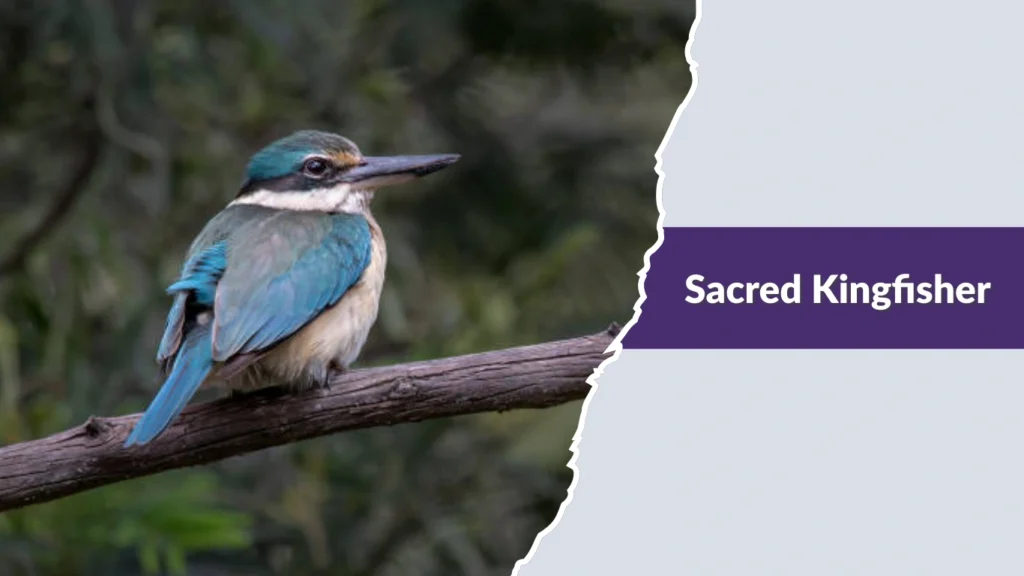
The Sacred Kingfisher is a medium-sized kingfisher widely distributed across Australia, New Zealand, and parts of Southeast Asia. It is admired for its calm behavior, striking coloration, and cultural significance in many Indigenous traditions.
Identification
- Medium-sized kingfisher with slender build
- Turquoise-blue upperparts and wings
- Buff to white underparts
- Dark eye stripe extending from bill to neck
- Long, straight black bill
Habitat
Sacred Kingfishers inhabit a wide variety of environments. They are found in open woodlands, forests, wetlands, mangroves, riverbanks, farmlands, and coastal areas. Unlike many kingfishers, they are not strictly tied to water and often hunt in dry habitats. Nesting usually occurs in tree hollows, termite mounds, or earthen banks.
Behavior
This species is usually seen alone or in pairs. Sacred Kingfishers hunt from low perches, scanning the ground or water before swooping down to capture prey. They are relatively quiet compared to other kingfishers, though sharp calls are used during breeding and territorial defense.
Diet and Lifespan
Sacred Kingfishers are carnivorous and opportunistic feeders. Their diet includes insects, beetles, grasshoppers, spiders, small reptiles, frogs, and occasionally fish. In the wild, they generally live 6–10 years, depending on habitat quality and seasonal conditions.
9. Ringed Kingfisher
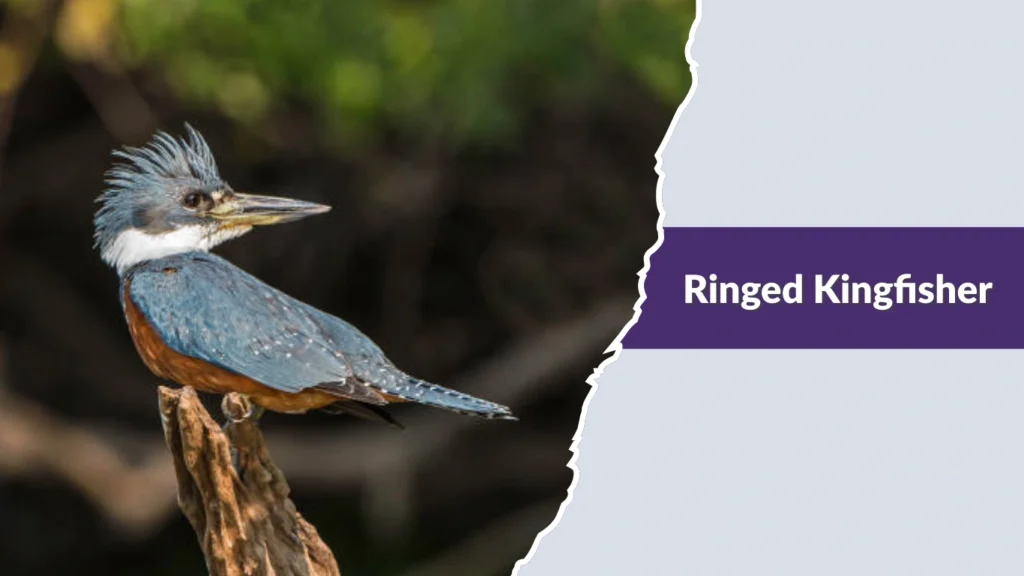
The Ringed Kingfisher is the largest kingfisher species in the Americas and is easily recognized by its powerful build and bold coloration. Commonly found along rivers and coastlines, it is a dominant presence in its aquatic habitats.
Identification
- Large, heavy-bodied kingfisher
- Blue-gray upperparts with shaggy crest
- White collar around the neck
- Rusty-brown chest band, more prominent in males
- Long, thick, pointed bill
Habitat
Ringed Kingfishers inhabit rivers, lakes, estuaries, mangroves, and coastal shorelines. They prefer open water with good visibility and abundant fish. Steep banks or cliffs near water are essential for nesting, as they excavate long burrows in earthen surfaces. They are found in both freshwater and saltwater environments.
Behavior
This species is often solitary and highly territorial. Ringed Kingfishers hunt by perching high above water before plunging forcefully to capture prey. They are loud and vocal, producing harsh, rattling calls during flight and territorial displays.
Diet and Lifespan
Ringed Kingfishers primarily feed on fish but also consume crustaceans, frogs, reptiles, insects, and occasionally small mammals. In the wild, they typically live 6–10 years, with longevity influenced by food availability and habitat stability.
10. Malachite Kingfisher
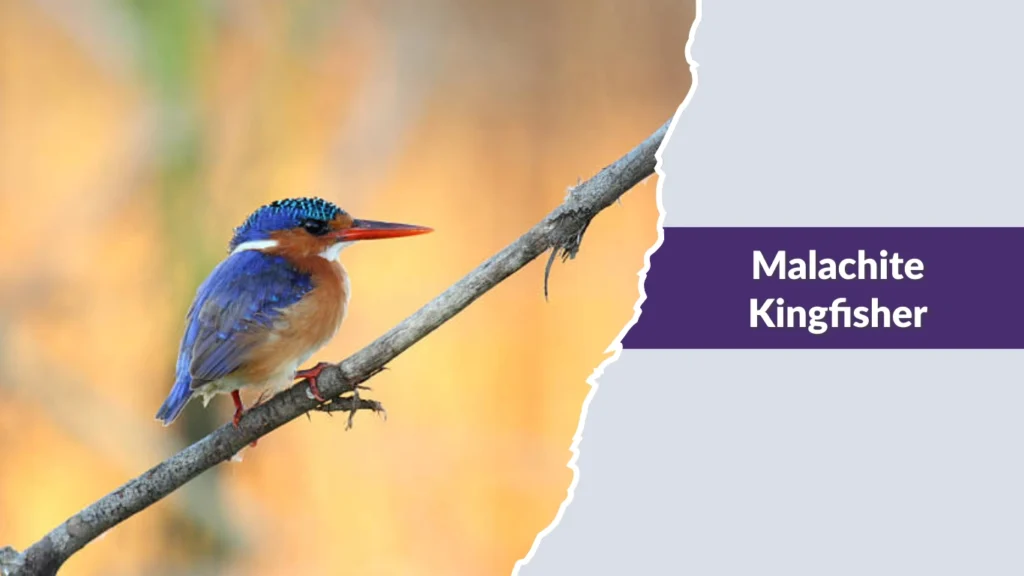
The Malachite Kingfisher is a small yet vividly colored kingfisher native to sub-Saharan Africa. Despite its tiny size, it is an energetic and efficient hunter, often seen flashing blue and orange along freshwater habitats.
Identification
- Very small kingfisher with compact body
- Bright metallic blue upperparts
- Rich orange underparts
- Short tail and rounded wings
- Long, fine black bill
Habitat
Malachite Kingfishers are closely associated with freshwater environments. They inhabit rivers, streams, lakes, ponds, marshes, and swamps with dense vegetation along the edges. They prefer calm or slow-moving water that supports small fish and aquatic insects. Nesting usually occurs in burrows dug into riverbanks or sandy ground.
Behavior
This species is usually solitary and highly active. It hunts from low perches close to the water, making quick dives to catch prey. Malachite Kingfishers are agile fliers and often move rapidly between perches. Their calls are high-pitched and sharp, though not as loud as those of larger kingfishers.
Diet and Lifespan
Malachite Kingfishers feed mainly on small fish, aquatic insects, crustaceans, and larvae. In the wild, they typically live 5–7 years, with survival closely linked to clean water and healthy wetland habitats.
11. Amazon Kingfisher
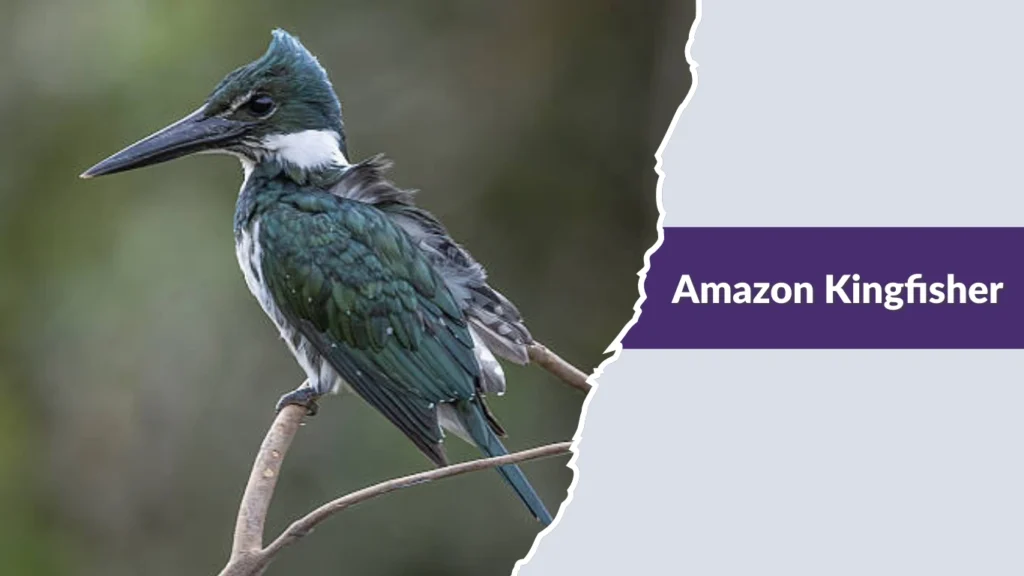
The Amazon Kingfisher is a medium-sized kingfisher native to Central and South America. It is closely related to the Green Kingfisher but is larger and more robust. Often seen perched quietly near water, it is a familiar sight along tropical rivers and wetlands.
Identification
- Medium-sized kingfisher with sturdy body
- Dark green upperparts with glossy sheen
- White collar and underparts
- Chestnut-colored chest band in males
- Long, straight, pointed black bill
Habitat
Amazon Kingfishers are found near a wide range of freshwater habitats. They commonly inhabit rivers, streams, oxbow lakes, marshes, ponds, and flooded forest edges. They prefer calm or slow-moving waters with overhanging vegetation that provides suitable perches. Nesting takes place in burrows dug into sandy or muddy riverbanks, often close to water.
Behavior
This species is usually solitary or seen in pairs. Amazon Kingfishers hunt by perching above water and diving headfirst to catch prey. They are patient hunters and may remain motionless for long periods before striking. Their calls are sharp and repetitive, often given during flight or territorial interactions.
Diet and Lifespan
Amazon Kingfishers primarily feed on small fish but also eat aquatic insects, crustaceans, tadpoles, and small amphibians. In the wild, they typically live 7–10 years, depending on habitat quality and availability of food.
12. Green Kingfisher

The Green Kingfisher is a small, compact kingfisher found from the southern United States through Central America and into northern South America. Although less brightly colored than some tropical species, it is admired for its deep green plumage and precise hunting skills. Its quiet behavior and preference for shaded waterways often make it a subtle presence along forested streams.
Identification
- Small kingfisher with compact, stocky body
- Dark green upperparts with glossy sheen
- White underparts with dark speckling on the sides
- Chestnut breast band in males
- Long, straight black bill
Habitat
Green Kingfishers inhabit a variety of freshwater environments, including rivers, streams, forest creeks, ponds, and wetlands. They prefer calm or slow-moving water with dense vegetation along the banks, which provides cover and hunting perches. Nesting typically occurs in burrows excavated in sandy or muddy riverbanks, often in quiet, undisturbed areas.
Behavior
This species is usually solitary and territorial. Green Kingfishers hunt by sitting quietly on low branches or roots overhanging the water before diving swiftly to capture prey. Their flight is fast and direct, usually low above the water. They are relatively quiet birds, using soft, high-pitched calls mainly during territorial disputes.
Diet and Lifespan
Green Kingfishers feed mainly on small fish, aquatic insects, crustaceans, and occasionally tadpoles. In the wild, they typically live 6–9 years, with survival closely linked to water quality and availability of suitable nesting sites.
13. Giant Kingfisher
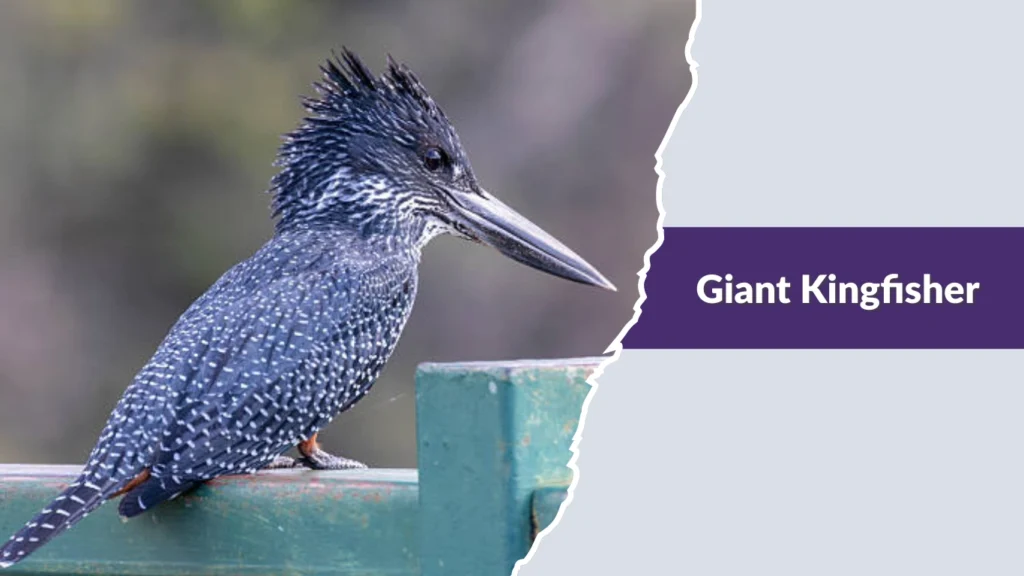
The Giant Kingfisher is the largest kingfisher species in Africa and is easily recognized by its impressive size and striking black-and-white plumage. Often seen along rivers and lakes, it is a powerful and confident hunter with a commanding presence.
Identification
- Very large kingfisher with heavy, robust body
- Black-and-white plumage with bold spotting
- Large head with shaggy crest
- Long, thick black bill
- Strong legs and short tail
Habitat
Giant Kingfishers are found near large freshwater bodies such as rivers, lakes, reservoirs, and wetlands. They prefer open water with abundant fish and nearby trees or rocks for perching. Steep riverbanks are essential for nesting, as they excavate long tunnels in earthen surfaces.
Behavior
This species is usually solitary or seen in pairs. Giant Kingfishers hunt by perching above water and plunging forcefully to seize prey. They are patient hunters and may remain motionless for long periods. Their calls are loud, harsh, and rattling, often heard echoing across water bodies.
Diet and Lifespan
Giant Kingfishers feed mainly on fish but also consume frogs, crustaceans, reptiles, and large aquatic insects. In the wild, they typically live 8–12 years, benefiting from their large size and strong hunting abilities.
14. Grey-headed Kingfisher
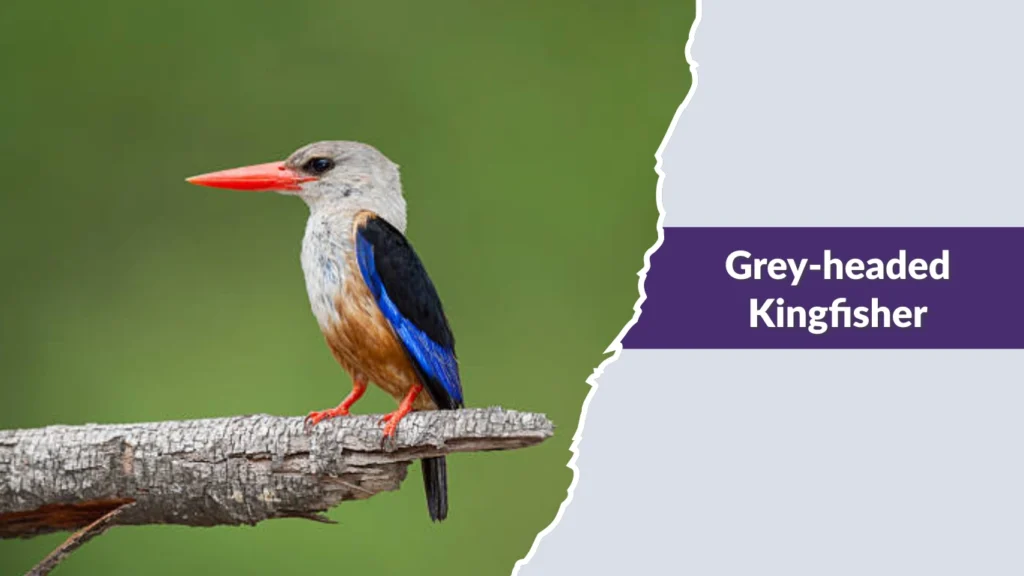
The Grey-headed Kingfisher is a colorful and adaptable species found across sub-Saharan Africa. Known for its bright plumage and pleasant calls, it is often seen in open woodlands and savannas rather than strictly aquatic environments.
Identification
- Medium-sized kingfisher with slender body
- Pale grey head and nape
- Bright blue wings and back
- Reddish-orange underparts
- Long, straight red bill
Habitat
Grey-headed Kingfishers inhabit a wide range of habitats, including savannas, open woodlands, grasslands, forest edges, farmlands, and gardens. They are not strongly dependent on water and are often found far from rivers or lakes. Nesting usually occurs in tree cavities or termite mounds.
Behavior
This species is usually seen alone or in pairs. It hunts mainly from perches, swooping down to capture prey on the ground. Grey-headed Kingfishers are active and alert birds, often moving between exposed perches. Their calls are loud and musical, especially during the breeding season.
Diet and Lifespan
Grey-headed Kingfishers are primarily insectivorous. Their diet includes beetles, grasshoppers, caterpillars, spiders, small lizards, and occasionally small rodents. In the wild, they typically live 6–10 years, depending on habitat conditions and food availability.
15. Woodland Kingfisher
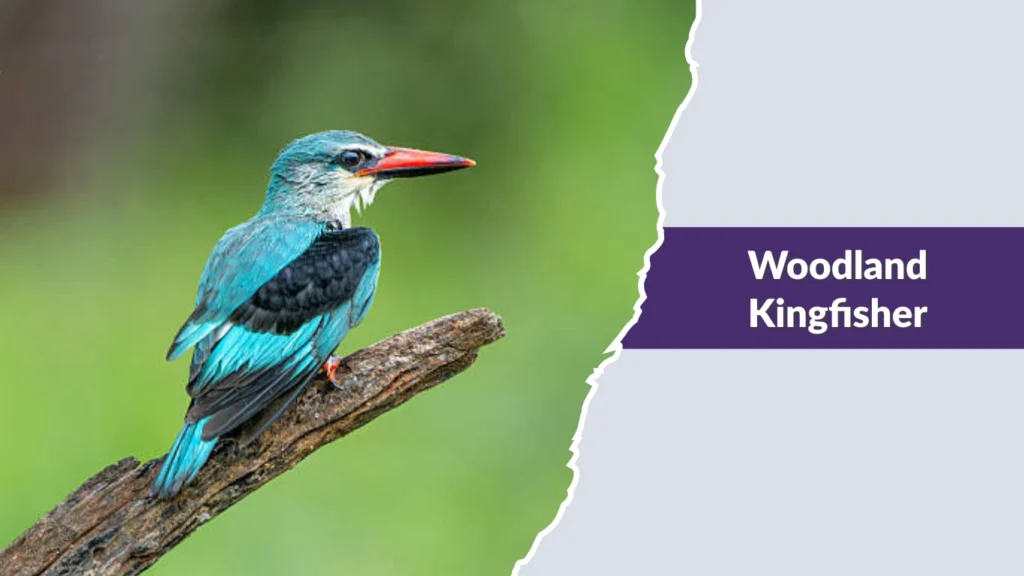
The Woodland Kingfisher is a strikingly beautiful and vocal kingfisher species found across much of sub-Saharan Africa. Known for its brilliant blue wings and loud, ringing calls, it is often associated with wooded habitats rather than open water.
Identification
- Medium-sized kingfisher with sturdy build
- Bright turquoise-blue wings and back
- White head and underparts
- Distinct dark eye stripe
- Long, straight red bill
Habitat
Woodland Kingfishers inhabit open woodlands, forest edges, savannas, riverine forests, and sometimes gardens or parks. They are not strictly tied to water and can be found far from rivers or lakes. Nesting usually occurs in tree cavities or termite mounds, providing shelter and protection.
Behavior
This species is usually seen alone or in pairs. Woodland Kingfishers are highly territorial during the breeding season and use loud, ringing calls to defend their territories. They hunt from elevated perches, swooping down to capture prey on the ground or among foliage.
Diet and Lifespan
Woodland Kingfishers primarily feed on insects such as beetles, grasshoppers, caterpillars, and termites. They also eat spiders, small reptiles, and occasionally frogs. In the wild, they typically live 7–12 years, depending on environmental conditions and habitat stability.
16. Black-capped Kingfisher
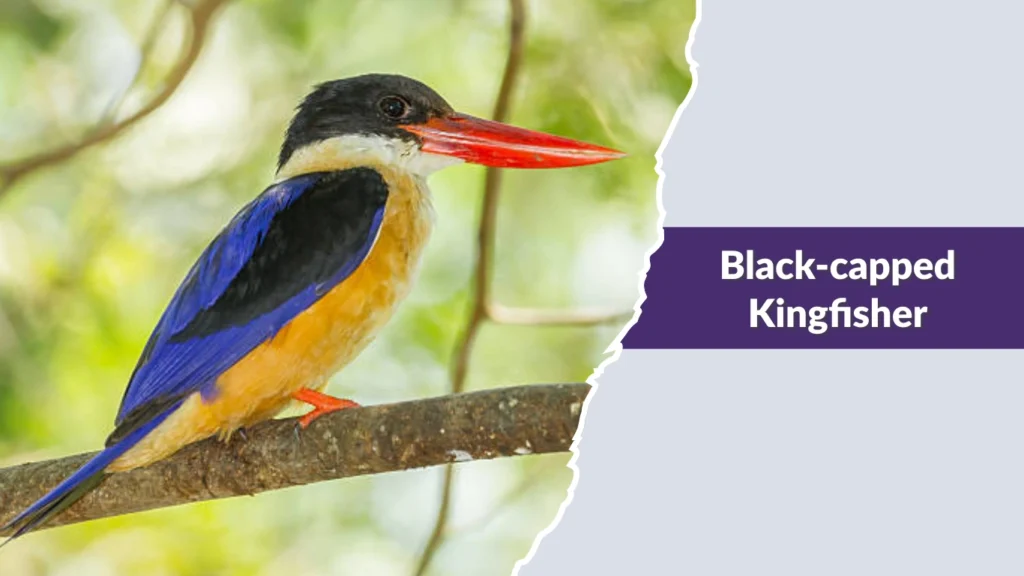
The Black-capped Kingfisher is a large and vividly colored kingfisher found mainly in coastal and lowland areas of East and Southeast Asia. With its bright turquoise wings, white underparts, and striking black cap, it is one of the most visually distinctive kingfisher species.
Identification
- Large kingfisher with strong, upright posture
- Bright turquoise-blue wings and back
- White underparts with buff tones on the sides
- Bold black cap and face markings
- Long, thick red bill
Habitat
Black-capped Kingfishers are commonly associated with coastal environments. They inhabit mangroves, estuaries, tidal flats, coastal lagoons, and river mouths. During migration or outside the breeding season, they may also be found along inland rivers, lakes, and rice fields. They rely on open areas with scattered perches for hunting.
Behavior
This species is usually solitary or seen in pairs. It hunts by watching from exposed perches before diving to catch prey on the ground or in shallow water. Black-capped Kingfishers are strong fliers and may travel long distances during migration. Their calls are loud, sharp, and repetitive, often heard in flight.
Diet and Lifespan
Black-capped Kingfishers feed on a wide variety of prey, including fish, crabs, insects, lizards, frogs, and small mammals. In the wild, they typically live 7–12 years, depending on habitat quality and food availability.
17. Rufous-collared Kingfisher
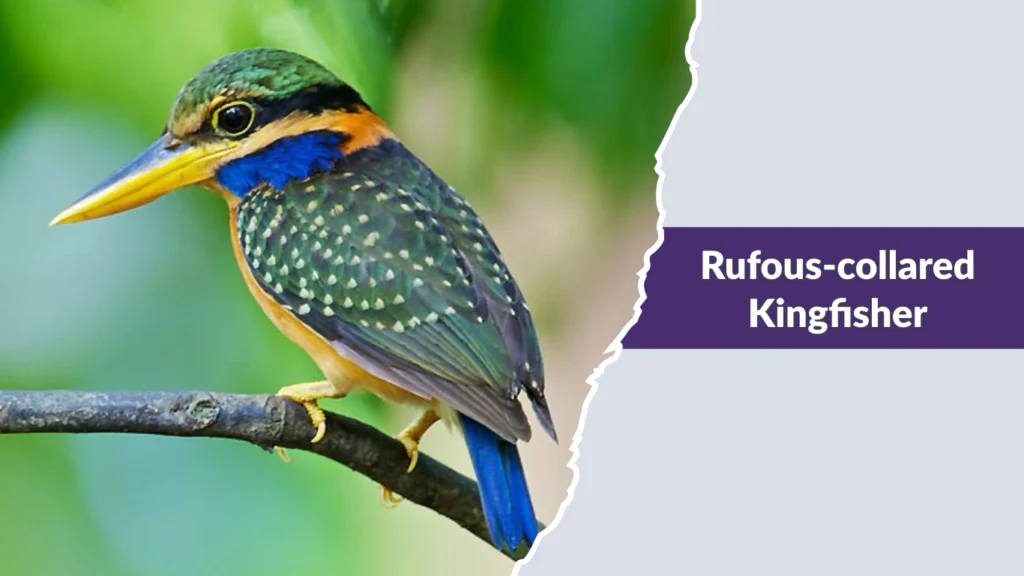
The Rufous-collared Kingfisher is a medium-sized, forest-dwelling kingfisher native to Southeast Asia. It is known for its rich chestnut and rufous tones, shy nature, and preference for dense woodland habitats, making it less commonly seen than more open-area kingfishers.
Identification
- Medium-sized kingfisher with compact body
- Deep blue upperparts and wings
- Rich rufous collar and underparts
- Dark head with contrasting pale throat
- Strong, straight black bill
Habitat
Rufous-collared Kingfishers primarily inhabit tropical and subtropical forests, forest edges, and wooded valleys. They are often found near streams or damp forest floors but are not strictly dependent on open water. Dense vegetation provides cover for hunting and nesting. Nesting typically occurs in tree cavities or earthen banks within forested areas.
Behavior
This species is generally solitary and secretive. It hunts from low perches, watching quietly before swooping down to catch prey on the ground or near water. Rufous-collared Kingfishers are relatively quiet, though soft calls may be heard during the breeding season or territorial encounters.
Diet and Lifespan
Rufous-collared Kingfishers feed mainly on insects, beetles, earthworms, spiders, small reptiles, and occasionally amphibians. In the wild, they typically live 6–9 years, with survival closely tied to intact forest habitats and minimal disturbance.
18. Brown-winged Kingfisher
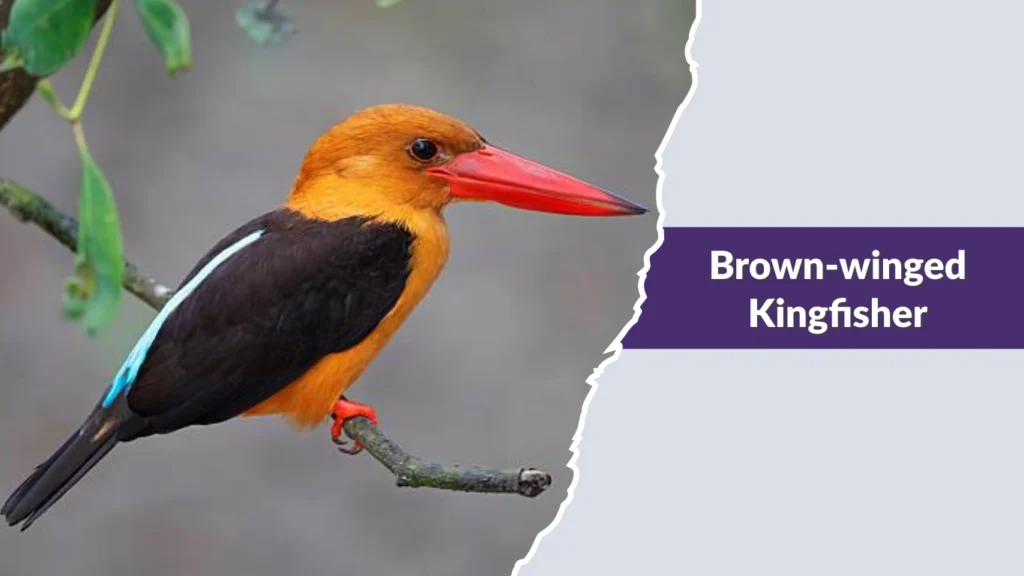
The Brown-winged Kingfisher is a medium-sized, forest-associated kingfisher found across South and Southeast Asia. It is less brightly colored than many other kingfishers, but its rich brown wings, sturdy build, and calm hunting style make it distinctive. This species is often encountered near shaded streams and forest edges.
Identification
- Medium-sized kingfisher with solid build
- Deep brown wings and back
- Chestnut to rufous head and underparts
- Pale throat patch
- Strong, straight red bill
Habitat
Brown-winged Kingfishers favor forested habitats close to water. They are commonly found along forest streams, rivers, shaded canals, mangroves, and wooded wetlands. Dense vegetation is important for cover, while nearby water bodies provide feeding opportunities. Nesting usually occurs in burrows dug into earthen banks or occasionally in tree cavities.
Behavior
This species is generally solitary or seen in pairs. It hunts from low to mid-level perches, watching patiently before making a short, direct dive or swoop to capture prey. Brown-winged Kingfishers are relatively quiet birds, using soft calls mainly during breeding or territorial defense.
Diet and Lifespan
Brown-winged Kingfishers are carnivorous feeders. Their diet includes fish, crabs, aquatic insects, frogs, and small reptiles. In the wild, they typically live 7–12 years, depending on habitat quality, water cleanliness, and human disturbance.
19. Oriental Dwarf Kingfisher
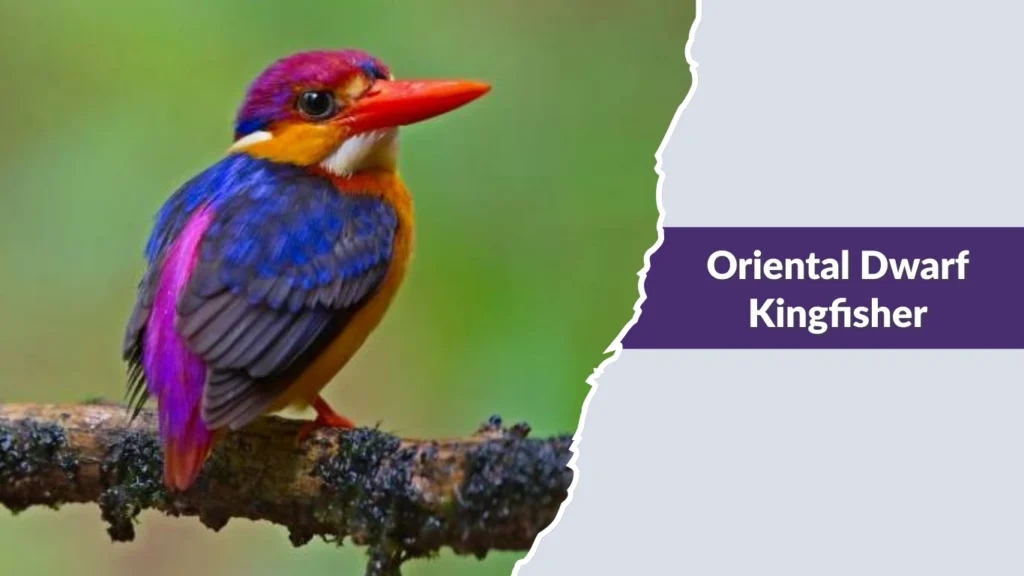
The Oriental Dwarf Kingfisher is one of the smallest and most vividly colored kingfishers in the world. Native to South and Southeast Asia, it is famous for its brilliant mix of orange, purple, blue, and pink hues. Due to its preference for dense forests, it is often difficult to spot despite its striking appearance.
Identification
- Very small kingfisher with compact body
- Bright orange head and underparts
- Vivid blue, purple, and pink upperparts
- Short tail and rounded wings
- Long, slender red bill
Habitat
Oriental Dwarf Kingfishers inhabit tropical and subtropical forests, forest edges, bamboo groves, and wooded stream valleys. They prefer shaded, humid environments with dense undergrowth and nearby water sources. Nesting typically occurs in earthen banks, termite mounds, or rotting tree trunks within forested areas.
Behavior
This species is secretive and usually seen alone. It hunts from low perches, swooping down quickly to capture prey on the ground or near water. Oriental Dwarf Kingfishers are fast and agile but relatively quiet, with soft calls that are rarely heard unless close by.
Diet and Lifespan
Oriental Dwarf Kingfishers feed mainly on insects, beetles, ants, spiders, worms, small crabs, and occasionally tiny fish or frogs. In the wild, they typically live 5–7 years, with survival closely tied to undisturbed forest habitats.
20. Shining Blue Kingfisher
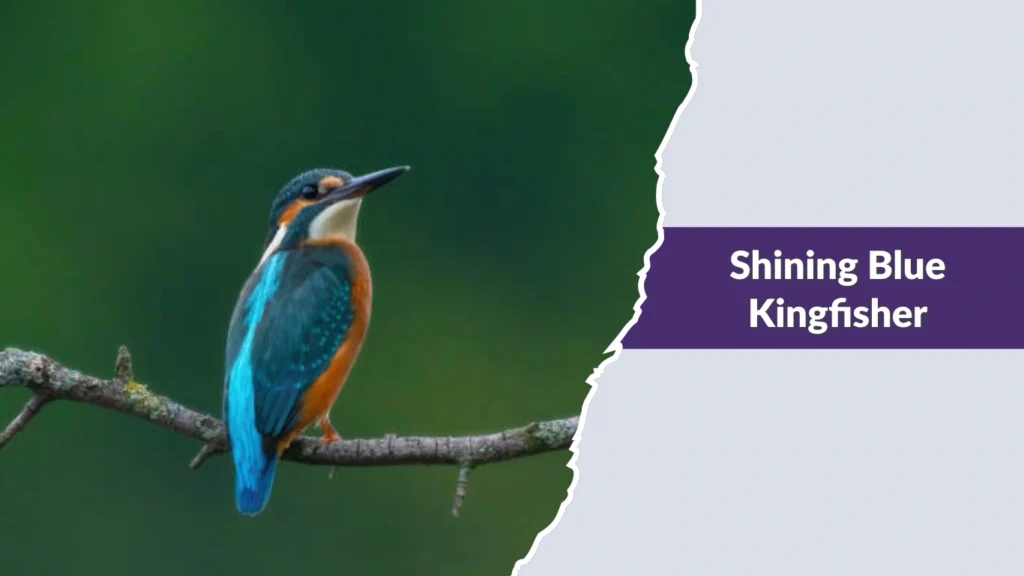
The Shining Blue Kingfisher is a small, brilliantly colored kingfisher native to Southeast Asia. Known for its deep iridescent blue plumage and shy nature, it is typically found along shaded forest streams where it blends into dark, leafy surroundings.
Identification
- Small kingfisher with compact body
- Deep iridescent blue upperparts
- Rich orange underparts
- Dark head with subtle facial markings
- Long, slender black bill
Habitat
Shining Blue Kingfishers prefer lowland and foothill forests with clear, slow-moving streams. They are commonly found along shaded rivers, creeks, and swampy forest wetlands. Dense vegetation is essential, providing both hunting cover and nesting sites. Nesting usually occurs in earthen banks or soft soil near water.
Behavior
This species is secretive and often remains hidden in dense foliage. It hunts by perching low above water and making quick dives to capture prey. Shining Blue Kingfishers are fast and agile but generally quiet, with soft calls that are rarely heard unless nearby.
Diet and Lifespan
Shining Blue Kingfishers feed mainly on small fish, aquatic insects, crustaceans, and larvae. In the wild, they typically live 5–7 years, with survival closely linked to clean water and intact forest habitats.
21. Silvery Kingfisher
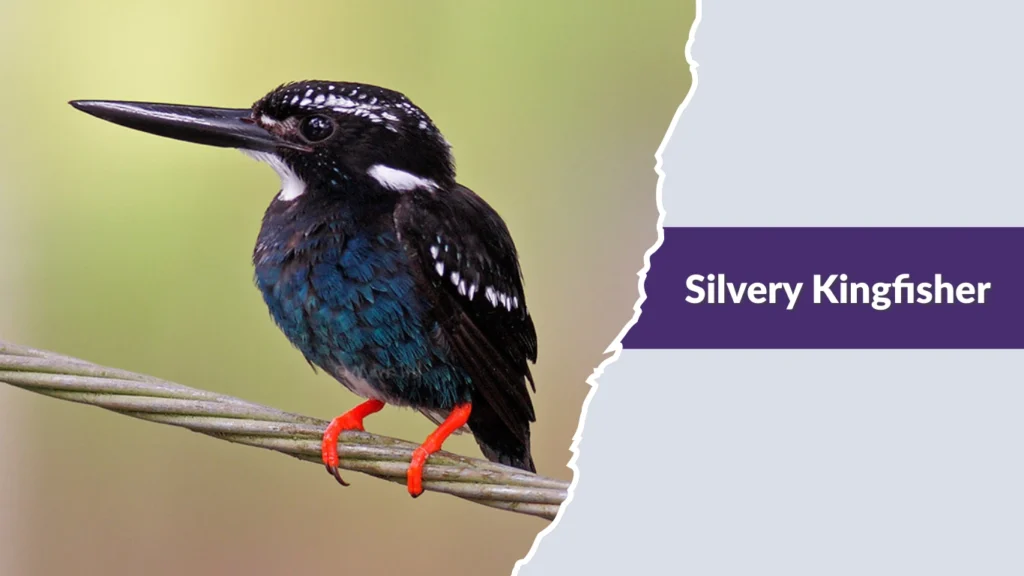
The Silvery Kingfisher is a rare and striking kingfisher species endemic to the Philippines. It is admired for its pale, silvery-blue plumage and compact body, but it is also one of the least-known kingfishers due to its restricted range and elusive behavior.
Identification
- Small to medium-sized kingfisher
- Pale silvery-blue upperparts
- White underparts with subtle bluish tones
- Large head with short neck
- Strong, straight black bill
Habitat
Silvery Kingfishers inhabit lowland tropical forests, particularly areas near slow-moving streams, rivers, and forest wetlands. They prefer dense, undisturbed forest with thick vegetation along watercourses. Because of ongoing deforestation, suitable habitat has become increasingly fragmented, limiting their distribution.
Behavior
This species is shy and secretive, usually seen alone. It hunts from low perches close to water, making short, direct dives to capture prey. Very little is known about its breeding behavior, but it is believed to nest in earthen banks or forested stream edges. Vocalizations are soft and infrequent.
Diet and Lifespan
Silvery Kingfishers primarily feed on small fish, aquatic insects, crustaceans, and larvae. Due to limited studies, exact lifespan is not well documented, but it is estimated to be around 5–8 years in the wild, depending on habitat conditions.
22. Hook-billed Kingfisher
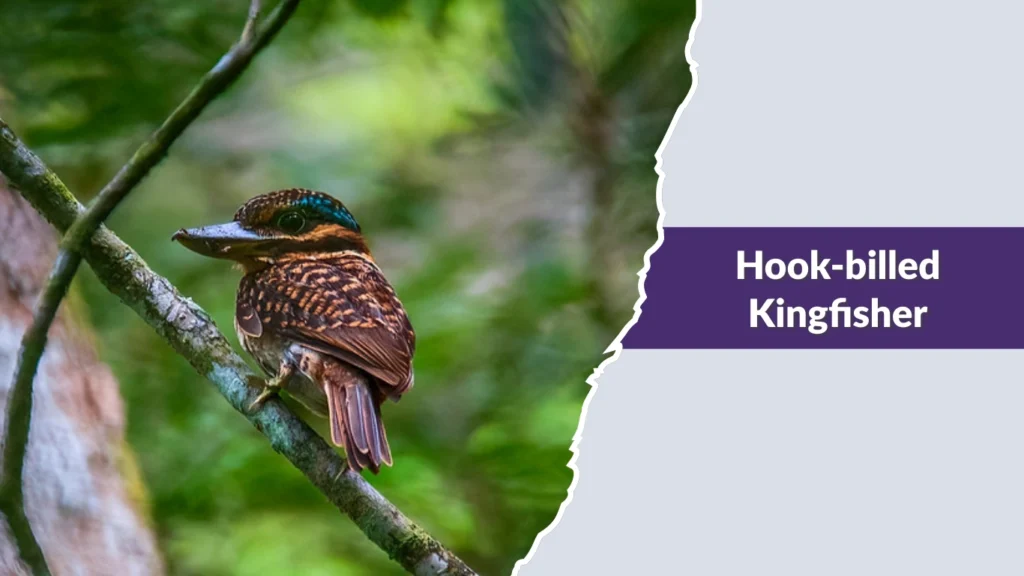
The Hook-billed Kingfisher is a large, forest-dwelling kingfisher native to the Philippines. It is named for its unusually heavy, hooked bill, which sets it apart from other kingfishers and reflects its preference for terrestrial prey rather than fish.
Identification
- Large kingfisher with robust body
- Pale bluish-gray upperparts
- Creamy white underparts
- Massive, strongly hooked red bill
- Large head with short neck
Habitat
Hook-billed Kingfishers inhabit lowland and foothill tropical forests, forest edges, and wooded river valleys. They are less dependent on open water compared to many kingfishers and are often found deep within forested areas. Nesting is believed to occur in tree cavities or earthen banks, though detailed information is limited due to the species’ elusive nature.
Behavior
This species is solitary and secretive. It spends much of its time perched quietly in the forest canopy or mid-level branches, scanning the ground for prey. Hook-billed Kingfishers are relatively inactive compared to fish-eating species and rely on stealth rather than rapid dives. Vocalizations are loud but infrequent.
Diet and Lifespan
Hook-billed Kingfishers primarily feed on insects, beetles, large arthropods, small reptiles, amphibians, and occasionally small mammals. Fish make up little of their diet. Their lifespan is not well documented, but it is estimated to be 6–10 years in the wild, depending on habitat quality.
23. Lazuli Kingfisher
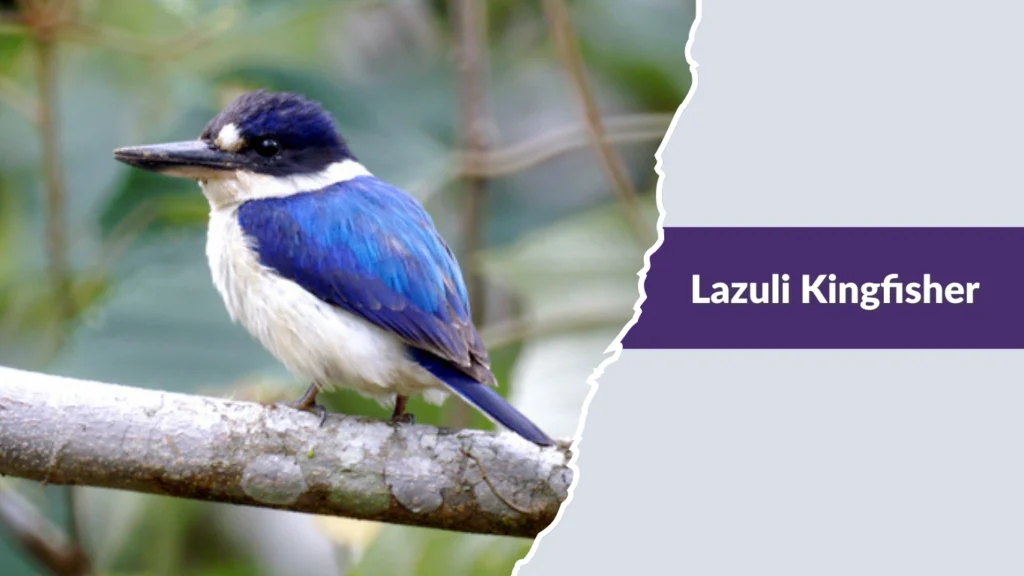
The Lazuli Kingfisher is a small, brilliantly colored kingfisher endemic to the Philippines. It is admired for its intense cobalt-blue plumage and compact form. Due to its limited range and preference for dense forest habitats, it is considered rare and is seldom seen in the wild.
Identification
- Small kingfisher with compact body
- Deep cobalt-blue upperparts and wings
- White to pale buff underparts
- Short tail and rounded wings
- Strong, straight black bill
Habitat
Lazuli Kingfishers inhabit lowland tropical rainforests, forest edges, and wooded areas near streams and rivers. They favor shaded environments with dense vegetation and minimal disturbance. Most sightings occur near freshwater sources within intact forest ecosystems, which are essential for feeding and nesting.
Behavior
This species is shy and secretive, usually observed alone. It hunts from low to mid-level perches, making short, swift dives to capture prey. Lazuli Kingfishers are generally quiet, producing soft calls that are rarely heard unless at close range. Little is known about their breeding behavior due to their elusive nature.
Diet and Lifespan
Lazuli Kingfishers feed mainly on insects, beetles, spiders, small crustaceans, and occasionally tiny fish or amphibians. Their exact lifespan is not well documented, but it is estimated to be around 5–8 years in the wild, with survival closely tied to forest conservation.
24. Chocolate-backed Kingfisher
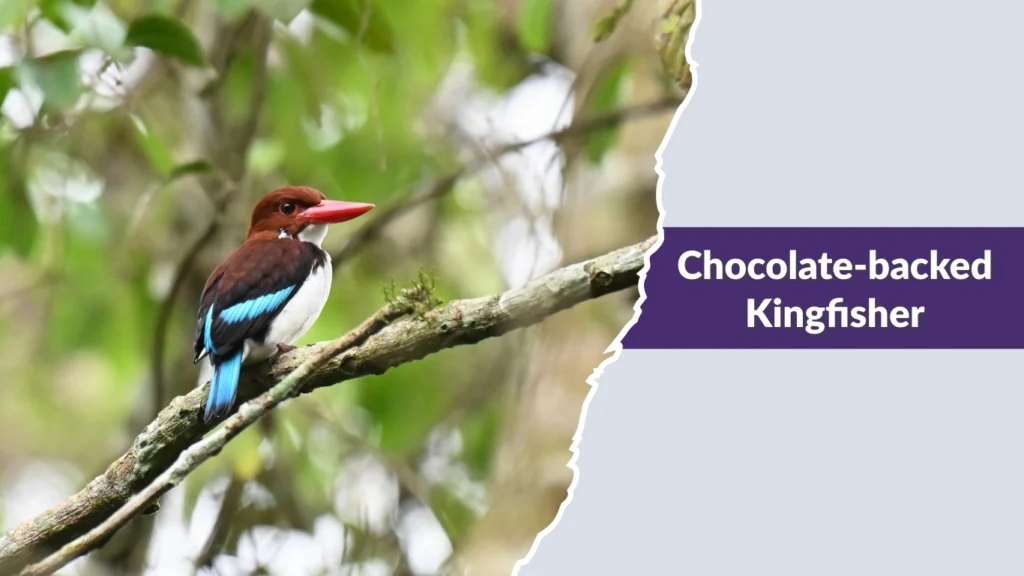
The Chocolate-backed Kingfisher is a medium-sized, forest-dwelling kingfisher found in parts of Central Africa. It is known for its rich dark-brown upperparts, contrasting pale underparts, and preference for dense woodland habitats rather than open waterways.
Identification
- Medium-sized kingfisher with sturdy body
- Dark chocolate-brown back and wings
- Pale buff to whitish underparts
- Large head with short neck
- Strong, straight black bill
Habitat
Chocolate-backed Kingfishers inhabit lowland tropical forests, forest edges, and wooded river valleys. They are often found near shaded streams, swamps, and damp forest floors but are not strictly tied to open water. Dense vegetation is essential, offering cover for hunting and nesting. They typically nest in tree cavities or earthen banks within forested areas.
Behavior
This species is usually solitary and secretive. It spends long periods perched quietly, scanning the ground or low vegetation for prey. Rather than diving into water, it often swoops down to capture prey on land. Calls are low and infrequent, making the bird easy to overlook in dense forest.
Diet and Lifespan
Chocolate-backed Kingfishers primarily feed on insects, beetles, caterpillars, spiders, small reptiles, and occasionally amphibians. In the wild, they are believed to live 6–10 years, with survival closely linked to intact forest habitats and minimal human disturbance.
25. Mountain Kingfisher
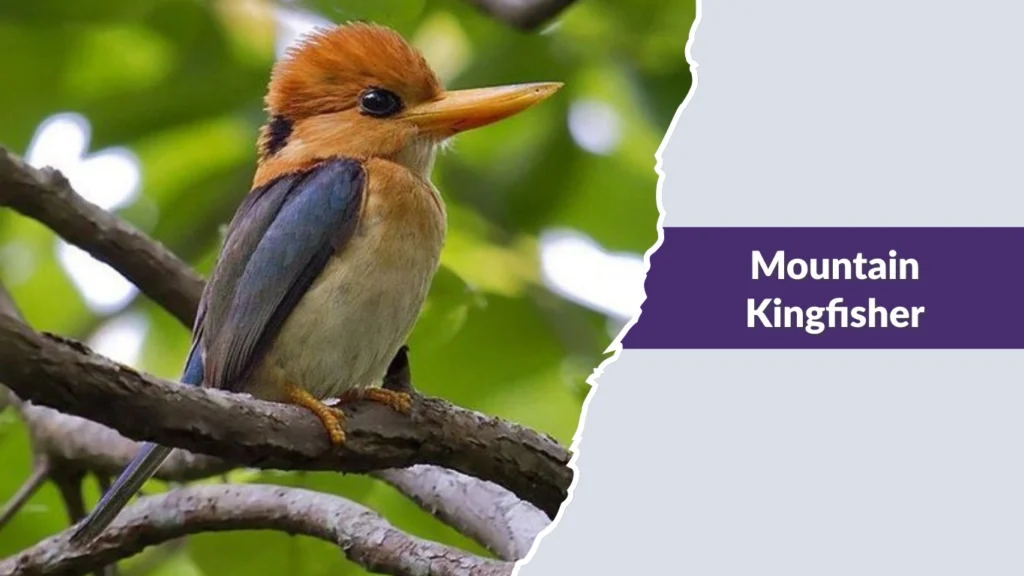
The Mountain Kingfisher is a medium-sized kingfisher species native to the highland forests of New Guinea. Unlike many kingfishers that favor lowland rivers or coasts, this species is adapted to cooler, mountainous environments and fast-flowing streams. Its more subdued coloration helps it blend into rocky and forested landscapes.
Identification
- Medium-sized kingfisher with sturdy body
- Dark blue to bluish-black upperparts
- White throat and underparts
- Subtle spotting on wings and back
- Strong, straight black bill
Habitat
Mountain Kingfishers inhabit montane forests, highland valleys, and fast-flowing mountain streams, usually at higher elevations. They prefer clear, rocky streams surrounded by dense forest cover. These habitats provide suitable perches, nesting sites, and a steady supply of aquatic prey. Nesting typically occurs in earthen banks or natural cavities near streams.
Behavior
This species is generally solitary and territorial. It hunts from rocks or low branches near fast-moving water, diving quickly to catch prey. Mountain Kingfishers are strong fliers but tend to stay close to their preferred stream habitats. They are relatively quiet birds, with soft calls that are rarely heard.
Diet and Lifespan
Mountain Kingfishers feed mainly on small fish, aquatic insects, crustaceans, and larvae found in mountain streams. Their lifespan is not well documented, but it is estimated to be around 6–9 years in the wild, depending on habitat stability and environmental conditions.
FAQs
What are kingfishers best known for?
Kingfishers are best known for their bright plumage and expert fishing skills. Many species hunt by diving headfirst into water to catch fish with remarkable speed and accuracy.
Do all kingfishers eat fish?
No, not all kingfishers rely on fish. While many species feed mainly on fish, others eat insects, crustaceans, reptiles, amphibians, and small mammals, especially forest-dwelling and terrestrial kingfishers.
Where are kingfishers commonly found?
Kingfishers are found on every continent except Antarctica. They inhabit rivers, lakes, wetlands, mangroves, forests, coastal areas, and even dry woodlands, depending on the species.
Are kingfishers migratory birds?
Some kingfisher species are migratory, moving seasonally in search of food or suitable breeding areas. Others are resident birds that remain in the same region year-round.
How do kingfishers nest?
Most kingfishers nest in burrows dug into riverbanks, sandy soil, or termite mounds. A few species use tree cavities instead. Both parents usually help with nesting duties.
