
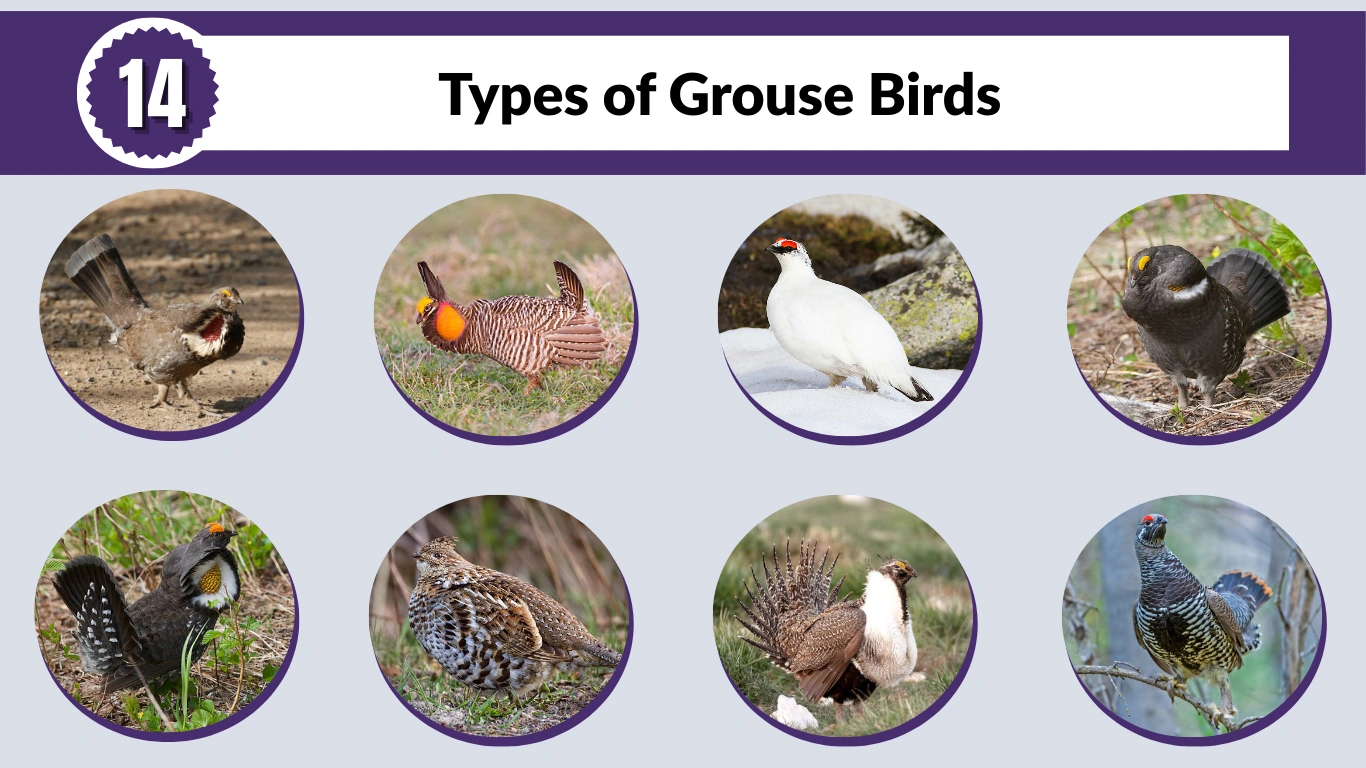
Grouse birds are fascinating ground-dwelling species known for their camouflage, seasonal plumage changes, and dramatic courtship displays. Found across grasslands, forests, mountains, and tundra, these birds are closely tied to specific habitats and ecosystems. Many species rely on wide, undisturbed landscapes, making them important indicators of environmental health. This guide explores 14 types of grouse birds, highlighting their key traits, behaviors, and habitats. Whether you are interested in wildlife, bird identification, or natural ecosystems, understanding grouse offers valuable insight into the balance of nature and habitat conservation.
1. Greater Sage-Grouse
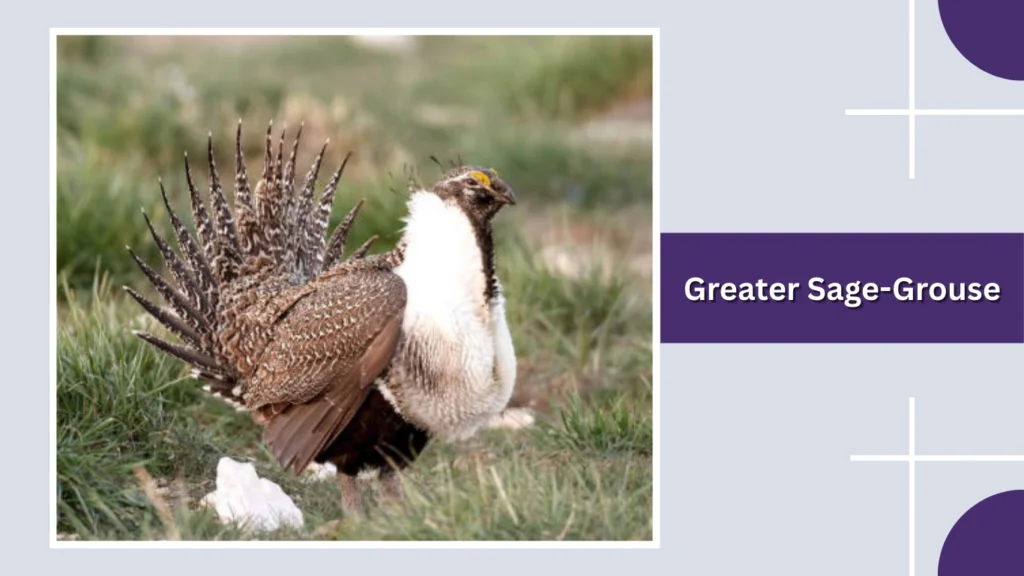
The Greater Sage-Grouse is the largest grouse species in North America and is closely tied to sagebrush ecosystems. Known for its dramatic mating displays and dependence on open landscapes, this bird is an important indicator of healthy sagebrush habitats.
Identification
- Large, round-bodied bird
- Males have spiky tail feathers and yellow eye combs
- Prominent white ruff on the chest (males)
- Olive-brown and gray mottled plumage
- Long, pointed tail
Habitat
Greater Sage-Grouse live almost exclusively in sagebrush plains, shrublands, and open basins of the western United States and southern Canada. They rely heavily on sagebrush year-round for food, cover, and nesting, making them highly sensitive to habitat loss.
Behaviors
Males are famous for their elaborate courtship displays performed on open mating grounds called leks. During these displays, they fan their tails, inflate chest air sacs, and produce popping sounds. Outside the breeding season, sage-grouse are generally quiet and well-camouflaged.
Diet
Sagebrush leaves make up the majority of their diet, especially in winter. During spring and summer, they also eat grasses, forbs, flowers, and insects, which are particularly important for growing chicks.
Lifespan
Greater Sage-Grouse typically live 3–6 years in the wild, though some individuals may survive longer under favorable conditions.
2. Gunnison Sage-Grouse
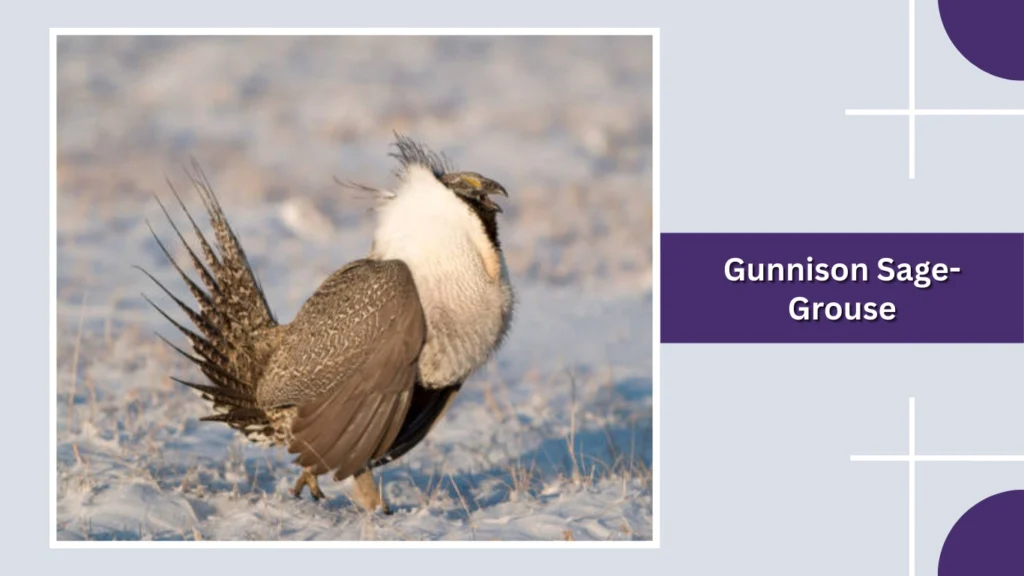
The Gunnison Sage-Grouse is a rare and localized grouse species found only in southwestern Colorado and southeastern Utah. Similar in appearance to the Greater Sage-Grouse, it is slightly smaller and is best known for its unique courtship displays and strong dependence on intact sagebrush landscapes.
Identification
- Medium to large, round-bodied bird
- Males have long, pointed tail feathers
- Distinctive white chest ruff on males
- Yellow eye combs above the eyes
- Gray-brown mottled plumage for camouflage
Habitat
Gunnison Sage-Grouse inhabit high-elevation sagebrush valleys, basins, and shrublands. They require large, continuous sagebrush ecosystems for feeding, nesting, and shelter. Because of their limited range, habitat fragmentation poses a serious threat to their survival.
Behaviors
Males gather on traditional leks each spring to perform courtship displays. These displays include tail fanning, chest inflation, and a series of low-pitched popping sounds that differ from those of the Greater Sage-Grouse. Outside the breeding season, these birds are generally secretive and difficult to spot.
Diet
Their diet is dominated by sagebrush leaves, especially in winter. During warmer months, they also consume grasses, wildflowers, and insects, which are essential for chick development.
Lifespan
Gunnison Sage-Grouse typically live between 3 and 5 years in the wild, though survival rates vary depending on habitat quality and environmental conditions.
3. Greater Prairie-Chicken
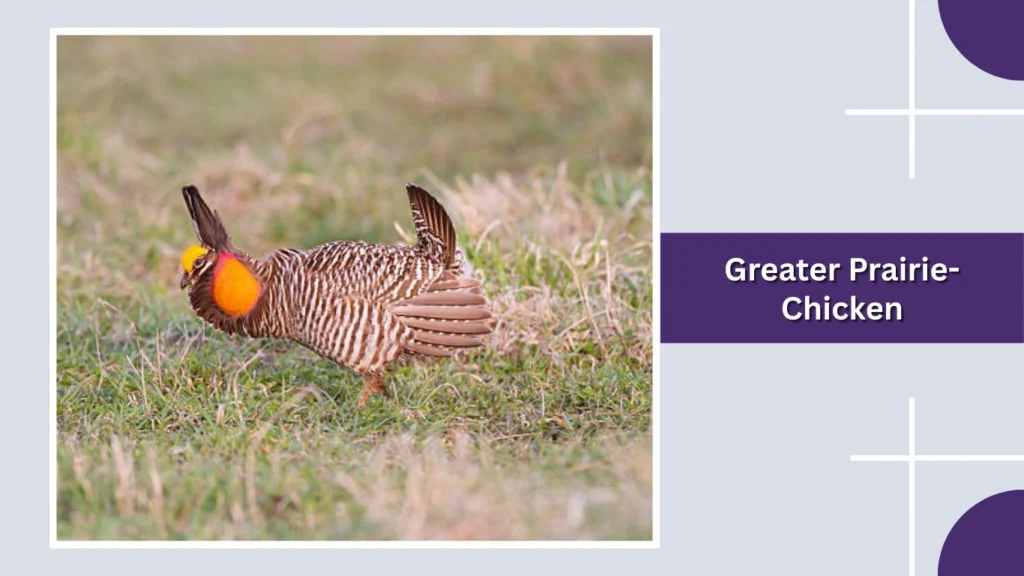
The Greater Prairie-Chicken is a grassland grouse species famous for its booming courtship displays and strong ties to native prairies. Once widespread, it now survives mainly in protected grassland areas, where it plays an important role in prairie ecosystems.
Identification
- Medium-sized, rounded body
- Males have orange air sacs on the neck
- Short, rounded tail
- Barred brown and black plumage
- Yellow eye combs above the eyes
Habitat
Greater Prairie-Chickens inhabit tallgrass and mixed-grass prairies, grasslands, and open fields with native vegetation. They require large, open landscapes for mating displays and nesting, making them sensitive to habitat fragmentation and agricultural expansion.
Behaviors
Males perform dramatic courtship displays on open areas called leks. During these displays, they inflate their orange neck sacs, stomp their feet, and produce deep booming calls. Outside the breeding season, prairie-chickens form small flocks and are more secretive.
Diet
Their diet includes seeds, grains, leaves, buds, insects, and berries. Insects are especially important for chicks during early development, providing essential protein.
Lifespan
Greater Prairie-Chickens typically live 3–6 years in the wild, though survival depends heavily on habitat quality and predator pressure.
4. Lesser Prairie-Chicken
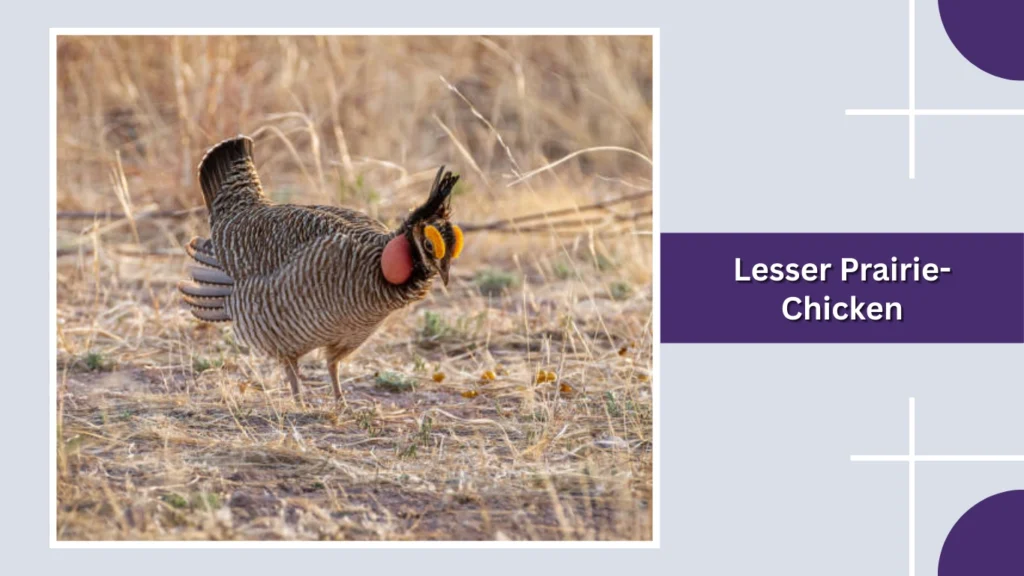
The Lesser Prairie-Chicken is a distinctive grouse species of the southern Great Plains, known for its colorful courtship displays and reliance on open grassland habitats. It is smaller and more restricted in range than its close relative, the Greater Prairie-Chicken.
Identification
- Medium-sized, rounded body
- Males have bright reddish-orange air sacs on the neck
- Short, rounded tail
- Finely barred brown, tan, and black plumage
- Yellow eye combs
Habitat
Lesser Prairie-Chickens inhabit shortgrass and mixed-grass prairies, sand sagebrush areas, and shrub-dominated grasslands. They require large, open tracts of native grassland with minimal disturbance for successful breeding and nesting.
Behaviors
During the breeding season, males gather on leks to perform energetic displays. These include inflating neck air sacs, stamping their feet, and producing distinctive popping and booming sounds. Outside the breeding season, they are more secretive and move in small groups.
Diet
Their diet consists of seeds, leaves, buds, insects, and grains. Insects are especially important for chicks, while plant material makes up most of the adult diet.
Lifespan
Lesser Prairie-Chickens typically live 3–5 years in the wild, though population survival is strongly influenced by habitat conditions and weather.
5. Sharp-tailed Grouse
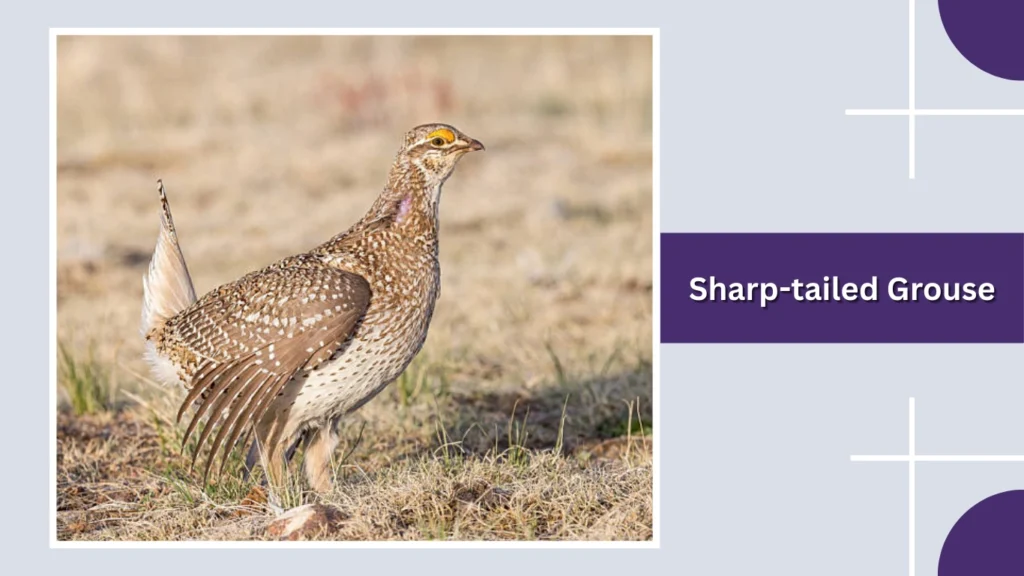
The Sharp-tailed Grouse is a medium-sized grouse species known for its energetic dancing displays and adaptability to open landscapes. It is widely distributed across northern grasslands and shrub-steppe regions, where it plays an important role in the ecosystem.
Identification
- Medium-sized body with a slim appearance
- Pointed, wedge-shaped tail with white underside
- Light-colored underparts with dark V-shaped markings
- Yellow eye combs above the eyes
- Brown and white mottled upperparts
Habitat
Sharp-tailed Grouse inhabit open grasslands, shrub-steppe, prairies, and parkland regions. They prefer areas with a mix of native grasses, shrubs, and open spaces, which provide food, nesting cover, and display grounds.
Behaviors
Males perform energetic courtship dances on leks, where they stamp their feet rapidly, spread their wings, and shake their tails. These displays are often accompanied by rattling or cooing sounds. Outside the breeding season, sharp-tailed grouse form flocks and are more nomadic.
Diet
Their diet includes buds, leaves, berries, seeds, grains, and insects. Insects are particularly important for chicks, while adults rely more heavily on plant material throughout the year.
Lifespan
Sharp-tailed Grouse typically live 3–5 years in the wild, though survival varies depending on habitat quality and environmental conditions.
6. Ruffed Grouse
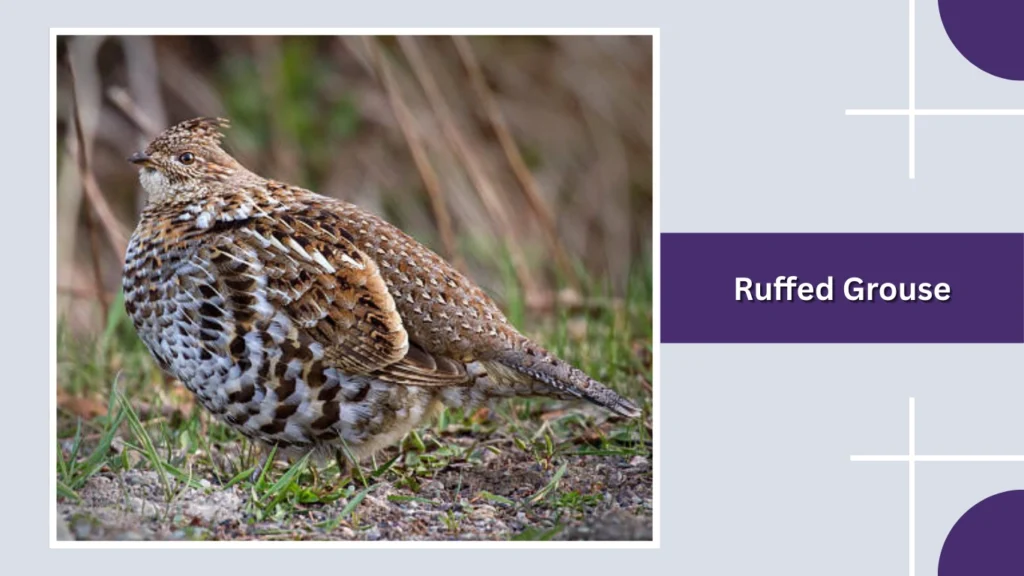
The Ruffed Grouse is a well-known forest grouse species, famous for the male’s deep drumming display produced by rapidly beating its wings. Often called the “king of game birds,” it is widely distributed across wooded regions of North America.
Identification
- Medium-sized, stocky body
- Mottled brown, gray, and black plumage
- Dark ruff of feathers on the neck (more visible in males)
- Broad, fan-shaped tail with a dark terminal band
- Short, rounded wings
Habitat
Ruffed Grouse inhabit deciduous and mixed forests, especially areas with dense understory and young trees. They favor early successional forests, forest edges, and woodland thickets that provide cover, food, and nesting sites throughout the year.
Behaviors
Males perform a distinctive drumming display, usually while standing on a log, to attract females and defend territory. These birds are mostly solitary and rely heavily on camouflage. When startled, they often burst into rapid flight, creating a loud whirring sound.
Diet
Their diet includes buds, leaves, twigs, fruits, seeds, and insects. In winter, they rely heavily on tree buds such as aspen and birch. Insects are especially important for chicks during early development.
Lifespan
Ruffed Grouse typically live 1–3 years in the wild, though some individuals may survive longer under favorable conditions.
7. Spruce Grouse
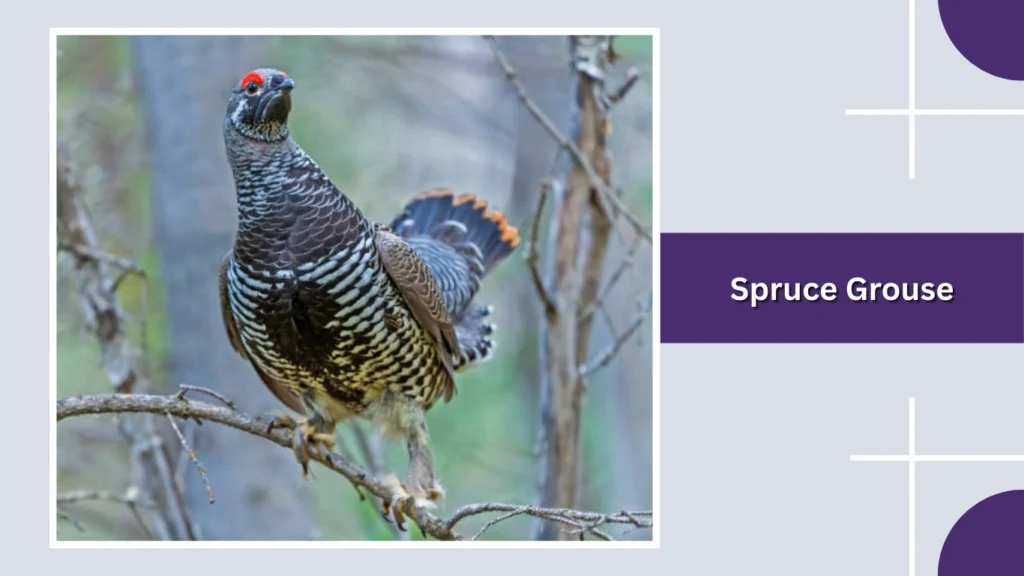
The Spruce Grouse is a quiet, forest-dwelling grouse of northern regions, often called the “fool hen” due to its calm behavior around humans. It is closely associated with coniferous forests and is well adapted to cold environments.
Identification
- Medium-sized, stocky body
- Dark gray to blackish plumage in males
- Females are mottled brown and gray
- Red eye combs above the eyes (males)
- Short, rounded tail
Habitat
Spruce Grouse inhabit boreal and subalpine coniferous forests dominated by spruce, pine, and fir. They prefer dense, evergreen cover and are rarely found far from these forest types. Their range includes northern North America and high-elevation mountain forests.
Behaviors
These birds are generally quiet and rely on camouflage rather than flight to avoid danger. Males perform subtle courtship displays that include tail fanning and wing dragging. Spruce Grouse spend much of their time on the ground or in low trees and are often solitary.
Diet
Their diet consists largely of conifer needles, especially spruce and pine, particularly in winter. During warmer months, they also eat berries, leaves, buds, and insects, which are important for chicks.
Lifespan
Spruce Grouse typically live 3–6 years in the wild, though survival depends heavily on habitat quality and predation levels.
8. Dusky Grouse
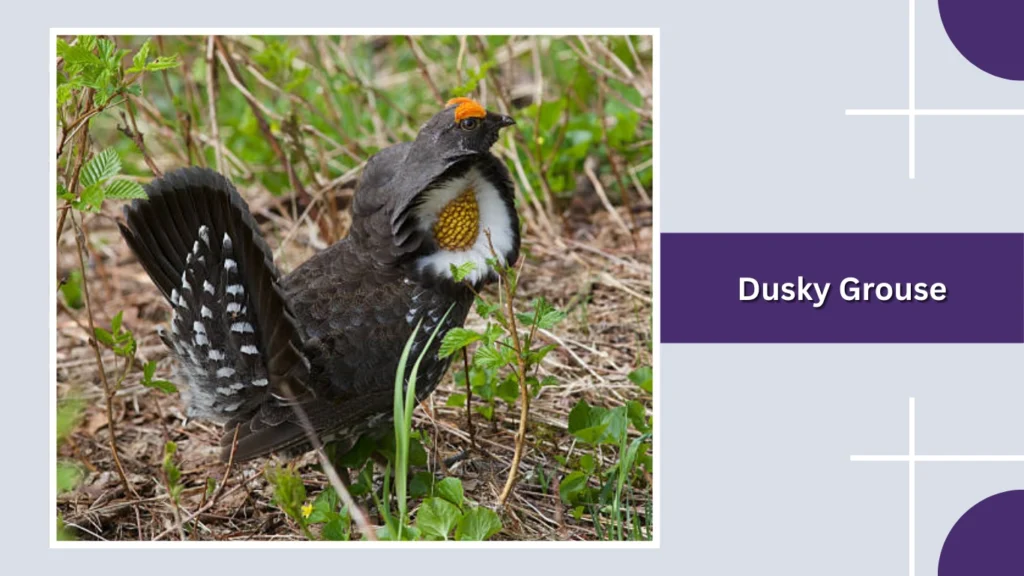
The Dusky Grouse is a large, forest-dwelling grouse found in mountainous regions of western North America. Formerly grouped with the Sooty Grouse as the “Blue Grouse,” it is known for its deep hooting calls and strong association with conifer forests.
Identification
- Large, heavy-bodied grouse
- Males are dark gray with a yellow throat air sac
- Females are mottled brown and gray
- Broad, rounded tail with a pale terminal band
- Short, stout bill
Habitat
Dusky Grouse inhabit coniferous and mixed forests in mountainous areas, particularly those dominated by pine, fir, and spruce. During summer, they are often found at higher elevations, while in winter they may move downslope to areas with dense evergreen cover.
Behaviors
These birds are generally solitary and secretive. Males produce deep, low-pitched hooting calls during the breeding season to attract females and establish territory. Dusky Grouse spend much of their time on the ground but may perch in trees, especially in winter.
Diet
Their diet includes leaves, buds, berries, flowers, insects, and conifer needles. In winter, pine and fir needles become an important food source when other vegetation is scarce.
Lifespan
Dusky Grouse typically live 3–6 years in the wild, with survival influenced by habitat quality, weather, and predation.
9. Sooty Grouse
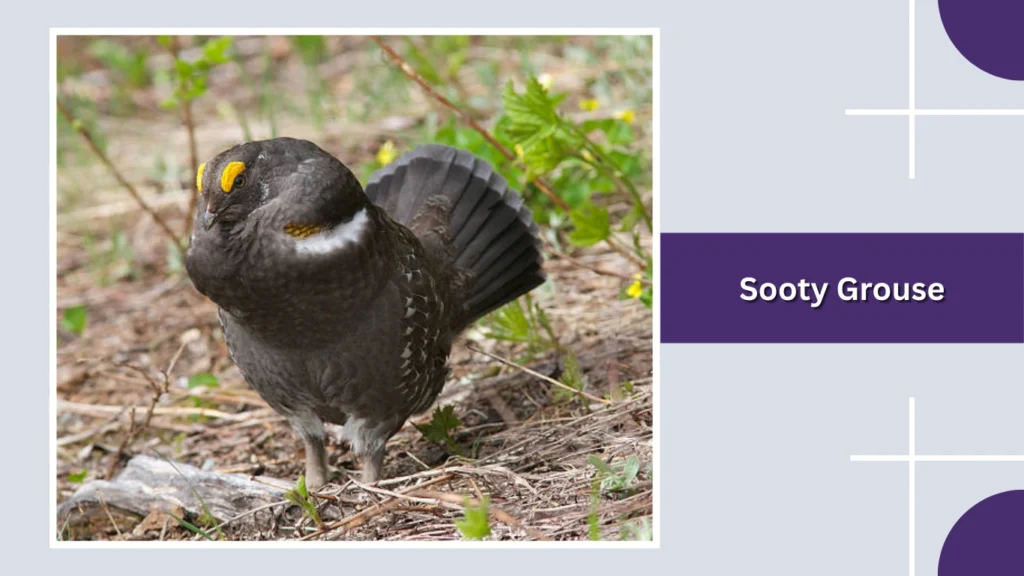
The Sooty Grouse is a large, forest grouse of the Pacific Coast ranges, closely related to the Dusky Grouse. It is known for its deep, resonant hooting calls and its strong dependence on mature conifer forests.
Identification
- Large, heavy-bodied grouse
- Males are dark gray to sooty black
- Yellow throat air sac visible during display (males)
- Females are mottled brown and gray
- Broad, rounded tail
Habitat
Sooty Grouse inhabit coniferous and mixed forests along the western mountains and coastal ranges. They favor mature forests with dense evergreen cover. Seasonal movements are common, with birds often shifting to higher elevations in summer and lower elevations in winter.
Behaviors
These birds are generally solitary and well-camouflaged. During breeding season, males produce deep, low hooting calls from the ground or low branches to attract females. Sooty Grouse are more likely to perch in trees than many other grouse species.
Diet
Their diet includes leaves, buds, berries, flowers, insects, and conifer needles. In winter, fir and pine needles make up a significant portion of their food.
Lifespan
Sooty Grouse typically live 3–6 years in the wild, though survival depends on habitat stability and environmental conditions.
10. Willow Ptarmigan
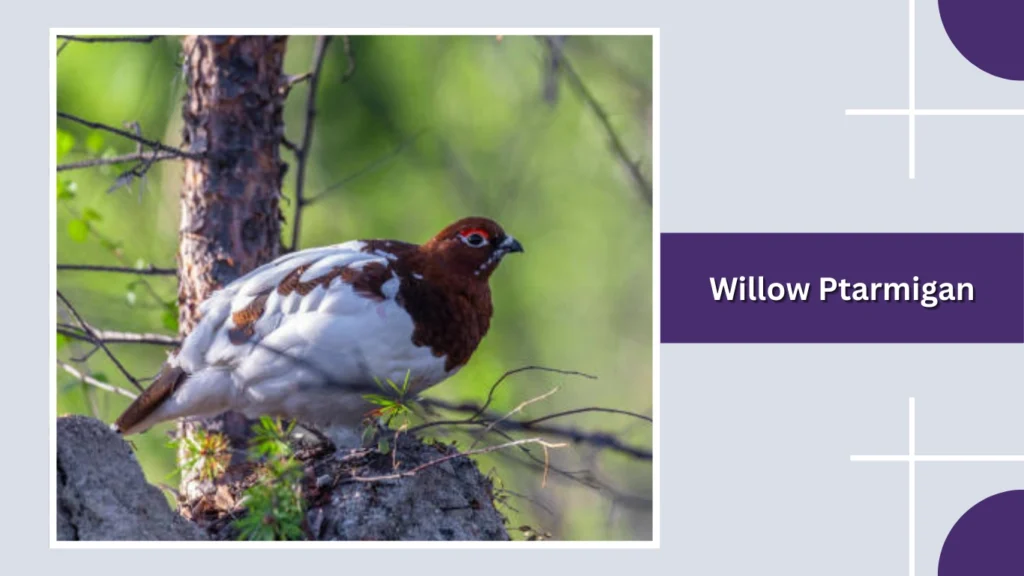
The Willow Ptarmigan is a cold-adapted grouse species best known for its seasonal color changes, turning white in winter to blend with snow. It is widely distributed across Arctic and subarctic regions and is one of the most northerly living land birds in the world.
Identification
- Medium-sized, stocky body
- Brown mottled plumage in summer
- Pure white plumage in winter
- Black tail feathers visible in flight
- Feathered legs and feet for insulation
Habitat
Willow Ptarmigans inhabit tundra, Arctic plains, wetlands, shrublands, and open boreal landscapes. They favor areas with willows, dwarf birch, and low vegetation that provide both food and cover. During winter, they often move to areas with denser shrubs for shelter.
Behaviors
These birds are well adapted to harsh climates and often remain motionless to avoid detection. In winter, they form flocks, while during the breeding season they become territorial. Their camouflage is their primary defense against predators.
Diet
Their diet consists mainly of willow buds, twigs, leaves, and other plant material. In summer, they also consume berries, seeds, and insects, which are especially important for chicks.
Lifespan
Willow Ptarmigans typically live 3–5 years in the wild, though survival varies depending on climate conditions and predation.
11. Rock Ptarmigan
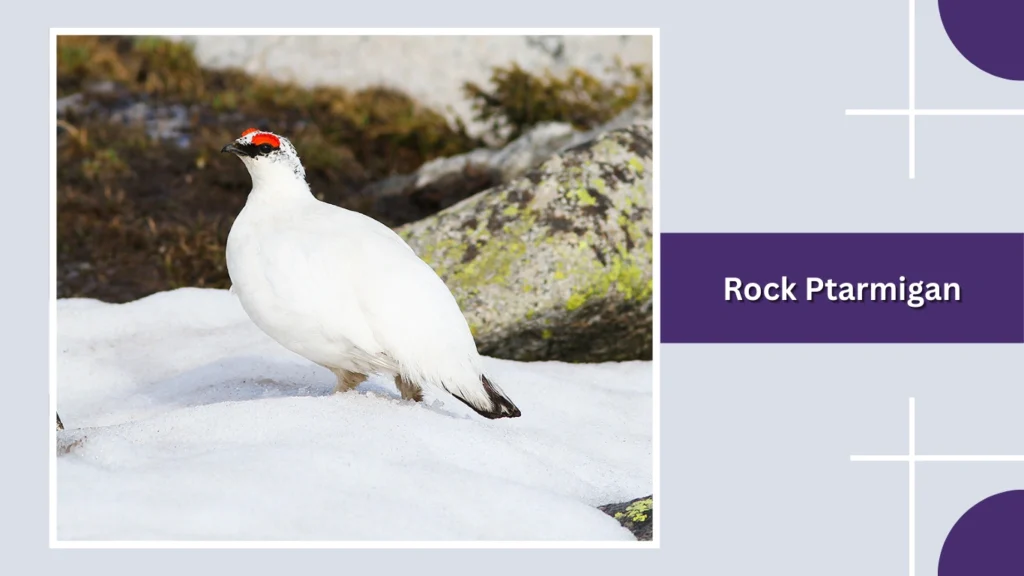
The Rock Ptarmigan is a hardy grouse species adapted to some of the coldest and most rugged environments on Earth. Like other ptarmigans, it is well known for its seasonal plumage changes, which provide excellent camouflage against snow, rocks, and tundra landscapes.
Identification
- Medium-sized, compact body
- Mottled brown and gray plumage in summer
- Mostly white plumage in winter
- Black tail and eye stripe in males
- Fully feathered legs and feet
Habitat
Rock Ptarmigans inhabit Arctic tundra, alpine slopes, rocky hillsides, and high-elevation mountain regions. They prefer open, treeless landscapes with sparse vegetation, where they can blend easily into their surroundings and avoid predators.
Behaviors
These birds rely heavily on camouflage and tend to remain still when threatened. During the breeding season, males become territorial and perform courtship displays that include vocalizations and wing movements. In winter, Rock Ptarmigans often form flocks and may burrow into snow for insulation.
Diet
Their diet consists mainly of buds, leaves, twigs, and shoots from low-growing plants such as willow and birch. During summer, they also eat berries, seeds, and insects, especially to support chick growth.
Lifespan
Rock Ptarmigans typically live 3–5 years in the wild, though survival depends greatly on weather conditions and predator abundance.
12. White-tailed Ptarmigan
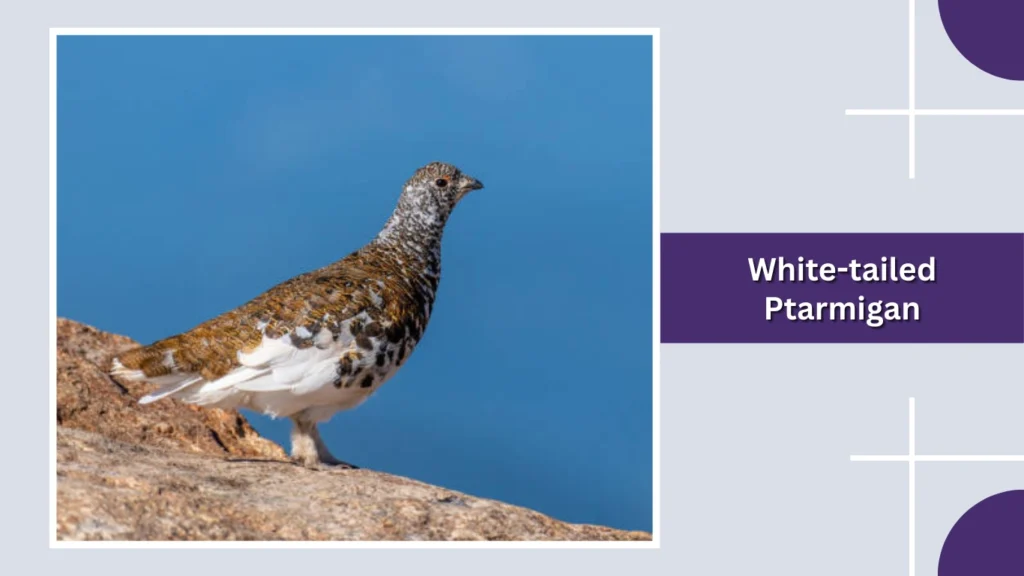
The White-tailed Ptarmigan is the smallest grouse species in North America and is uniquely adapted to life at high elevations. Famous for its year-round white tail and seasonal camouflage, it is one of the few birds that lives permanently in alpine environments.
Identification
- Small, compact body
- White tail in all seasons
- Mottled brown and gray plumage in summer
- Nearly pure white plumage in winter
- Feathered legs and feet for warmth
Habitat
White-tailed Ptarmigans inhabit alpine tundra, rocky slopes, and high mountain plateaus above the tree line. They are closely tied to cold, open environments and are rarely found at lower elevations, even during winter.
Behaviors
These birds rely heavily on camouflage and tend to crouch motionless when threatened. They are strong walkers and often move across rocky terrain rather than flying. In winter, they may burrow into snow for insulation against extreme cold.
Diet
Their diet consists mainly of buds, leaves, twigs, and flowers from alpine plants such as willow and alpine grasses. During summer, insects are also consumed, especially by chicks.
Lifespan
White-tailed Ptarmigans typically live 3–5 years in the wild, though survival depends on weather severity and habitat conditions.
13. Plains Grouse
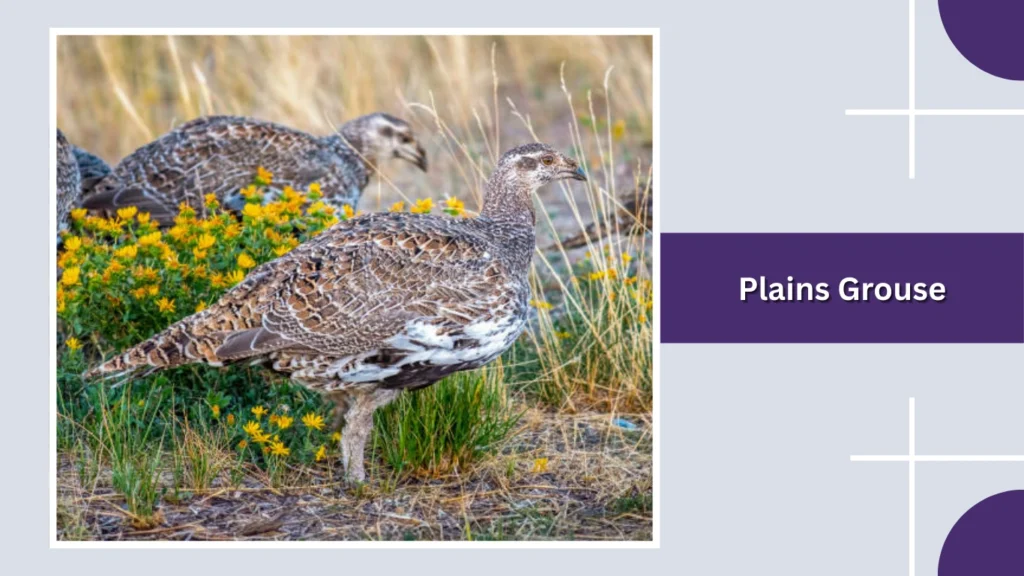
The Plains Grouse is a ground-dwelling bird associated with wide, open landscapes dominated by grasses and low vegetation. It is known for its strong camouflage and reliance on expansive plains for feeding, nesting, and seasonal movement.
Identification
- Medium-sized, rounded body
- Brown and tan mottled plumage for camouflage
- Short, rounded wings
- Fan-shaped tail
- Strong legs adapted for ground movement
Habitat
Plains Grouse inhabit open grasslands, prairies, and steppe-like environments with minimal tree cover. These areas provide the visibility and space required for foraging and breeding displays. They depend heavily on intact grassland ecosystems and are sensitive to habitat disturbance.
Behaviors
These birds spend most of their time on the ground, relying on camouflage to avoid predators. During breeding season, males perform display behaviors in open areas to attract females. Outside of breeding, they are generally quiet and may form small groups.
Diet
Their diet consists mainly of seeds, grasses, leaves, buds, and insects. Insects are particularly important for chicks, while adults rely more on plant material throughout the year.
Lifespan
Plains Grouse typically live 3–5 years in the wild, with survival closely linked to habitat quality and environmental stability.
14. Plains Steppe Grouse
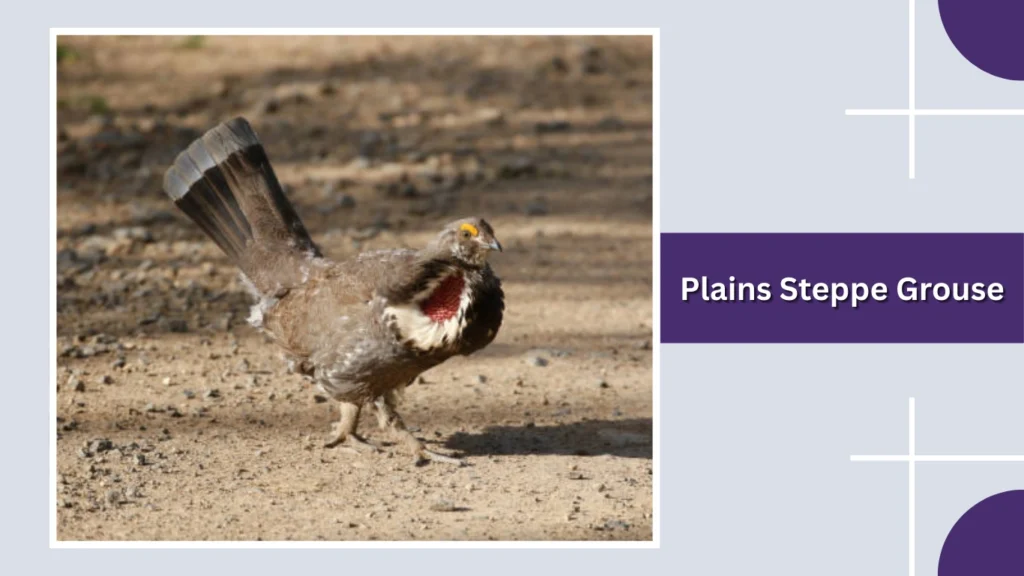
The Plains Steppe Grouse is a ground-dwelling bird adapted to vast, open steppe and prairie-like landscapes. Its survival depends on wide, undisturbed areas where grasslands dominate and human activity is limited. Strong camouflage and seasonal behaviors help it thrive in these exposed environments.
Identification
- Medium-sized, robust body
- Earth-toned brown and gray plumage
- Fine barring or mottling across body
- Short, rounded wings
- Rounded tail suited for short bursts of flight
Habitat
Plains Steppe Grouse inhabit open steppes, dry grasslands, and semi-arid plains with sparse shrubs. These habitats provide the visibility needed for predator detection and space for breeding displays. The species relies on native vegetation and is highly vulnerable to land conversion and overgrazing.
Behaviors
This grouse spends most of its time walking or foraging on the ground. During the breeding season, males display in open areas, using posture, movement, and vocal sounds to attract females. Outside the breeding period, individuals are quieter and may gather in small groups.
Diet
The diet consists mainly of grasses, seeds, shoots, buds, and leaves. Insects form an important part of the diet during spring and summer, especially for chicks that require high-protein food for growth.
Lifespan
Plains Steppe Grouse typically live 3–5 years in the wild, with survival closely tied to habitat quality, climate conditions, and predation levels.
FAQs
What is a grouse bird?
Grouse are ground-dwelling birds belonging to the pheasant family. They are adapted to open grasslands, forests, tundra, and alpine regions, and are known for their strong camouflage, seasonal plumage changes, and unique courtship displays performed by males.
Where are grouse birds commonly found?
Grouse are found across North America, Europe, and Asia. Different species occupy different habitats, including prairies, sagebrush plains, forests, mountains, and Arctic tundra, depending on their specific ecological adaptations.
Do all grouse perform mating displays?
Most grouse species have some form of mating display, especially males. These displays may include dancing, drumming, tail fanning, vocal calls, or inflating air sacs, and are usually performed on traditional breeding grounds called leks.
What do grouse birds eat?
Grouse mainly eat plant material such as leaves, buds, seeds, berries, and grasses. Insects are also an important part of the diet, especially for chicks during early growth stages when protein is essential.
Are grouse birds migratory?
Most grouse species are not long-distance migrants. However, some move seasonally to different elevations or habitats, such as shifting from alpine areas to lower forests during winter to find food and shelter.
