
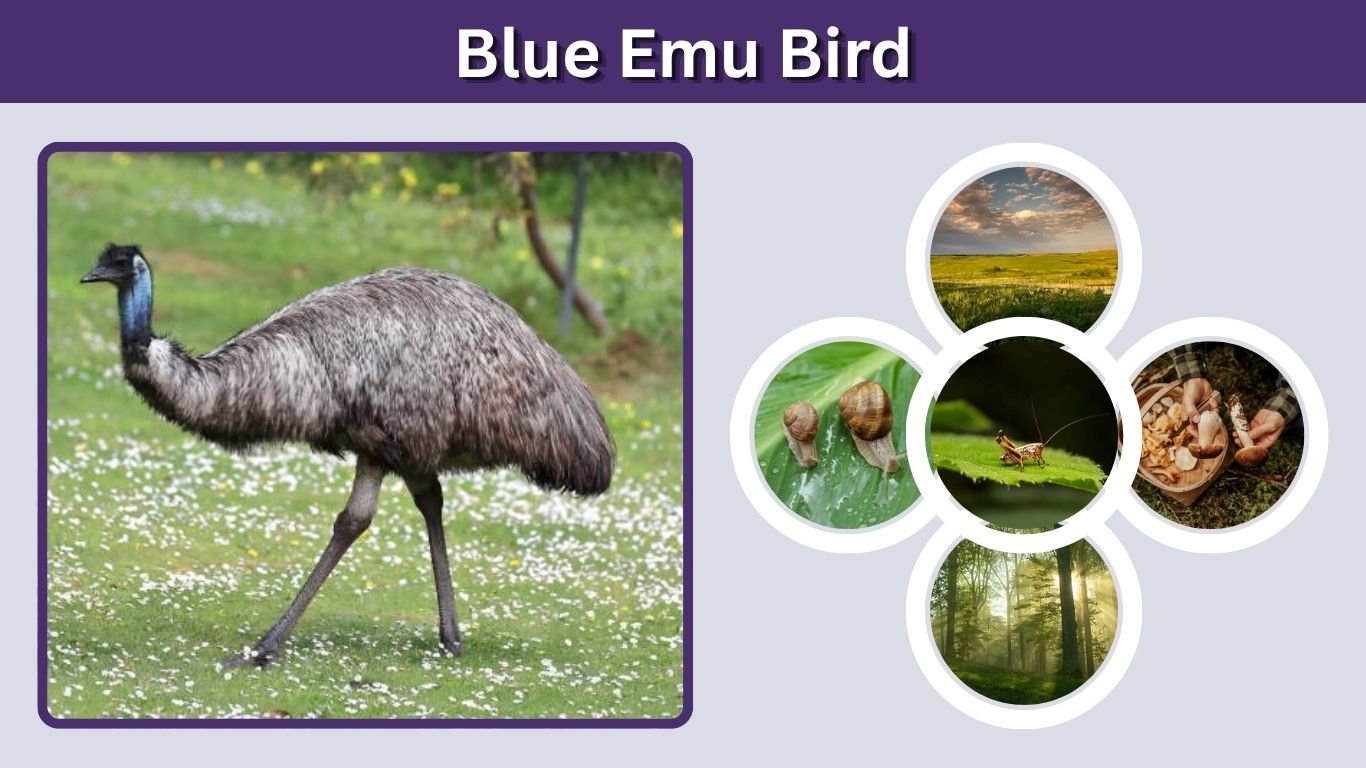
The term blue emu bird can cause some confusion because there is no officially recognized bird species with that exact common name. A real emu can have bluish skin on its head and neck, but people describing a large emu-like bird with a bright blue head, black body, and prominent crest or helmet are usually referring to a cassowary. Cassowaries are close relatives of emus, which explains their similar body shape.
What Is the Blue Emu Bird?
When someone mentions a big blue bird that looks like an emu, the bird is often a southern cassowary (Casuarius casuarius).
The southern cassowary is a large, flightless bird with a black body, brilliant blue skin on the head and neck, reddish wattles, powerful legs, and a helmet-like structure known as a casque. It is closely related to the Australian emu.
However, actual emus (Dromaius novaehollandiae) can also show bluish-black or blue-gray skin around their sparsely feathered head and neck. Their bodies are covered primarily with shaggy gray-brown feathers.
Blue Emu-Like Bird Identification
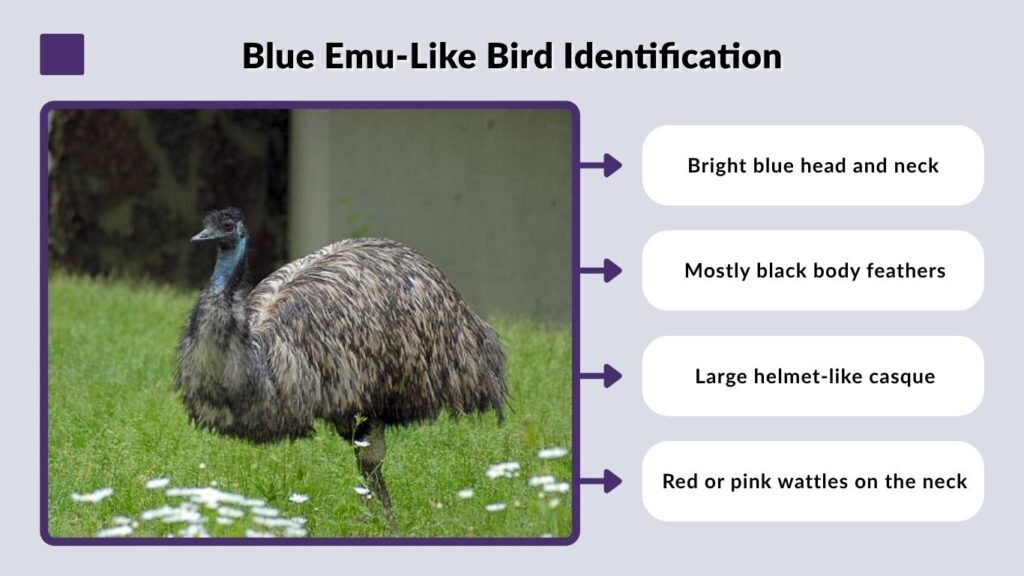
The easiest way to determine whether you are looking at an emu or cassowary is to examine the head, neck, and body coloration.
Cassowary Identification
A cassowary typically has:
- Bright blue head and neck
- Mostly black body feathers
- Large helmet-like casque
- Red or pink wattles on the neck
- Thick, muscular legs
- Three-toed feet
- Long inner claw
- Heavy, rounded body
- Very small wings
The southern cassowary is particularly recognizable because adults have two colorful wattles hanging from the neck.
Emu Identification
A true emu generally has:
- Shaggy gray-brown body feathers
- Long legs
- Long, relatively thin neck
- Small head
- Bluish or bluish-black neck skin
- No large casque
- No red hanging wattles
Therefore, a crested blue emu-like bird with a helmet on its head is almost certainly a cassowary rather than an emu.
Why Does the Cassowary Have a Blue Head?
The vivid coloration comes from exposed skin rather than blue feathers.
Southern cassowaries have blue skin over the head and front of the neck, while parts of the rear neck can appear red. Their bodies are covered with coarse, black, hair-like feathers.
The combination of brilliant blue skin, red wattles, black plumage, and a large casque makes the cassowary considerably more colorful than an emu.
Blue Emu Bird Size
Cassowaries and emus are both among the world’s largest living birds.
Cassowary Size
The southern cassowary can reach approximately 5.6–5.8 feet (1.7 meters) in height. Females are larger and may weigh around 167 pounds (76 kg), while males can reach about 121 pounds (55 kg).
Females also tend to be more brightly colored and may have a larger casque.
Emu Size
Emus can reach roughly 4.9–6.2 feet (1.5–1.9 meters) tall and weigh approximately 66–121 pounds (30–55 kg). Their thinner necks and shaggy brown plumage give them a noticeably different appearance from the heavier-looking cassowary.
Where Does the Blue Emu-Like Bird Live?
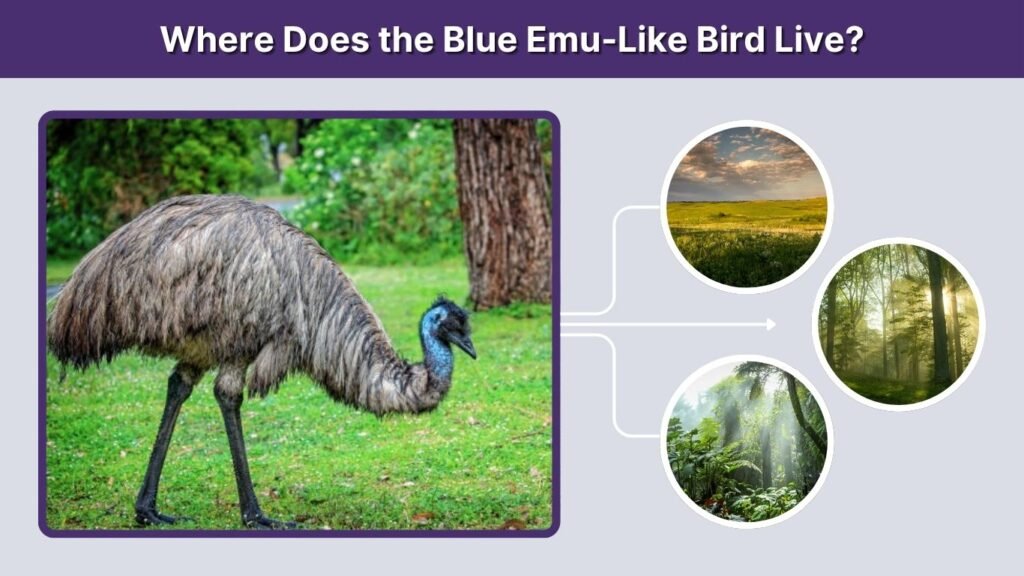
If the bird being described is a cassowary, its natural habitat is primarily tropical forest.
Southern cassowaries occur in northeastern Australia, New Guinea, and nearby Indonesian islands. They are strongly associated with tropical rainforest but can also occur around forest edges, riverbanks, mangroves, plantations, and some savanna habitats.
Emus, by comparison, occur widely across mainland Australia and use more open habitats. They are generally associated with grasslands, woodland, scrub, and other relatively open landscapes rather than dense tropical rainforest.
What Does a Blue Emu Bird Eat?
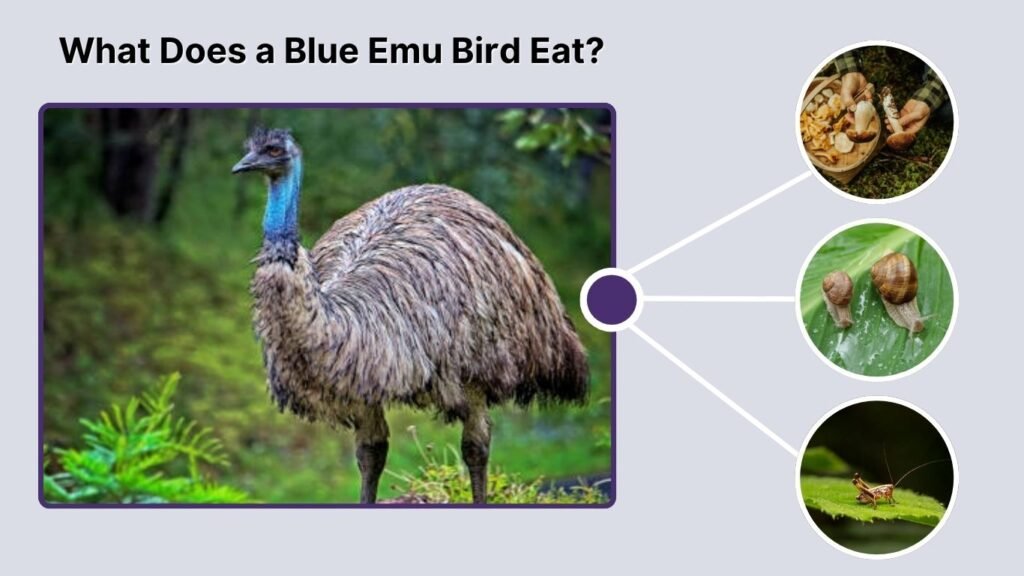
Cassowaries primarily eat fruit. Fallen rainforest fruit makes up an especially important part of their diet.
They may also consume:
- Fungi
- Snails
- Insects
- Small reptiles
- Small mammals
- Other available animal material
Because cassowaries swallow many fruits whole and later deposit the seeds elsewhere, they are important seed dispersers in tropical forests.
Emus have a broader omnivorous diet that can include grasses, seeds, fruits, beetles, grasshoppers, caterpillars, crickets, ants, and small reptiles.
Blue Emu Bird Egg
The phrase blue emu bird egg can refer to either an emu egg or a cassowary egg, and both are unusual compared with ordinary white bird eggs.
Cassowary Eggs
Southern cassowaries generally lay three to five green eggs. The nest is a simple depression on the forest floor lined with leaves and other plant material.
After the female lays the eggs, the male incubates them and later takes responsibility for protecting and raising the chicks. Incubation lasts roughly 50 days.
Emu Eggs
Emu eggs are also striking, but they are generally dark green and may resemble large avocados in shape and color.
A female emu can lay approximately 5–15 eggs in a clutch. As with cassowaries, the male takes responsibility for incubation.
So, if you see a photograph labeled “blue emu bird egg,” checking whether the pictured adult has a casque can help determine whether the egg belongs to an emu or cassowary.
Is the Blue-Faced Emu-Like Bird Dangerous?
Cassowaries deserve considerably more caution than their colorful appearance might suggest.
They have extremely powerful legs and a long, dagger-like claw on the inner toe of each foot. These structures are primarily defensive, and a cassowary can potentially cause serious injuries if it feels threatened or cornered.
That does not mean cassowaries normally pursue humans. They are generally solitary birds and should simply be observed from a respectful distance.
Never approach, feed, corner, or attempt to touch a wild cassowary.
Cassowary vs. Blue-Necked Emu
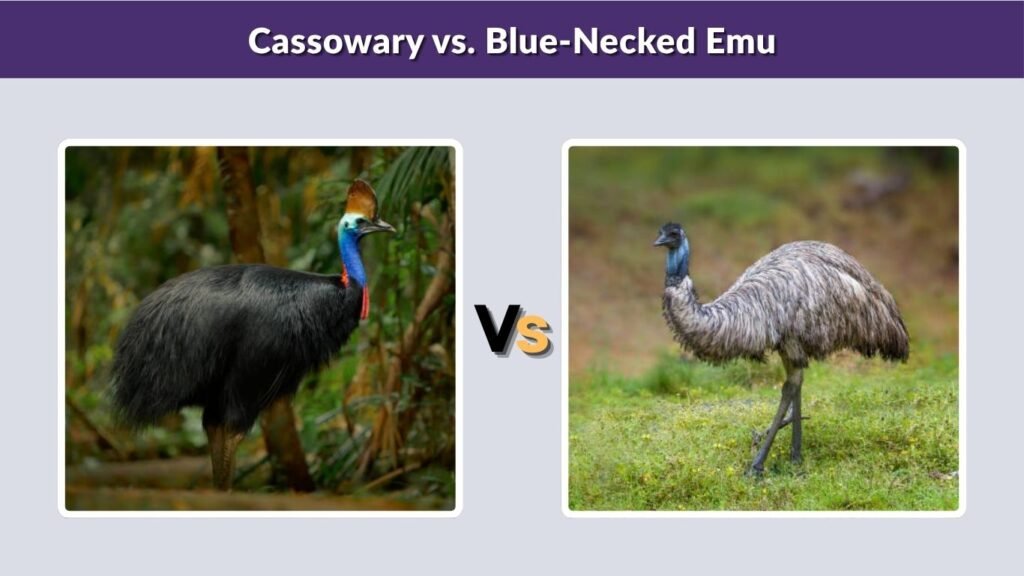
Although they are relatives, several features quickly separate the two birds.
| Feature | Cassowary | Emu |
| Head/neck | Bright blue and red | Blue-gray to bluish-black |
| Body | Mostly black | Gray-brown |
| Casque | Large helmet present | Absent |
| Wattles | Present in some species | Absent |
| Habitat | Mostly tropical forest | Mostly open Australian habitats |
| Eggs | Green | Dark green |
| Flight | Flightless | Flightless |
| General build | Heavy and compact | Taller and lankier |
Both belong to a group of large flightless birds and are close relatives, which is why a cassowary is frequently described informally as looking like a colorful or blue emu.
FAQs
Is There Really a Blue Emu Bird?
There is no separate species officially called the “blue emu.” Real emus have some bluish skin, while a vivid blue-headed, black, emu-like bird is usually a cassowary.
What Bird Looks Like an Emu With a Blue Head?
The cassowary, particularly the southern cassowary, strongly fits this description because it has a blue head and neck, black body, casque, and powerful legs.
What Is the Big Blue Bird That Looks Like an Emu?
It is most likely a southern cassowary. Adults can approach 5.8 feet tall and are among the world’s largest flightless birds.
What Color Is a Blue Emu Bird Egg?
Cassowary eggs are green, while true emu eggs are typically dark green. Both species have males that perform the primary incubation duties.
Is a Cassowary an Emu?
No. Cassowaries and emus are different birds, but they are close relatives. Both are large flightless birds adapted mainly for walking and running rather than flying.