
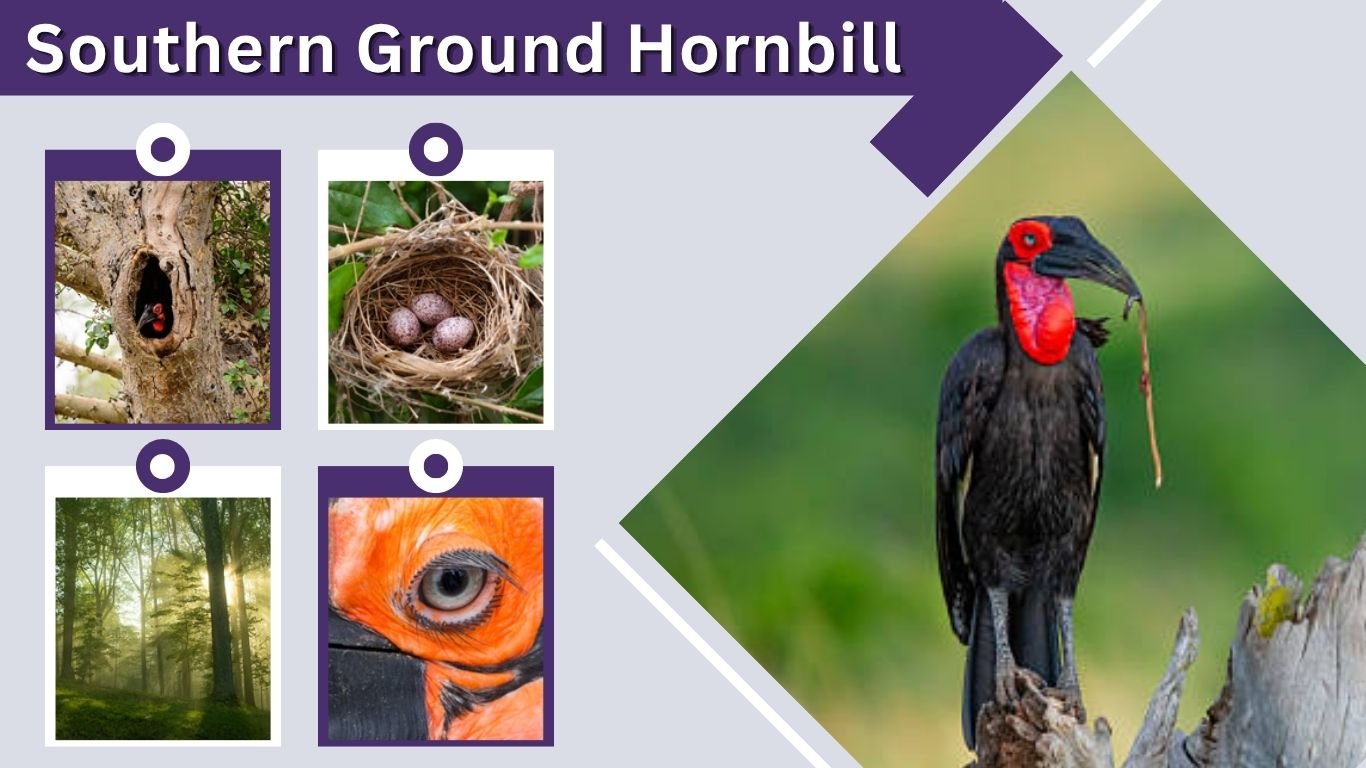
The southern ground hornbill is a large, striking African bird recognized by its black feathers, massive curved bill, bright red facial skin, and booming voice. Unlike most hornbills, it spends much of its day walking across grasslands searching for prey. Scientifically known as Bucorvus leadbeateri, it is the world’s largest hornbill and lives in social family groups across parts of sub-Saharan Africa. Its unusual appearance, slow breeding rate, complex behavior, and declining population make the southern ground hornbill one of Africa’s most fascinating birds.
Southern Ground Hornbill Identification
The southern ground hornbill is difficult to mistake for most other African birds. Adults have almost entirely black plumage combined with brightly colored bare skin around the eyes, face, and throat.
Physical Characteristics
Key identification features include:
- Glossy black body feathers
- Large, slightly curved black bill
- Bright red facial skin
- Red inflatable throat pouch
- Yellowish eyes
- Long, powerful legs
- Broad black wings
- Bare skin around the eyes
- Heavy, turkey-like body
Despite spending most of its time walking, the southern ground hornbill can fly. Its large wings allow it to reach trees used for roosting and nesting.
Southern Ground Hornbill Size
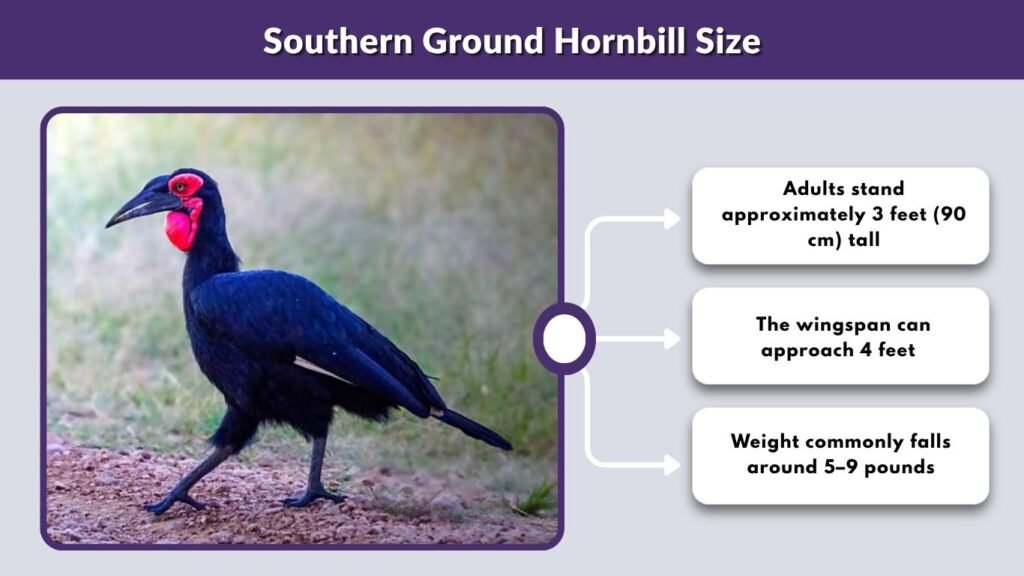
The southern ground hornbill is the largest species of hornbill in the world.
Adults stand approximately 3 feet (90 cm) tall, while the wingspan can approach 4 feet (1.2 meters). Weight commonly falls around 5–9 pounds, although particularly large males can be heavier.
Its size, long legs, and habit of walking across open ground can make it resemble a small turkey from a distance.
Male vs. Female Southern Ground Hornbill
Male and female southern ground hornbills look similar at first glance, but their throat coloration provides an easy identification clue.
Male Southern Ground Hornbill
An adult male normally has almost completely red bare skin on the face and throat pouch.
Female Southern Ground Hornbill
The female also has red facial skin but displays a distinctive blue or violet-blue patch on the throat. Females are generally somewhat smaller than males.
This blue throat patch is one of the easiest ways to distinguish a female southern ground hornbill from a mature male.
Southern Ground Hornbill Eyelashes
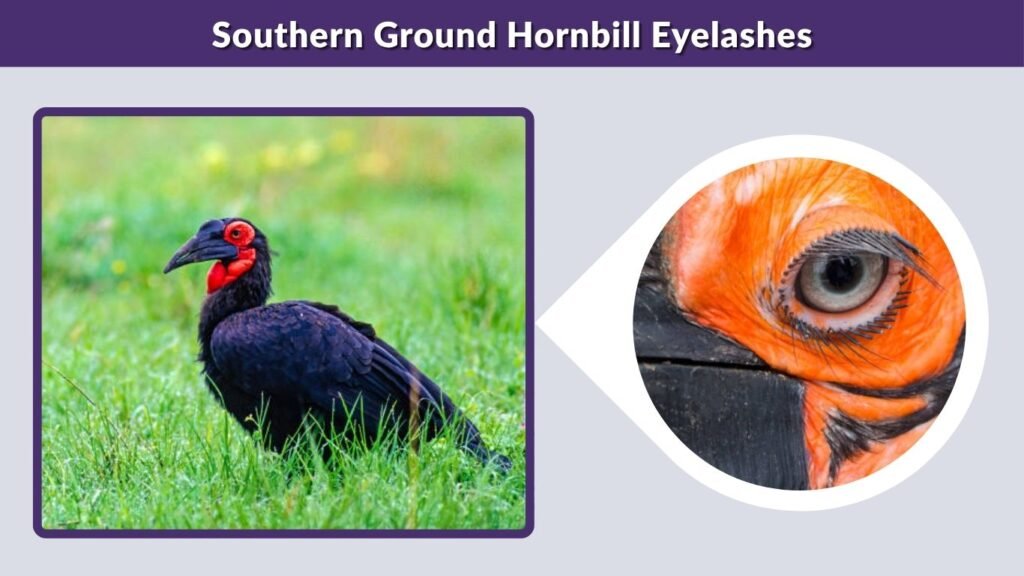
One particularly unusual feature is the bird’s apparent eyelashes.
They are actually specialized feather structures around the eyes rather than mammal-like hairs. Combined with the bird’s large eyes and exposed red facial skin, these feather-like lashes give the southern ground hornbill a remarkably expressive appearance.
Southern Ground Hornbill Habitat
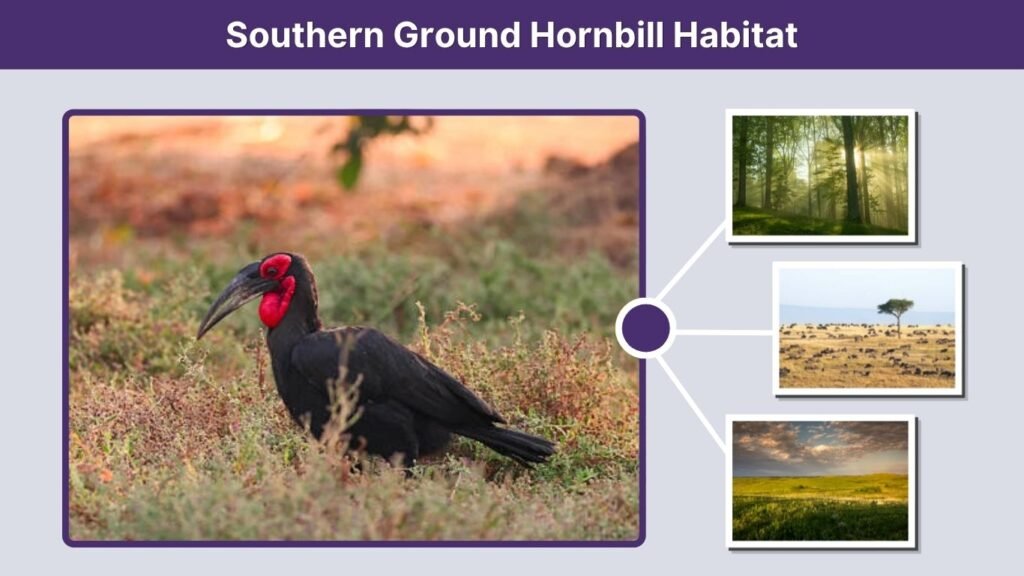
Southern ground hornbills primarily inhabit open grasslands, savannas, scrublands, and open woodland.
Although they forage on the ground, trees remain important because the birds need suitable places for roosting and nesting.
Their range extends through portions of eastern, central, and southern Africa, including areas from Kenya and the Democratic Republic of the Congo south toward Botswana and South Africa.
They are particularly well known from protected landscapes such as Kruger National Park in South Africa.
Southern Ground Hornbill Diet
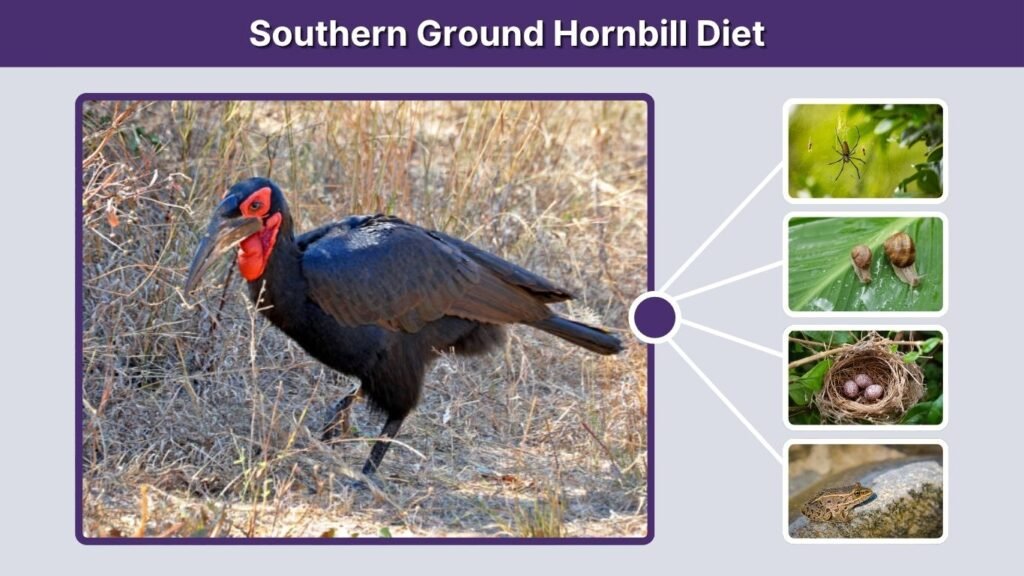
The southern ground hornbill is primarily a carnivore and spends hours walking slowly through grass searching for animals.
Its diet can include:
- Grasshoppers and other large insects
- Spiders
- Snails
- Frogs and toads
- Lizards
- Snakes
- Tortoises
- Rodents
- Bird eggs
- Nestling birds
- Small mammals
They can even kill venomous snakes using repeated strikes from their heavy bills. Fruit and seeds may occasionally be eaten, but animal prey forms the majority of their diet.
Southern Ground Hornbill Sound
One of the bird’s most impressive characteristics is its voice.
The southern ground hornbill sound is a deep, booming series of notes that can carry across open African savanna. The call can sound surprisingly mammal-like when heard from a distance.
Why Do Southern Ground Hornbills Call?
Their low-frequency booming calls are primarily used to announce and defend territory. Members of a group may call together, especially during the morning.
The inflatable throat pouch also plays a role in producing their powerful vocalizations.
Southern Ground Hornbill Behavior
Southern ground hornbills are highly social compared with many other large birds.
Groups commonly consist of a dominant breeding pair and several helpers. These additional group members participate in defending territory, searching for food, and helping raise young.
They spend much of the day walking rather than flying. A group may methodically move through tall grass, inspecting vegetation and capturing almost any suitably sized animal it encounters.
Are Southern Ground Hornbills Aggressive?
They are formidable predators, but they are not normally hunting humans. Their powerful bills can nevertheless cause injuries if a bird is threatened or handled.
Southern ground hornbills are also known for interacting intensely with objects, sometimes pecking, tossing, or striking unfamiliar items.
Southern Ground Hornbill Nest
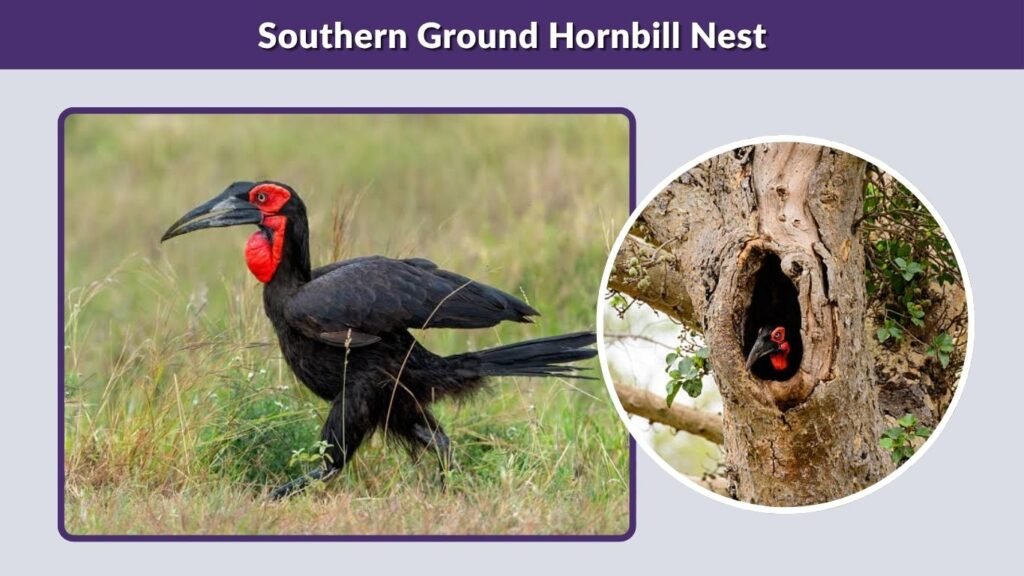
Southern ground hornbills usually nest in large natural cavities, particularly holes in mature trees. Ground hornbills may also use hollow logs, rock cavities, palm stumps, or other protected openings.
Unlike many other hornbill species, ground hornbills do not seal the female inside the nest cavity.
Eggs and Incubation
A female generally lays one or two eggs, and incubation lasts around 40 days.
Although multiple eggs may be produced, raising young successfully is difficult. Southern ground hornbills have an exceptionally slow reproductive cycle.
Southern Ground Hornbill Chick
Newly hatched chicks are highly dependent on adults.
An unusual feature of southern ground hornbill society is cooperative breeding. Nonbreeding members of the social group help the dominant pair feed, protect, and raise the offspring.
Young birds remain associated with adults for an extended period while learning how to locate prey and function within the group’s complex social structure. Chicks generally fledge when roughly 80–90 days old.
Southern Ground Hornbill Lifespan
Southern ground hornbills are exceptionally long-lived birds.
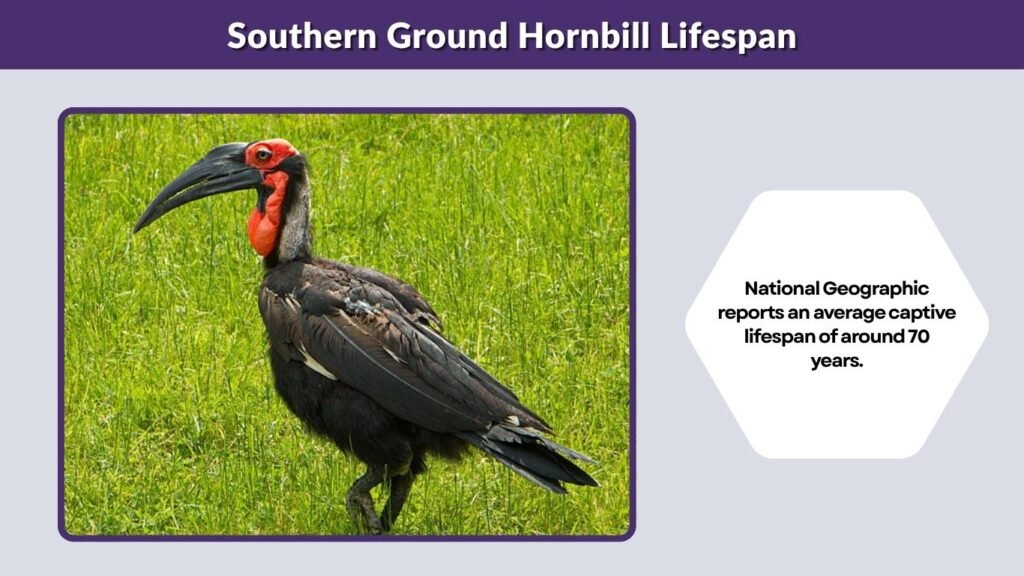
National Geographic reports an average captive lifespan of around 70 years. Their long lifespan helps compensate somewhat for their extremely slow reproductive rate, although losing breeding adults can have major consequences for wild populations.
Southern Ground Hornbill Predators
Healthy adults are large, powerful birds and therefore have relatively few natural predators.
Eggs and young chicks are more vulnerable to predators capable of reaching nesting cavities. Adult birds rely on their enormous bills, group defense, and powerful flight when confronted by threats.
Today, human-related pressures are much more significant to the species than natural predation.
Why Is the Southern Ground Hornbill Endangered?
The southern ground hornbill is currently classified globally as Vulnerable, while it is classified as Endangered within South Africa.
Important threats include habitat loss, poisoning, persecution, loss of suitable nesting trees, agricultural expansion, and other human-caused changes to savanna ecosystems. Their extremely slow breeding rate makes population recovery particularly difficult.
Conservation programs in southern Africa work to protect nests, reduce human-caused mortality, monitor populations, and reintroduce suitable birds into areas where populations have disappeared.
Interesting Southern Ground Hornbill Facts
The southern ground hornbill is unusual even among hornbills. It spends most of its life walking, hunts surprisingly large prey, lives in cooperative family groups, and can survive for decades.
It can also fly despite its strongly terrestrial lifestyle, and its deep booming calls can travel considerable distances across open savanna.
Another remarkable feature is its social structure: only the dominant pair typically breeds while other group members help raise their chicks.
FAQs
What Is the Scientific Name of the Southern Ground Hornbill?
Its scientific name is Bucorvus leadbeateri.
Is the Southern Ground Hornbill From Africa?
Yes. It occurs in parts of eastern, central, and southern Africa and is particularly associated with savannas and open woodland.
Can a Southern Ground Hornbill Fly?
Yes. Although it spends most of its time walking on the ground, it can fly and regularly uses trees for roosting and nesting.
Is Zazu a Southern Ground Hornbill?
No. Zazu from The Lion King is depicted as a much smaller hornbill rather than a southern ground hornbill. Southern ground hornbills are much larger, predominantly black birds with bright red facial and throat skin.
Are Southern Ground Hornbills Related to Toucans?
No. Hornbills and toucans are different bird families. Their oversized bills create a superficial resemblance, but southern ground hornbills are African hornbills rather than toucans.
