
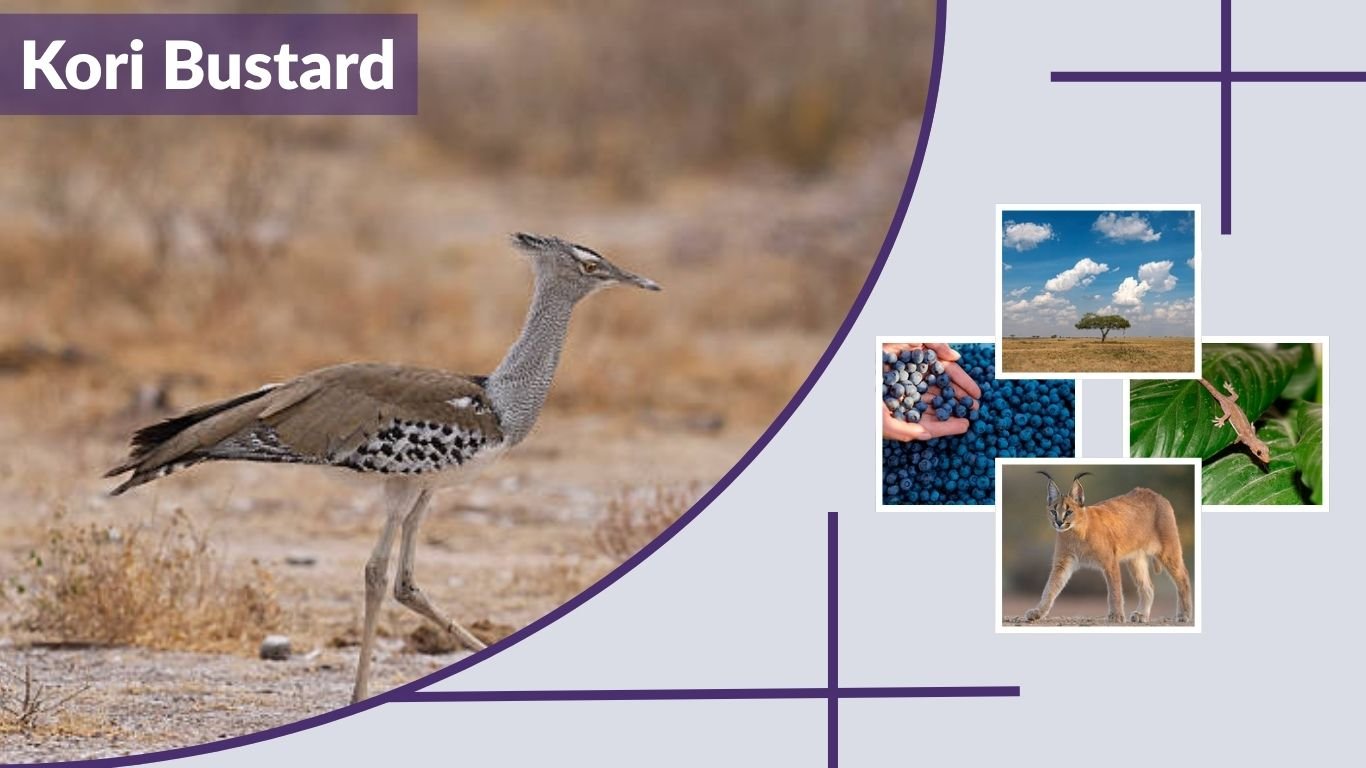
The kori bustard is a huge African ground bird famous for its impressive size and ability to fly despite its considerable weight. Scientifically known as Ardeotis kori, it inhabits open grasslands and savannas of eastern and southern Africa. Adult males can weigh more than 40 pounds, making the species one of the heaviest living birds capable of flight. Kori bustards spend most of their time walking, searching for insects, reptiles, seeds, berries, and other foods rather than flying.
Kori Bustard Identification
The kori bustard is a tall, long-legged bird with a heavy body, long neck, relatively small head, and broad wings. Its muted coloration provides excellent camouflage in dry African grasslands.
Adults have gray and buff upperparts covered with fine dark markings. The neck is grayish, while black-and-white patterns are visible around the shoulders and wings. A noticeable dark crest rises from the top and rear of the head.
Physical Characteristics
A kori bustard can be identified by:
- Large, heavy body
- Long gray neck
- Long, strong legs
- Gray-brown and buff plumage
- Black head crest
- White eyebrow-like markings
- Black-and-white shoulder pattern
- Broad wings
- Three forward-facing toes
- Yellowish to pale legs and bill
The three-toed feet are particularly suited to walking and running across the ground.
Kori Bustard Size
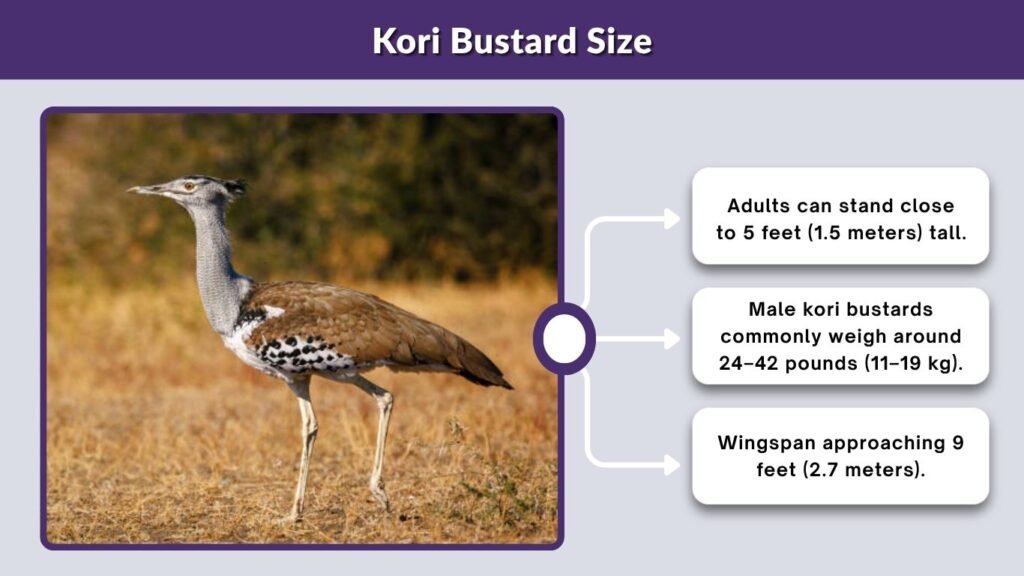
The kori bustard is one of the largest flying birds in the world and the heaviest flying bird native to Africa.
Adults can stand close to 5 feet (1.5 meters) tall. Their impressive height comes largely from their long legs and extended neck.
Kori Bustard Weight
Male kori bustards commonly weigh around 24–42 pounds (11–19 kg). Females are substantially smaller and may weigh only about half as much as large males.
This extreme difference makes the kori bustard strongly sexually dimorphic in body size.
Kori Bustard Wingspan
Despite its enormous body, a kori bustard has sufficiently large and powerful wings to become airborne. Large individuals may have a wingspan approaching 9 feet (2.7 meters).
Their long flight feathers are strongly constructed and generate the lift required to keep such a heavy bird airborne.
Kori Bustard Next to a Human
Seeing a kori bustard next to a human makes its extraordinary size much easier to understand.
At nearly 5 feet tall, a large bird can reach approximately the chest or shoulder level of many adults when standing upright. Its body is also much heavier and broader than that of familiar birds such as geese or turkeys.
An adult male weighing up to about 42 pounds can be heavier than a small child. When its broad wings are fully spread, its span may considerably exceed the height of an adult human.
Can a Kori Bustard Fly?
Yes, kori bustards can fly. Their enormous size does not make them flightless.
However, flying is energetically demanding, so they strongly prefer walking. Kori bustards spend most of their lives on the ground and typically take flight when disturbed or when escaping danger.
Kori Bustard in Flight
Getting such a heavy body into the air requires considerable power. Once airborne, however, the bird’s broad wings can support sustained flight.
Its reluctance to fly explains why people sometimes mistakenly assume that the kori bustard is flightless.
When threatened, a bird will often attempt to walk away first. If danger becomes serious, it can spread its enormous wings and launch into flight.
Male vs. Female Kori Bustard
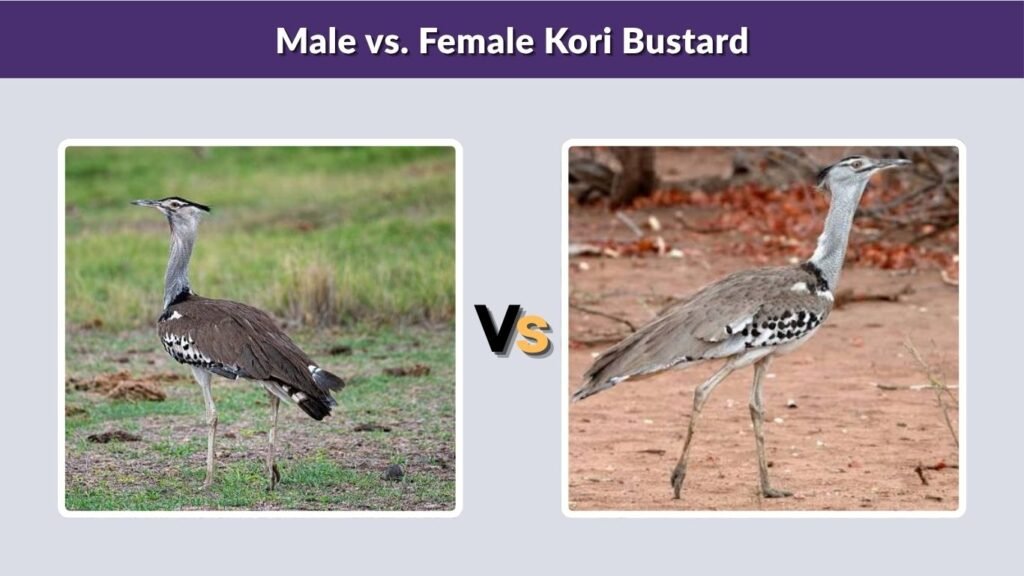
The most obvious difference between a male and female kori bustard is size.
Males can be dramatically heavier than females. Smithsonian reports males weighing 24–42 pounds, while females are approximately half their size. Males may also appear somewhat more strongly colored.
Outside the breeding season, both sexes have broadly similar brown, gray, black, and white plumage.
During courtship, however, the male becomes unmistakable because he transforms his appearance through an elaborate display.
Kori Bustard Mating Display
The kori bustard display is among the bird’s most impressive behaviors.
During breeding periods, males may gather in loose display areas where they attempt to attract females. A displaying male inflates his esophagus dramatically, making his neck appear much larger than normal.
He also raises his head crest, puffs his chest feathers, lifts and fans the tail to expose bright white underfeathers, lowers his wings, and slowly struts through the grass.
Kori Bustard Call and Sound
During the mating display, males produce a deep booming call.
This low-frequency sound can travel a considerable distance across open savanna. The combination of booming, inflated neck, exposed white feathers, and exaggerated posture helps females locate displaying males.
Kori bustards are otherwise relatively quiet birds.
Kori Bustard Habitat and Range
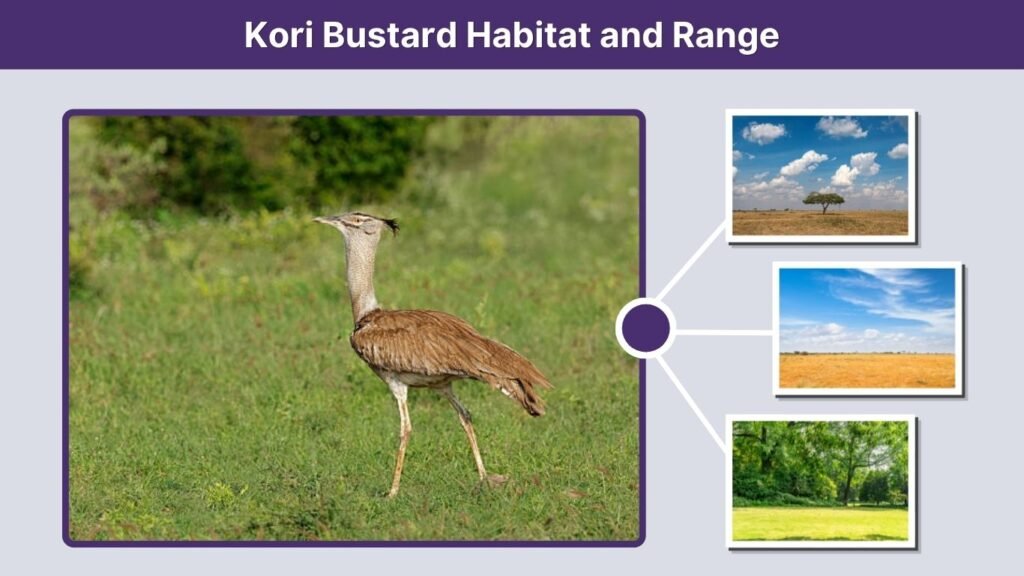
Kori bustards live mainly in eastern and southern Africa.
They favor wide, open environments where their long legs allow them to walk easily while searching for food.
Typical habitat includes:
- Savannas
- Dry grasslands
- Open woodland
- Lightly wooded plains
- Semi-arid scrub
- Areas with scattered trees
The species generally avoids dense forest. Open vegetation provides feeding opportunities while also allowing the birds to watch for approaching predators.
What Does a Kori Bustard Eat?
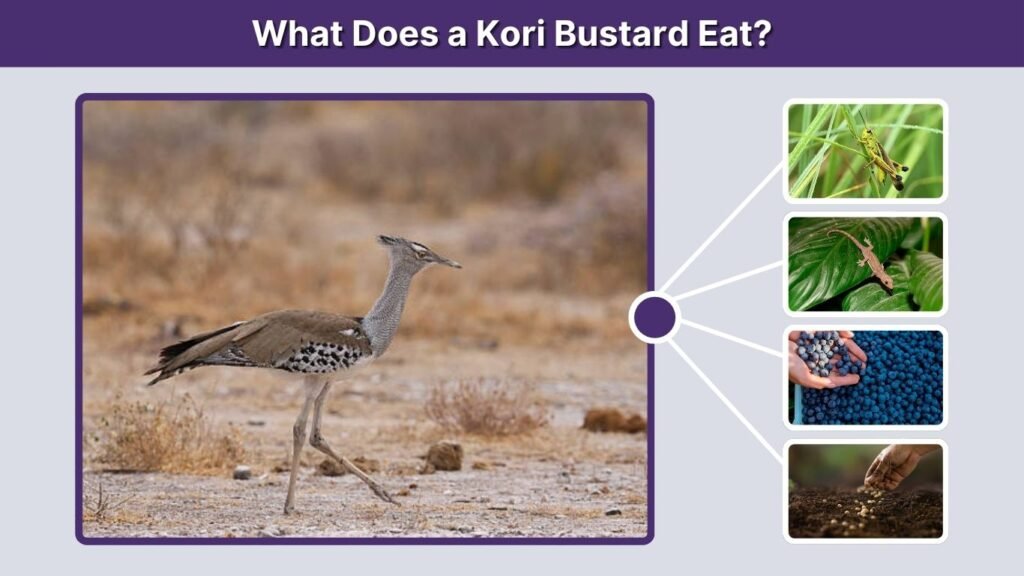
Kori bustards are omnivores with an extremely varied diet. They spend much of the day walking slowly while picking food from the ground.
Their diet includes:
- Grasshoppers
- Beetles and other insects
- Lizards
- Snakes
- Small rodents
- Small birds
- Carrion
- Seeds
- Berries
- Roots
- Acacia gum
Insects are particularly important to young kori bustards. Adults may consume almost any appropriately sized food they encounter while foraging.
Do Kori Bustards Eat Grasshoppers and Dung Beetles?
Yes. Insects make up an important part of the kori bustard diet, so grasshoppers, beetles, and similar invertebrates are readily eaten.
They sometimes follow areas affected by fires, where exposed or killed insects can provide easy feeding opportunities.
Kori Bustard Nest and Eggs
Unlike birds that construct nests in trees, the kori bustard nests directly on the ground.
The female creates a shallow scrape, usually surrounded by vegetation that provides some concealment. She generally lays one or two eggs, which are pale olive or tan with darker markings.
Incubation and Chicks
The female performs the parental duties without help from the male.
Incubation lasts about 23–24 days. Kori bustard chicks are precocial, meaning they hatch relatively well and can begin walking soon afterward.
The chicks usually fledge at approximately four to five weeks, although they remain associated with their mother considerably longer.
Kori Bustard Predators
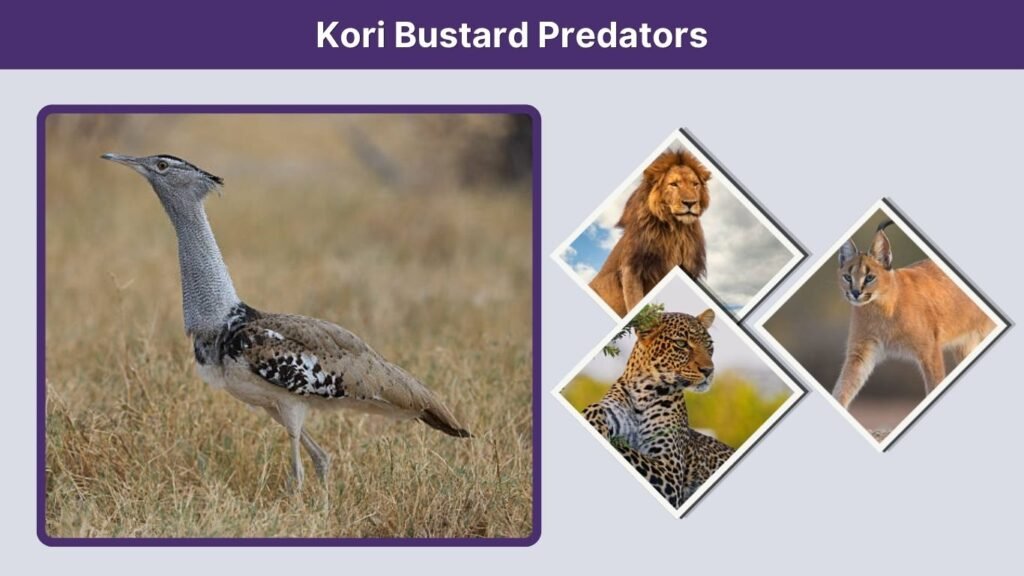
Despite their enormous size, kori bustards still face predators.
Potential predators include:
- Lions
- Leopards
- Cheetahs
- Caracals
- Jackals
- Hyenas
- Large eagles
Adults can sometimes escape by running or flying, but nests and young chicks are particularly vulnerable because they live on the ground.
Their mottled plumage provides camouflage and helps both adults and young blend into dry grass and soil.
Kori Bustard Lifespan
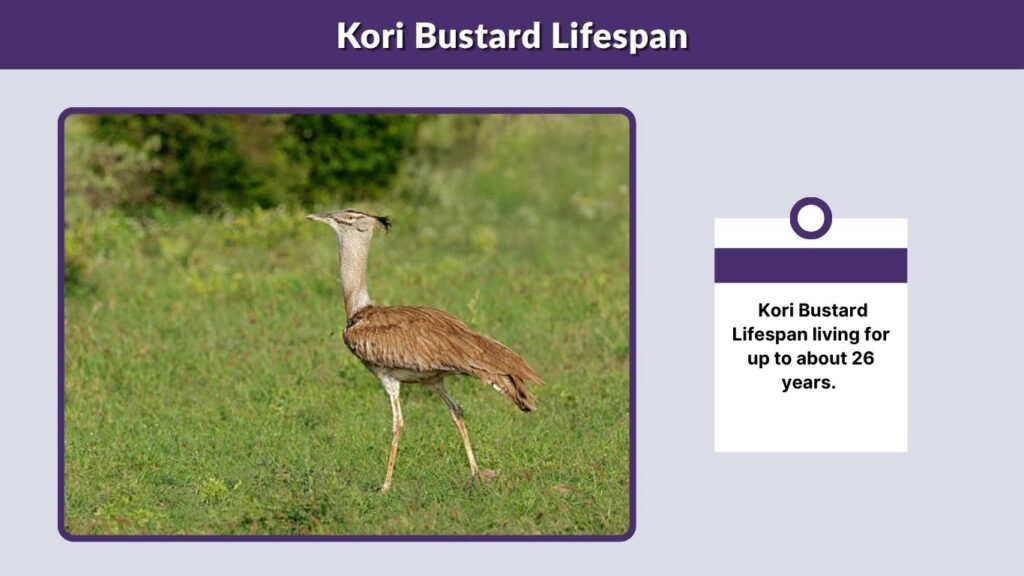
The exact kori bustard lifespan in the wild is not well established.
However, individuals under human care have been documented living for up to about 26 years. Wild lifespan can be influenced by predation, food availability, drought, hunting, habitat changes, and collisions with infrastructure.
Kori Bustard Conservation Status
The kori bustard is currently assessed as Near Threatened, with populations believed to be declining across much of its range.
Major threats include habitat loss and disturbance, agricultural development, hunting, and collisions with overhead power lines. Because these birds spend much of their lives in relatively undisturbed open landscapes, increasing human development can reduce suitable habitat.
Their relatively low reproductive output also means populations can take time to recover after major losses.
Interesting Kori Bustard Facts
The scientific name of the kori bustard is Ardeotis kori, and it belongs to the bustard family Otididae.
One particularly unusual behavior involves drinking. Instead of repeatedly scooping water into the bill and tipping the head backward like many birds, kori bustards can draw water into the mouth with a sucking motion.
Kori bustards are also sometimes accompanied by carmine bee-eaters. As a large bustard walks through grass, it disturbs insects that the smaller birds can catch.
Their combination of enormous size, strong flight ability, elaborate courtship behavior, and terrestrial lifestyle makes the kori bustard one of Africa’s most distinctive birds.
FAQs
Is the Kori Bustard the Heaviest Flying Bird?
The kori bustard is widely described as one of the world’s heaviest flying birds, and adult males can reach approximately 42 pounds (19 kg). It is considered the heaviest flying bird native to Africa.
How Tall Is a Kori Bustard?
A large kori bustard can stand close to 5 feet (1.5 meters) tall, making it surprisingly large when compared directly with a person.
How Much Does a Kori Bustard Weigh?
Adult males generally weigh around 24–42 pounds (11–19 kg). Females are much smaller and may weigh roughly half as much as males.
Can Kori Bustards Really Fly?
Yes. Kori bustards are fully capable of flight, although they prefer walking and generally fly when escaping danger or when necessary.
Where Do Kori Bustards Live?
They occur in eastern and southern Africa, particularly in grasslands, savannas, and lightly wooded open habitats.
