
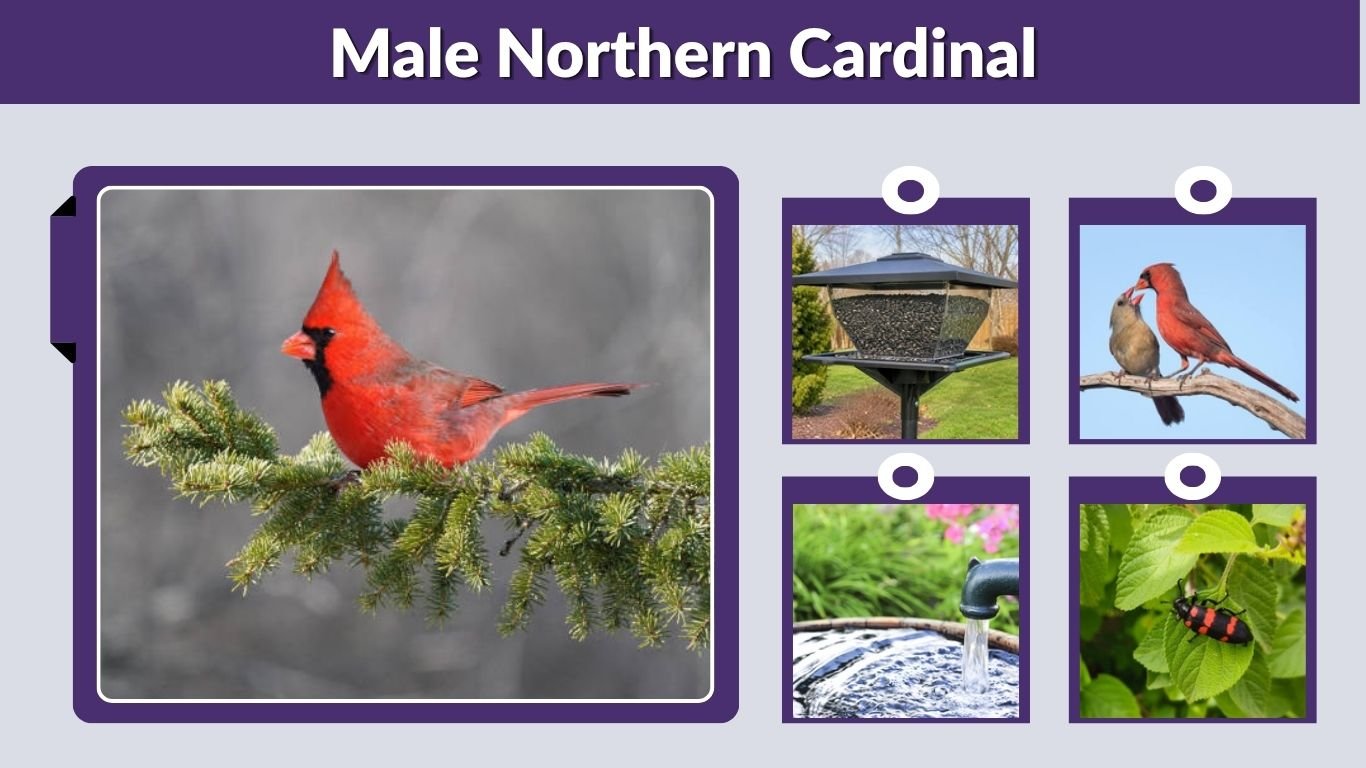
The male northern cardinal is one of the most recognized red birds in North America. With bright red feathers, a black face mask, a pointed crest, and a strong orange-red bill, he stands out in backyards, forests, parks, and gardens. Male cardinals are also famous for their clear songs, territorial behavior, and strong bond with females during the breeding season.
What Is a Male Northern Cardinal?
The male northern cardinal is the bright red adult male of the northern cardinal species. He belongs to the cardinal family and is known for his bold color, strong voice, and active behavior around feeders and shrubs.
The scientific name of the northern cardinal is Cardinalis cardinalis. Many people call the male a red cardinal because of his brilliant red plumage. However, the proper name is still male northern cardinal or male cardinal.
Basic Description
A male northern cardinal has a bright red body, red crest, red wings, and red tail. Around the bill, he has a black mask that gives his face a strong, bold look. His bill is thick, cone-shaped, and orange-red in adults.
This bird is medium-sized compared with many backyard songbirds. He has a long tail, rounded body, and upright posture. When he is excited or alert, his crest stands high. When he is calm, the crest may lie flatter.
Male cardinals are common in eastern and central North America. They are year-round birds in most of their range and do not usually migrate.
Male Northern Cardinal Identification
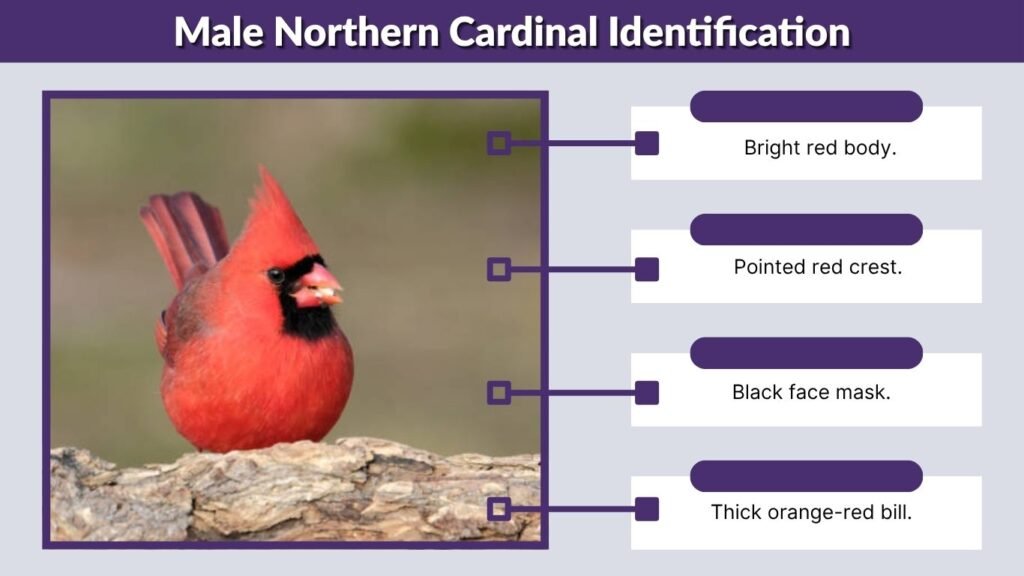
Male northern cardinal identification is usually easy because few backyard birds are so bright red. His shape is also important. The crest, heavy bill, and long tail help separate him from other red birds, such as summer tanagers, house finches, and scarlet tanagers.
He is often seen sitting in shrubs, singing from high branches, or feeding near the ground. His red color is especially noticeable in winter.
Key Identification Marks
- Bright red body
- Pointed red crest
- Black face mask
- Thick orange-red bill
- Long red tail
- Rounded body shape
- Red wings
- Upright posture
- Loud whistled song
- Often seen near shrubs and feeders
An adult male northern cardinal looks much brighter than the female. In strong sunlight, his feathers can appear glowing red. In shade, he may look darker red or crimson. During molt or feather wear, some males may look patchy for a short time.
Male Northern Cardinal Color
The male northern cardinal is best known for his red color. His feathers are mostly red because of pigments called carotenoids, which come from food. These pigments are found in fruits, berries, and other natural foods.
Healthy males with bright feathers may look more attractive to females. Bright color can also show strength and good condition.
Are Male Cardinals Only Red?
Male northern cardinals are mostly red, but they are not only red. They also have a black mask around the face and an orange-red bill. Some feathers may appear darker red, grayish, or brownish depending on light, age, season, and feather condition.
People sometimes ask, “Northern cardinal males are red and what other color?” The simple answer is red, black, and orange-red. The body is red, the face mask is black, and the bill is orange-red.
A rare yellow male northern cardinal can happen, but it is very unusual. Yellow cardinals are caused by pigment differences and are not a different species.
Male Northern Cardinal vs Female Northern Cardinal
Male and female northern cardinals are easy to tell apart. The male is bright red, while the female is warm brown or tan with red highlights. Both have a crest, long tail, and thick orange-red bill.
The female’s softer color helps her hide in shrubs and nesting areas. The male’s red color helps him stand out and may help attract a mate.
Male and Female Comparison
| Feature | Male Northern Cardinal | Female Northern Cardinal |
| Main color | Bright red | Brown or tan |
| Face mask | Black and bold | Grayish or dark |
| Crest | Red | Brownish-red |
| Wings | Red | Brown with red highlights |
| Tail | Red | Reddish-brown |
| Bill | Orange-red | Orange-red |
| Song | Loud and clear | Also sings clearly |
The northern cardinal male and female often stay close together during breeding season. You may see the male feeding the female. This is part of courtship and pair bonding.
Both sexes can sing, which is unusual among many familiar backyard birds.
Juvenile Male Northern Cardinal
A juvenile male northern cardinal does not look exactly like an adult male. Young males are often dull brownish or grayish with some red patches. Their bill may be dark instead of bright orange-red.
As the young male grows, he slowly develops more red feathers. This change can make identification confusing because an immature male may look partly like a female.
Young Male Identification
A young male northern cardinal may show reddish feathers on the wings, tail, chest, or crest. Over time, the red becomes stronger. The dark juvenile bill gradually changes to orange-red as the bird matures.
Juvenile northern cardinal male vs female identification can be difficult at first. Young males usually show more red as they grow, while young females remain mostly brown with softer red highlights.
If you see a dull cardinal with red patches and a dark bill, it may be a young male northern cardinal. Watching the bird over several weeks can make the change easier to notice.
Male Northern Cardinal Song
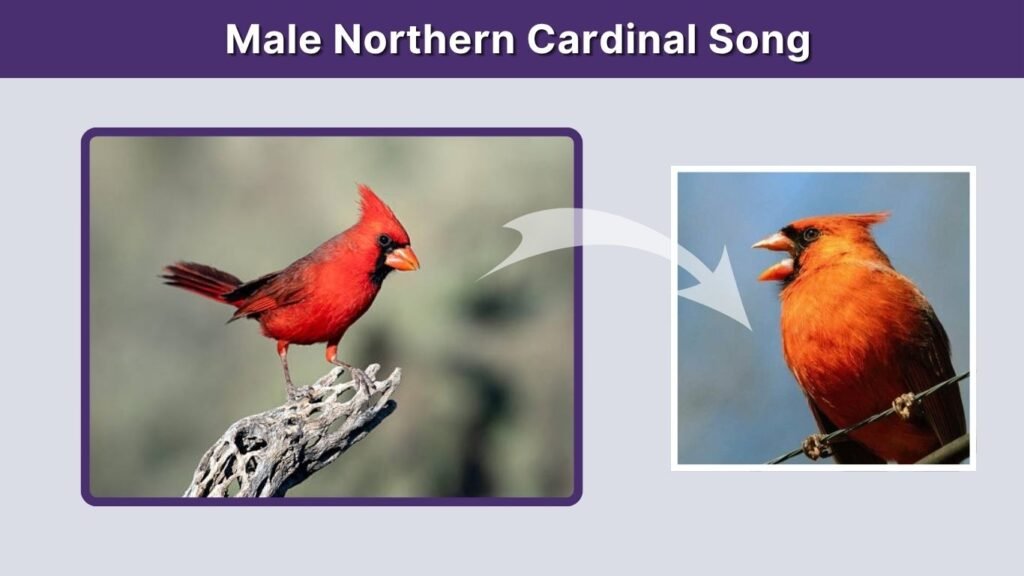
The male northern cardinal is a strong singer. His song is clear, loud, and musical. He often sings from tree branches, shrubs, fences, rooftops, and other open perches.
The song helps him defend territory and attract a mate. Male cardinals may start singing before sunrise and continue through the day, especially in spring.
What Sound Does a Male Northern Cardinal Make?
A male northern cardinal song often sounds like repeated whistles. Many people describe it as “cheer-cheer-cheer,” “birdie-birdie-birdie,” or “what-cheer, what-cheer.” The exact sound can vary by bird and region.
The male northern cardinal call is different from the song. The call is often a sharp metallic “chip.” He may use it when alarmed, when staying in contact with the female, or when moving through cover.
Male cardinals can sing many song phrases. Some pairs may even sing back and forth, especially during the breeding season.
Male Northern Cardinal Behavior
The male northern cardinal is active, alert, and often territorial. He may defend a nesting area from other male cardinals. During breeding season, he may chase rivals, sing loudly, or even attack his own reflection in windows.
This reflection behavior happens because the male thinks the reflection is another bird entering his territory. It is most common in spring and early summer.
Common Behavior Traits
- Sings from high perches
- Defends territory
- Feeds the female during courtship
- Visits backyard feeders
- Gives sharp alarm calls
- Chases rival males
- May attack window reflections
- Stays in range year-round
- Uses shrubs for cover
- Feeds on seeds, fruits, and insects
Male cardinals are often seen early in the morning and late in the afternoon. They may visit feeders with females, juveniles, or other backyard birds. Although they can be bold, they still prefer cover nearby.
Male Northern Cardinal Diet
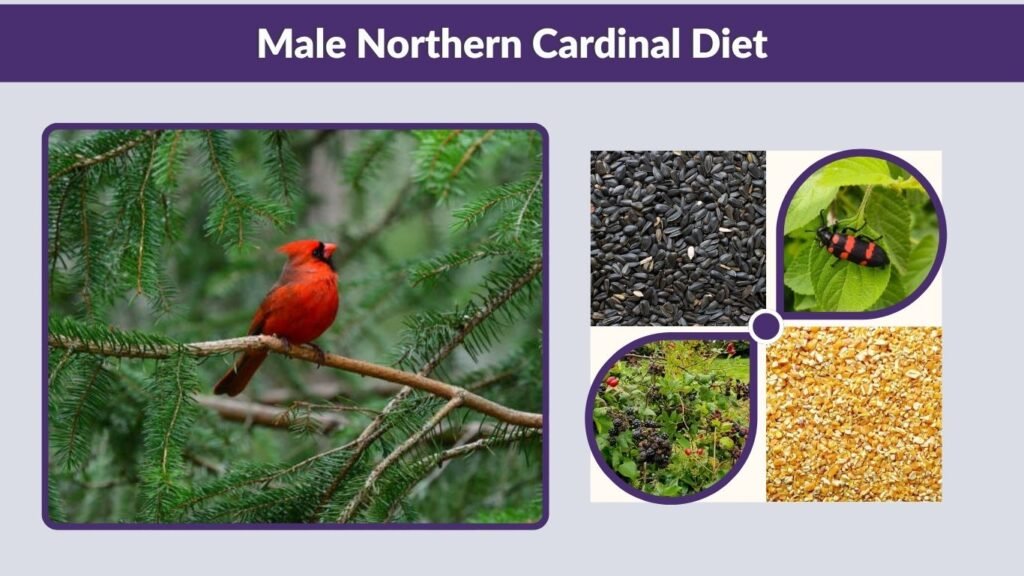
The male northern cardinal eats seeds, fruits, berries, and insects. His thick bill is perfect for cracking seeds, but he also eats soft foods when available. During breeding season, insects become more important because chicks need protein.
At backyard feeders, male cardinals often prefer larger seeds and stable feeding surfaces.
What Male Cardinals Eat
- Black oil sunflower seeds
- Safflower seeds
- Cracked corn
- Millet
- Wild berries
- Grapes and small fruits
- Weed seeds
- Beetles
- Caterpillars
- Grasshoppers
- Spiders
- Small insects
Male cardinals often feed on platform feeders, hopper feeders, and the ground below feeders. They may not use small tube feeders as easily because of their size and long tail.
To attract male cardinals, offer sunflower seeds and safflower seeds near shrubs or trees. Native berry bushes also help provide natural food.
Male Northern Cardinal Habitat
Male northern cardinals live in many habitats with shrubs, trees, vines, and thick cover. They are common in backyards, parks, woodland edges, gardens, farms, and brushy areas.
They do not need deep forests. In fact, they often do very well around people when suitable food and cover are available.
Common Places to Find Male Cardinals
- Backyard gardens
- Parks
- Woodland edges
- Hedgerows
- Shrubby fields
- Forest borders
- Swamps and thickets
- Suburban neighborhoods
- Farms
- Brushy stream edges
A male northern cardinal in New York City may live in parks, gardens, cemeteries, and green neighborhoods. In other places, such as Kentucky, Florida, or Texas, male cardinals can be seen year-round in suitable habitat.
They prefer areas where they can hide quickly if predators appear.
Male Northern Cardinal in Winter
Male northern cardinals are very noticeable in winter. Their red feathers look bright against snow, bare branches, and gray skies. Because they do not usually migrate, many people see the same cardinals throughout the year.
In winter, food and cover become very important. Male cardinals may visit feeders more often when natural food is harder to find.
Winter Behavior
During winter, male cardinals often feed on seeds and berries. They may join loose groups with females and other cardinals. However, they still remain alert and may keep some personal space around food.
Cold weather can make a male cardinal look round and fluffy. This happens when he fluffs his feathers to trap warm air close to his body. It is normal unless the bird appears weak, injured, or unable to fly.
Evergreen shrubs, dense hedges, and clean feeders can help cardinals survive cold months.
Male Northern Cardinal Mating Behavior
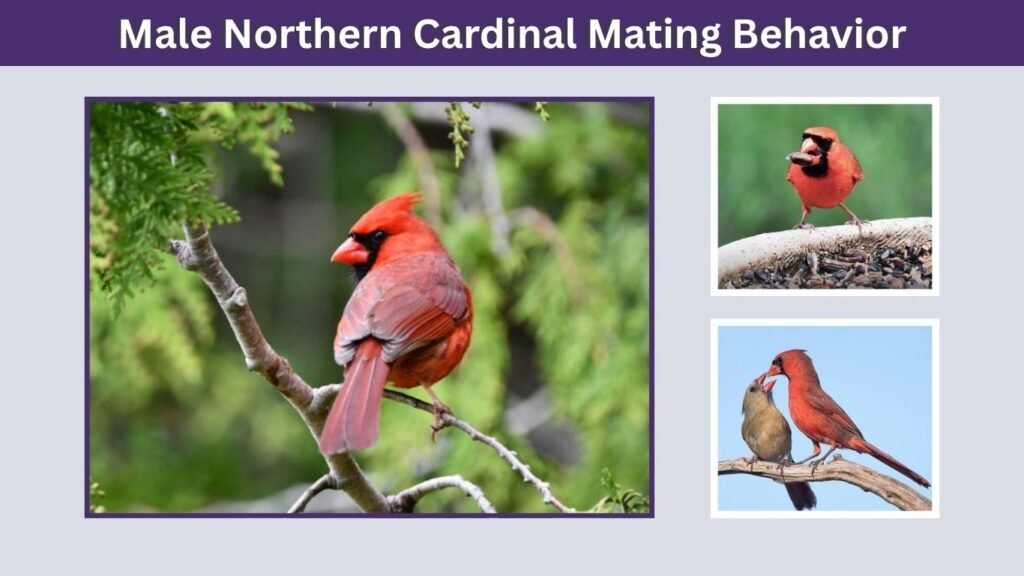
The male northern cardinal plays an important role during courtship and breeding. He sings to defend territory and attract a female. He may also bring food to the female, which strengthens the pair bond.
This feeding behavior is often called courtship feeding. It may look like the male is gently feeding the female “beak to beak.”
Mating and Pair Bond
Northern cardinals often form strong pair bonds. Some pairs may stay together for more than one breeding season, although not every pair stays together for life.
During nesting, the female builds most of the nest and incubates the eggs. The male helps by feeding her, defending the area, and later feeding the chicks.
A male northern cardinal mating call is usually part of his song and courtship behavior. His loud whistles help mark his territory and signal his presence.
Half Male Half Female Northern Cardinal
A half male half female northern cardinal is very rare. This condition is called bilateral gynandromorphism. In such birds, one side may show male-like red plumage, while the other side may look more like a female.
These birds can appear split down the middle, with one side red and the other side brownish.
Why It Happens
This unusual condition happens during early development when male and female traits form differently on each side of the body. It is rare, but cardinals are one of the birds where people sometimes notice it because male and female colors are so different.
A half male half female northern cardinal is still a northern cardinal. It is not a hybrid or a new species. Birdwatchers are often excited to see one because it is so uncommon.
Rare Yellow Male Northern Cardinal
A yellow male northern cardinal is another rare color form. Instead of bright red, the bird may appear yellow, orange-yellow, or golden. This happens because of unusual pigment expression.
Yellow cardinals attract attention because they look so different from normal red males.
Is a Yellow Male Cardinal a Different Species?
No, a yellow male northern cardinal is not a different species. It is still a northern cardinal with a rare color variation. The unusual yellow color is linked to the way pigments are processed in the feathers.
Because these birds are rare, sightings are often shared by birders and photographers. A yellow male cardinal may behave like any other male cardinal, singing, feeding, and defending territory.
How to Attract a Male Northern Cardinal
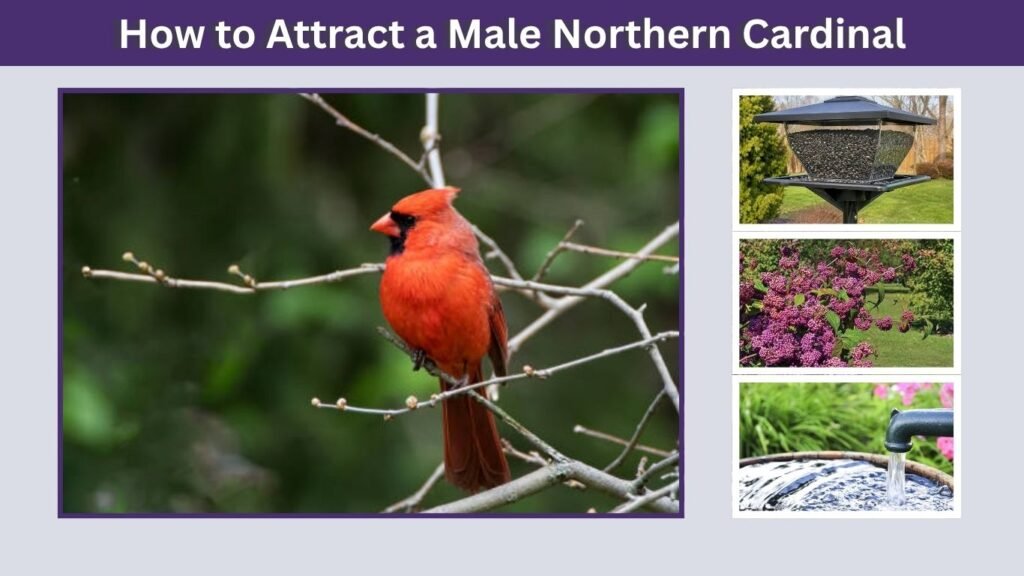
Attracting a male northern cardinal is not difficult if your yard has the right food and cover. Cardinals like feeding areas close to shrubs or trees. They feel safer when they can quickly escape into thick vegetation.
They do not usually use birdhouses, so natural cover is more important than nest boxes.
Backyard Tips
- Offer black oil sunflower seeds
- Offer safflower seeds
- Use platform feeders
- Use hopper feeders
- Keep feeders near shrubs
- Plant native berry bushes
- Provide fresh water
- Keep cats indoors
- Avoid heavy pesticide use
- Leave dense cover for nesting
Male cardinals may visit feeders early and late in the day. If you keep the feeder clean and place it near safe cover, he may return often.
A good cardinal-friendly yard includes food, water, shrubs, and quiet nesting places.
Male Northern Cardinal Size and Lifespan
The male northern cardinal is a medium-sized songbird. He is larger than many sparrows but smaller than birds like robins or blue jays. His long tail and crest can make him look bigger than he really is.
Male cardinals can live several years in the wild, although many young birds do not survive their first year.
Size and Life Details
An adult male northern cardinal is usually about 8 to 9 inches long. His wingspan is roughly 10 to 12 inches. He has a strong body, long tail, and thick bill.
The lifespan of a male cardinal depends on food, weather, predators, disease, and accidents. Hawks, cats, snakes, and window collisions can all be threats. Clean feeders, native plants, and safer windows can help support local cardinals.
FAQs
What is a male northern cardinal called?
A male northern cardinal is usually called a male northern cardinal or male cardinal. Many people also call him a red cardinal because of his bright red feathers. However, the species name is northern cardinal, and the scientific name is Cardinalis cardinalis.
What does a male northern cardinal look like?
A male northern cardinal is bright red with a pointed crest, long tail, thick orange-red bill, and black face mask. His wings, body, and tail are mostly red. In shade, he may look darker crimson, while in sunlight he can appear very bright.
What is the difference between male and female northern cardinals?
The male northern cardinal is bright red with a black mask, while the female is brown or tan with red highlights. Both have a crest and orange-red bill. The female is more camouflaged for nesting, while the male is brighter and more noticeable.
What does a male northern cardinal sound like?
A male northern cardinal sings loud, clear whistles. His song may sound like “cheer-cheer-cheer” or “birdie-birdie-birdie.” He also gives a sharp metallic “chip” call. Songs are often used for territory and courtship, while calls are used for alarm and contact.
Do male northern cardinals turn red?
Young male northern cardinals are not fully red at first. Juveniles often look brownish with dull red patches and a dark bill. As they mature, they grow brighter red feathers, and the bill changes to orange-red. Adult males are the classic bright red cardinals.
