
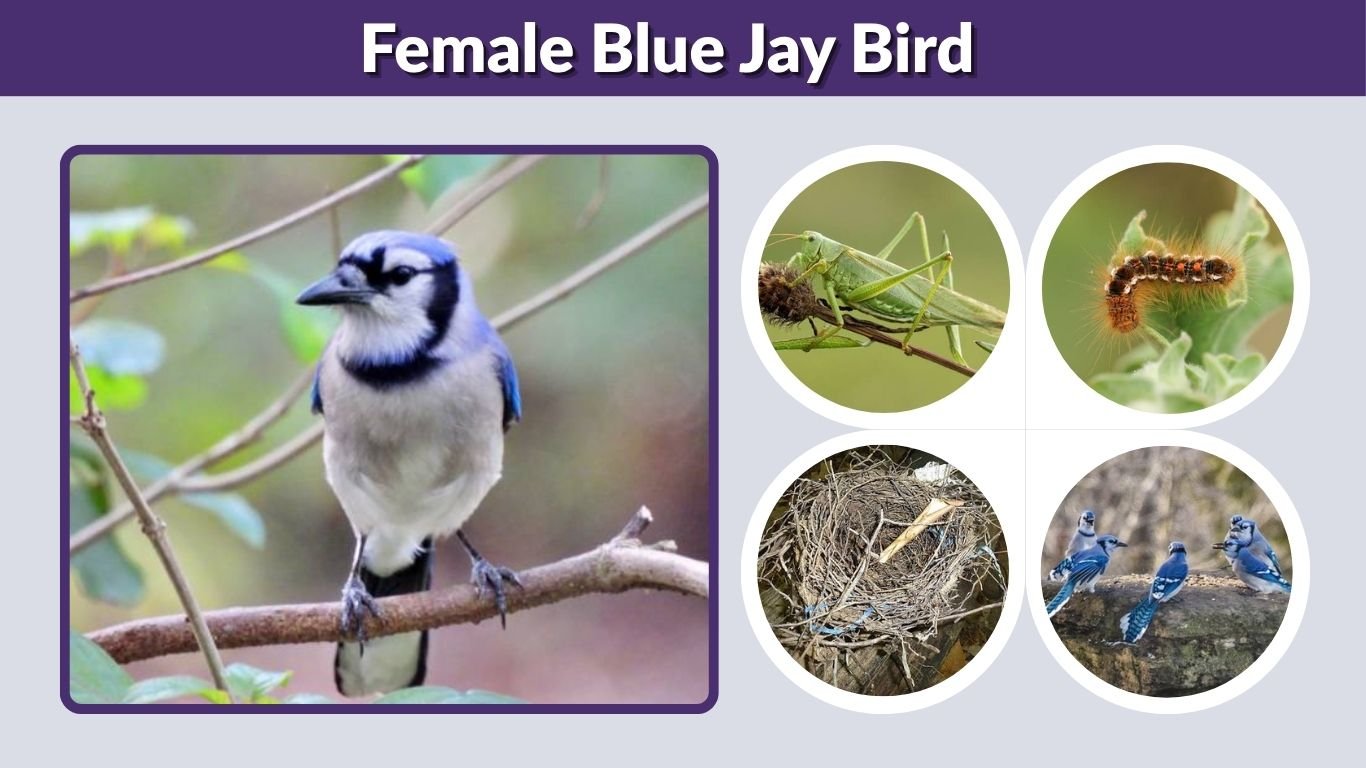
The female Blue Jay bird looks almost identical to the male, which makes identification difficult for many backyard birdwatchers. Both sexes have blue, white, and black plumage, a raised crest, a strong bill, and a loud voice. Unlike Northern Cardinals, female Blue Jays are not brown or dull-colored. The best way to identify a female is by watching behavior, pair activity, courtship feeding, and nesting roles rather than color alone.
What Does a Female Blue Jay Bird Look Like?
A female Blue Jay has the same bold pattern as a male Blue Jay. She has a blue crest, blue wings, a long blue tail, white or pale gray underparts, and a black necklace-like marking around the face and throat. Cornell describes Blue Jays as large, noisy songbirds with blue, white, and black plumage and a noticeable crest.
Because both sexes share these same field marks, a single Blue Jay in a photo is usually impossible to sex with certainty. The bird may look bright blue, but that does not automatically mean it is male.
Female Blue Jay Identification
A female Blue Jay can be identified as a Blue Jay by her body shape, crest, feather pattern, and call. However, identifying her as female needs careful observation.
Key identification signs include:
- Crest: Blue crest on top of the head
- Face: White face with black markings
- Neck: Black collar or necklace-like band
- Wings: Blue, black, and white barred pattern
- Tail: Long blue tail with black bars
- Body: White to pale gray chest and belly
- Bill: Strong black bill for nuts and seeds
- Size: Medium-sized songbird, larger than many feeder birds
- Behavior clue: May be fed by the male during courtship
- Nest clue: Often spends more time shaping or sitting near the nest
These clues help you recognize a Blue Jay, but they do not always prove the bird is female. For accurate sex identification, behavior is more useful than plumage.
Female Blue Jay Color
Female Blue Jays are not plain or brown like females of many other bird species. They are also blue, white, and black. Their blue color may look brighter or darker depending on sunlight, angle, feather condition, and season.
The blue color of Blue Jays is not produced by blue pigment. It comes from the structure of the feathers reflecting light. That is why a feather may appear less blue when damaged or viewed from a different angle.
A female may sometimes look slightly softer or smaller than a male, but this is not a reliable field mark. In normal backyard viewing, male and female Blue Jays usually look the same.
Blue Jay Bird Male vs Female
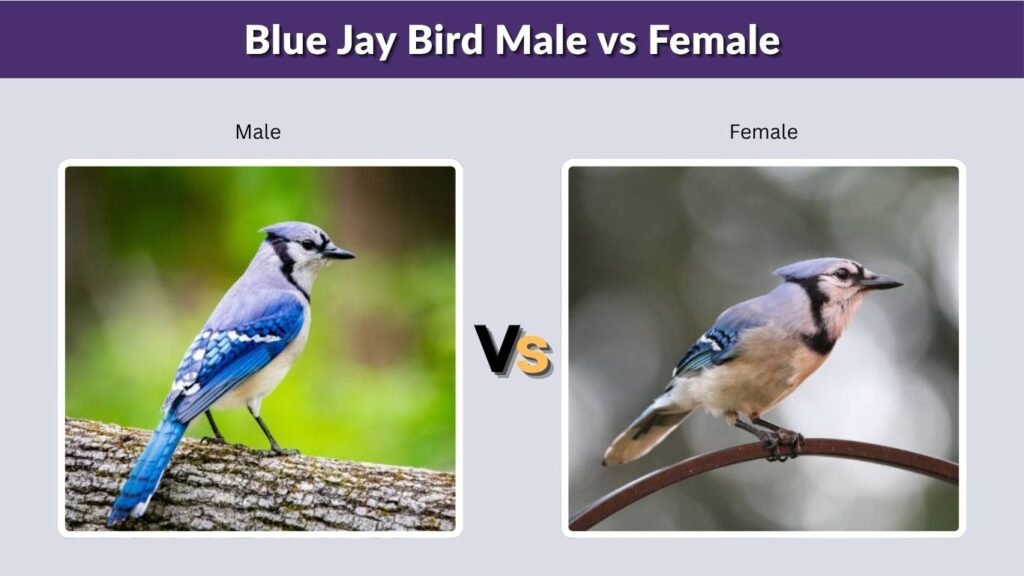
Male and female Blue Jays are sexually similar. This means they do not show strong color differences. Both have crests, blue backs, white faces, black markings, and barred wings and tails.
This is why the keyword “Blue Jays birds male vs female” is so common. Many people expect a clear color difference, but Blue Jays do not work that way.
Male vs Female Blue Jay Comparison
The table below shows the main differences and similarities between male and female Blue Jays.
| Feature | Female Blue Jay | Male Blue Jay |
| Plumage color | Blue, white, and black | Blue, white, and black |
| Crest | Present | Present |
| Body size | Often slightly smaller | Often slightly larger |
| Field identification | Difficult by color alone | Difficult by color alone |
| Courtship role | May receive food from male | May feed female |
| Nesting role | Often more involved in incubation | Helps defend and feed |
| Call | Loud and varied | Loud and varied |
| Feeder behavior | Bold, but may be cautious near nest | Often bold and territorial |
The most important point is simple: female and male Blue Jays look almost the same. Size can give a hint, but it is not enough unless you compare a pair closely.
Do Male and Female Blue Jays Look the Same?
Yes, male and female Blue Jays look nearly the same. A female Blue Jay has the same blue crest, black collar, white face, barred wings, and long tail as the male.
This makes them different from birds like Northern Cardinals, where males are bright red and females are brownish. In Blue Jays, both sexes are colorful.
If you see two Blue Jays together, the male may be slightly larger. During courtship, the male may feed the female. Watching this behavior is one of the better ways to guess which bird is female.
Female Blue Jay Bird Pictures and Photos
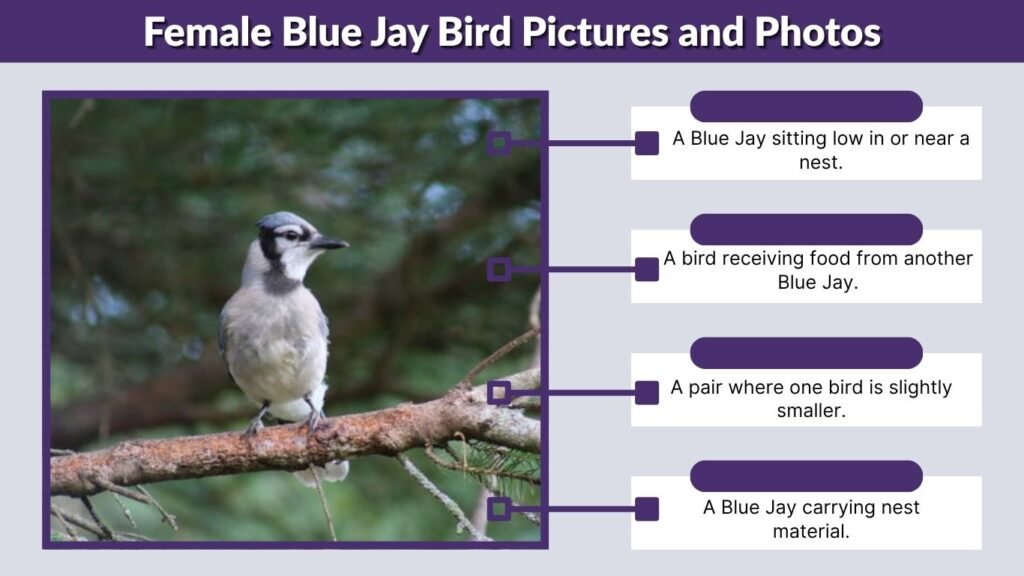
Many people search for female Blue Jay bird photos because they want to see the difference between male and female birds. The challenge is that most female Blue Jay pictures look just like male Blue Jay pictures.
A photo can show Blue Jay identification features, but it usually cannot confirm sex unless the photo captures behavior such as courtship feeding, nesting, egg incubation, or a known breeding pair.
How to Identify a Female Blue Jay from a Photo
Photo identification can be tricky. A bird standing alone on a branch or feeder usually cannot be confirmed as male or female. However, some clues can help.
Look for these photo clues:
- A Blue Jay sitting low in or near a nest
- A bird receiving food from another Blue Jay
- A pair where one bird is slightly smaller
- A Blue Jay carrying nest material
- A bird staying close to nestlings
- A Blue Jay brooding eggs or young
- A pair during breeding season
Even with these clues, it is best to say “likely female” rather than “definitely female” unless the behavior is clear.
Why Female Blue Jay Photos Look Like Males
Female Blue Jay photos look like male photos because both sexes share the same plumage. Their blue color, black markings, and crest do not separate them.
Lighting can also confuse people. A bird in bright sunlight may look more vivid blue, while one in shade may look grayish or dull. This does not always show sex. It often only shows lighting and feather angle.
When writing or captioning a photo, it is better to avoid claiming a Blue Jay is female unless behavior or field context supports it.
Female Blue Jay Call and Sounds
Female Blue Jays can call loudly just like males. Blue Jays are known for noisy calls, harsh “jay” sounds, rattles, whistles, and mimicry. Cornell notes that Blue Jays are often detected by their noisy calls and have complex social behavior.
A female Blue Jay is not silent. She can communicate with her mate, warn of danger, and call around the nest. Both sexes are vocal, so sound alone usually does not confirm gender.
What Does a Female Blue Jay Sound Like?
A female Blue Jay may make harsh calls, soft contact notes, rattles, and warning sounds. Around the nest, she may be quieter when trying to avoid attention, but she can become loud if a predator comes near.
Common Blue Jay sounds include:
- Harsh “jay-jay” calls
- Alarm calls
- Rattling sounds
- Whistles
- Soft mate-contact calls
- Hawk-like mimic calls
Because males and females both call, a loud Blue Jay is not automatically male. Females can also be bold, noisy, and defensive.
Do Female Blue Jays Sing?
Blue Jays are not famous for sweet musical songs like some songbirds, but they do make many vocal sounds. Females can use calls and softer vocalizations for communication.
During nesting season, a female may use quieter calls near the nest. This helps her communicate without attracting predators. If danger appears, she may become loud and aggressive along with her mate.
Blue Jay communication is complex because they are part of the corvid family, which includes crows, ravens, magpies, and other intelligent birds.
Female Blue Jay Behavior
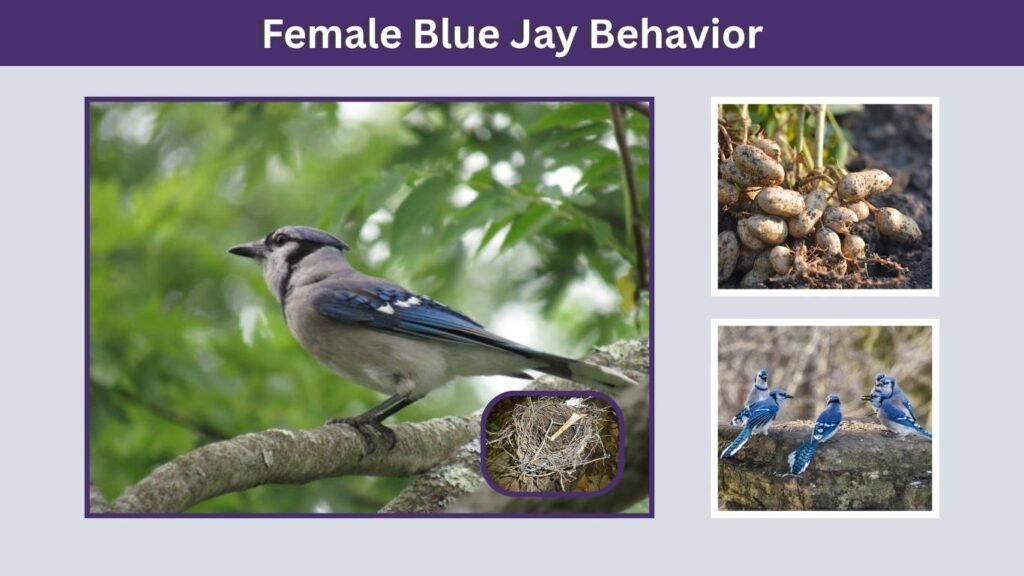
Female Blue Jays are intelligent, alert, and active. They forage for food, communicate with family members, help with nesting, and defend young. Like males, they can be bold at feeders and cautious around threats.
A female may seem less obvious during nesting because she spends more time near the nest. Blue Jays can become quiet and less visible around nesting areas, but they may loudly attack or scold predators that threaten the nest.
Courtship and Pair Behavior
Courtship is one of the best times to observe male and female differences. During the breeding season, you may see a group of Blue Jays following one bird. This can be part of courtship behavior.
The male may feed the female as part of pair bonding. If one Blue Jay offers food to another, the bird receiving food may be the female, especially during courtship or nesting season.
Pair behavior may include staying close together, calling softly, moving through trees together, and defending territory. Blue Jays may form strong pair bonds and family groups.
Female Blue Jay at Feeders
Female Blue Jays visit feeders for peanuts, sunflower seeds, suet, and cracked corn. They use their strong bills to crack seeds and nuts. Like males, they may grab food quickly and fly away to eat or store it.
At feeders, female and male Blue Jays are hard to separate. Both can be bold, noisy, and dominant. If you see a smaller bird in a pair, it may be the female, but size alone is not a perfect clue.
A platform feeder or hopper feeder is best for Blue Jays because they are larger than finches and chickadees. Peanuts and sunflower seeds are especially attractive.
Female Blue Jay Nesting Role
Female Blue Jays play an important role during nesting. Blue Jays build open cup nests in trees or large shrubs. Audubon notes that both sexes help build the nest, which is usually placed in a tree fork and made from twigs, grass, bark strips, moss, and sometimes mud.
The female is usually more closely connected with incubation and brooding, while the male helps with feeding and defense.
Nest Building and Eggs
During nesting season, both birds may gather material, but the female often shapes the nest. The nest is usually bulky and placed above the ground in a tree or large shrub.
Blue Jay eggs are usually greenish, bluish, or buff-colored with darker markings. A typical clutch may contain several eggs. The female does most incubation, while the male may bring food.
Nesting behavior can help identify a female. If one bird spends more time sitting in the nest or brooding young, it is likely the female.
Raising Baby Blue Jays
After the eggs hatch, both parents feed the chicks. Baby Blue Jays need soft, protein-rich foods such as insects. The parents may bring caterpillars, beetles, grasshoppers, and other small prey.
Young Blue Jays stay in the nest until they are old enough to leave, but they may still depend on parents after fledging. During this time, both male and female adults may feed and protect them.
If you find a young Blue Jay on the ground, do not assume it is abandoned. Fledglings often leave the nest before they can fly perfectly. The parents may be nearby watching.
Female Blue Jay Diet and Food
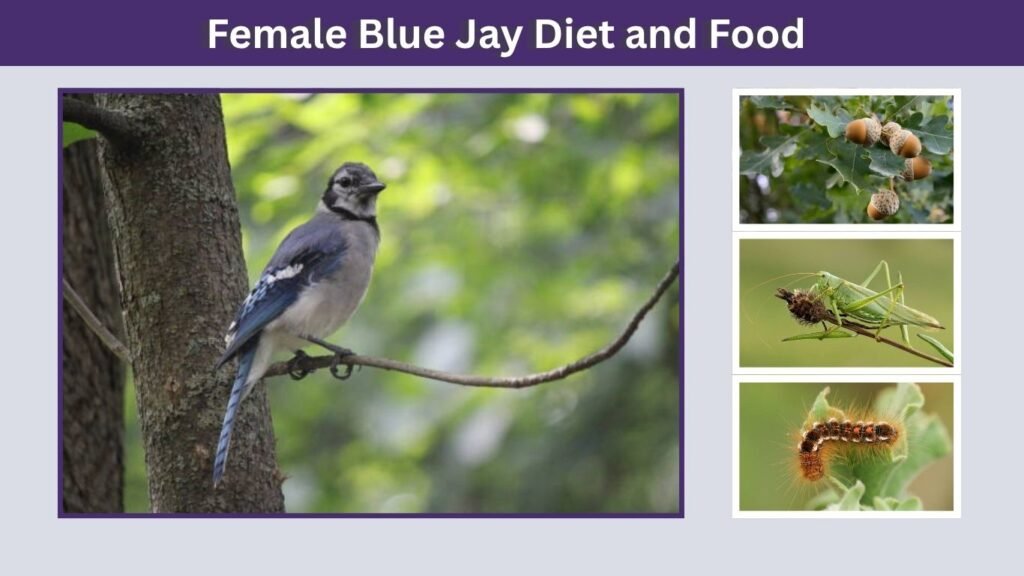
Female Blue Jays eat the same foods as males. Their diet includes acorns, nuts, seeds, fruits, berries, insects, and sometimes eggs or small animals. Most of their diet is plant-based, especially nuts and seeds.
During nesting season, insects become more important because chicks need protein. A female may also need extra energy while producing eggs and caring for young.
Foods Female Blue Jays Eat
Female Blue Jays eat a wide range of foods in the wild and at feeders.
Common foods include:
- Acorns
- Peanuts
- Sunflower seeds
- Beechnuts
- Corn
- Berries
- Fruits
- Caterpillars
- Beetles
- Grasshoppers
- Spiders
- Suet at feeders
Blue Jays are famous for storing acorns and other foods. They may hide food in the ground or leaves and return later. This caching behavior also helps spread oak trees.
Best Foods to Attract Female Blue Jays
If you want to attract Blue Jays, offer foods that match their natural diet. Unsalted peanuts are one of the best options. Black oil sunflower seeds, striped sunflower seeds, suet, and cracked corn can also work well.
Use a platform feeder, tray feeder, or hopper feeder. Blue Jays are medium-sized birds and need room to land. Keep the feeder clean and avoid salted, seasoned, or moldy foods.
Planting oak trees, berry shrubs, and native plants can also help. Natural habitat supports insects and provides shelter, which is important during nesting season.
Common Mistakes About Female Blue Jays
Female Blue Jays are often misunderstood because people expect them to look different from males. Many birds have strong male-female color differences, but Blue Jays do not.
This leads to confusion in photos, backyard sightings, and online searches. A bright blue bird is not always male. A slightly dull-looking Blue Jay is not always female.
Mistake 1: Thinking Only Males Are Blue
Both male and female Blue Jays are blue. A female Blue Jay has the same general color pattern as the male. She is not brown, gray, or plain-colored like some female songbirds.
If you see a blue bird with a crest and black necklace, it may be either male or female. You need behavior, size comparison, or nesting clues to make a better guess.
Mistake 2: Using One Photo as Proof
One photo usually cannot prove whether a Blue Jay is female. Lighting, posture, age, and feather condition can change how the bird looks.
A photo is more useful if it shows behavior. A bird sitting on a nest, receiving food from another Blue Jay, or caring for young may be identified more confidently.
Mistake 3: Calling Every Quiet Blue Jay Female
A quiet Blue Jay is not always female. Both sexes can be quiet or loud depending on the situation. Around a nest, Blue Jays may become more secretive. Near a predator, both sexes may call loudly.
Sound and personality can help, but they should not be used alone. The best identification method combines appearance, behavior, season, and context.
FAQs
What does a female Blue Jay bird look like?
A female Blue Jay looks very similar to a male. She has blue wings, a blue crest, a long blue tail, a white or pale gray underside, and black markings around the face and throat. Color alone usually cannot confirm whether a Blue Jay is female.
How can you tell a male from a female Blue Jay?
The best way to tell male and female Blue Jays apart is by behavior. Males may feed females during courtship, while females may spend more time incubating eggs or brooding young. Males may be slightly larger, but the size difference is hard to see.
Are female Blue Jays blue?
Yes, female Blue Jays are blue. They have the same blue, white, and black pattern as males. Unlike female cardinals, female Blue Jays are not dull brown. Their blue color comes from feather structure reflecting light rather than blue pigment.
Do female Blue Jays call?
Yes, female Blue Jays call and can be very vocal. They may make harsh “jay” calls, alarm calls, rattles, whistles, and softer contact sounds. Both males and females are noisy, so a loud call does not prove the bird is male.
Can you identify a female Blue Jay from a picture?
Usually, you cannot identify a female Blue Jay from a single picture unless the photo shows clear behavior. A bird sitting on a nest, receiving food from a mate, or caring for young may be female. A normal feeder photo is usually not enough.