
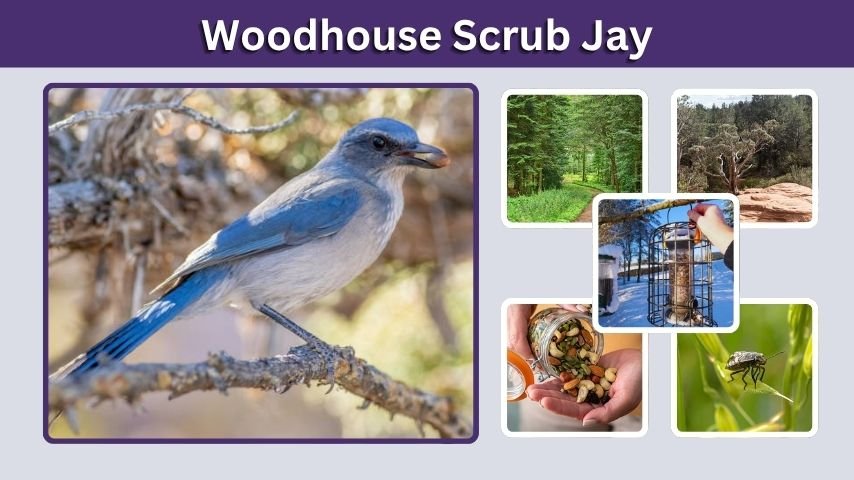
The Woodhouse Scrub Jay is a blue-gray jay of the dry interior West. It is often seen in pinyon-juniper woodlands, oak scrub, desert foothills, and open country with scattered trees. Many birdwatchers still connect it with the older name “Western Scrub-Jay,” but it is now treated as a separate species from the California Scrub-Jay. This guide explains its identification, range, call, diet, nesting habits, and key differences from similar jays.
What Is a Woodhouse Scrub Jay?
The Woodhouse Scrub Jay, also written as Woodhouse’s Scrub-Jay, is a medium-sized jay in the corvid family. Its scientific name is Aphelocoma woodhouseii. Like crows, ravens, magpies, and other jays, it is intelligent, vocal, curious, and quick to notice changes in its surroundings.
This bird was once included under the broader name Western Scrub-Jay. In 2016, the Western Scrub-Jay was split into two species: the California Scrub-Jay and Woodhouse’s Scrub-Jay. Audubon describes Woodhouse’s as the scrub-jay of the Interior West, while California Scrub-Jay is more closely tied to the Pacific side.
| Quick Fact | Woodhouse Scrub Jay |
| Scientific name | Aphelocoma woodhouseii |
| Family | Corvidae |
| Main colors | Blue, gray, white |
| Crest | No crest |
| Common habitat | Pinyon-juniper woodland, oak scrub, arid foothills |
| Diet | Omnivore |
| Old group name | Western Scrub-Jay |
Woodhouse Scrub Jay Identification
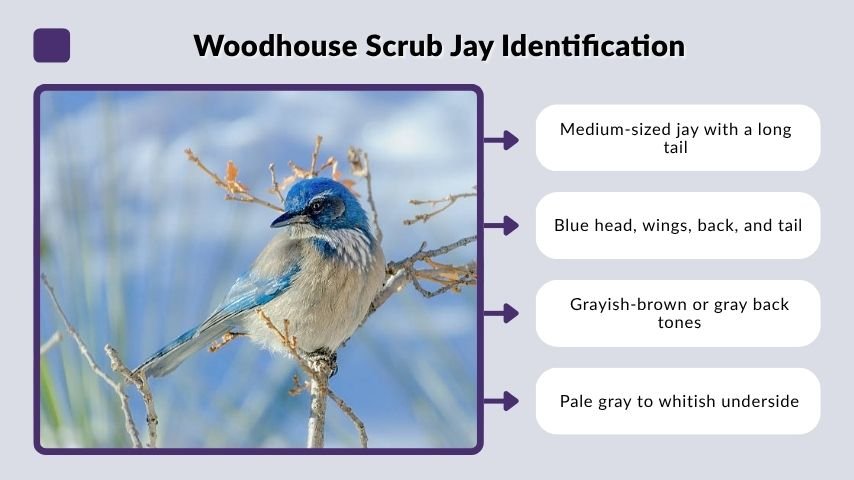
The Woodhouse Scrub Jay is often described as the “blue jay” of dry lowlands from Nevada south into Mexico. Cornell Lab notes that it is a dusty blue bird with gray-brown and white tones, and it often perches on trees, posts, or wires as a lookout.
Key Identification Features
- Medium-sized jay with a long tail
- Blue head, wings, back, and tail
- Grayish-brown or gray back tones
- Pale gray to whitish underside
- Whitish throat with a faint blue necklace-like border
- No crest on the head
- Long, straight, pointed bill
- Dark eye line or dusky face patch
- Often seen in pairs or small family groups
- Flight can look slow, with fluttering and short glides
Compared with the California Scrub-Jay, Woodhouse’s usually looks duller and grayer. It often has a less bright blue body and a more muted underside. This softer coloring helps it blend into dry woodland and desert-edge habitats.
Woodhouse Scrub Jay Range
The Woodhouse Scrub Jay is mainly an inland western bird. It occurs across dry parts of the western United States and into Mexico. Its range includes areas such as Nevada, Utah, Colorado, Arizona, New Mexico, parts of Texas, Wyoming, Idaho, and nearby regions where suitable habitat exists.
Audubon describes it as a bird of the Interior West, often living in sparse juniper and pinyon pine woodland in arid foothills. It can also enter suburbs of some western cities, especially where trees, shrubs, and food sources are available.
Woodhouse Scrub Jay Range Map Search Intent
Many people search for a Woodhouse’s Scrub Jay range map because this species can be confused with California Scrub-Jay. A simple way to remember the range is this: California Scrub-Jay is more coastal and Pacific-side, while Woodhouse Scrub Jay is more inland and desert-side. Their ranges come close in some areas, especially around parts of Nevada and eastern California.
Woodhouse Scrub Jay Habitat
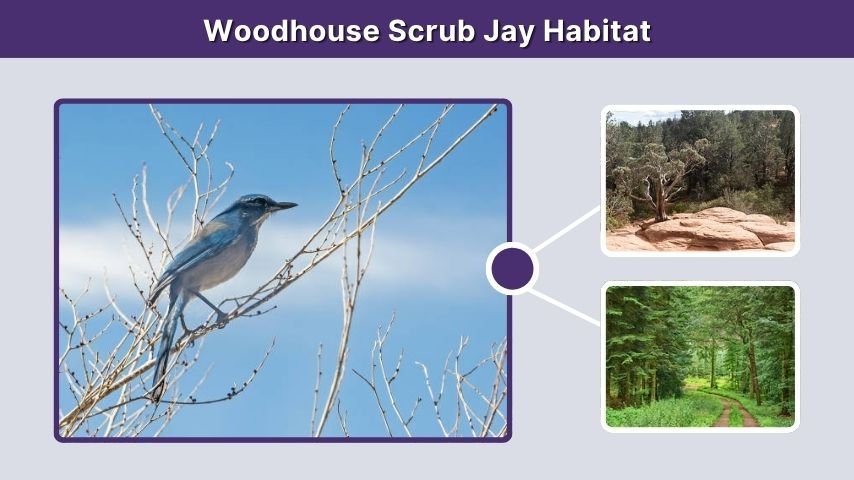
Woodhouse Scrub Jays prefer dry, open habitats with shrubs, scattered trees, and good lookout perches. They are especially associated with pinyon pine and juniper woodland, but they can also use oak scrub, arid foothills, canyon edges, ranch country, and wooded neighborhoods.
A good habitat for this bird usually includes open ground for foraging, shrubs or small trees for cover, and seed-producing plants. In some areas, pinyon pine seeds and juniper berries are especially important foods. The National Wildlife Federation notes that Woodhouse’s scrub-jays commonly forage in pairs or small family groups and eat insects, fruits, nuts, berries, seeds, and sometimes small animals.
Woodhouse Scrub Jay Call and Sounds
The Woodhouse Scrub Jay call is loud, rough, and sharp. It does not sing sweetly like many small songbirds. Instead, it gives harsh calls, scolding notes, and scratchy sounds that fit its bold personality.
These calls help the bird defend territory, warn family members, announce danger, and stay connected with its mate or group. Because Woodhouse Scrub Jays often perch in visible places, you may see one calling from a fence post, utility wire, shrub top, or tree branch.
Why Is It So Vocal?
Woodhouse Scrub Jays are alert birds. They may call loudly when they see hawks, owls, snakes, cats, or people near a nest. They may also call around feeders, food caches, or territory boundaries. Their noise can make them seem aggressive, but much of it is normal corvid communication.
What Does a Woodhouse Scrub Jay Eat?
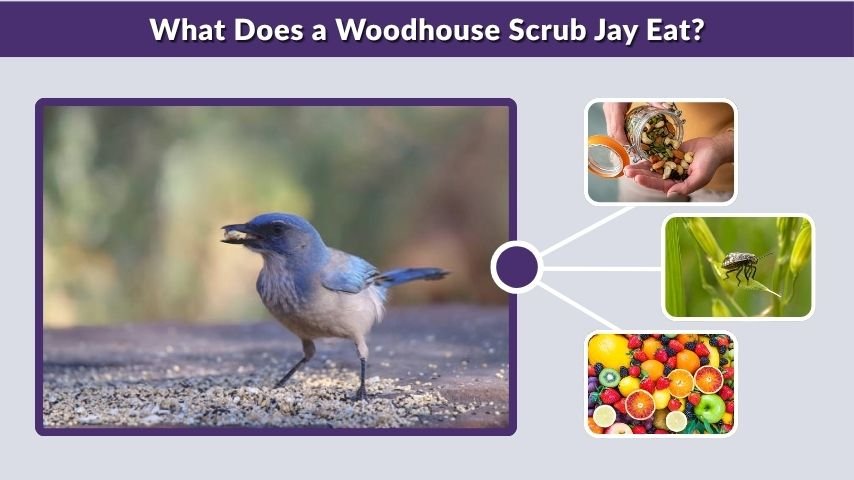
Woodhouse Scrub Jays are omnivores, so they eat both plant and animal foods. Their diet changes by season. During warmer months, they may eat more insects and fruit. In fall and winter, they rely more on seeds, nuts, and stored foods.
Celebrate Urban Birds notes that Woodhouse’s Scrub-Jays eat mostly insects and fruit in spring and summer, then shift more toward nuts and seeds during fall and winter. They also eat small animals such as lizards and nestling birds, along with pine nuts, juniper berries, grass seeds, sunflower seeds, peanuts, corn, almonds, walnuts, and cherries.
| Food Type | Examples |
| Seeds and nuts | Pine seeds, acorns, sunflower seeds, peanuts |
| Fruits and berries | Juniper berries, cultivated cherries, wild fruits |
| Insects | Beetles, caterpillars, grasshoppers |
| Small animals | Lizards, eggs, nestlings |
| Feeder foods | Unsalted peanuts, sunflower seeds, suet |
Like other jays, this bird caches food. It may hide seeds or nuts in the ground, under leaves, or in small crevices. Later, it returns to many of those hidden food spots. This caching habit shows strong memory and may also help spread trees when forgotten seeds sprout.
Woodhouse Scrub Jay Nest and Eggs
Woodhouse Scrub Jays usually nest in shrubs, small trees, tangled vines, or live branches. NestWatch lists the species as an open-cup nester and provides nesting details for monitoring this bird safely.
The nest is usually made from twigs, plant fibers, grasses, roots, and softer lining materials. Both members of a pair may stay close to the nest area, and the adults can become noisy or defensive if predators approach.
Nesting Behavior
The female usually lays several eggs in the nest. The eggs are incubated until they hatch, and the young remain in the nest while they grow feathers and strength. After leaving the nest, young Woodhouse Scrub Jays may still follow adults and beg for food while learning how to forage.
If you find a young scrub jay on the ground, it may be a fledgling rather than an abandoned bird. A feathered fledgling that can hop or flutter is often still being cared for by parents nearby.
Female Woodhouse Scrub Jay vs Male
Male and female Woodhouse Scrub Jays look very similar. Both have blue-gray coloring, a pale throat, a long tail, and no crest. In the field, most birdwatchers cannot reliably separate male and female Woodhouse Scrub Jays by appearance alone.
Males may average slightly larger, but size is difficult to judge unless both birds are side by side. Behavior during nesting season may provide clues, but it is still not always obvious. For everyday identification, it is better to focus on species-level features such as range, habitat, body shape, and color pattern.
Woodhouse Scrub Jay vs California Scrub Jay
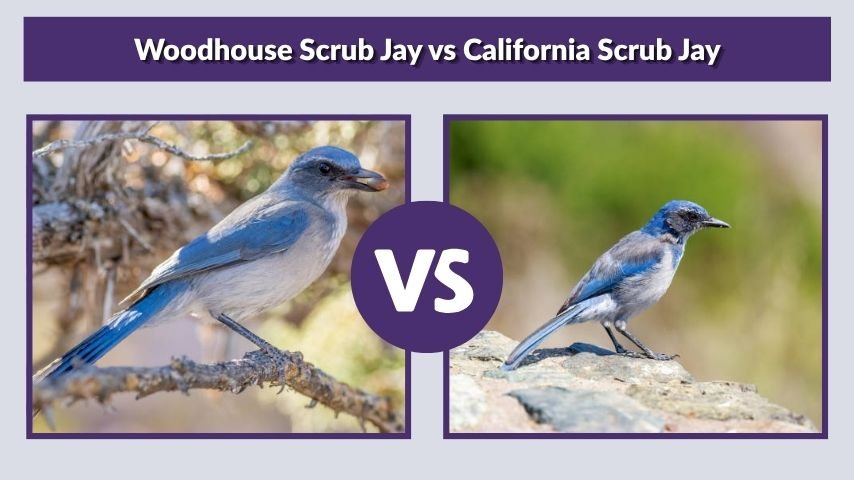
Woodhouse Scrub Jay and California Scrub-Jay are closely related, and they were once grouped under the name Western Scrub-Jay. This is why searches like “woodhouse scrub jay vs california scrub jay” and “western scrub jay vs woodhouse scrub jay” are common.
The main differences are range, habitat, and color. California Scrub-Jay is more common along the Pacific side, especially in oak woodland, chaparral, suburban yards, and coastal scrub. Cornell describes California Scrub-Jays as birds of scrub, oak woodlands, and suburban yards from southern British Columbia through Baja California. Woodhouse Scrub Jay is more inland and is strongly linked with dry pinyon-juniper woodland and arid foothills.
| Feature | Woodhouse Scrub Jay | California Scrub-Jay |
| Main range | Interior West | Pacific side |
| Color | Duller blue-gray | Brighter blue |
| Habitat | Pinyon-juniper, oak scrub, arid foothills | Oak woodland, chaparral, suburbs |
| Crest | No crest | No crest |
| Old group | Western Scrub-Jay | Western Scrub-Jay |
Is Western Scrub Jay Now Woodhouse’s Scrub Jay?
Not exactly. The old name Western Scrub-Jay was split into two main species: California Scrub-Jay and Woodhouse’s Scrub-Jay. So, a bird once called Western Scrub-Jay might now be one or the other depending on where it lives and what it looks like.
If the bird is in coastal California, western Oregon, or similar Pacific-side habitat, it is more likely a California Scrub-Jay. If the bird is in dry interior habitats such as Nevada, Utah, Arizona, New Mexico, Colorado, or parts of Texas, it is more likely a Woodhouse Scrub Jay.
How Did Woodhouse’s Scrub Jay Get Its Name?
The name honors Samuel Washington Woodhouse, an American physician and naturalist. Many bird names were created to recognize early naturalists, explorers, or collectors. In this case, the common name helps separate this inland scrub-jay from the California Scrub-Jay after the taxonomic split.
The scientific name, Aphelocoma woodhouseii, also reflects this naming history. While the name may seem unusual, it is now the standard English name used by major birding references for the inland western scrub-jay.
Are Woodhouse Scrub Jays Rare?
Woodhouse Scrub Jays are not rare across all of their range, but they can be local. Audubon describes them as mostly uncommon birds of sparse juniper and pinyon pine woodlands, though they may come into suburbs in some western cities.
In the right habitat, you may see them regularly. In the wrong habitat, you may not see them at all. This is why range and habitat are so important for identification.
How to Attract Woodhouse Scrub Jays
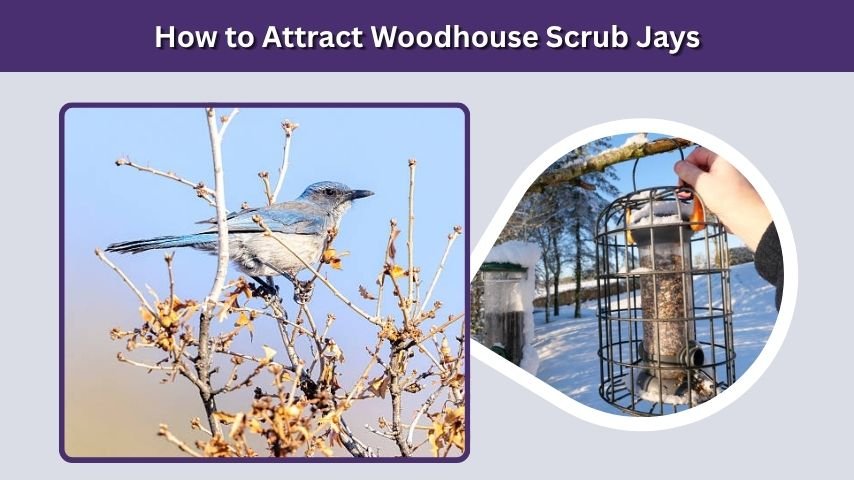
If you live within their range, Woodhouse Scrub Jays may visit a yard with suitable trees, shrubs, and food. Cornell notes that they are fond of sunflower seeds and peanuts at feeders, and a pair may nest in a yard with dense shrubs or small trees.
Good ways to attract them include offering unsalted peanuts, sunflower seeds, suet, a clean birdbath, native shrubs, and pinyon or oak habitat where appropriate. Avoid bread, salty snacks, candy, and processed human food. These foods can be unhealthy for wild birds.
Woodhouse Scrub Jay Facts
Woodhouse Scrub Jays are smart, adaptable, and watchful. Their habit of hiding food shows excellent memory. Their strong calls help warn other animals of danger. Their bold behavior around feeders and neighborhoods makes them easy to notice, but they are still wild birds and should not be hand-fed.
They may also interact with other wildlife in interesting ways. Some field guides and birding sources note that Woodhouse’s Scrub-Jays can pick ticks or parasites from large mammals, showing how opportunistic and observant these birds can be in their environment.
FAQs
Is a Woodhouse Scrub Jay the same as a Western Scrub-Jay?
Not exactly. Western Scrub-Jay was the older broader name. It was split into California Scrub-Jay and Woodhouse’s Scrub-Jay. Today, inland western birds are generally called Woodhouse Scrub Jays, while many Pacific-side birds are called California Scrub-Jays.
What does a Woodhouse Scrub Jay eat?
A Woodhouse Scrub Jay eats insects, fruit, nuts, seeds, berries, eggs, nestlings, and small animals such as lizards. It also visits feeders for sunflower seeds and peanuts. Its diet changes by season, with more insects and fruit in warm months and more seeds and nuts in cooler months.
Where does the Woodhouse Scrub Jay live?
The Woodhouse Scrub Jay lives mainly in the Interior West of North America. It is found in dry habitats such as pinyon-juniper woodland, oak scrub, desert foothills, canyon edges, and open areas with scattered trees.
What does a Woodhouse Scrub Jay sound like?
A Woodhouse Scrub Jay makes loud, harsh, raspy calls. It may give scolding sounds, alarm calls, and sharp contact notes. These sounds help it communicate, warn others about predators, and defend territory.
How can you tell male and female Woodhouse Scrub Jays apart?
Male and female Woodhouse Scrub Jays look very similar. Males may be slightly larger on average, but this is hard to see in the field. Most birdwatchers identify the species rather than trying to determine the bird’s sex.
