
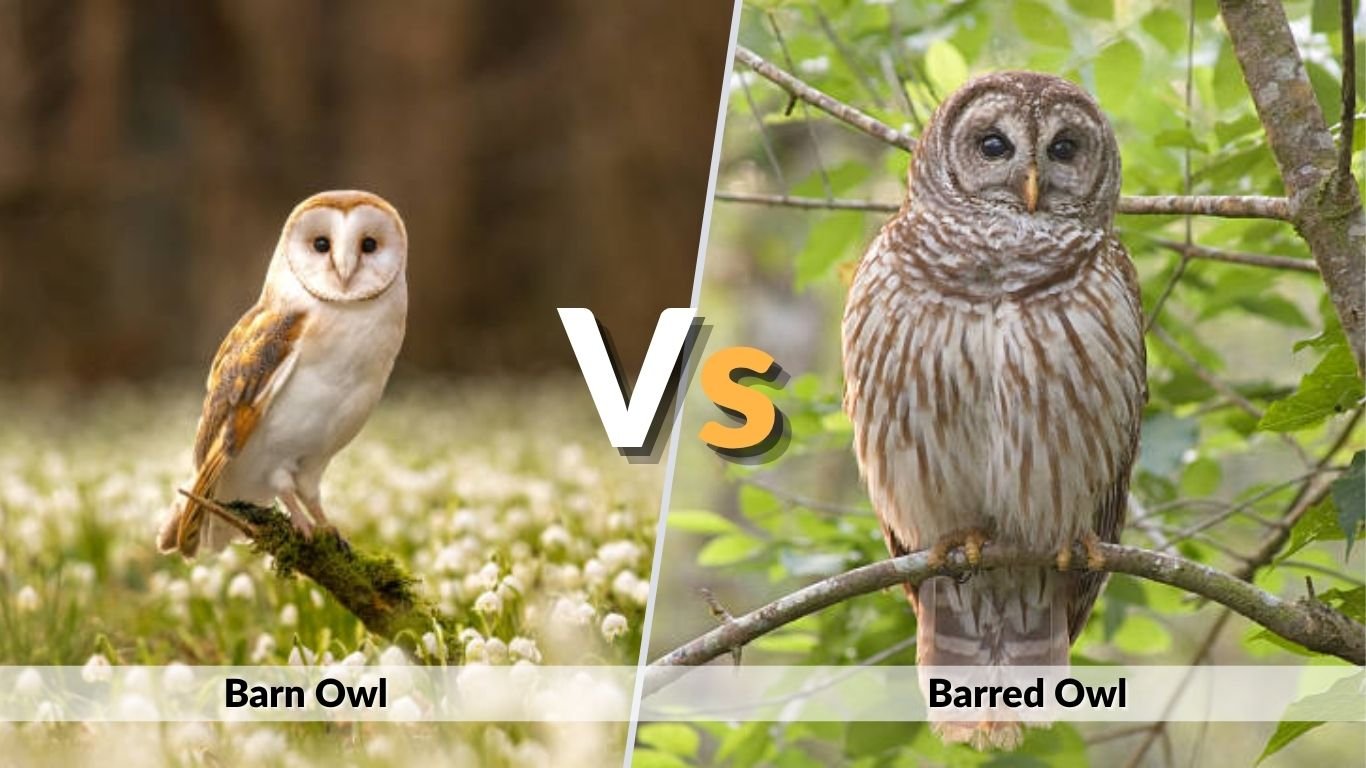
Barn owls and barred owls are often confused because their names sound similar, but they are very different birds. A barn owl is pale, heart-faced, and usually hunts over open fields. A barred owl is darker, round-headed, and more closely linked with forests and wooded wetlands. This guide compares barn owl vs barred owl by appearance, size, sound, habitat, diet, nesting, and behavior so you can identify them quickly.
Barn Owl vs Barred Owl: Quick Comparison
Barn owls and barred owls differ most in face shape, color, call, and habitat. The barn owl has a white heart-shaped face and dark eyes, while the barred owl has a rounded head, dark eyes, brown-and-white plumage, and a yellow bill. Cornell describes American Barn Owls as pale, heart-faced owls, while Barred Owls are larger, stockier, and heavily marked with brown and white barring.
| Feature | Barn Owl | Barred Owl |
| Face shape | White, heart-shaped face | Round face, no heart shape |
| Eyes | Dark eyes | Dark eyes |
| Bill | Pale bill | Yellow bill |
| Body color | Pale white, buff, gray, cinnamon | Brown and white with bars and streaks |
| Main habitat | Open fields, grasslands, farms, marshes | Mature forests, wooded swamps, treed areas |
| Sound | Harsh scream, hiss, raspy calls | Classic hooting call |
| Size | Medium-sized owl | Larger and stockier owl |
| Ear tufts | None | None |
Appearance and Identification
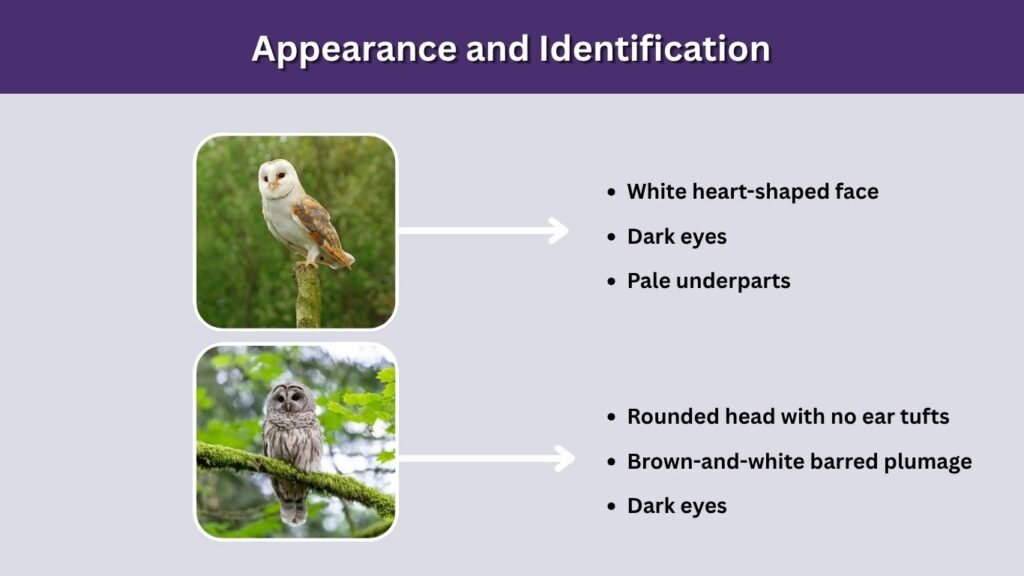
Barn owls have one of the easiest owl faces to recognize. Their pale heart-shaped facial disc, dark eyes, long legs, and ghostly color make them stand out from most other owls. They may look almost white at night when flying low over fields. Cornell notes that American Barn Owls are pale overall, with white face, body, and underwings, plus buff and gray on the upperparts.
Barred owls look more like a classic woodland owl. They have a rounded head, no ear tufts, dark eyes, a yellow bill, brown upperparts, white mottling, and brown barring on the wings and tail. Their underparts show vertical brown markings, while the upper breast has horizontal bars.
Barn Owl Identification Signs
- White heart-shaped face
- Dark eyes
- Pale underparts
- Golden-buff, gray, and cinnamon upperparts
- Long legs
- Smooth rounded head with no ear tufts
- Floating, buoyant flight over open land
Barred Owl Identification Signs
- Rounded head with no ear tufts
- Brown-and-white barred plumage
- Dark eyes
- Yellow bill
- Stocky body
- Broad rounded wings
- Often perched quietly in forest trees
Size Difference Between Barn Owl and Barred Owl
Barred owls are usually larger and heavier than barn owls. American Barn Owls measure about 12.6–15.8 inches long, weigh about 14.1–24.7 ounces, and have a wingspan of 39.4–49.2 inches. Barred Owls measure about 16.9–19.7 inches long, weigh about 16.6–37.0 ounces, and have a wingspan of 39.0–43.3 inches.
| Measurement | Barn Owl | Barred Owl |
| Length | 12.6–15.8 in | 16.9–19.7 in |
| Weight | 14.1–24.7 oz | 16.6–37.0 oz |
| Wingspan | 39.4–49.2 in | 39.0–43.3 in |
| Body type | Slimmer, longer-legged | Larger, stockier |
The interesting point is wingspan. A barn owl can have a wingspan similar to or even longer than some barred owls, but the barred owl is still usually bulkier. This makes the barn owl look lighter and more graceful in flight, while the barred owl looks broader and heavier.
Barred Owl vs Barn Owl Sound
Sound is one of the easiest ways to separate these owls. Barn owls do not make the classic “hoot” that many people expect from owls. Instead, they often give a long, harsh scream. Cornell says American Barn Owls make a harsh scream lasting about two seconds and may also hiss loudly when disturbed at the nest.
Barred owls are famous for their deep hooting call, often described as “Who cooks for you? Who cooks for you-all?” Cornell describes it as an 8–9 note call that carries through the woods. During courtship, pairs may also make cackles, hoots, caws, and gurgling sounds.
Quick Sound Guide
| Sound Type | Barn Owl | Barred Owl |
| Main call | Harsh scream | Deep hooting |
| Common phrase | No classic phrase | “Who cooks for you?” |
| Hissing | Yes, especially near nest disturbance | Less famous than hooting |
| Best clue | Sounds eerie and raspy | Sounds like classic woodland owl hoots |
If you hear a ghostly scream near open fields or barns, it may be a barn owl. If you hear rhythmic hooting from woods or a swampy forest, it is more likely a barred owl.
Habitat: Open Fields vs Forests
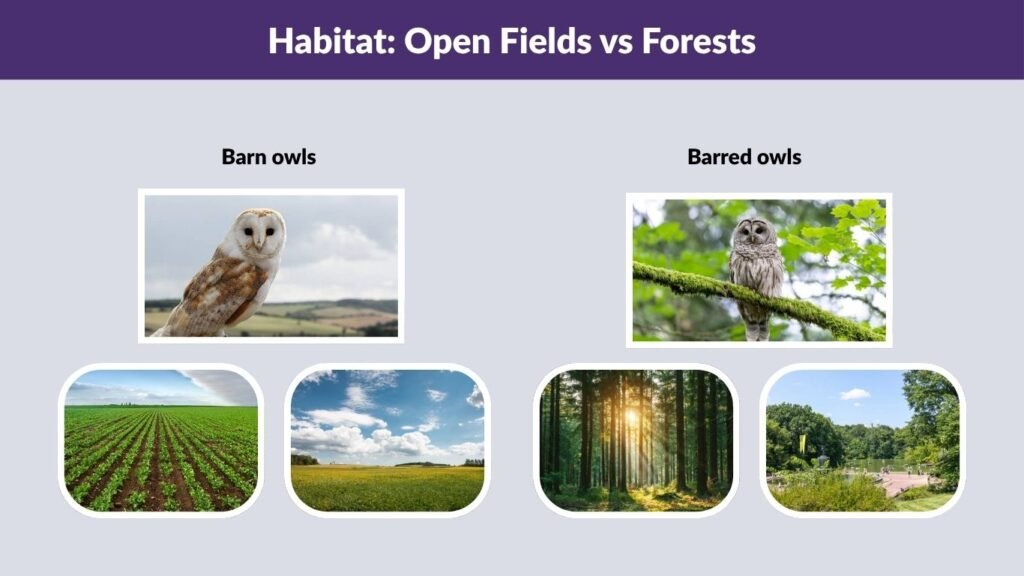
Barn owls are birds of the open country. They need large open areas for hunting, including marshes, grasslands, and mixed agricultural fields. For nesting and roosting, they often use quiet cavities, barns, silos, tree holes, cliffs, and other sheltered spaces.
Barred owls are much more connected to trees. Cornell describes Barred Owls as birds of large, mature forests with both deciduous and evergreen trees, often near water. They also nest in tree cavities.
Where You Are More Likely to See Each Owl
Barn owls are more likely around:
- Farms
- Hay fields
- Grasslands
- Marsh edges
- Open agricultural land
- Old barns and silos
- Open areas with nest boxes
Barred owls are more likely around:
- Mature forests
- Wooded swamps
- River bottoms
- Tree-filled parks
- Forest edges
- Large wooded yards
- Areas with old cavity trees
Diet and Hunting Behavior
Both barn owls and barred owls are predators, but they hunt in different habitats and often focus on different prey. Barn owls usually hunt by flying low over open habitats, searching mainly for small rodents by sound. Their silent flight, strong hearing, and open-field hunting style make them excellent mousers.
Barred owls hunt from forest perches and take a wider variety of prey. Cornell notes that they hunt small animals, especially rodents, and may also take prey such as amphibians and fish. They often sit quietly in trees and listen before dropping onto prey.
The main difference is hunting style. A barn owl is more like a low-flying field hunter. A barred owl is more like a woodland perch hunter.
Nesting and Nest Boxes
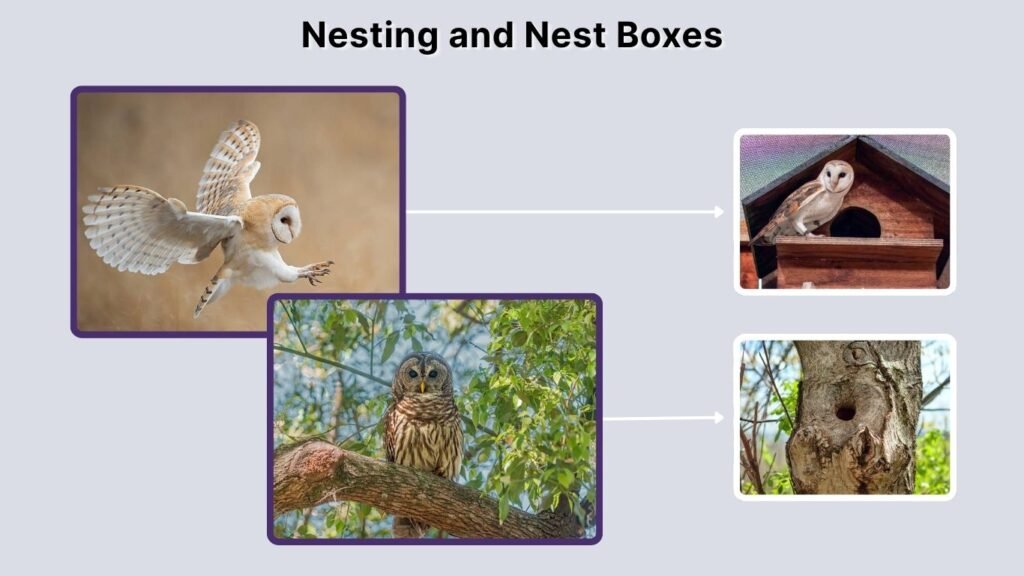
Barn owls are well known for using nest boxes when the habitat is right. Cornell NestWatch says Barn Owls prefer open habitats such as agricultural fields, and their boxes can be placed in barns, silos, granaries, grain elevators, church steeples, or on free-standing poles. NestWatch also warns that Barn Owls are sensitive during the early nesting phase and may abandon a nest if disturbed.
Barred owls usually need wooded habitat and tree cavities. A barred owl box is different from a barn owl box because the bird’s natural habitat is different. If your property is mostly open farmland, barn owl habitat may be more suitable. If your property has mature woods, wetlands, and large trees, barred owls may be more likely.
Which Owl Is Better for Rodent Control?
Barn owls are often promoted for natural rodent control because they hunt open fields and eat many small mammals. However, they should not be treated like a guaranteed pest-control tool. They need safe habitat, nesting space, low disturbance, and a healthy prey base.
Barred owls also eat rodents, but they are not usually associated with open farmland in the same way. They belong more to forest ecosystems and may eat a broader mix of prey, including small mammals, amphibians, and other animals.
Are Barn Owls and Barred Owls Related?
Barn owls and barred owls are both owls, but they belong to different owl families. Barn owls belong to the barn owl family, while barred owls belong to the true owl family. This is one reason they look so different. Barn owls have a heart-shaped facial disc and a more delicate, pale appearance, while barred owls have the rounder, heavier look of many true owls.
This family difference also helps explain why their calls are so different. Barred owls give the classic hooting sound people often associate with owls, while barn owls are better known for screams and hisses.
Barn Owl vs Barred Owl: Which One Are You Seeing?
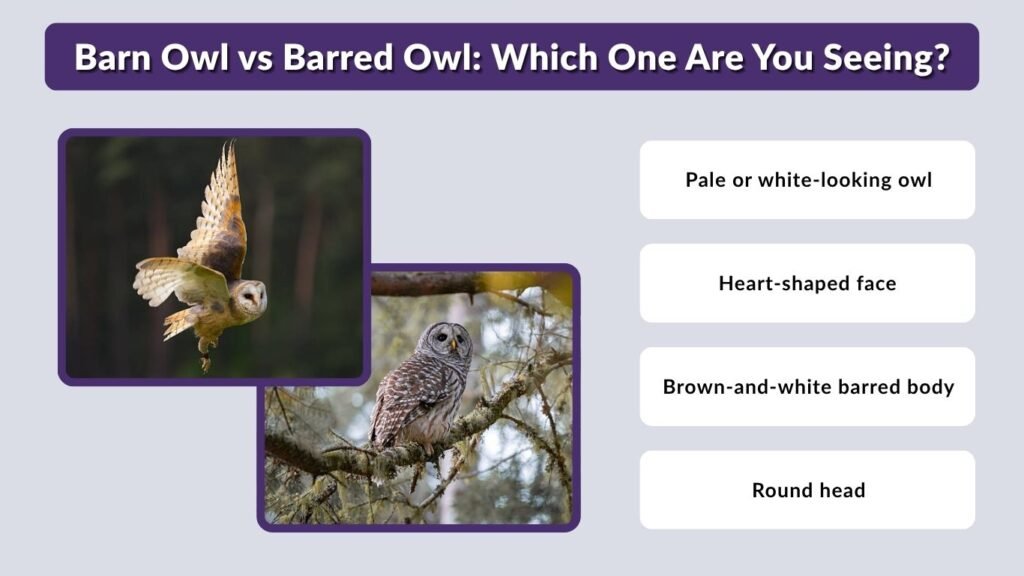
Use location, habitat, face shape, and sound together. A pale owl flying low over a field at night is more likely a barn owl. A brown barred owl sitting in a forest tree or calling from a wooded swamp is more likely a barred owl.
Fast ID Checklist
Choose barn owl if you notice:
- Pale or white-looking owl
- Heart-shaped face
- Long legs
- Open-field hunting
- Harsh scream instead of hoot
- Roosting near barns, silos, or nest boxes
Choose barred owl if you notice:
- Brown-and-white barred body
- Round head
- Yellow bill
- Stockier shape
- Forest or wooded swamp habitat
- “Who cooks for you?” hooting call
Common Mistakes When Comparing Barn and Barred Owls
One common mistake is thinking “barn” and “barred” are just spelling variations. They are completely different owl types. Another mistake is identifying by eye color alone. Both birds have dark eyes, so eye color is not enough. Face shape, body pattern, habitat, and sound are much more useful.
A third mistake is assuming every owl near a house is a barn owl. Barred owls can live near wooded neighborhoods, parks, and forest edges. Barn owls are more strongly tied to open hunting areas and suitable cavities or structures for roosting and nesting.
FAQs
Is a barn owl the same as a barred owl?
No. A barn owl and a barred owl are different species. Barn owls are pale, heart-faced owls of open habitats. Barred owls are larger, brown-and-white woodland owls with a classic hooting call.
Which is bigger, a barn owl or a barred owl?
A barred owl is usually bigger and heavier than a barn owl. Barn owls are slimmer and lighter, while barred owls are stockier with a larger body.
Do barn owls and barred owls sound the same?
No. Barn owls usually make harsh screams, hisses, and raspy calls. Barred owls make the famous “Who cooks for you?” hooting call.
Do barn owls and barred owls live in the same habitat?
Sometimes their ranges may overlap, but they prefer different habitats. Barn owls usually hunt open fields, grasslands, marshes, and farms. Barred owls prefer mature forests, wooded swamps, and tree-filled areas.
Can a barn owl nest box attract a barred owl?
Usually not if it is placed in open barn owl habitat. Barn owl boxes are best for open fields and farm areas, while barred owls are more likely to use wooded areas with large trees or suitable cavity-style nest sites.
