
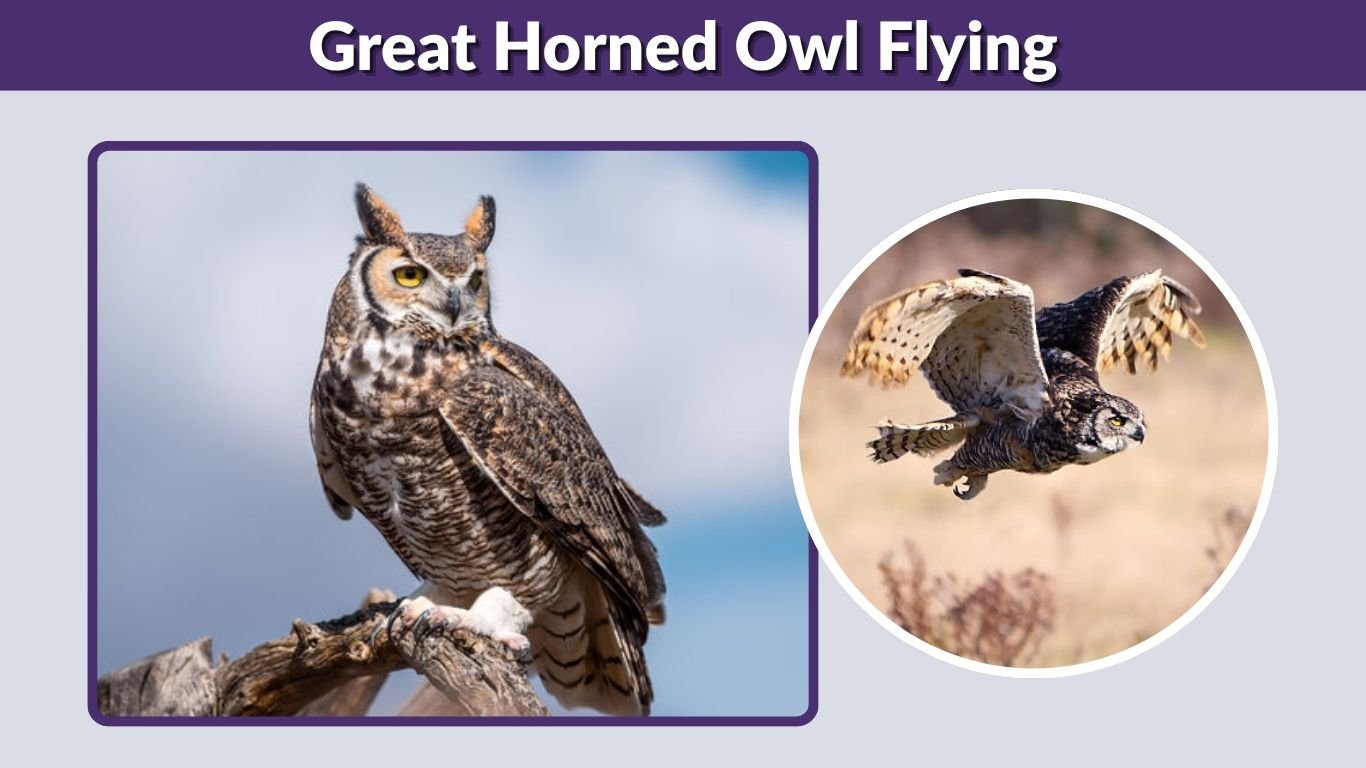
The great horned owl is one of the most powerful flying owls in North America. Its broad wings, silent feathers, strong talons, and night-hunting skills make it a skilled aerial predator. Many people search for great horned owl flying facts because this bird looks dramatic in flight, especially with its wide wings, yellow eyes, and horn-like feather tufts.
Great Horned Owl Flying Overview
Great horned owls have broad, rounded wings built for quiet, controlled flight. They are not long-distance speed hunters like falcons. Instead, they use stealth, low flight, short attacks, and surprise. Audubon describes their hunting style as watching from a high perch, then swooping down to catch prey in their talons, mostly at night or dusk.
| Flying feature | Great horned owl fact |
| Flight style | Quiet, strong, controlled |
| Main flying time | Night and dusk |
| Speed | About 20–40 mph |
| Wingspan | 3 ft 4 in–4 ft 9 in |
| Hunting method | Perch, swoop, grab prey |
| Young flying age | About 9–10 weeks |
How Fast Can a Great Horned Owl Fly?
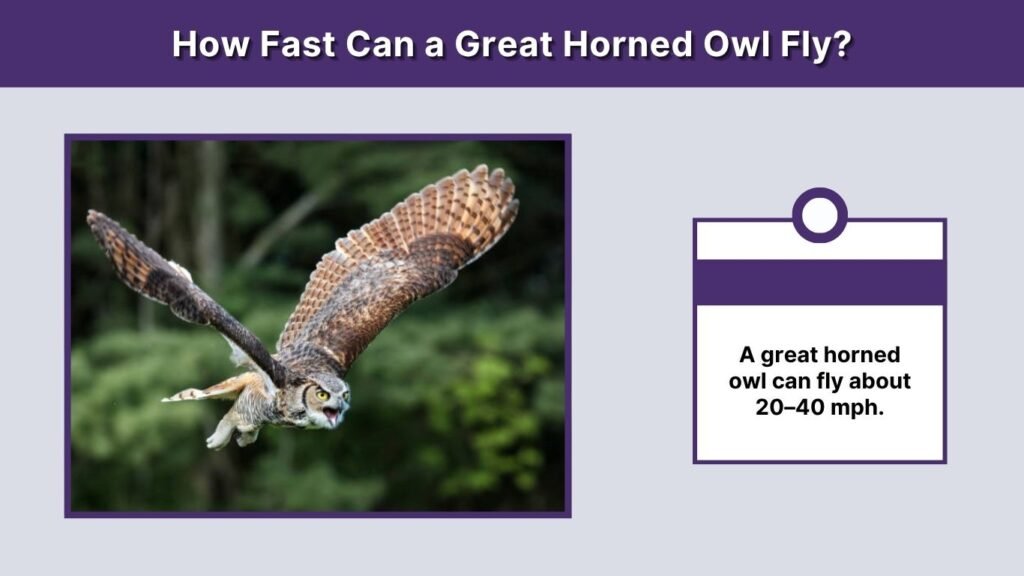
A great horned owl can fly about 20–40 mph, depending on the situation. It usually does not need extreme speed because it hunts by stealth rather than long chase. Cascades Raptor Center says flight speeds up to 40 mph have been recorded, while Squam Lakes Natural Science Center gives a flight speed of about 20–40 mph.
Why Speed Is Not Its Main Weapon
The great horned owl’s real advantage is surprise. It can sit quietly on a branch, listen for movement, then fly down quickly with strong wingbeats. Its large wings help it move slowly and carefully when needed, especially through woods, fields, and neighborhood edges.
Do Great Horned Owls Fly Silently?
Yes, great horned owls can fly almost silently. Audubon explains that even large owls, including great horned owls, can fly virtually silently because of special feather structures. Serrated feather edges, soft feather texture, and fringed wing edges help reduce the sound made by moving air.
How Silent Flight Helps
Silent flight helps great horned owls in two major ways:
- It keeps prey from hearing the owl coming.
- It helps the owl hear prey while flying.
- It allows surprise attacks at night.
- It helps the owl move through trees quietly.
- It makes hunting more effective in low light.
This is why a great horned owl may seem to appear suddenly, even though it is a large bird.
Great Horned Owl Flying at Night
Great horned owls are mostly nocturnal hunters. They often become active at dusk and continue hunting through the night. Their large eyes, strong hearing, and silent wings help them find prey in darkness. Audubon notes that they have extremely good hearing and good vision in low-light conditions.
Night Hunting Flight
At night, a great horned owl may fly from perch to perch, stopping to listen and scan. When it detects prey, it drops or glides downward and strikes with its talons. This flight is usually short, direct, and quiet rather than long and fast.
Do Great Horned Owls Fly During the Day?
Great horned owls can fly during the day, but they usually rest in daylight. They may fly if disturbed, chased by crows, moving to a better roost, feeding young, or hunting when food is needed. Cascades Raptor Center notes that this owl is primarily semi-nocturnal to nocturnal, but may also hunt in daytime.
During the day, crows and other birds may mob a great horned owl if they find it roosting. Cornell notes that American Crows may gather and harass great horned owls because the owl is one of their most dangerous predators.
What Does a Flying Great Horned Owl Look Like?
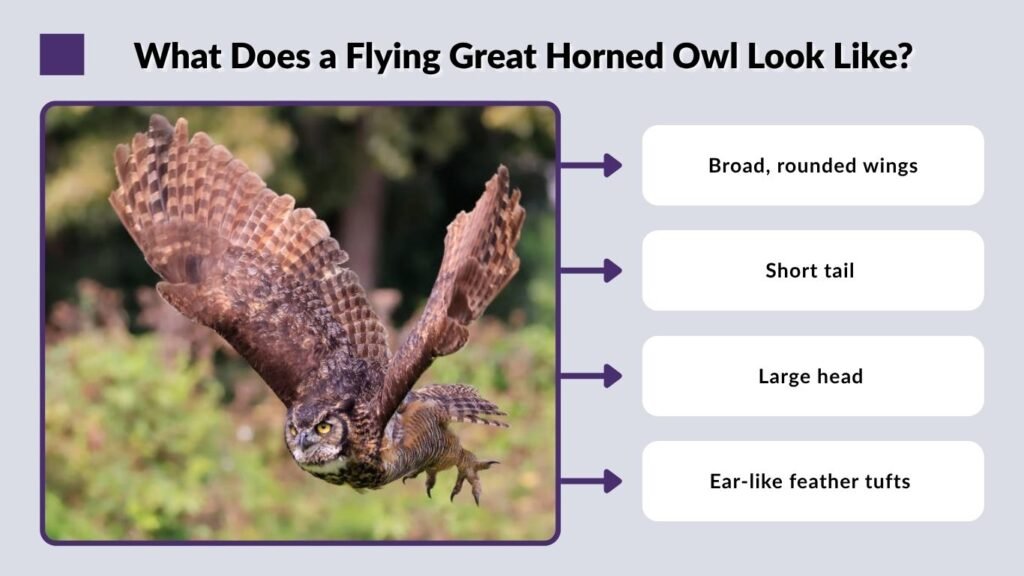
A flying great horned owl looks broad-winged, heavy-bodied, and powerful. Its wings are rounded rather than pointed, and its tail is fairly short. In flight, the owl may look larger than expected because of its wide wingspan and thick feathering.
Flying Identification Clues
Look for these features:
- Broad, rounded wings
- Short tail
- Large head
- Ear-like feather tufts
- Slow, deep wingbeats
- Mottled brown and gray pattern
- Pale barred underside
- Silent or nearly silent movement
Audubon lists the great horned owl’s wingspan as 3 ft 4 in to 4 ft 9 in, with a body length of 18–24 inches and weight of 32–88 ounces.
Great Horned Owl Flying Away
If you see a great horned owl flying away, you may notice its wide wings, pale underside, and steady wingbeats. It may fly low through trees or across an open area before landing on another perch. Great horned owls often choose hidden daytime roosts, so they may fly away quietly if people approach too closely.
Why It Might Fly Away
A great horned owl may fly away because:
- It feels disturbed.
- It is moving to a safer perch.
- It is being mobbed by crows.
- It is hunting.
- It is returning to a nest.
- It is avoiding people or pets.
Give the owl space and avoid following it too closely.
Great Horned Owl Learning to Fly
Baby great horned owls do not become strong fliers right away. Audubon says young may leave the nest and climb on nearby branches at about 5 weeks, but they can usually fly at about 9–10 weeks. Parents may continue feeding them for several months.
Branching Before Flying
Young owls often go through a “branching” stage. During this time, they climb, hop, flap, and move around the nest tree before true flight begins. A young owl on the ground is not always abandoned, but it may be vulnerable to dogs, cats, and people.
Do Great Horned Owls Fly South for Winter?
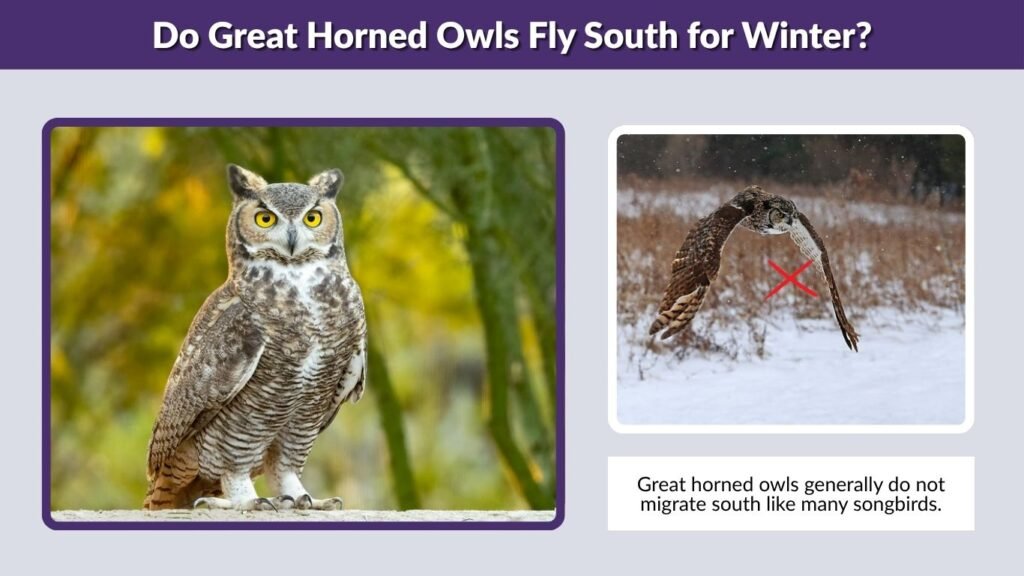
Great horned owls generally do not migrate south like many songbirds. They are territorial and often stay in the same general area year-round. Squam Lakes Natural Science Center notes that great horned owls do not migrate and remain within a home range of several hundred acres.
In winter, they may still fly and hunt at night, even in cold conditions. They can also nest early in the year, sometimes while snow is still present.
How High Do Great Horned Owls Fly?
Great horned owls usually fly at low to moderate heights when hunting. They often move between trees, fence posts, utility poles, cliffs, or other perches. They are not known for soaring high in the sky like vultures or eagles. Their hunting flight is usually close enough to the ground to detect and attack prey.
Great Horned Owl Flying Images and Videos
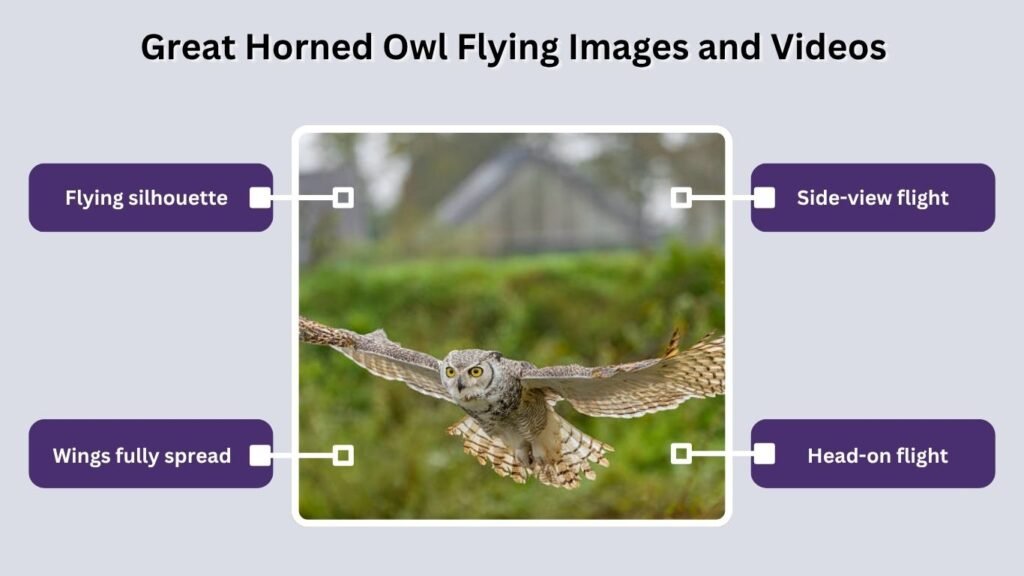
Great horned owl flying images are popular because the bird looks dramatic in motion. Photographers often capture the owl flying head-on, from the side, or low over grassland. In videos, the most interesting detail is often how little sound the owl makes as it moves.
Best Flying Photo Ideas
Common great horned owl flying photo angles include:
- Side-view flight
- Head-on flight
- Flying silhouette
- Wings fully spread
- Owl flying at night
- Owl landing on a perch
- Owl carrying prey
- Young owl practicing flight
For drawings or tattoos, the flying silhouette is especially popular because the wide wings and horn-like tufts make the species easy to recognize.
FAQs
How fast can a great horned owl fly?
A great horned owl can fly about 20–40 mph. It does not depend mainly on speed like a falcon. Instead, it uses silent flight, strong talons, night vision, and surprise attacks to catch prey efficiently.
Do great horned owls fly silently?
Yes, great horned owls can fly almost silently. Their feathers have special structures that reduce wing noise, including serrated edges, soft surfaces, and fringed trailing edges. This helps them sneak up on prey and hear movement while hunting.
Do great horned owls fly at night?
Yes, great horned owls mostly fly and hunt at night, though they may also be active at dusk. They use strong hearing and low-light vision to find prey, then swoop down from a perch to capture it.
When can baby great horned owls fly?
Baby great horned owls may leave the nest and climb nearby branches at around 5 weeks old. They usually begin flying at about 9–10 weeks. Even after they can fly, the parents may keep feeding them for several months.
Do great horned owls fly south for winter?
Great horned owls usually do not fly south for winter. They are mostly year-round territorial birds and may remain in the same home range through all seasons. They continue hunting during winter and can nest very early in the year.
