
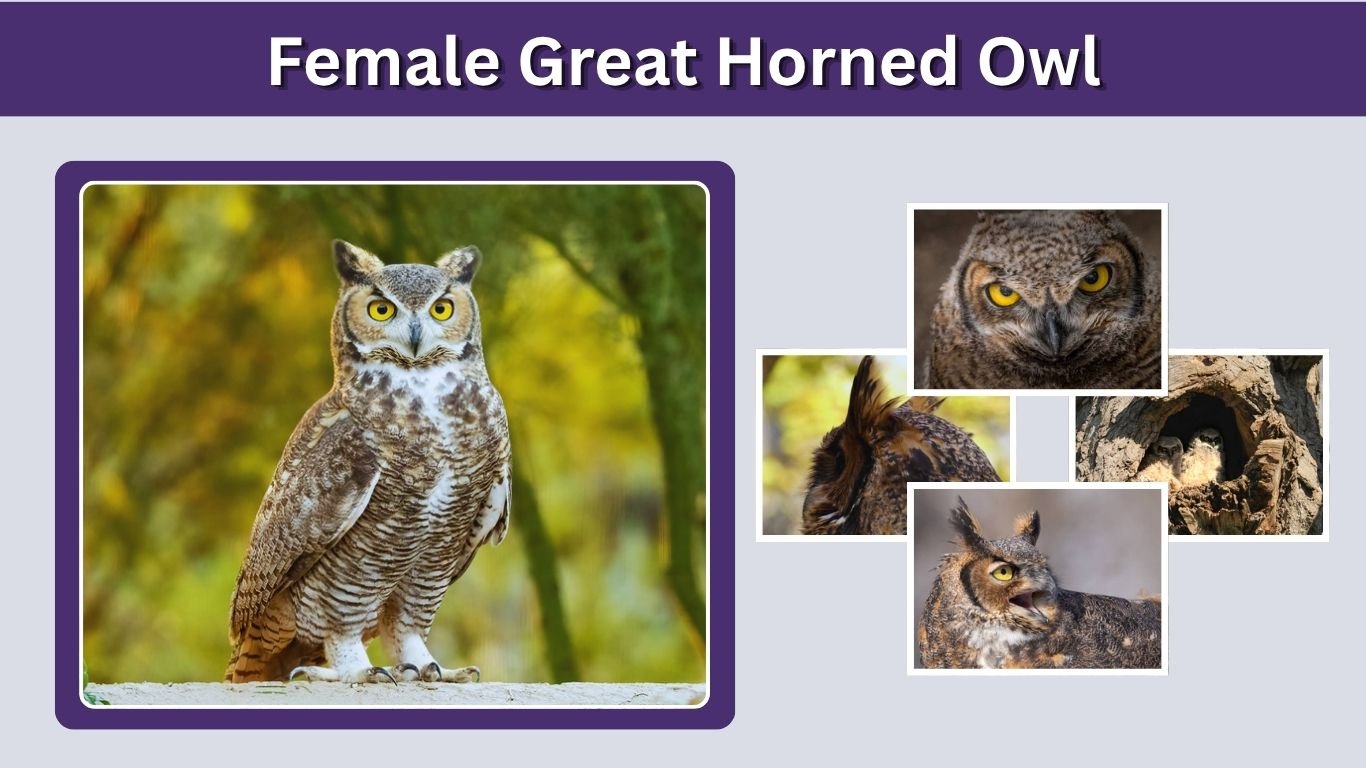
A female great horned owl looks powerful, broad, and heavily feathered, but telling her apart from a male is not always easy. Males and females have similar colors, yellow eyes, barred bellies, and tall feather tufts. The main differences are size and voice. Females are usually larger, while males often have deeper calls. This guide explains female great horned owl size, sound, behavior, nesting role, and male vs female identification.
What Is a Female Great Horned Owl Called?
A female great horned owl is usually just called a female great horned owl. In general bird terms, she may also be called a hen, while a male bird may be called a cock. However, most bird guides and wildlife experts simply use “female” and “male.”
Female great horned owls belong to the same species as males: great horned owl (Bubo virginianus). They are not a separate type of owl.
Female Great Horned Owl Size
Female great horned owls are usually bigger than males. Great horned owls in general measure about 18–24 inches long, with a wingspan of 3 feet 4 inches to 4 feet 9 inches, and a weight range of 32–88 ounces. Audubon notes that both sexes look similar, but the female is larger.
Female Size Features
A female great horned owl may look:
- Heavier-bodied than the male
- Broader through the chest
- Slightly larger when perched beside a male
- Stronger-looking around the feet and legs
- Similar in color and pattern to the male
Size is helpful only when a male and female are seen together. A lone owl is difficult to sex by appearance.
Great Horned Owl Male vs Female
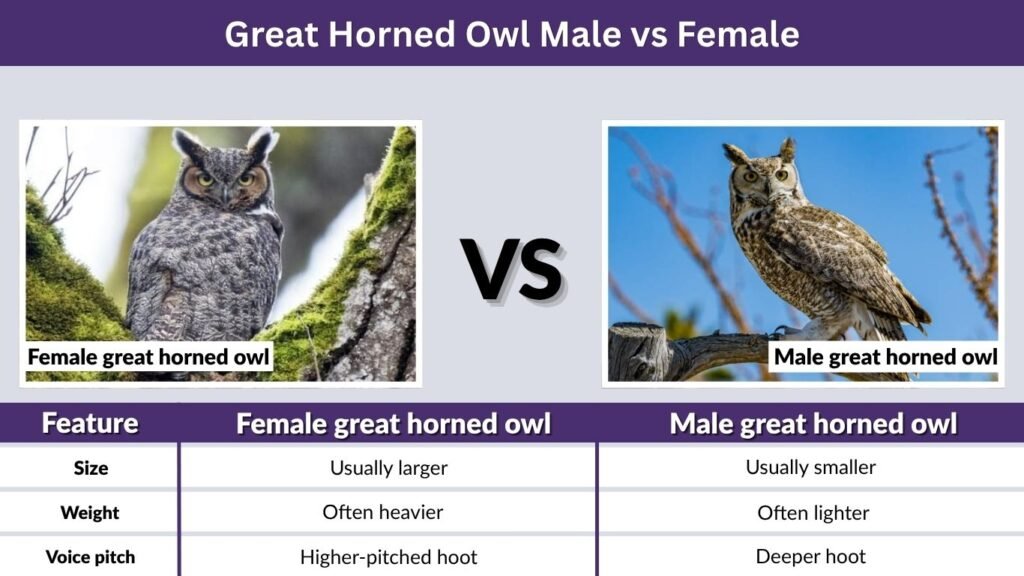
Male and female great horned owls look very similar. Both have mottled brown, gray, black, and reddish-brown feathers. Both have yellow eyes, a white throat patch, barred underparts, and long “horn-like” feather tufts.
Male vs Female Comparison Table
| Feature | Female great horned owl | Male great horned owl |
| Size | Usually larger | Usually smaller |
| Weight | Often heavier | Often lighter |
| Voice pitch | Higher-pitched hoot | Deeper hoot |
| Plumage | Similar to male | Similar to female |
| Nesting role | Incubates eggs more | Brings food often |
| Easy to identify alone? | No | No |
The most reliable field clue is often the voice, not the feathers. Cornell explains that even though the female is larger, the male has a larger voice box and a deeper voice.
Female Great Horned Owl Call
The female great horned owl call is a deep hoot, but it is usually higher in pitch than the male’s call. A pair may call together in a duet, and the female’s voice can often be recognized because it sounds slightly sharper or higher. Cornell describes the female’s voice in paired calling as recognizably higher in pitch than the male’s.
Female Call Sound
A female great horned owl may make:
- Deep hoots
- Higher-pitched hoots than the male
- Screams near the nest
- Barks or squawks when alarmed
- Hisses or harsh sounds when disturbed
Great horned owls advertise territory with a soft, deep, rhythmic hooting pattern. Adults may also make whistles, barks, shrieks, hisses, coos, and wavering cries.
Female Great Horned Owl Mating Call
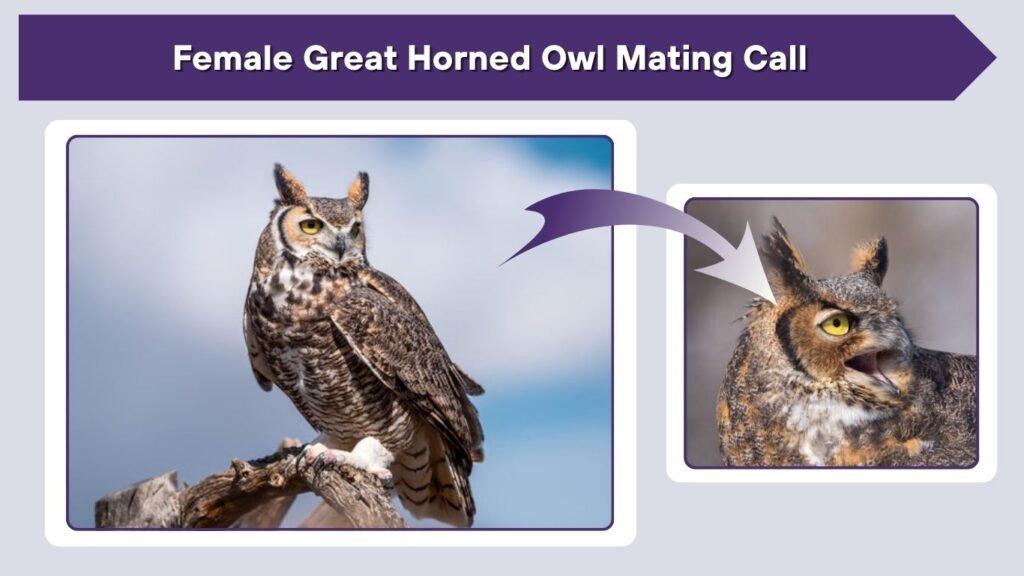
During courtship and territory defense, male and female great horned owls may call back and forth. The female often gives a higher call, while the male replies with a lower, deeper hoot. Audubon explains that in a duet, the female usually hoots first and the male answers at a lower pitch.
Why Females Call
A female great horned owl may call to:
- Communicate with her mate
- Defend territory
- Signal during breeding season
- Warn intruders near the nest
- Stay in contact at night
Calling is especially noticeable before and during the nesting season.
How to Tell Male From Female Great Horned Owl
The easiest way to tell male and female great horned owls apart is to compare size and sound. Color is not very useful because both sexes have similar plumage.
Best Identification Clues
- The female is usually larger: This is easiest to see when both birds are together.
- Male call is deeper: The male often sounds lower and more booming.
- Female call is higher: The female’s hoot is often higher in pitch.
- Behavior near the nest helps: The female often stays close to eggs or young.
- Plumage is not reliable: Both sexes have similar feather patterns.
A single silent owl in a tree may be impossible to identify as male or female without expert observation.
Do Female Great Horned Owls Look Different?
Female great horned owls do not have a special color pattern that clearly separates them from males. They share the same general appearance: mottled upperparts, barred belly, bright yellow eyes, and feather tufts.
Why They Look Alike
This similar appearance helps both sexes blend into tree bark, branches, and shadows. Their camouflage is important because great horned owls often roost during the day. A perched female may sit motionless and become very hard to notice.
Female Great Horned Owl Nesting Behavior
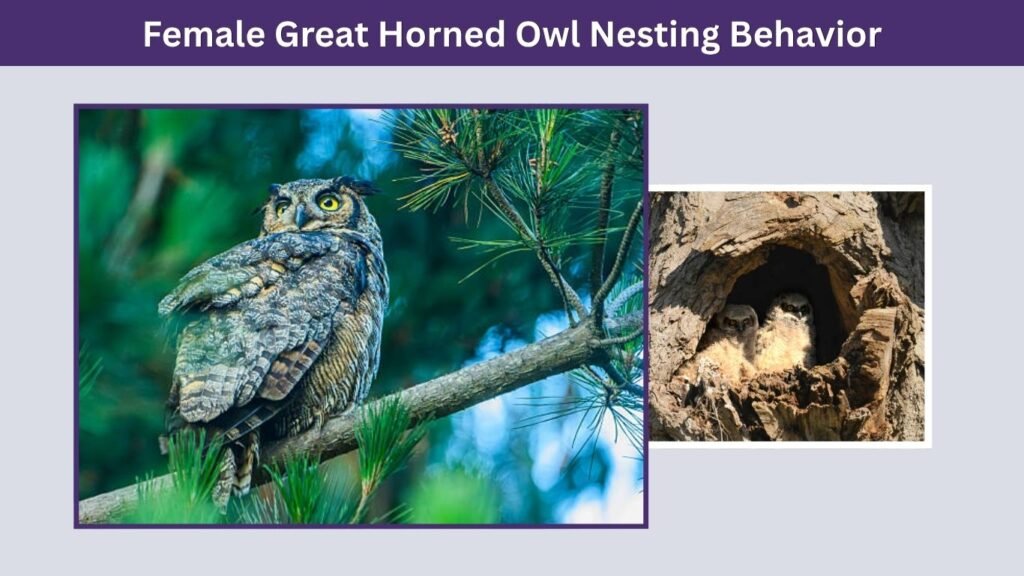
Female great horned owls play a major role during nesting. Great horned owls often use old nests built by hawks, crows, ravens, herons, or squirrels instead of building their own nest from scratch. They may also nest in tree cavities, cliffs, ledges, buildings, or artificial platforms.
Female Role in Nesting
The female usually spends more time incubating the eggs and brooding small chicks. The male often hunts and brings food. This teamwork helps the young survive during cold weather and early nesting periods.
Female Great Horned Owl Eggs and Babies
Female great horned owls usually lay 1–4 eggs. The eggs are dull white and nearly round. Young owls hatch helplessly and are covered in pale down. They grow quickly but remain dependent on their parents for food and protection.
Baby Owl Care
Female great horned owls are protective around the nest. If people, pets, or other animals come too close, the adult owls may hoot, bark, scream, or even swoop defensively. It is best to keep distance from any active owl nest.
Are Female Great Horned Owls Bigger Than Males?
Yes. Female great horned owls are generally bigger than males. This pattern is common in many birds of prey and is called reverse sexual size dimorphism. Audubon notes that female great horned owls average about a third larger than males, although the male has the deeper voice.
This size difference may help females with egg production, incubation, and protecting young, while males remain agile hunters.
Female Great Horned Owl Pictures: What to Notice
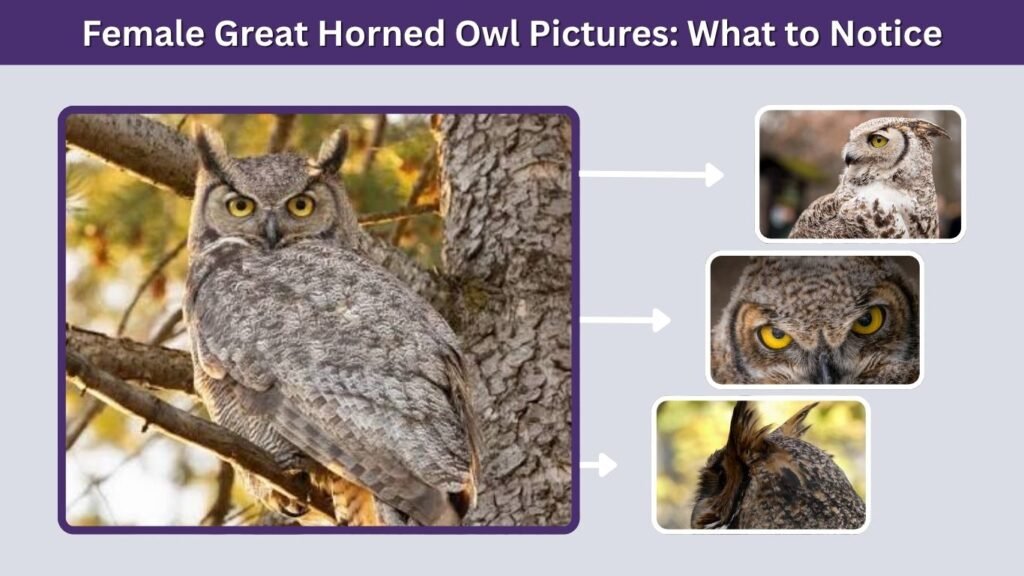
When looking at female great horned owl pictures, focus on body shape and context. A female may appear large, heavy, and broad, especially if she is sitting on a nest or beside a smaller male.
Visual Features to Check
- Large rounded head
- Long feather tufts
- Yellow eyes
- White throat patch
- Barred belly
- Thick feathered body
- Strong feet and talons
However, photos alone usually cannot prove whether the owl is female unless the photographer observed nesting behavior, pair size difference, or vocalizations.
Female Great Horned Owl Sounds vs Male Sounds
The female’s sound is often higher, while the male’s sound is deeper. This difference is one of the best ways to separate a calling pair. When both birds call together, the contrast becomes easier to hear.
Quick Sound Comparison
| Sound feature | Female | Male |
| Hoot pitch | Higher | Lower |
| Duet role | Often heard with male | Often replies lower |
| Alarm sounds | Screams, barks, squawks | Screams, barks, squawks |
| Best clue | Higher voice | Deeper voice |
Young owls may also scream loudly when begging for food, which can be confused with adult calls.
FAQs
Is a female great horned owl bigger than a male?
Yes, the female great horned owl is usually larger and heavier than the male. This difference may be noticeable when a pair is sitting together. However, it can be hard to judge the sex of a single owl by size alone.
What does a female great horned owl sound like?
A female great horned owl gives deep hoots, but her voice is usually higher in pitch than the male’s. She may also scream, bark, hiss, or squawk, especially near a nest or when disturbed.
How can you tell if a great horned owl is male or female?
The best clues are size and voice. The female is usually larger, while the male usually has a deeper hoot. Plumage is not a reliable clue because male and female great horned owls look very similar.
What is a female great horned owl called?
A female great horned owl is usually called a female. In general bird terms, she may also be called a hen, but most field guides and wildlife sources simply use “female great horned owl.”
Why does a female great horned owl make barking sounds?
A female great horned owl may bark, squawk, or scream when alarmed, defending a nest, communicating with her mate, or warning an intruder. These sounds are normal parts of great horned owl behavior, especially around breeding season.
