
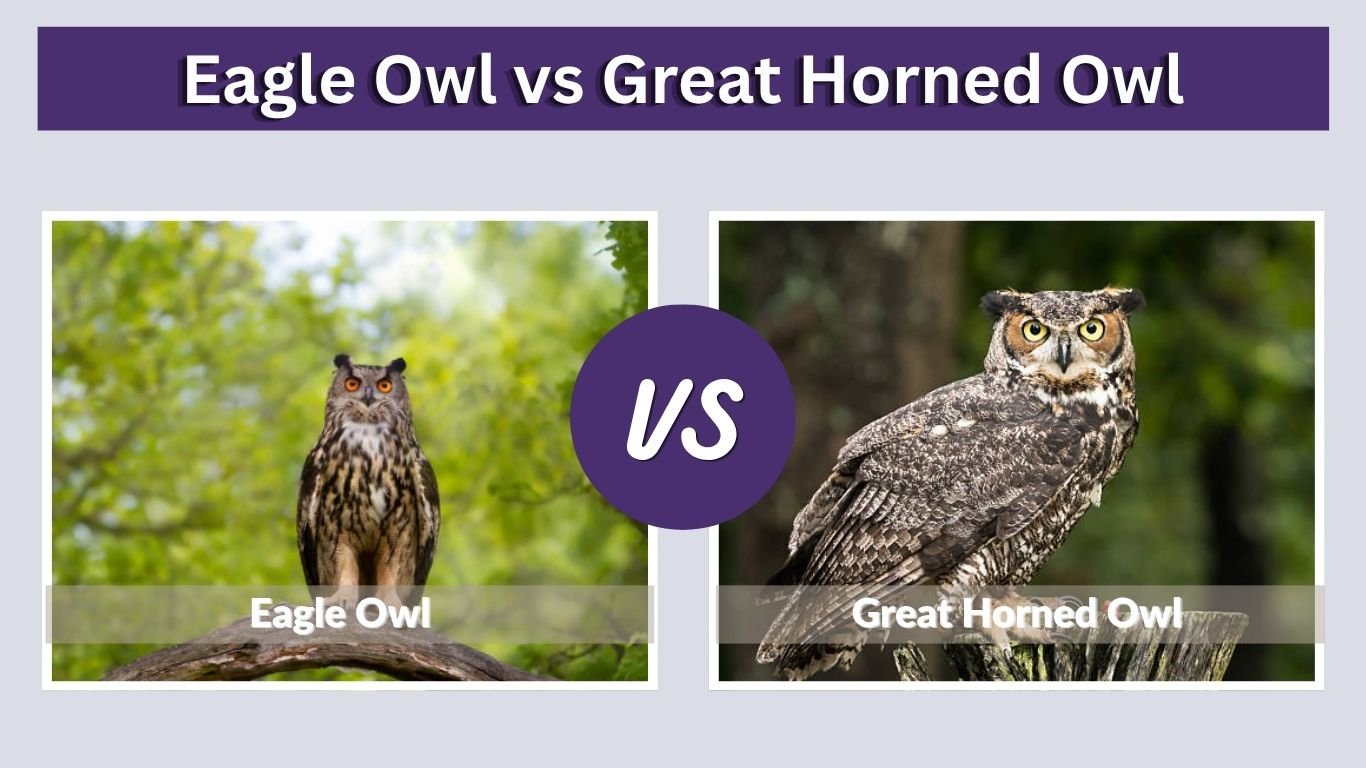
The eagle owl and great horned owl look similar at first because both have large bodies, strong talons, orange-yellow eyes, and feather tufts that look like horns. However, they are not the same bird. The Eurasian eagle-owl is usually larger and heavier, while the great horned owl is one of the most powerful and adaptable owls in the Americas. This guide compares their size, habitat, hunting style, and how they differ from eagles.
Eagle Owl vs Great Horned Owl: Quick Comparison
Both birds belong to the genus Bubo, which explains their similar appearance. The biggest difference is range: the Eurasian eagle-owl lives across Europe and Asia, while the great horned owl lives across North and South America. Size is another major difference.
| Feature | Eurasian Eagle-Owl | Great Horned Owl |
| Scientific name | Bubo bubo | Bubo virginianus |
| Length | About 23–29 inches | About 18–25 inches |
| Wingspan | About 4.5–6.6 feet | About 3.3–4.8 feet |
| Weight | About 3.3–9.2 pounds | About 2–5.5 pounds |
| Range | Europe and Asia | Americas |
| Main advantage | Larger body and wingspan | Adaptability and strong grip |
The great horned owl measures about 46–63 cm long, weighs 910–2,500 g, and has a wingspan of 101–145 cm, according to Cornell Lab. Eurasian eagle-owls are larger overall, with some sources listing them around 58–71 cm long and up to about 1.5–2 m in wingspan.
What Is a Eurasian Eagle-Owl?
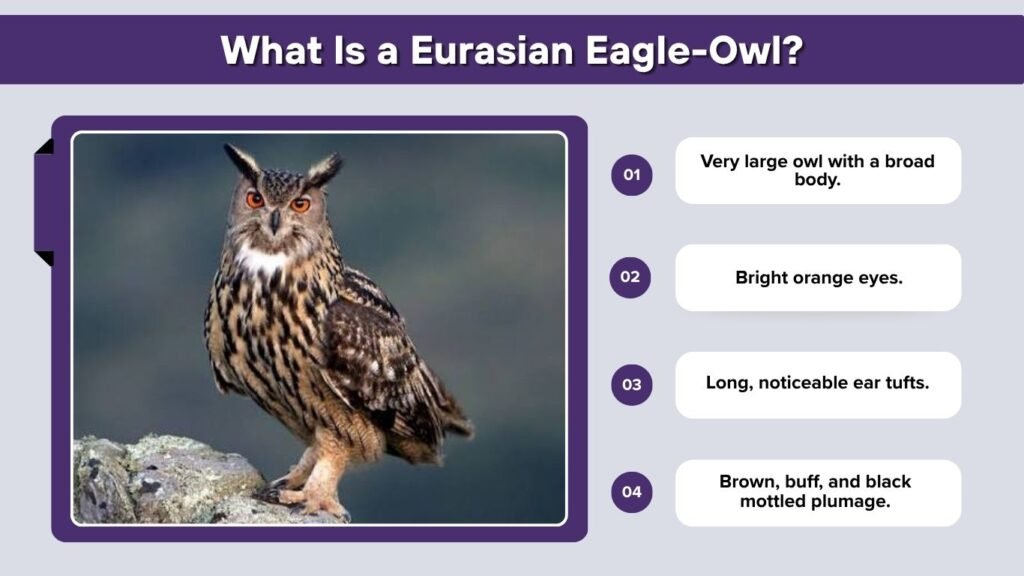
The Eurasian eagle-owl is one of the largest owls in the world. It has a massive head, deep orange eyes, bold ear tufts, barred feathers, and a heavy body. Its size makes it look more eagle-like than many other owls.
Identification
- Very large owl with a broad body
- Bright orange eyes
- Long, noticeable ear tufts
- Brown, buff, and black mottled plumage
- Powerful feet and large talons
- Deeper, heavier look than a great horned owl
Habitat and Range
The Eurasian eagle-owl is found across much of Europe and Asia. It often uses rocky cliffs, mountains, forests, open country, and rugged landscapes. Some populations also live near wetlands, farmland, and semi-open areas where prey is available.
Hunting Style
This owl is a nocturnal predator. It hunts mammals, birds, reptiles, and other animals depending on location. Because of its large size, it can take bigger prey than many owl species. It relies on stealth, strong feet, and a sudden attack rather than long-distance chasing.
What Is a Great Horned Owl?
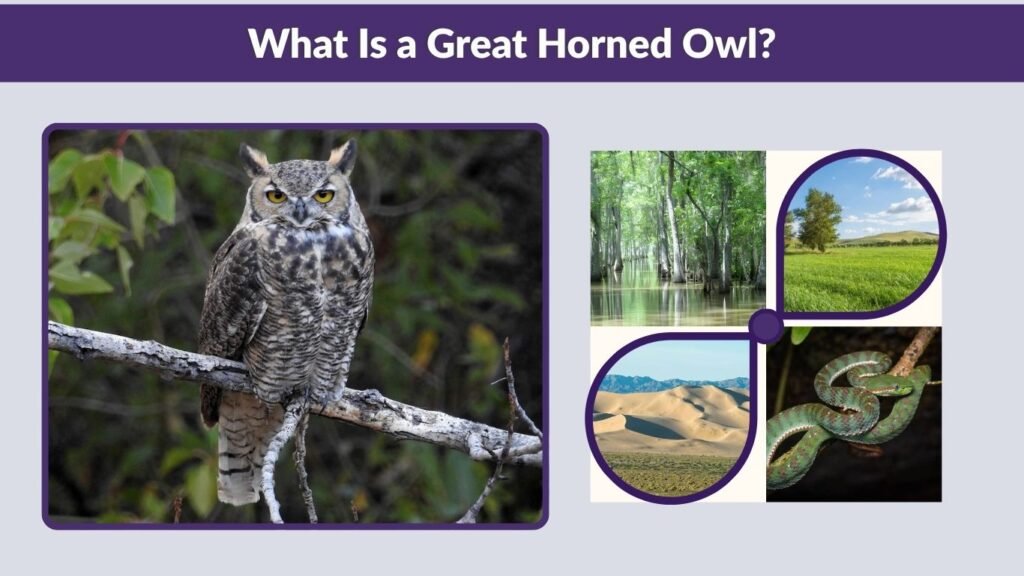
The great horned owl is one of the most widespread and powerful owls in the Americas. It is sometimes called the “tiger of the sky” because it hunts many types of prey and adapts to many habitats.
Identification
- Large owl with prominent feather tufts
- Yellow eyes
- White throat patch
- Mottled gray-brown or brown plumage
- Heavily barred underside
- Deep hooting call
Habitat and Range
Great horned owls live in forests, swamps, deserts, grasslands, farmland, cities, and suburbs. Cornell notes that they occur widely across North America and use many habitats, usually where open hunting areas are near trees or nesting sites.
Hunting Style
Great horned owls hunt mostly at night. Their soft feathers help them fly quietly, and their short, broad wings help them maneuver through trees. They eat rabbits, rodents, birds, snakes, skunks, and many other animals.
Eurasian Eagle-Owl vs Great Horned Owl: Who Is Bigger?
The Eurasian eagle-owl is usually bigger than the great horned owl. It has a larger wingspan, heavier body, and more massive appearance. A large female Eurasian eagle-owl can be much heavier than an average great horned owl.
However, the great horned owl is still a large and powerful predator. It may look smaller beside a Eurasian eagle-owl, but it is not weak. In North America, it is one of the top nocturnal hunters.
Great Horned Owl vs Bald Eagle
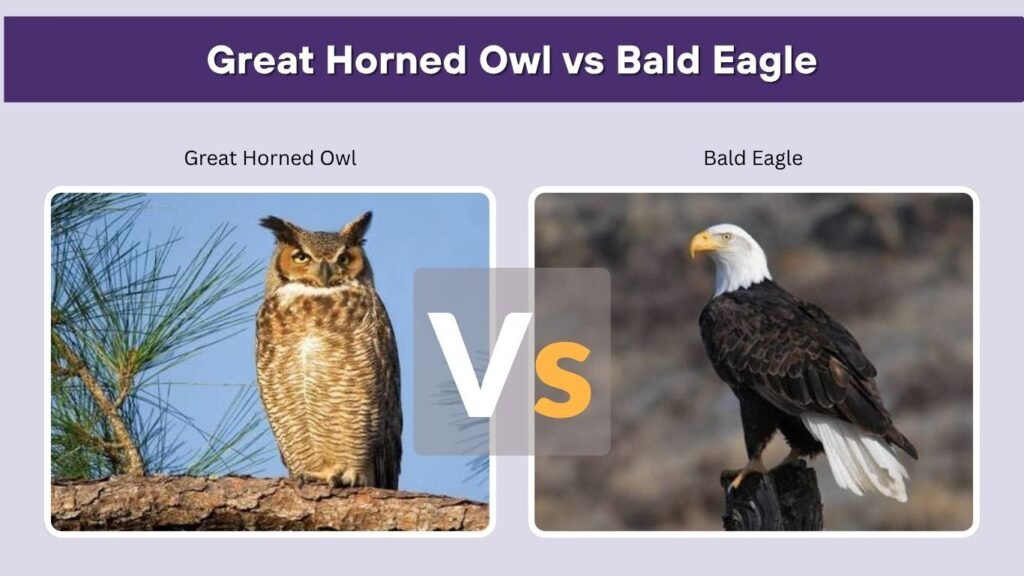
A bald eagle is much larger in wingspan and body length than a great horned owl. Bald eagles measure about 71–96 cm long, weigh 3,000–6,300 g, and have a wingspan around 204 cm.
| Feature | Great Horned Owl | Bald Eagle |
| Wingspan | 3.3–4.8 feet | About 6.7 feet |
| Weight | 2–5.5 pounds | 6.6–13.9 pounds |
| Active time | Mostly night | Mostly day |
| Hunting edge | Silent attack | Size and aerial power |
| Nest behavior | Often uses old nests | Builds huge stick nests |
Can a Great Horned Owl Kill an Eagle?
A great horned owl could injure or possibly kill an eagle in rare situations, especially during a surprise night attack, nest conflict, or attack on a young or vulnerable bird. But a healthy adult bald eagle is much larger and would be dangerous in a direct fight.
Great horned owls are known to use abandoned eagle nests. Cornell’s Savannah owl cam notes that a pair of great horned owls used a recently abandoned bald eagle nest in Georgia. This is one reason people search for “great horned owl eagle nest” or “great horned owl attacks eagle.”
Do Great Horned Owls Eat Eagles?
They do not normally hunt adult eagles as regular prey. They are more likely to take rodents, rabbits, birds, and other manageable prey. Conflict with eagles is usually about territory, nests, eggs, chicks, or roosting space rather than a normal food source.
Great Horned Owl vs Golden Eagle or Harpy Eagle
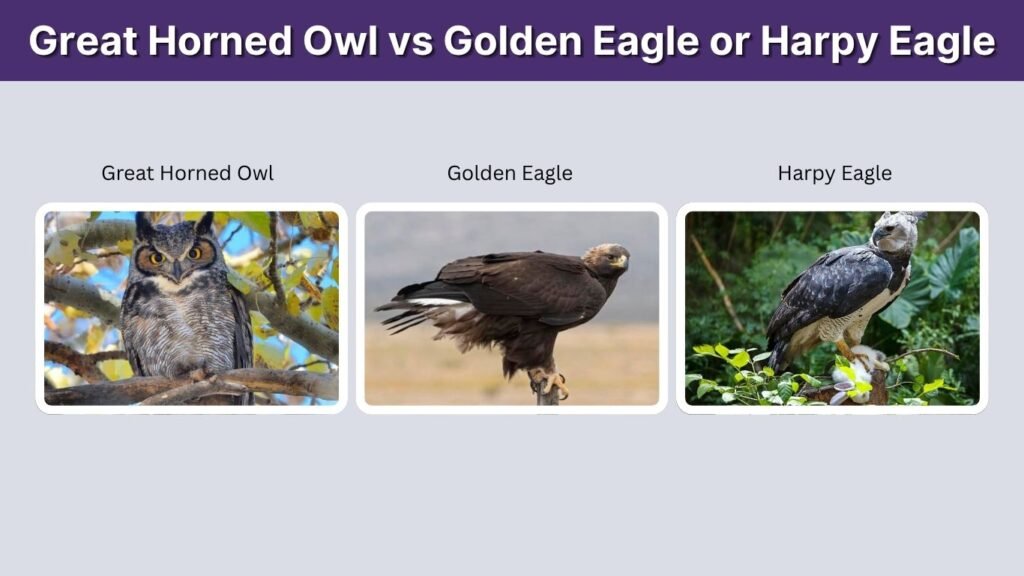
A golden eagle or harpy eagle is generally much larger and stronger than a great horned owl. In a direct daylight fight, the eagle would usually have the size advantage. But owls do not fight like eagles. A great horned owl’s best advantage is surprise, darkness, silence, and ambush.
A harpy eagle is far beyond a great horned owl in body power. A golden eagle is also much larger and built for taking bigger prey. So, for searches like golden eagle vs great horned owl or harpy eagle vs great horned owl, the eagle is usually the stronger bird overall.
Eagle Owl vs Great Horned Owl: Who Would Win?
If a Eurasian eagle-owl and great horned owl met in a direct fight, the Eurasian eagle-owl would likely have the advantage because it is usually larger and heavier. Size matters in raptor conflicts, especially when both birds have strong feet and similar hunting styles.
However, this is mostly a hypothetical comparison. These two owls live on different continents in the wild, so natural fights between them do not normally happen.
Main Differences Between Eagle Owl and Great Horned Owl
The easiest way to separate them is by location and size. If the owl is in Europe or Asia and looks extremely large with orange eyes, it may be a Eurasian eagle-owl. If it is in the Americas with yellow eyes, a white throat patch, and bold ear tufts, it is likely a great horned owl.
The Eurasian eagle-owl is the bigger bird. The great horned owl is the more familiar North American species and is famous for adapting to almost any habitat.
FAQs
Is an eagle owl the same as a great horned owl?
No. They are related but different species. The Eurasian eagle-owl is Bubo bubo, while the great horned owl is Bubo virginianus. They look similar because both are large owls with ear tufts and strong talons.
Is a great horned owl bigger than a bald eagle?
No. A bald eagle is much bigger in wingspan and usually heavier. A great horned owl is powerful for an owl, but a bald eagle has a longer body, broader wingspan, and greater overall mass.
Can a great horned owl take over an eagle nest?
Yes, it can use an abandoned eagle nest or another large stick nest. Great horned owls usually do not build their own nests. They often reuse nests made by hawks, crows, herons, or eagles.
Which is stronger, eagle owl or great horned owl?
The Eurasian eagle-owl is usually stronger because it is larger and heavier. The great horned owl is still extremely powerful for its size and is one of the top nocturnal predators in the Americas.
Do great horned owls attack bald eagles?
They can attack or harass bald eagles, especially near nests or roosts. Most conflicts happen because of territory, nesting sites, or vulnerable young birds. A direct fight with a healthy adult eagle would be risky for the owl.