
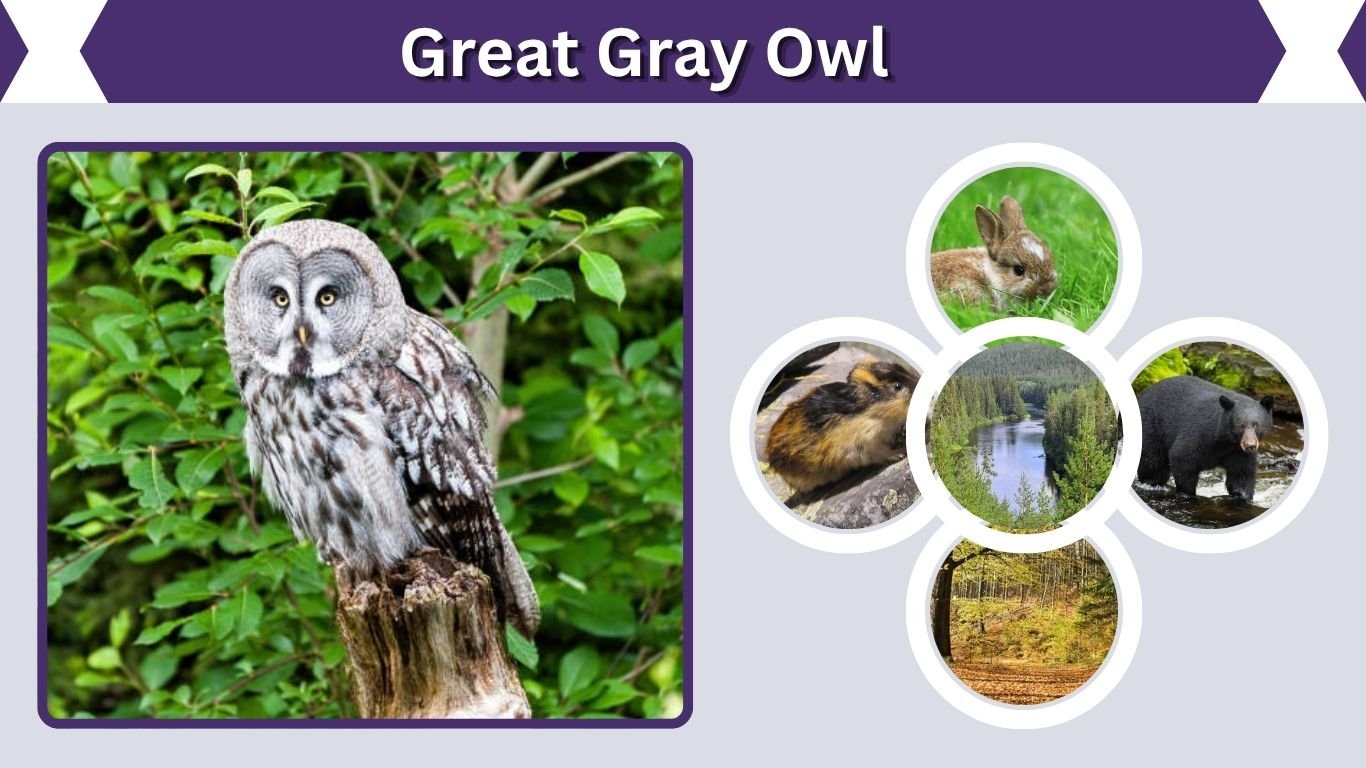
The Great Gray Owl is one of the world’s tallest and most impressive owls. Its enormous round face, bright yellow eyes, silvery plumage, and broad wings create the appearance of a powerful, heavy bird. Much of that size, however, comes from exceptionally thick feathers adapted to cold northern environments. Known scientifically as Strix nebulosa, this elusive owl occupies boreal forests across North America and Eurasia. It hunts mainly in meadows, bogs, and forest openings, where its sensitive hearing allows it to locate small mammals hidden beneath vegetation or deep snow.
Great Gray Owl Overview
Great Gray Owls belong to the true owl family, Strigidae. They are sometimes called Great Grey Owls outside North America. Although they are among the tallest owls, they are not the heaviest. Their bulky appearance comes largely from loose, insulating feathers rather than an exceptionally large body.
| Feature | Great Gray Owl |
|---|---|
| Scientific name | Strix nebulosa |
| Bird family | Strigidae |
| Length | About 24–33 inches |
| Wingspan | About 54–60 inches |
| Weight | About 25–60 ounces |
| Primary food | Voles and other small mammals |
| Main habitat | Boreal forest with nearby openings |
| Global conservation status | Least Concern |
Measurements vary considerably between individuals, with females generally larger and heavier than males.
Great Gray Owl Identification
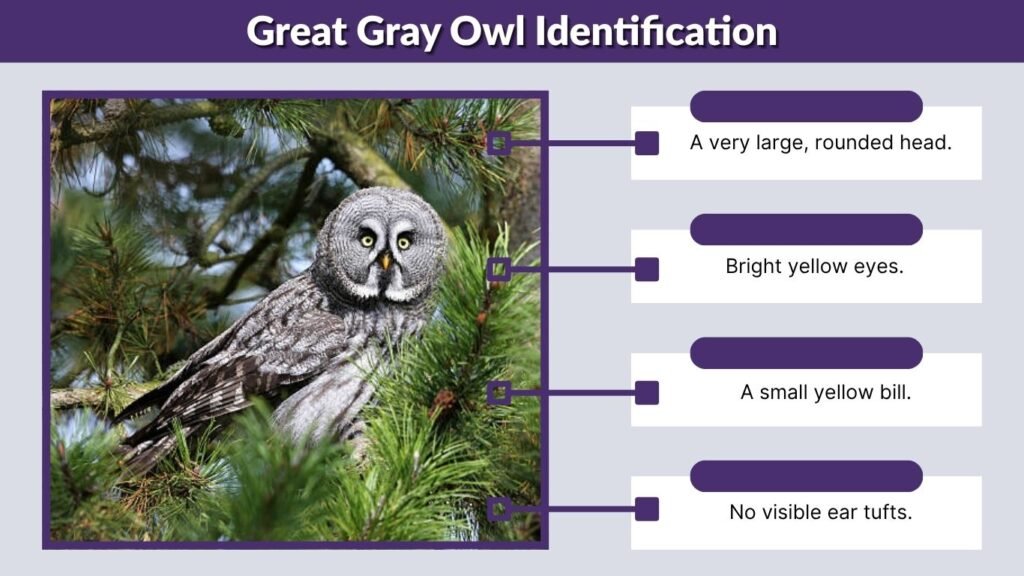
The Great Gray Owl is immediately recognizable when seen clearly. Its oversized facial disk is crossed by numerous fine gray and brown rings, giving the face a patterned, almost hypnotic appearance.
Key Characteristics
Important identification features include:
- A very large, rounded head
- Bright yellow eyes
- A small yellow bill
- No visible ear tufts
- Gray-brown plumage with streaks and bars
- A dark patch resembling a bow tie below the bill
- A long tail
- Broad, rounded wings
- Heavily feathered legs and feet
Unlike the Great Horned Owl, the Great Gray Owl has no prominent feather tufts above its head. Its overall color is also softer and more uniformly gray.
From a distance, its facial disk may appear nearly circular. The disk is not simply decorative; it helps collect sound and direct it toward the owl’s ears.
Great Gray Owl Size and Wingspan
Great Gray Owls measure approximately 24 to 33 inches long and have a wingspan of roughly 54 to 60 inches. Their weight ranges from around 25 to 60 ounces.
These measurements make the species one of North America’s tallest owls. However, a Great Horned Owl can be heavier despite appearing shorter. Thick, fluffy plumage makes the Great Gray Owl look far more massive than its body actually is.
Females are normally larger than males. This size difference can be difficult to judge unless a pair is seen together.
The owl’s large wings allow it to fly slowly and quietly over open ground. Its long tail helps with balance, steering, and controlled landings.
Where Do Great Gray Owls Live?
Great Gray Owls have a broad northern distribution across North America, Europe, and Asia. Their North American range includes Alaska, much of Canada, portions of the northern United States, and isolated western mountain populations.
They occur year-round through much of Alaska and Canada and are also found in northern Minnesota, the northern Rocky Mountains, the Pacific Northwest, and parts of the Sierra Nevada.
In Eurasia, their range extends through Scandinavia, Russia, Siberia, and other northern forest regions.
Most Great Gray Owls do not perform regular long-distance migrations. However, food shortages can cause some birds to move south during winter. These irregular movements are often called irruptions.
During irruption years, Great Gray Owls may appear in places where they are rarely seen. These movements are often related to changing vole populations and snow conditions.
Great Gray Owl Habitat
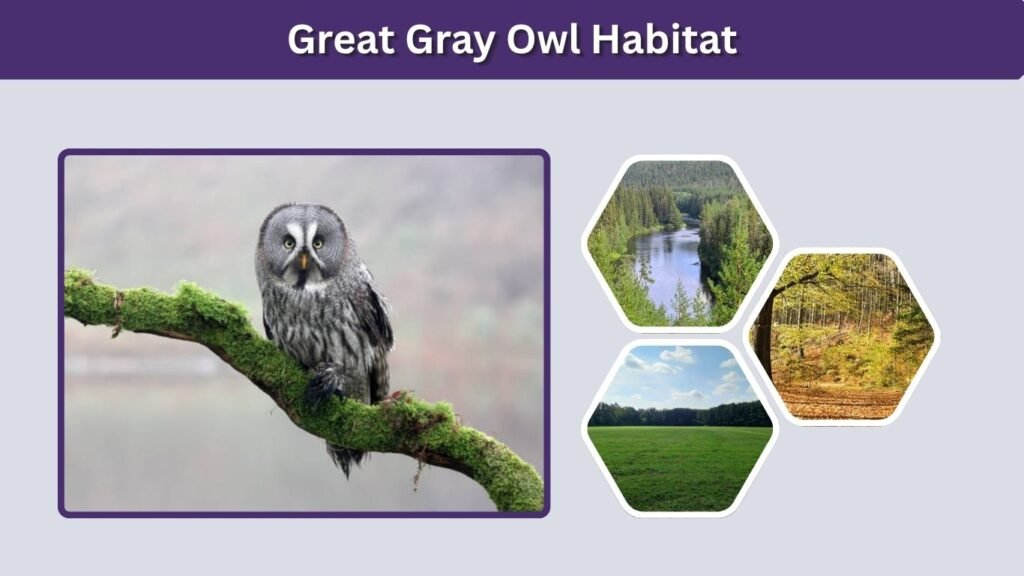
Great Gray Owls are strongly associated with mature northern forests. However, they need more than dense woodland. The most suitable habitat includes both nesting cover and nearby open hunting areas.
Common habitats include:
- Boreal coniferous forests
- Mixed forests
- Forested mountain valleys
- Meadows bordered by trees
- Bogs and muskeg
- Clearings and forest edges
- Recently burned areas
- Open stands of pine or fir
They frequently rest and nest inside mature forests but hunt over meadows, bogs, fields, and other open ground where small mammals are easier to detect.
Large trees and standing dead trees are also important because Great Gray Owls do not build conventional nests. They depend on broken tree tops, old nests, and suitable platforms left by natural forest processes or other birds.
What Do Great Gray Owls Eat?
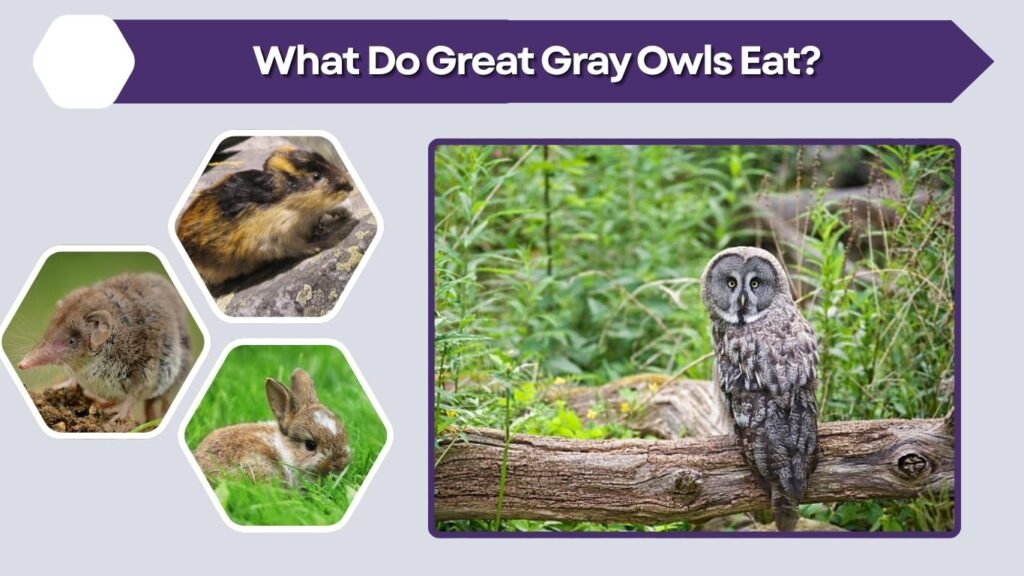
Great Gray Owls are carnivores that specialize in hunting small mammals. Voles often form the largest part of their diet.
Other prey may include:
- Mice
- Lemmings
- Pocket gophers
- Shrews
- Moles
- Chipmunks
- Young rabbits
- Small birds
In North America, voles and pocket gophers are particularly important prey.
The owl usually swallows small prey whole. It later regurgitates compact pellets containing indigestible fur, bones, teeth, and claws.
Great Gray Owl numbers and breeding success may change with rodent abundance. When prey populations are high, adults may remain in one area and raise larger broods. During shortages, they may travel farther or fail to breed.
Great Gray Owl Hunting Behavior
The Great Gray Owl is famous for detecting prey beneath snow. It often watches from a low branch, stump, or fence post while listening carefully for movement.
Once it locates a rodent, the owl launches from its perch and glides silently toward the sound. It may plunge feet-first through the snow to seize prey hidden below the surface.
Its enormous facial disk acts like a sound-collecting structure. Sound is directed toward ears positioned asymmetrically on the skull, helping the owl calculate the exact direction and distance of hidden prey.
Great Gray Owls usually hunt around dawn, dusk, and nighttime, although they may also hunt during daylight. In northern summer, extended daylight makes daytime hunting especially common.
They frequently fly low across clearings, sometimes only a few feet above grass or snow.
Great Gray Owl in Flight
Despite its great apparent size, a Great Gray Owl flies with remarkable softness and control. Its broad wings support slow flight, while specialized feather edges reduce noise.
In flight, the owl shows a long tail and heavily patterned wings. The wingbeats may appear deep and unhurried, followed by extended glides.
Silent flight serves two purposes. It prevents prey from hearing the owl’s approach and allows the owl to continue listening while flying.
A hunting owl may cross a meadow at low height before suddenly dropping toward the ground. When traveling between resting sites, it may fly higher through the forest.
Great Gray Owl Call and Sounds
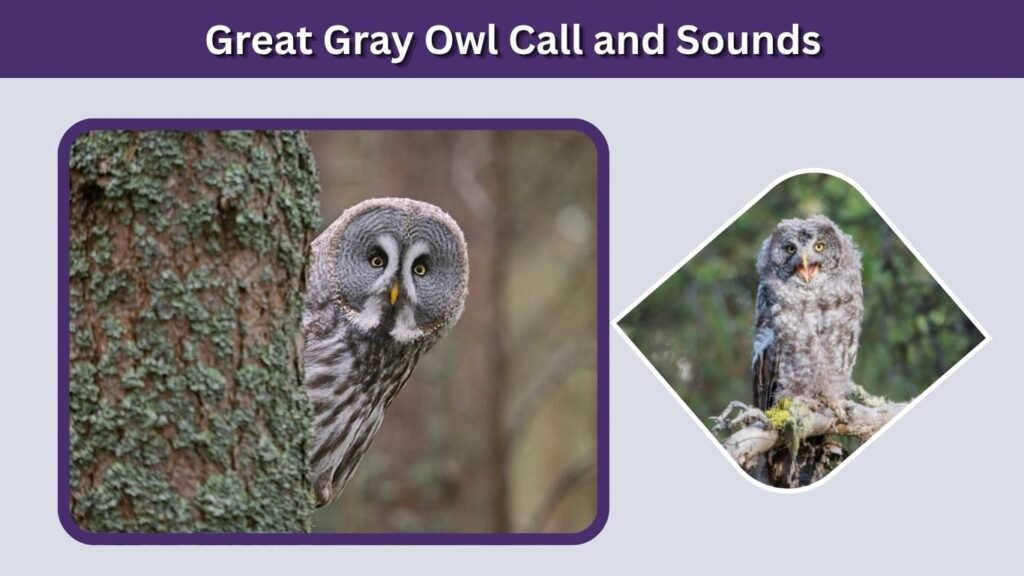
The best-known Great Gray Owl call is a series of deep, evenly spaced hoots. The male’s territorial call may contain several low notes repeated in a steady rhythm.
The sound is deeper and softer than the powerful hooting of a Great Horned Owl. It can carry through quiet forest habitat, especially during the breeding season.
Great Gray Owls also produce:
- Short alarm notes
- Clicking or snapping sounds
- Whistles
- Begging calls from young owls
- Harsh defensive calls near nests
Males call to advertise territories and communicate with females. Females and young birds may use higher-pitched sounds during feeding or nest interactions.
Nesting and Life Cycle
Great Gray Owls usually do not construct nests from the ground up. They use old nests built by ravens, hawks, or other large birds. They may also nest in broken tree tops, natural platforms, artificial nesting structures, or hollow snags.
Breeding generally begins in late winter or early spring. The female incubates the eggs while the male brings food.
The number of eggs varies, often reflecting prey availability. When rodents are plentiful, the pair may raise several young. During poor food years, breeding may be delayed or skipped.
Young Great Gray Owls sometimes leave the nest before they can fly well. They climb on branches or remain on the forest floor while their parents continue feeding and protecting them.
Adults can be highly defensive near a nest and may swoop toward people or animals that approach too closely.
Great Gray Owl Adaptations
The Great Gray Owl possesses several adaptations for life in snowy northern forests.
Its thick plumage provides excellent insulation during severe cold. Feathers covering the legs and feet also help retain warmth.
The broad facial disk and uneven ear placement improve sound localization. This allows the owl to detect small animals that cannot be seen.
Long, sharp talons help penetrate snow and hold prey. Broad wings support slow, quiet flight, while mottled gray plumage provides camouflage against tree bark, shadows, and snowy forest backgrounds.
The owl’s relatively light body reduces the amount of energy needed for slow flight and may help it remain supported by softer snow after a hunting plunge.
Lifespan and Predators
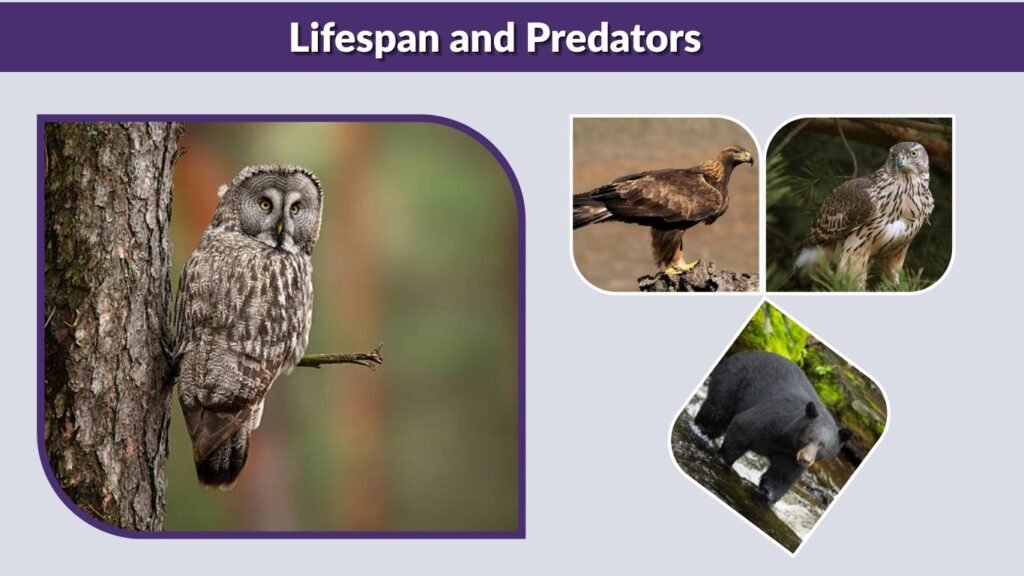
Wild Great Gray Owls can live for many years, although young birds face significant risks before reaching adulthood. Survival depends on food supply, weather, habitat quality, and human disturbance.
Potential predators include:
- Great Horned Owls
- Golden Eagles
- Northern Goshawks
- Black bears near nests
- Martens and other climbing mammals
Eggs and nestlings are much more vulnerable than healthy adults.
Other threats include vehicle collisions, habitat loss, starvation during prey shortages, and injuries involving fences or power lines.
Is the Great Gray Owl Endangered?
The Great Gray Owl is globally classified as Least Concern because it has a very broad circumboreal range. Many populations live in remote northern forests that remain relatively undisturbed.
However, conservation conditions differ locally. Southern populations may be small and vulnerable to habitat loss, logging, disturbance, and the loss of meadow hunting areas.
California lists its Great Gray Owl population as endangered, and estimates suggest that only about 100 to 200 breeding pairs may occur in the state. A large portion of that population is associated with Yosemite and surrounding Sierra Nevada habitat.
Protecting mature forest, nesting snags, open meadows, and healthy small-mammal populations is essential for maintaining local Great Gray Owl populations.
Interesting Great Gray Owl Facts
The Great Gray Owl is one of the tallest owls in the world, but much of its impressive size comes from feathers.
Its small eyes look even more striking because they sit inside an enormous facial disk.
The species can locate prey concealed beneath vegetation or snow primarily by sound.
Great Gray Owls may break through crusted snow when attacking rodents below the surface.
They are quieter and less aggressive than their intimidating appearance suggests, except when defending a nest.
Their scientific name, Strix nebulosa, refers to an owl with a cloudy or misty appearance, matching its softly patterned gray plumage.
FAQs
How Big Is a Great Gray Owl?
A Great Gray Owl is approximately 24 to 33 inches tall, with a wingspan of about 54 to 60 inches. It is among North America’s tallest owls, although its body is lighter than its thick feathers and large silhouette suggest.
What Does a Great Gray Owl Sound Like?
Its typical call is a sequence of low, soft, evenly spaced hoots. It also produces alarm calls, whistles, clicks, and harsher defensive sounds. Young owls use higher begging calls when requesting food from their parents.
What Do Great Gray Owls Eat?
Great Gray Owls primarily eat voles, mice, pocket gophers, lemmings, shrews, and other small mammals. They may occasionally capture birds or larger prey, but rodents make up the majority of their diet.
Where Can Great Gray Owls Be Seen?
They can be found in Alaska, Canada, northern Minnesota, western mountain regions, and boreal forests across northern Europe and Asia. Suitable viewing areas usually combine mature forest with open meadows or bogs used for hunting.
Is a Great Gray Owl the Same as a Great Horned Owl?
No. The Great Gray Owl has a round head without ear tufts, a large circular facial disk, and mostly gray plumage. The Great Horned Owl has prominent ear tufts, a heavier body, and a more varied brown pattern.
