
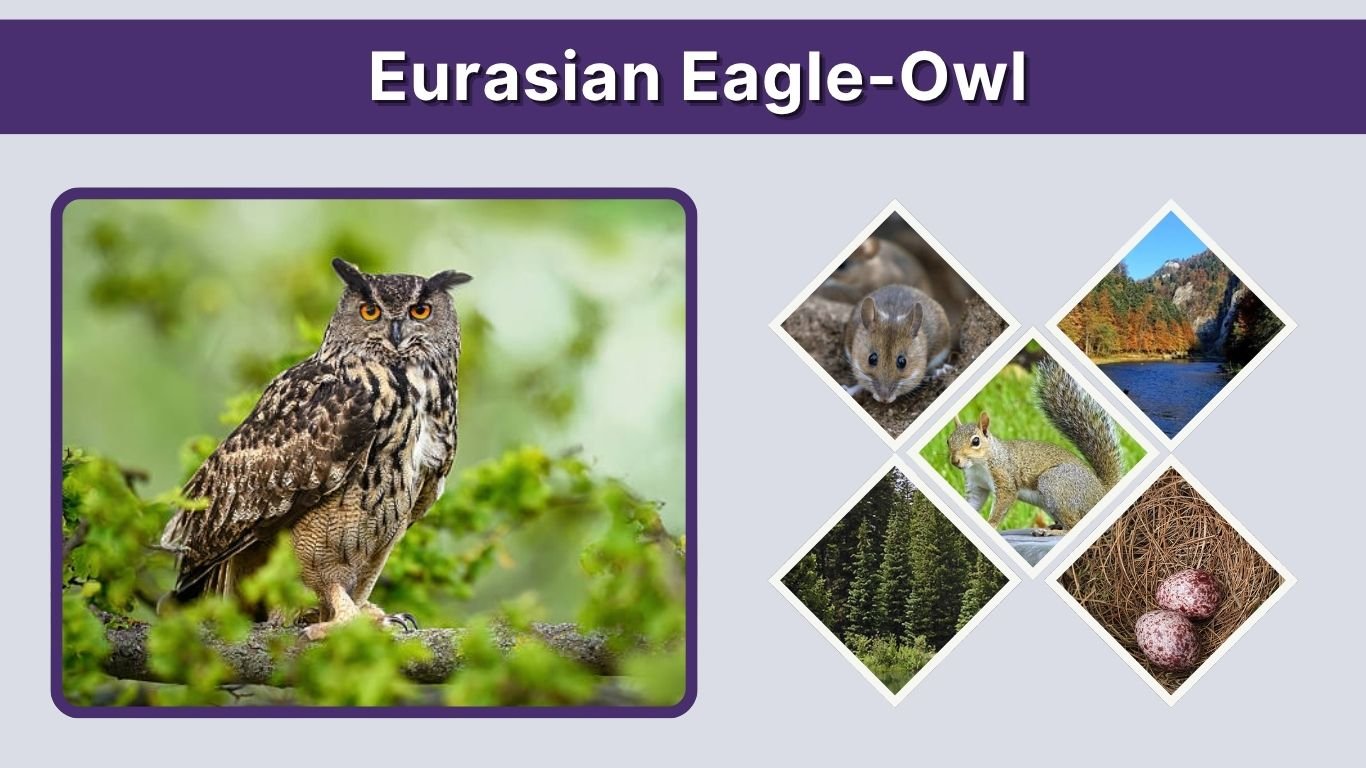
The Eurasian eagle-owl is one of the largest and most powerful owls in the world. Recognized by its vivid orange eyes, prominent ear tufts, massive feet, and heavily patterned feathers, this impressive predator lives across much of Europe and Asia. Its scientific name is Bubo bubo, and it occupies habitats ranging from rocky mountains and forests to grasslands, deserts, and farmland. Eurasian eagle-owls mainly hunt at night and eat an exceptionally varied diet that includes rodents, rabbits, birds, reptiles, and other predators. Despite their size and strength, they usually avoid people and rely on camouflage, quiet flight, and secluded nesting places.
Eurasian Eagle-Owl Overview
The Eurasian eagle-owl belongs to the true owl family, Strigidae. It has an enormous geographical range and several recognized regional forms that vary somewhat in size and coloration.
| Feature | Eurasian eagle-owl |
|---|---|
| Scientific name | Bubo bubo |
| Family | Strigidae |
| Length | Approximately 58–75 cm |
| Wingspan | Commonly around 1.4–1.9 m |
| Weight | Roughly 1.5–4.2 kg |
| Diet | Mammals, birds, reptiles, amphibians and fish |
| Activity | Mainly nocturnal |
| Global status | Least Concern |
Females are generally larger and heavier than males. The species is globally classified as Least Concern because of its huge range, although BirdLife reports that its overall population trend is decreasing.
Eurasian Eagle-Owl Identification
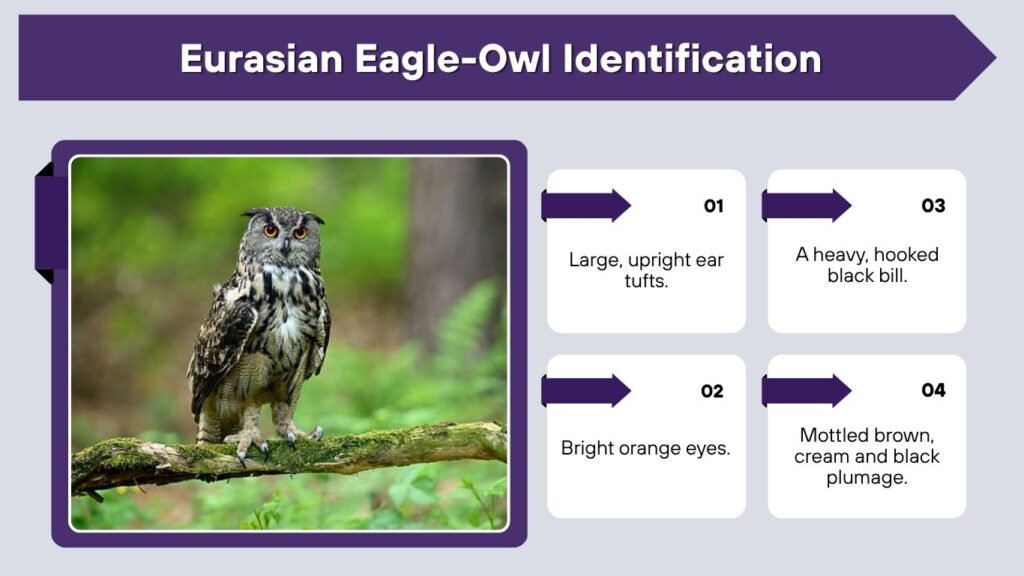
A full-grown Eurasian eagle-owl has a broad head, barrel-shaped body and powerful legs. Its bold expression is created by large orange or reddish-orange eyes set beneath dark feather markings.
Main Physical Traits
Important identification features include:
- Large, upright ear tufts
- Bright orange eyes
- A heavy, hooked black bill
- Mottled brown, cream and black plumage
- A pale throat patch
- Broad, rounded wings
- Strong, fully feathered legs
- Large feet with curved talons
- A short, barred tail
The ear tufts are made of feathers and are not the owl’s actual ears. They may help with visual communication and camouflage. The true ear openings sit on the sides of the head beneath the feathers.
Plumage varies geographically. Some individuals are pale gray-brown, while others appear warmer, darker or more reddish. A white Eurasian eagle-owl would be highly unusual and could result from abnormal pigmentation rather than representing a separate species.
Eurasian Eagle-Owl Size and Wingspan
The Eurasian eagle-owl is among the largest living owls. Adults are commonly about 58 to 75 centimeters long, although exact measurements differ among subspecies and sexes. Females can weigh more than 4 kilograms, while males are usually substantially lighter.
Its wingspan often reaches between 1.4 and 1.9 meters. This allows the owl to appear enormous when flying overhead, especially because its wings are broad and deeply feathered.
| Measurement | Male | Female |
|---|---|---|
| Typical length | About 58–68 cm | About 62–75 cm |
| Typical weight | Around 1.5–2.8 kg | Around 2.3–4.2 kg |
| Wingspan | Often 1.4–1.7 m | Often 1.6–1.9 m |
Size varies across the species’ range. Northern birds are often larger and paler, while some southern populations may be smaller and more warmly colored.
Despite its great size, the Eurasian eagle-owl can fly quietly. Soft feather edges reduce turbulence and help conceal the sound of its approach.
Where Do Eurasian Eagle-Owls Live?
The Eurasian eagle-owl has one of the widest ranges of any owl. It occurs across much of Europe and Asia, extending from the Iberian Peninsula and Scandinavia through eastern Europe, Russia, Central Asia, the Middle East, Mongolia and parts of China.
It is generally a resident species rather than a regular long-distance migrant. Adults often remain within or near their territories throughout the year. Young birds travel farther while searching for territories of their own. BirdLife lists it as a nonmigratory species with an enormous resident and breeding range.
The species does not naturally occur as a widespread native bird in North America. Individual captive birds may escape, but these do not represent an established native population.
Eurasian Eagle-Owl Habitat and Biome
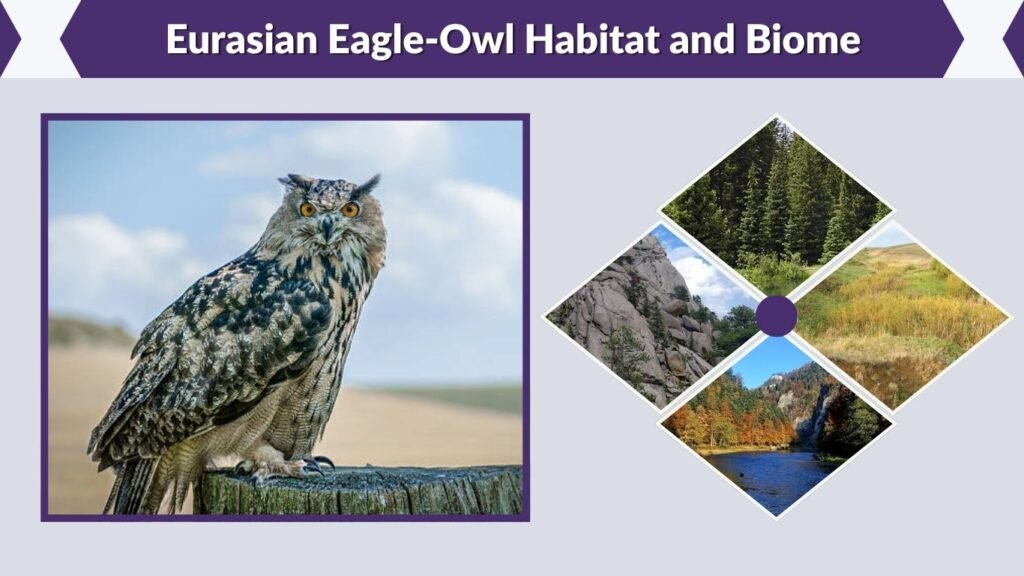
Eurasian eagle-owls can survive in an unusually broad range of environments. Their most important requirements are plentiful prey, secure nesting sites and suitable daytime roosts.
Common habitats include:
- Rocky mountains and cliffs
- Coniferous and mixed forests
- River valleys and ravines
- Grasslands and steppes
- Semi-desert regions
- Quarries and rocky hillsides
- Farmland with wooded edges
- Coastal cliffs
- Open woodland
They often favor rocky landscapes for nesting, but they also occupy forests, deserts, mountain ranges, riverbeds and open agricultural areas.
Many pairs nest in quarries because ledges and steep rock faces resemble natural cliffs. Some have also adapted to living near towns, industrial areas and other human-modified landscapes where disturbance is limited.
What Do Eurasian Eagle-Owls Eat?
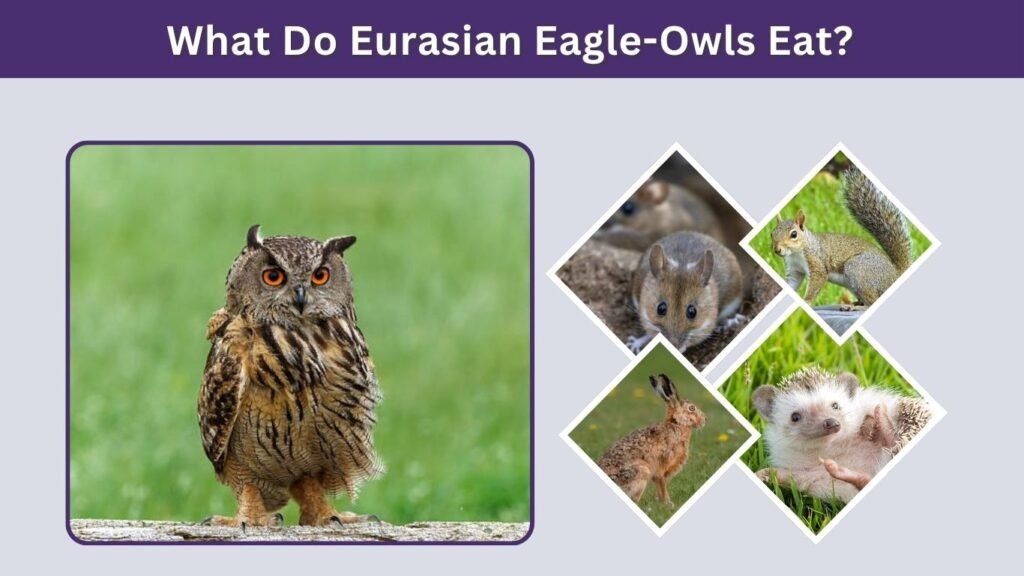
The Eurasian eagle-owl is a carnivore and an opportunistic apex predator. It eats whatever suitable prey is locally abundant, allowing it to survive in many different habitats.
Its diet may include:
- Rats, mice and voles
- Rabbits and hares
- Hedgehogs
- Squirrels
- Fox cubs and other small carnivores
- Ducks, pigeons and crows
- Grouse and pheasants
- Other owls and birds of prey
- Snakes and lizards
- Frogs and fish
Medium-sized mammals and birds frequently form the core of its diet. Rabbits may be particularly important in parts of Europe, while rodents dominate in other regions.
The eagle-owl’s position in the food chain is generally near the top. Healthy adults have few natural predators, and they may even kill smaller raptors, owls and mammalian predators.
Hunting Behavior and Strength
Eurasian eagle-owls usually begin hunting around dusk. They often wait quietly on a rock, branch, post or other elevated perch before flying toward detected prey.
Their large eyes provide excellent low-light vision, while sensitive hearing helps them locate animals hidden by darkness or vegetation. Once a target is found, the owl approaches silently and extends its talons just before impact.
Its feet are exceptionally powerful. Long, curved claws can penetrate prey and maintain a secure hold. The hooked bill is then used to tear larger food into manageable pieces.
Eurasian eagle-owls may also hunt while flying low over open ground. Their broad wings produce deep, controlled wingbeats, and their short tail allows them to maneuver around trees, rocks and uneven terrain.
Although powerful enough to capture surprisingly large animals, they do not normally hunt humans. Reports of attacks usually involve nest defense, captive birds or unusual close encounters.
Eurasian Eagle-Owl Sound and Call
The best-known Eurasian eagle-owl call is a deep, resonant hoot. The male typically produces a low “oo-hu” sound that carries over long distances, especially in quiet rocky valleys.
Females also hoot, but their calls are often higher pitched. Other vocalizations include:
- Barking alarm notes
- Harsh screams
- Clicking or snapping sounds
- Begging calls from young owls
- Soft calls exchanged between mates
Calling becomes especially noticeable during courtship and territory establishment. Vocal activity often increases in autumn and again before the breeding season.
The call helps a pair maintain contact and warns neighboring owls that the territory is occupied.
Breeding, Eggs, and Nesting
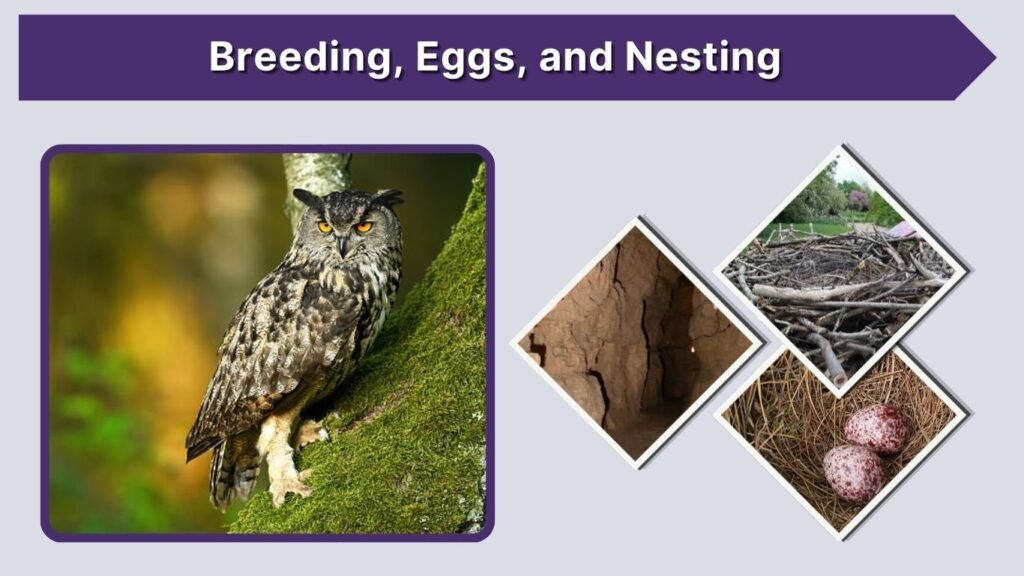
Eurasian eagle-owls generally form long-term pair bonds. Courtship may involve calling, bowing, food offerings and flights around the territory.
They do not build elaborate stick nests. Instead, they use:
- Sheltered cliff ledges
- Rocky caves or crevices
- Quarry shelves
- Ground scrapes beneath cover
- Abandoned nests of large birds
- Occasionally buildings or ruins
The female commonly lays two to four white eggs, although clutch size varies. She performs most incubation while the male supplies food.
After hatching, chicks are covered in pale down and depend completely on their parents. They gradually explore the nest area before they can fly well. Juveniles continue receiving food for weeks after leaving the nest.
Adults can be highly defensive around eggs or young. A person approaching an active nest may be swooped at or struck, so nesting areas should be given plenty of space.
Lifespan and Predators
Wild Eurasian eagle-owls may live for around 20 years or more under favorable conditions. Captive birds can survive considerably longer, with some reportedly reaching several decades of age.
Young owls face the greatest dangers. Eggs and chicks may be taken by foxes, martens and other predators when nests are accessible. Adults have few natural enemies, although territorial conflicts and attacks by other large raptors can occur.
Major human-related threats include:
- Electrocution on power lines
- Vehicle and train collisions
- Illegal persecution
- Poisoning from contaminated prey
- Disturbance at nests
- Habitat degradation
- Collisions with fences and wires
The species has recovered in several European regions after earlier declines, assisted by legal protection, reintroduction and changes in public attitudes. However, threats remain uneven across its vast range.
Eurasian Eagle-Owl vs. Great Horned Owl
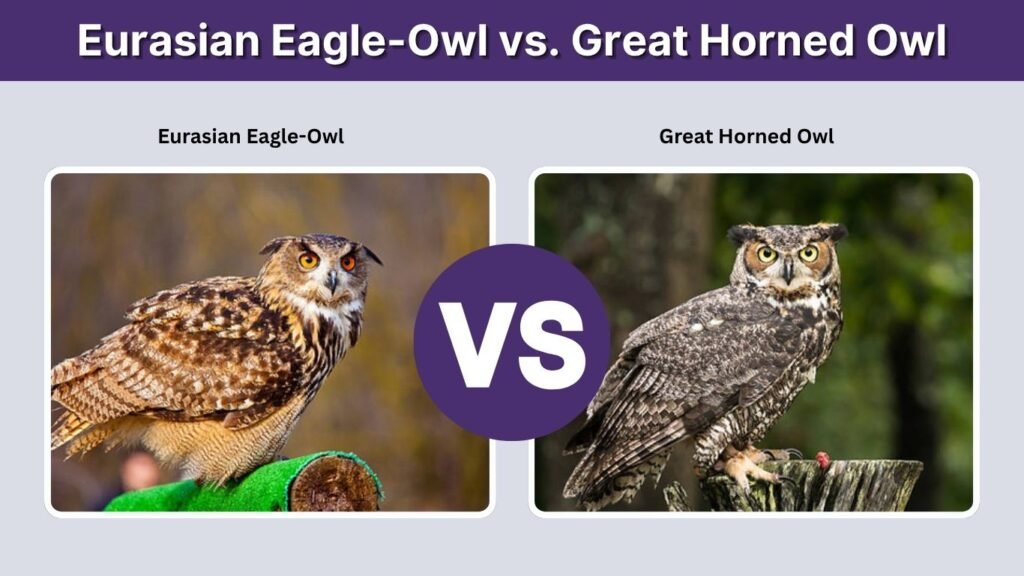
The Eurasian eagle-owl and Great Horned Owl look similar because both belong to the genus Bubo. Each has ear tufts, powerful feet, barred plumage and a broad body.
| Feature | Eurasian eagle-owl | Great Horned Owl |
|---|---|---|
| Native range | Europe and Asia | North and South America |
| Eye color | Usually orange | Usually yellow |
| Average size | Generally larger | Usually smaller |
| Ear tufts | Large and often angled outward | Prominent and more upright |
| Typical mass | Up to about 4 kg or more | Commonly under about 2.5 kg |
| Scientific name | Bubo bubo | Bubo virginianus |
The Eurasian species is typically larger and heavier, with orange eyes rather than the Great Horned Owl’s yellow eyes. Both are adaptable predators occupying similar ecological roles on different continents.
Can a Eurasian Eagle-Owl Be Kept as a Pet?
A Eurasian eagle-owl is not suitable as a conventional pet. It needs extensive space, specialized food, expert veterinary care and experienced handling. Its talons can cause serious injuries, and its natural behaviors cannot be accommodated in an ordinary home.
Ownership laws vary by country and region. Permits, falconry credentials or animal-welfare inspections may be required. Purchasing one without understanding the legal and husbandry requirements can endanger both the bird and its owner.
Wild owls should never be removed from nests or captured.
Interesting Eurasian Eagle-Owl Facts
The Eurasian eagle-owl’s scientific name repeats the genus and species name: Bubo bubo.
Its orange eyes become especially striking in low light, but they do not glow independently. Reflected illumination makes them appear brighter.
Its large ear tufts can be lowered until they are barely visible.
The species can live in environments ranging from cold northern forests to warm deserts.
It occasionally catches other owls, falcons and hawks, demonstrating its position near the top of the food chain.
Its enormous-looking body contains thick feathers that provide insulation and make the owl appear even larger.
FAQs
How Big Is a Eurasian Eagle-Owl?
An adult Eurasian eagle-owl is typically about 58 to 75 centimeters long. Its wingspan may reach roughly 1.4 to 1.9 meters, and large females can weigh more than 4 kilograms. Females are generally larger than males.
What Do Eurasian Eagle-Owls Eat?
They eat rodents, rabbits, hares, hedgehogs, birds, reptiles, amphibians and occasionally fish. They may also kill smaller owls and birds of prey. Their exact diet depends on which animals are most abundant within their territory.
Are Eurasian Eagle-Owls Aggressive?
They usually avoid humans and are not naturally interested in attacking people. However, adults may defend a nest, mate or young. Captive individuals can also be dangerous because their powerful talons and bill can cause severe injuries.
Where Do Eurasian Eagle-Owls Live?
They live across much of Europe and Asia. Their habitats include mountains, forests, cliffs, quarries, steppes, deserts, grasslands and farmland. Rocky areas are especially valuable because they provide protected ledges for nesting.
Is the Eurasian Eagle-Owl Endangered?
The species is globally classified as Least Concern because it has a vast range and a large population. Nevertheless, BirdLife estimates that the global population is decreasing, and some local populations remain vulnerable to habitat loss, persecution, poisoning and collisions.