
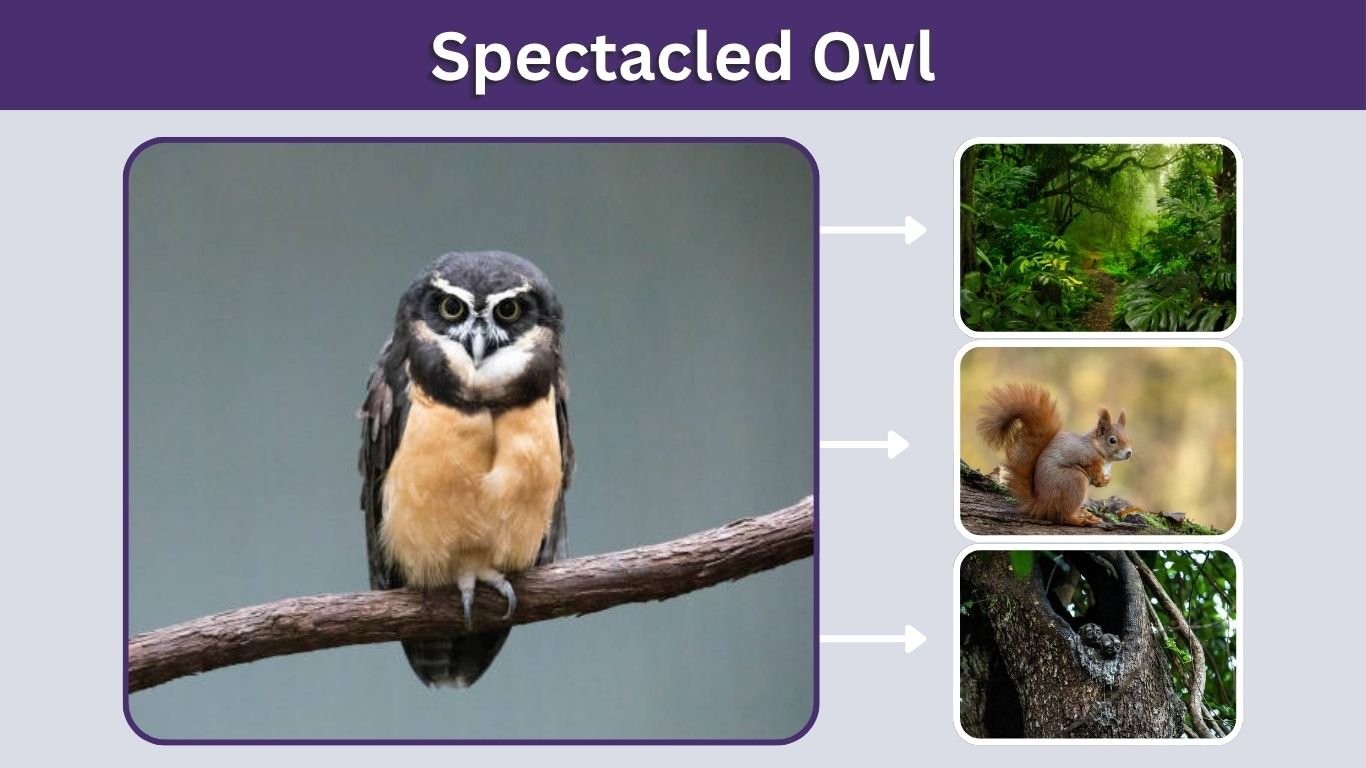
The spectacled owl is a large tropical owl known for its bold facial markings, bright yellow eyes, and deep nighttime calls. Pale feathers surrounding its eyes resemble a pair of glasses, giving the bird its distinctive common name.
Scientifically known as Pulsatrix perspicillata, the spectacled owl lives in forests across Central and South America. It spends much of the day hidden among dense foliage and becomes active after sunset. As a powerful nocturnal predator, it hunts mammals, birds, reptiles, amphibians, bats, and large insects. Although the species occupies a broad geographic range, continued deforestation can reduce the mature trees and nesting cavities it needs.
What Is a Spectacled Owl?
The spectacled owl belongs to the family Strigidae, which includes most typical owls. It is one of the largest forest owls found in the tropical Americas.
Its range extends from southern Mexico through Central America and into much of South America. Populations occur as far south as Paraguay and northern Argentina. Spectacled owls are generally permanent residents rather than long-distance migrants.
The species is mainly nocturnal. During daylight, it rests quietly on a concealed branch, often beneath thick forest cover. At dusk, it leaves its roost and begins searching for prey.
Spectacled owls are usually seen alone or in pairs. Their secretive behavior, dark plumage, and preference for dense tropical vegetation can make them difficult to observe.
Spectacled Owl Identification
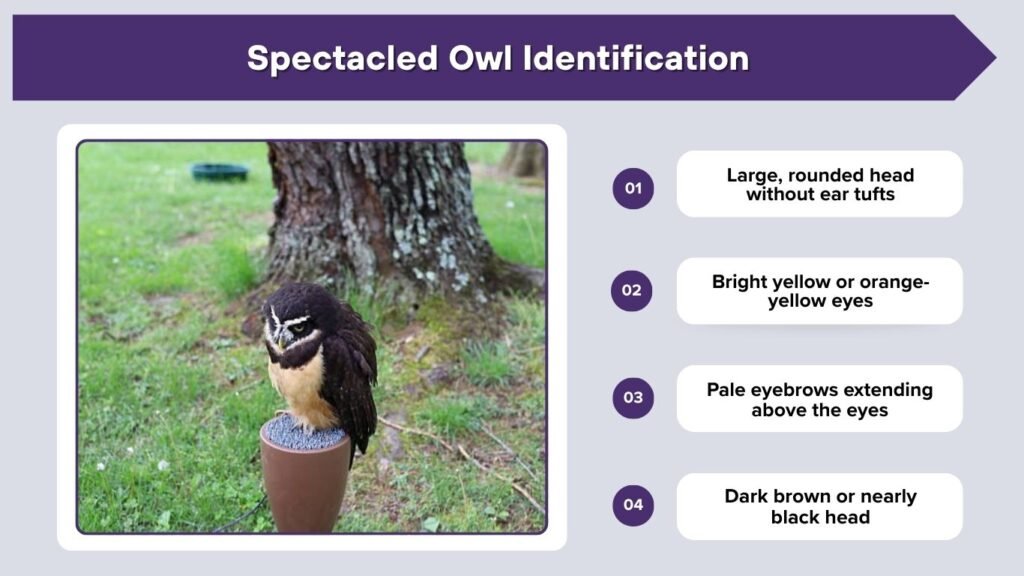
Adult spectacled owls have one of the most recognizable faces among tropical owls. Their pale eyebrows and facial markings sharply contrast with the dark feathers surrounding their eyes.
What Does a Spectacled Owl Look Like?
Important identification features include:
- Large, rounded head without ear tufts
- Bright yellow or orange-yellow eyes
- Pale eyebrows extending above the eyes
- Light feathers surrounding the bill and lower face
- Dark brown or nearly black head
- Dark upperparts and wings
- Broad dark band across the upper chest
- Cream, buff, or yellowish underparts
- Strong feet with sharp talons
- Short, curved bill
The light markings around the eyes create the appearance of spectacles. This facial pattern is the main reason the bird is called the spectacled owl.
Adult males and females have similar plumage. Females, however, are generally larger and heavier than males.
What Does a Juvenile Spectacled Owl Look Like?
Young spectacled owls look surprisingly different from adults. Juveniles have mostly white or pale cream heads and bodies, with a dark facial mask around the eyes. Their wings and backs are darker, creating a dramatic black-and-white appearance.
As they mature, the pale juvenile feathers are replaced by the darker brown plumage of an adult. The adult facial markings gradually become clearer, and the chest develops its characteristic dark band.
Because the juvenile plumage is so different, a young spectacled owl can easily be mistaken for another species. The yellow eyes, rounded head, strong feet, and developing facial pattern help identify it correctly.
Spectacled Owl Size
The spectacled owl is a medium-large to large owl. Adults commonly measure around 43–52 centimeters, or approximately 17–20 inches, in length.
Females may weigh close to 950 grams, while males are usually lighter. Body size varies between individuals, regions, and subspecies.
| Feature | Typical description |
|---|---|
| Body length | About 43–52 cm |
| Weight | Roughly 590–950 g |
| Eye color | Yellow to orange-yellow |
| Head shape | Large and rounded |
| Ear tufts | Absent |
| Female size | Usually larger than male |
Its broad wings are well suited to controlled flight through forest vegetation. Like other owls, the spectacled owl has specialized wing feathers that reduce noise, helping it approach prey quietly.
Where Do Spectacled Owls Live?
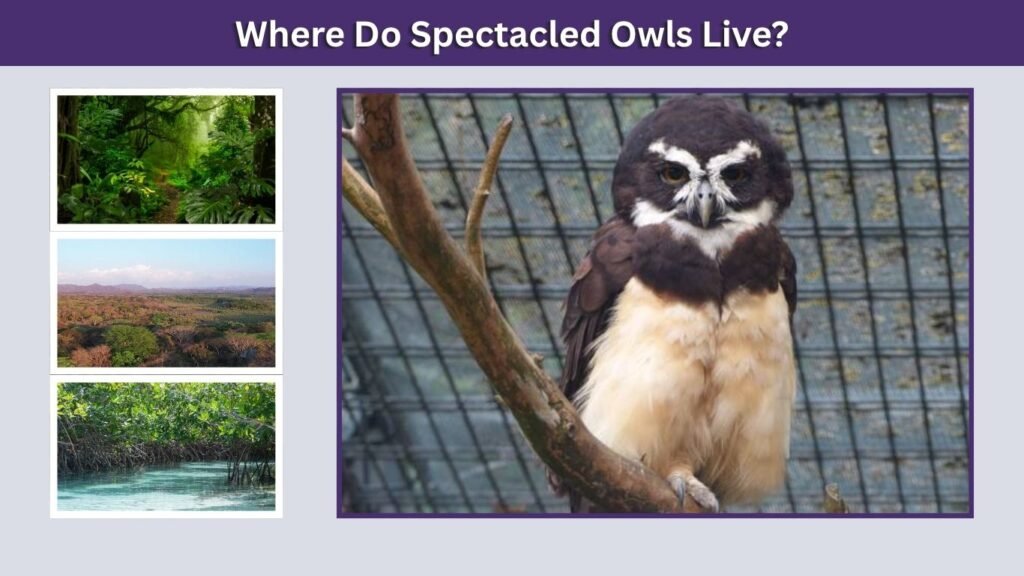
Spectacled owls have an extensive range across the tropical Americas. They occur from southern Mexico through Belize, Guatemala, Honduras, Nicaragua, Costa Rica, and Panama. Their South American range includes countries such as Colombia, Venezuela, Ecuador, Peru, Bolivia, Brazil, Paraguay, and northern Argentina. They also occur on Trinidad.
Spectacled Owl Habitat
The species occupies several wooded environments, including:
- Tropical rainforests
- Humid lowland forests
- Tropical dry forests
- Forest edges
- Wooded savannas
- Mangrove areas
- Plantations with mature trees
- Secondary forests
- Wooded river corridors
Spectacled owls are often associated with lowland forest, although they may also occur at moderate elevations. They need trees large enough to provide protected roosts and nesting cavities.
They can sometimes tolerate modified habitats when enough tree cover remains. However, heavily cleared landscapes usually provide fewer nesting places, less protection, and reduced prey diversity.
What Do Spectacled Owls Eat?
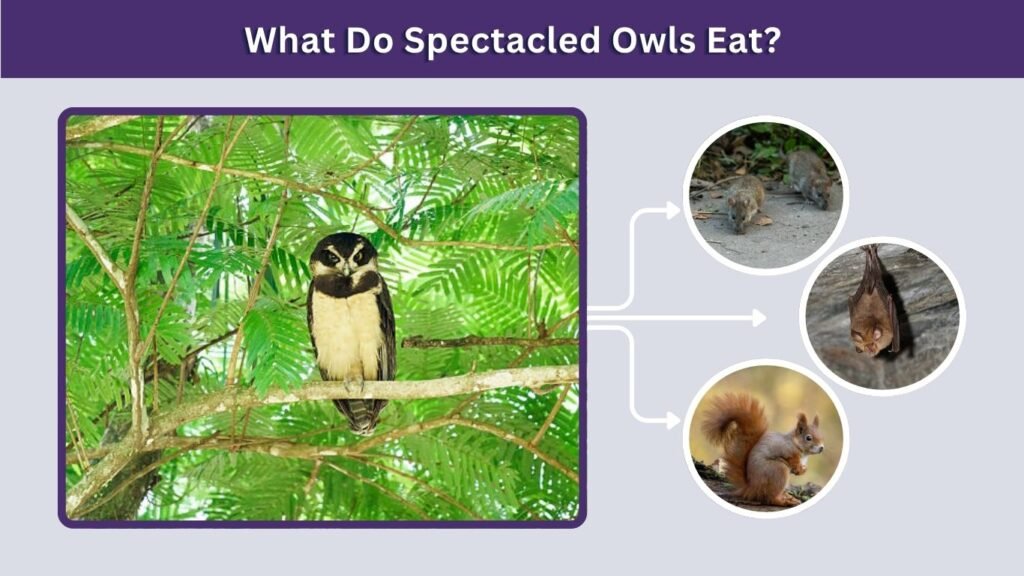
Spectacled owls are carnivorous and capable of capturing a broad variety of prey. Their diet depends on the animals available in their local habitat.
Common prey includes:
- Mice and rats
- Bats
- Small opossums
- Squirrels
- Small birds
- Pigeons and doves
- Frogs
- Lizards
- Snakes
- Large beetles
- Crickets and other insects
They may occasionally take surprisingly large prey for an owl of their size. Researchers have even documented spectacled owl predation involving a three-toed sloth, showing the strength and adaptability of this tropical hunter.
How Do Spectacled Owls Hunt?
A spectacled owl often hunts from a concealed perch. It waits quietly while watching and listening for movement in the surrounding vegetation.
Once prey is detected, the owl glides from its perch and captures the animal with its talons. Small prey may be swallowed whole, while larger animals are torn into smaller pieces.
Its large eyes are adapted for low-light conditions, while its facial disc helps direct sound toward the ears. These features allow the owl to hunt effectively even when prey is partly hidden by leaves or darkness.
After eating, the owl regurgitates pellets containing indigestible material such as fur, bones, teeth, feathers, and insect shells.
What Does a Spectacled Owl Sound Like?
The spectacled owl produces deep, resonant calls that can travel through dense forest. Its best-known call is a series of low, pulsing notes that may gradually become softer and lower.
Some listeners compare the sound to knocking, tapping, or a hammer striking wood. The species may also produce whistles, screeches, barks, and other calls.
Spectacled owls call to:
- Announce their territory
- Communicate with a mate
- Warn competing owls
- Maintain contact in dense forest
- Support courtship during the breeding season
Because the owl is difficult to see at night, its distinctive call is often the best way to confirm its presence.
Spectacled Owl Behavior
Spectacled owls spend most daylight hours resting. They choose shaded branches where their dark feathers blend with surrounding bark and foliage.
At night, they become active and may travel through their territory in search of prey. Their flight is controlled and quiet, allowing them to move between trees without attracting much attention.
Adults can be territorial, especially around a nest. A pair may use the same general area for an extended period when food and nesting sites remain available.
Spectacled owls are powerful predators, but they do not normally threaten people. Like most wild birds, they prefer to avoid humans. However, approaching a nest too closely may cause defensive calling or aggressive behavior.
Spectacled Owl Nesting and Reproduction
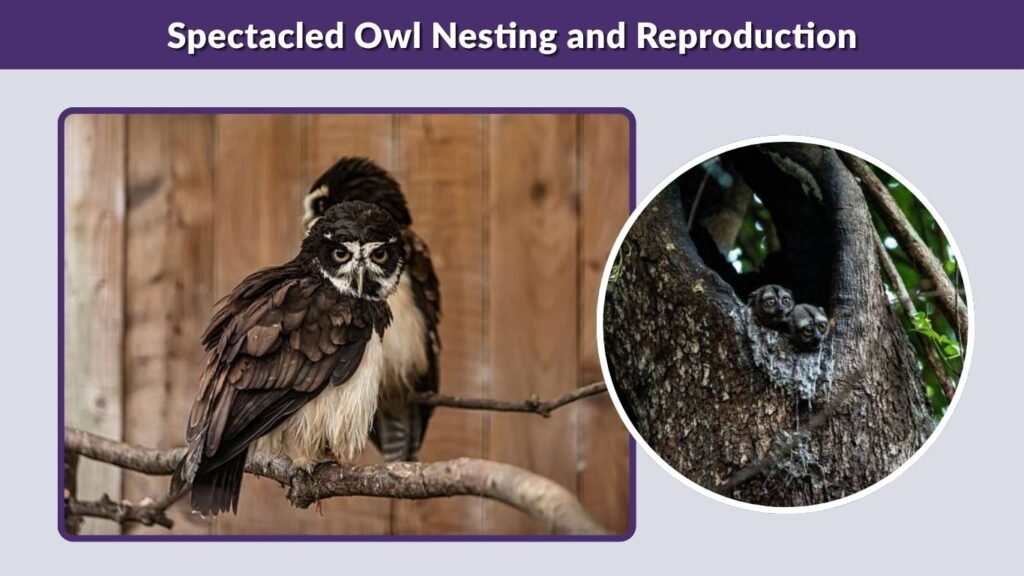
Spectacled owls generally nest in large natural cavities inside mature or decaying trees. They may also use a broken trunk or another sheltered opening high above the ground.
The species does not normally construct an elaborate nest. Instead, the female lays her eggs on debris already present inside the cavity.
Eggs and Chicks
A female usually lays one or two white eggs. Incubation is mainly her responsibility, while the male supplies food.
After the chicks hatch, the female remains close to them during their most vulnerable stage. The male continues hunting, and both parents eventually help feed the growing young.
Young spectacled owls may leave the nest before achieving complete independence. They remain close to their parents while learning to fly, locate prey, and survive in the forest. Some observations indicate that young birds can remain associated with their parents for an extended period after leaving the nest.
How Long Do Spectacled Owls Live?
The exact average lifespan of wild spectacled owls is not well documented. Like many large owls, they may survive for many years when they have secure habitat, adequate prey, and limited exposure to human threats.
Young birds face the highest risks because they are inexperienced hunters and more vulnerable to starvation, predators, severe weather, and accidents.
Spectacled owls living under professional human care may survive longer than wild birds because they receive regular food, veterinary treatment, and protection from predators.
Are Spectacled Owls Endangered?
The spectacled owl has an extremely large geographic range. However, BirdLife International reports that the species is expected to lose a meaningful portion of suitable habitat across three generations.
The main threats include:
- Tropical deforestation
- Removal of large nesting trees
- Conversion of forests into farmland
- Forest fragmentation
- Wildfires
- Human disturbance near nests
- Declining prey populations
- Illegal capture or persecution
Protecting large trees is particularly important because spectacled owls depend on natural cavities for nesting. Even where some forest remains, the removal of old trees can leave the owls without suitable breeding sites.
Maintaining connected forests also helps adults move safely between roosting and hunting areas.
Spectacled Owl vs Great Horned Owl
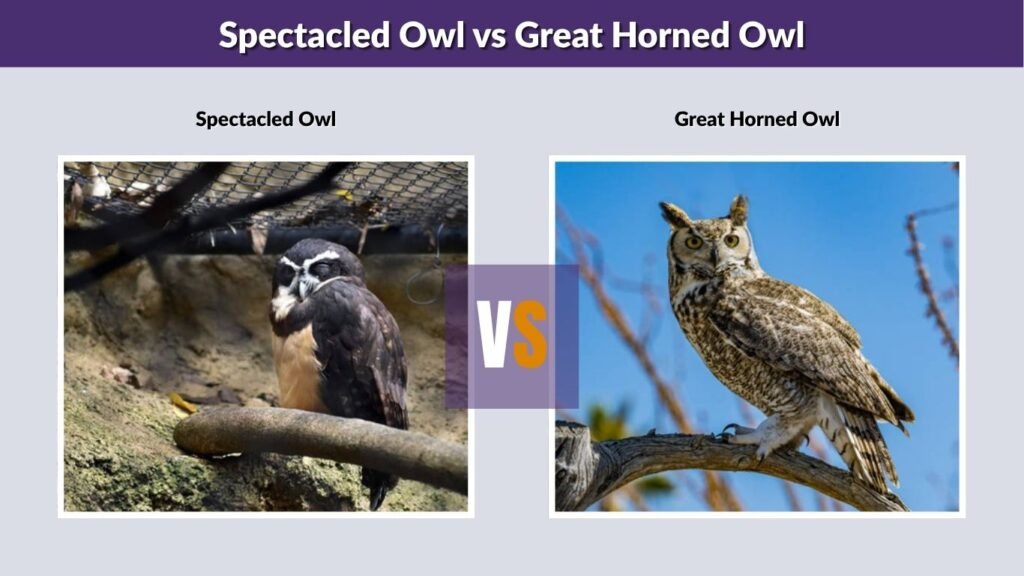
Although both are large nocturnal predators, they look noticeably different.
| Feature | Spectacled owl | Great horned owl |
|---|---|---|
| Ear tufts | None | Prominent |
| Eye color | Yellow or orange-yellow | Yellow |
| Facial markings | Pale spectacle-like pattern | Broad facial disc |
| Main range | Central and South America | North and South America |
| Typical habitat | Tropical forest | Forest, desert, farmland and cities |
| Chest pattern | Pale body with dark chest band | Heavily barred and mottled |
| Head shape | Smooth and rounded | Horned appearance |
The great horned owl is more adaptable and lives in a wider variety of open and wooded habitats. The spectacled owl is more strongly associated with tropical forests.
Interesting Spectacled Owl Facts
- Its pale facial feathers look like a pair of glasses.
- Juveniles are mostly white and look very different from adults.
- Females are larger than males.
- The species has no visible ear tufts.
- It is primarily active at night.
- Its range extends from southern Mexico to northern Argentina.
- Spectacled owls hunt mammals, birds, bats, reptiles, and insects.
- Their calls may sound like knocking on wood.
- They usually nest inside natural tree cavities.
- Large old trees are essential to successful breeding.
FAQs
Are spectacled owls nocturnal?
Yes. Spectacled owls are primarily nocturnal. They usually rest on concealed branches during daylight and begin hunting around dusk. Their large eyes, sensitive hearing, strong talons, and quiet flight help them locate and capture prey in darkness.
Why is it called a spectacled owl?
The owl gets its name from the pale markings surrounding its bright eyes. These markings look similar to a pair of eyeglasses or spectacles against the bird’s dark facial feathers.
What does a spectacled owl eat?
Spectacled owls eat mammals, birds, bats, frogs, reptiles, and large insects. Rats, mice, opossums, squirrels, pigeons, beetles, and lizards may all form part of the diet, depending on local prey availability.
Where do spectacled owls nest?
They generally nest in large natural cavities inside mature trees. A suitable cavity protects the eggs and chicks from rain, heat, and many predators. The owls add little material before laying their eggs.
Are spectacled owls dangerous?
Spectacled owls are powerful predators but are not normally dangerous to people. They usually avoid human contact. A nesting owl may defend its eggs or chicks, so observers should remain at a respectful distance.
