
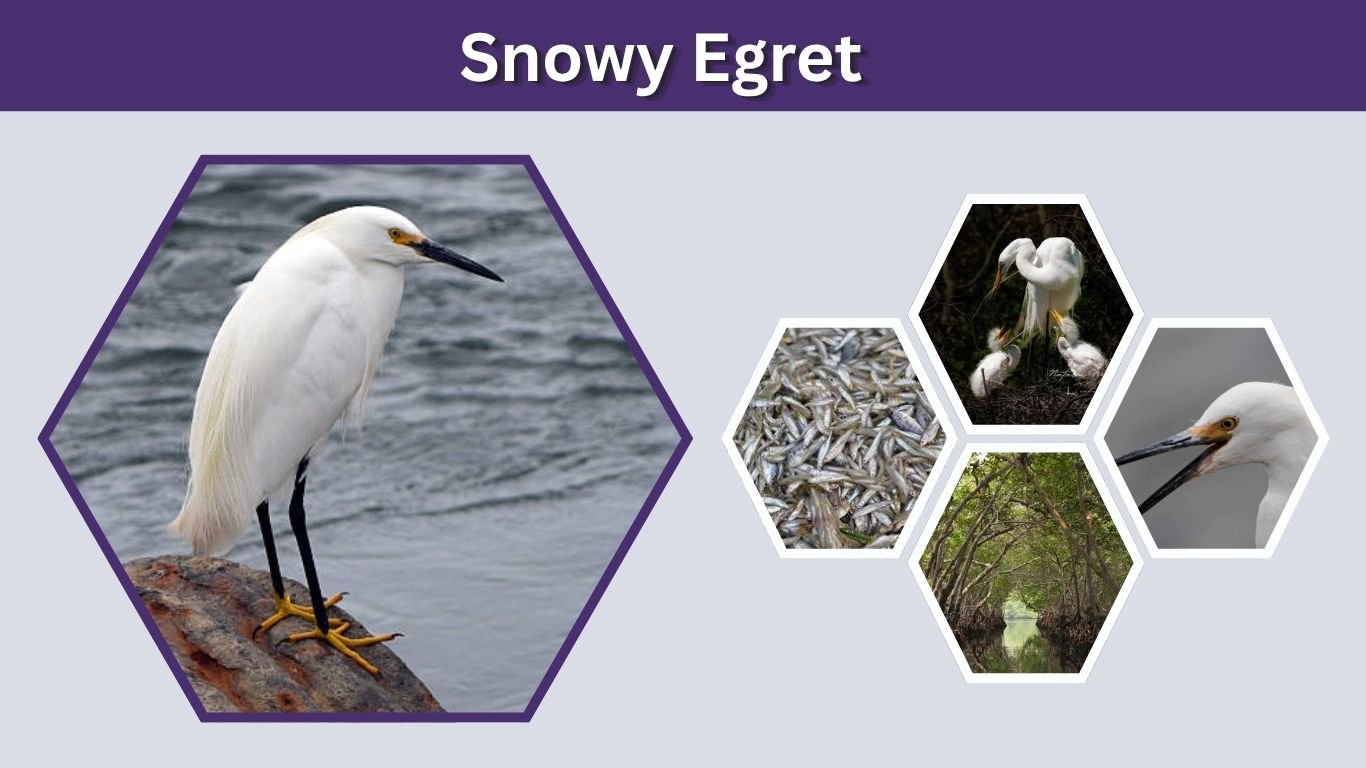
The Snowy Egret is a graceful white wading bird recognized by its thin black bill, black legs, and bright yellow feet. Scientifically named Egretta thula, it inhabits wetlands throughout much of the Americas. Unlike larger egrets that often remain motionless while hunting, this energetic bird runs, turns, and shuffles its feet to disturb hidden prey. This guide covers the Snowy Egret’s identification, size, habitat, range, diet, breeding behavior, flight, sounds, and differences from similar white herons.
What Is a Snowy Egret?
The Snowy Egret is a small member of the heron family, Ardeidae. It is one of several predominantly white herons commonly called egrets. Its delicate body, active hunting behavior, and contrasting yellow feet make it relatively easy to recognize.
Snowy Egrets occur throughout North, Central, and South America. Their scientific name, Egretta thula, distinguishes them from the similar Little Egret of Europe, Africa, Asia, and Australia.
Snowy Egret Identification
Important identification features include:
- Completely white body plumage
- Long, slender black bill
- Long black legs
- Bright yellow feet
- Yellow facial skin between the eyes and bill
- Thin, S-shaped neck
- Long, wispy breeding plumes
- Graceful but highly active feeding movements
The bright yellow feet are among the most reliable field marks. When a Snowy Egret walks or runs through shallow water, its feet may appear almost golden against the dark mud.
Snowy Egret Size
Snowy Egrets are smaller and more delicate than Great Egrets. Males and females are similar in appearance, although males may average slightly larger.
| Measurement | Approximate size |
|---|---|
| Body length | 22–27 inches |
| Height | About 24 inches |
| Wingspan | 39–41 inches |
| Weight | 11–13 ounces |
| Bill length | Approximately 3–4 inches |
Their lightweight bodies allow them to make quick turns, short flights, and sudden leaps while pursuing fish and aquatic invertebrates.
Male vs. Female Snowy Egret
Male and female Snowy Egrets have nearly identical plumage. Both are white with black bills, black legs, and yellow feet. It is therefore difficult to determine sex through casual field observation.
During breeding, males usually establish territories and perform courtship displays. They raise their decorative feathers, stretch their necks, and produce calls to attract females. Behavioral observation at a nesting colony may provide better clues than plumage alone.
Snowy Egret Habitat and Range

Snowy Egrets live in freshwater, brackish, and saltwater environments. They need shallow water for feeding and trees, shrubs, mangroves, or dense vegetation for nesting.
The birds may move between several wetlands during the day as tides, water levels, and prey availability change.
Preferred Habitats
Snowy Egrets commonly inhabit:
- Freshwater marshes
- Coastal lagoons
- Tidal mudflats
- Mangrove swamps
- Estuaries
- Ponds and lakes
- Shallow rivers
- Flooded agricultural fields
- Salt marshes
- Beaches and protected bays
They usually feed where the water is only a few inches deep. Open shorelines and patches of emergent vegetation provide especially productive hunting areas.
Geographic Distribution
The Snowy Egret’s range extends from the United States through Central America, the Caribbean, and much of South America. Breeding populations occur in many regions of the United States, particularly around the Gulf Coast, Atlantic Coast, and parts of the West.
Snowy Egrets are frequently observed in Florida and California throughout the year. Northern populations generally migrate south during winter, although individual birds sometimes remain in areas with unfrozen wetlands.
They can also appear away from their typical range. Snowy Egrets are uncommon but possible visitors to inland states such as Colorado, especially during migration and postbreeding dispersal.
What Does a Snowy Egret Eat?
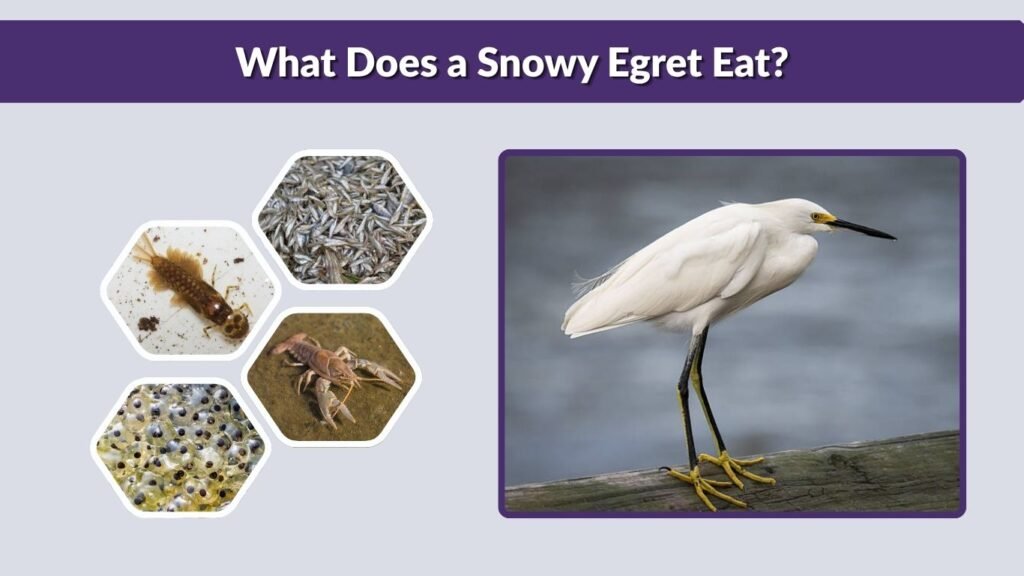
The Snowy Egret is a carnivore that captures a wide range of small aquatic animals. Its diet changes according to habitat, season, and local prey availability.
Fish usually make up a significant portion of its food, but the bird readily takes crustaceans, amphibians, and insects.
Common Foods
The Snowy Egret diet includes:
- Small fish
- Shrimp
- Crayfish
- Crabs
- Frogs and tadpoles
- Aquatic insects
- Dragonflies
- Grasshoppers
- Worms
- Snails
- Small lizards
- Occasionally small snakes
Most prey is swallowed whole. The egret may reposition a fish in its bill before swallowing it headfirst, preventing fins and scales from catching in its throat.
Feeding and Hunting Techniques
Snowy Egrets use more varied and energetic hunting methods than many other herons. One bird may walk slowly and patiently, while another runs through the water with its wings partially open.
A particularly recognizable technique involves shuffling or vibrating the yellow feet against the bottom. This movement disturbs small fish, shrimp, and insects hiding beneath mud or vegetation. When prey attempts to escape, the egret strikes quickly with its bill.
Snowy Egrets may also:
- Stand motionless and wait for prey
- Chase fish through shallow water
- Sweep their bills from side to side
- Hover briefly over the surface
- Spread their wings to create shade
- Follow other animals that disturb prey
They sometimes forage in groups, especially where fish become concentrated in shrinking pools or tidal channels.
Snowy Egret Breeding and Nesting
Snowy Egrets become especially decorative during the breeding season. Long, fine plumes develop on the head, neck, and back. The bare facial skin may change from yellow to reddish or pinkish, while the feet can become brighter orange.
These beautiful breeding feathers once made the birds targets of the plume trade. Snowy Egrets were killed in enormous numbers so their feathers could decorate fashionable hats.
Courtship Behavior
Males typically select territories within nesting colonies before females arrive. A male performs displays by raising his plumes, pointing his bill upward, moving his body, and calling. He also defends the immediate nesting area against rival males.
Once paired, both birds participate in nest construction. The male often gathers sticks while the female arranges them into a platform.
Nest and Eggs
Snowy Egrets commonly nest in mixed colonies with Great Egrets, herons, ibises, spoonbills, and cormorants. Nesting sites include trees, bushes, mangroves, reed beds, and low vegetation on protected islands.
A female usually lays two to six pale blue-green eggs. Both parents incubate them for approximately three to four weeks. They take turns guarding the nest and searching for food.
Chicks and Juvenile Snowy Egrets
Newly hatched chicks are covered with pale down and rely completely on their parents. Adults provide regurgitated fish and other prey. Young birds become increasingly active and may climb onto nearby branches before developing strong flight skills.
Juvenile Snowy Egrets resemble adults but may have greenish or yellowish coloring along the backs of their legs. Their feathers also lack the long ornamental plumes of breeding adults.
Young egrets generally leave the nest several weeks after hatching. Parents may continue feeding them for a short period as they develop independent hunting skills.
Snowy Egret in Flight
A Snowy Egret in flight displays broad, rounded white wings and relatively quick wingbeats. Its black legs extend behind the tail, often making the yellow feet visible from a distance.
Like other herons, the bird retracts its neck into a tight S shape while flying. This separates it from cranes, storks, and spoonbills, which generally fly with their necks extended forward.
Snowy Egrets often fly low between nearby feeding locations. During migration or when traveling to communal roosts, they may fly higher and cover much greater distances.
Snowy Egret Sound
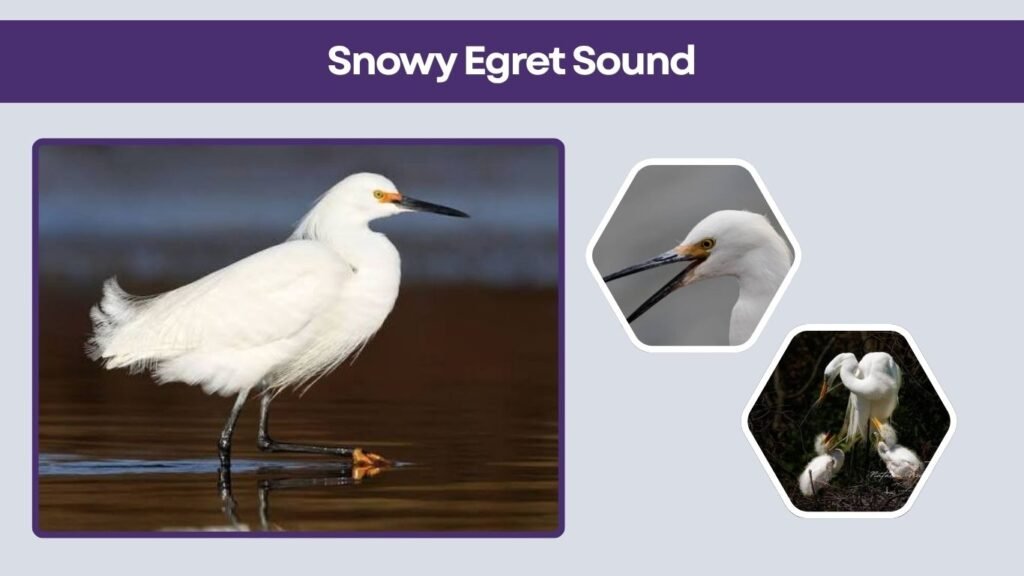
Snowy Egrets are relatively quiet when feeding alone. However, they produce harsh, raspy calls when alarmed, competing for food, or interacting at nesting colonies.
Their sounds include croaks, squawks, and nasal calls. Chicks make persistent begging noises when adults return with food. A large mixed-species colony can become extremely noisy due to the combined calls of adults and young birds.
Snowy Egret vs. Similar Birds
The Snowy Egret can be confused with several white herons. Bill color, leg color, foot color, size, and feeding behavior are the best features for separating them.
| Feature | Snowy Egret | Great Egret | Little Egret | Cattle Egret |
|---|---|---|---|---|
| Size | Small | Large | Small | Small and stocky |
| Bill | Black | Yellow | Black | Yellow-orange |
| Legs | Black | Black | Black | Dark or yellowish |
| Feet | Bright yellow | Black | Yellow | Usually match legs |
| Feeding style | Highly active | Slow and patient | Active | Follows grazing animals |
| Main habitat | Shallow wetlands | Wetlands and shores | Wetlands and coasts | Fields and pastures |
Snowy Egret vs. Great Egret
The Great Egret is much larger and has a long yellow bill with black feet. The Snowy Egret has a thin black bill and bright yellow feet.
A Great Egret generally hunts by standing still or walking slowly. A Snowy Egret is more likely to run, shuffle its feet, open its wings, and rapidly change direction while pursuing prey.
Snowy Egret vs. Little Egret
Snowy and Little Egrets look remarkably similar. Both have white bodies, black bills, black legs, and yellow feet. Geographic location is often an important clue because Snowy Egrets are native to the Americas, whereas Little Egrets primarily inhabit Europe, Africa, Asia, and Australia.
A breeding Little Egret typically develops two long head plumes. Facial skin color, leg proportions, vocalizations, and subtle structural differences can also help experienced observers separate them.
Snowy Egret vs. Cattle Egret
Cattle Egrets have stockier bodies, shorter necks, and thicker yellow or orange bills. During breeding, they develop buff-orange feathers on the head, chest, and back.
Snowy Egrets remain entirely white apart from their decorative plumes. They usually forage in shallow water, while Cattle Egrets commonly hunt insects in pastures near cows, horses, and farm machinery.
Snowy Egret Symbolism
The Snowy Egret is often associated with patience, grace, resourcefulness, purity, and adaptability. Its bright white plumage can represent peace, while its lively hunting behavior may symbolize determination and the willingness to try different approaches.
Spiritual meanings vary among cultures and individuals. They reflect human interpretations rather than scientifically established qualities of the bird.
FAQs
Why do Snowy Egrets have yellow feet?
Snowy Egrets may use their bright yellow feet as part of their hunting strategy. By shuffling or moving them through shallow water, they disturb concealed fish and invertebrates. The movement and color may attract attention, bringing curious prey close enough to capture.
Are Snowy Egrets rare?
Snowy Egrets are not considered globally rare, and they can be locally common in suitable American wetlands. However, their numbers and distribution vary by region. Habitat loss, water pollution, disturbance at nesting colonies, and changing wetland conditions can affect local populations.
Do Snowy Egrets migrate?
Many Snowy Egrets migrate, particularly those breeding in northern parts of the United States. They travel south toward the Gulf Coast, Caribbean, Mexico, Central America, or South America for winter. Populations in warm regions may remain near the same wetlands throughout the year.
Is a Snowy Egret a heron?
Yes. The Snowy Egret belongs to the heron family, Ardeidae. “Egret” is an informal name generally applied to certain herons with white plumage and ornamental breeding feathers. Therefore, every Snowy Egret is a heron, although not every heron is an egret.
Can Snowy Egrets swim?
Snowy Egrets normally wade rather than swim. Their long legs allow them to walk through shallow water while keeping their feathers relatively dry. They can land briefly in deeper water or float when necessary, but swimming is not their usual method of movement or feeding.