
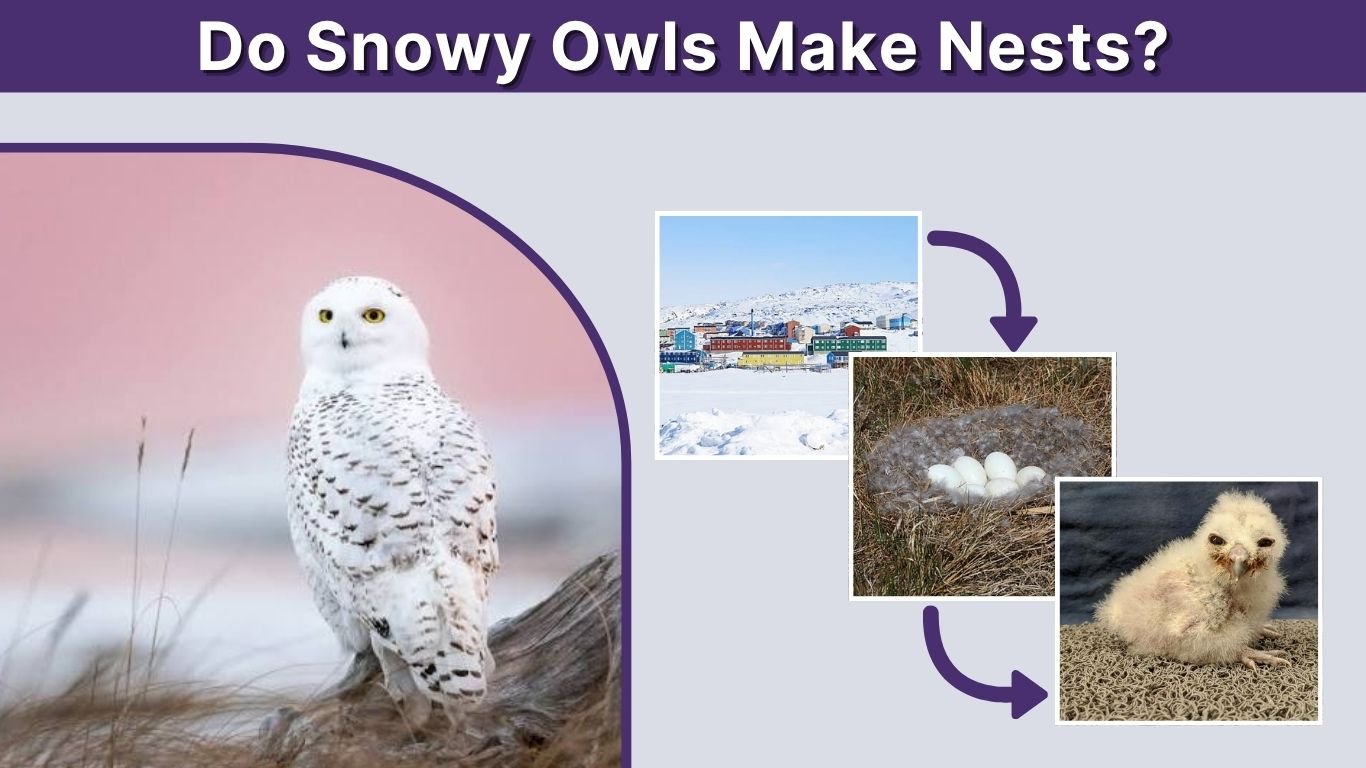
Yes, Snowy Owls make nests, but their nests are very different from the stick nests built by many large birds. A female Snowy Owl creates a simple, shallow depression directly on the Arctic tundra. She usually chooses a raised, windswept location that remains dry, loses its snow early and provides a clear view of approaching predators. Snowy Owls do not normally nest in trees, cavities or artificial nest boxes.
What Does a Snowy Owl Nest Look Like?
A Snowy Owl nest looks like a shallow bowl or scrape in the ground. It is usually difficult to recognize from a distance because it blends naturally with the surrounding tundra.
The female forms the nest by scratching at the soil or turf with her feet. She then presses and turns her body inside the depression until it becomes a suitable shape for holding eggs.
The nest may contain:
- Bare soil or turf
- Small pieces of tundra vegetation
- Loose feathers shed by the female
- Eggshell fragments after hatching
- Prey remains or owl pellets nearby
However, these materials are not carefully woven together. Snowy Owl nests generally have no substantial lining or insulating layer.
Where Do Snowy Owls Build Their Nests?
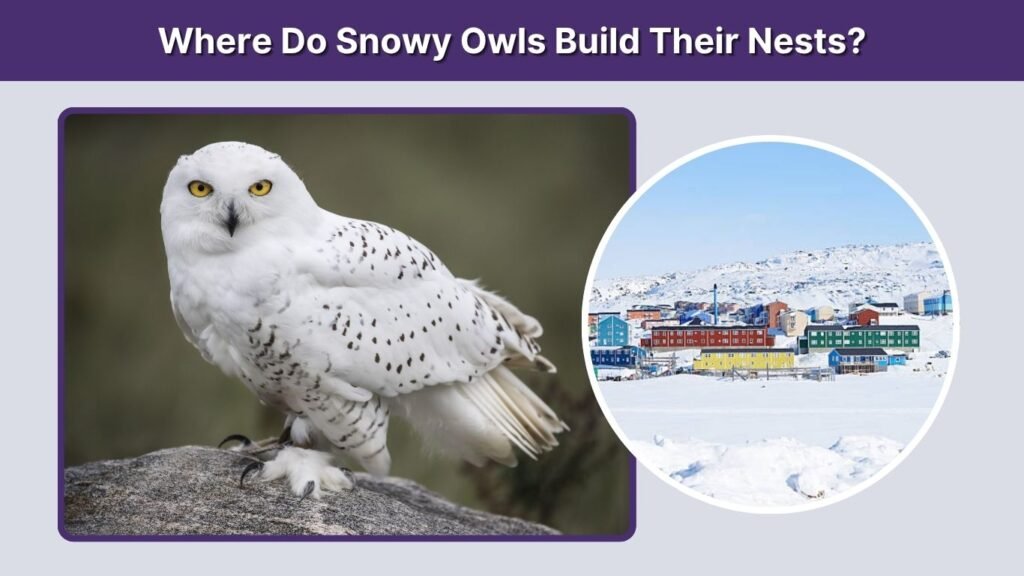
Snowy Owls nest on open Arctic tundra across northern North America, Greenland, Scandinavia and Russia. Their nesting grounds are broad, nearly treeless landscapes covered with grasses, mosses, lichens and low-growing plants.
Raised Tundra Mounds
Females usually select a slight rise, hummock, ridge, hillock or low boulder. A raised site offers several advantages:
- It provides a wide view of the surrounding territory.
- Wind may clear snow from the ground earlier.
- The nest is less likely to flood during spring thaw.
- Adults can detect foxes, jaegers and other threats.
- Nearby open land offers suitable hunting space.
Snowy Owl nests studied near Utqiaġvik, Alaska, have been found on low tundra mounds. However, the height and shape of the selected rise vary between locations.
Areas With Abundant Food
Snowy Owls are nomadic breeders and do not necessarily return to the same region every year. They search for areas where lemmings and other small mammals are plentiful.
When prey is scarce, pairs may produce fewer eggs or skip breeding entirely. When lemming populations are exceptionally high, many Snowy Owls may nest within the same wider region and raise unusually large families.
Do Snowy Owls Nest in Trees?
Snowy Owls do not normally nest in trees. Their natural breeding habitat is largely treeless, so they have evolved to lay their eggs directly on the ground.
A Snowy Owl may occasionally perch in a tree during migration or winter, but seeing one in a tree does not mean it has a nest there. Unlike Great Horned Owls and some other owl species, Snowy Owls do not usually take over old hawk or crow nests.
They also do not depend on tree cavities. Open ground gives them the visibility they need to guard their eggs and locate prey across the tundra.
How Do Snowy Owls Make Their Nests?
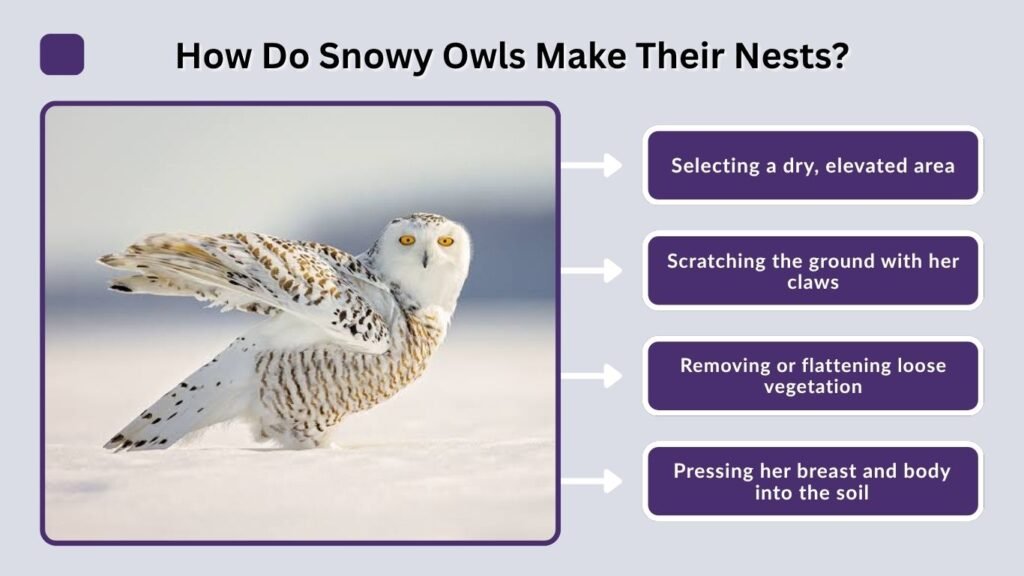
The female performs nearly all the physical nest construction. The male usually establishes and defends the breeding territory, while the female chooses the exact nesting location.
She creates the nest by:
- Selecting a dry, elevated area
- Scratching the ground with her claws
- Removing or flattening loose vegetation
- Pressing her breast and body into the soil
- Turning inside the scrape to form a shallow bowl
The process may take several days. Some suitable nest scrapes may be reused during later breeding seasons, although the same pair may not necessarily return together.
What Are Snowy Owl Nests Made Of?
A Snowy Owl nest is primarily made from the existing ground. The female does not collect large numbers of sticks, grasses or soft materials from other locations.
| Nest feature | Description |
| Main structure | Shallow depression in soil or turf |
| Nest builder | Female Snowy Owl |
| Typical lining | Little or no deliberate lining |
| Normal location | Elevated Arctic tundra |
| Trees used | No |
| Nest boxes used | No |
| Reuse | A suitable scrape may be used again |
Some dried grasses or tundra plants may be present because they were already growing at the chosen site. Feathers, pellets and prey remains may also accumulate as nesting continues, but they are not the nest’s main construction materials.
When Is Snowy Owl Nesting Season?
Snowy Owls generally breed during the brief Arctic spring and summer. Adults may begin reaching breeding areas in late April, with courtship, territory selection and nest preparation following soon afterward.
Egg laying commonly begins in May or June, although timing varies according to latitude, snowmelt, weather and food availability. The complete breeding period can extend from approximately May through September as chicks hatch, grow, begin flying and become independent.
The long Arctic daylight allows adults to hunt at almost any hour. Snowy Owls can hunt during both daylight and darkness, which is useful in a region where the summer sun may remain above the horizon throughout the day.
Snowy Owl Eggs and Incubation
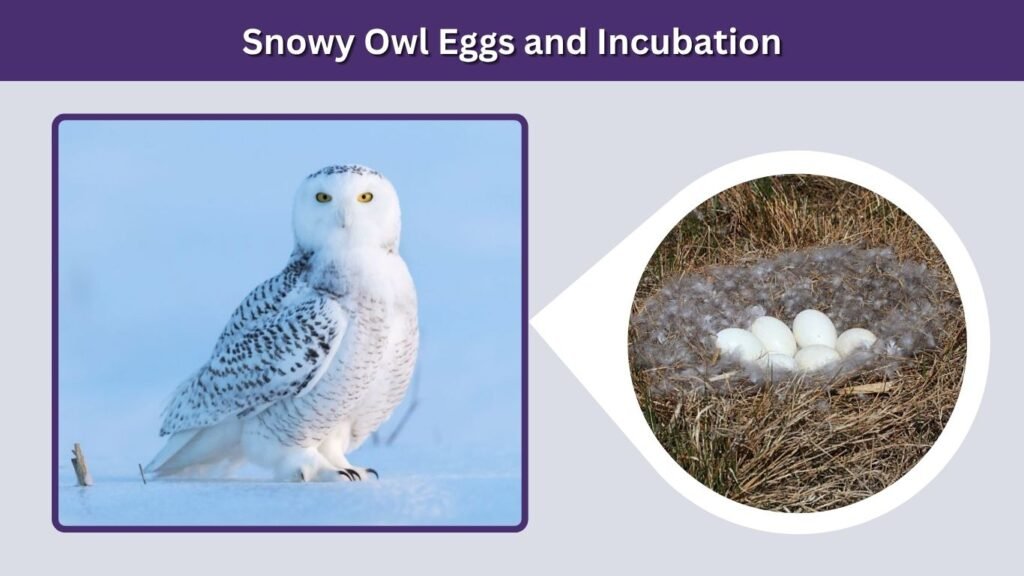
Snowy Owl eggs are plain white and relatively large. A normal clutch contains about three to eleven eggs, although the number is strongly influenced by prey availability.
| Nesting fact | Typical information |
| Clutch size | 3–11 eggs |
| Egg color | White |
| Egg laying interval | Approximately every two days |
| Incubation | About 32 days |
| Parent incubating | Female |
| Broods per year | Usually one |
The female begins incubating as soon as the first egg is laid rather than waiting for the clutch to be complete. As a result, the eggs hatch on different days, creating noticeable differences in the ages and sizes of the chicks.
How Do Snowy Owl Parents Care for the Nest?
The female performs most incubation and early brooding. Her body warmth protects the eggs and young chicks from cold Arctic conditions.
Role of the Male
The male provides food for the female while she remains at the nest. He also patrols the territory and helps defend the family from potential threats.
Role of the Female
After the eggs hatch, the female tears prey into manageable pieces and feeds the chicks. She stays close to brood and protect them during their most vulnerable early stage.
Both parents may become highly defensive if a fox, bird or person approaches. They may call loudly, perform distraction displays or swoop toward an intruder.
Why Are Lemmings Seen Around Snowy Owl Nests?
Lemmings do not help build Snowy Owl nests. They are the owls’ primary Arctic prey.
The male frequently brings freshly killed lemmings to the female and chicks. During times of abundance, prey may temporarily accumulate around a nesting area or at nearby perches.
These stored animals provide a ready supply of food when:
- The female cannot leave the eggs
- Young chicks require frequent meals
- Bad weather makes hunting difficult
- Several chicks need to be fed
- Lemmings are temporarily plentiful
Snowy Owls have also been observed caching surplus lemmings away from the nest. Therefore, photographs showing a nest surrounded by lemmings document food storage and feeding behavior, not nesting material.
When Do Snowy Owl Chicks Leave the Nest?
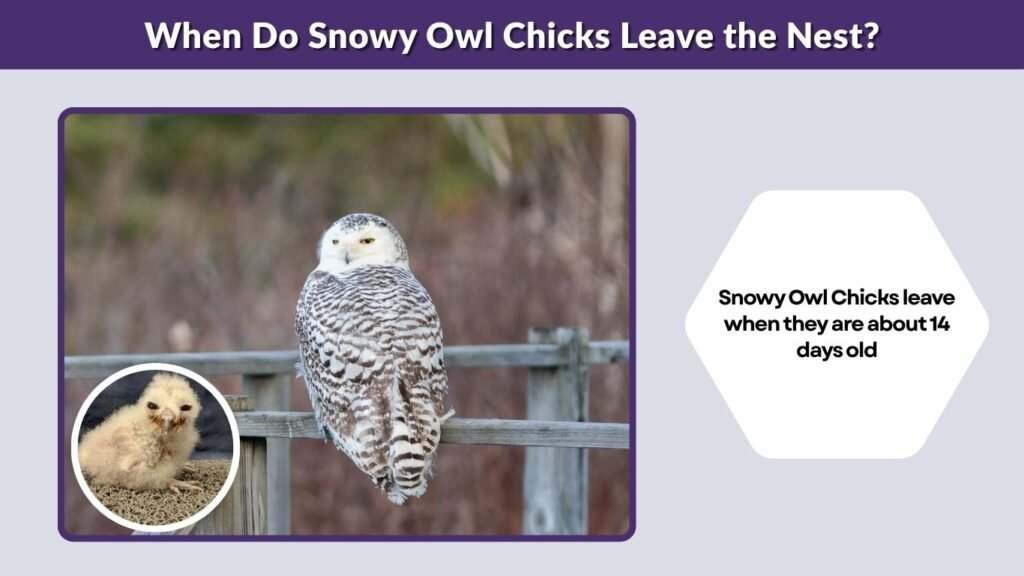
Young Snowy Owls remain in the nest for only a few weeks. Some begin wandering away when they are about 14 days old, while others remain until roughly 25 or 26 days after hatching.
They are still covered with gray down and cannot fly when they first leave. The chicks spread out across the tundra, where their coloration helps hide them among plants, rocks and shadows. Dispersing may also prevent a predator from finding the entire brood in one place.
The parents continue locating, protecting and feeding the scattered chicks. Most young Snowy Owls make their first proper flights at approximately six to seven weeks old and continue receiving food while learning to hunt.
Can You Build a Nest Box for a Snowy Owl?
Snowy Owls do not need conventional owl boxes because they are not cavity nesters. A wooden box placed in a garden or tree is unlikely to attract them.
Their breeding requirements include enormous open territories, Arctic tundra, abundant prey and safe raised ground. These conditions cannot be recreated through a standard backyard nesting project.
People should also avoid approaching or searching closely for wild nests. Nesting adults are defensive, and unnecessary disturbance may expose eggs or chicks to cold, predators and stress.
FAQs
Do Snowy Owls make their own nests?
Yes. The female creates a shallow scrape in the tundra by scratching and pressing her body into the ground. It is a simple nest rather than a large structure made from sticks, grass or branches.
Do Snowy Owls nest on the ground?
Yes. Snowy Owls are ground-nesting birds. They usually choose a raised, windswept tundra mound that provides dry soil, early snowmelt and a clear view of the surrounding landscape.
Do Snowy Owls live in their nests all year?
No. A nest is used only for laying eggs and raising chicks during the Arctic breeding season. Outside this period, Snowy Owls rest and hunt in open habitats without maintaining a permanent nest.
How big is a Snowy Owl nest?
There is no fixed nest size because the female shapes a natural depression in the ground. It is generally a shallow bowl large enough to hold her body, eggs and newly hatched chicks.
Why do Snowy Owl chicks leave before they can fly?
Leaving early spreads the chicks across the tundra and makes it more difficult for a predator to find the entire brood. Their parents continue feeding and defending them until they can fly and hunt independently.
