
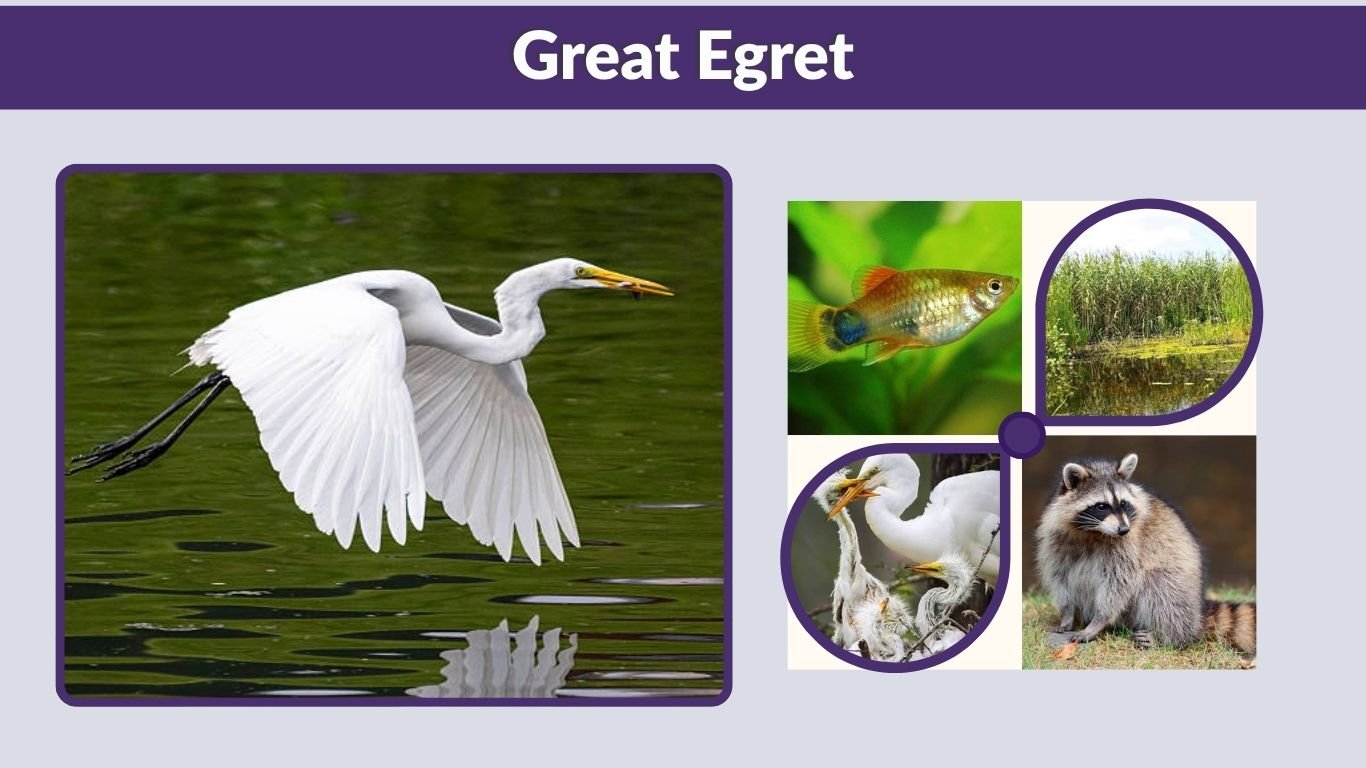
The Great Egret is a striking white wading bird found around wetlands across much of the world. Recognized by its long neck, yellow bill, black legs, and graceful movements, it is one of the largest members of the heron family. The bird patiently stalks fish and other small animals in shallow water before striking with remarkable speed. This guide covers the Great Egret’s identification, size, habitat, diet, breeding behavior, flight, sounds, and comparisons with similar white birds.
What Is a Great Egret?
The Great Egret is a large member of the heron family, Ardeidae. Its scientific name is Ardea alba. Other common names include the common egret, large egret, and great white egret. Although “heron” and “egret” appear to describe different birds, egrets are actually types of herons.
Great Egrets have an extensive global distribution. Different populations live in North America, South America, Europe, Africa, Asia, and Australia.
Great Egret Identification
Look for the following characteristics when identifying a Great Egret:
- Completely white plumage
- Long, slender, S-shaped neck
- Long yellow or yellow-orange bill
- Black legs and feet
- Yellow eyes surrounded by bare facial skin
- Tall body with a smooth, upright posture
- Long ornamental plumes during the breeding season
A Great Egret often stands motionless in shallow water with its neck partially folded. When it detects prey, it rapidly extends its neck and uses its sharp bill to seize or spear the animal.
Great Egret Size and Wingspan
Great Egrets typically stand between 31 and 41 inches tall. Their wingspan commonly measures approximately 51 to 57 inches, although dimensions vary slightly among geographic populations and individuals.
| Measurement | Approximate size |
|---|---|
| Height | 31–41 inches |
| Body length | 31–41 inches |
| Wingspan | 51–57 inches |
| Weight | 1.5–3.3 pounds |
| Bill length | Around 4–5 inches |
Despite its impressive height and wingspan, the Great Egret has a relatively lightweight body. Its long legs, neck, and bill account for much of its apparent size.
Male vs. Female Great Egret
Male and female Great Egrets look extremely similar. Both have white feathers, long dark legs, and yellow bills outside the breeding season. Males are generally a little larger than females, but size alone is not a dependable way to determine sex in the field.
Behavior can provide clues during breeding. Males usually select nesting territories and perform courtship displays. However, reliable sex identification often requires close examination, measurements, or behavioral observation at an active colony.
Great Egret Habitat and Range
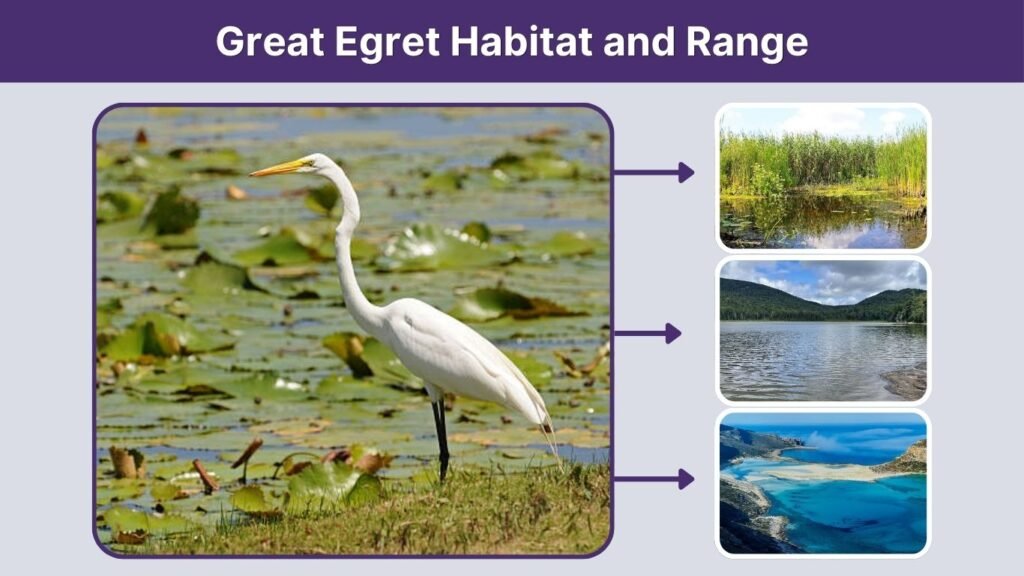
Great Egrets depend on wetlands that provide shallow feeding areas and plentiful prey. They can use freshwater, brackish, and saltwater environments, allowing them to survive in numerous regions.
Although associated mainly with water, these birds may travel across fields, grasslands, or agricultural areas while searching for food.
Where Do Great Egrets Live?
Typical Great Egret habitats include:
- Freshwater marshes
- Lakes and ponds
- Rivers and streams
- Coastal lagoons
- Mangrove swamps
- Estuaries and tidal flats
- Flooded agricultural fields
- Wet meadows
- Wooded swamps
Great Egrets usually forage where the water is shallow enough for them to stand and walk. They rest and nest in trees, shrubs, mangroves, or reed beds near productive wetlands.
Great Egrets in North America
Great Egrets occur across much of the United States during at least part of the year. They are particularly familiar in Florida, Texas, Louisiana, and California, where suitable wetlands remain available throughout the year.
During spring and summer, breeding birds may travel north into the Great Lakes region, southern Canada, and other inland areas. Great Egrets seen in places such as Michigan, Ohio, and Ontario commonly migrate south as temperatures fall and shallow water freezes.
What Does a Great Egret Eat?
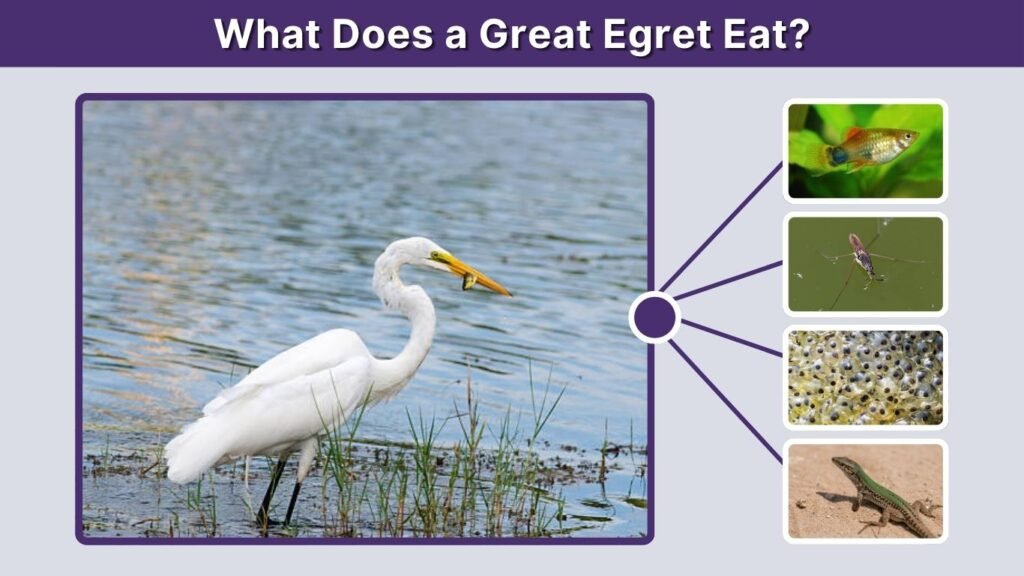
The Great Egret is a carnivorous bird with a varied diet. Fish are its principal food in many wetlands, but it readily captures any appropriately sized animal that comes within reach.
Its flexible feeding habits allow it to use coastal waters, freshwater marshes, flooded fields, and even relatively dry grasslands.
Common Foods
A Great Egret may eat:
- Small and medium-sized fish
- Frogs and tadpoles
- Crayfish and shrimp
- Aquatic insects
- Dragonflies and dragonfly larvae
- Snakes
- Lizards
- Small turtles
- Mice and other small mammals
- Occasionally small birds or chicks
Yes, Great Egrets eat dragonflies when they can catch them. They consume both flying adults and aquatic nymphs living in wetland vegetation or shallow water.
Hunting Behavior
A Great Egret commonly hunts by standing almost perfectly still and watching for movement. It may also walk slowly, lifting each foot carefully to avoid alarming nearby prey. Once an animal moves into range, the egret unfolds its neck in a quick forward strike.
The bird usually grips smaller prey between the tips of its bill and swallows it whole. Larger fish may be repositioned so they enter the throat headfirst. This reduces resistance from fins, scales, and limbs.
Great Egrets sometimes defend especially productive feeding spots from other wading birds. However, they may also forage near herons, ibises, spoonbills, and cormorants when food is plentiful.
Great Egret Breeding and Nesting
The Great Egret’s appearance changes noticeably during the breeding season. Both sexes grow long, delicate ornamental feathers called aigrettes on their backs. The facial skin may become green, while the bill can darken and the upper legs may develop a reddish tone.
These elegant feathers nearly caused the species’ destruction when birds were once killed in large numbers for the fashion trade.
Courtship and Pair Formation
A male normally arrives at a nesting colony and chooses a territory before attracting a mate. He raises his long breeding plumes, stretches his neck, and performs ritualized movements. He may also offer sticks to a visiting female.
Once a pair forms, the male frequently gathers nesting material while the female arranges it. Both birds defend the immediate nest area, although numerous Great Egrets may nest close together in the same colony.
Nest and Eggs
Great Egrets build broad but relatively loose platforms from sticks. Nests are usually placed in trees, shrubs, mangroves, or dense wetland vegetation. They may nest with other egrets, herons, ibises, and cormorants.
A female commonly lays one to six pale blue-green eggs, with two to four being typical in many populations. Both parents incubate the eggs for approximately three to four weeks.
Great Egret Chicks and Juveniles
Newly hatched chicks are helpless and depend entirely on their parents for warmth, protection, and food. Adults feed them by regurgitating partially digested prey. Competition among nestlings can be intense, particularly when food is limited.
Young Great Egrets begin climbing around nearby branches before they can fly well. They generally leave the nest after about six or seven weeks but may continue receiving food from their parents temporarily.
A juvenile Great Egret resembles an adult, with white plumage, a yellow bill, and black legs. Immature birds lack the long breeding plumes displayed by mature adults.
Great Egret in Flight
A flying Great Egret can appear surprisingly powerful and graceful. Its broad white wings move with slow, deep beats. The bird may glide briefly, especially when traveling between feeding and resting areas.
Like other herons, it pulls its long neck backward into a tight S shape while flying. Its black legs extend well beyond the tail.
This neck position distinguishes a Great Egret in flight from cranes, storks, and spoonbills, which generally fly with their necks extended forward. Great Egrets may travel alone, in loose lines, or in small groups.
Great Egret Sound and Communication
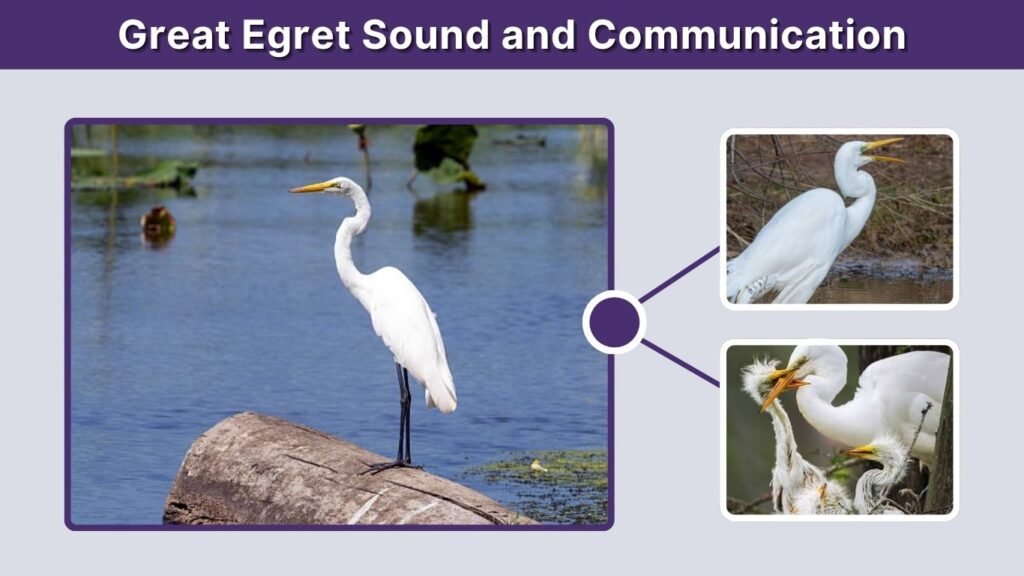
Great Egrets are often quiet while feeding, but they are not silent. Their most recognizable call is a deep, harsh croak. They may also produce squawks, clicks, and guttural sounds around nesting colonies.
Chicks are especially noisy when begging for food. Adults use calls and visual displays to communicate with mates, defend nest sites, and warn intruding birds. A breeding colony can consequently become loud despite the species’ usually calm appearance.
Great Egret vs. Similar White Birds
Several herons have predominantly white plumage, making identification challenging from a distance. Body size, bill color, leg color, foot color, and habitat provide the most useful clues.
| Feature | Great Egret | Snowy Egret | Cattle Egret | Great White Heron |
|---|---|---|---|---|
| Body size | Large and slender | Small and delicate | Small and stocky | Very large and heavy |
| Bill | Long and yellow | Thin and black | Short and yellow-orange | Thick and yellow |
| Legs | Black | Black | Usually dark or yellowish | Yellowish |
| Feet | Black | Bright yellow | Usually match legs | Yellowish |
| Typical habitat | Wetlands and shorelines | Shallow wetlands | Fields and pastures | Mainly coastal South Florida |
| Neck | Very long | Long but delicate | Relatively short | Long and thick |
Great Egret vs. Snowy Egret
The Great Egret is considerably larger than the Snowy Egret. It normally has a yellow bill and entirely black feet, whereas the Snowy Egret has a black bill and bright yellow feet.
Both species have white plumage and black legs, but the Snowy Egret appears more delicate and frequently uses active hunting techniques. It may run through water, shuffle its feet, or spread its wings while pursuing prey.
Great Egret vs. Cattle Egret
A Cattle Egret is shorter, stockier, and has a much shorter neck. It frequently searches for insects in fields near cattle, horses, or farm machinery. During breeding, it develops orange-buff feathers on its head, chest, and back.
The Great Egret remains more closely associated with wetlands. It has a longer neck, longer legs, and a more slender, dagger-like bill.
Great Egret vs. Great White Heron
The Great White Heron is generally considered a white form of the Great Blue Heron rather than another name for the Great Egret. It is larger and more robust, with a heavier bill and pale yellowish legs.
Great White Herons are strongly associated with coastal southern Florida, especially the Florida Keys. In contrast, Great Egrets have black legs and an extremely broad worldwide range.
Predators and Threats
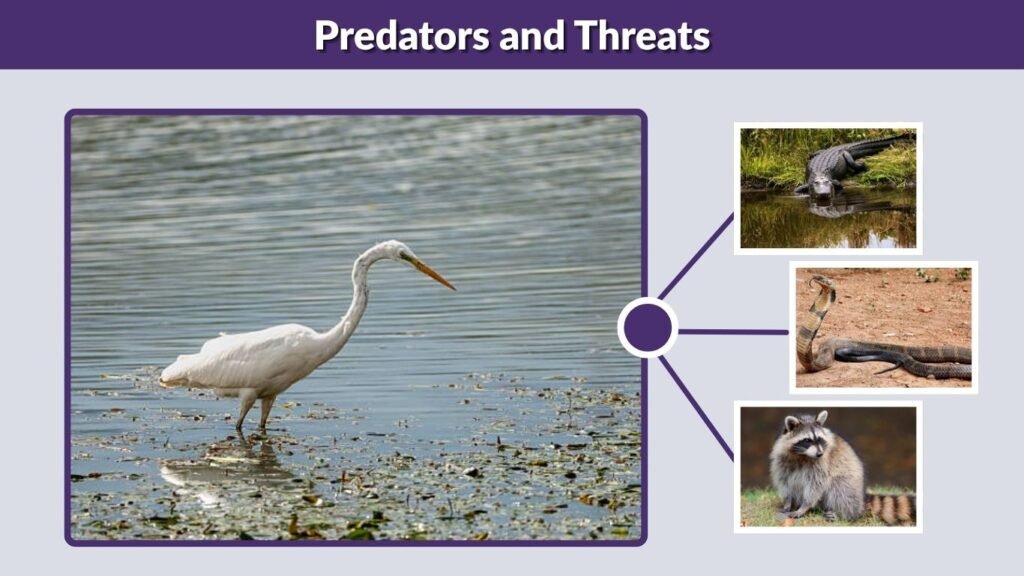
Adult Great Egrets have relatively few natural predators because of their size and ability to fly. However, alligators, large snakes, raccoons, and birds of prey may occasionally kill adults or young birds. Eggs and nestlings are more vulnerable to crows, ravens, raccoons, and other nest predators.
Wetland drainage, water pollution, shoreline development, disturbance at nesting colonies, and changes in prey availability remain significant concerns. Climate-related changes to water levels may also affect breeding and feeding habitats.
Great Egrets were once hunted extensively for their ornamental breeding feathers. Legal protection and conservation campaigns helped populations recover, and the bird became an important symbol of the movement to protect wild birds.
Great Egret Symbolism and Spiritual Meaning
The Great Egret’s white plumage and patient hunting behavior have inspired symbolic interpretations in different cultures. It is commonly associated with purity, peace, patience, independence, grace, and careful decision-making.
Seeing a Great Egret is sometimes interpreted spiritually as a reminder to remain calm and wait for the right opportunity. These meanings come from human traditions and personal beliefs rather than the bird’s biological behavior.
FAQs
Is a Great Egret the same as a white heron?
A Great Egret is a type of white heron, but not every white heron is a Great Egret. Several species have white plumage, including Snowy Egrets and Cattle Egrets. The Great White Heron is a white form of the Great Blue Heron.
How can you identify a Great Egret?
A Great Egret is a large white bird with a very long S-shaped neck, a yellow bill, and black legs and feet. During breeding, it develops long ornamental back plumes and green facial skin. Its size separates it from most other white egrets.
Do Great Egrets migrate?
Some Great Egrets migrate while others remain in the same region throughout the year. Northern populations generally move south before winter freezes their feeding areas. Birds in Florida and other warm locations may stay year-round when wetlands continue providing sufficient open water and food.
Where do Great Egrets sleep?
Great Egrets usually sleep or roost in trees, shrubs, mangroves, or other elevated locations near water. Roosting above the ground provides protection from many predators. Multiple egrets and other wading birds may gather at a shared nighttime roost.
Are Great Egrets aggressive?
Great Egrets are not normally aggressive toward humans, but they can be territorial around productive feeding places and active nests. They may chase other birds, perform threatening postures, or use their pointed bills defensively. People should observe nesting colonies from a respectful distance.
