
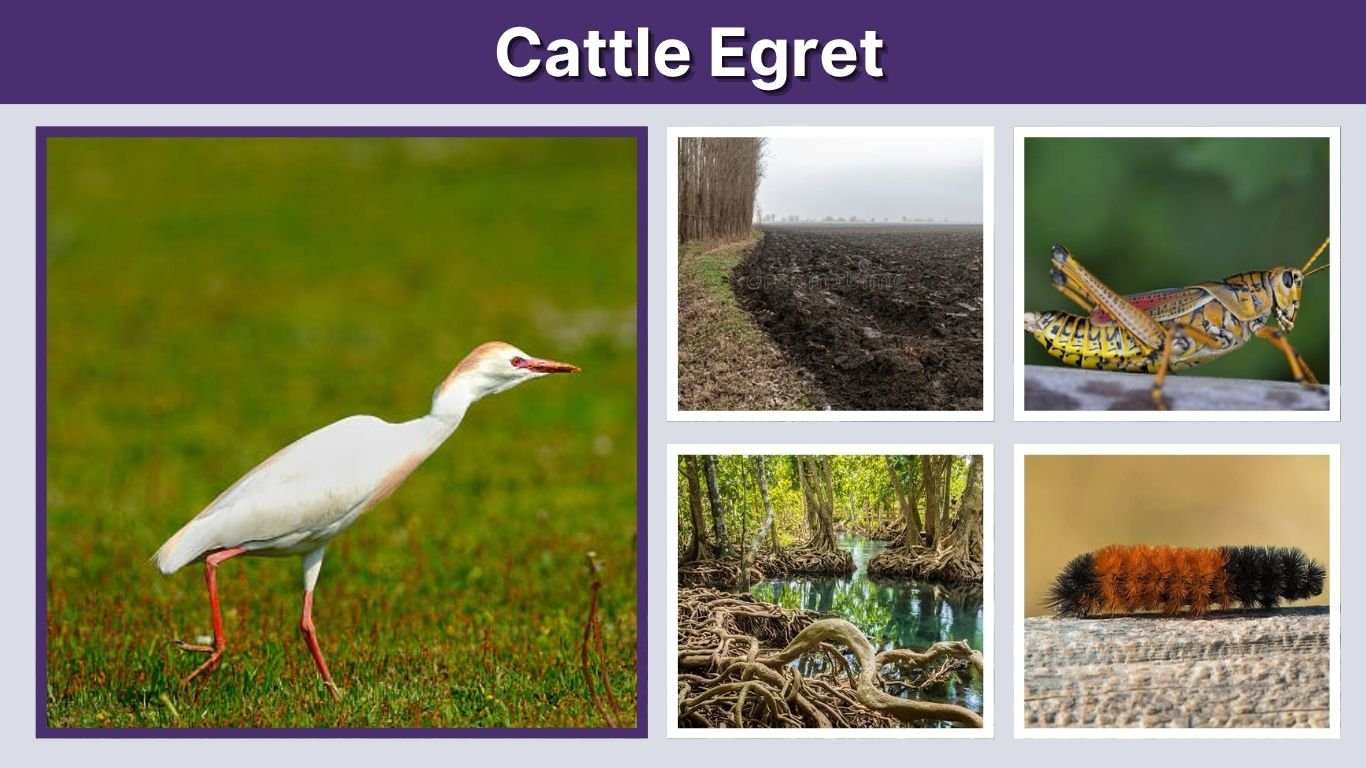
The cattle egret is a small, stocky white heron commonly seen walking through pastures beside cows, buffalo, horses, and other large animals. Instead of relying mainly on ponds and streams, it often hunts in dry grasslands and agricultural fields. Its compact body, short yellow bill, and seasonal orange-buff feathers make it relatively easy to recognize. This adaptable bird has spread across much of the world and now thrives in natural grasslands, farms, wetlands, and even urban areas.
Cattle Egret Overview
Cattle egrets belong to the heron family, Ardeidae. Two closely related forms are commonly recognized: the Western Cattle Egret (Bubulcus ibis) and the Eastern Cattle Egret (Bubulcus coromandus). The Eastern species occurs across South and Southeast Asia, including Bangladesh, while the Western species is widespread in Africa, Europe, and the Americas.
| Feature | Description |
|---|---|
| Common name | Cattle egret |
| Family | Ardeidae |
| Length | Approximately 46–56 cm (18–22 inches) |
| Wingspan | Approximately 88–96 cm (35–38 inches) |
| Weight | Approximately 270–512 g (9.5–18 ounces) |
| Main color | White with seasonal orange or buff patches |
| Diet | Insects, spiders, frogs, lizards, and small animals |
| Habitat | Pastures, farms, grasslands, wetlands, and roadsides |
| Nest type | Platform of sticks in a tree, shrub, or reed bed |
| Social behavior | Highly social and usually seen in flocks |
Cattle Egret Identification
The cattle egret looks different from the tall, elegant egrets normally seen wading through water. It has a shorter neck, more compact body, thicker head, and relatively short legs. Its movements on land are quick and purposeful as it follows animals or machinery that disturb potential prey.
Key Identification Features
- A compact, stocky body rather than a long and slender shape
- Predominantly white plumage
- A short, thick, pointed bill
- A relatively short neck that often appears tucked into the body
- Shorter legs than those of many other white herons
- Yellow or orange bill in adults
- Yellowish, gray, brown, or dark legs, depending on age and season
- Buff, golden, or orange plumage during the breeding season
- A habit of feeding in fields near livestock
- Direct flight with steady wingbeats and the neck folded back
When standing in a pasture, the bird may appear almost hunched because of its thick neck and upright posture. In flight, it holds its neck folded into an S-shaped curve, as other herons and egrets do.
Cattle Egret Size
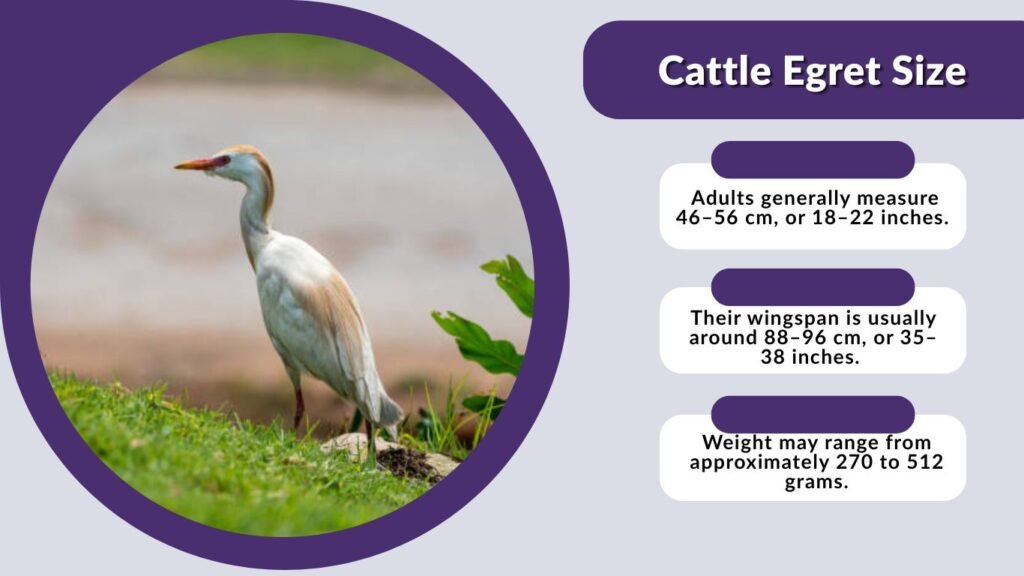
A cattle egret is a small to medium-sized member of the heron family. Adults generally measure 46–56 cm, or 18–22 inches, from the tip of the bill to the end of the tail. Their wingspan is usually around 88–96 cm, or 35–38 inches. Weight may range from approximately 270 to 512 grams.
Males and females are very similar in appearance and size, although males can be slightly larger and may develop somewhat longer breeding plumes. Size alone is usually not enough to distinguish the sexes in the field.
Compared with a Great Egret, a cattle egret is considerably shorter, heavier-looking, and more compact. It is roughly comparable to an American Crow in length, although its long wings and legs give it a different overall shape.
What Color Is a Cattle Egret?
The bird’s appearance changes with its age and breeding condition. These seasonal differences occasionally cause people to mistake one cattle egret for several different species.
Nonbreeding Adults
Outside the breeding season, an adult is almost entirely white. It normally has a yellow bill, pale yellow eyes, and yellowish to dark legs. Depending on the individual and lighting, its legs may appear greenish, gray, brown, or nearly black.
Breeding Adults
During courtship and nesting, adults develop golden-buff, peach, or orange patches on the head, neck, breast, and back. The bill may turn orange-red, while the legs can become pinkish, reddish, or brighter orange for a short period.
The Eastern Cattle Egret generally develops more extensive and intense orange breeding plumage than the Western species. Its orange color may spread across much of the head and neck rather than appearing only as limited buff patches.
Juvenile Cattle Egrets
Young birds are primarily white but usually have a dark or blackish bill shortly after leaving the nest. Their legs are also dark. As they mature, the bill gradually becomes yellow and the bird takes on the appearance of a nonbreeding adult.
Cattle Egret Habitat
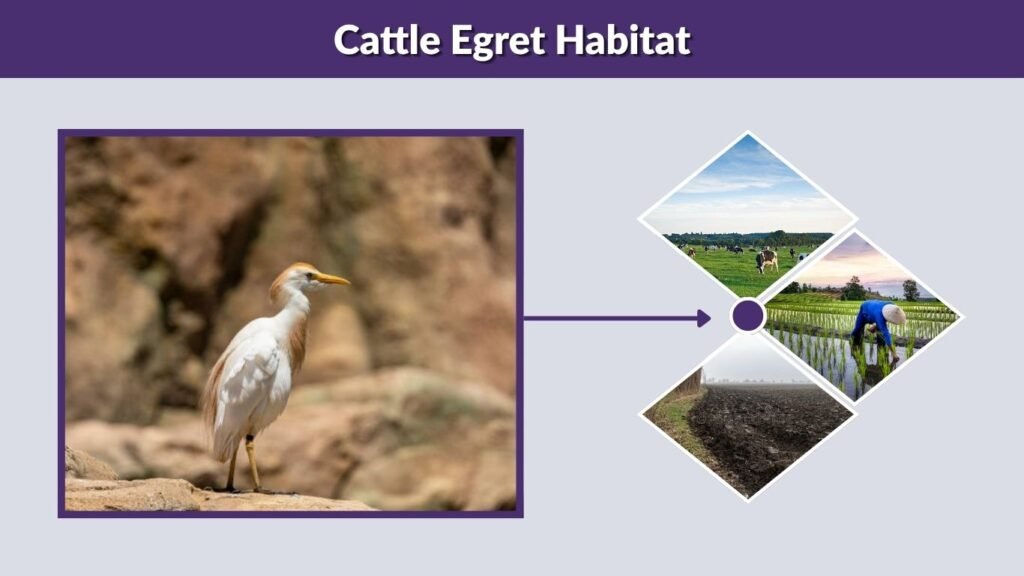
Unlike many herons, cattle egrets spend much of their feeding time away from open water. They favor places where short vegetation allows them to walk easily and see insects moving across the ground.
Common habitats include:
- Cattle pastures and grazing land
- Rice fields and other agricultural areas
- Recently plowed or harvested fields
- Open grasslands and savannas
- Roadside verges and highway edges
- Parks, airports, and large lawns
- Floodplains and wet meadows
- Freshwater marshes and swamps
- Mangrove areas and wooded islands
Although they frequently feed in dry places, cattle egrets usually select nesting and nighttime roosting sites near water. Trees growing in swamps or on islands can provide protection from ground-dwelling predators.
Where Do Cattle Egrets Live?
Cattle egrets have one of the widest distributions of any heron. Their range includes Africa, Europe, Asia, Australia, and North and South America. Some populations remain in the same region throughout the year, while others migrate or move according to rainfall, temperature, food availability, and agricultural activity.
The birds originated in parts of Africa and Asia but expanded naturally into many new regions. They reached South America in the late nineteenth century and later spread through the Caribbean and North America. Their ability to use farms, pastures, and other human-modified environments helped this rapid expansion.
What Do Cattle Egrets Eat?
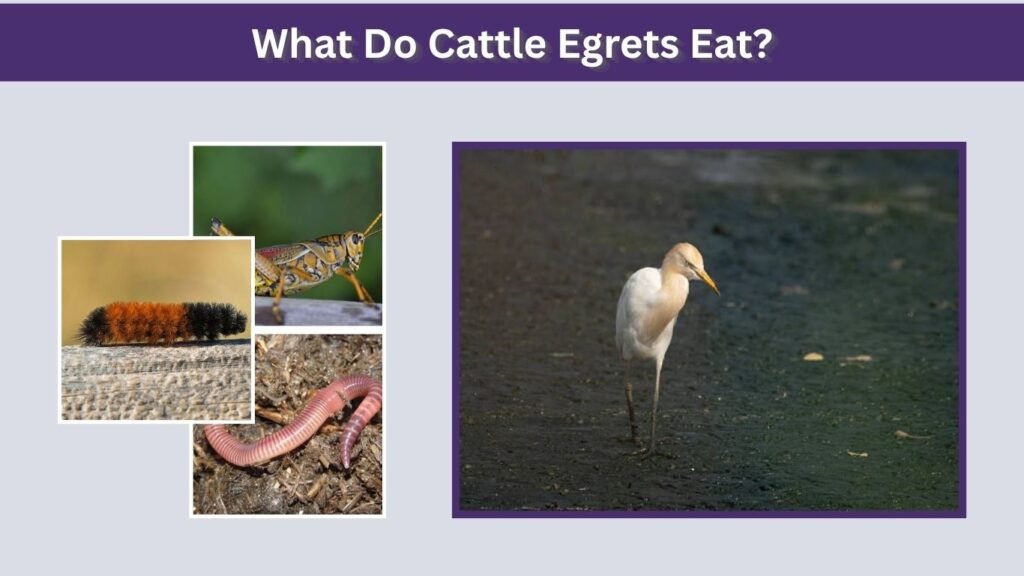
Cattle egrets are opportunistic carnivores whose diet is dominated by insects and other small animals. Grasshoppers and crickets are particularly important, but the exact diet changes according to location and season.
Common Foods
- Grasshoppers
- Crickets
- Beetles
- Flies and their larvae
- Moths and caterpillars
- Dragonflies
- Spiders
- Earthworms
- Frogs and tadpoles
- Small fish
- Lizards
- Small snakes
- Crayfish and other crustaceans
- Occasionally small rodents, birds, or eggs
Cattle egrets usually swallow small prey whole. Their sharp, pointed bills allow them to seize fast-moving insects with a rapid forward strike.
Why Do Cattle Egrets Follow Cows?
Grazing cattle disturb grasshoppers, flies, beetles, and other creatures hidden in the vegetation. The egrets walk near the animals’ feet and catch the prey as it attempts to escape. They may also follow buffalo, horses, sheep, goats, elephants, rhinoceroses, and other large mammals.
The birds sometimes perch on an animal’s back, where they may catch flies or other invertebrates. However, most of their food is taken from the ground. They also follow tractors, harvesters, and lawnmowers because these machines expose insects in much the same way as grazing livestock.
Feeding and Daily Behavior
Cattle egrets normally feed during daylight, either individually or in loose flocks. A feeding bird walks rapidly, pauses when it notices movement, and then strikes with its bill. It may run after an insect or make a short flight to capture airborne prey.
These birds are highly social. Large numbers may gather wherever food suddenly becomes available, including recently cut fields or areas affected by fire. At sunset, groups fly to communal roosts in trees, reed beds, or wetlands. Their daytime feeding areas may be several kilometers from these roosts.
Their calls are generally harsh and low, including croaks and grating “rick-rack” sounds. They are often quiet while feeding but become noisy around crowded breeding colonies.
Cattle Egret Nesting Habits
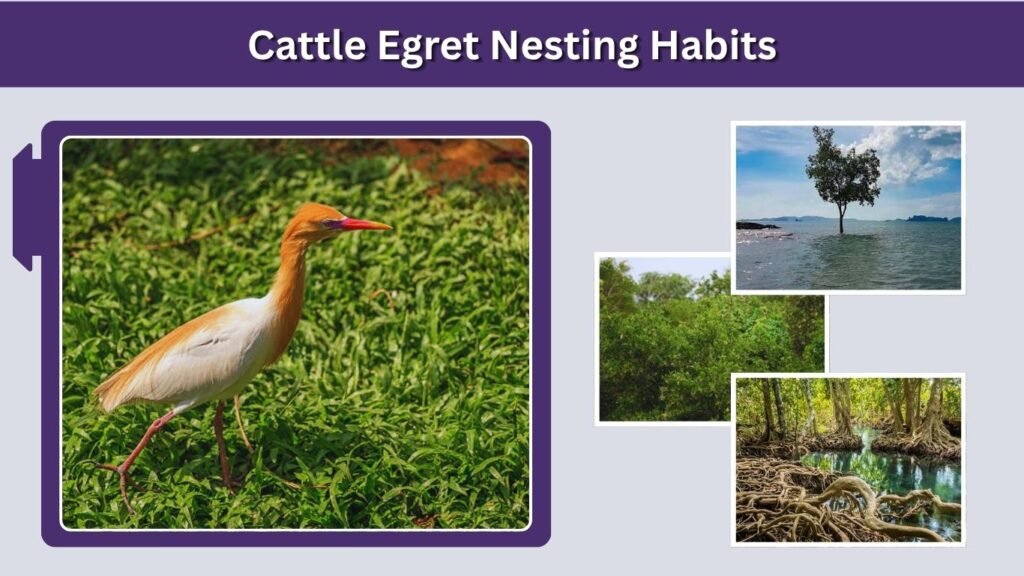
Cattle egrets are colonial nesters. Rather than building an isolated nest, hundreds or even thousands of pairs may breed close together. They frequently share a nesting colony, known as a heronry or rookery, with ibises and other herons and egrets.
Courtship and Pair Formation
A male establishes a small nesting territory within the colony and performs displays to attract a female. He may stretch his neck, raise his decorative plumes, sway from side to side, snap his bill, or make short flights with exaggerated wingbeats.
Pairs are generally monogamous during a breeding attempt. Once a pair forms, both birds defend the immediate area around their nest, even though many neighboring nests may be only a short distance away.
Nest Construction
The nest is a shallow, sometimes untidy platform made from sticks, twigs, reeds, or other plant materials. It may be placed in:
- A tree growing over land or water
- A dense shrub
- Mangrove vegetation
- A reed bed
- Vegetation on a wetland or coastal island
The male often gathers nesting materials, while the female arranges them. Birds may steal sticks from nearby nests, which can lead to noisy disputes between neighbors.
Eggs and Chicks
A typical clutch contains two to five pale bluish-white eggs, though the number varies by location and food conditions. Both parents participate in incubation, which generally lasts about three weeks.
Newly hatched chicks are helpless and depend completely on their parents. Adults feed them by regurgitating partially digested food. As the chicks grow, they become increasingly active and may climb onto branches surrounding the nest before they can fly properly.
Sibling competition can be intense, particularly when food is limited. Older or stronger chicks may receive more food than smaller nestmates. Young cattle egrets generally leave the nest and begin flying when they are approximately one month old, although their parents may continue feeding them for a while.
Cattle Egret vs. Great Egret
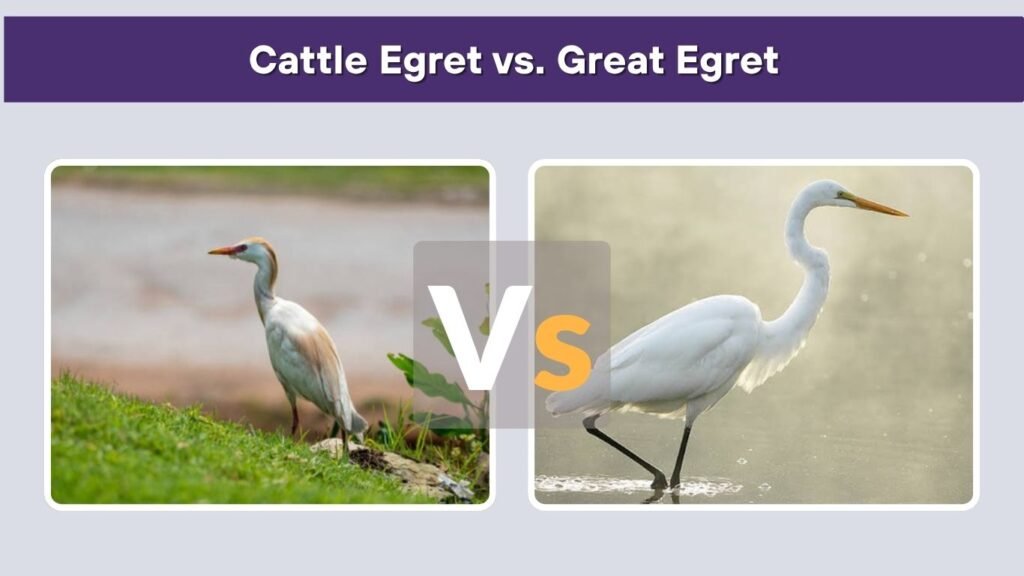
Both birds have mostly white plumage, but their body proportions, habitats, and feeding behaviors are noticeably different.
| Feature | Cattle Egret | Great Egret |
|---|---|---|
| Body shape | Short and stocky | Tall and slender |
| Neck | Relatively short and thick | Very long and thin |
| Bill | Shorter and thicker | Long, dagger-shaped |
| Legs | Relatively short | Very long |
| Breeding color | Orange-buff head, breast, and back | Remains white with long ornamental plumes |
| Feeding habitat | Fields, farms, and pastures | Marshes, ponds, lakes, and shorelines |
| Typical food | Mainly insects | Mainly fish and aquatic animals |
| Livestock association | Very common | Uncommon |
Seeing a white egret following cows in a relatively dry pasture is one of the strongest clues that it is a cattle egret.
Are Cattle Egrets Beneficial?
Cattle egrets can benefit farms by consuming large numbers of grasshoppers, flies, beetles, and other insects. They do not normally harm cattle and are not drinking the animals’ blood when they stand nearby.
However, very large nesting colonies can create local problems. Droppings may damage vegetation, produce strong odors, contaminate water, and create conflicts near homes or public areas. Large flocks close to airports may also become an aviation hazard.
Despite these concerns, cattle egrets play an important ecological role as predators of insects and other small animals. Their presence in a pasture is generally natural and does not require control.
FAQs
Do cattle egrets eat ticks from cattle?
Cattle egrets may occasionally take ticks or insects directly from an animal, especially while perched on its back. However, they primarily eat grasshoppers, flies, beetles, and other prey stirred from the grass as cattle walk and graze.
Do cattle egrets always live near cattle?
No. They can survive without cattle and often follow horses, buffalo, sheep, elephants, tractors, and lawnmowers. The birds are attracted to anything that disturbs vegetation and makes insects easier to capture.
Can cattle egrets swim?
Cattle egrets can cope with shallow water but are not specialized swimming birds. They normally walk on land or wade through shallow wetlands. Their shorter legs and preference for dry fields distinguish them from many other members of the heron family.
Do cattle egrets migrate?
Some populations migrate, while others remain in the same general area throughout the year. Their movements depend on regional weather, rainfall, breeding conditions, and food availability. Birds may also wander far beyond their normal range.
How can you identify a cattle egret in flight?
Look for a compact white bird with broad, rounded wings, dark feet extending slightly behind the tail, and a neck folded close to the body. Its flight is direct, with steady wingbeats, and flocks often travel between fields and communal roosts.
