
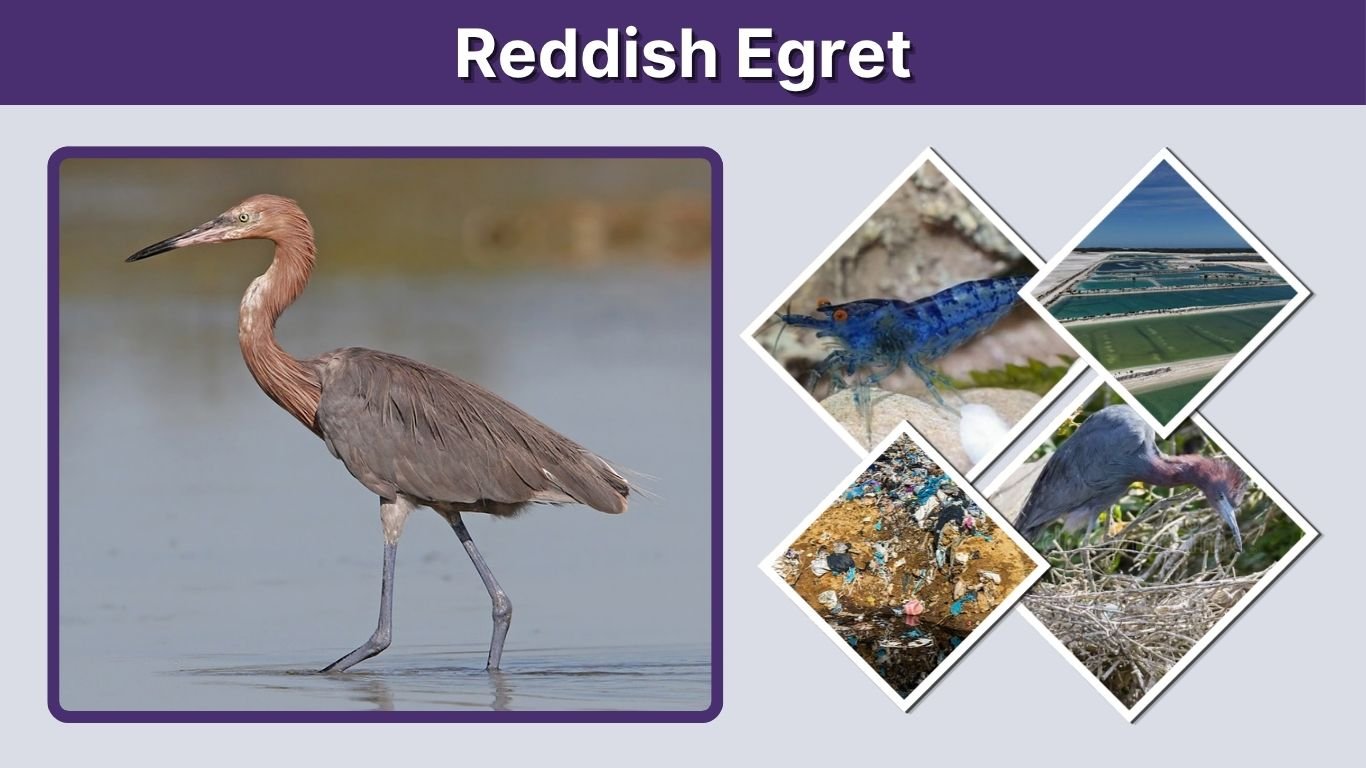
The Reddish Egret is a graceful coastal heron famous for its energetic and almost comical hunting style. Instead of standing still and waiting for prey, it runs, jumps, spins, and spreads its wings while chasing fish through shallow water. Found mainly around the Gulf Coast, Mexico, the Caribbean, and Central America, this uncommon egret occurs in both dark and white color forms. Its distinctive appearance, specialized habitat, and animated behavior make it one of North America’s most fascinating wading birds.
Reddish Egret Quick Facts
The Reddish Egret’s scientific name is Egretta rufescens. It belongs to the Ardeidae family, which includes herons, egrets, and bitterns.
| Feature | Description |
|---|---|
| Common name | Reddish Egret |
| Scientific name | Egretta rufescens |
| Family | Ardeidae |
| Length | Approximately 68–82 cm |
| Wingspan | About 116–124 cm |
| Weight | Approximately 360–870 grams |
| Color forms | Dark morph and white morph |
| Primary food | Small fish |
| Habitat | Coastal lagoons, tidal flats, and saltwater bays |
| Clutch size | Usually 2–4 eggs |
| Conservation status | Near Threatened |
Size and Physical Appearance
The Reddish Egret is a medium-sized heron with a slender body, long neck, narrow wings, and long legs. Although smaller than a Great Blue Heron, it is larger and more heavily built than a Snowy Egret.
Its long neck allows it to reach quickly toward fish, while its extended legs help it run through shallow coastal water. The bill is long, straight, and sharply pointed. Adult birds generally have a pinkish bill with a dark or black tip. Their legs are usually dark bluish-gray or blackish.
Dark-Morph Reddish Egret
The dark morph is the most familiar form of this species. Its body is mostly slate-gray or bluish-gray, while the head and neck are covered with reddish-brown or cinnamon-colored feathers.
During the breeding season, adults develop loose, shaggy plumes on the head and neck. The feathers can look especially untidy when the bird is excited, hunting, or displaying. The contrast between the reddish neck and dark gray body gives the species its common name.
White-Morph Reddish Egret
White-morph adults have completely white plumage but retain the same body shape and energetic behavior as dark birds. Their pink-and-black bill helps distinguish them from other white egrets.
White morphs are more frequent in some parts of the range than in others. They can be especially confusing because they resemble Great Egrets, Snowy Egrets, and immature Little Blue Herons. Careful attention to bill color, leg color, size, habitat, and hunting behavior is necessary.
Juvenile Appearance
Young Reddish Egrets are generally duller than adults. Dark-morph juveniles have brownish-gray bodies and less colorful heads and necks. Their bills may appear dark before developing the pinkish adult coloration.
Young birds do not possess the long, shaggy breeding plumes seen on mature adults. As they age, their plumage gradually becomes more strongly patterned and colorful.
Reddish Egret Identification
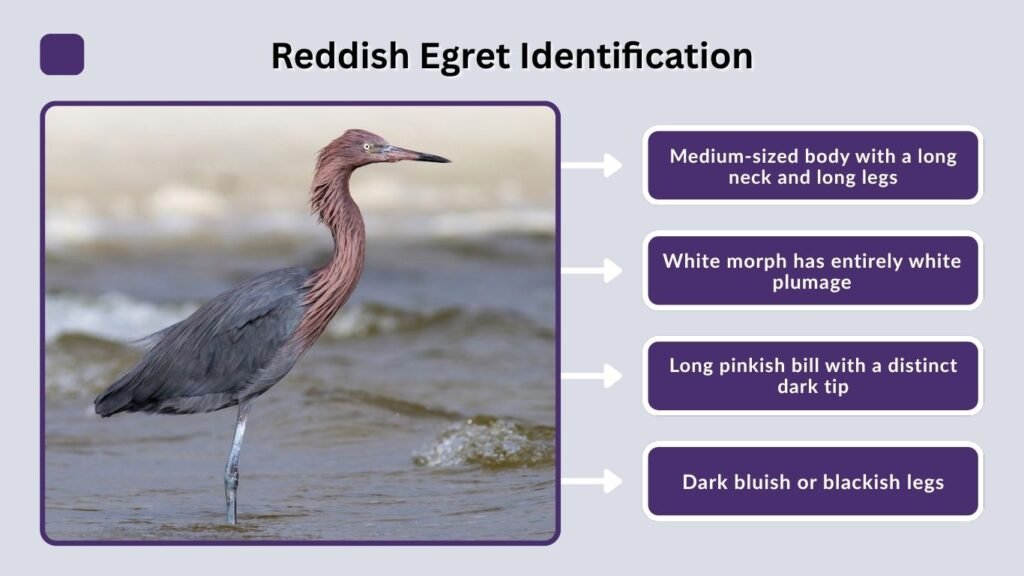
Identifying a dark Reddish Egret is usually straightforward when its plumage and behavior are clearly visible. White birds require closer observation because several other egret species share their white coloration.
Main Identification Features
- Medium-sized body with a long neck and long legs
- Dark morph has a slate-gray body and reddish-brown neck
- White morph has entirely white plumage
- Long pinkish bill with a distinct dark tip
- Dark bluish or blackish legs
- Shaggy head and neck feathers on breeding adults
- Fast, erratic movements while hunting
- Frequent wing spreading over shallow water
- Strong preference for coastal saltwater habitats
A Snowy Egret is smaller and has a thin black bill, black legs, and bright yellow feet. A Great Egret is substantially larger and usually has a yellow bill and black legs. An immature Little Blue Heron has a pale or bluish bill with a dark tip, but it is smaller and typically hunts much more slowly.
The Reddish Egret’s highly active feeding behavior is often the easiest way to confirm its identity.
Distribution and Range
Reddish Egrets live primarily along tropical and subtropical coastlines. Their distribution is relatively limited compared with many other North American herons.
They occur along the Gulf Coast of the United States, especially in Texas and Florida. Their range extends southward through Mexico, the Bahamas, the Caribbean, Belize, Guatemala, and other parts of Central America. Small numbers may occasionally travel beyond the usual range.
Texas supports a particularly important portion of the United States breeding population. Florida populations are concentrated around Florida Bay, the Keys, and suitable areas along the Gulf and Atlantic coasts.
Most adults remain relatively close to established breeding and feeding areas. However, young birds may wander widely after leaving their nesting colonies. Local movements are also influenced by changing tides, water levels, storms, seasonal food supplies, and the availability of shallow feeding grounds.
Reddish Egret Habitat
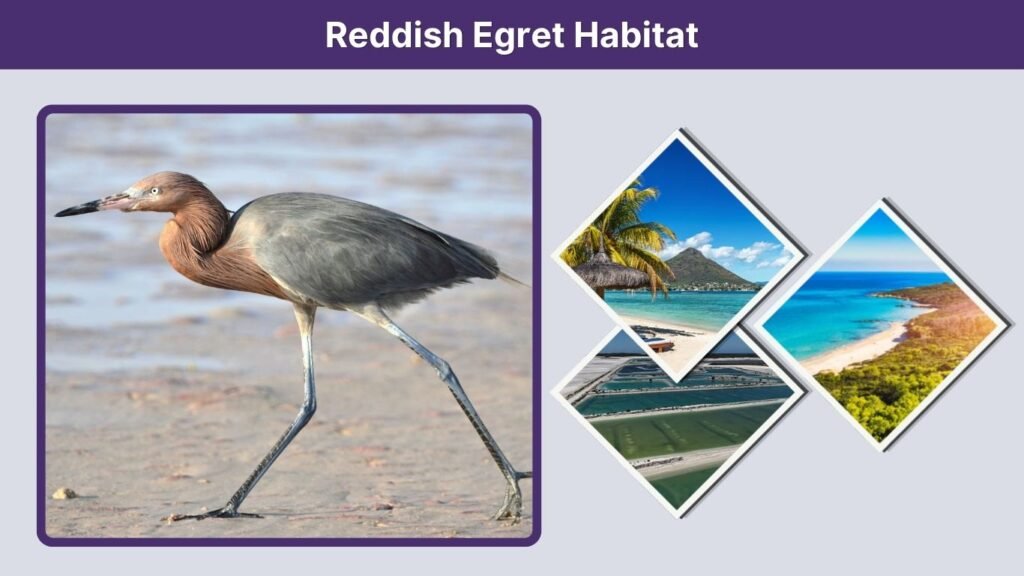
The Reddish Egret is almost exclusively a coastal bird. It depends heavily on broad expanses of clear, shallow saltwater where small fish can be pursued.
Common habitats include:
- Coastal lagoons
- Tidal flats and mudflats
- Saltwater bays
- Mangrove-lined shorelines
- Shallow estuaries
- Barrier islands
- Beaches and sandbars
- Salt ponds
- Coastal overwash pools
These egrets usually feed in water less than 15–20 centimeters deep. Water that is too deep prevents them from using their energetic running technique effectively.
They prefer open flats with relatively little tall vegetation. Quiet, undisturbed coastal areas are particularly valuable because repeated disturbance can reduce feeding time and cause birds to abandon productive hunting locations.
Unlike Snowy Egrets and Great Egrets, Reddish Egrets rarely visit inland freshwater wetlands. A bird far from the coast is therefore unlikely to be this species.
Diet of the Reddish Egret
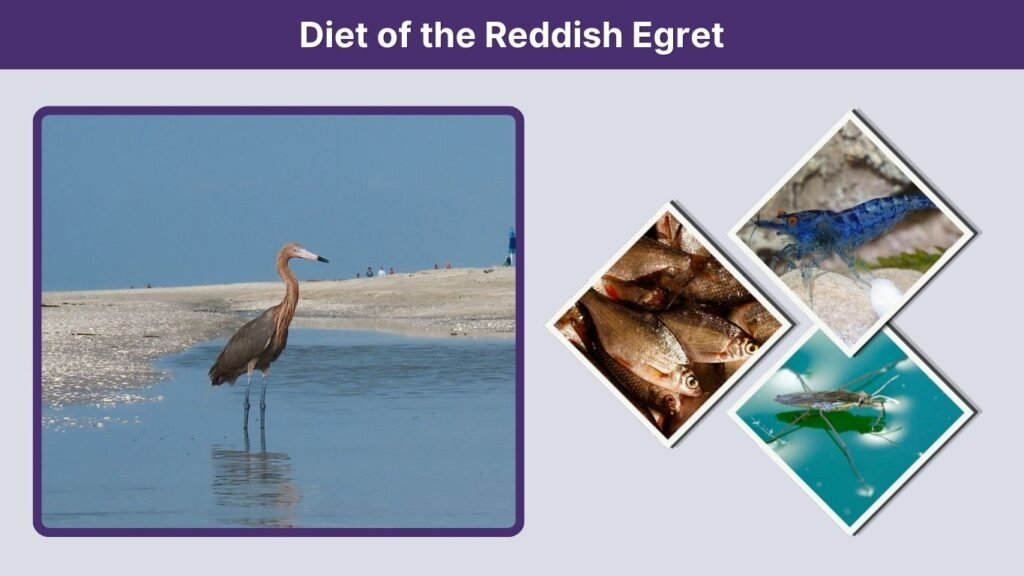
The Reddish Egret is carnivorous, and small fish make up most of its diet. It may consume other aquatic animals when they are readily available, but its body and behavior are especially adapted for catching fish.
| Food group | Examples |
|---|---|
| Fish | Small mullet, minnows, and killifish |
| Crustaceans | Shrimp, small crabs, and prawns |
| Amphibians | Occasionally small frogs |
| Aquatic animals | Small marine invertebrates |
| Insects | Aquatic and shoreline insects |
The exact diet varies between regions. Fish abundance, water depth, salinity, season, and tidal movement all influence what a Reddish Egret can catch.
Unique Feeding Behavior
Reddish Egrets are among the most active members of the heron family. Their unusual movements are sometimes described as dancing, although every jump and turn helps them locate or capture prey.
Running and Chasing
Rather than waiting motionlessly, the egret runs through shallow water with its neck extended. It abruptly changes direction as fish attempt to escape. The bird may leap sideways, stop suddenly, turn in a circle, or sprint several meters before striking.
This strategy causes small fish to reveal their positions. The chase continues until the egret can thrust its bill into the water and grab its prey.
Canopy Feeding
The Reddish Egret frequently raises one or both wings over its head, forming a canopy above the water. This technique creates shade, reduces glare, and allows the bird to see fish more clearly.
Fish may also move toward the shaded area, possibly treating it as shelter. Once a fish comes within reach, the egret quickly strikes. Other herons use canopy feeding, but few combine it with such rapid running and turning.
Influence of the Tide
Tides play a major role in the bird’s daily routine. Falling water can concentrate fish in pools and shallow channels, making them easier to catch. The egret may move between different flats as tidal conditions change.
It occasionally feeds in temporary coastal pools created when storms push seawater across barrier islands. Fish trapped in these shallow pools provide valuable feeding opportunities.
Behavior and Communication
Reddish Egrets generally feed alone and may defend productive hunting areas from other birds. They can become aggressive when another egret enters their preferred section of a tidal flat.
Displays may include raised feathers, extended wings, neck stretching, chasing, and bill movements. Their usual vocalization is a low, rough or guttural croak. They are otherwise relatively quiet away from nesting colonies.
In flight, a Reddish Egret pulls its head back toward its shoulders and extends its long legs behind its body. Its wingbeats appear strong and steady. Birds traveling between nesting and feeding areas may fly low over bays or coastal flats.
Nesting and Reproduction
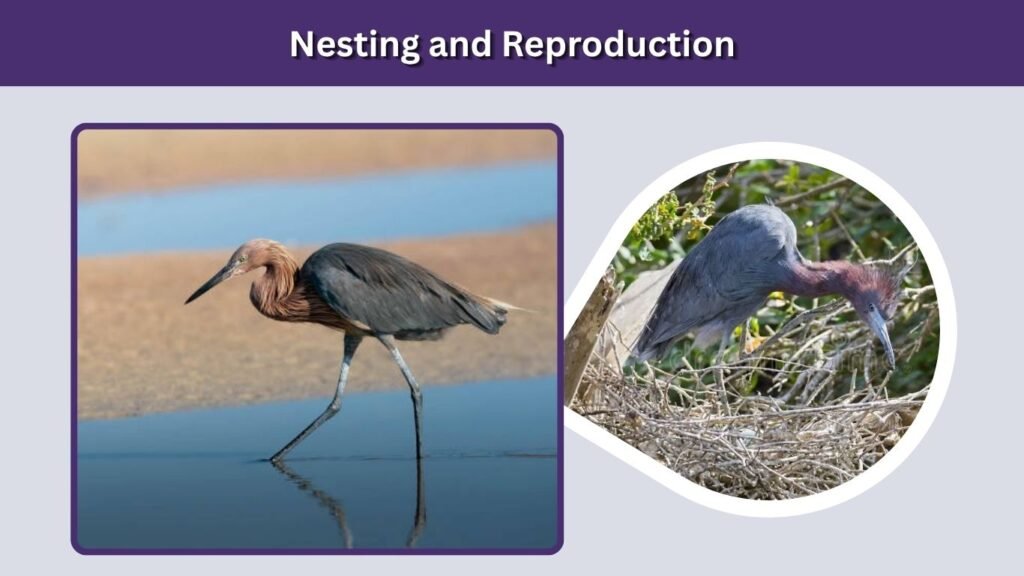
Reddish Egrets breed on remote coastal islands, mangrove keys, sandbars, and other protected locations near suitable feeding habitat. They may nest in mixed colonies alongside herons, spoonbills, ibises, and other waterbirds.
Courtship
Courtship involves several dramatic displays. Adults may raise their shaggy head and neck feathers, stretch their necks, snap their bills, chase each other, and perform circular flights.
The bright facial colors and loose breeding plumes become especially noticeable during these displays. Males and females look alike, although males may average slightly larger.
Nest and Eggs
The nest is a platform constructed from sticks and twigs. It may be placed in a mangrove, low shrub, small tree, cactus, or vegetation close to the ground. In some Texas colonies, nests are built on low coastal islands or shell-covered areas.
Females generally lay two to four pale blue-green eggs. Both adults incubate the clutch, with incubation lasting approximately 26 days. The parents also share the work of guarding and feeding the chicks.
Young birds remain around the nest while developing their flight feathers. They are fed regurgitated fish until they can begin finding food independently.
Lifespan and Predators
The exact average lifespan of wild Reddish Egrets is not well documented. Birds that survive the vulnerable egg, chick, and juvenile stages may live for many years.
Eggs and chicks can be taken by raccoons, snakes, gulls, crows, birds of prey, and other predators. Coastal colonies on isolated islands offer some protection from land mammals. However, rising water, hurricanes, severe storms, and extreme heat can destroy nests or reduce breeding success.
Adult egrets have fewer natural predators, but they remain vulnerable to large raptors, severe weather, collisions, fishing equipment, and human disturbance.
Conservation Status and Threats
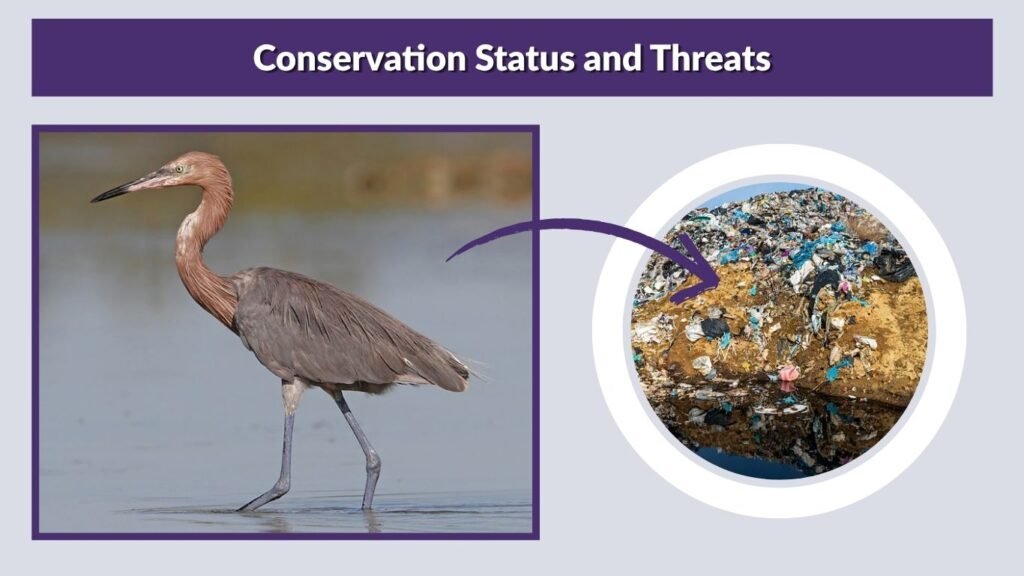
The Reddish Egret is currently classified as Near Threatened. It has a relatively small global population, estimated at approximately 5,000–9,999 mature individuals, and it is considered one of North America’s least common egrets. BirdLife International tracks its population and conservation status.
During the late 1800s and early 1900s, plume hunters killed large numbers of egrets for feathers used in the fashion industry. Reddish Egret populations were severely reduced and disappeared from some former breeding areas. Legal protection helped the species begin a gradual recovery, but its numbers remain well below historical levels.
Present-day threats include:
- Coastal development and habitat loss
- Disturbance at nesting colonies
- Altered freshwater flows into coastal bays
- Pollution and declining water quality
- Rising sea levels and stronger storms
- Predators introduced to nesting islands
- Boating activity near feeding or nesting areas
- Loss of shallow tidal feeding grounds
Protecting mangrove islands, tidal flats, shallow lagoons, and undisturbed nesting colonies is essential for the species’ long-term recovery.
FAQs
Why is it called a Reddish Egret?
The name comes from the reddish-brown or cinnamon feathers covering the head and neck of dark-morph adults. Their bodies are actually slate-gray. White-morph birds lack the reddish coloration but belong to the same species and can breed with dark birds.
Is a Reddish Egret rare?
Yes. It is one of the least numerous egrets in North America and has a much smaller range than Great or Snowy Egrets. It is most reliably observed along suitable coastal areas in Texas, Florida, Mexico, the Caribbean, and Central America.
Why do Reddish Egrets spread their wings while feeding?
They spread their wings to form shade over the water. This canopy reduces surface glare, making fish easier to see. The shadow may also attract fish seeking shelter, allowing the egret to strike when prey moves into the shaded area.
Do Reddish Egrets live near freshwater?
Reddish Egrets are primarily saltwater birds. They prefer shallow coastal lagoons, tidal flats, mangroves, bays, and estuaries. They rarely use inland freshwater habitats, although they may occasionally visit brackish pools or temporary wetlands created by coastal storms.
How can you distinguish a white Reddish Egret from a Great Egret?
A white Reddish Egret is smaller than a Great Egret and has a pinkish bill with a dark tip instead of a mostly yellow bill. It also displays much faster, more erratic hunting behavior and usually feeds on shallow coastal flats.