
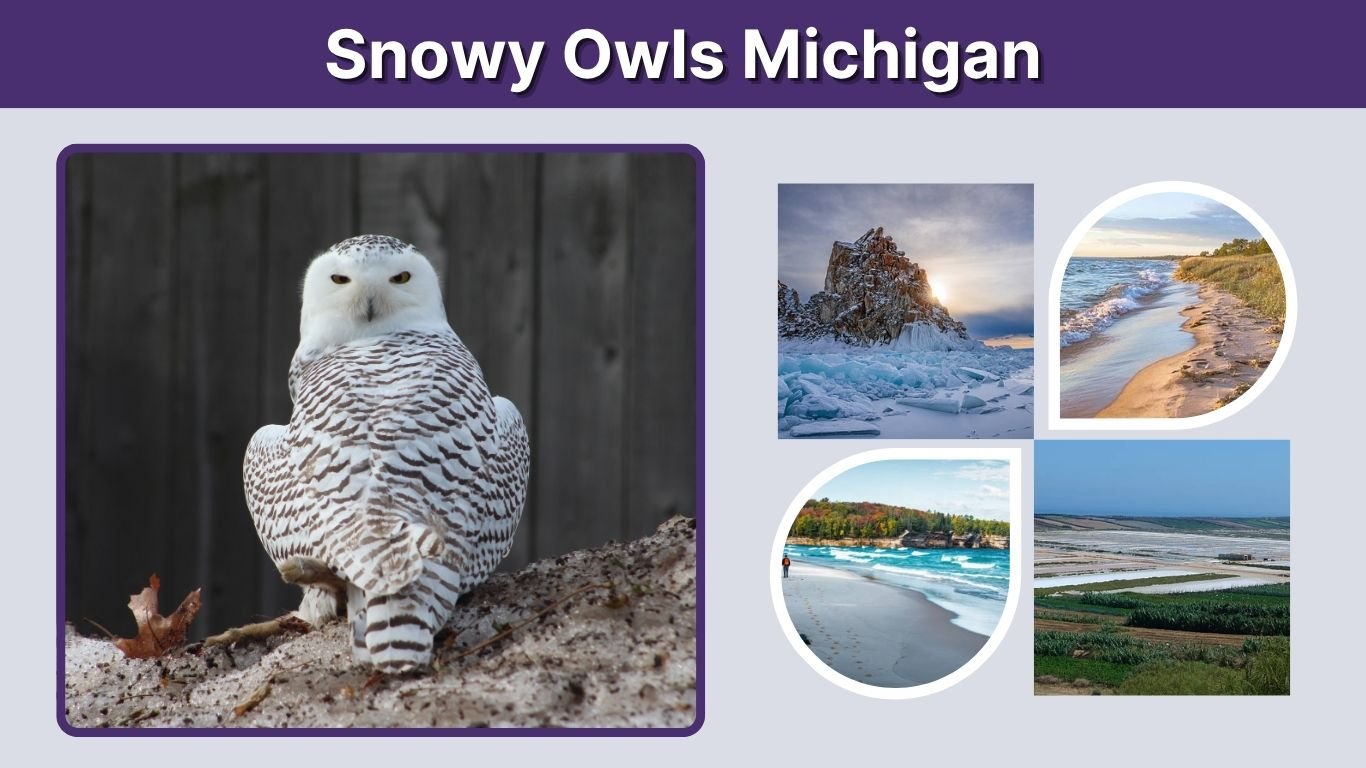
Snowy Owls visit Michigan mainly during winter, when some birds migrate south from their Arctic breeding grounds. They are most likely to appear in wide-open landscapes such as farm fields, airports, shorelines, marshes and the flat countryside of the eastern Upper Peninsula. Their numbers vary greatly between winters, so a place with several owls one year may have none the next. Michigan also gained attention in 2025 after an unusually orange-colored Snowy Owl was photographed in the state’s Thumb region.
Are There Snowy Owls in Michigan?
Yes, Snowy Owls are regularly recorded in Michigan, but they are generally winter visitors rather than permanent residents. They breed much farther north on the Arctic tundra and move into the Great Lakes region outside the breeding season.
Snowy Owls may begin arriving in Michigan during late fall. Sightings are generally most likely from approximately November through March, although the timing varies by bird and year. A few individuals may remain into early spring before returning north.
Most Michigan sightings involve single birds. However, certain winters bring noticeably larger numbers. These major movements are commonly called irruptions.
| Michigan status | Details |
| Residency | Primarily a winter visitor |
| Most likely season | Late fall through early spring |
| Best habitat | Open fields, marshes, beaches and lakeshores |
| Most reliable region | Eastern Upper Peninsula |
| Breeding in Michigan | Not considered a regular Michigan breeder |
Snowy Owls use open winter landscapes because these areas resemble their treeless Arctic home. Prairies, farmland, coastal marshes, beaches, dunes and large airport grounds can all offer suitable winter habitat.
Where to See Snowy Owls in Michigan
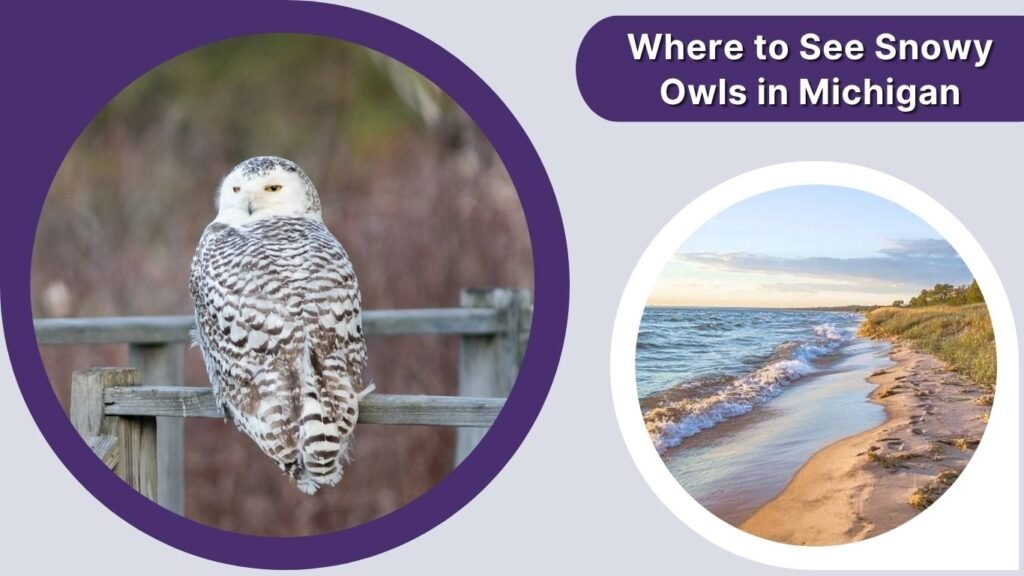
Snowy Owls can appear in both the Upper and Lower Peninsulas. The best locations usually combine broad visibility, low vegetation, dependable prey and convenient elevated perches.
Eastern Upper Peninsula
The eastern Upper Peninsula is Michigan’s best-known region for finding Snowy Owls. Open agricultural areas around Rudyard, Pickford, Kinross and Sault Ste. Marie can attract wintering birds.
Michigan Audubon has organized winter birding tours in this region specifically for opportunities to observe Snowy Owls. The flat farmland and utility poles around these communities provide excellent hunting ground and lookout points.
Rudyard
Rudyard is often informally called the “Snowy Owl Capital of Michigan.” It lies in Chippewa County in the eastern Upper Peninsula, where large open fields create tundra-like winter habitat.
Bird numbers are never guaranteed, but several owls may sometimes be visible around the wider Rudyard area during a productive winter. One Michigan wildlife photographer reported counting seven birds from a single location there in February 2023.
Michigan’s Thumb
The Thumb contains extensive farmland that attracts voles, mice and other small animals. Snowy Owls may perch on utility poles, barns, fence posts or directly on the ground while scanning these fields.
The region became especially well known after the unusual orange Snowy Owl nicknamed Creamsicle was photographed there in 2025.
Lake Michigan Shore
Snowy Owls sometimes occur along Lake Michigan beaches, dunes, harbors and breakwaters. Potential areas include the Muskegon and Holland regions, although sightings differ from season to season.
Open shorelines resemble the Arctic habitats these owls normally use. The birds may hunt rodents around dunes or pursue waterbirds near open water and ice.
Lower Michigan Farmland
Snowy Owls are also reported in the agricultural landscapes of central, western and southeastern Michigan. Promising areas include:
- Large harvested corn or soybean fields
- Flat rural roads with utility poles
- Open grasslands and marshes
- Areas surrounding reservoirs
- Lakeshores and coastal dunes
Fields with scattered poles, silos and barns are especially attractive because they provide elevated hunting perches.
Snowy Owl Sightings in Michigan
Michigan Snowy Owl sightings change daily. A bird reported in one field may disappear the next day, while another may remain in the same general area for weeks.
Snowy Owls are nomadic. Their winter movements are influenced by weather, food supplies, age and conditions farther north. Major numbers do not necessarily mean the birds are starving. In some cases, an irruption follows a successful Arctic breeding season that produced many young owls.
Historical observations show that increased numbers can appear around the Great Lakes during large irruption years.
How to Find Current Sightings
Current reports are usually more useful than old lists of locations. Birders can check recent observations through eBird’s species map and local birding groups.
When reviewing a report, check:
- The date and time of the observation
- Whether the location is publicly accessible
- How many birds were reported
- Whether later visitors confirmed the sighting
- Which roads or fields can be viewed without trespassing
Even a recent report does not guarantee that the owl will still be present. Michigan photographers commonly search nearby fields, poles, buildings and shorelines after checking recent records.
Snowy Owl Habitat in Michigan
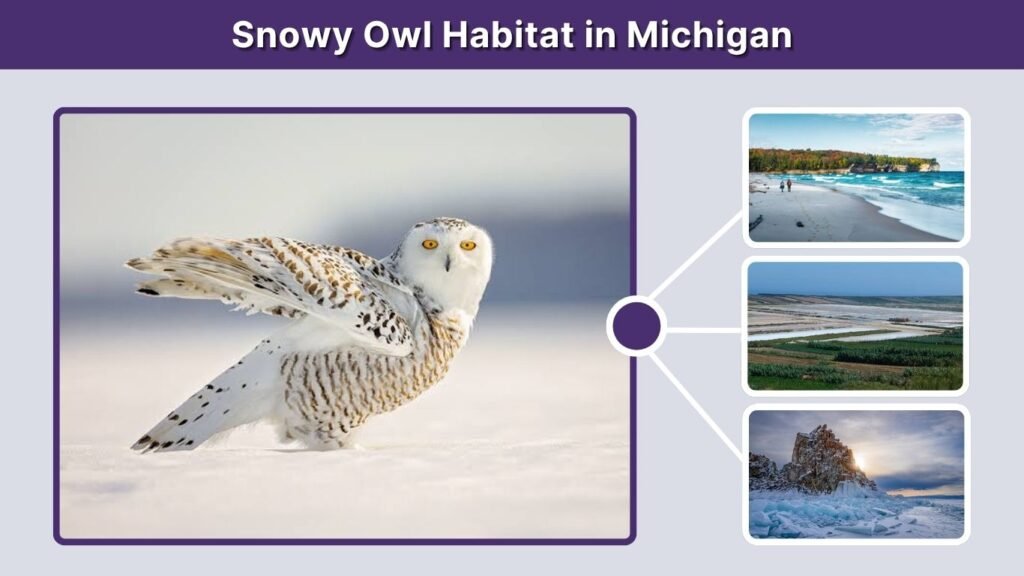
Michigan provides temporary winter habitat rather than the nesting tundra Snowy Owls use in summer. The most attractive areas are broad, treeless and rich in prey.
Common Michigan Habitats
Snowy Owls may use:
- Agricultural fields
- Great Lakes beaches
- Sand dunes
- Open marshes
- Frozen shorelines
- Airports
- Harbors
- Industrial waterfronts
- Flat grasslands
Some tracked Snowy Owls have even spent long periods on the frozen surfaces of the Great Lakes, where they can hunt waterbirds around cracks and areas of open water.
What Do They Eat in Michigan?
Snowy Owls hunt many of the small animals found in Michigan’s open country. Likely prey includes voles, mice, rats, rabbits and birds.
Older research examining Snowy Owl food in Michigan found that meadow voles represented a large portion of identified prey. The exact diet varies with location and availability.
Michigan Snowy Owl Migration
Snowy Owls do not follow one simple migration route. Some remain in the Arctic all winter, while others travel south into Canada, the Great Lakes and the northern United States.
Young owls often form a noticeable part of southern winter movements. Each bird may select a different winter territory, and the same individual may use fields, shorelines or frozen lakes during a single season.
| Season | Expected activity in Michigan |
| Summer | Snowy Owls are generally absent |
| Early fall | Usually too early for most sightings |
| Late fall | First winter visitors may arrive |
| Winter | Best period for observations |
| Early spring | Remaining birds begin moving north |
| Late spring | Most have left Michigan |
The Orange Snowy Owl in Michigan
An extraordinary orange or rusty-colored Snowy Owl was photographed in Michigan’s Thumb area in early 2025. Wildlife photographer Julie Maggert nicknamed the bird Creamsicle after spending several trips trying to obtain clear photographs.
The owl displayed orange-brown coloring across areas that would normally appear white. However, it retained the body shape, yellow eyes and dark markings of a Snowy Owl. It was not a separate owl species or a recognized orange color morph.
The reason for its appearance remains uncertain. A Michigan State University biology professor suggested that environmental exposure affecting the bird or its mother could potentially have influenced its coloration, but no cause was confirmed. Therefore, claims that Creamsicle represented a newly discovered genetic mutation should be treated cautiously.
How to Identify a Snowy Owl in Michigan
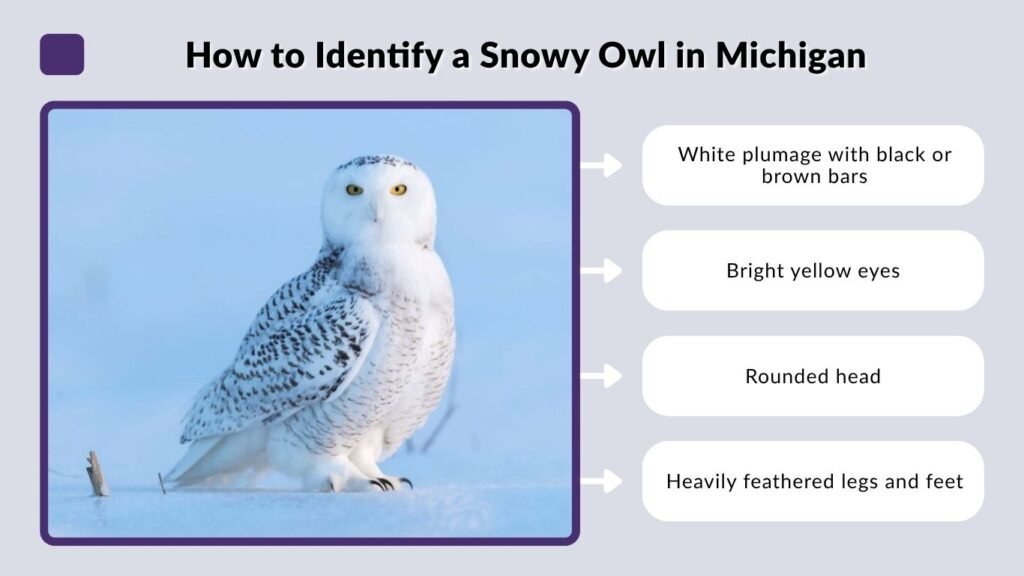
Snowy Owls are large, heavy-bodied owls with rounded heads and no prominent ear tufts.
Important identification features include:
- White plumage with black or brown bars
- Bright yellow eyes
- Rounded head
- Heavily feathered legs and feet
- Broad wings
- Large body
- Upright posture
Adult males are often whiter, while females and young birds generally show heavier dark barring. A distant Snowy Owl sitting in a Michigan field can resemble a snow-covered rock, white plastic bag or pale clump of vegetation.
Responsible Snowy Owl Watching
Snowy Owls may allow people to approach because they have limited experience with humans. This does not mean the bird is comfortable or tame.
Keep a generous distance and use binoculars or a long camera lens. Do not enter private fields, block rural roads or walk onto airport property. Never bait an owl with live rodents and do not intentionally force it to fly.
Repeated disturbance wastes energy that the bird needs for hunting and migration. Audubon recommends watching Snowy Owls from a respectful distance, especially because many southern visitors are young and inexperienced birds.
FAQs
Do Snowy Owls live in Michigan year-round?
No. Snowy Owls are mainly winter visitors to Michigan. They normally breed on Arctic tundra in northern Canada and other circumpolar regions. Most individuals seen in Michigan arrive during late fall or winter and leave for northern areas during spring.
What is the best place to see Snowy Owls in Michigan?
The eastern Upper Peninsula, particularly the countryside around Rudyard, is Michigan’s most famous Snowy Owl region. However, birds also appear in the Thumb, along Great Lakes shorelines and across open farmland in the Lower Peninsula.
When can Snowy Owls be seen in Michigan?
The best period is generally from late November through February. Sightings may begin earlier in fall or continue into March and April. Arrival times and total numbers vary greatly from one winter to another.
Was the orange Snowy Owl in Michigan real?
Yes. A rusty-orange Snowy Owl nicknamed Creamsicle was photographed in Michigan’s Thumb region in 2025. The unusual coloring was real, but its cause was not conclusively established. It was still a Snowy Owl rather than a new species.
How can I check current Michigan Snowy Owl sightings?
Use the eBird species map and select Snowy Owl, Michigan and a recent date range. Local Audubon chapters and regional birding groups may also share reports. Respect sensitive locations, private property and requests to keep exact locations confidential.
