
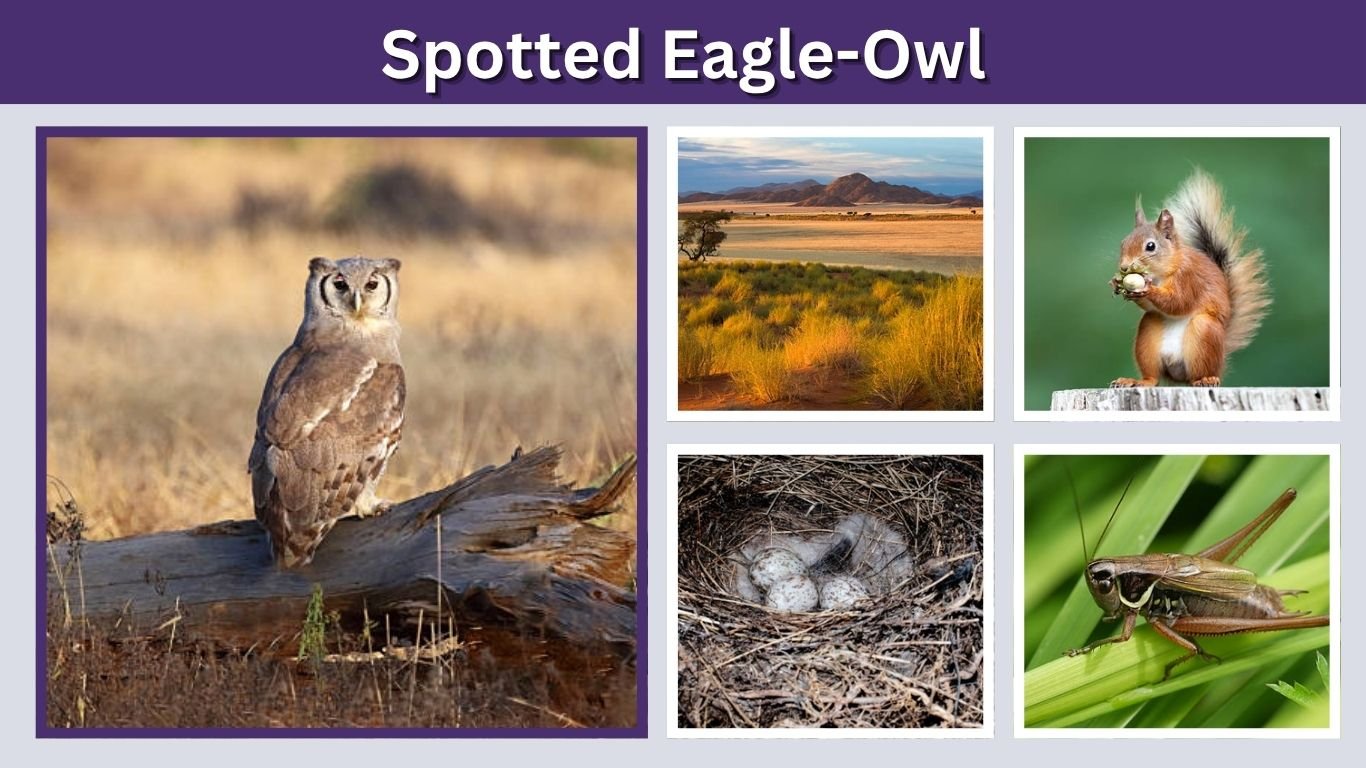
The spotted eagle-owl is a medium-sized African owl recognized by its prominent ear tufts, bright yellow eyes, and beautifully patterned plumage. Also called the African spotted eagle-owl, it is widely distributed across southern Africa and has adapted surprisingly well to towns and cities. This nocturnal predator eats rodents, insects, birds, reptiles, and amphibians. Although adaptable, it still faces dangers from vehicles, power lines, poisoned prey, and disturbance around nesting sites.
Spotted Eagle-Owl Quick Facts
The spotted eagle-owl belongs to the typical owl family, Strigidae. Its scientific name is Bubo africanus, with “africanus” referring to its African distribution. It is among the most frequently encountered large owls in southern Africa.
| Feature | Information |
| Scientific name | Bubo africanus |
| Other name | African spotted eagle-owl |
| Length | Approximately 43–50 cm |
| Wingspan | Around 1 metre |
| Eye color | Bright yellow |
| Activity | Nocturnal |
| Diet | Rodents, insects, birds, reptiles and frogs |
| Eggs | Usually two or three |
| Conservation status | Least Concern |
| Main range | Sub-Saharan Africa and southern Arabia |
BirdLife currently lists the spotted eagle-owl as a species of Least Concern, meaning it is not considered globally threatened with extinction.
What Does a Spotted Eagle-Owl Look Like?
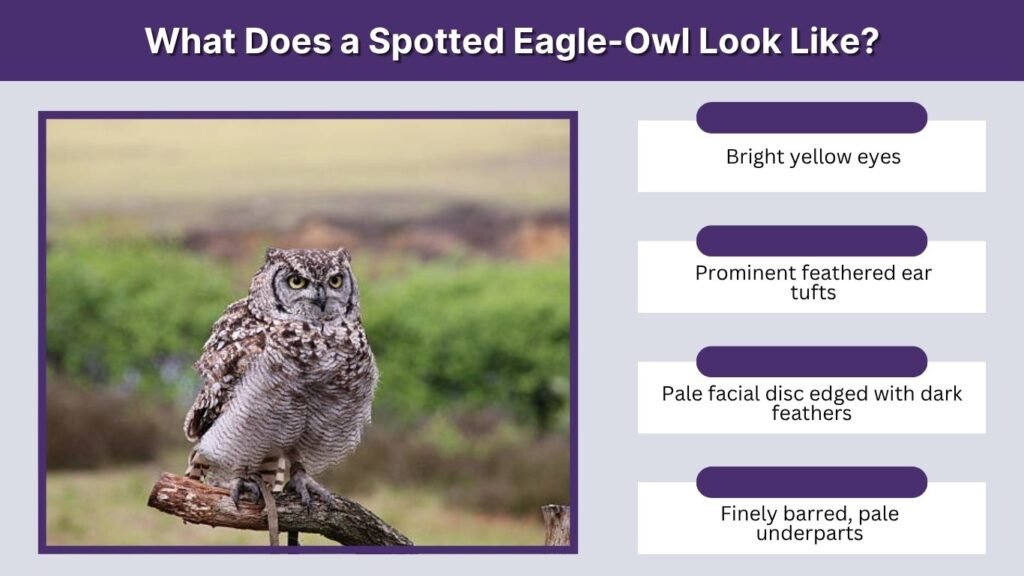
This owl’s grey-brown plumage helps it disappear against rocks, tree bark, dry vegetation, and shaded buildings. Males and females look similar, although females may appear slightly larger.
Identification Features
A spotted eagle-owl can be recognized by its:
- Bright yellow eyes
- Prominent feathered ear tufts
- Pale facial disc edged with dark feathers
- Grey or brown upperparts with dark blotches
- Finely barred, pale underparts
- Strong, feathered legs
- Sharp, dark talons
- Rounded wings and a short tail
Its ear tufts are decorative feathers rather than external ears. The actual ear openings are hidden beneath feathers on the sides of the head. The owl can raise or lower its tufts depending on alertness, communication, and camouflage.
Spotted Eagle-Owl Size
An adult usually measures approximately 43–50 cm tall and has a wingspan of around one metre. Despite its powerful appearance, it is smaller than several other eagle-owls, including the Cape eagle-owl and Verreaux’s eagle-owl.
Spotted Eagle-Owl Feathers
The bird’s feathers combine grey, brown, black, and cream markings. Fine barring covers much of the chest and belly, while larger irregular spots appear across the back, head, and wings.
Its flight feathers have soft edges that reduce noise as air passes over the wings. This allows the owl to approach small mammals without giving them much warning.
Spotted Eagle-Owl Habitat and Range
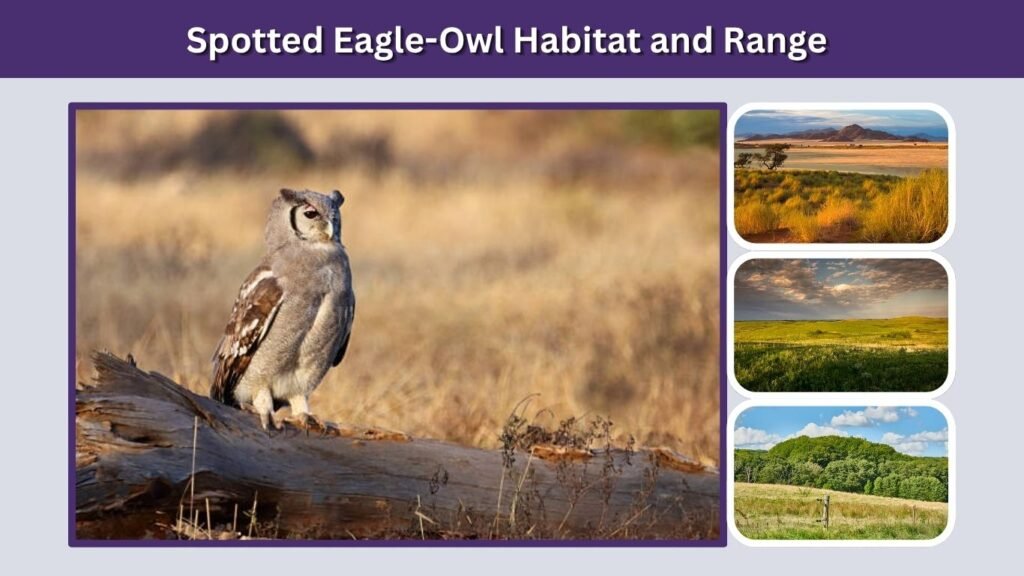
The spotted eagle-owl is highly adaptable and occupies more habitat types than many forest-dependent owls. Suitable hunting areas, safe daytime roosts, and protected nesting locations are more important than any single type of vegetation.
Natural Habitat
Spotted eagle-owls inhabit:
- Savannas
- Grasslands
- Open woodlands
- Shrublands
- Rocky hillsides
- Forest edges
- Semi-desert regions
- Agricultural landscapes
They generally avoid dense evergreen forest and extremely sandy desert. During daylight, an owl may rest in a tree, among rocks, beneath a bush, on a sheltered ledge, or inside an abandoned animal burrow.
Where Do Spotted Eagle-Owls Live?
The species occurs widely across southern Africa, including South Africa, Namibia, Botswana, Zimbabwe, Mozambique, Eswatini, and Lesotho. Its broader range extends into parts of sub-Saharan Africa and the southern Arabian Peninsula.
It is especially common in South Africa, where it may be seen in protected reserves, farmland, gardens, parks, and suburban neighborhoods.
Living in Towns and Cities
Spotted eagle-owls can live near people when urban areas provide mature trees, open lawns, rodents, insects, and quiet daytime roosts. They may perch on rooftops, streetlights, telephone poles, and garden walls while searching for prey.
They sometimes nest on buildings, window ledges, flower boxes, or specially designed owl boxes. However, suitable nesting structures should be installed in quiet, elevated places away from busy roads and frequent human activity.
What Do Spotted Eagle-Owls Eat?
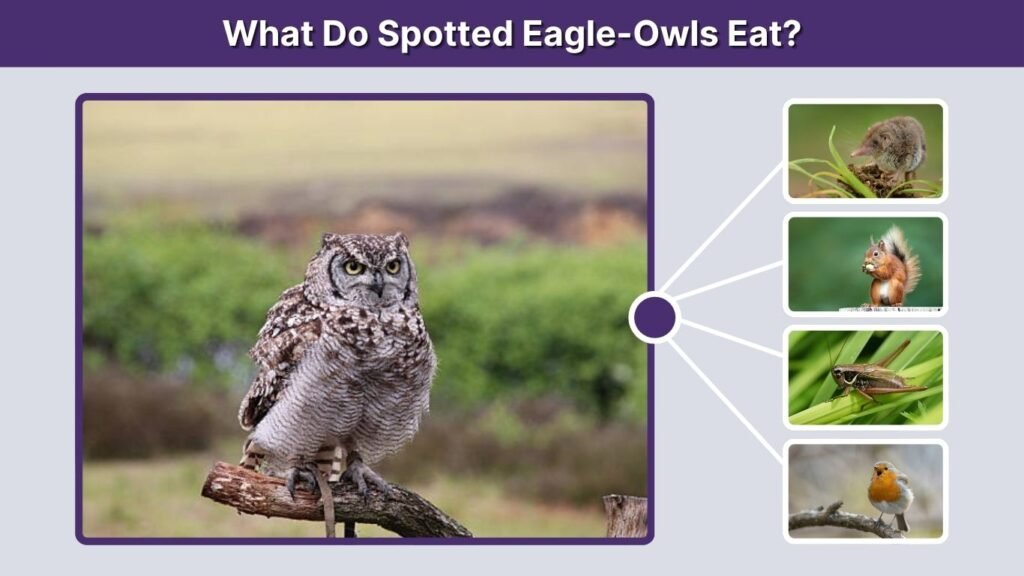
This owl is an opportunistic carnivore, meaning it hunts whatever suitable prey is abundant in its surroundings. Its varied diet is one reason it can survive in both natural landscapes and developed areas.
Common Prey
The spotted eagle-owl eats:
- Mice and rats
- Shrews
- Squirrels
- Mole-rats
- Crickets
- Large beetles
- Small birds
- Young gamebirds
- Frogs
- Lizards
- Snakes
- Occasionally carrion
Rodents may form an important part of its urban and agricultural diet. The owl can therefore help control local rodent populations without relying on chemical poisons.
How Does It Hunt?
The owl usually begins hunting around sunset. It waits on an elevated perch, watches and listens for movement, and then glides silently toward its target.
Small prey may be swallowed whole. Indigestible material, including bones, teeth, feathers, and fur, is later compressed and regurgitated as a pellet. Larger prey is torn into smaller pieces with the beak and talons.
Spotted Eagle-Owl Call and Behavior
The spotted eagle-owl spends most daylight hours hidden and becomes active around dusk. Its calls help pairs remain in contact, advertise territory, and communicate during the breeding period.
What Does Its Call Sound Like?
The male usually produces a mellow double hoot that may sound like “hoo-hooooee.” The female responds with a softer, higher-pitched triple hoot. Pairs sometimes duet, particularly before and during the breeding season.
Young owls do not initially hoot. Hungry chicks make wheezing, hissing, or screech-like sounds to attract their parents’ attention. Threatened chicks may hiss and click their beaks.
Daytime Behavior
During the day, the owl sits quietly near a tree trunk, beneath vegetation, or in a rocky shelter. It may compress its feathers, narrow its eyes, and remain motionless to avoid detection.
Spotted eagle-owls are not normally aggressive toward people. However, breeding adults may swoop or use their talons when a person or dog approaches their chicks too closely.
Spotted Eagle-Owl Nest and Eggs
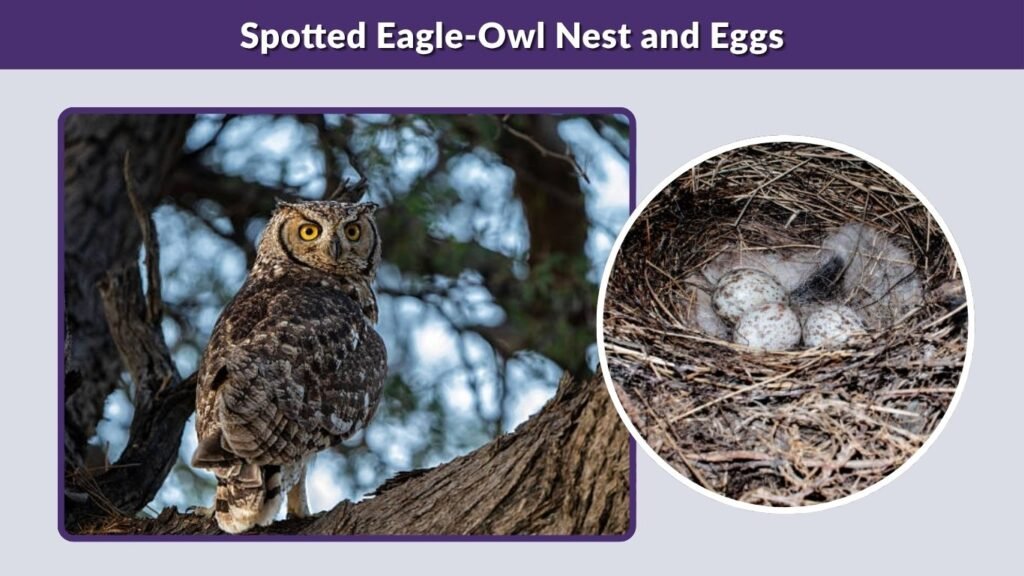
These owls do not build complex stick nests. Instead, they select sheltered natural depressions or reuse suitable structures created by other animals and people.
Where Do They Nest?
Nesting locations may include:
- Shallow scrapes on the ground
- Areas beneath shrubs
- Spaces between rocks
- Cliff ledges
- Tree hollows and stumps
- Abandoned bird nests
- Quarries and riverbanks
- Window ledges and buildings
- Properly designed nesting boxes
Pairs may return to a successful nesting location for many years. A site offering protection from rain, predators, and disturbance is more important than the nest’s height.
Eggs and Incubation
The female normally lays two or three white eggs, often several days apart. She performs most of the incubation while the male hunts and delivers food.
Because the eggs hatch at different times, one chick may be noticeably larger than its siblings. The female protects and feeds the newly hatched young using food supplied by the male.
Spotted Eagle-Owl Chicks
Newly hatched chicks are blind and covered with pale down. Their eyes begin opening after approximately one week. As they grow, they become increasingly active and may leave the immediate nest area before they are capable of strong flight.
Young owls begin exploring at roughly four to six weeks old. Their parents may continue feeding and protecting them for another five or six weeks. A chick found on the ground is not necessarily abandoned; its parents may be watching from nearby.
Spotted Eagle-Owl vs Cape Eagle-Owl
These two southern African species can look similar, especially when observed at night. Eye color, chest markings, habitat, and overall size can help separate them.
| Feature | Spotted Eagle-Owl | Cape Eagle-Owl |
| Scientific name | Bubo africanus | Bubo capensis |
| Typical size | 43–50 cm | 48–54 cm |
| Eye color | Usually yellow | Usually orange |
| Body color | Grey-brown | More rufous-brown |
| Breast pattern | Fine barring and grey blotches | Black and chestnut blotches |
| Habitat | Highly varied, including cities | Often rocky and mountainous |
Breast pattern is generally more reliable than body color because a rare reddish form of the spotted eagle-owl may resemble the Cape eagle-owl.
Spotted Eagle-Owl vs Spot-Bellied Eagle-Owl
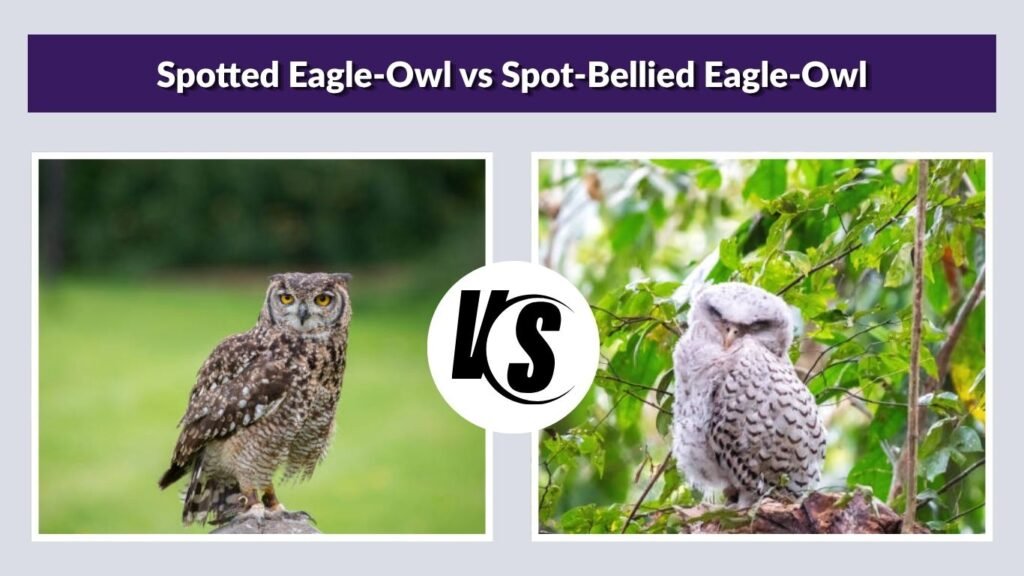
Despite their similar names, these are completely different species. The spotted eagle-owl is a medium-sized African bird, while the spot-bellied eagle-owl is a much larger forest owl from South and Southeast Asia.
| Feature | Spotted Eagle-Owl | Spot-Bellied Eagle-Owl |
| Scientific name | Bubo africanus | Bubo nipalensis |
| Distribution | Africa and southern Arabia | South and Southeast Asia |
| Length | About 43–50 cm | About 50–65 cm |
| Main habitat | Savanna, grassland and open woodland | Dense tropical and subtropical forest |
| Eyes | Yellow | Dark brown |
| Call | Mellow hooting | Deep hoots and human-like screams |
The spot-bellied eagle-owl is known for its large size, pale spotted underparts, long sideways-pointing ear tufts, and unusual screaming call. It should not be described as an African spotted eagle-owl.
Conservation and Common Threats
The spotted eagle-owl is classified as Least Concern because it has a wide distribution and remains relatively common. However, individual owls are regularly harmed by vehicle collisions, power infrastructure, barbed wire, habitat disturbance, and poisoned rodents.
Using rodent poison can unintentionally kill an owl that captures a poisoned rat or mouse. Safer rodent management includes sealing food containers, removing waste, blocking building entrances, and using properly enclosed mechanical traps.
People should also avoid approaching active nests, handling chicks unnecessarily, or revealing precise nest locations publicly.
FAQs
Is the spotted eagle-owl dangerous?
It is not normally dangerous to people and usually avoids close contact. However, adults may defend their nest by swooping when people or pets approach their eggs or chicks. Keeping a respectful distance protects both the owls and visitors.
How big is a spotted eagle-owl?
An adult is approximately 43–50 cm tall and has a wingspan of around one metre. It looks powerful but is considered a medium-sized eagle-owl and is smaller than the Cape and Verreaux’s eagle-owls.
What do spotted eagle-owls eat?
They eat mice, rats, shrews, insects, small birds, frogs, lizards, and snakes. Their diet changes according to habitat and prey availability. Urban owls frequently hunt rodents and large insects in parks and gardens.
Where do spotted eagle-owls nest?
They may nest on the ground, among rocks, under bushes, on cliff ledges, inside tree hollows, on buildings, or in suitable owl boxes. Pairs often return to successful nesting locations in later years.
Is the spotted eagle-owl endangered?
No. It is currently classified as Least Concern at the global level. Nevertheless, local owls remain vulnerable to traffic, poisoned rodents, dangerous fencing, electrical infrastructure, and disturbance at nesting locations.
