
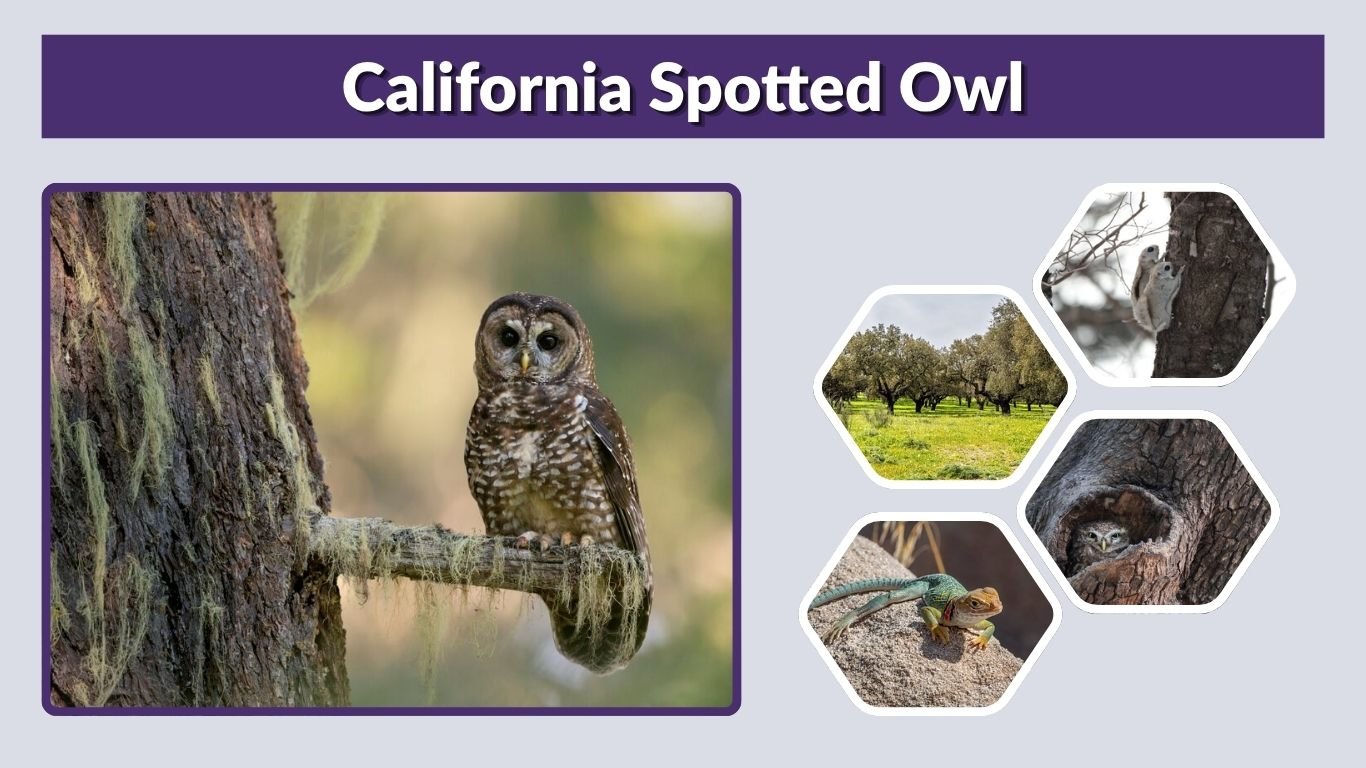
The California spotted owl is a secretive forest bird native to the mountains of California, western Nevada, and northern Baja California. Known for its dark eyes, rounded head, and white-spotted brown feathers, this nocturnal hunter depends heavily on forests containing large trees and complex canopies. Its numbers have declined in several parts of its range because of habitat loss, severe wildfires, drought, and competition from barred owls.
California Spotted Owl Quick Facts
The California spotted owl is one of three recognized spotted owl subspecies. The others are the northern spotted owl and Mexican spotted owl. Although the three look similar, they occupy different regions of western North America.
| Feature | Information |
| Scientific name | Strix occidentalis occidentalis |
| Bird family | Strigidae |
| Length | 18.3–19 inches |
| Male weight | 16.6–24.2 ounces |
| Female weight | 18.9–27.3 ounces |
| Eye color | Dark brown |
| Main foods | Flying squirrels and woodrats |
| Average lifespan | 10–15 years |
| Typical clutch | About two eggs |
| Activity | Primarily nocturnal |
Females are usually slightly larger than males, but both sexes have similar coloration and markings.
What Does a California Spotted Owl Look Like?
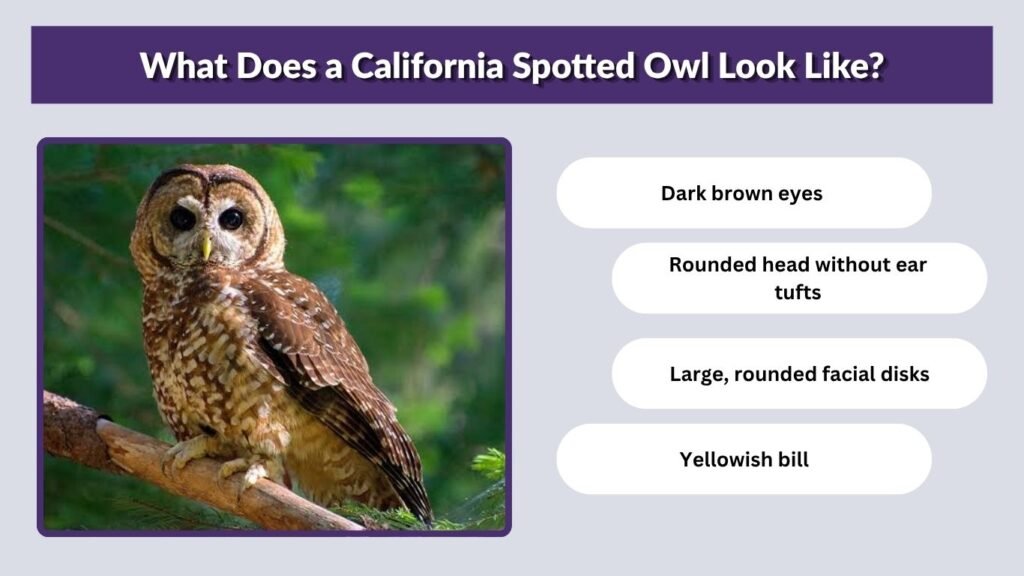
California spotted owls are medium-sized birds with rounded heads and no visible ear tufts. Their mottled plumage helps them blend into tree bark, shaded branches, and old forest vegetation.
Identification Features
A California spotted owl can be recognized by its:
- Dark brown eyes
- Rounded head without ear tufts
- Brown feathers covered with white spots
- Large, rounded facial disks
- Yellowish bill
- Barred wings and tail
- Short tail and broad wings
- Strong, feathered legs
Unlike many other North American owls, it has dark eyes rather than yellow or orange eyes. Its white spots are especially noticeable across the head, back, and chest.
California Spotted Owl Size
Adults measure approximately 18.3 to 19 inches long. Males weigh between 16.6 and 24.2 ounces, while females generally weigh between 18.9 and 27.3 ounces. The female’s larger size may help her protect and incubate eggs while the male supplies food.
California Spotted Owl Habitat
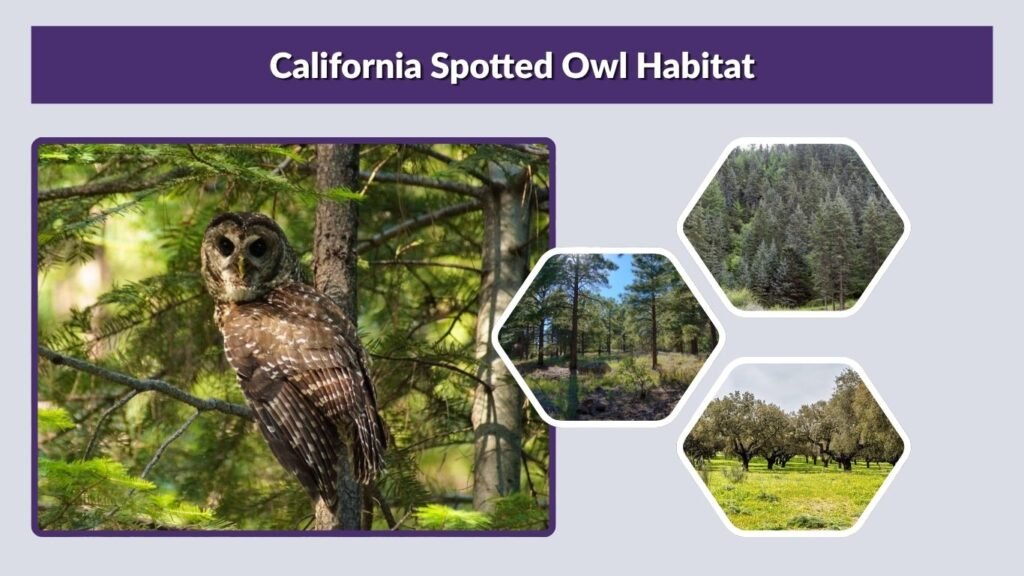
California spotted owls are strongly associated with older forests containing tall trees, high canopy cover, multiple vegetation layers, large branches, standing snags, and fallen logs. These features provide nesting cavities, cool roosting sites, and habitat for their prey.
Forest Types
In the Sierra Nevada, California spotted owls commonly occupy:
- Ponderosa pine forests
- Mixed-conifer forests
- White fir forests
- Mixed-evergreen forests
- Oak woodlands
- Riparian woodlands
In coastal and Southern California, they may live in live oak, big-cone Douglas-fir, redwood, California laurel, and streamside hardwood forests. Nesting areas typically contain more large trees and greater canopy cover than the surrounding landscape.
Nesting and Roosting Habitat
Large, old trees are particularly important because they develop cavities, broken tops, and heavy branches that support nests. Dense foliage also protects resting owls from heat, predators, and disturbance during daylight.
Fallen wood benefits the owls indirectly by providing shelter and food resources for woodrats and other small mammals. California spotted owls may hunt along forest edges and openings, but their nests and daytime roosts are generally located in denser, cooler forest.
Where Do California Spotted Owls Live?
The California spotted owl has a naturally fragmented range extending through several mountain systems. It is not found throughout every part of California.
California Spotted Owl Range
Its distribution includes:
- The Sierra Nevada of California
- A small portion of western Nevada
- California’s Coast Ranges
- The Transverse Ranges
- The Peninsular Ranges
- The Sierra de San Pedro Mártir in northern Baja California
The subspecies occurs in places such as Yosemite, Sequoia and Kings Canyon, and Lassen Volcanic national parks. Its southern populations occupy isolated mountain forests surrounded by dry, unsuitable landscapes, making movement between territories difficult.
Do They Migrate?
California spotted owls generally remain within the same territory throughout the year. However, some Sierra Nevada birds move from mid-elevation breeding forests to lower oak and riparian woodlands during winter. These seasonal movements are relatively short compared with long-distance bird migration.
What Do California Spotted Owls Eat?
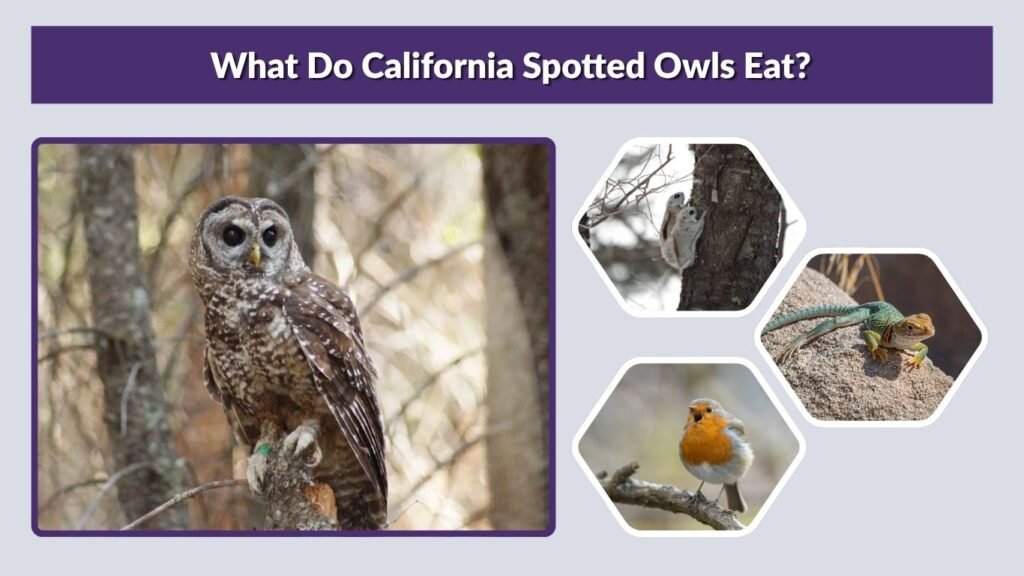
California spotted owls are nocturnal carnivores that specialize in hunting small mammals. The most important prey depends on the owl’s elevation and local habitat.
Common Prey
Their diet includes:
- Northern flying squirrels
- Dusky-footed woodrats
- Mice
- Pocket gophers
- Small birds
- Lizards
- Moths and other insects
Flying squirrels are particularly important at higher elevations, while woodrats are more common in lower-elevation forests and woodlands.
How Do They Hunt?
The owl normally waits quietly on a branch while listening and watching for prey. Its unevenly positioned ear openings help it determine the exact direction of faint sounds in darkness.
Once prey is detected, the owl makes a short, nearly silent flight from its perch. Small animals may be swallowed whole. Fur, bones, teeth, and other indigestible materials are later regurgitated as compact pellets.
California Spotted Owl Call and Behavior
California spotted owls are most active from dusk through the night. During the day, they remain hidden in shaded trees, where their patterned feathers make them difficult to detect.
California Spotted Owl Sound
Pairs communicate using a series of hoots and other vocalizations. Calling is frequently heard around dusk and dawn, particularly when pairs are establishing territories or preparing to breed.
Calls allow owls to locate their mates and warn other spotted owls away from an occupied territory. Males and females may also call to each other during courtship and nesting.
Territorial Behavior
A breeding pair occupies and defends an area surrounding its nesting and roosting sites. California spotted owls often show strong attachment to successful territories and may continue using the same general area for many years.
They are usually quiet and difficult to observe outside the breeding period. Their nocturnal habits and dense habitat make population surveys challenging.
California Spotted Owl Nesting, Eggs and Chicks
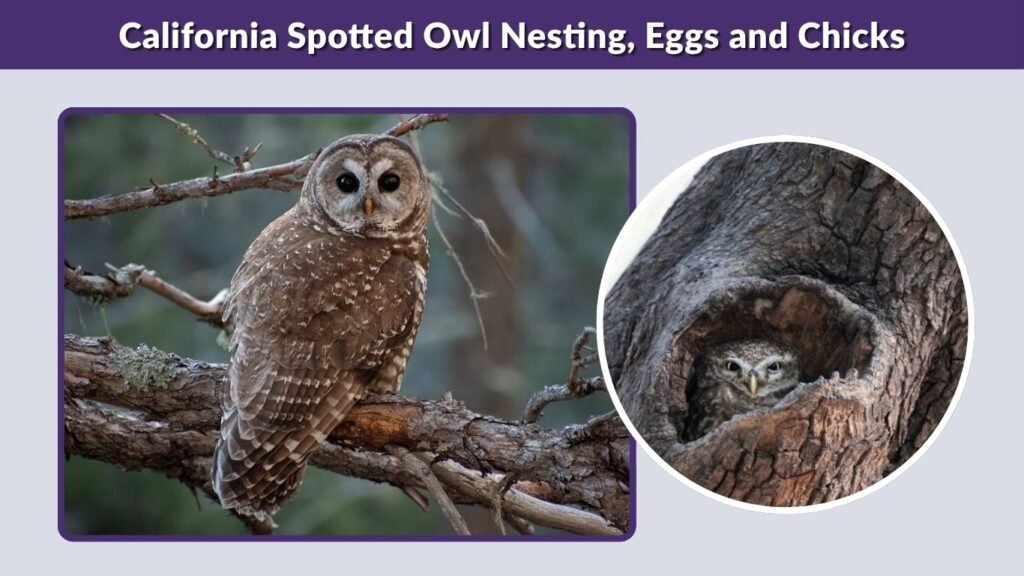
The California spotted owl does not build a traditional nest. Instead, it uses an existing cavity, broken tree top, abandoned raptor nest, or natural platform in a large tree.
Breeding Season
Courtship generally begins around mid-February. The male brings food to the female, and the pair may roost and call together.
The female normally lays about two eggs, although clutches may contain between one and four. She incubates the eggs for approximately one month while the male supplies most of her food. Nesting success varies with weather and food availability, and pairs do not necessarily reproduce every year.
California Spotted Owl Chicks
The chicks hatch covered in soft down and depend entirely on their parents. They remain in the nest for approximately five weeks.
Young owls sometimes leave the cavity before they can fly well and move onto nearby branches. Their parents continue feeding and protecting them through the summer. Juveniles eventually leave their parents’ territory to search for an unoccupied area and a mate.
Is the California Spotted Owl Endangered?
As of July 2026, the California spotted owl’s federal listing remains proposed rather than final. The U.S. Fish and Wildlife Service proposed listing the Coastal–Southern California population as endangered and the Sierra Nevada population as threatened. The federal species profile continues to describe its listing status as “Proposed Endangered and Proposed Threatened.”
Main Threats
California spotted owls face several interconnected threats:
- Severe wildfire: Large, high-intensity fires can destroy nesting trees and remove extensive forest cover.
- Habitat loss: Past timber harvesting reduced large trees, dense canopies, snags, and fallen logs.
- Climate change and drought: Hotter, drier conditions increase tree mortality and wildfire risk.
- Barred owls: Invasive barred owls compete for territories and prey as they expand southward.
- Population isolation: Southern mountain populations are separated by deserts, cities, and other unsuitable habitats.
Research published in 2025 found that occupied territories were rare across surveyed areas of the Los Padres and Angeles national forests. Earlier monitoring also recorded a substantial decline in occupancy within Cleveland National Forest.
Northern Spotted Owl vs California Spotted Owl
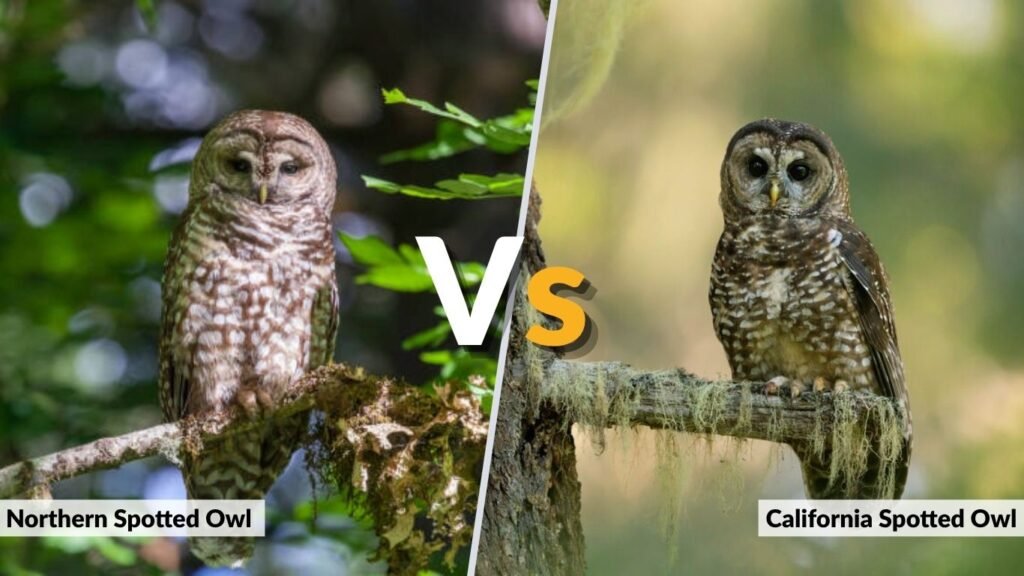
The California and northern spotted owls are subspecies of the same species, but their ranges and average appearance differ.
| Feature | California Spotted Owl | Northern Spotted Owl |
| Scientific name | S. o. occidentalis | S. o. caurina |
| Main range | Sierra Nevada and Southern California | Pacific Northwest and northern California |
| Average appearance | Intermediate brown coloration | Generally larger and darker |
| Typical habitat | Mountain conifer and oak forests | Moist, mature Pacific forests |
| Federal status | Listing proposed | Federally threatened |
Their ranges approach or overlap in northern California, making geographic location important when identifying an individual. The California subspecies is generally lighter than the northern spotted owl but darker than the Mexican spotted owl.
FAQs
What does a California spotted owl eat?
California spotted owls primarily eat northern flying squirrels and woodrats. They also hunt mice, pocket gophers, small birds, lizards, moths, and other available animals. Flying squirrels are especially important at higher elevations, while woodrats dominate diets in many lower forests.
Where does the California spotted owl live?
It lives in the Sierra Nevada, western Nevada, California’s coastal and southern mountain ranges, and northern Baja California. Important habitats include mature conifer forests, oak woodlands, mixed-evergreen forests, and wooded stream corridors.
Is the California spotted owl endangered?
Its Coastal–Southern California population has been proposed for endangered status, while its Sierra Nevada population has been proposed for threatened status. As of July 2026, these federal classifications remain proposed rather than finalized.
How big is a California spotted owl?
Adults measure approximately 18.3 to 19 inches long. Males weigh about 16.6 to 24.2 ounces, while females weigh around 18.9 to 27.3 ounces. Females are usually slightly larger than males.
How long do California spotted owls live?
California spotted owls live approximately 10 to 15 years on average. Their survival depends on suitable forest habitat, adequate prey, successful reproduction, and protection from wildfire, barred owl competition, and other threats.
