
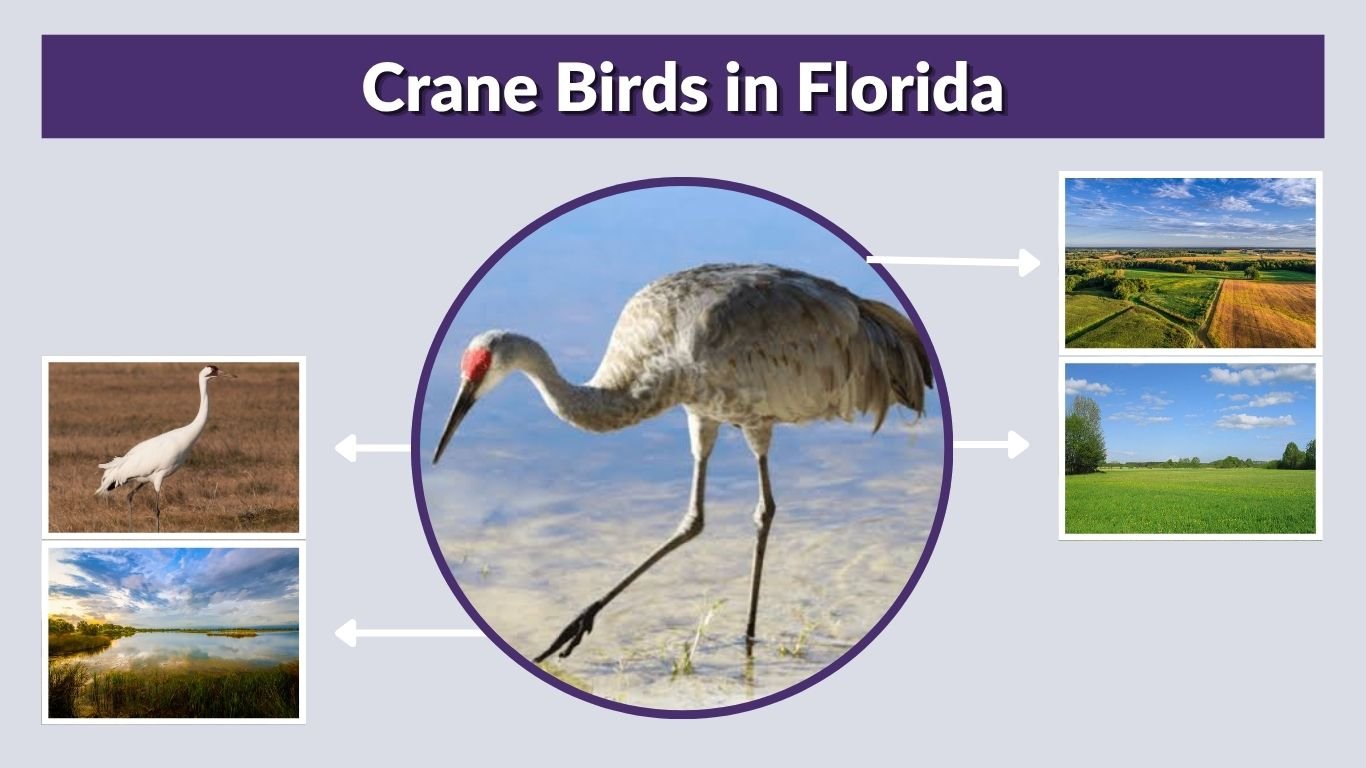
Florida’s freshwater marshes, prairies, pastures, golf courses, and suburban neighborhoods provide excellent habitat for several large, long-legged birds. However, only two true crane species occur in the state: the sandhill crane and the extremely rare whooping crane.
Sandhill cranes are familiar residents in central Florida, while thousands of migratory cranes arrive during winter. Whooping cranes are much harder to find. Several herons, egrets, and storks are also frequently mistaken for cranes because of their similar size and shape.
Types of Crane Birds in Florida
Florida has two crane species, but sandhill cranes are represented by resident and migratory subspecies.
| Type | Appearance | Florida occurrence |
| Florida sandhill crane | Gray body and red crown | Year-round resident |
| Greater sandhill crane | Similar but slightly larger | Winter visitor |
| Whooping crane | White body, red crown and black wingtips | Extremely rare |
1. Florida Sandhill Crane
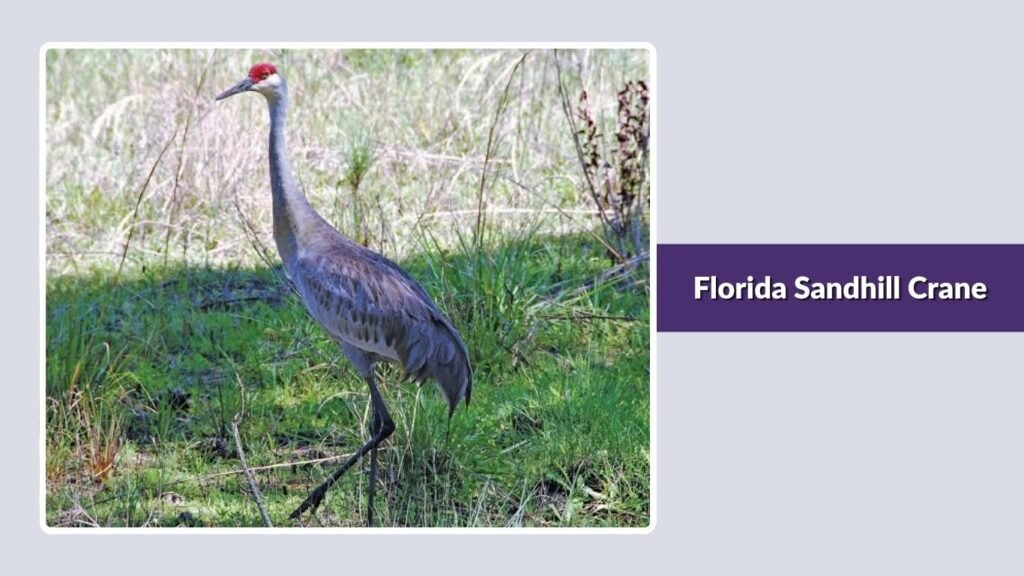
The Florida sandhill crane is the crane most people see walking through neighborhoods, pastures, wetlands, and golf courses. It is a non-migratory subspecies that lives and breeds in peninsular Florida throughout the year.
Identification
- Height: Nearly 4 feet
- Color: Gray, sometimes stained rusty brown
- Head: Red crown with pale cheeks
- Bill: Long, straight, and dark
- Legs: Long and blackish
- Wingspan: Approximately 6–7 feet
Adults have gray plumage, a bare red crown, white cheeks, and a pointed bill. The feathers near the tail form a drooping, bustle-like shape. Juvenile sandhill cranes, called colts, have rusty or cinnamon-colored feathers and lack the bright red crown.
Habitat and Range
Florida sandhill cranes inhabit freshwater marshes, wet prairies, open pastures, shallow ponds, and grassy fields. They occur from the Everglades northward toward the Okefenokee Swamp, although their largest populations are associated with the Kissimmee and DeSoto prairie regions.
They have also adapted to developed areas. Around Orlando, Kissimmee, Tampa, Sarasota, and other central Florida communities, cranes regularly appear beside roads, on lawns, and around golf courses.
Diet
Sandhill cranes are omnivores. Their diet includes:
- Seeds and grains
- Berries and plant roots
- Earthworms and insects
- Frogs and crayfish
- Lizards and snakes
- Mice and other small animals
Unlike herons, sandhill cranes do not normally stand in deep water waiting to catch fish. They usually search the ground or probe shallow soil and mud for food.
Nesting and Family Life
Pairs usually build broad nests from grasses, sticks, moss, and wetland vegetation. The nest is normally positioned in shallow water, which provides some protection from terrestrial predators.
Females commonly lay two eggs. Both parents incubate them and care for the young. Newly hatched colts can leave the nest and follow their parents within approximately 24 hours. Family groups may remain together for around ten months.
2. Greater Sandhill Crane
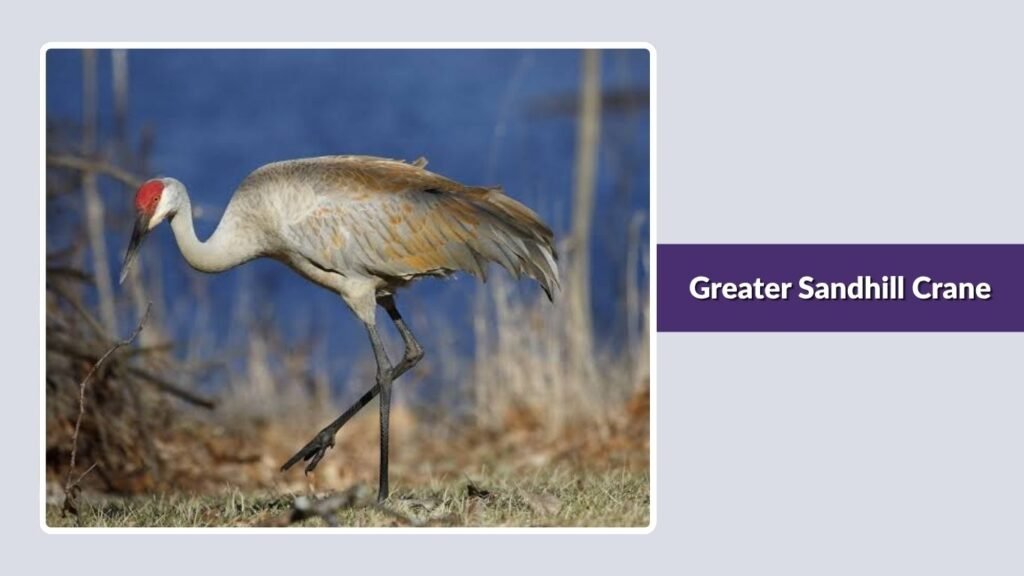
Greater sandhill cranes are winter visitors rather than permanent Florida residents. They breed around the Great Lakes and other northern areas before traveling south.
These cranes look almost identical to Florida sandhill cranes, although greater sandhills are generally larger. Distinguishing the two subspecies in the field can be difficult unless they are standing near each other.
Florida supports an estimated 4,000–5,000 resident Florida sandhill cranes. During winter, they may be joined by approximately 25,000 migratory greater sandhill cranes. Large winter flocks begin arriving around November and December and generally depart during March and April.
Resident cranes are commonly seen in pairs or small family groups. A large field containing dozens or hundreds of cranes during winter is more likely to include migratory greater sandhill cranes.
3. Whooping Crane
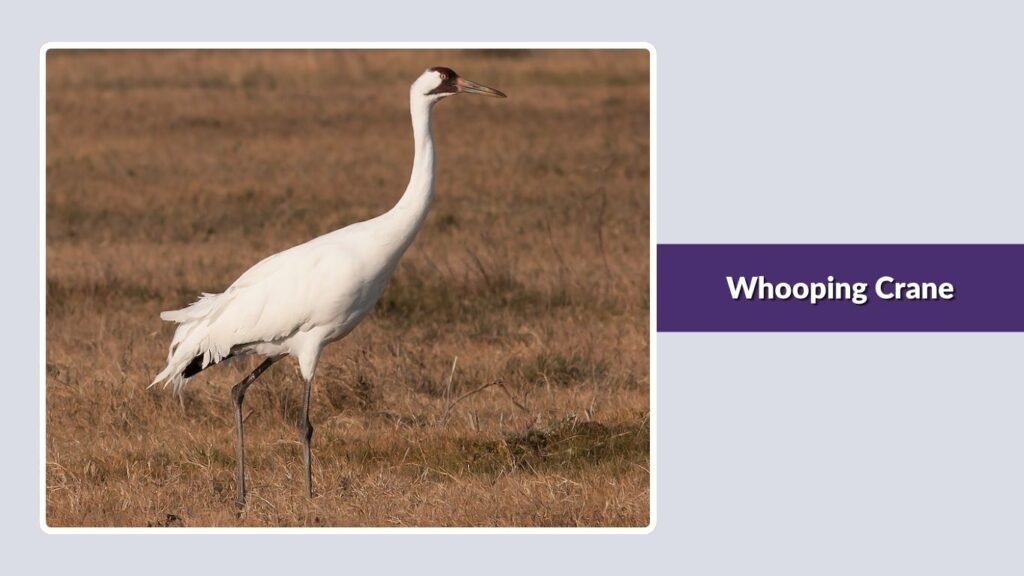
The whooping crane is one of North America’s rarest birds. It is also the tallest bird on the continent, reaching nearly five feet in height with a wingspan of approximately seven to eight feet.
Identification
- Plumage: Almost completely white
- Crown: Bare and red
- Face: Red and black markings
- Legs: Long and black
- Wingtips: Black, mainly visible during flight
- Height: Up to nearly 5 feet
Young whooping cranes are cinnamon brown. They gradually develop white feathers and usually resemble adults by the time they approach one year old.
Are Whooping Cranes the Biggest Birds in Florida?
The answer depends on how “biggest” is measured. A whooping crane is the tallest bird that may be found in Florida, standing noticeably taller than a sandhill crane, heron, egret, or wood stork. However, it is not a common Florida bird.
Florida’s non-migratory whooping crane reintroduction began in 1993, but releases were eventually discontinued because of low reproduction and survival problems. The latest federal recovery report recorded only four cranes remaining in Florida’s non-migratory population in March 2025.
Consequently, a large white bird seen in Florida is much more likely to be an egret, heron, ibis, or wood stork.
Where to See Cranes in Florida
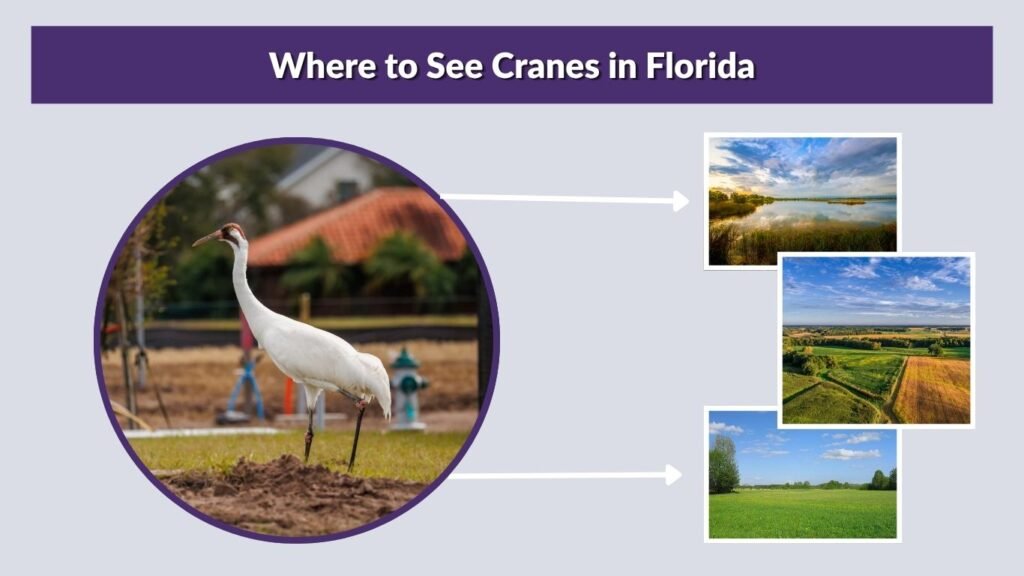
Central Florida offers some of the best opportunities to observe sandhill cranes. Productive areas include the Kissimmee Prairie region, freshwater marshes, ranchlands, wildlife management areas, and open fields around Orlando and Osceola County.
Sandhill cranes are also found near Sarasota, although many large white wading birds around the coast are egrets or wood storks rather than cranes. South Florida has fewer resident sandhill cranes than central Florida, but sightings remain possible in prairies, wetlands, agricultural areas, and the northern Everglades region.
During winter, open wetlands and agricultural fields may attract large gatherings of migratory cranes.
Crane-Like Birds in Florida
Several Florida birds are regularly confused with cranes.
Great Blue Heron
A so-called “blue crane” in Florida is usually a great blue heron. Great blue herons have blue-gray plumage, long yellowish bills, and dark stripes above the eyes.
The easiest difference appears during flight. A crane flies with its neck extended straight ahead. A heron folds its neck into an S-shape.
The true Blue Crane is an African species and is not a native wild bird of Florida.
Great Egret
A tall white crane-like bird is frequently a great egret. Great egrets have pure white feathers, yellow bills, and black legs. They stand beside ponds, rivers, canals, and coastal wetlands while hunting fish.
Unlike whooping cranes, great egrets lack a red crown and fly with their necks folded.
Wood Stork
Wood storks are large white birds with black flight feathers. Adults have bare, dark heads and thick, curved bills. They may resemble whooping cranes from far away, especially when flying.
White Ibis
White ibises are considerably smaller than cranes. Adults have white bodies, reddish legs, and long, downward-curving red bills. They commonly gather on lawns and around shallow wetlands.
Living Safely with Florida Cranes
Sandhill cranes frequently cross roads and walk through residential properties. Drivers should slow down when cranes or their young are nearby because family groups may cross one bird at a time.
People should never intentionally feed them. Feeding sandhill cranes is prohibited in Florida because it can cause the birds to lose their natural fear of humans, approach roads, damage property, or become aggressive while demanding food.
The Florida sandhill crane is protected under the Migratory Bird Treaty Act and is designated as a threatened species by the state. Its major threats include wetland loss, development, vehicle collisions, and power-line strikes.
FAQs
What crane birds live in Florida?
Florida has sandhill cranes and a very small number of whooping cranes. Sandhill cranes include the resident Florida subspecies and the migratory greater sandhill crane, which arrives during winter.
Are sandhill cranes common in Orlando?
Yes. Sandhill cranes are frequently seen around Orlando’s wetlands, subdivisions, golf courses, grassy roadsides, and open fields. Central Florida contains some of the state’s strongest resident populations.
What is the big gray bird with a red head in Florida?
It is most likely a sandhill crane. Adults have gray bodies, long legs, pale cheeks, pointed bills, and distinctive patches of red skin on their crowns.
What is the large white crane-like bird in Florida?
Most sightings involve great egrets, wood storks, white ibises, or white herons. A true white whooping crane is possible but exceedingly rare.
How can you distinguish a crane from a heron?
Watch the bird in flight. Cranes fly with their necks stretched straight forward, while herons and egrets retract their necks into an S-shaped position. Cranes also tend to forage by walking through open fields and shallow wetlands.
