
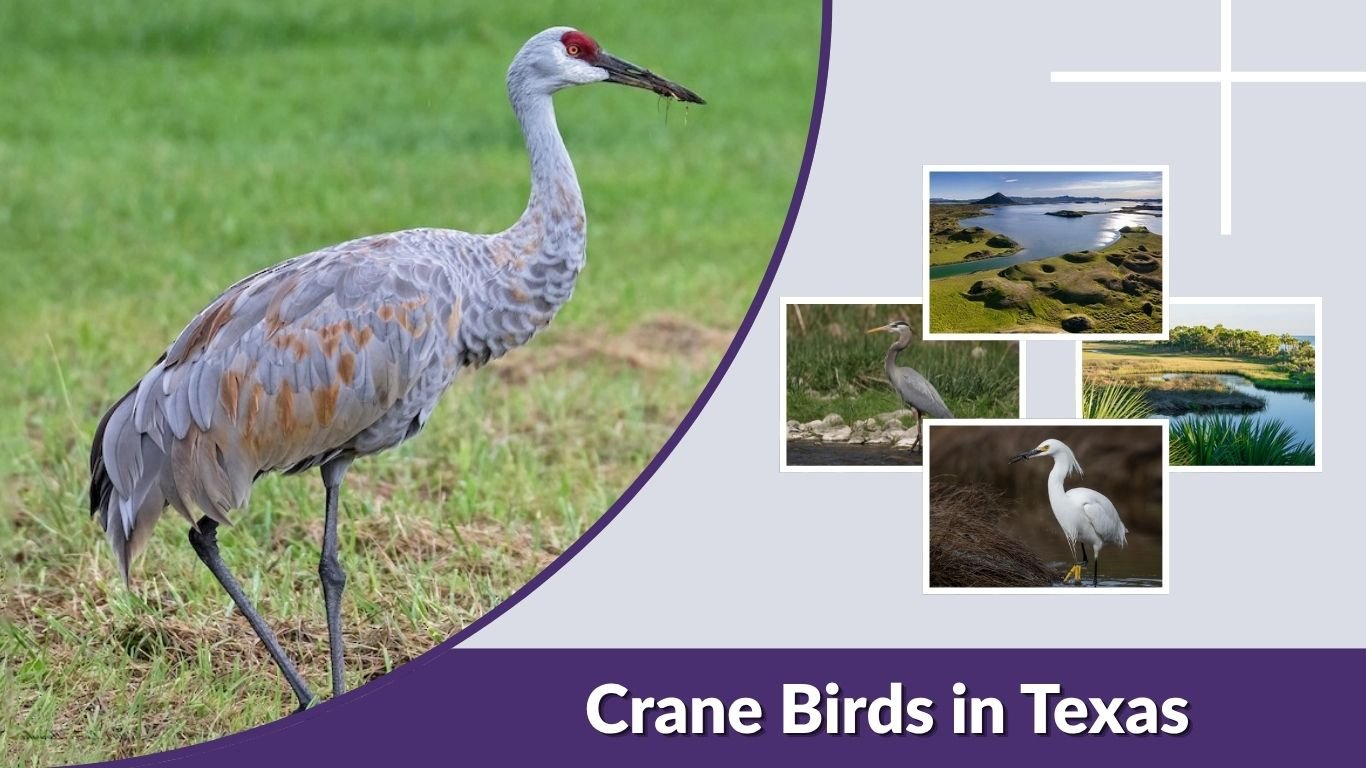
Texas provides important wintering and migration habitat for thousands of crane birds. These tall, long-legged birds gather in wetlands, grasslands, agricultural fields, and coastal marshes, where their loud calls can be heard from considerable distances.
Only two true crane species regularly occur in Texas: the Sandhill Crane and the endangered Whooping Crane. However, herons, egrets, storks, and other large wading birds are frequently mistaken for cranes. Knowing their colors, flight posture, calls, and preferred habitats makes identification much easier.
Types of Crane Birds in Texas
Although people sometimes report several different types of crane birds in Texas, the state’s regular crane diversity consists of two species.
| Crane species | Main color | Height | Texas status | Best places to see it |
| Sandhill Crane | Gray, sometimes rusty brown | 3–4 feet | Common migrant and winter visitor | Panhandle, West Texas, agricultural areas |
| Whooping Crane | White with black wingtips | About 5 feet | Rare, endangered winter visitor | Central Texas coast near Aransas |
1. Sandhill Crane
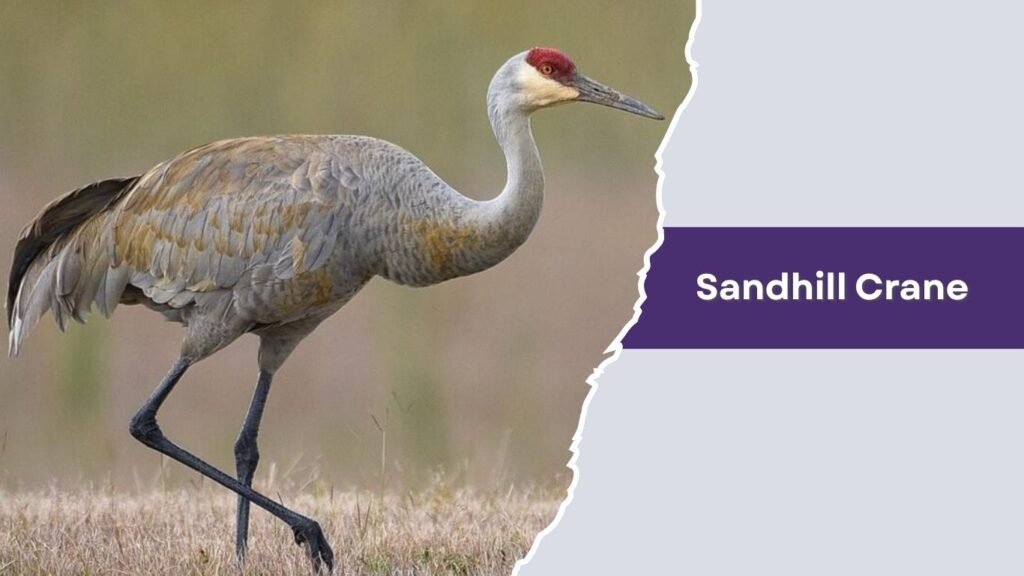
The Sandhill Crane is the most common crane bird in Texas. Huge flocks arrive during fall and spend the colder months in the state before returning north in spring. Their numbers, noisy behavior, and habit of feeding in open fields make them relatively easy to find.
Identification
- Gray body with long, dark legs
- Bare red patch on the forehead
- Long, straight, pointed bill
- Wingspan commonly approaching 6–7 feet
- Long neck remains extended during flight
- Some birds have rusty or brown-stained feathers
- Usually travels in pairs, family groups, or large flocks
The brown coloration does not necessarily indicate a separate species. Sandhill Cranes sometimes rub iron-rich mud onto their feathers, producing rusty patches across an otherwise gray body.
Habitat and Range in Texas
Sandhill Cranes are particularly numerous in the Texas Panhandle, High Plains, and portions of West Texas. They use shallow lakes, playa wetlands, reservoirs, grasslands, and cultivated fields. Wintering flocks often leave their nighttime roosts around sunrise and fly to nearby fields.
North and Central Texas also receive migrating flocks. Their routes vary with weather, water availability, and food conditions. Some birds continue toward the Gulf Coast, while others spend winter farther west.
Diet
Sandhill Cranes are opportunistic omnivores. In Texas, they commonly eat waste grain left in harvested corn, wheat, sorghum, and peanut fields. They also consume seeds, roots, insects, worms, snails, frogs, lizards, and small mammals.
Call
A Sandhill Crane produces a loud, rolling, rattling call. Its long windpipe helps create a powerful sound that can carry for more than a mile under favorable conditions. A flock passing overhead may be heard before it becomes visible.
2. Whooping Crane
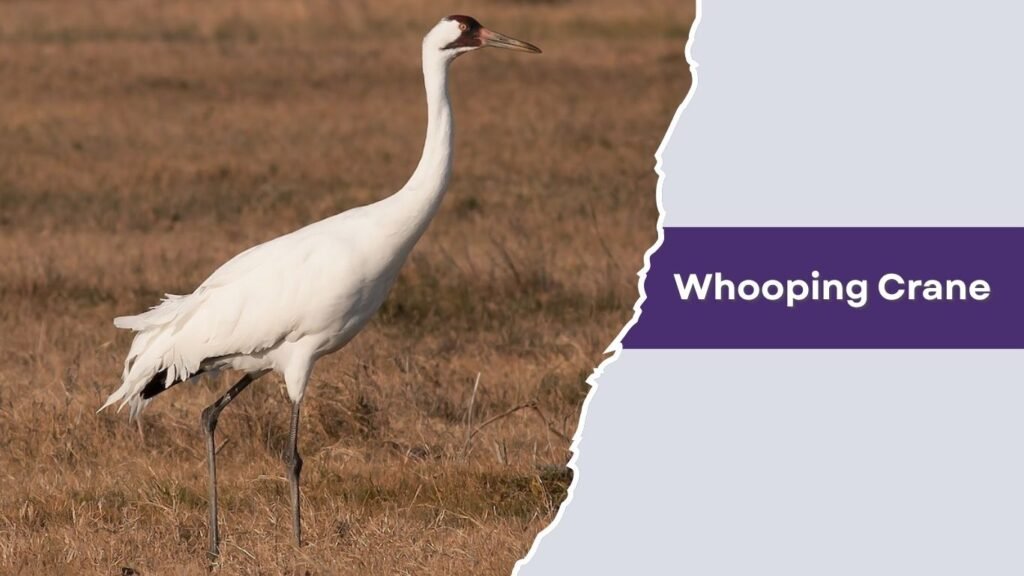
The Whooping Crane is the rarest and most celebrated Texas crane bird. It is North America’s tallest bird, standing approximately five feet tall with a wingspan exceeding seven feet. Each year, the natural migratory population travels between northern Canada and the Texas coast. Texas Parks and Wildlife identifies Aransas National Wildlife Refuge near Rockport as its principal wintering area.
Identification
- Nearly all-white adult plumage
- Red crown and facial markings
- Long, dark bill
- Long black legs
- Black wingtips visible during flight
- Long neck held completely straight
- Juveniles have cinnamon-brown feathers
When standing, a Whooping Crane’s black flight feathers are mostly hidden. They become obvious when the bird spreads its wings. This feature helps distinguish it from white herons and egrets.
Texas Migration
Whooping Cranes begin moving south from Canada in September. Most reach their Texas wintering grounds from late October through November. Their route may carry them from the Panhandle toward Dallas–Fort Worth and then south through Central Texas to the coast.
The natural Aransas–Wood Buffalo population migrates between Aransas National Wildlife Refuge and Wood Buffalo National Park in Canada. It is the world’s only naturally occurring, self-sustaining migratory population of this species.
Winter Habitat and Diet
On the Texas coast, Whooping Cranes inhabit salt marshes, tidal flats, shallow bays, coastal prairies, and freshwater wetlands. They feed on blue crabs, clams, snails, insects, frogs, small fish, berries, and plant material.
Pairs and family groups may defend individual feeding territories. Unlike Sandhill Cranes, Whooping Cranes usually do not form enormous winter flocks.
Where to See Crane Birds in Texas
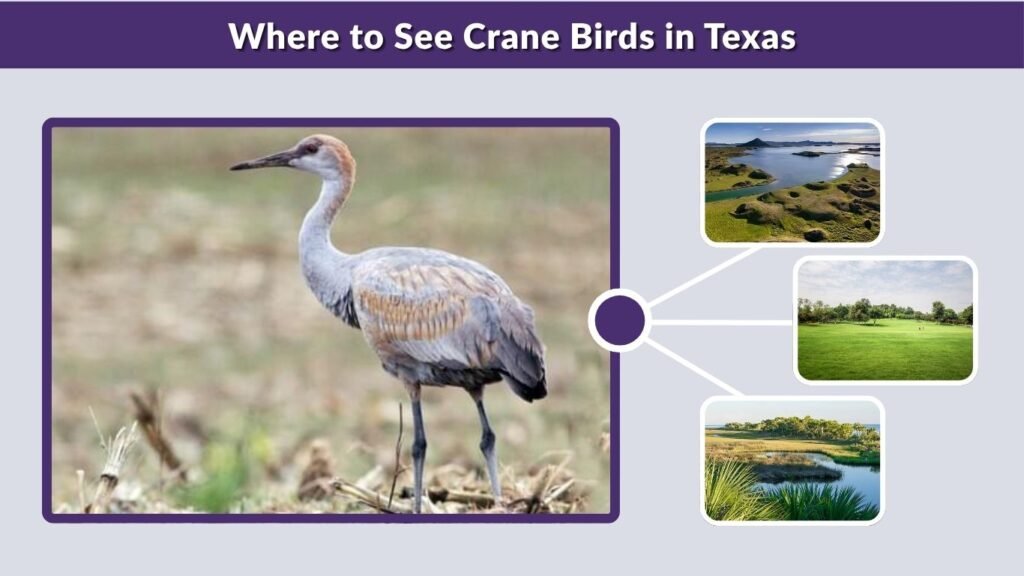
The best viewing location depends on which species you want to find.
Texas Panhandle and West Texas
The Panhandle, High Plains, and western agricultural regions provide some of the best opportunities to see Sandhill Cranes. Look near shallow lakes, open fields, playa wetlands, and reservoirs from late fall through winter.
Early morning and late afternoon are usually the most productive times. Cranes leave their roosts in the morning, feed during the day, and return near sunset.
North and Central Texas
Sandhill Cranes regularly pass over North and Central Texas during migration. Whooping Cranes also travel through a broad corridor that can include areas near Wichita Falls, Fort Worth, Waco, Austin, and Victoria.
Migrating birds may stop at reservoirs, flooded fields, river shallows, or isolated wetlands. Whooping Crane stopovers are typically brief, so sightings away from the coast are unpredictable.
Texas Gulf Coast
The central Gulf Coast is the premier location for observing Whooping Cranes. Aransas National Wildlife Refuge and surrounding areas between Rockport and Seadrift support the main wintering population. Boat tours operating around the coastal marshes may offer distant but valuable views.
South and East Texas
Sandhill Cranes may winter in suitable parts of South Texas, especially where open agricultural land occurs near wetlands. In heavily wooded East Texas, true cranes are generally less conspicuous. Many reported East Texas crane birds are actually Great Blue Herons, Great Egrets, or other wading birds.
Crane-Like Birds in Texas
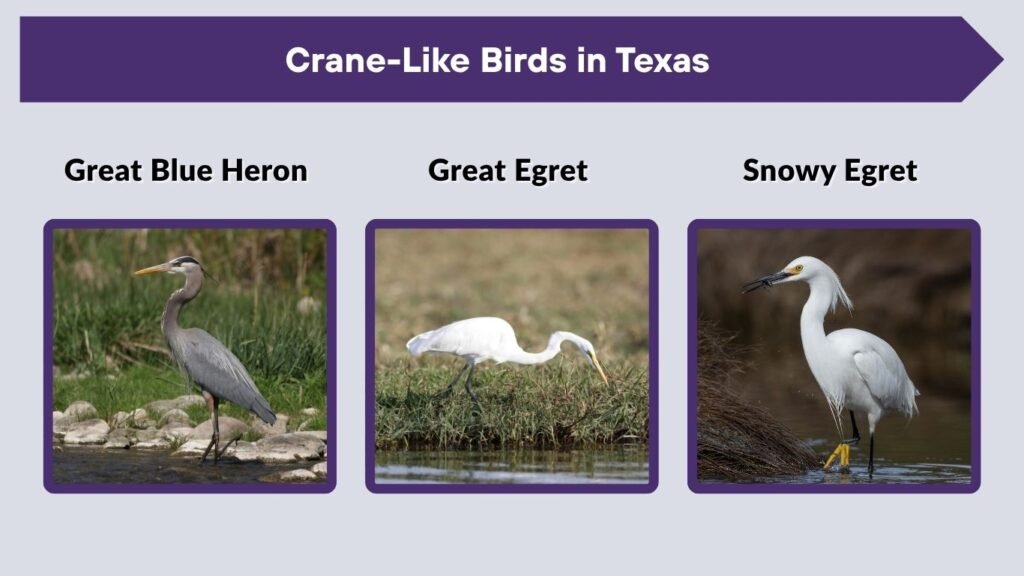
Several large Texas birds have the same long legs, long bills, or wetland habits as cranes.
| Bird | How it differs from a crane |
| Great Blue Heron | Blue-gray body; flies with its neck folded |
| Great Egret | White body, yellow bill, black legs; folds its neck in flight |
| Snowy Egret | Smaller white bird with a black bill and yellow feet |
| Wood Stork | White body, black flight feathers, and bald dark head |
| American White Pelican | Very large white waterbird with a long yellow-orange bill |
| Roseate Spoonbill | Pink plumage and a broad, spoon-shaped bill |
| Limpkin | Brown, white-spotted body and slightly curved bill |
White Crane-Like Birds
A white crane bird in Texas may be a Whooping Crane, but Great Egrets are considerably more common. A Whooping Crane is much taller and has a red crown, a straight neck in flight, and black wingtips. A Great Egret has a yellow bill and retracts its neck into an S-shape while flying.
Gray Crane Birds
A large gray bird standing in an open field may be a Sandhill Crane. However, a gray bird hunting alone beside a pond is more likely a Great Blue Heron. Sandhill Cranes frequently travel in groups and have a visible red forehead.
Black or Brown Crane-Like Birds
Texas does not have a regularly occurring native black crane species. A dark crane-like bird could be an immature heron, an Anhinga, or another large waterbird.
A brown crane-like bird in South Texas may be a rust-stained Sandhill Crane, a juvenile Whooping Crane, a Limpkin, or a young heron. Neck position during flight is one of the most useful identification clues.
Crane Versus Turkey
Sandhill Cranes are occasionally mistaken for Wild Turkeys when seen feeding in distant fields. Both are large birds that may appear in groups, but cranes are taller, slimmer, and longer-necked.
In flight, cranes hold their necks and legs fully extended. Turkeys have short necks, broad rounded wings, and fan-shaped tails. A crane also flies with slow, deep wingbeats and frequently calls while airborne.
Are Crane Birds Protected in Texas?
Whooping Cranes are federally endangered and completely protected. Observers should remain at a respectful distance and avoid approaching, feeding, or disturbing them.
Sandhill Cranes are managed as migratory game birds in designated parts of Texas. Hunting them requires the appropriate licenses and permits and is governed by specific zones, dates, and regulations. Because endangered Whooping Cranes can sometimes occur near Sandhill Cranes, correct identification is essential.
FAQs
What is the most common crane bird in Texas?
The Sandhill Crane is the most common Texas crane. Large numbers migrate into the state each fall and spend winter in the Panhandle, West Texas, and other open agricultural regions. Their gray bodies, red foreheads, loud rattling calls, and habit of gathering in flocks make them recognizable.
Are Whooping Cranes native to the Texas Gulf Coast?
Whooping Cranes are native North American birds, but they do not normally breed on the Texas coast. The natural migratory population nests in northern Canada and uses the central Texas coast as its winter home, particularly the salt marshes surrounding Aransas National Wildlife Refuge.
When do cranes migrate through Texas?
Fall crane migration generally occurs from October through November, although some birds may arrive earlier or later. Spring migration begins around March and continues into April. Sandhill Crane timing varies among populations, while most Whooping Cranes leave their Texas winter territories by late April.
How can I distinguish a crane from a heron in flight?
A crane flies with its long neck stretched straight forward and its legs trailing behind. A heron pulls its neck backward into a compact S-shape. Cranes also have broader wings, steadier wingbeats, and louder rolling calls, while herons are usually quieter and often travel alone.
What should I do if I see a Whooping Crane?
Observe it from a considerable distance, avoid making loud noises, and never attempt to approach or flush it. Record the location, time, number of birds, and identifying features. Sightings can be submitted through the Texas Whooper Watch citizen-science project operated by Texas Parks and Wildlife.
