
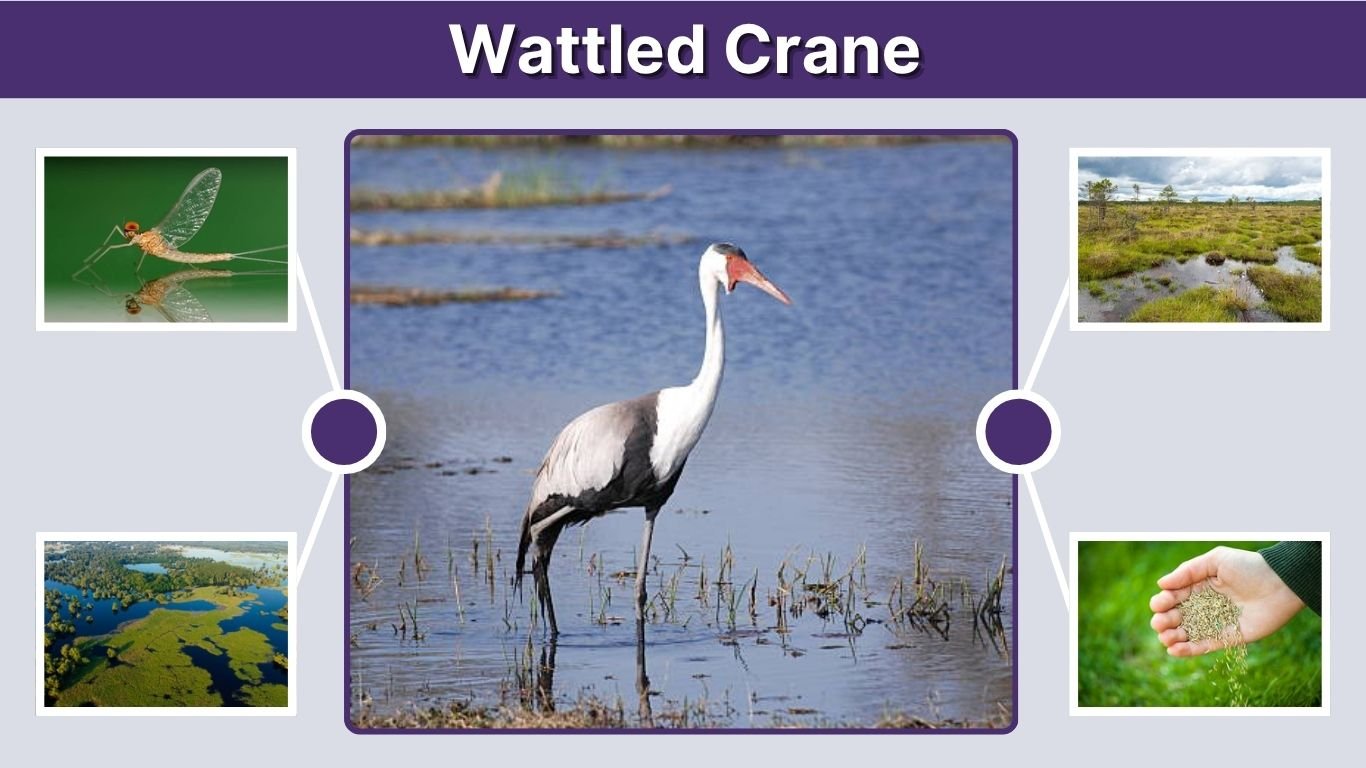
The Wattled Crane (Bugeranus carunculatus, also classified as Grus carunculatus by some authorities) is Africa’s largest crane and one of the continent’s most wetland-dependent birds. It has a long white neck, grey wings, black underparts, red facial skin, and distinctive feathered wattles hanging beneath its throat. Wattled Cranes inhabit shallow wetlands and floodplains across sub-Saharan Africa, where they feed mainly on aquatic plant roots, seeds, grains, and small animals.
Wattled Crane Quick Facts
Wattled Cranes are tall, heavy birds with exceptionally long legs and necks. Their dependence on permanent and seasonally flooded wetlands makes them especially sensitive to changes in water levels and wetland management.
| Feature | Description |
| Scientific name | Bugeranus carunculatus |
| Alternative classification | Grus carunculatus |
| Family | Gruidae |
| Height | Up to about 172 cm or 5.6 feet |
| Weight | Around 7.5–8.4 kg |
| Diet | Aquatic plants, seeds, grain and small animals |
| Range | Sub-Saharan Africa |
| Typical clutch | Usually one egg; occasionally two |
| Global population | Fewer than approximately 9,600 |
| Global status | Vulnerable |
| South African status | Endangered |
The species occurs in about 11 African countries. More than half of the world’s Wattled Cranes are found in Zambia, while Botswana’s Okavango Delta supports one of the largest concentrations.
What Does a Wattled Crane Look Like?
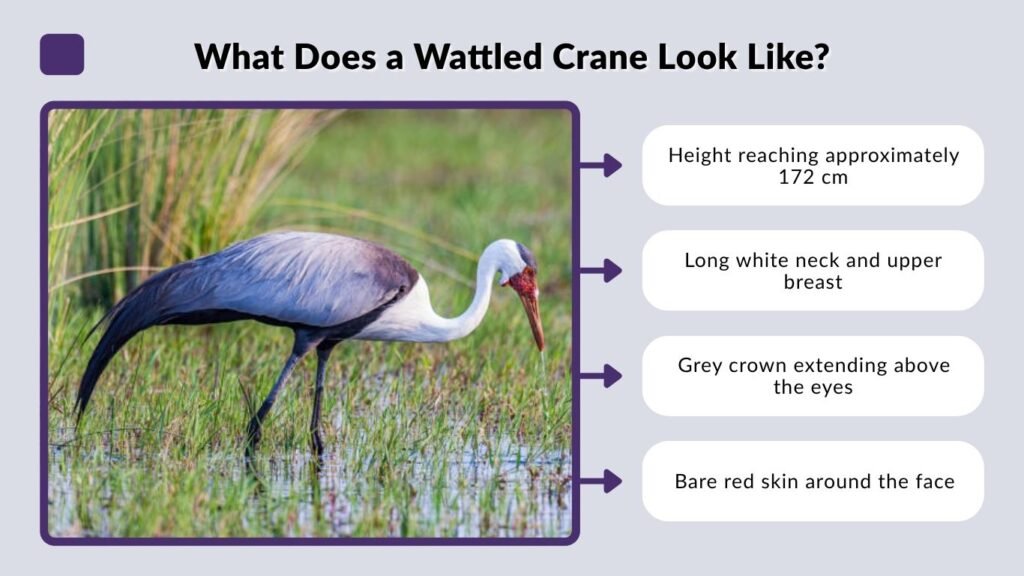
The Wattled Crane is a stately bird with a slender white neck and contrasting grey, black, red, and white plumage. Its name comes from the two feather-covered folds that hang from the upper throat.
Identification Features
- Height reaching approximately 172 cm
- Long white neck and upper breast
- Grey crown extending above the eyes
- Bare red skin around the face
- Two white feathered throat wattles
- Ash-grey back and upper wings
- Black breast, flight feathers and tail coverts
- Long black legs and toes
- Long, pointed pinkish or reddish bill
- Orange or reddish-brown eyes
Males and females look similar, although males are usually slightly larger. Juveniles have tawny-brown plumage, lack the adult’s red facial skin, and possess much smaller wattles.
Wattled Crane Size
The Wattled Crane is the largest crane species in Africa and the second-tallest crane in the world after the Sarus Crane. Adults commonly weigh around 7.5–8.4 kg, although individual measurements vary.
Its long legs allow it to walk through relatively deep wetlands, while its long bill helps it reach plant material growing beneath the water.
Where Do Wattled Cranes Live?
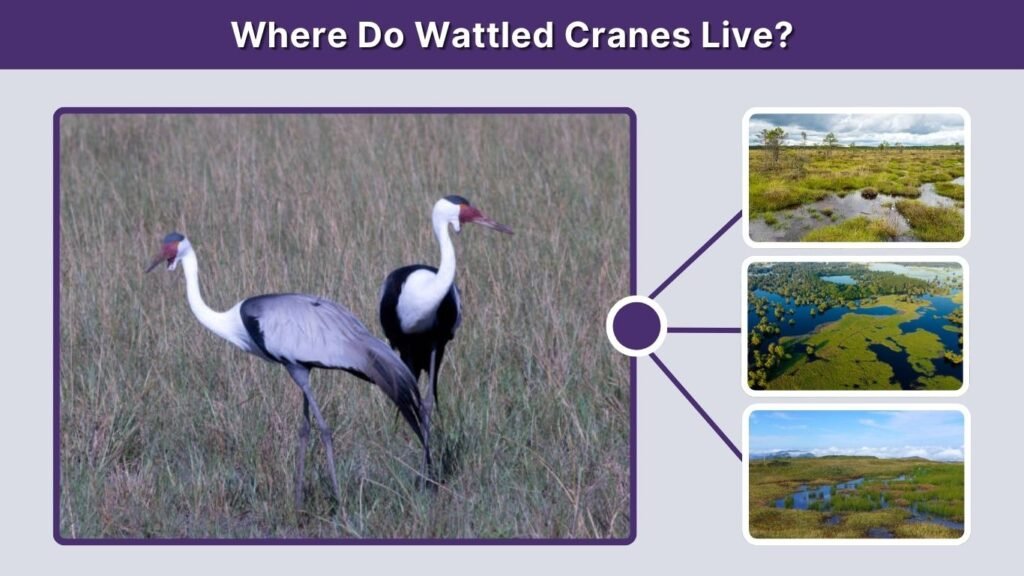
Wattled Cranes have a scattered distribution across eastern, central, and southern Africa. Important populations occur in Zambia, Botswana, Angola, the Democratic Republic of the Congo, Ethiopia, Tanzania, Mozambique, Zimbabwe and South Africa.
The largest population is associated with Zambia’s major floodplains, while Botswana’s Okavango Delta is another important stronghold. Ethiopia supports a smaller, geographically isolated highland population.
Preferred Habitat
Wattled Cranes primarily inhabit:
- Shallow freshwater wetlands
- Large river floodplains
- Permanent sedge marshes
- Seasonally flooded grasslands
- High-altitude marshes
- Open grasslands beside wetlands
- Agricultural land near natural feeding areas
They are considered the most wetland-dependent crane species in Africa. Breeding pairs need quiet, shallow wetlands with extensive vegetation, while nearby grasslands provide additional feeding habitat for adults and growing chicks.
Movement and Migration
Wattled Cranes are not regular long-distance migrants. However, many move locally as floodwaters rise, fall, or shift between river systems.
Breeding pairs may remain close to established territories, while non-breeding birds travel farther in search of suitable feeding and roosting conditions. In South Africa, some non-breeding birds move more than 100 km between seasonal locations.
What Do Wattled Cranes Eat?
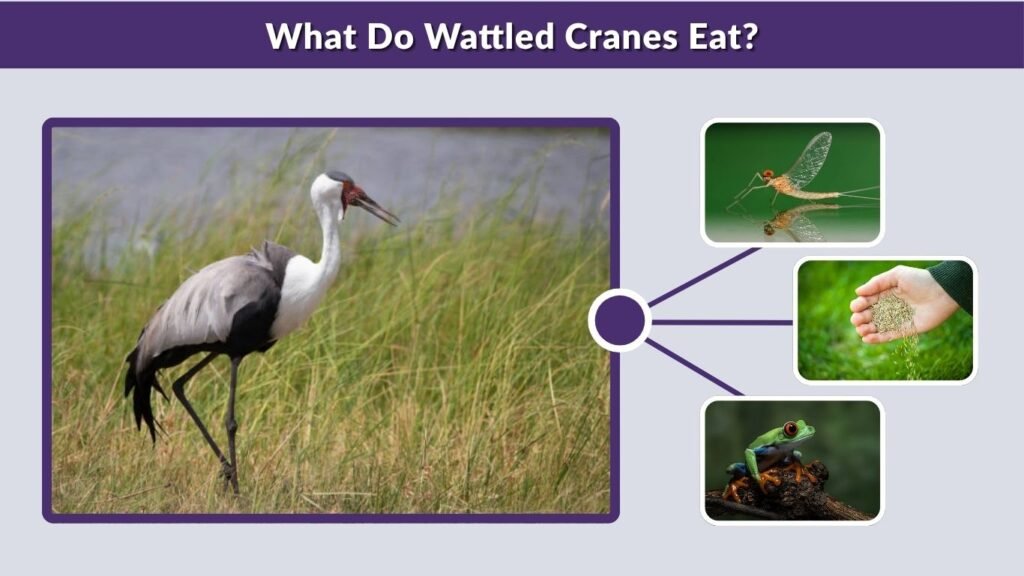
Wattled Cranes are omnivores, but aquatic vegetation forms a major part of their diet. They spend long periods walking through shallow water and probing soft mud with their bills.
Common Foods
Their diet includes:
- Tubers and rhizomes of aquatic sedges
- Eleocharis roots and underground stems
- Grass seeds
- Cereal grain
- Aquatic insects
- Worms and snails
- Frogs
- Small reptiles
- Small fish and other aquatic animals
The bird’s long bill is particularly well adapted for digging up nutritious underground plant parts. It may also feed in grasslands and cultivated fields when grain, insects, or other foods are available.
Behavior, Call and Adaptations
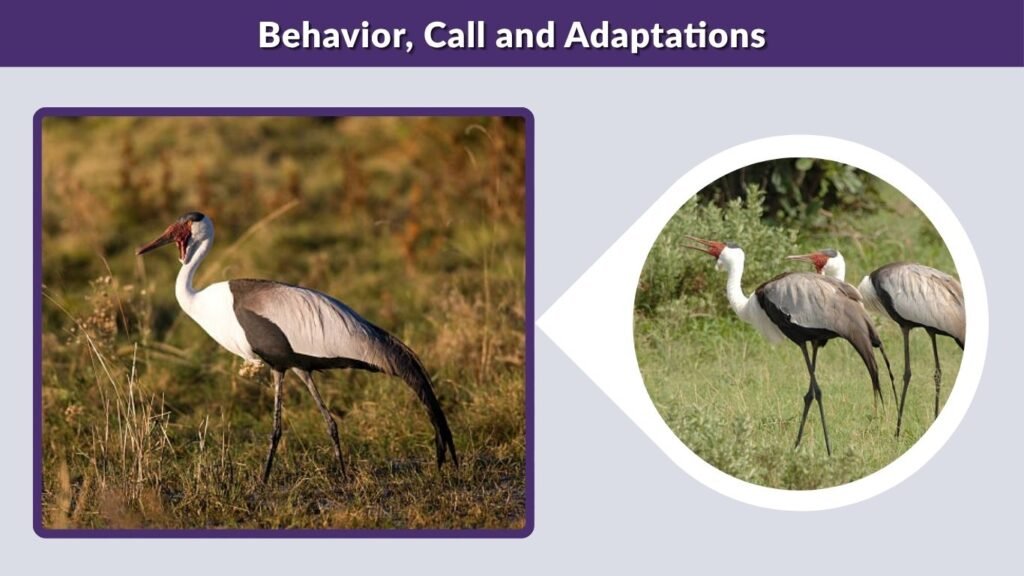
Wattled Cranes are usually seen alone, in breeding pairs, family groups, or loose non-breeding flocks. They spend much of the day feeding and may roost together in shallow wetlands at night.
Wattled Crane Call
Their calls include loud, far-carrying crane notes used for communication between partners and family members. The guard call is a sharp, single note produced when a bird detects possible danger.
Pairs may also perform coordinated calls during territorial and courtship displays. These vocalizations help maintain pair bonds and advertise ownership of a breeding wetland.
Dance and Courtship
Courtship displays include bowing, jumping, running, wing spreading, head tossing, and throwing vegetation into the air. Dancing is most closely connected with courtship, but young and non-breeding cranes may also perform these movements.
Wattled Cranes generally form long-term monogamous pair bonds. Both members of a pair participate in defending their territory, building the nest, incubating eggs, and raising the chick.
Wattled Crane Nesting, Eggs and Chicks
Breeding usually occurs when wetland conditions provide shallow water, dense vegetation, and reliable food. The exact breeding period varies according to rainfall and local flooding.
Nest Construction
Both adults build a large platform from grasses, reeds, sedges, and other wetland vegetation. The nest is normally surrounded by shallow water, which helps discourage some land-based predators.
Wattled Cranes are sensitive to disturbance around their nests. Changes in water depth, livestock activity, wetland burning, or repeated human visits can cause nesting failure.
Eggs and Incubation
The female usually lays one egg, although some pairs produce two. This gives the Wattled Crane one of the lowest reproductive rates among cranes.
Both parents incubate the egg for approximately 36–40 days—the longest incubation period reported for any crane. The chick can walk soon after hatching but remains dependent on its parents for food, protection, and guidance.
Wattled Crane Lifespan and Predators
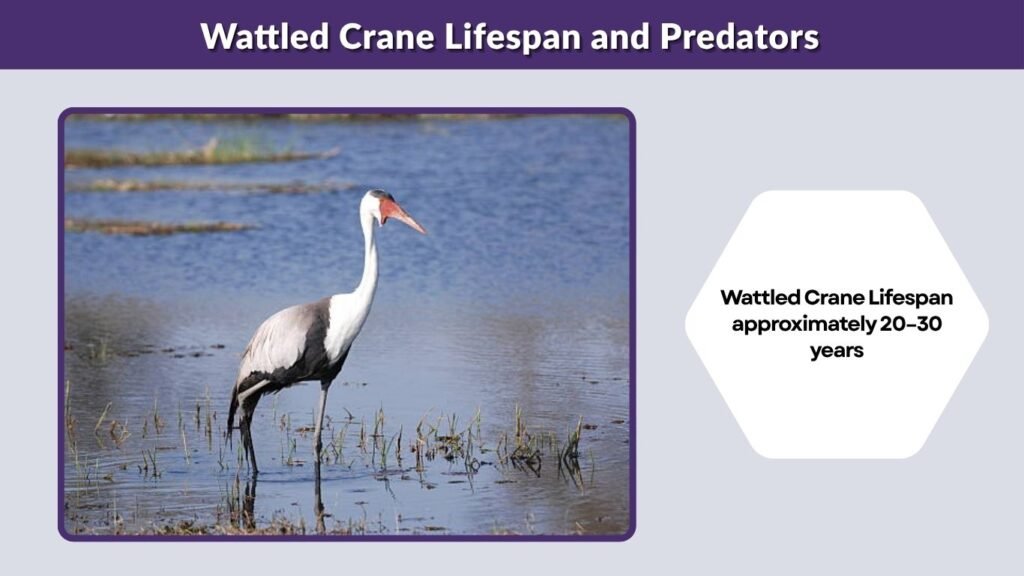
The exact average lifespan of wild Wattled Cranes has not been established through sufficient long-term studies. Managed-care estimates commonly suggest approximately 20–30 years, but wild birds may experience very different survival conditions.
Eggs and chicks may be threatened by snakes, monitor lizards, jackals, domestic dogs, and large birds of prey. Adult cranes are safer because of their large size, vigilance, powerful bill, and ability to fly, but they remain vulnerable to power-line collisions and human activity.
Wattled Cranes in South Africa
South Africa’s Wattled Cranes are concentrated mainly in the wetlands and grasslands of KwaZulu-Natal, especially the Midlands and southern Drakensberg. Smaller numbers occur in Mpumalanga, the Eastern Cape, and the Free State.
The country’s regional classification improved from Critically Endangered to Endangered in 2025. BirdLife South Africa estimated approximately 213 mature individuals, while a 2024 survey counted 304 birds in the population stronghold. The improvement reflects decades of habitat protection, monitoring, cooperation with landowners, and efforts to reduce power-line deaths.
Why Is the Wattled Crane Vulnerable?
The Wattled Crane is globally classified as Vulnerable, with fewer than approximately 9,600 birds remaining. Its dependence on large, healthy wetlands means that habitat changes can quickly affect breeding and feeding opportunities.
Main Threats
Major threats include wetland drainage, dams that alter natural flooding, agricultural expansion, commercial forestry, mining, invasive plants, inappropriate burning, livestock disturbance, pesticide exposure, power-line collisions, and illegal collection of eggs or chicks.
Conservation work focuses on restoring wetlands, protecting breeding territories, improving land management, marking dangerous power lines, monitoring populations, and maintaining professionally managed breeding programs.
FAQs
Why is it called a Wattled Crane?
The bird is named after the two elongated, feather-covered folds hanging beneath its throat. These wattles become especially noticeable when the crane raises its head, calls, or performs a courtship display.
How tall is a Wattled Crane?
An adult may stand approximately 172 cm, or about 5.6 feet tall. Its exceptional height makes it the largest crane in Africa and one of the tallest flying birds on the continent.
What does a Wattled Crane eat?
Its main foods are aquatic sedge tubers and rhizomes. It also consumes seeds, grain, insects, worms, frogs, small reptiles, and other small animals found in wetlands and surrounding grasslands.
How many eggs does a Wattled Crane lay?
Most females lay only one egg, although two-egg clutches occasionally occur. The egg is incubated by both parents for approximately 36–40 days.
Where can Wattled Cranes be seen?
Major wild populations occur in Zambia’s floodplains and Botswana’s Okavango Delta. They can also be found in parts of Angola, Ethiopia, Tanzania, Mozambique, Zimbabwe, the Democratic Republic of the Congo, and South Africa.
