
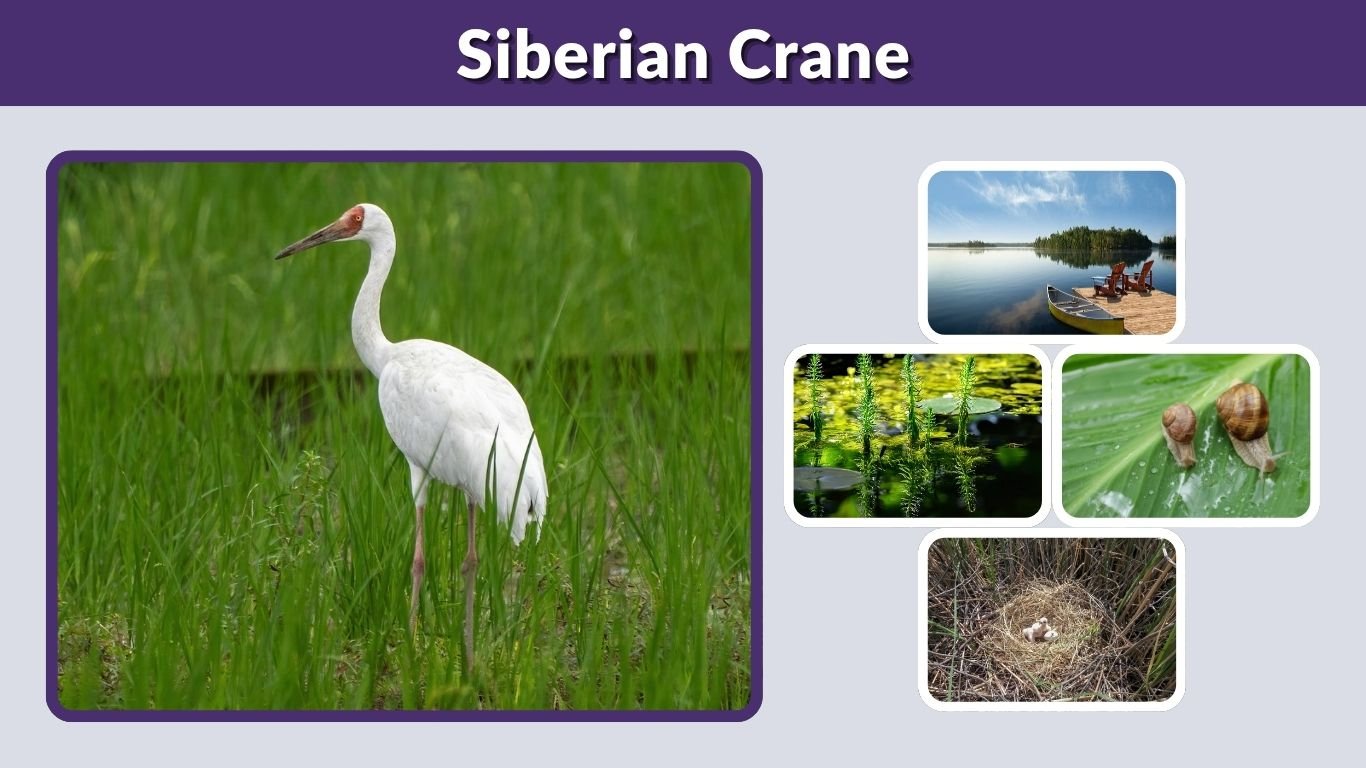
The Siberian Crane (Leucogeranus leucogeranus) is a tall white crane known for its long migrations between Arctic Russia and wintering wetlands in Asia. Adults have snowy white plumage, a red face, long reddish legs, and black wing tips visible during flight. Although more than 5,500 birds may remain, almost all belong to the eastern population that winters in China. The western and central populations that once travelled to Iran and India are now nearly extinct.
Siberian Crane Quick Facts
The Siberian Crane is also called the Siberian White Crane or Snow Crane. Older sources often use the scientific name Grus leucogeranus, but many current authorities place it in the separate genus Leucogeranus.
| Feature | Description |
| Scientific name | Leucogeranus leucogeranus |
| Older scientific name | Grus leucogeranus |
| Family | Gruidae |
| Height | About 140 cm or 5 feet |
| Weight | Approximately 6 kg or 13 pounds |
| Wingspan | Around 2.1–2.3 metres |
| Main habitat | Shallow freshwater wetlands |
| Diet | Roots, tubers, fruits and small animals |
| Typical clutch | Two eggs |
| Conservation status | Critically Endangered |
| Estimated population | More than 5,500 |
The current eastern population is stable or increasing, but the historic western and central groups are extremely close to extinction.
What Does a Siberian Crane Look Like?
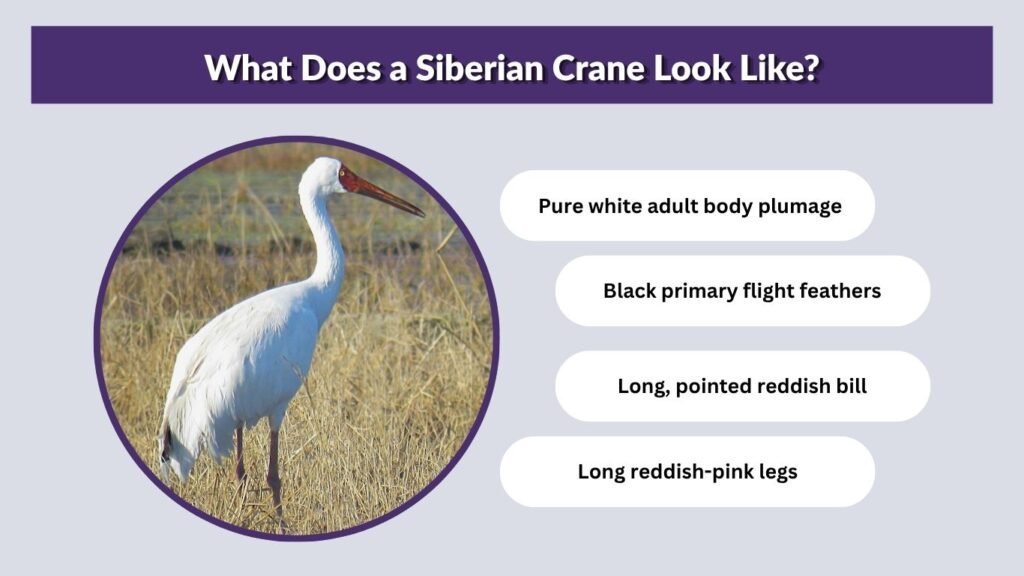
Adult Siberian Cranes are nearly completely white. Their black primary feathers remain hidden when the wings are folded but form striking black wing tips during flight.
Identification Features
- Pure white adult body plumage
- Black primary flight feathers
- Bare red skin across the face and forehead
- Long, pointed reddish bill
- Long reddish-pink legs
- Yellowish or reddish eyes
- Long neck held straight in flight
- Juveniles covered in cinnamon-brown and white feathers
Males and females look very similar, although males are generally slightly larger. Juveniles lack the bright red facial skin and gradually become whiter as they mature.
Size and Wingspan
A Siberian Crane stands approximately 108–140 centimetres tall and may weigh between about 4.9 and 8.6 kilograms. Its broad wings can span approximately 2.1–2.3 metres, allowing it to travel enormous distances during migration.
Where Do Siberian Cranes Live?
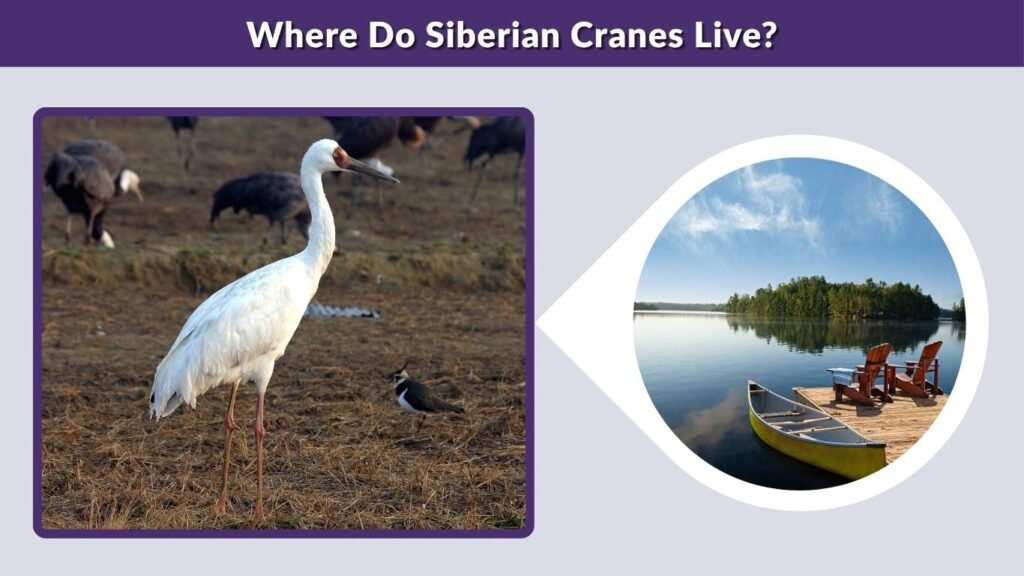
Siberian Cranes breed in remote wetlands across northern Russia. They require large areas of shallow freshwater with open visibility, aquatic vegetation and limited human disturbance.
Breeding Habitat
Their breeding grounds include Arctic and sub-Arctic tundra, marshes, bogs and the transition zone between tundra and taiga. Pairs establish territories around shallow lakes and wetlands where they can nest, feed and watch for approaching predators.
Winter Habitat
Most surviving Siberian Cranes winter around Poyang Lake and other wetlands in the Yangtze River basin of China. These areas provide shallow water, mudflats and underground aquatic plants that the cranes can dig up with their long bills.
Small historic populations followed separate routes to Iran and India. Today, the eastern group accounts for almost the entire surviving wild population.
Siberian Crane Migration
The Siberian Crane is among the world’s great long-distance migratory birds. Eastern cranes breed in northeastern Siberia and travel approximately 6,000 kilometres to wintering grounds in China.
Eastern Migration Route
The eastern population crosses Russia and stops at important wetlands in northeastern China before continuing to the Poyang Lake region. Stopover wetlands allow the birds to rest and rebuild their energy reserves during the journey.
Historic Migration to India
The central population once bred around the Ob River basin in western Siberia and travelled roughly 5,500 kilometres through Kazakhstan, Uzbekistan, Turkmenistan, Afghanistan and Pakistan before reaching India.
Its traditional wintering site was Keoladeo National Park, also known as Bharatpur Bird Sanctuary, in Rajasthan. The last pair known to winter there was recorded during 2001–2002, and the central migratory population is now considered functionally extinct.
Why Do Siberian Cranes Migrate?
Their northern breeding wetlands freeze during winter, making food inaccessible. Migration allows the cranes to reach warmer wetlands where shallow water, plant roots and other foods remain available.
They return north during spring because Arctic wetlands provide long daylight hours, open nesting space and abundant seasonal food for raising chicks.
What Do Siberian Cranes Eat?

Siberian Cranes are omnivorous but depend heavily on aquatic plants. Their long bills have serrated edges that help them pull slippery roots, tubers and other food from wet soil and shallow water.
Common Foods
Their diet includes:
- Aquatic plant roots and tubers
- Cranberries and other fruits
- Leaves and plant shoots
- Insects and worms
- Snails and other mollusks
- Fish
- Small mammals
Plant material forms much of the diet outside the breeding season. During summer, adults may consume more insects, fish and other animal foods while raising growing chicks.
Nesting and Breeding
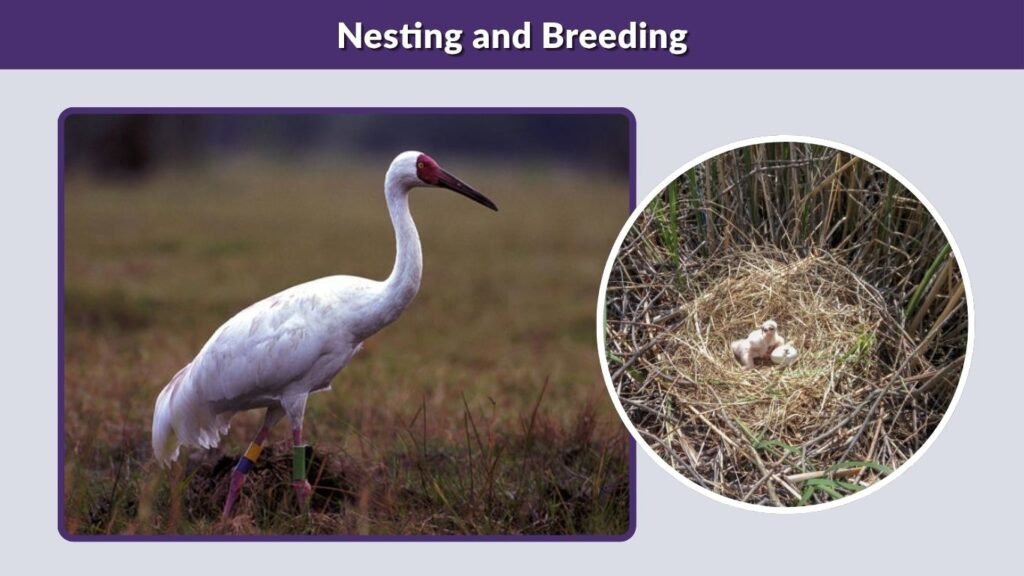
Siberian Cranes form long-term pair bonds and return to northern breeding grounds during spring. Their courtship includes loud coordinated calls, bowing, jumping and graceful dancing.
Nest and Eggs
A pair builds a low nest from grasses, sedges and other wetland plants. The nest is normally positioned in shallow water, offering visibility and some protection from land predators.
The female usually lays two eggs. Both parents incubate them for approximately 27–29 days, but often only one chick survives to fledging. Young cranes can leave the nest soon after hatching and normally begin flying at around 70–75 days old.
Call and Dance
Siberian Cranes produce clear, flute-like calls that carry across open wetlands. A pair performs a coordinated unison call to maintain its bond and defend its territory.
Their dance may involve running, bowing, wing spreading and jumping. Cranes can dance during courtship or simply when excited.
Who Is Omid the Siberian Crane?
Omid, whose name means “hope” in Persian, became famous as the last known wild male from the western Siberian Crane population. For many years, he migrated alone between western Siberia and the Fereydoonkenar wetlands beside Iran’s Caspian coast.
A captive female named Roya was introduced in 2023 in an attempt to form a pair with him. They departed the Iranian wetland together, but Roya was later found alone. Omid was not observed at his usual wintering area later in 2023, creating uncertainty about his fate, although the International Crane Foundation’s current species account still describes a single western crane associated with Iran.
Why Is the Siberian Crane Critically Endangered?
The Siberian Crane is classified as Critically Endangered. Although the eastern population has grown to more than 5,500 birds, the species remains concentrated along one main flyway and depends on a limited number of major wetlands.
Main Threats
Wetland drainage, dams, water diversion and changing lake levels can destroy feeding and roosting areas. Other threats include illegal hunting, trapping, poisoning, pollution and collisions with power lines.
The decline of the western and central populations demonstrates how the loss of only a few migration stopovers can break an entire migration route. International conservation efforts therefore focus on protecting breeding areas, wintering wetlands and stopover sites across all range countries.
Siberian Crane Adaptations
The species has several features that help it survive in shallow northern wetlands:
- Long legs for walking through water
- A long serrated bill for extracting roots and slippery prey
- Broad wings for long-distance migration
- White plumage that blends with bright northern landscapes
- Loud calls for communicating over large wetlands
- Strong territorial behaviour around nesting and feeding areas
Its dependence on open shallow water is also a weakness because the bird cannot easily adapt when major wetlands are drained or permanently flooded.
Siberian Crane Lifespan
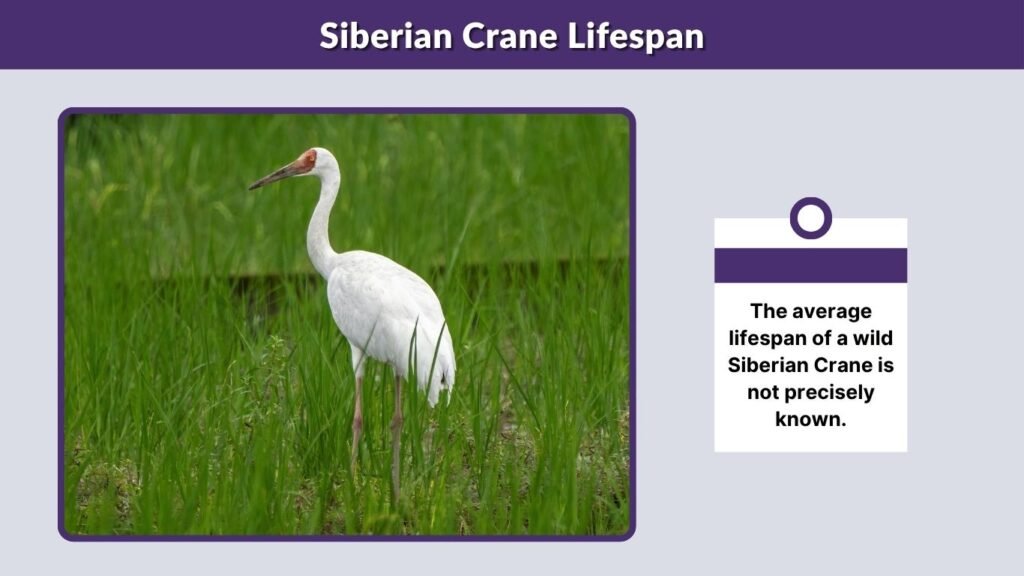
The average lifespan of a wild Siberian Crane is not precisely known. Managed cranes have survived for several decades, and exceptional captive birds have lived much longer.
Wild cranes generally face greater risks from migration, severe weather, predators, hunting and habitat loss. Therefore, extreme captive-longevity records should not be treated as the normal lifespan of a wild bird.
FAQs
Are Siberian Cranes extinct?
No. More than 5,500 are estimated to remain, mainly in the eastern population that winters in China. However, the central population that migrated to India has disappeared, while the western population is nearly extinct.
Do Siberian Cranes still migrate to India?
No regular wild Siberian Cranes currently winter in India. The last known pair at Keoladeo National Park was recorded during the winter of 2001–2002.
What is the scientific name of the Siberian Crane?
Its currently accepted scientific name is Leucogeranus leucogeranus. The older name Grus leucogeranus remains common in historical publications and some conservation agreements.
What do Siberian Cranes eat?
They mainly eat aquatic plant roots, tubers, leaves and fruits. They also consume insects, worms, snails, fish and small mammals, particularly during the breeding season.
Why is the Siberian Crane endangered?
Its decline is primarily linked to wetland destruction, altered water systems, hunting, trapping, poisoning and the loss of safe migration stopovers. Its dependence on a few major wetlands makes it especially vulnerable.
