
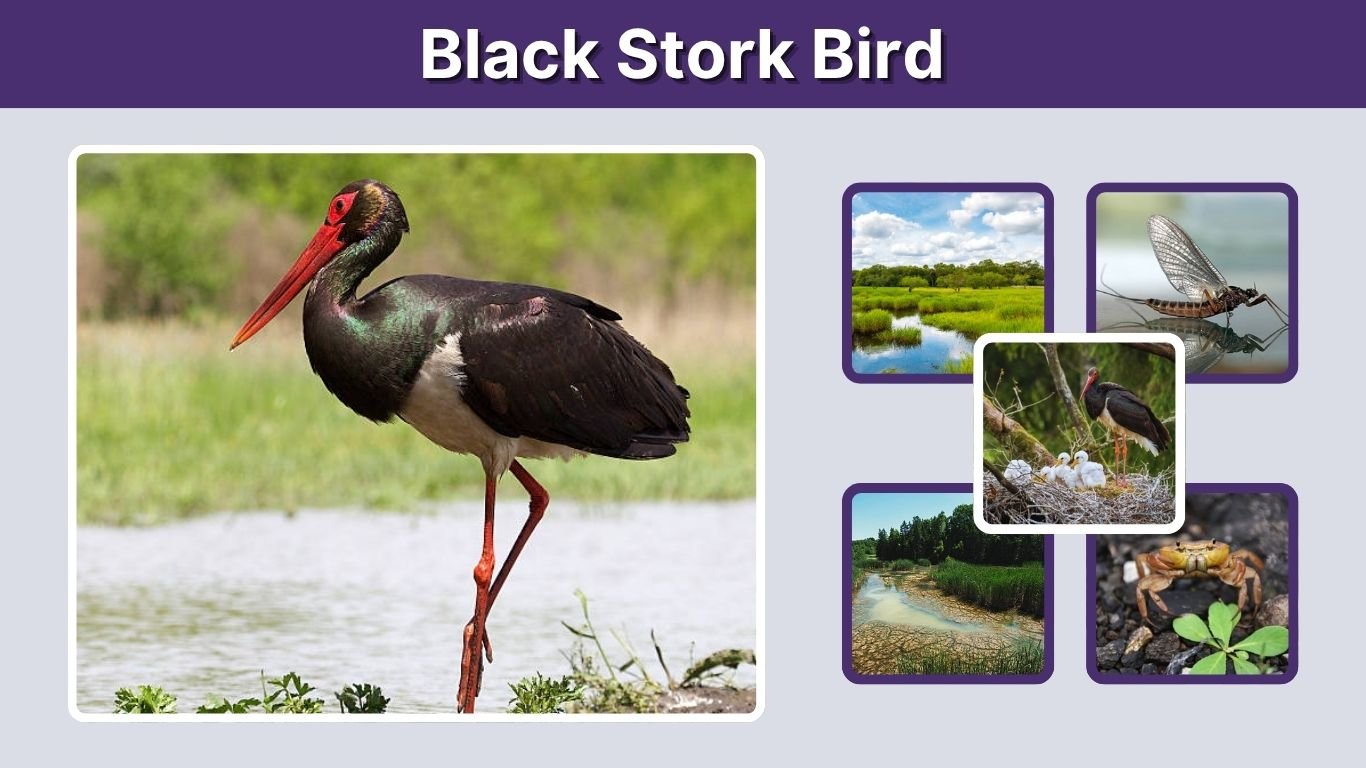
The Black Stork (Ciconia nigra) is a large, secretive waterbird with glossy black upperparts, a white belly and bright red legs and bill. Unlike the familiar White Stork, it avoids towns and agricultural settlements, preferring quiet forests near rivers, marshes and shallow wetlands. Black Storks breed across parts of Europe and Asia, while separate resident populations occur in southern Africa. Many northern birds undertake long migrations to Africa or southern Asia for winter.
Black Stork Quick Facts
The Black Stork belongs to the same family as White Storks, Wood Storks and other long-legged wading birds. However, its shy behaviour and solitary nesting habits make it more difficult to observe.
| Feature | Description |
| Scientific name | Ciconia nigra |
| Family | Ciconiidae |
| Length | Approximately 90–105 cm |
| Wingspan | Approximately 145–155 cm |
| Weight | Usually around 2.5–3.2 kg |
| Main colours | Glossy black and white |
| Bill and legs | Bright red in adults |
| Diet | Primarily fish, frogs and aquatic animals |
| Clutch size | Usually 2–5 eggs |
| Incubation | Approximately 32–38 days |
| Global status | Least Concern |
Despite its name, the Black Stork is not completely black. Its belly, lower breast and undertail are bright white.
What Does a Black Stork Look Like?
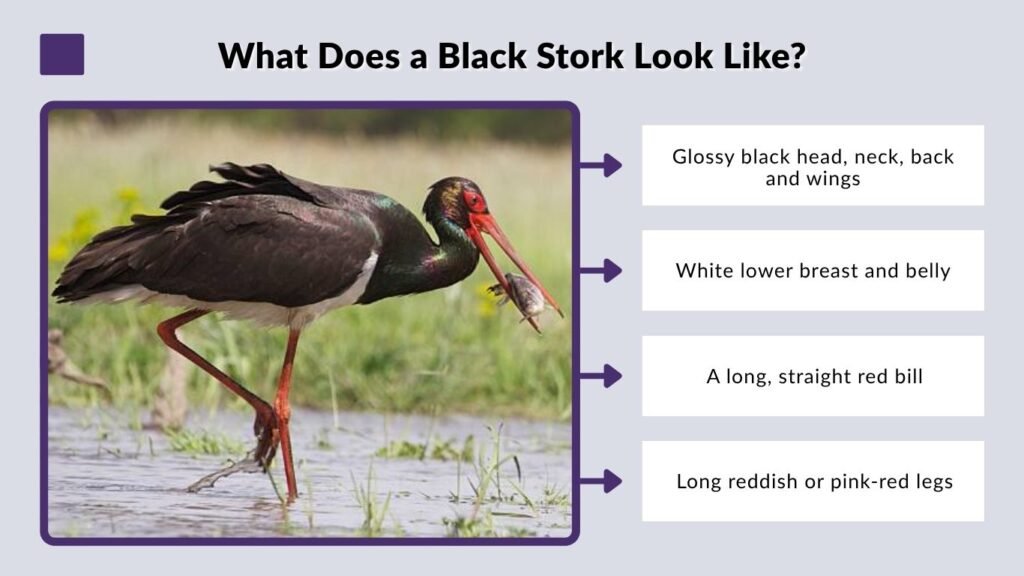
Adult Black Storks are striking birds, especially when sunlight reveals the green, bronze and purple sheen within their dark feathers.
Adult Identification
A mature Black Stork has:
- Glossy black head, neck, back and wings
- White lower breast and belly
- A long, straight red bill
- Long reddish or pink-red legs
- Red bare skin surrounding the eyes
- Broad wings and a relatively short tail
- A long neck held extended in flight
Males and females have similar plumage. Males are generally slightly larger and may have heavier bills, but distinguishing the sexes in the field is difficult.
Juvenile Black Stork
Juveniles lack the adults’ vivid red features. They have dull brownish-black or sooty upperparts, a grey-green bill and greyish or greenish legs.
The dark feathers also lack the strong metallic sheen of mature birds. As juveniles age, the bill, legs and facial skin gradually become red.
Black Stork in Flight
A flying Black Stork holds its neck and legs completely extended. Its broad wings are mostly black, while the white belly forms a noticeable pale patch beneath the body.
Like other large storks, it uses warm rising air to soar. Deep, slow wingbeats are usually followed by extended gliding. Its flight silhouette may initially resemble a crane, heron or large bird of prey.
Black Stork Habitat and Range
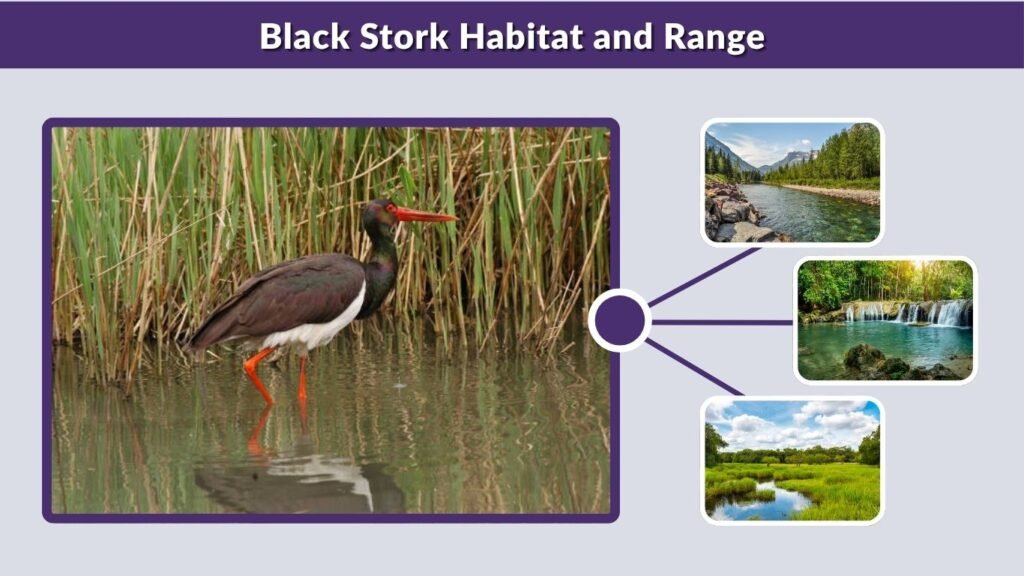
Black Storks require both secluded nesting locations and productive wetlands. A suitable territory typically combines mature forest with nearby rivers, pools, marshes or wet meadows.
Preferred Habitat
Common Black Stork habitats include:
- Mature and old-growth forests
- Wooded river valleys
- Forest streams and pools
- Marshes and floodplains
- Wet forest meadows
- Shallow lakes and reservoirs
- Estuaries and fishponds
- Remote mountain cliffs in southern Africa
The species is particularly sensitive to repeated human disturbance near its nest. Breeding pairs often select large trees deep inside quiet forests, sometimes several kilometres from settlements.
Geographic Range
The northern breeding range extends from parts of western and central Europe across eastern Europe, Russia and Central Asia to northern China and the Russian Far East.
Migratory birds spend winter in sub-Saharan Africa, northern India, southern China and parts of Southeast Asia. Smaller resident populations occur in the Iberian Peninsula and southern Africa, where movements are more local or seasonal.
What Do Black Storks Eat?
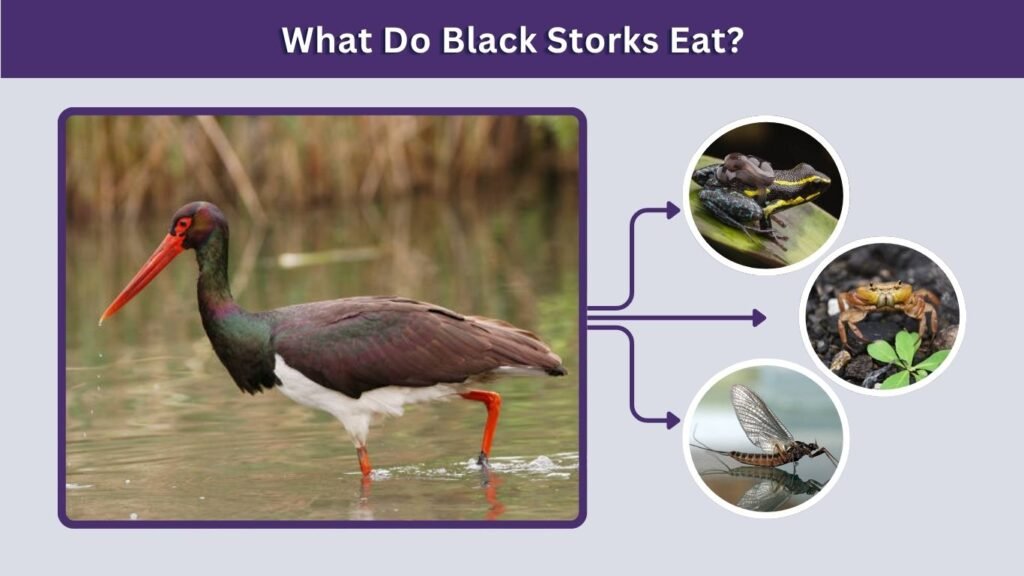
The Black Stork is primarily a fish-eating bird. It hunts in shallow, relatively clear water where prey can be located visually.
Black Stork Diet
Common foods include:
- Small and medium-sized fish
- Frogs and tadpoles
- Newts and salamanders
- Crayfish and freshwater crabs
- Aquatic insects and larvae
- Snails and worms
- Small snakes and lizards
- Occasionally rodents or young birds
The precise diet varies between regions. BirdLife South Africa reports that southern African Black Storks primarily catch fish in streams, estuaries and dams.
Feeding Behaviour
A Black Stork usually walks slowly through shallow water while watching for movement. When prey is detected, it thrusts its bill forward and seizes the animal.
It may also disturb prey by moving one foot through mud or vegetation. Most small fish and amphibians are swallowed whole, with the bird repositioning them so they enter headfirst.
Black Stork Migration
Many Black Storks undertake long seasonal journeys between northern breeding areas and warmer wintering grounds. Their migration differs slightly according to geographic population.
European Migration Routes
European Black Storks generally leave their nesting territories between August and October. Western birds commonly travel through France and Spain before crossing near Gibraltar.
Birds from central and eastern Europe often move through the Balkans, Turkey, the Bosphorus, Israel and Egypt before entering Africa. They avoid long journeys over open sea because rising air currents are weaker over water.
Spring migration begins during February or March, with many adults returning to breeding territories between March and April.
Asian Migration
Asian populations migrate south towards India, southern China and Southeast Asia. Black Storks can therefore appear in northern India during winter, particularly around rivers, reservoirs and undisturbed wetlands.
Some populations travel alone or in small groups. They generally do not form the enormous migration flocks commonly associated with White Storks.
Southern African Movement
Southern African Black Storks are mainly resident breeders. They make regional movements in response to rainfall and changing water levels rather than migrating annually between Europe and Africa.
Breeding in southern Africa often occurs during the dry winter months, when falling water levels concentrate fish and make feeding easier.
Black Stork Nesting and Life Cycle
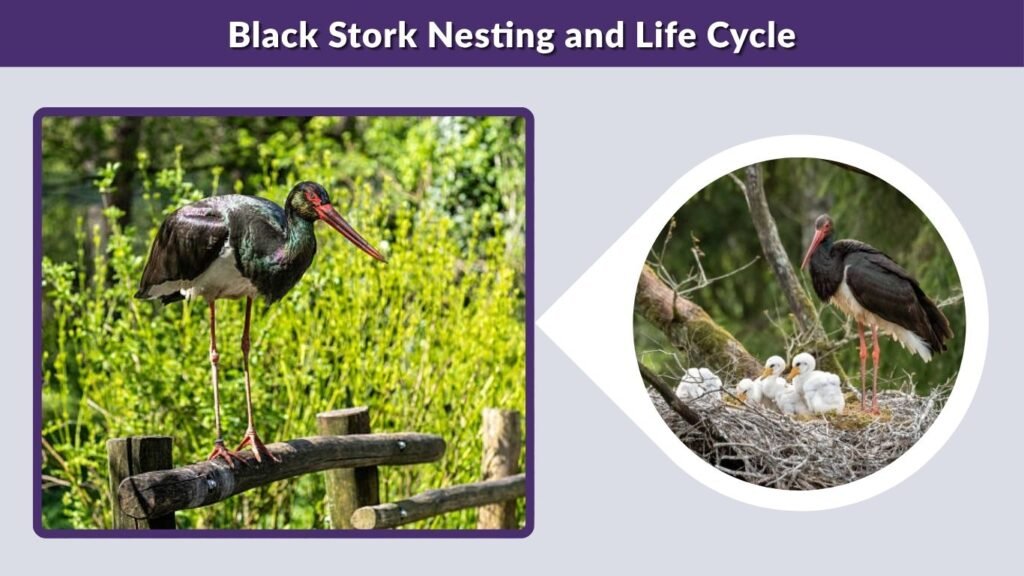
Black Storks are solitary nesters. Each breeding pair generally occupies a large territory and remains well separated from other nesting pairs.
Nest Location
In Europe and Asia, nests are usually built high in mature forest trees. Pairs prefer strong horizontal branches capable of supporting a large platform of sticks.
In mountainous regions, particularly southern Africa and parts of southern Europe, nests may be placed on cliffs, ledges or beneath rocky overhangs. Sites are normally close enough to productive rivers or wetlands for regular feeding trips.
Eggs and Incubation
The female generally lays two to five white eggs. Both parents incubate them for approximately 32–38 days, although the female may spend more time on the nest.
Hatching is asynchronous, meaning the eggs do not all hatch on the same day. Older chicks may therefore be noticeably larger than their younger siblings.
Chicks and Fledging
Both parents bring fish and other prey to the nest and regurgitate it for their chicks. Young Black Storks develop white down before growing darker juvenile feathers.
The chicks begin making short flights at approximately nine to ten weeks. They remain near the nest for a period while improving their flying and feeding skills before dispersing or beginning migration.
Nest Reuse
A breeding pair may return to the same territory and reuse a nest for several years. New sticks and vegetation are added each season, allowing the structure to become extremely large and heavy.
The birds may maintain several alternative nests within a territory and change sites after disturbance, storm damage or nest collapse.
Black Storks in Poland
Poland is an important European breeding stronghold for the Black Stork, locally known as bocian czarny. Unlike White Storks, which frequently nest on roofs and utility poles, Black Storks remain hidden in mature forests.
Habitat in Poland
Polish Black Storks nest in old forest stands and forage in marshes, wet meadows, streams and flooded woodlands. Fish and frogs are particularly important foods.
Government conservation information describes the species as closely associated with forests and notes that Polish birds migrate to Africa or southern Asia for winter. Nest protection zones help reduce disturbance caused by forestry, tourism and photography.
Black Stork Nest Cameras
Conservation organisations, forestry authorities and researchers have operated live Black Stork nest cameras in Poland, including projects associated with the Łódź region.
Camera availability and nesting activity vary by year. Viewers should use official wildlife or forestry channels and never attempt to locate or approach a nest shown online.
Black Stork vs Black-Necked Stork
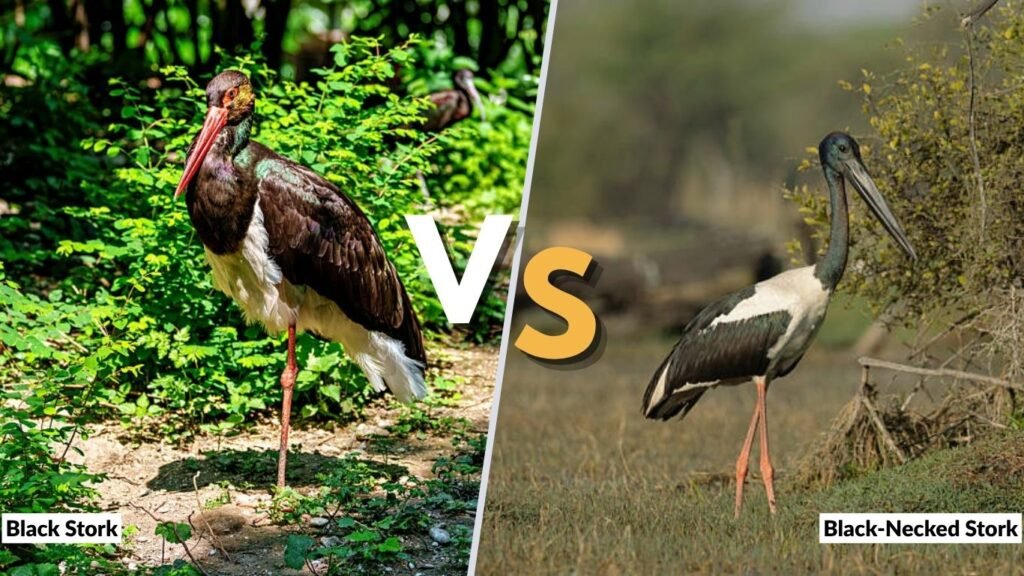
The Black Stork and Black-necked Stork are separate species living in different regions. They can be distinguished by their colour patterns and size.
| Feature | Black Stork | Black-necked Stork |
| Scientific name | Ciconia nigra | Ephippiorhynchus asiaticus |
| Main colour | Mostly glossy black with white belly | White body with black head, neck and wings |
| Bill | Long and red | Massive and black |
| Legs | Red | Bright red |
| Range | Europe, Asia and Africa | South and Southeast Asia and Australia |
| Habitat | Forest rivers and remote wetlands | Open wetlands, marshes and floodplains |
In Australia, the Black-necked Stork is commonly called the “jabiru.” However, the true Jabiru, Jabiru mycteria, is a different species native to Central and South America.
Other Black-and-White Stork-Like Birds
Several birds can be mistaken for the Black Stork. Location and bill colour are especially helpful for identification.
Large Black-and-White Stork in India
A large white-and-black stork in India may be a Black-necked Stork, Asian Woolly-necked Stork or wintering Black Stork.
The Black-necked Stork has a white body, glossy black neck and enormous black bill. The Asian Woolly-necked Stork has a white woolly neck, dark body and reddish bill. A true Black Stork has a red bill and mostly black upperparts.
Black Stork-Like Bird in Southern Africa
Southern Africa has several dark stork species. An African Openbill is smaller and has a visible gap between its mandibles. A Marabou Stork has a bald pinkish head and extremely heavy bill, while a Saddle-billed Stork has bold black-and-white plumage and a colourful red-and-black bill.
Black Stork-Like Bird in Southwest Florida
A true Black Stork would be exceptionally unusual in Southwest Florida because the species is not native to the Americas.
A black-and-white bird with a pale head in Florida is more likely a juvenile Wood Stork. Other possibilities include an Anhinga, Great Blue Heron or dark-plumaged cormorant, depending on its body shape and behaviour.
Conservation Status and Threats
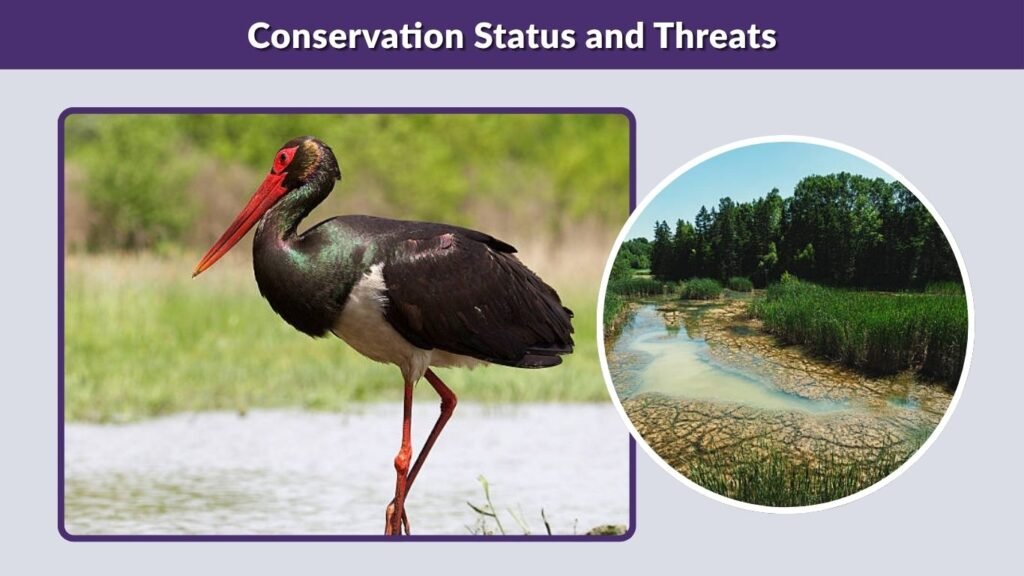
The Black Stork is globally classified as Least Concern, but it is uncommon and declining in some parts of its range. The southern African breeding population is regionally considered vulnerable.
Main Threats
Significant threats include:
- Removal of mature nesting trees
- Wetland drainage and river modification
- Human disturbance near nests
- Water pollution and declining fish populations
- Collisions with power lines
- Illegal hunting along migration routes
- Drought and changing water levels
The BirdLife species assessment recognises the Black Stork as globally widespread, but protecting undisturbed forests, rivers and migration stopovers remains important.
FAQs
Is a Black Stork completely black?
No. Adult Black Storks have glossy black heads, necks, backs and wings, but their lower breasts, bellies and undertails are white. Their red bills, legs and facial skin create an additional contrast. Juveniles are duller, with brownish-black feathers and grey-green bills.
Where do Black Storks live?
Black Storks breed across parts of Europe and temperate Asia, with smaller resident populations in southern Africa and the Iberian Peninsula. They favour mature forests near streams, rivers and wetlands. Migratory populations winter in Africa, India, southern China and Southeast Asia.
Are Black Storks rare?
Black Storks have a wide global range but are uncommon and difficult to observe. Their preference for remote forests and solitary nests makes them seem rarer than more social storks. Local populations may be threatened even though the species is globally classified as Least Concern.
Do Black Storks migrate to Africa?
Many European Black Storks migrate to sub-Saharan Africa for winter. Western birds often travel through Gibraltar, while eastern populations cross through Turkey and the Middle East. Southern African Black Storks are mainly resident and make shorter regional movements based on rainfall and food.
What is the difference between a Black Stork and a Wood Stork?
A Black Stork has glossy black upperparts, a white belly and a red bill. A Wood Stork is primarily white with black flight feathers, a heavy dark bill and a bare scaly head. Black Storks occur in Europe, Asia and Africa; Wood Storks live in the Americas.