
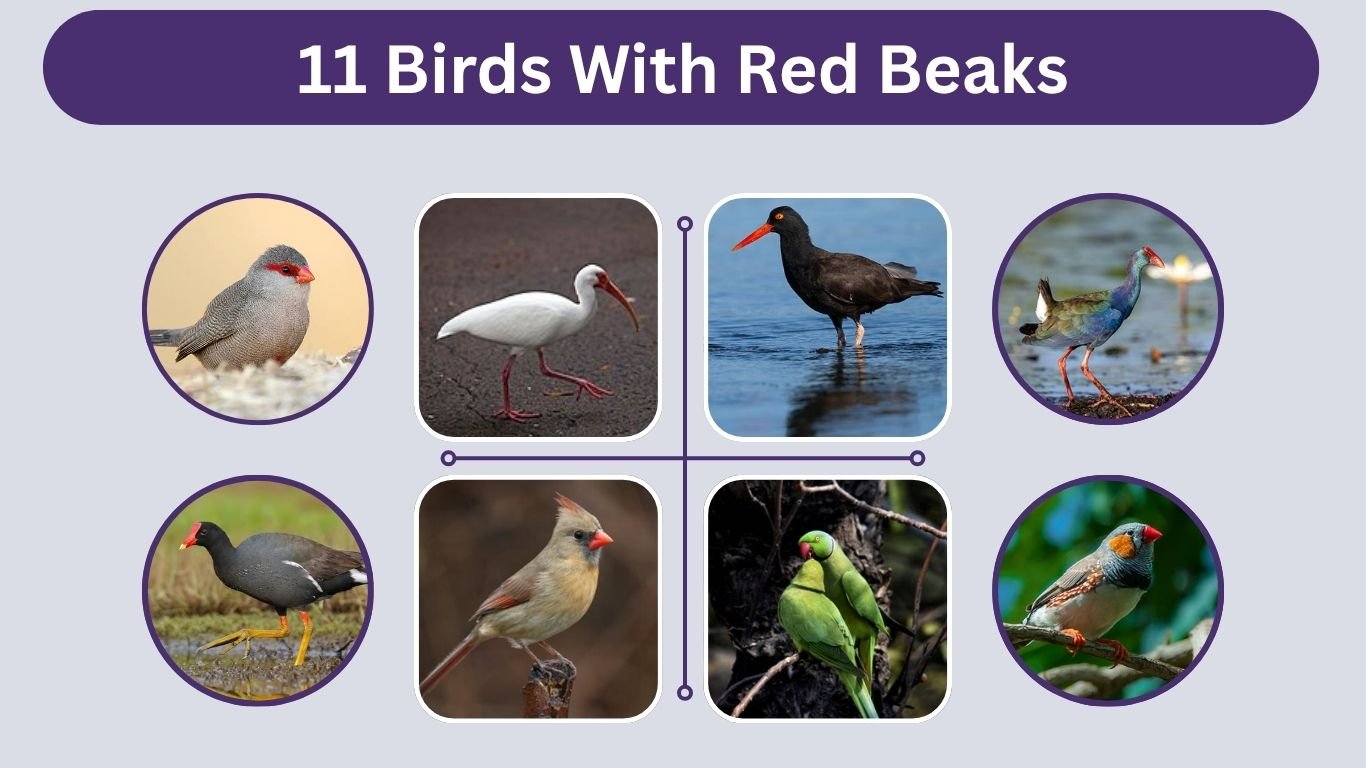
Birds with red beaks come in many colors, sizes, and shapes. Possible matches range from the small brown Common Waxbill and green Rose-ringed Parakeet to the large Black Swan. A black bird with a red beak could be a Common Gallinule, Black Oystercatcher, or Red-billed Chough, while a white bird with a long red beak may be an American White Ibis. This guide explores 11 red-beaked birds, covering their appearance, habitat, diet, behavior, and male and female differences.
1. Northern Cardinal
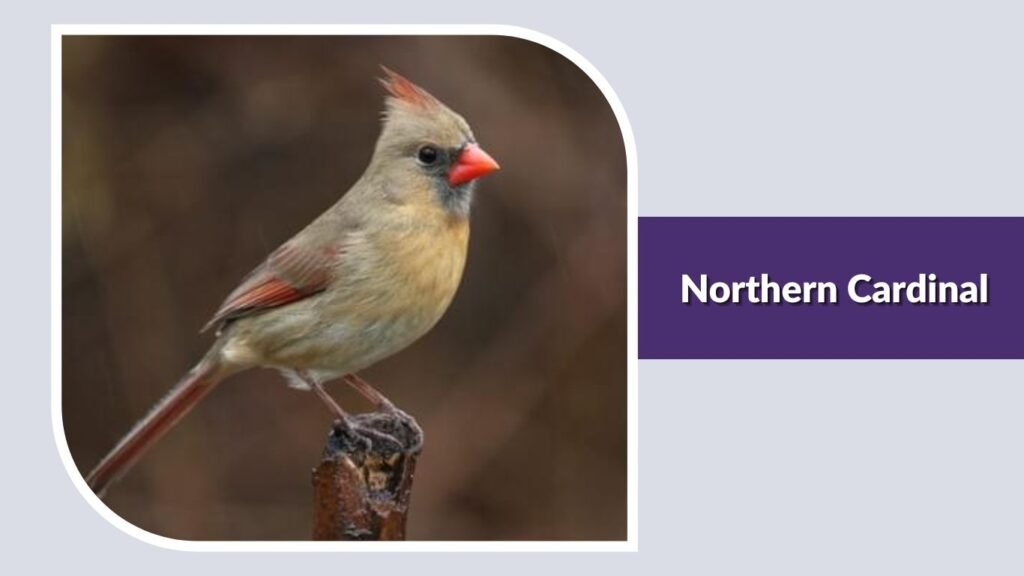
The Northern Cardinal is a familiar red bird with a reddish-orange beak and a pointed head crest. Adult males are almost entirely red, while females are mostly warm brown. This species is common in gardens, parks, woodland edges, and backyards throughout eastern and central North America.
Identification
- Bright red plumage on adult males
- Reddish-orange, cone-shaped beak
- Black mask around the bill in males
- Prominent crest on the head
- Long, rounded tail
Male vs. Female
Male Northern Cardinals have bright red bodies with black facial masks. Females are primarily brown or tan with reddish coloring on their wings, crest, and tail. Both sexes have thick reddish-orange beaks. Juveniles initially have dark bills that gradually become orange-red.
Habitat and Distribution
Northern Cardinals inhabit woodland edges, dense shrubs, gardens, parks, and suburban neighborhoods. They are common in Florida, Georgia, Tennessee, and much of the eastern United States. They do not migrate and can remain within the same territory throughout the year.
Diet and Behavior
Cardinals eat seeds, berries, fruits, beetles, grasshoppers, and other insects. They frequently visit backyard feeders for sunflower and safflower seeds. Males are territorial and may attack their reflections in windows, believing that another bird has entered their territory.
2. Common Gallinule
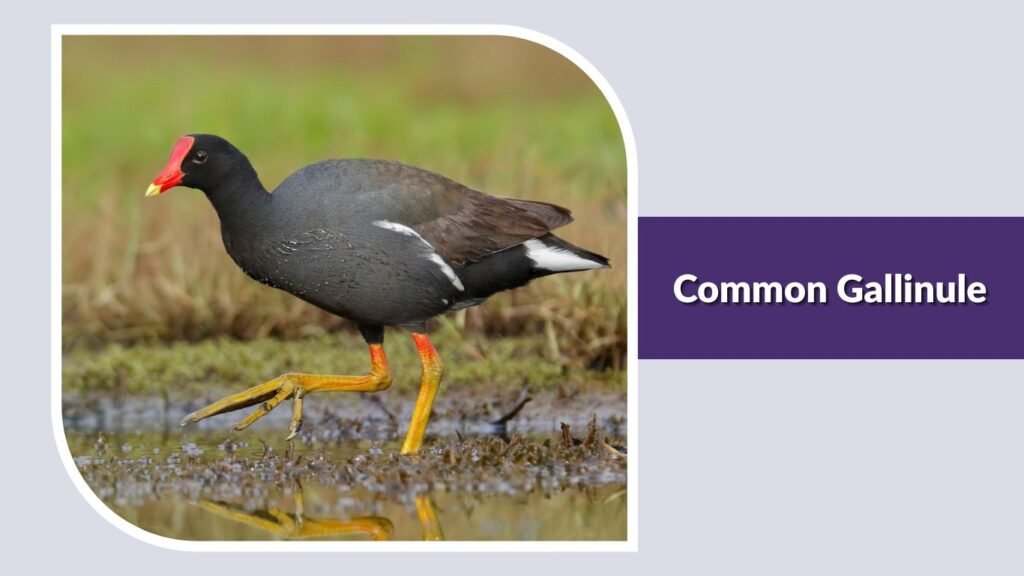
The Common Gallinule is a dark gray or black water bird with a bright red beak tipped with yellow. It is also recognized by the red shield extending from its bill onto its forehead. The species walks on floating plants and swims through freshwater marshes.
Identification
- Dark gray or black body
- Bright red beak with a yellow tip
- Red forehead shield
- White stripes along the sides
- Long yellow-green legs and toes
Male vs. Female
Male and female Common Gallinules look very similar, although males are generally slightly larger. Both sexes possess red-and-yellow bills and red forehead shields as adults. Juveniles are brownish-gray with pale throats and dull bills rather than the bright colors seen on adults.
Habitat and Distribution
Common Gallinules occupy freshwater marshes, lakes, ponds, and slow-moving waterways with dense vegetation. They are frequently seen in Florida and other southeastern states, although breeding populations also occur across scattered parts of the United States.
Diet and Behavior
These birds eat aquatic plants, seeds, snails, insects, worms, small fish, and tadpoles. Their unusually long toes help distribute their weight while they walk across floating vegetation. They swim with a distinctive forward-and-back movement of the head.
3. Purple Gallinule
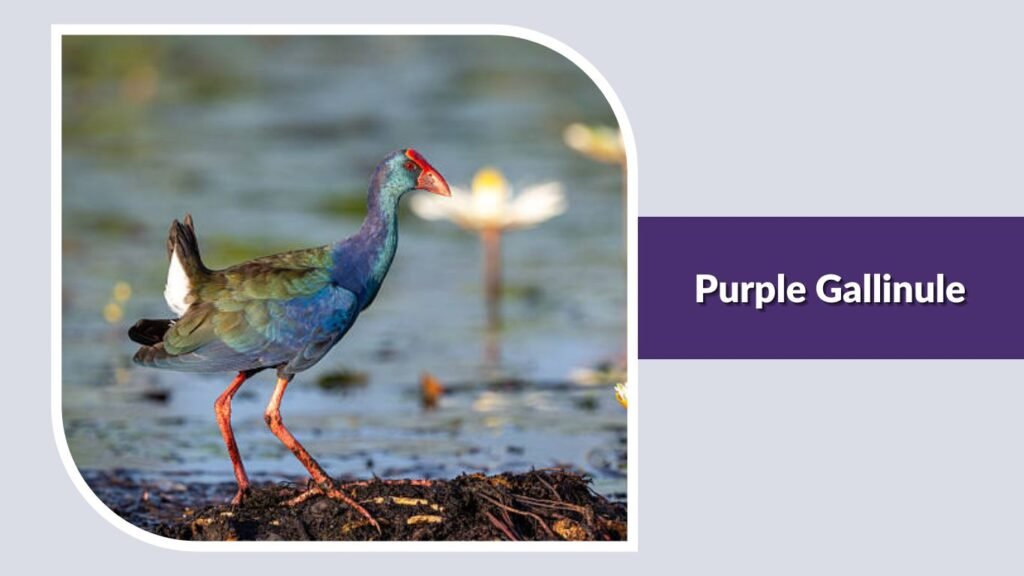
The Purple Gallinule is a colorful teal, blue, and green bird with a bright red beak tipped in yellow. Its vivid plumage, long yellow legs, and enormous toes create a distinctive appearance. It is one of the most colorful wetland birds regularly found in Florida.
Identification
- Purple-blue head, neck, and underparts
- Green or bronze back and wings
- Bright red beak with a yellow tip
- Pale blue forehead shield
- Long yellow legs and toes
Male vs. Female
Male and female Purple Gallinules have nearly identical plumage, although males may be slightly larger. Juveniles look very different, displaying brown upperparts, a white chest and belly, and dull-colored bills. Their blue, green, and purple feathers develop gradually as they mature.
Habitat and Distribution
Purple Gallinules inhabit freshwater marshes, ponds, swamps, and lakes covered with water lilies and other floating plants. In the United States, they are most common in Florida and along the Gulf Coast. Their wider range extends through the Caribbean and Central and South America.
Diet and Behavior
Purple Gallinules eat seeds, fruits, aquatic plants, insects, snails, frogs, and small fish. Their extremely long toes allow them to walk across lily pads and climb wetland vegetation. They can also swim and fly, despite appearing somewhat awkward when taking off.
4. American Oystercatcher
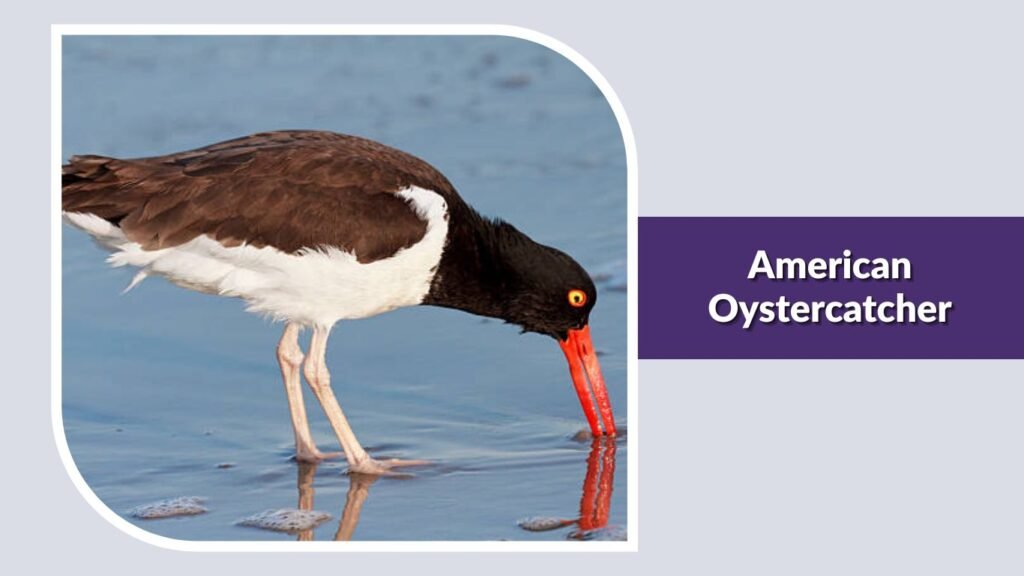
The American Oystercatcher is a large black and white shorebird with a long, bright red-orange beak. Its bold head pattern, yellow eyes, and sturdy pink legs make it easy to identify. It lives along coastal beaches, rocky shores, mudflats, and oyster reefs.
Identification
- Black head, neck, and upper chest
- White belly and wing patches
- Long, straight red-orange beak
- Bright yellow eyes with red eye rings
- Thick, pale pink legs
Male vs. Female
Males and females look nearly identical, but females are usually slightly larger and may have longer bills. Young American Oystercatchers have darker-tipped beaks, duller legs, and brown-edged back feathers. Their bills become brighter as they reach adulthood.
Habitat and Distribution
American Oystercatchers occur along the Atlantic, Gulf, and Pacific coasts of the Americas. In the United States, they are regularly found in Florida, Georgia, and other coastal states. They nest on sandy beaches, shell-covered islands, and areas above the high-tide line.
Diet and Feeding
These shorebirds eat oysters, mussels, clams, crabs, marine worms, and other coastal animals. They use their powerful bills to stab between open shells or hammer shells apart. Despite their name, their diet is not limited to oysters.
5. Black Oystercatcher
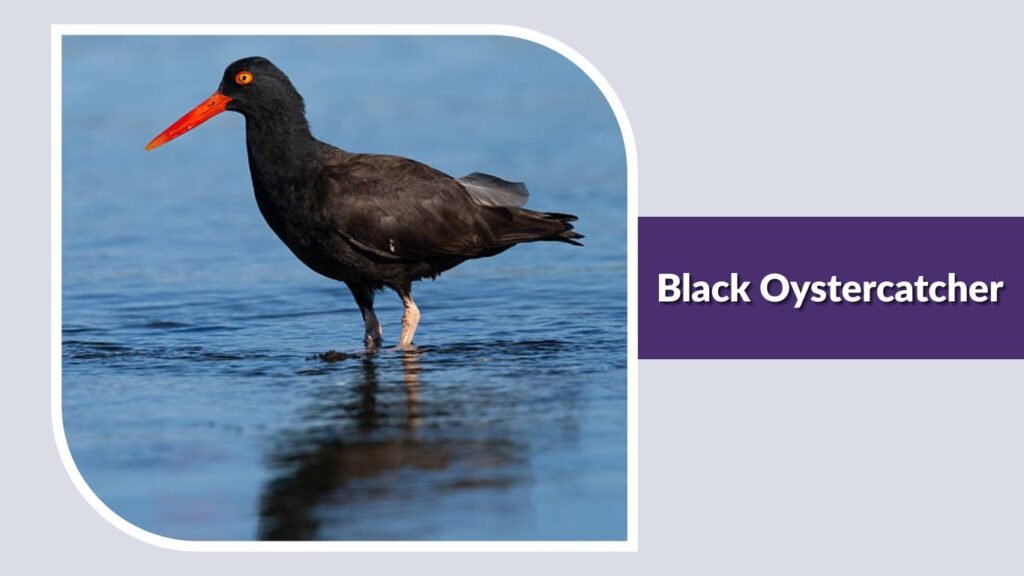
The Black Oystercatcher is a large black bird with a long red-orange beak. It inhabits rocky shorelines along the Pacific Coast of North America. Its dark plumage, yellow eyes, pink legs, and loud calls make it one of the region’s most recognizable coastal birds.
Identification
- Entirely black or dark brown body
- Long, straight red-orange beak
- Yellow eyes surrounded by red rings
- Thick, pale pink legs
- Broad wings and a short tail
Male vs. Female
Male and female Black Oystercatchers have similar appearances, though females are generally larger and may have slightly longer beaks. Juveniles have brownish feathers, darker bill tips, and duller legs. Their bills gradually become bright red-orange as they mature.
Habitat and Distribution
Black Oystercatchers live on rocky islands, beaches, cliffs, and exposed shorelines from Alaska to Baja California. They are especially associated with California, Oregon, Washington, and western Canada. Most pairs remain close to their coastal territories throughout the year.
Diet and Feeding
Black Oystercatchers consume mussels, limpets, chitons, crabs, barnacles, and other marine invertebrates. They search for food during low tide, using their strong bills to pry animals from rocks or open shells. They typically nest in shallow scrapes above the high-tide line.
6. Red-billed Chough
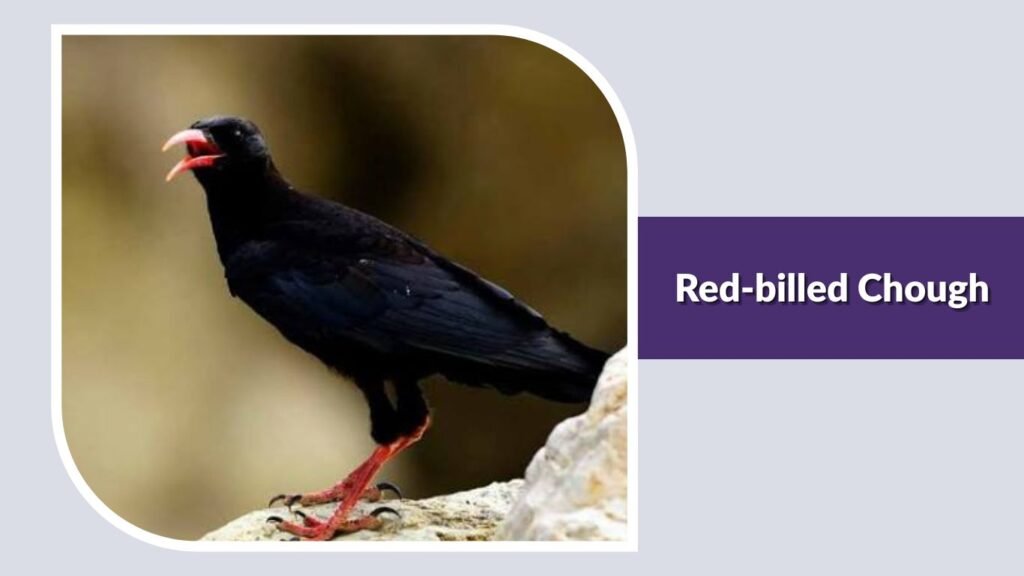
The Red-billed Chough is a glossy black bird with a long, curved red beak and bright red legs. It belongs to the crow family but has a slimmer build than most crows. This highly social bird is known for performing acrobatic flights around mountains and coastal cliffs.
Identification
- Glossy black plumage
- Long, curved, bright red beak
- Red legs and feet
- Broad, rounded wings
- Finger-like feathers at the wingtips
Male vs. Female
Male and female Red-billed Choughs look almost identical, although males may be slightly larger and have heavier bills. Juveniles have duller plumage and yellowish-orange bills and legs. Their beaks and legs gradually become bright red as they mature.
Habitat and Distribution
Red-billed Choughs inhabit mountains, coastal cliffs, rocky grasslands, and agricultural areas. They occur across parts of Europe, North Africa, and Asia. Their range includes the British Isles, the Alps, the Himalayas, China, and several Mediterranean regions.
Diet and Behavior
These birds primarily eat insects, spiders, worms, seeds, and berries. Their curved red bills allow them to probe soil, animal droppings, and rocky crevices for food. Red-billed Choughs often form social groups and use rising air currents to perform rolls, dives, and other aerial movements.
7. American White Ibis
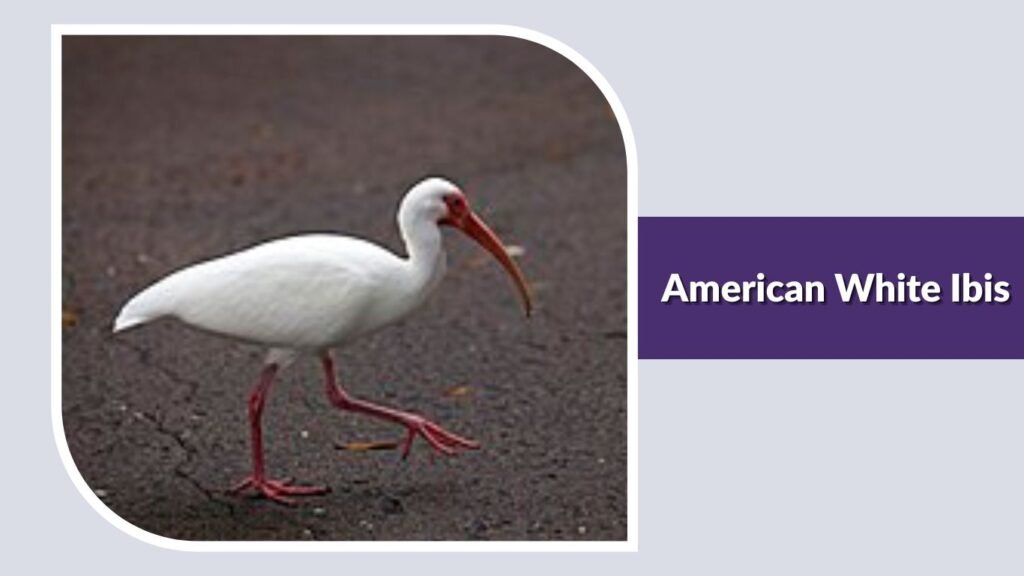
The American White Ibis is a medium-sized white water bird with a long, downward-curved red-orange beak. Adults also have pinkish-red legs and facial skin. This distinctive wetland species is especially common in Florida, where groups forage across marshes, lawns, and shallow coastal waters.
Identification
- Mostly white body
- Long, curved red-orange beak
- Pinkish-red legs and facial skin
- Black wingtips visible during flight
- Long neck and legs
Male vs. Female
Male and female American White Ibises have similar plumage, but males are generally larger and have longer, thicker bills. Juveniles are mostly brown with white underparts and have duller bills and legs. They gradually develop white plumage as they mature.
Habitat and Distribution
American White Ibises inhabit freshwater marshes, mangroves, coastal lagoons, mudflats, ponds, and wet lawns. They are widespread in Florida and also occur along the Atlantic and Gulf coasts. Their overall range extends through the Caribbean and into northern South America.
Diet and Feeding
These birds eat crayfish, crabs, aquatic insects, snails, worms, frogs, and small fish. They sweep their long bills through mud and shallow water, detecting hidden prey by touch. American White Ibises frequently feed in groups, sometimes alongside herons and other wading birds.
8. Black Swan
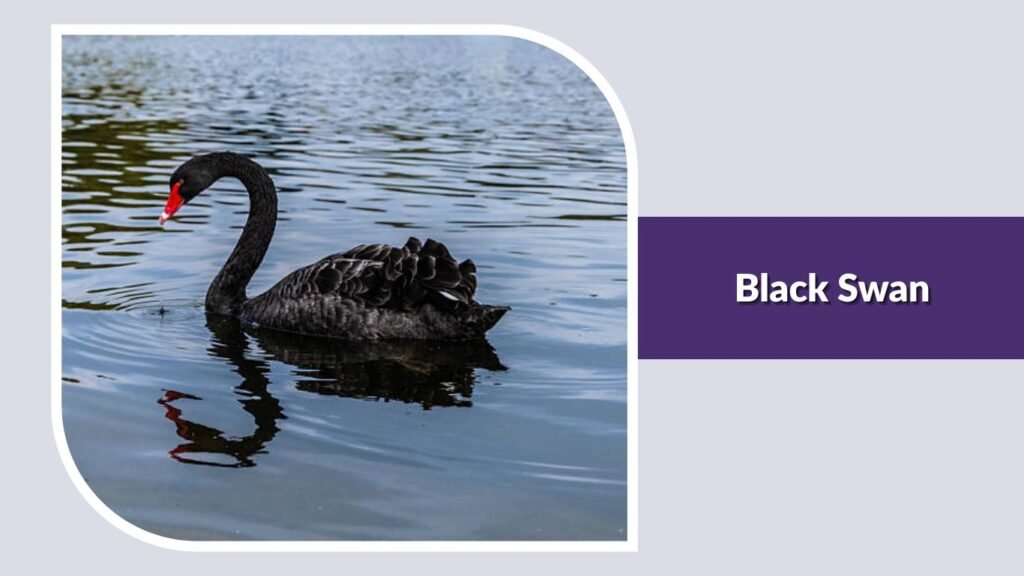
The Black Swan is a large black water bird with a bright red beak crossed by a white band near the tip. Its long, curved neck and contrasting white flight feathers make it easy to recognize. Native to Australia, it has also been introduced to several other countries.
Identification
- Mostly black body feathers
- Bright red beak with a white band
- Long, S-shaped neck
- White wing feathers visible in flight
- Dark gray or black legs
Male vs. Female
Male and female Black Swans look similar, but males are usually larger and have straighter, heavier beaks. Females may have slightly duller plumage and shorter necks. Young swans, called cygnets, have fluffy gray bodies and dark bills rather than the adults’ black plumage and red beaks.
Habitat and Distribution
Black Swans inhabit lakes, rivers, swamps, coastal lagoons, and estuaries throughout Australia. Introduced or escaped populations may appear elsewhere, including North America and Europe. They favor shallow water with plentiful aquatic vegetation and suitable nesting sites.
Diet and Behavior
Black Swans mainly eat aquatic plants, algae, grasses, and reeds. They reach underwater vegetation by dipping their heads and long necks below the surface. Pairs often remain together for multiple breeding seasons and construct large nests from reeds and other plant material.
9. Rose-ringed Parakeet
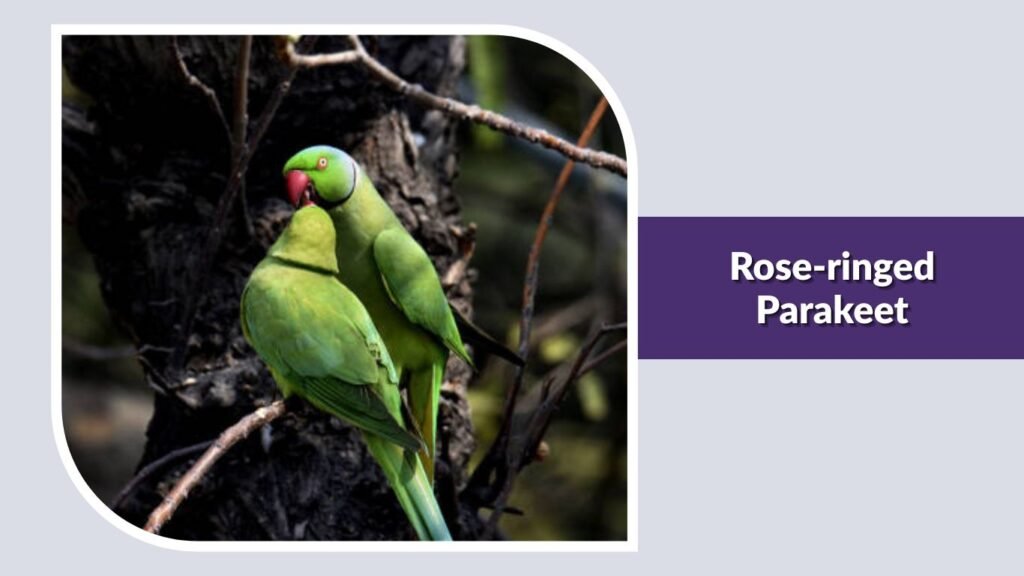
The Rose-ringed Parakeet is a bright green bird with a strong red beak and a long, pointed tail. It is also known as the Ring-necked Parakeet. Native to Africa and South Asia, it has established wild populations in many cities outside its natural range.
Identification
- Bright green body
- Curved red or reddish-orange beak
- Long, narrow, pointed tail
- Dark and rose-colored neck ring on adult males
- Pale yellow-green eyes
Male vs. Female
Adult males develop a black and rose-colored ring around the neck, usually after reaching maturity. Females and young birds lack the complete ring or show only a faint greenish outline. Both sexes have green plumage and reddish beaks, although the male’s coloring may appear brighter.
Habitat and Distribution
Rose-ringed Parakeets occupy forests, farmland, parks, gardens, and urban neighborhoods. Their native range includes India, Bangladesh, Pakistan, and parts of Africa. Introduced populations are established in the United Kingdom, Europe, the Middle East, and several other regions.
Diet and Behavior
These parakeets eat seeds, nuts, buds, flowers, grains, and fruit. They often gather in noisy flocks and may feed in agricultural fields or fruit trees. Rose-ringed Parakeets nest in tree cavities and can adapt successfully to heavily populated urban environments.
10. Zebra Finch
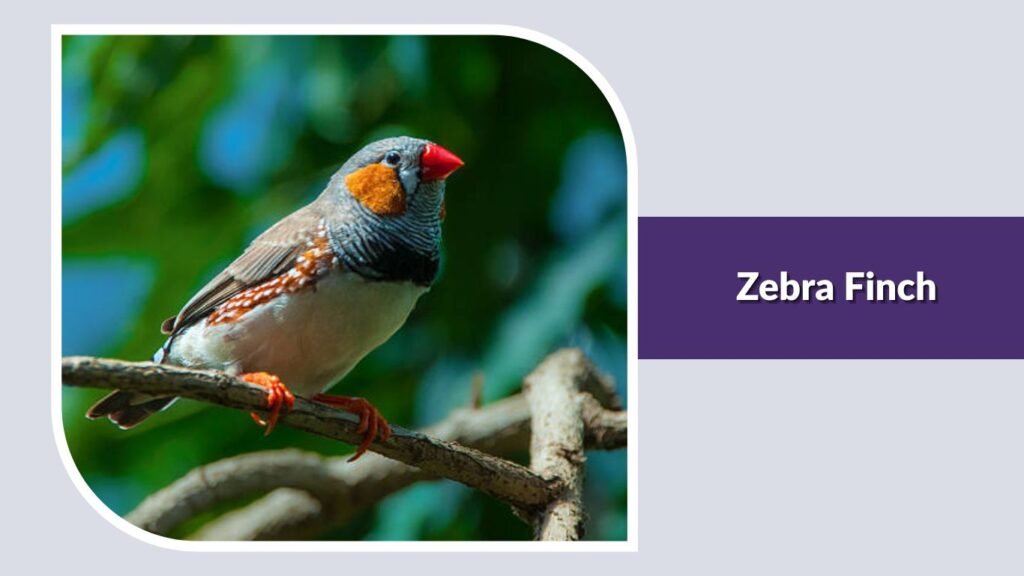
The Zebra Finch is a small gray-brown bird with a bright orange-red beak. Males display colorful cheek patches, striped chests, and spotted sides, while females have simpler plumage. Native to Australia, this social finch is also one of the world’s most popular captive birds.
Identification
- Small gray or brown body
- Bright orange-red, cone-shaped beak
- Black-and-white markings on males
- Orange cheek patches on adult males
- White-spotted reddish-brown sides
Male vs. Female
Male Zebra Finches have orange cheek patches, black-and-white chest bars, and reddish-brown sides covered with white spots. Females lack these decorative markings and are mainly gray. Both sexes have orange-red beaks, although the male’s beak is usually darker and brighter.
Habitat and Distribution
Wild Zebra Finches inhabit dry grasslands, open scrub, farmland, and areas near water throughout much of mainland Australia. They have also been introduced to several locations outside their native range. These birds often form large flocks where food and water are available.
Diet and Behavior
Zebra Finches mainly eat grass seeds and other small seeds but may also consume insects, particularly during breeding. They are highly social and communicate through short calls and songs. Wild pairs build enclosed grass nests in bushes, trees, or sheltered artificial structures.
11. Common Waxbill
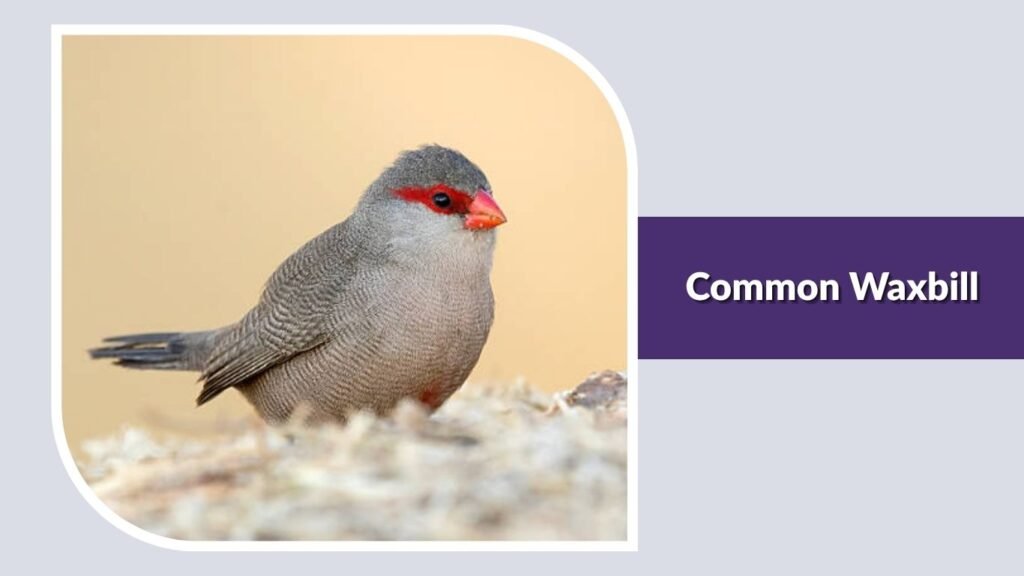
The Common Waxbill is a small brownish-gray bird with a bright red beak, red eye stripe, and finely barred plumage. Its beak resembles the color of sealing wax, which inspired its name. Native to sub-Saharan Africa, it has also established populations in several other regions.
Identification
- Bright red, cone-shaped beak
- Red stripe extending through each eye
- Gray-brown body with fine dark bars
- Pinkish or reddish patch on the belly
- Long, narrow, dark-colored tail
Male vs. Female
Male and female Common Waxbills look very similar, although males often have brighter red belly patches. Females may appear slightly duller and have less extensive pink coloring underneath. Juveniles are browner and initially have black bills rather than the distinctive red beaks of adults.
Habitat and Distribution
Common Waxbills inhabit grasslands, wetlands, farmland, gardens, and areas with tall vegetation. They are native to much of sub-Saharan Africa. Introduced populations are now found in Portugal, Spain, Brazil, Hawaii, and several islands around the world.
Diet and Behavior
These small birds primarily eat grass seeds, which they collect from seed heads and the ground. They occasionally consume insects, especially during the breeding season. Common Waxbills are highly social and frequently travel in flocks while producing soft, high-pitched calls.