
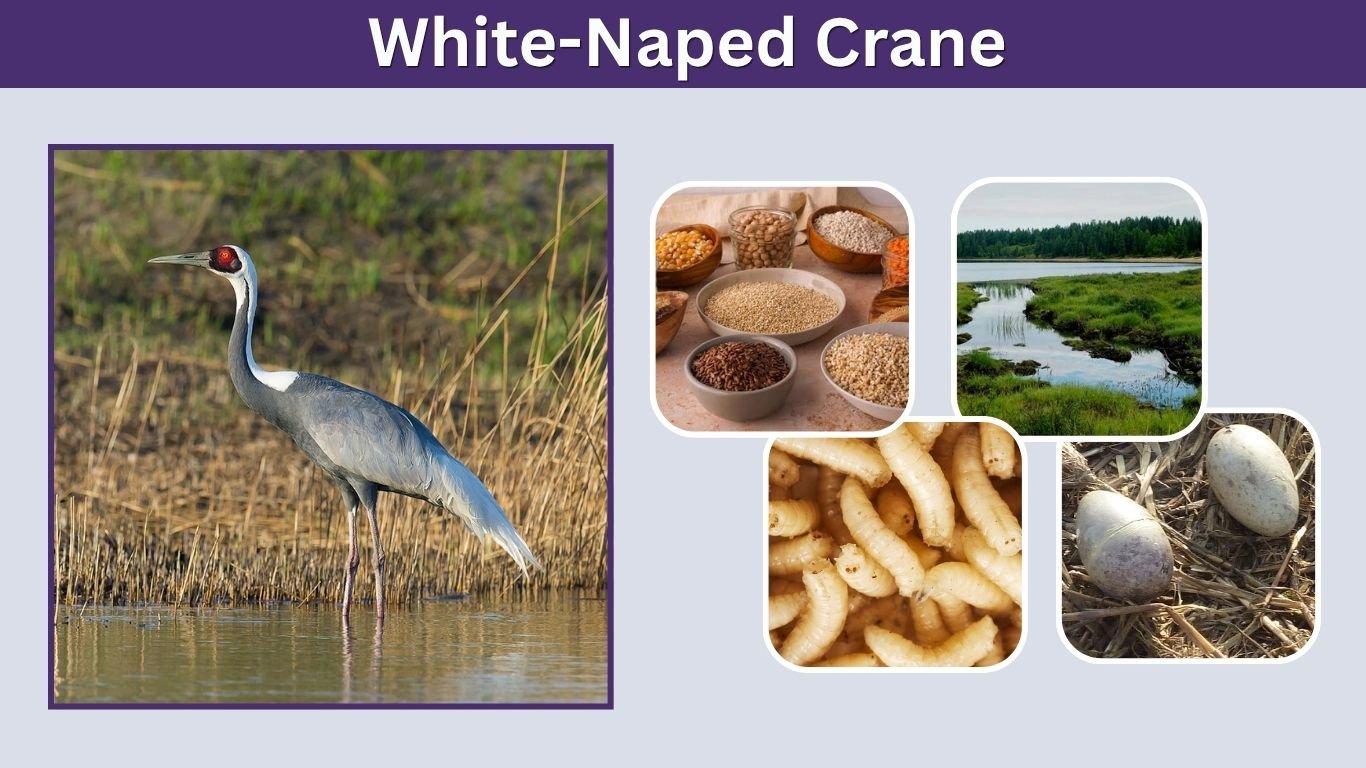
The white-naped crane is a graceful East Asian bird distinguished by its slate-gray body, white nape, pink legs, and bright red facial patch. These cranes migrate between breeding wetlands in Mongolia, China, and Russia and wintering areas in China, Korea, and Japan. They are also known for loud paired calls, elaborate dances, and strong family bonds. Although more than 11,000 may remain, the species is classified as Vulnerable because wetland loss and other human pressures continue to threaten important populations.
What Is a White-Naped Crane?
The white-naped crane is a large member of the crane family, Gruidae. Its scientific name is commonly written as Antigone vipio, although many conservation organizations and zoological institutions still use Grus vipio.
It is one of the most distinctive cranes in East Asia. Its name refers to the broad white area running from the crown down the back of its neck.
White-Naped Crane Identification
Adult white-naped cranes have several recognizable features:
- Dark slate-gray body
- Silvery-gray wings
- White crown and hind neck
- Dark stripe along the front and sides of the neck
- Bright red skin surrounding the eyes
- Long, pointed bill
- Long pinkish legs
- Straight neck and legs during flight
White-naped cranes are the only crane species combining pink legs with a dark gray-and-white striped neck. Juveniles have browner heads, cinnamon-gray plumage, and less distinct neck markings. Males and females look almost identical, although males are usually slightly larger.
White-Naped Crane Size
An adult white-naped crane stands approximately 125–130 centimeters tall, or a little over 4 feet. It commonly weighs about 5.6 kilograms, or 12 pounds.
| Measurement | Typical figure |
| Height | 125–130 cm |
| Weight | About 5.6 kg |
| Wingspan | Approximately 2–2.2 m |
| Clutch size | Usually 2 eggs |
| Incubation | 28–32 days |
Its long neck and legs make it appear especially tall, although it is smaller than the red-crowned crane and considerably shorter than the Sarus crane.
Where Do White-Naped Cranes Live?
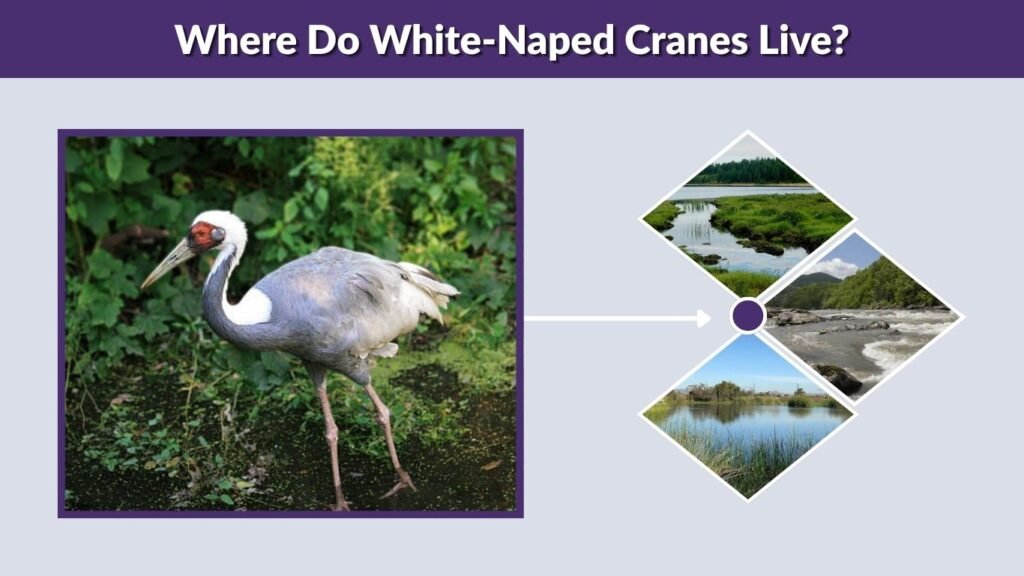
White-naped cranes breed primarily in northeastern Mongolia, northeastern China, and neighboring parts of southeastern Russia. Their population follows two main migration routes.
Western birds travel through China and spend winter around wetlands in the middle Yangtze River basin. Eastern birds migrate through the Korean Peninsula. Some remain near the Demilitarized Zone between North and South Korea, while others continue to Kyushu, Japan.
White-Naped Crane Habitat
These cranes favor open wetlands that provide shallow water, tall vegetation, and nearby feeding grounds.
Typical habitats include:
- Grassy marshes
- Sedge meadows
- Reedbeds
- Broad river valleys
- Lake depressions
- Boggy upland wetlands
- Freshwater lakes
- Rice fields and farmland
- Coastal flats during winter
Breeding pairs prefer relatively quiet wetlands where vegetation can conceal their nests. During winter, cranes often forage in harvested fields and agricultural landscapes where grains remain available.
What Do White-Naped Cranes Eat?
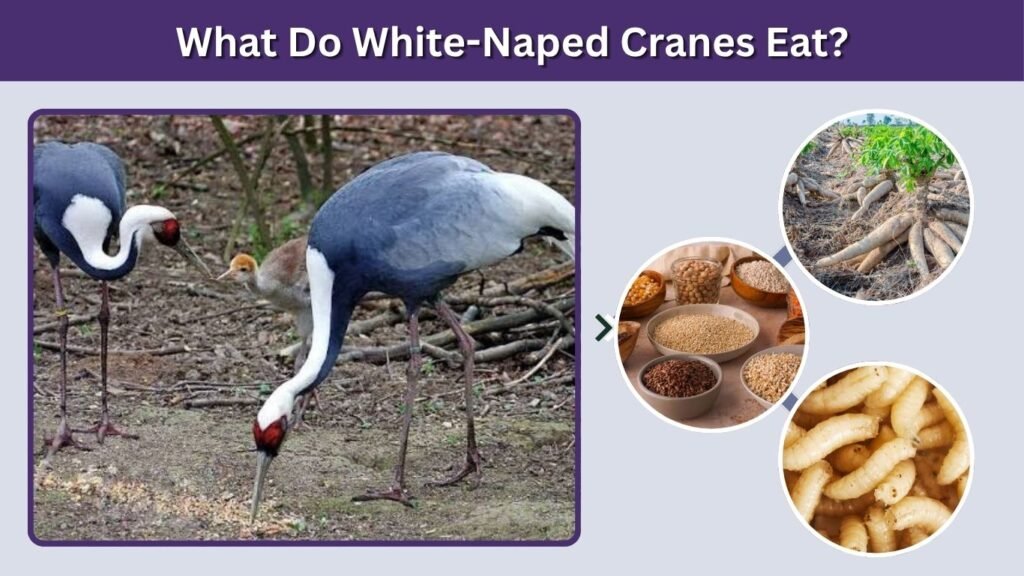
White-naped cranes are omnivores. They forage by walking slowly through wetlands and fields, probing or digging into mud and soil with their bills.
White-Naped Crane Diet
Their diet includes:
- Roots and tubers
- Sedge bulbs
- Aquatic plants
- Seeds and cereal grains
- Waste rice
- Insects and larvae
- Frogs and other amphibians
- Small rodents
- Other small vertebrates
Plant material forms an important part of their diet. White-naped cranes are particularly skilled at digging up underground sedge tubers. Outside the breeding season, they tend to consume more grains, seeds, and roots.
White-Naped Crane Call
The white-naped crane produces a high-pitched, penetrating trumpet-like call. Its sound can travel across large open wetlands and agricultural fields.
Pairs perform a coordinated vocal display known as a unison call. During this display, both birds lift their heads and point their bills upward. The female commonly produces two notes for each note from the male.
Unison calling helps cranes strengthen their pair bond and advertise or defend their territory. A short, sharp call may also be used when a crane becomes alarmed.
Why Do White-Naped Cranes Dance?
White-naped crane dances include bowing, running, jumping, wing flapping, and throwing sticks or pieces of grass into the air.
Dancing is frequently associated with courtship, but it is not performed only by breeding adults. Young cranes and established pairs may also dance.
The behavior can help cranes:
- Attract a potential partner
- Reinforce an existing pair bond
- Practice coordination
- Reduce tension or aggression
- Express excitement
- Communicate with other cranes
A pair may combine dancing with loud calling, creating an impressive display across its wetland territory.
Breeding and Life Cycle
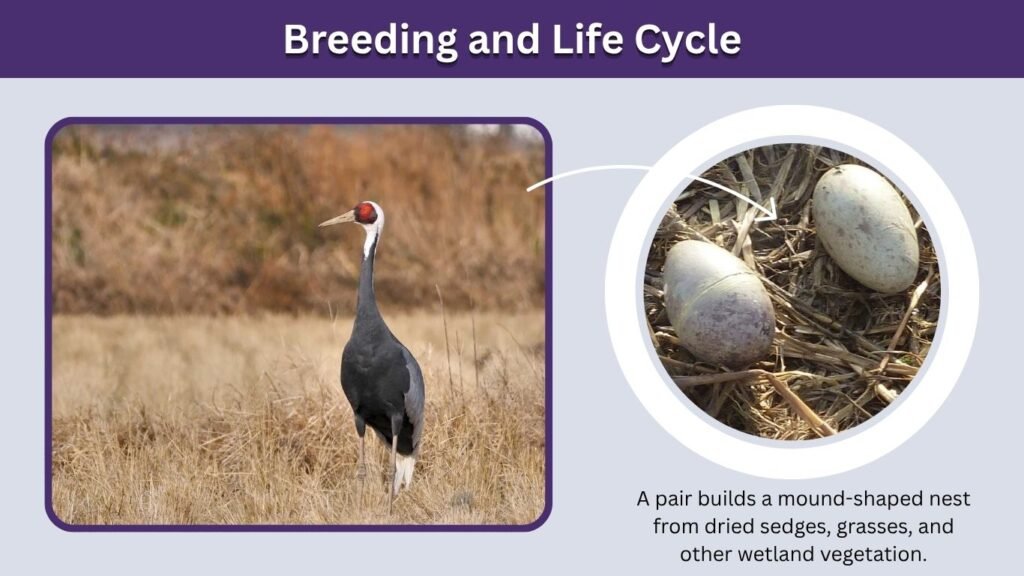
The breeding season generally runs from April through June. A pair builds a mound-shaped nest from dried sedges, grasses, and other wetland vegetation.
Eggs and Incubation
The female usually lays two eggs, often two or three days apart. Both parents incubate them for approximately 28–32 days.
The male often takes the leading role in defending the nesting territory, while both adults build the nest, incubate the eggs, feed the chicks, and guard the family.
Babies and Development
Newly hatched chicks have yellowish-brown down marked with darker spots. They can leave the nest shortly after hatching and follow their parents through the wetland.
Young cranes generally begin flying around 70–75 days after hatching. They remain with their parents while learning migration routes and feeding behaviors. White-naped cranes usually reach sexual maturity at about two to three years old.
White-Naped Crane Lifespan
The average lifespan of a wild white-naped crane is not precisely known. In managed populations, the median lifespan has been reported at approximately 15 years, although some individuals survive much longer.
The oldest managed cranes have reached more than 40 years of age. Survival in the wild depends on food availability, weather, disease, wetland quality, predation, migration hazards, and human disturbance.
Walnut the White-Naped Crane
Walnut was a famous female white-naped crane cared for at the Smithsonian Conservation Biology Institute in Virginia. Because she had been raised by humans, she became strongly attached to people and rejected male crane partners.
Walnut formed an unusual bond with animal keeper Chris Crowe, whom she treated as her mate. Crowe participated in her courtship behavior and helped conservation specialists use artificial insemination successfully.
Walnut produced eight surviving offspring and became an important contributor to the managed population. She died in January 2024 at the exceptional age of 42. Her story attracted public attention to crane behavior and conservation.
Are White-Naped Cranes Endangered?

The white-naped crane is classified as Vulnerable. The International Crane Foundation currently estimates the population at more than 11,000 birds. However, the eastern population is increasing while the western population is decreasing.
Major Threats
White-naped cranes face several pressures:
- Wetland drainage and conversion
- Water diversion and altered river flow
- Agricultural development
- Grassland fires
- Pollution and pesticide exposure
- Hunting, trapping, and poisoning
- Power-line collisions
- Disturbance near nesting areas
- Changes in farming practices
- Disease outbreaks at crowded feeding sites
Protecting connected breeding, migration, and wintering habitats is essential because these cranes cross several international borders every year. Conservation programs also work with farmers and communities to maintain wetlands and safer feeding areas.
Interesting White-Naped Crane Facts
- It is the only crane with both pink legs and a striped gray-and-white neck.
- Pairs perform carefully coordinated unison calls.
- Both parents incubate eggs and raise their chicks.
- Some birds spend winter close to the Korean Demilitarized Zone.
- White-naped cranes commonly feed alongside other crane species.
- Their dances are performed by both adults and young birds.
- The species is featured in Korean art, folklore, and New Year traditions.
- Its wild lifespan remains uncertain.
- The birds migrate through several East Asian countries.
- One managed crane, Walnut, lived to 42 years old.
FAQs
Do white-naped cranes mate for life?
White-naped cranes form strong monogamous pair bonds that may last for many years. Pairs strengthen their relationship through dancing, unison calling, nesting, and shared chick care. A surviving bird may eventually choose another partner if its mate dies.
Can white-naped cranes fly?
Yes. They are powerful migratory birds that travel long distances between breeding and wintering grounds. During flight, they hold their necks straight ahead and extend their legs behind their bodies.
Why are white-naped cranes Vulnerable?
Their major problem is the loss and degradation of wetlands. Water diversion, farming, development, pollution, hunting, power lines, and disturbance affect breeding grounds, migration stopovers, and wintering areas.
Are white-naped cranes found in South Korea?
Yes. Eastern white-naped cranes migrate through the Korean Peninsula. Several hundred may winter near the Demilitarized Zone, while others continue south to Japan.
Are white-naped cranes important to humans?
Yes. They are culturally important in East Asian art and folklore and can indicate the health of wetland ecosystems. Protecting crane habitat also benefits fish, waterbirds, plants, farmers, and communities that rely on healthy freshwater systems.
