
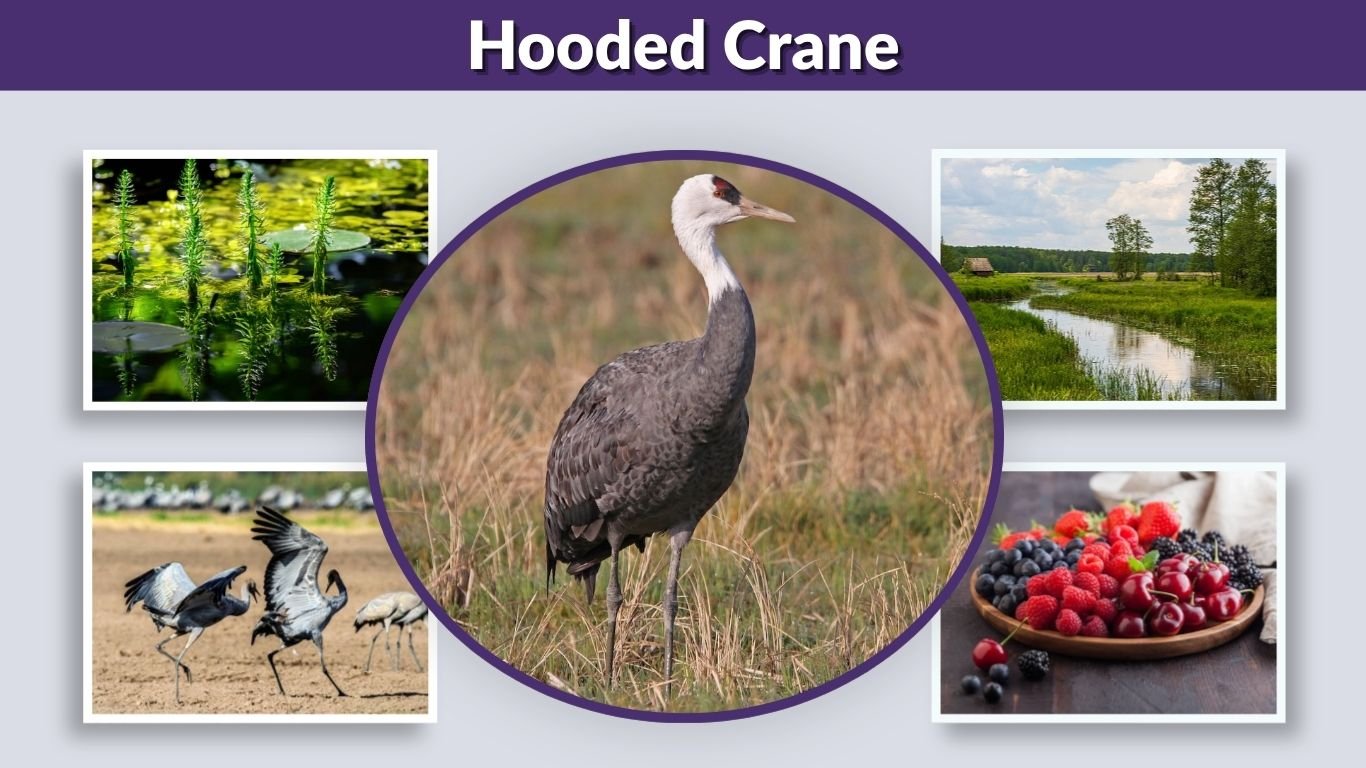
The Hooded crane is a small, elegant crane recognized by its dark gray body, white head and neck, black legs, and small red crown patch. This migratory Asian bird breeds mainly in remote wetlands of Russia and northern China before traveling south to wintering grounds in Japan, South Korea, and China. Hooded cranes are social, vocal birds known for coordinated calls, elaborate dances, strong pair bonds, and close family groups.
What Is a Hooded Crane?
The Hooded crane is an East Asian crane belonging to the family Gruidae. Its scientific name is Grus monacha. The word monacha means “nun,” referring to the bird’s dark body and contrasting white head, which resemble a traditional hooded garment.
It is one of the smaller crane species, although an adult still stands approximately three feet tall. The species is migratory and depends on wetlands, grasslands, forests, and agricultural areas throughout its annual cycle.
Hooded Crane Identification
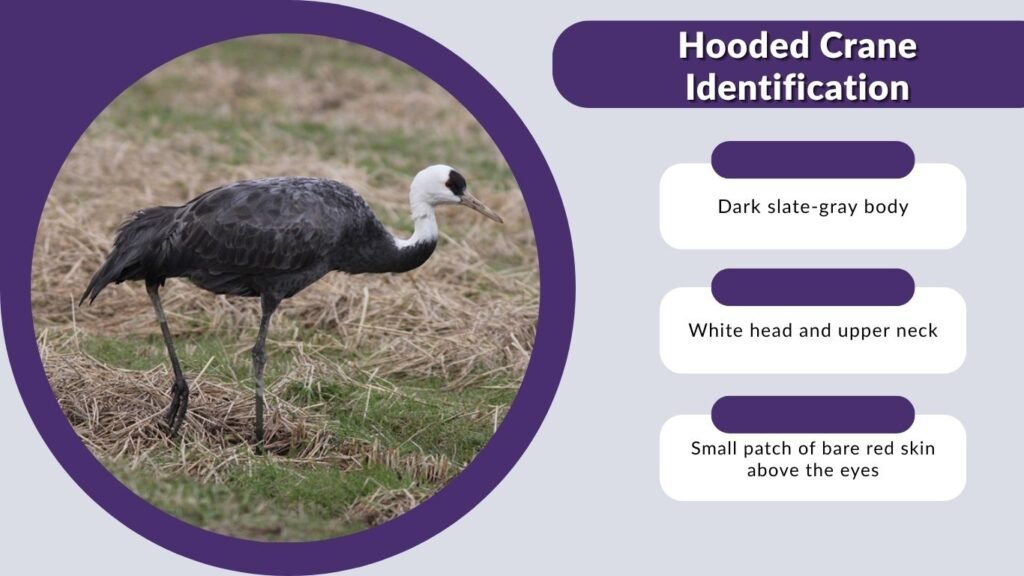
Adult Hooded cranes have a distinctive two-toned appearance. Their bodies are mainly slate gray, while their heads and upper necks are white.
Key Identification Features
- Dark slate-gray body
- White head and upper neck
- Small patch of bare red skin above the eyes
- Black flight feathers and tail
- Long black legs
- Pale yellowish-brown bill
- Long neck held straight during flight
- Compact body compared with larger cranes
The red area is relatively small, so “red Hooded crane” does not represent a separate species. The term usually refers to the red crown patch visible on an adult’s forehead.
Juveniles are less colorful. They have tan or brownish heads and necks with gray-brown body feathers. Their adult white-and-red head pattern develops as they mature. Male and female Hooded cranes look nearly identical, although males are generally slightly larger.
Hooded Crane Size
The Hooded crane is one of the smallest true cranes. Its light build helps it travel long distances between breeding and wintering grounds.
| Measurement | Typical size |
| Height | About 100 cm |
| Weight | 3.5–3.9 kg |
| Wingspan | About 187 cm |
| Incubation period | 27–30 days |
| Typical clutch | Two eggs |
Although relatively small for a crane, its wingspan can exceed six feet. It flies with its long neck extended forward and its legs stretched behind the body.
Where Do Hooded Cranes Live?

Hooded cranes breed mainly in central and southeastern Russia, particularly in remote areas of Siberia. Breeding also occurs in northern China, while possible breeding areas exist in Mongolia.
During migration, nonbreeding flocks may gather around the border region shared by Russia, Mongolia, and China. Small numbers winter in China and South Korea, but most travel to southern Japan.
More than 80% of the global population winters around the Izumi Feeding Station on Kyushu, Japan. This concentration makes Izumi one of the world’s most important locations for the species.
Hooded Crane Habitat
Habitat use changes throughout the year. Common environments include:
- Forested marshes
- Mossy bogs
- Wet meadows
- Shallow freshwater wetlands
- River and lake shores
- Natural grasslands
- Rice paddies
- Agricultural fields
- Coastal tidal flats
Breeding pairs prefer quiet, wet areas with scattered larch trees. They generally avoid landscapes that are completely open or covered by extremely dense forest.
Wintering birds use more open environments. They frequently roost near shallow lakes or rivers and forage in rice fields, marshes, grasslands, and cultivated farmland.
What Do Hooded Cranes Eat?
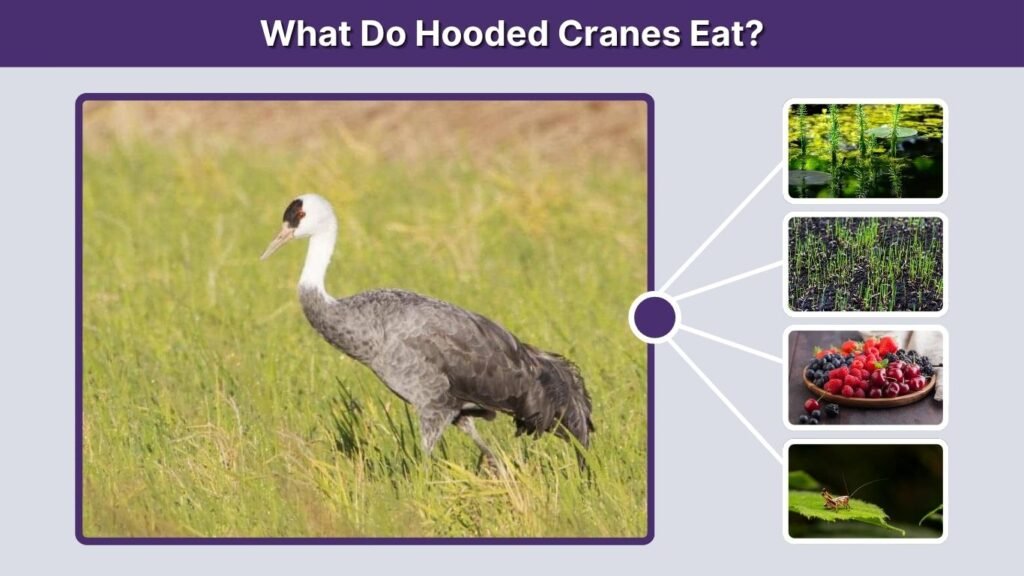
Hooded cranes are omnivorous opportunistic feeders. Their diet changes according to season, location, and available food.
Hooded Crane Diet
Their natural foods include:
- Aquatic plants
- Grass and seeds
- Roots and rhizomes
- Berries
- Insects
- Frogs and salamanders
- Small aquatic animals
- Small mammals
- Rice, wheat, and cereal grains
During the breeding season, animal foods such as insects and amphibians provide valuable protein. During winter, roots, seeds, grasses, rice, and other grains become especially important.
At managed feeding stations in Japan and South Korea, the cranes receive rice, wheat, and other cereal grains. Supplementary feeding helps support large wintering flocks but also causes many birds to gather in one location.
Are Hooded Cranes Secondary Consumers?
Hooded cranes can function as both primary and secondary consumers. When they eat plants, seeds, or grains, they act as primary consumers. When they eat insects, amphibians, small mammals, or aquatic animals, they act as secondary consumers.
Their exact position in a food chain therefore depends on what they are eating at that moment.
Hooded Crane Call
The Hooded crane produces several recognizable vocalizations. Its general call is loud and high-pitched, helping cranes communicate across open wetlands and fields.
A soft, purring contact call helps family members or flock mates maintain contact. A sharp single call signals alarm or danger.
Bonded pairs also perform a coordinated unison call. The birds point their bills upward and produce a carefully timed duet that strengthens their relationship and warns other cranes away from their territory. The female usually gives two notes for every note produced by the male.
Why Do Hooded Cranes Dance?
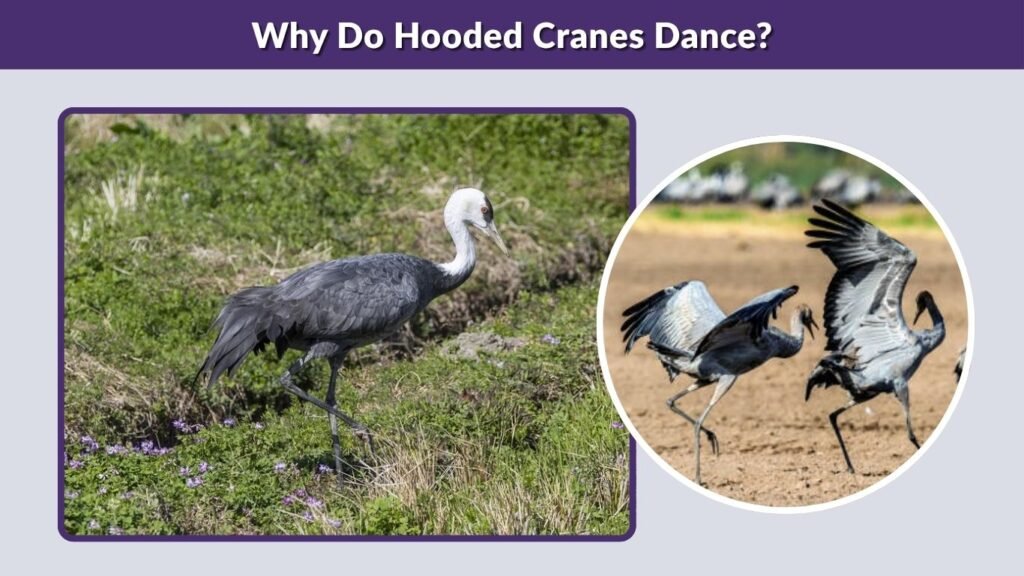
Hooded cranes perform elaborate dances involving leaping, bowing, wing spreading, head bobbing, running, and tossing pieces of grass or sticks into the air.
Dancing is associated with courtship, but it serves additional purposes. It may help cranes:
- Attract potential partners
- Reinforce established pair bonds
- Practice coordination
- Communicate excitement
- Reduce aggression
- Develop social skills
Young cranes may dance before reaching breeding age. Bonded adults can also dance throughout the year rather than only during the mating season.
Breeding and Life Cycle
Hooded cranes form long-term monogamous partnerships. A surviving crane may eventually accept another mate when its previous partner dies.
Nest and Eggs
Pairs build nests in wet, mossy areas containing scattered trees. Both adults collect reeds and grasses to construct the nest.
The female usually lays two eggs during April or early May. Both parents incubate them for approximately 27 to 30 days. When the male is not incubating, it commonly guards the nesting territory.
Hooded Crane Chicks
The chicks hatch covered in soft down and can leave the nest relatively soon. Both parents lead them to feeding areas and protect them from predators.
Although two eggs are commonly laid, both chicks do not always survive. One chick may receive more attention or outcompete its sibling for food.
Young cranes usually become capable of sustained flight at around 75 days old. By August, family groups begin leaving the breeding areas. Hooded cranes generally become sexually mature at approximately three to four years of age.
Hooded Crane Lifespan
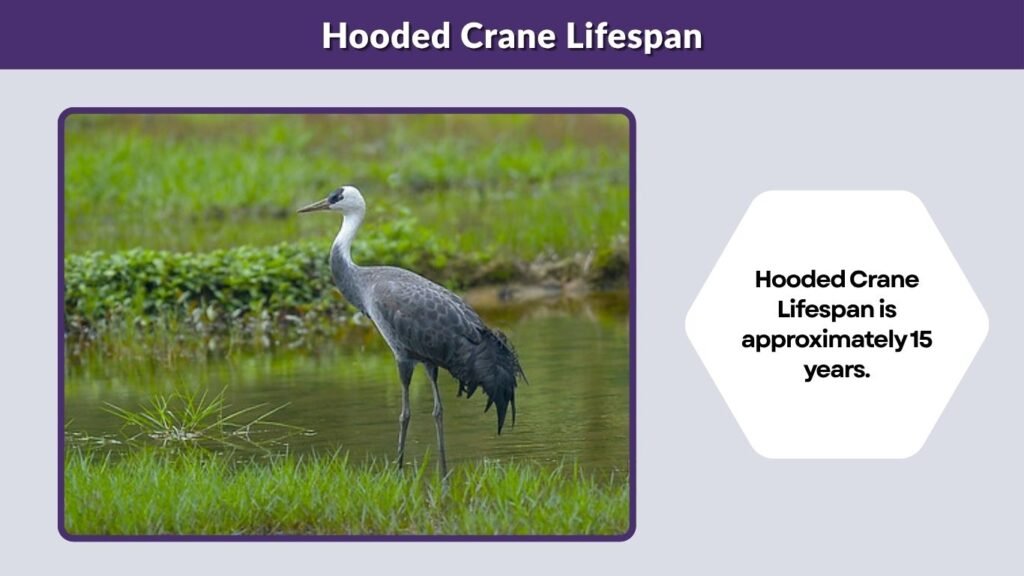
The lifespan of wild Hooded cranes has not been thoroughly documented because they breed in remote and difficult-to-study habitats.
In managed populations, the median lifespan is approximately 15 years. Some individuals may live considerably longer when they receive appropriate food, veterinary care, and protection from predators and environmental hazards.
Are Hooded Cranes Rare or Endangered?
The Hooded crane is currently classified as Vulnerable. The International Crane Foundation estimates the global population at approximately 18,500 to 19,000 birds and describes its overall trend as stable to increasing.
The species remains vulnerable because such a large proportion of the population winters in one small region. A severe disease outbreak, extreme weather event, or major habitat disruption around Izumi could affect thousands of cranes simultaneously.
Major Threats
Hooded cranes face several continuing dangers:
- Wetland destruction and degradation
- Disease outbreaks in crowded flocks
- Pollution and environmental contamination
- Illegal hunting or capture
- Power-line collisions
- Changes in agricultural practices
- Pesticide exposure
- Human disturbance
- Development near wintering grounds
- Altered water levels and river systems
Conservation programs are working to protect wetlands, improve water management, restore alternative wintering sites, reduce dangerous concentrations, and cooperate with farmers and local communities.
Interesting Hooded Crane Facts
- Its scientific name means “nun crane.”
- It is one of the smallest crane species.
- Adults have only a small red patch above their eyes.
- More than 80% of the winter in one region of Japan.
- Hooded cranes perform coordinated paired calls.
- Both parents incubate and protect the chicks.
- Their breeding nests remained scientifically undiscovered until 1974.
- They eat both plants and small animals.
- Juveniles have brownish heads instead of white ones.
- The species is classified as Vulnerable.
FAQs
Do Hooded cranes mate for life?
Hooded cranes form strong, long-term monogamous pair bonds. They reinforce their relationships through dancing, coordinated calling, nesting, and raising chicks together. A bird may eventually form another partnership when its mate dies.
Can Hooded cranes fly?
Yes. Hooded cranes are strong migratory flyers with wingspans of approximately 187 centimeters. They travel between breeding areas in Russia and China and wintering grounds in Japan, South Korea, and China.
Are Hooded cranes found in North America?
They are native to East Asia, not North America. An individual appearing in places such as Indiana or Tennessee would be an exceptionally rare visitor, an escaped managed bird, or a crane that requires careful identification.
What is the difference between a Hooded crane and a White-naped crane?
Hooded cranes have dark bodies, white heads and necks, black legs, and a small red crown. White-naped cranes are larger, have pink legs, paler gray bodies, striped necks, and more extensive red facial skin.
Why are Hooded cranes important?
Hooded cranes contribute to wetland food webs by consuming plants and animals while dispersing some seeds. Protecting their habitat also safeguards wetlands that support fish, waterbirds, flood control, agriculture, and nearby communities.
