
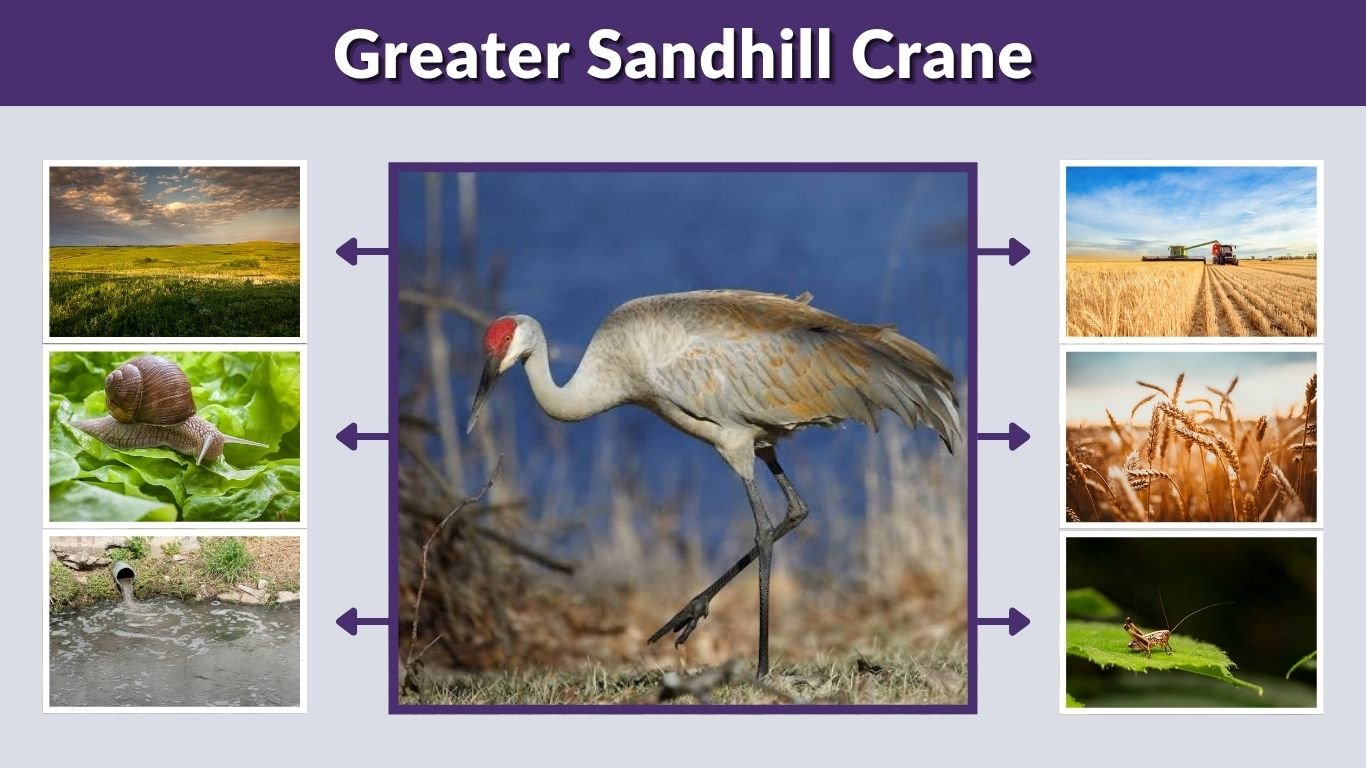
The greater sandhill crane is a tall North American bird recognized by its gray plumage, red crown, long black legs, and powerful trumpeting call. It is the largest sandhill crane subspecies and inhabits wetlands, grasslands, agricultural fields, and river valleys. Many populations migrate hundreds or thousands of miles between northern breeding grounds and southern wintering areas. Although greater sandhill cranes have recovered dramatically in several regions, wetland loss, development, collisions, and human disturbance remain important concerns.
What Is a Greater Sandhill Crane?
The greater sandhill crane is the largest subspecies of the sandhill crane. Its scientific name is commonly written as Antigone canadensis tabida, although the U.S. Fish and Wildlife Service continues to list it as Grus canadensis tabida. It is one of three migratory sandhill crane subspecies found in North America.
Greater sandhill cranes are especially associated with the northern United States and southern Canada. Their populations are managed in several regional groups, including the Eastern, Rocky Mountain, Central Valley, Lower Colorado River Valley, and Pacific Coast populations.
Greater Sandhill Crane Identification
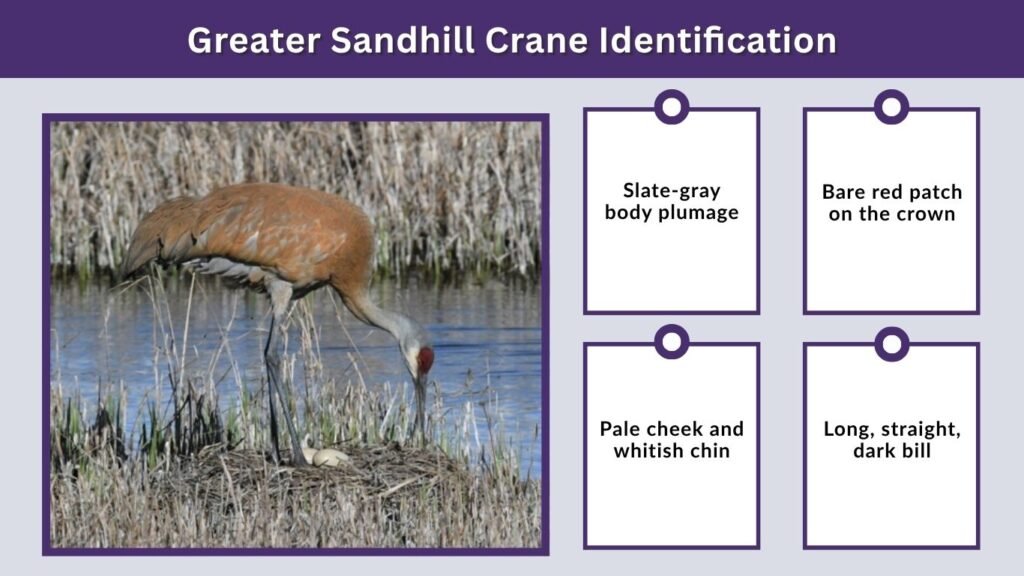
Adult greater sandhill cranes are large, long-legged birds with bulky bodies and relatively small heads. Their feathers are naturally gray, but many individuals develop rusty-brown patches after rubbing iron-rich mud into their plumage.
Key Identification Features
- Slate-gray body plumage
- Bare red patch on the crown
- Pale cheek and whitish chin
- Long, straight, dark bill
- Long black legs
- Broad, rounded wings
- Drooping rear feathers forming a “bustle”
- Straight neck and trailing legs during flight
Juveniles are browner than adults and lack the bright red crown. Their heads and necks gradually become grayer as they mature.
Male vs Female Greater Sandhill Crane
Males and females have almost identical plumage. Males are generally larger and heavier, but the difference is difficult to judge unless a pair is standing together.
The sexes can sometimes be distinguished during their coordinated calls. In a typical unison call, the female produces two notes for each longer note from the male.
Greater Sandhill Crane Size and Height
Greater sandhill cranes are the largest sandhill crane form. Sandhill cranes generally measure around 47 inches in body length and have a wingspan close to 79 inches, but greater sandhill cranes are usually taller and heavier than the species-wide average.
| Measurement | Approximate range |
| Standing height | 4–4.5 feet |
| Wingspan | 6–7 feet |
| Weight | Approximately 10–14 pounds |
| Body length | Around 46–48 inches |
Their great height comes mainly from their long neck and legs. Despite their size, they are powerful flyers capable of soaring at high altitudes during migration.
Where Do Greater Sandhill Cranes Live?
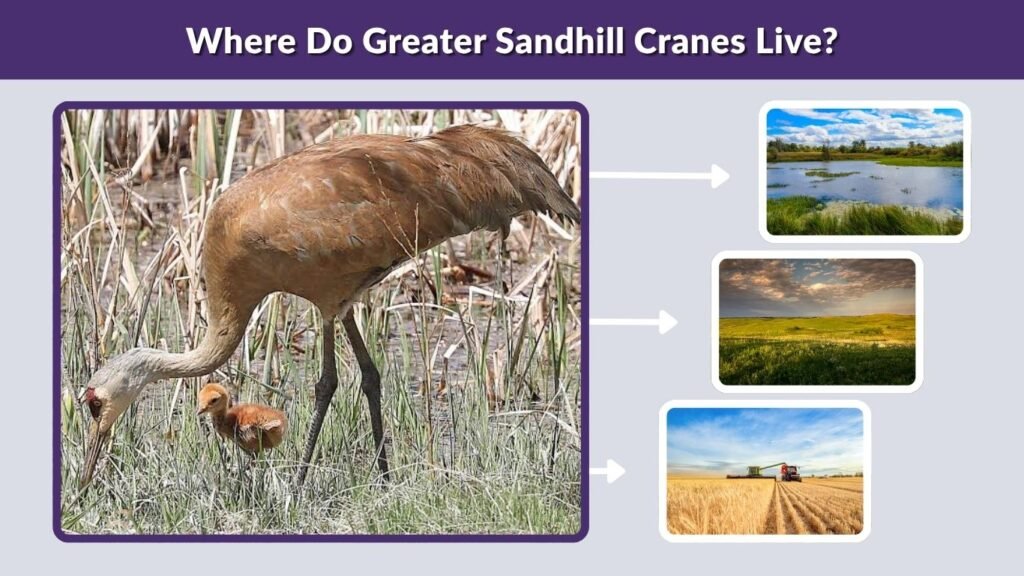
Greater sandhill cranes breed across parts of the northern and western United States and southern Canada. Important breeding regions include the Great Lakes, the northern Rocky Mountains, the Pacific Northwest, and parts of California, Nevada, Oregon, Idaho, Montana, Wyoming, and Colorado.
The Eastern population breeds primarily in Wisconsin, Michigan, Minnesota, and southern Ontario. Tracking research found that many of these birds wintered in Indiana, Tennessee, Georgia, and Florida.
Greater Sandhill Crane Habitat
Greater sandhill cranes depend on a combination of wetlands and nearby uplands. They frequently use:
- Freshwater marshes
- Wet meadows
- Bogs and shallow wetlands
- River valleys
- Prairies and grasslands
- Agricultural fields
- Irrigated pastures
- Shallow lakes and reservoirs
Breeding cranes generally select open wetlands with standing water and surrounding vegetation. Outside the breeding season, they feed in fields and grasslands before gathering in shallow water to roost safely at night.
Greater Sandhill Crane Migration
Most greater sandhill cranes are migratory. The exact routes and distances vary among regional populations.
Eastern birds migrate between the Great Lakes region and the southeastern United States. Western populations move between breeding areas in the Rocky Mountains, Great Basin, Pacific Northwest, and northeastern California and wintering areas in California, Arizona, New Mexico, Texas, and Mexico.
During migration, cranes fly with their necks extended and legs trailing behind them. They commonly travel in V-shaped formations or long, uneven lines. By circling in rising columns of warm air, they can gain altitude and glide considerable distances while conserving energy.
Great Sandhill Crane Migration in Nebraska
Nebraska’s Platte River is famous for enormous gatherings of sandhill cranes during spring migration. However, many birds there belong to the smaller lesser sandhill crane subspecies, while some greater sandhill cranes are also present.
Therefore, “greater sandhill crane migration” and the broader “great sandhill crane migration” are not always the same thing. The famous Nebraska event includes multiple sandhill crane populations rather than only the greater subspecies.
What Do Greater Sandhill Cranes Eat?

Greater sandhill cranes are omnivores. They feed on land and in shallow water, picking food from the surface or probing mud and soil with their bills.
Greater Sandhill Crane Diet
Common foods include:
- Corn, wheat and other grains
- Seeds and berries
- Roots and plant tubers
- Insects and larvae
- Earthworms and snails
- Frogs and small reptiles
- Small mammals
- Crayfish and other aquatic animals
- Occasionally eggs or young birds
Grains and seeds form a large part of their diet outside the breeding season. During spring and summer, animal prey provides protein for growing chicks and breeding adults.
Call, Dance, and Social Behavior
Greater sandhill cranes produce loud, rolling trumpet calls that can be heard from great distances. Their unusual windpipe coils inside the breastbone, helping create a resonant sound.
Why Do Greater Sandhill Cranes Dance?
Their dances involve bowing, running, jumping, wing spreading, and tossing sticks or grass into the air. Dancing plays an important role in courtship and pair formation, but established pairs and young cranes also dance.
The behavior may strengthen relationships, improve coordination, release excitement, and reduce social tension. Sandhill cranes usually form long-term pair bonds and remain together throughout migration, winter, and the breeding season.
Nesting and Reproduction
Greater sandhill cranes build broad nests from grasses, sedges, reeds, and other available vegetation. Nests are usually placed in shallow marshes, wet meadows, or bogs where surrounding water provides some protection from land predators.
Eggs and Chicks
A female generally lays one to three eggs, although two is most common. Both parents incubate the eggs for approximately 29–32 days. The eggs are pale brown, yellowish, or olive with darker markings.
The chicks, called colts, hatch covered in down with their eyes open. They can leave the nest within hours and follow their parents through wetlands. Although two chicks may hatch, frequently only one survives until fledging. Family groups normally remain together through winter, separating before the next breeding season.
Greater vs Lesser Sandhill Crane
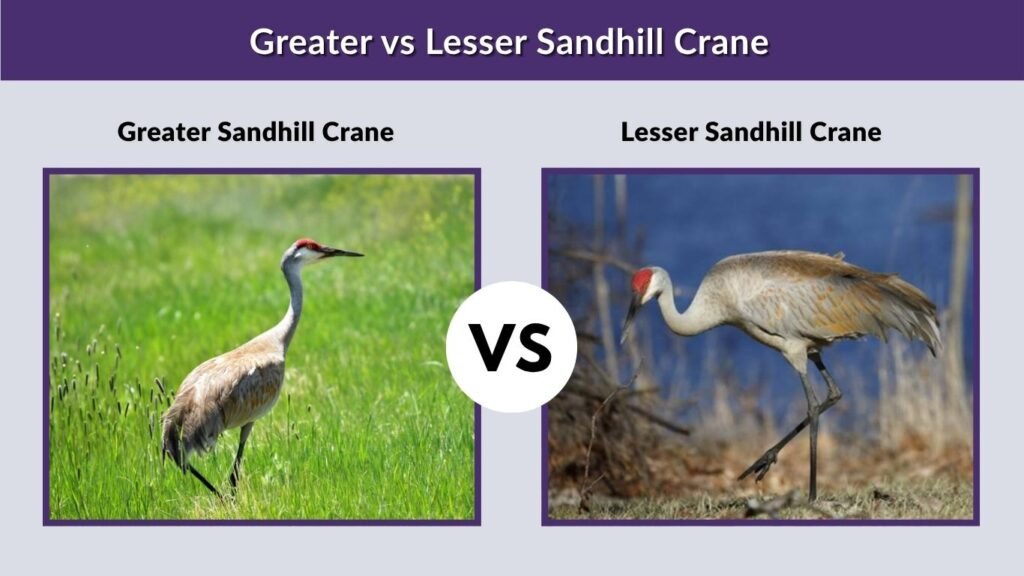
The greater and lesser sandhill cranes have similar colors and markings, making identification difficult when they are not standing together.
| Feature | Greater sandhill crane | Lesser sandhill crane |
| Overall size | Largest subspecies | Smallest subspecies |
| Body shape | Taller, heavier and bulkier | Shorter and more compact |
| Bill | Longer and heavier | Shorter and finer |
| Legs | Longer | Relatively shorter |
| Breeding range | Northern U.S. and southern Canada | Arctic and subarctic regions |
| Migration distance | Moderate to long | Often extremely long |
Size is the most useful difference. Greater sandhill cranes are visibly larger and heavier, while lesser cranes have shorter bills and more compact bodies. Plumage is usually too similar to provide reliable identification.
Greater vs Florida Sandhill Crane
Florida sandhill cranes are nonmigratory and remain in Florida throughout the year. They are intermediate in size, generally smaller than greater sandhill cranes but larger than lesser sandhill cranes.
A crane’s location and seasonal behavior can provide important clues. A permanent Florida resident is likely a Florida sandhill crane, while a large crane arriving from the north for winter may be a migratory greater sandhill crane.
Greater Sandhill Crane vs Great Blue Heron
These two tall gray birds are frequently confused, especially during flight.
| Feature | Greater sandhill crane | Great blue heron |
| Body | Large and bulky | Slimmer and more angular |
| Crown | Red patch | Black head plumes |
| Bill | Dark and relatively straight | Large, yellowish, dagger-shaped |
| Flight posture | Neck held straight | Neck folded into an S shape |
| Feeding style | Walks and probes fields or marshes | Stands and strikes at aquatic prey |
| Social behavior | Often seen in pairs or flocks | Frequently forages alone |
The easiest flight identification feature is the neck. A sandhill crane flies with its neck completely extended, while a great blue heron pulls its neck into a tight S shape.
Are Greater Sandhill Cranes Endangered?
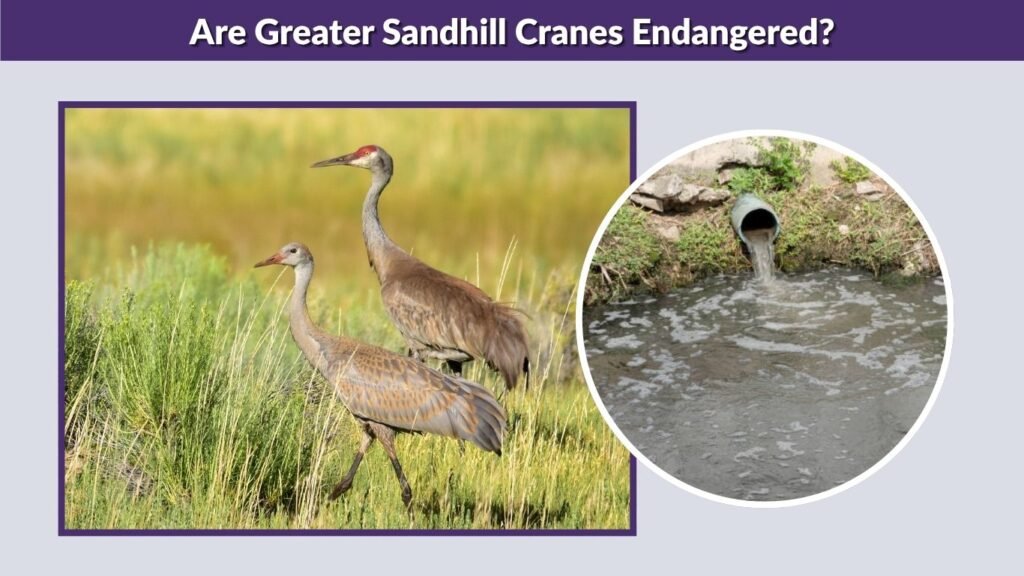
Greater sandhill cranes are not federally listed as endangered or threatened throughout the United States. Sandhill cranes are abundant overall, and several regional populations have increased considerably after historical declines.
However, their legal and conservation status varies by location. California lists the greater sandhill crane as threatened and fully protected, reflecting its smaller breeding population and dependence on vulnerable wetlands.
Sandhill cranes are protected under the Migratory Bird Treaty Act. Taking, capturing, selling, or transporting protected migratory birds generally requires authorization. Regulated hunting seasons are permitted for certain sandhill crane populations in some jurisdictions, based on population monitoring and wildlife regulations.
Major Threats
Greater sandhill cranes face several pressures:
- Wetland drainage and altered water levels
- Agricultural and urban development
- Disturbance near nesting sites
- Collisions with power lines and fences
- Vehicle strikes
- Pesticide or chemical exposure
- Loss of migration stopover sites
- Predation on eggs and chicks
Protecting wetlands, maintaining shallow roosting water, reducing disturbance, marking power lines, and conserving nearby agricultural feeding areas can support healthy crane populations.
FAQs
How tall is a greater sandhill crane?
A greater sandhill crane commonly stands approximately four to four-and-a-half feet tall. It is the largest sandhill crane subspecies, with a broad wingspan that may approach seven feet.
Do greater sandhill cranes mate for life?
They form strong, long-term monogamous pair bonds. Pairs migrate, defend territories, dance, call, and raise chicks together. A surviving crane may eventually form a new partnership after losing its mate.
Are greater sandhill cranes found in California?
Yes. They breed in northeastern California and winter in the Central Valley and other suitable areas. California classifies the greater sandhill crane as a threatened and fully protected species.
How long do greater sandhill cranes live?
Sandhill cranes are long-lived birds, and individuals can survive for several decades. Actual life expectancy varies according to habitat quality, disease, predation, collisions, weather, and human activity.
Is it common to see greater sandhill cranes in Michigan?
Yes. Michigan lies within the core breeding range of the expanding Eastern population. Cranes can be seen in wetlands, grasslands, and agricultural landscapes, especially during breeding and migration periods.
