
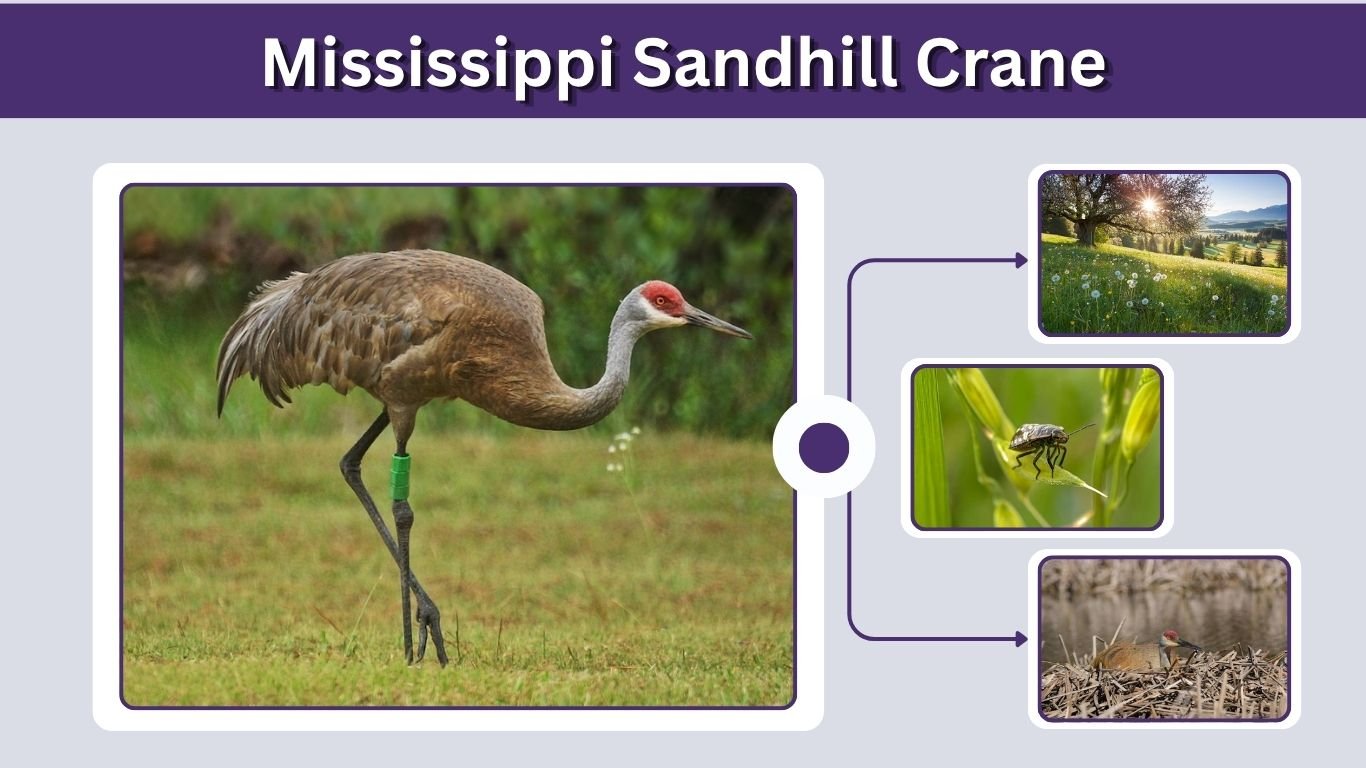
The Mississippi sandhill crane is one of North America’s rarest birds. This nonmigratory crane lives only in a small area along Mississippi’s Gulf Coast, where it depends on wet pine savannas for nesting, feeding, and roosting. Adults are recognized by their gray plumage, red crowns, long legs, and loud rattling calls. Although conservation programs have increased their population from fewer than 35 birds to approximately 200, the subspecies remains federally endangered.
What Is a Mississippi Sandhill Crane?
The Mississippi sandhill crane is a rare subspecies of the sandhill crane. Its scientific name is Grus canadensis pulla, although some modern classifications place sandhill cranes in the genus Antigone.
Unlike the large migratory flocks that travel through central North America, Mississippi sandhill cranes remain near the Mississippi Gulf Coast throughout the year. Their extremely limited range makes them especially vulnerable to habitat loss, severe storms, disease, disturbance, and other local threats.
Mississippi Sandhill Crane Identification
Adult Mississippi sandhill cranes have several recognizable features:
- Gray to dark gray body plumage
- Bare red skin on the crown
- Whitish cheek area
- Long, straight, dark bill
- Long black or dark gray legs
- Drooping rear feathers resembling a bustle
- Neck held straight during flight
- Loud, rolling or clattering call
Adults stand approximately four feet tall. Males and females look nearly identical, although males are generally somewhat larger. Young cranes, called colts, have cinnamon-brown feathers and lack the prominent red crown of adults.
Mississippi Sandhill Crane vs Other Sandhill Cranes
The Mississippi sandhill crane belongs to the same species as Florida, greater, and lesser sandhill cranes, but it differs in range, migration, appearance, and conservation status.
| Feature | Mississippi sandhill crane | Migratory sandhill crane |
| Movement | Nonmigratory | Travels seasonally |
| Range | Mississippi Gulf Coast | Broad parts of North America |
| Plumage | Generally darker gray | Often paler or more variable |
| Population | Approximately 200 | Hundreds of thousands overall |
| Federal status | Endangered | Generally not federally endangered |
| Primary habitat | Wet pine savanna | Marshes, prairies and farmland |
The Mississippi form was recognized partly because of its darker plumage, body proportions, restricted range, and genetic characteristics.
Where Do Mississippi Sandhill Cranes Live?
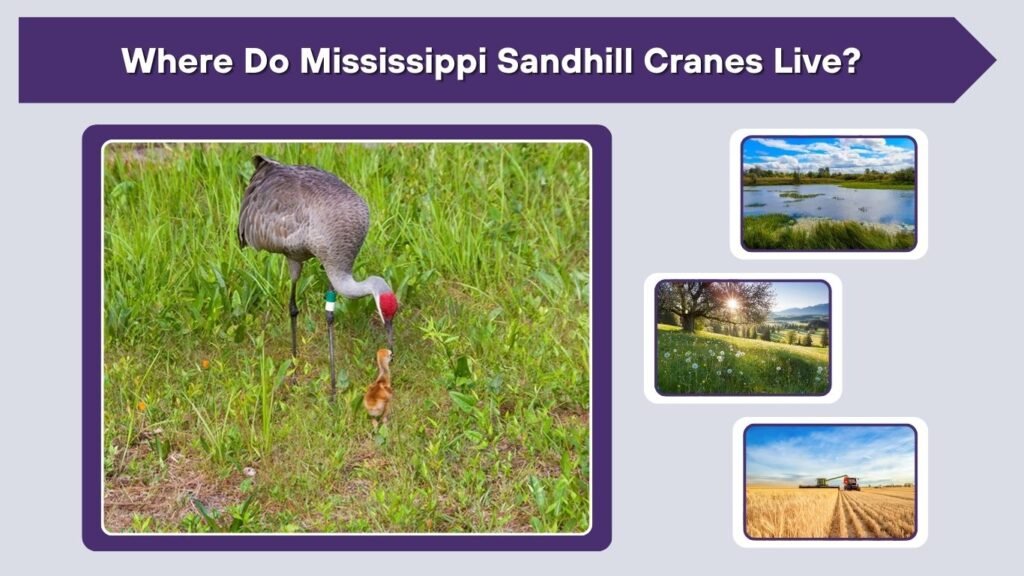
Mississippi sandhill cranes occur only in southeastern Mississippi. Their remaining wild population is concentrated on Mississippi Sandhill Crane National Wildlife Refuge and nearby private lands in Jackson County.
Historically, resident cranes occupied Gulf Coast areas from Louisiana to Florida. Most of their original wet savanna habitat has since disappeared, leaving the Mississippi population isolated within a very small region.
Mississippi Sandhill Crane Habitat
These cranes depend mainly on wet pine savannas—flat, open landscapes with scattered pine trees, grasses, sedges, shallow wetlands, and waterlogged acidic soil.
Important habitats include:
- Wet pine savannas
- Shallow freshwater wetlands
- Open grasslands
- Pine flatwoods
- Seasonal ponds
- Agricultural food plots
- Marshy nesting areas
- Shallow nighttime roosts
The open landscape allows cranes to watch for predators while finding plant and animal foods. Scattered shallow wetlands provide nesting and roosting locations.
Wet pine savanna must be burned periodically to remain open. Without natural or prescribed fire, shrubs and trees gradually create dense vegetation that is less suitable for cranes. The refuge therefore uses controlled burns as an essential habitat-management tool.
What Do Mississippi Sandhill Cranes Eat?
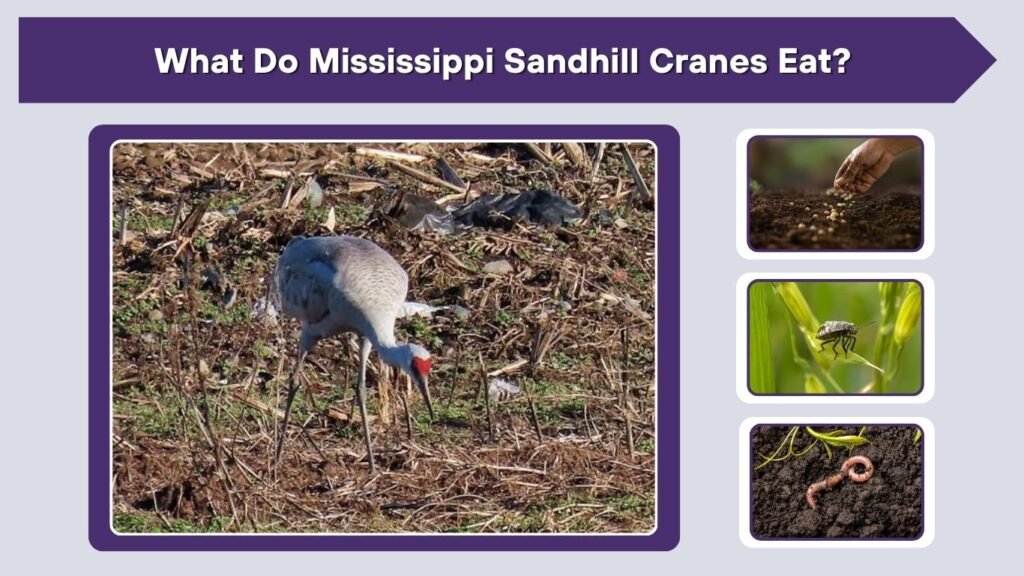
Mississippi sandhill cranes are omnivores. They walk through savannas, wetlands, and food plots while picking food from the surface or probing into soft ground with their bills.
Mississippi Sandhill Crane Diet
Their diet may include:
- Seeds and cereal grains
- Berries and other fruit
- Roots and plant tubers
- Insects and larvae
- Earthworms
- Snails and crayfish
- Frogs and small reptiles
- Small mammals
- Other small wetland animals
Plant foods are especially important during periods when insects and other prey are less abundant. The cranes may also use managed food plots within protected habitat. Sandhill cranes generally adjust their diet according to seasonal availability.
Call, Dance, and Behavior
The Mississippi sandhill crane produces a loud, rattling trumpet call that can carry across open savannas. A specially adapted windpipe helps create its deep, resonant sound.
Pairs also perform synchronized unison calls. During this display, both cranes raise their heads and point their bills upward while producing a coordinated sequence of notes.
Why Do Mississippi Sandhill Cranes Dance?
Their dance may involve:
- Bowing
- Running
- Jumping into the air
- Spreading the wings
- Tossing grass or sticks
- Turning around another crane
Dancing is important during courtship, but young cranes and established pairs may also perform it. The behavior can reinforce pair bonds, improve coordination, express excitement, and reduce social tension.
Nesting and Reproduction
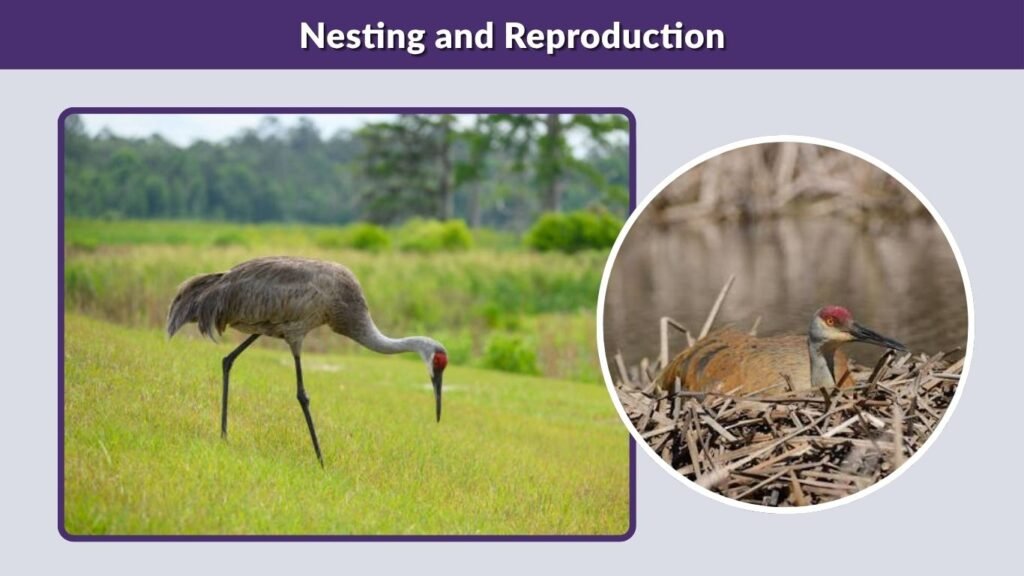
Mississippi sandhill cranes form long-lasting monogamous partnerships. Breeding pairs defend territories containing suitable feeding grounds and shallow wetlands.
Nest and Eggs
Both adults build a mound-shaped nest using grasses, sedges, and other wetland vegetation. The nest is commonly positioned in shallow water or saturated ground.
A female normally lays two eggs. Both parents participate in incubation and protect the nesting area from intruders.
Mississippi Sandhill Crane Chicks
Newly hatched colts are covered in brownish down and can leave the nest shortly after hatching. Their parents guide them to food and protect them from predators.
Young cranes generally become capable of flight after approximately 70–80 days. They may remain with their parents for around ten months before becoming independent and eventually forming their own pair bonds.
Why Is the Mississippi Sandhill Crane Endangered?
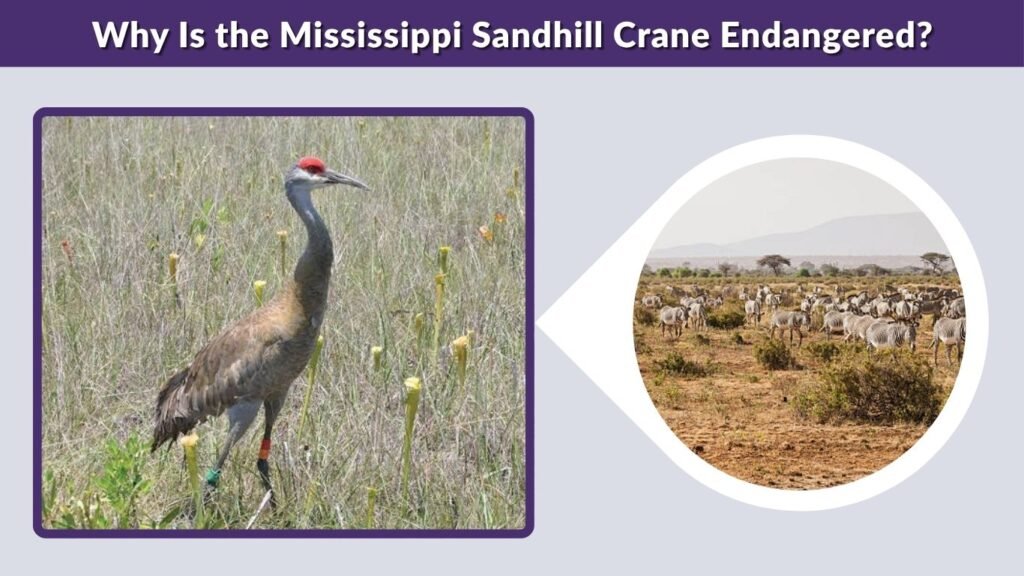
The Mississippi sandhill crane was federally listed as endangered in 1973. Habitat destruction was the main cause of its decline.
Timber plantations, fire suppression, industrial development, roads, and changes in land use eliminated most of the wet pine savanna that once covered the Gulf Coastal Plain. The U.S. Fish and Wildlife Service reports that 5% or less of the original savanna habitat remains.
Other Major Threats
The cranes continue to face dangers from:
- Road and power-line collisions
- Habitat fragmentation
- Poor nesting success
- Predation on eggs and colts
- Severe storms and hurricanes
- Disease
- Human disturbance
- Loss of genetic diversity
- Dense vegetation caused by fire suppression
Their concentration in one small region means a single hurricane, disease outbreak, or major habitat change could affect much of the population.
Mississippi Sandhill Crane Population
Only around 30–35 cranes remained when the national wildlife refuge was established in 1975. The current population is approximately 200 birds.
This recovery has been supported by habitat restoration, captive breeding, releases of young cranes, nest monitoring, prescribed burning, and protection of surrounding land. However, the population is still too small and geographically restricted for the subspecies to be considered secure.
Mississippi Sandhill Crane National Wildlife Refuge
Mississippi Sandhill Crane National Wildlife Refuge was established in 1975 under the Endangered Species Act. It protects cranes and one of the largest remaining areas of wet pine savanna on the Gulf Coast.
The refuge is located in Jackson County, with its visitor center at 7200 Crane Lane in Gautier. It is a national wildlife refuge—not a national park or commercial crane sanctuary.
Fontainebleau Nature Trail
The Fontainebleau Nature Trail passes through pine forest and offers views toward Davis Bayou. Visitors may see woodland birds, wetland wildlife, wildflowers, and other plants, although crane sightings are never guaranteed.
Some sections may become wet after rain, so suitable walking shoes are recommended. Visitors should remain on the designated route and respect all closures.
C. L. Dees Nature Trail
The C. L. Dees Nature Trail begins near the visitor center and forms an easy loop through wet pine savanna. Interpretive signs explain the habitat and seasonal plants.
Visitors may encounter carnivorous plants such as:
- Pitcher plants
- Sundews
- Butterworts
These unusual plants grow in nutrient-poor, acidic soil and obtain extra nutrients by trapping insects. The refuge’s trails pass through wetlands, savannas, pitcher-plant bogs, and cypress habitats.
Best Time to See Sandhill Cranes in Mississippi
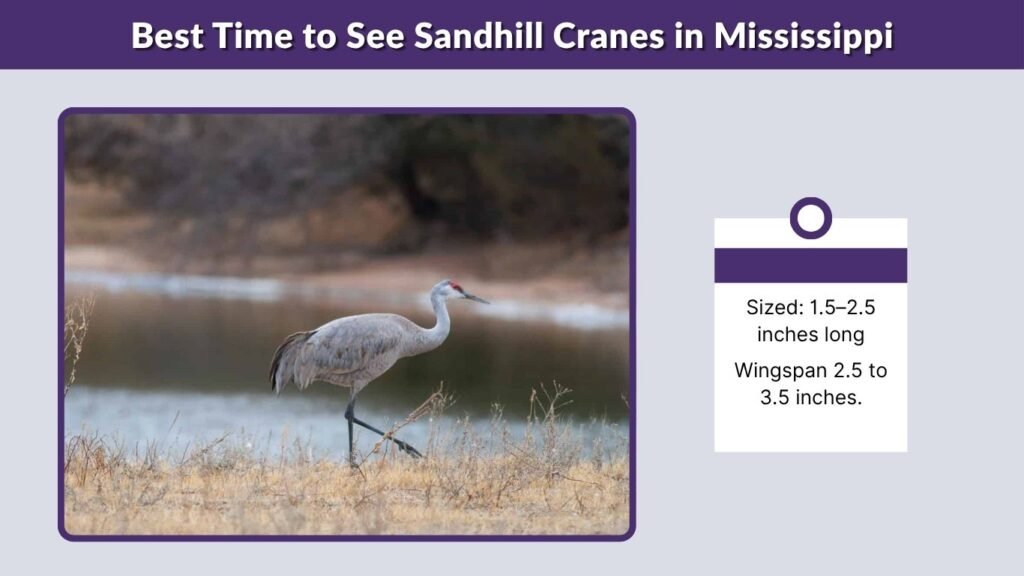
Fall and winter are generally the best seasons for observing Mississippi sandhill cranes. The birds tend to become more secretive during their spring and summer nesting period.
Visitors can check the refuge’s sightings board or ask staff about recent activity. Observation areas near the visitor center and designated trails provide birdwatching opportunities, but cranes may remain hidden in distant or closed areas.
Can You Hunt Mississippi Sandhill Cranes?
No. Mississippi sandhill cranes are federally endangered and cannot legally be hunted, killed, captured, or intentionally harmed.
Public hunting, fishing, and trapping are also prohibited within Mississippi Sandhill Crane National Wildlife Refuge because the cranes are extremely sensitive to disturbance. Camping, fires, horseback riding, and leaving designated public areas are prohibited as well.
Interesting Mississippi Sandhill Crane Facts
- It is a nonmigratory sandhill crane subspecies.
- Its entire wild population occupies southeastern Mississippi.
- Adults stand approximately four feet tall.
- The population has grown from about 30–35 to around 200 birds.
- Young cranes are called colts.
- Colts can usually fly at approximately 70–80 days old.
- Prescribed fire is essential for maintaining their habitat.
- The refuge was established specifically to protect this crane.
- Fall and winter provide the best viewing opportunities.
- The subspecies remains federally endangered.
FAQs
Do Mississippi sandhill cranes migrate?
No. They are permanent residents of southeastern Mississippi and remain within the same general Gulf Coast region throughout the year.
How many Mississippi sandhill cranes remain?
The U.S. Fish and Wildlife Service currently estimates the population at approximately 200 birds. That is an improvement from the 30–35 cranes present when the refuge was established.
Are Mississippi sandhill cranes aggressive?
They generally avoid people, but nesting adults may defend their eggs or colts. Visitors should keep their distance and never approach, feed, chase, or disturb a crane.
Can you camp at the crane refuge?
No. Camping is not permitted within Mississippi Sandhill Crane National Wildlife Refuge. Nearby public campgrounds provide alternative accommodation.
Is seeing a crane guaranteed at the refuge?
No. These endangered birds move across a large protected landscape and may remain hidden, particularly during nesting season. Fall and winter generally offer the best chance of a sighting.
