
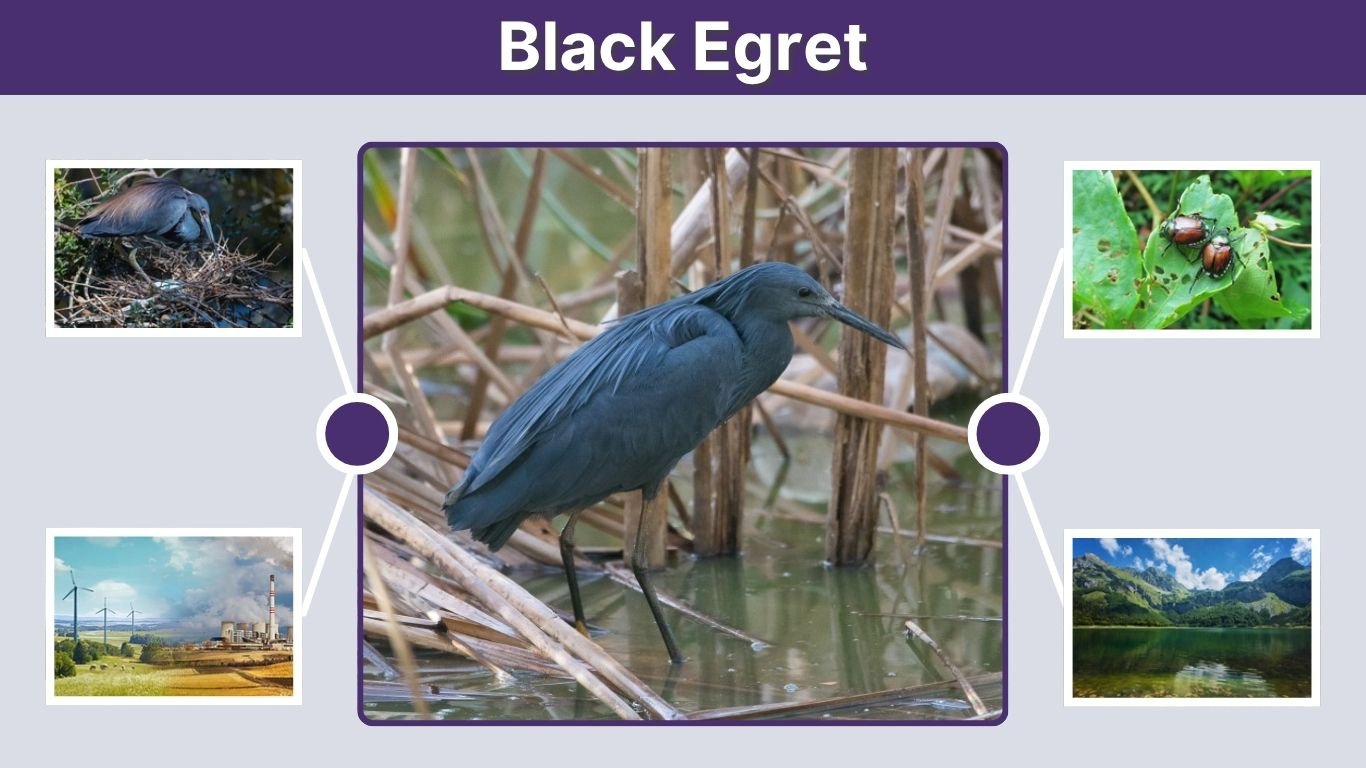
The Black Egret is a striking African waterbird known for one of the most remarkable fishing techniques in the bird world. While hunting, it spreads its wings forward to form a complete umbrella over its head, creating a patch of shade in the water. This behavior attracts fish and helps the bird see its prey more clearly. Also called the Black Heron, this dark-plumaged egret lives around shallow lakes, marshes, rivers, rice fields, and coastal wetlands across sub-Saharan Africa and Madagascar.
Black Egret Quick Facts
The scientific name of the Black Egret is Egretta ardesiaca. It belongs to the Ardeidae family, which includes herons, egrets, and bitterns.
| Feature | Description |
|---|---|
| Common name | Black Egret |
| Other name | Black Heron |
| Scientific name | Egretta ardesiaca |
| Family | Ardeidae |
| Length | Approximately 43–66 cm |
| Weight | About 270–390 grams |
| Plumage | Black or dark slate-gray |
| Bill | Long and black |
| Feet | Bright yellow |
| Diet | Fish, insects, crustaceans, and amphibians |
| Range | Sub-Saharan Africa and Madagascar |
| Conservation status | Least Concern |
Size and Physical Appearance
The Black Egret is a medium-sized, slender waterbird. It has the long neck, pointed bill, broad wings, and extended legs normally associated with herons and egrets. Its compact size allows it to move quickly through shallow water while pursuing small fish.
Its body length typically falls between approximately 43 and 66 centimeters. Individuals generally weigh around 270–390 grams, although size can vary according to sex, age, and geographical region.
Plumage and Color
Adult Black Egrets are almost completely black. Under bright sunlight, their feathers may display bluish-gray, charcoal, or slightly glossy tones. This uniform coloration separates the species from many other African herons, which usually have white, gray, brown, or patterned plumage.
The head is relatively narrow, and the neck can appear short when folded against the body. When the bird becomes alert or begins hunting, it extends its neck and displays a much taller profile.
Bill, Legs, and Feet
The bill is long, straight, sharply pointed, and almost entirely black. It works like a spear or pair of forceps, allowing the egret to seize fish and small aquatic animals quickly.
The legs are dark gray, brownish-black, or black. In contrast, the feet are bright yellow or orange-yellow. This difference between dark legs and yellow feet is an important identification feature.
The toes are long and widely spread. They distribute the bird’s weight across mud, floating plants, and other soft surfaces while providing balance in moving water.
Breeding Plumage
During the breeding season, adults develop elongated plumes on the crown and back of the neck. These plumes can produce a shaggy or crested appearance, especially during courtship displays.
Males and females are extremely similar in color and overall appearance. Males may average slightly larger, but the difference is generally too small to be useful for field identification.
Black Egret Identification
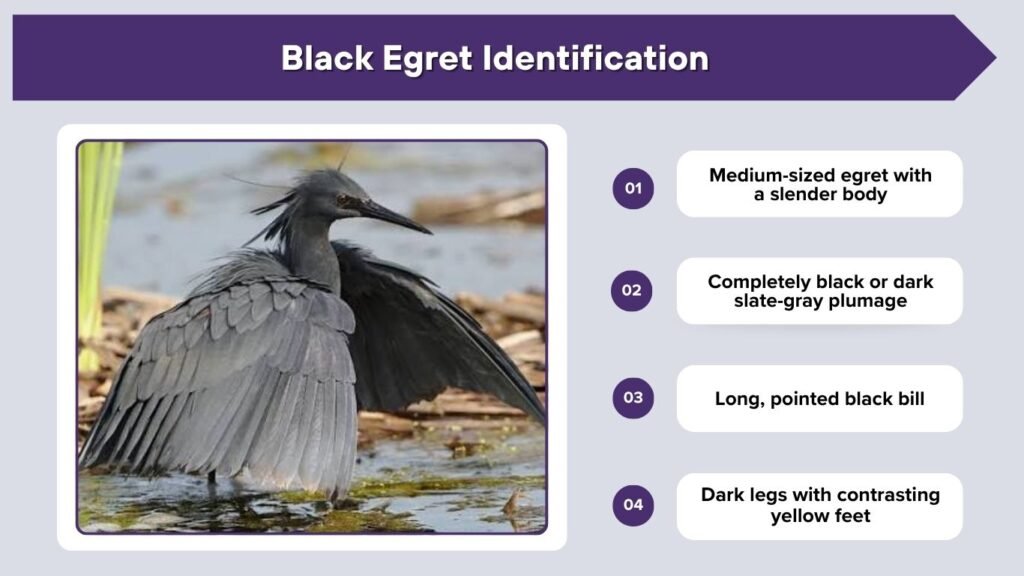
A Black Egret can be recognized by combining its plumage, yellow feet, wetland habitat, and distinctive hunting method. The umbrella-like posture is the clearest clue, but the bird does not hold this position continuously.
Main Identification Features
- Medium-sized egret with a slender body
- Completely black or dark slate-gray plumage
- Long, pointed black bill
- Dark legs with contrasting yellow feet
- Long toes adapted for walking in shallow water
- Yellow or orange eyes
- Shaggy head and neck plumes during breeding
- Frequently feeds with its wings forming an umbrella
- Commonly seen alone or in loose feeding groups
Juvenile birds resemble adults but usually have duller, browner feathers. They may also lack the long ornamental plumes of breeding adults.
Black Egret vs. Black-Headed Heron
The Black-Headed Heron is significantly larger and has a gray body, black head, pale throat, and longer, heavier bill. It often searches for prey in dry grasslands as well as wetlands.
The Black Egret is smaller, entirely dark, and closely connected to shallow water. Its bright yellow feet and umbrella-feeding behavior provide additional identification clues.
Black Egret vs. Slaty Egret
The Slaty Egret closely resembles the Black Egret and shares its dark plumage and yellow feet. However, the Slaty Egret generally appears bluish-gray rather than jet-black. It also has a yellow throat and may show reddish or pinkish coloration on the front of its legs during breeding.
The Black Egret has a black throat, darker plumage, and an especially strong association with canopy feeding. Location is also useful because the Slaty Egret has a more restricted range in south-central Africa.
Distribution and Range
Black Egrets are native to Africa. They have a broad but uneven distribution across sub-Saharan regions, occurring from parts of West Africa eastward to Ethiopia and southward into southern Africa.
Countries within their range include Senegal, Gambia, Ghana, Nigeria, Sudan, Ethiopia, Kenya, Uganda, Tanzania, Zambia, Botswana, Zimbabwe, Mozambique, Namibia, and South Africa. They are also found in Madagascar.
The species may be common around suitable wetlands in certain areas while being scarce or absent in nearby regions. Its movements are strongly influenced by seasonal rainfall and water levels.
Some populations remain near permanent wetlands throughout the year. Others move locally or travel longer distances when seasonal floodplains fill or begin to dry. These movements allow the birds to follow concentrations of fish and other aquatic prey.
Black Egret Habitat
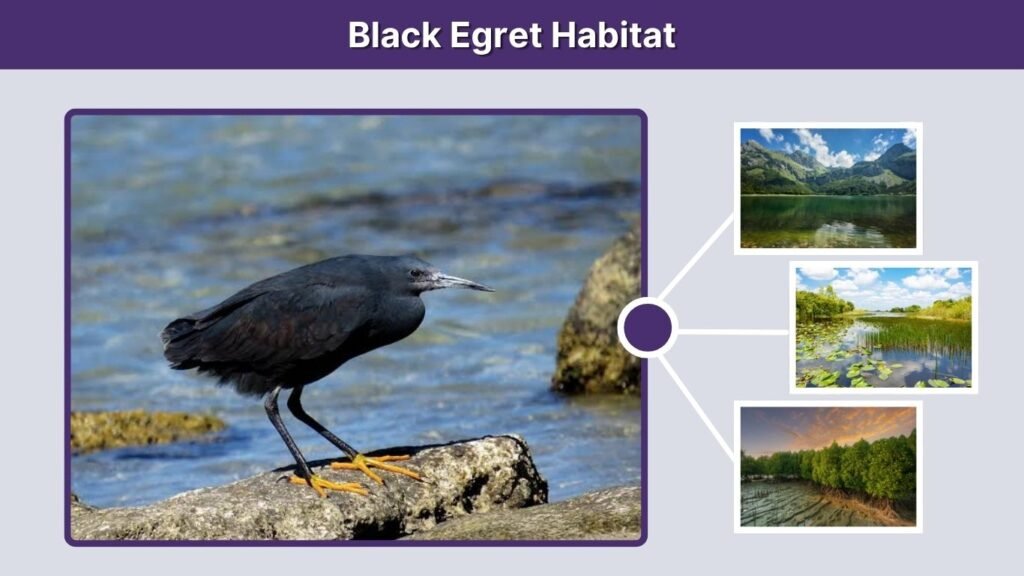
The Black Egret occupies freshwater, brackish, and occasionally saltwater environments. Shallow water is the most important habitat requirement because its specialized feeding method works best where fish remain within striking distance.
Common habitats include:
- Shallow freshwater lakes
- Marshes and swamps
- Riverbanks and slow-moving streams
- Flooded grasslands
- Seasonal pools
- Rice fields
- Reservoir edges
- Coastal lagoons
- Mangroves and estuaries
- Tidal flats and creeks
Black Egrets generally prefer open water with some nearby vegetation. Reeds, bushes, and trees provide nesting and roosting locations, while open shallows offer space for canopy feeding.
Human-created environments can provide suitable habitat when managed appropriately. Rice paddies, reservoirs, drainage areas, and aquaculture ponds may attract the birds if the water is shallow and contains abundant prey.
What Does a Black Egret Eat?
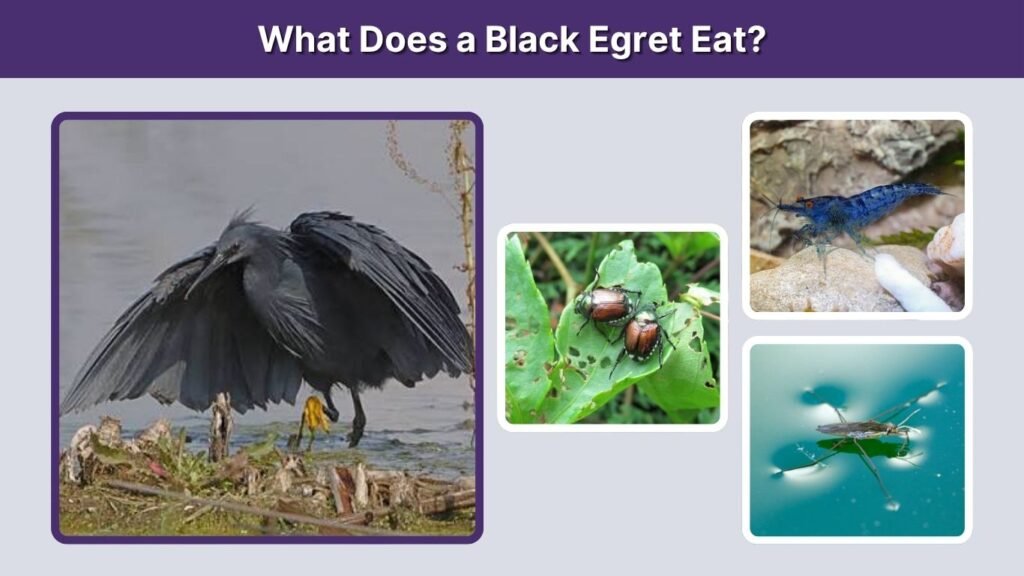
The Black Egret is a carnivorous bird that feeds on small aquatic animals. Its diet varies depending on habitat, season, water depth, and local food availability.
| Food type | Common examples |
|---|---|
| Fish | Tilapia fry, minnows, and other small fish |
| Aquatic insects | Beetles, larvae, and water bugs |
| Crustaceans | Shrimp and small crabs |
| Amphibians | Tadpoles and small frogs |
| Other prey | Small mollusks and aquatic invertebrates |
Fish form the largest part of the diet in many locations. The egret swallows small prey whole, usually positioning a fish head-first before consuming it. Larger prey may be shaken or repositioned in the bill.
Umbrella Feeding Behavior
The Black Egret is famous for a hunting method known as canopy feeding. Although a few other herons occasionally use their wings to produce shade, the Black Egret performs the behavior more consistently and completely.
How Umbrella Feeding Works
The egret begins by walking slowly through shallow water. When it reaches a promising spot, it lowers its head and spreads both wings forward until the flight feathers meet around its bill.
This posture creates a circular umbrella that blocks sunlight from reaching the water. Hidden beneath its wings, the bird watches the shaded area before striking at any fish that approaches.
The entire process may last only a few seconds. If no prey appears, the egret folds its wings, takes several steps, and forms another canopy in a different location.
Why Does the Black Egret Create Shade?
The wing canopy may offer several advantages. First, shade reduces glare and reflections from the water’s surface, helping the egret see fish more clearly.
Second, small fish often move toward shaded areas because they associate darkness with vegetation, rocks, or other shelter. The bird effectively creates a temporary hiding place and then waits for fish to enter it.
The dark space may also make it more difficult for prey to detect the egret’s head and bill. This gives the bird a better opportunity to strike successfully.
Other Hunting Methods
Black Egrets do not rely exclusively on umbrella feeding. They may walk slowly, stand still, stir the water with their feet, or chase prey for short distances.
Some birds hunt alone, while others feed in flocks. Groups of 50 or more may gather where fish are concentrated, and much larger feeding gatherings have occasionally been reported.
They feed mainly during daylight but can be particularly active in the late afternoon and around sunset. Coastal birds adjust their feeding activity according to the tides.
Behavior and Communication
Black Egrets may be social when feeding, nesting, or roosting. Outside these activities, individuals can be solitary and may maintain distance from other birds.
At night, groups often roost together in trees, reeds, or bushes near water. Coastal populations may gather at high tide when their shallow feeding flats are covered.
The species is generally quiet while feeding. Its vocalizations include harsh croaks and rough calls that are most often heard during flight, conflict, courtship, or activity around a nesting colony.
When flying, the Black Egret folds its neck into an S-shape and stretches its legs behind the body. Its broad, rounded wings produce steady wingbeats. The yellow feet may remain visible beyond the dark tail.
Nesting and Reproduction
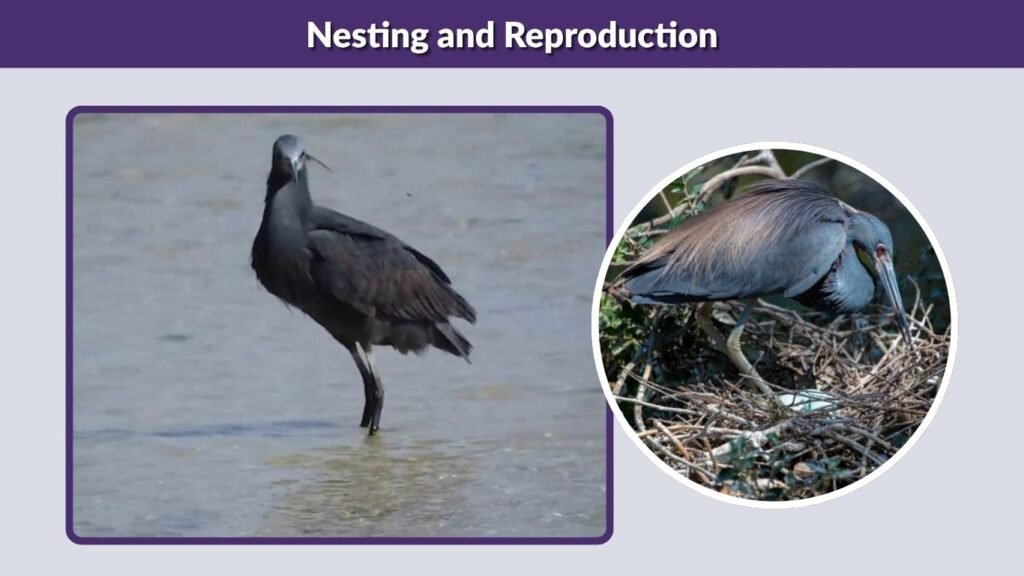
Black Egrets normally breed when seasonal rains produce abundant food and suitable nesting conditions. The exact breeding period varies considerably across their large African range.
Courtship and Colonies
Breeding birds usually gather in colonies. A colony may contain only Black Egrets, but these birds frequently nest alongside Cattle Egrets, ibises, cormorants, Black-Headed Herons, and other waterbirds.
Courtship displays can include raised feathers, neck stretching, bill movements, calling, and the presentation of nesting material. The long plumes on the head and neck become especially noticeable during these displays.
Nest Construction
The nest is a sturdy platform made from sticks and twigs. It is commonly positioned over or near water in:
- Trees and bushes
- Reed beds
- Papyrus stands
- Mangroves
- Flooded vegetation
- Small wetland islands
Placing the nest above water can reduce access for some ground predators. However, eggs and chicks remain vulnerable to snakes, monitor lizards, monkeys, raptors, crows, and other nest-raiding animals.
Eggs and Chicks
A typical clutch contains two to four dark blue or blue-green eggs. Both parents are believed to participate in incubation and chick care.
Newly hatched chicks are helpless and depend completely on their parents. Adults bring fish and other aquatic prey to the nest, feeding the young by regurgitation. The chicks gradually become stronger, grow their flight feathers, and begin exploring branches around the nest before they can fly confidently.
Lifespan and Natural Predators
The precise average lifespan of the Black Egret in the wild is not well documented. As with many waterbirds, mortality is probably highest among eggs, chicks, and newly independent juveniles.
Crocodiles and large predatory fish may occasionally capture birds feeding in water. Eagles and other raptors can attack adults or young birds, while snakes, monitor lizards, mammals, and large birds may raid nests.
Black Egrets reduce some risks by nesting and roosting in groups. Numerous birds can detect approaching danger more quickly, and flooded colony sites are harder for terrestrial predators to reach.
Conservation Status and Threats
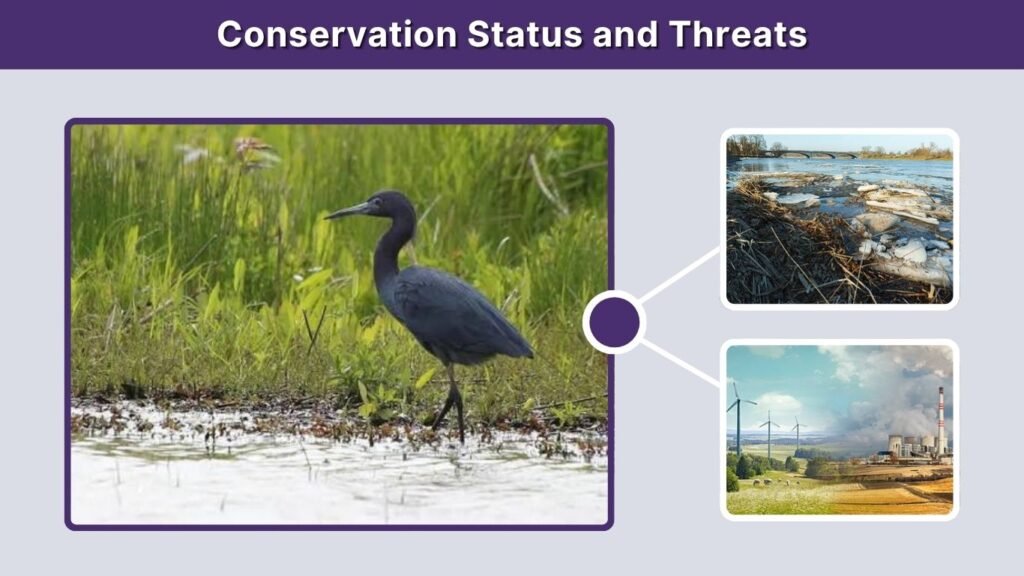
The Black Egret is classified as Least Concern because it has an extensive range and remains widespread. However, populations are unevenly distributed, and regional declines have been reported. BirdLife International provides the species’ global conservation assessment.
Important threats include:
- Wetland drainage and conversion
- Pollution from agriculture and industry
- Changes to natural flooding patterns
- Disturbance at nesting colonies
- Removal of wetland vegetation
- Excessive water extraction
- Human interference at breeding sites
- Predation on eggs and chicks
- Declining fish populations
The loss of shallow wetlands is especially harmful because canopy feeding depends on the right water depth. Protecting lakeshores, seasonal floodplains, marshes, mangroves, and nesting colonies will help maintain healthy Black Egret populations.
FAQs
Is a Black Egret the same as a Black Heron?
Yes. Black Egret and Black Heron are two common names for Egretta ardesiaca. “Black Heron” is widely used by international bird authorities, while “Black Egret” remains common in general descriptions because the species belongs to the egret genus Egretta.
Why does the Black Egret make an umbrella with its wings?
The wing umbrella creates shade, reduces glare, and allows the bird to see underwater prey more clearly. Fish may also enter the shaded area because it resembles safe cover. Once a fish moves beneath the canopy, the egret strikes with its pointed bill.
Where can Black Egrets be found?
Black Egrets occur across much of sub-Saharan Africa and on Madagascar. They inhabit shallow lakes, marshes, rivers, floodplains, rice fields, coastal lagoons, tidal creeks, and mangroves. Their local abundance often changes according to rainfall and seasonal water levels.
Are Black Egrets completely black?
Adults appear almost completely black, although their feathers may show dark bluish-gray or slate-colored reflections in strong light. They also have yellow eyes and feet. Juveniles are usually duller and may have brownish or gray tones in their plumage.
Is the Black Egret endangered?
No. It is currently classified as Least Concern because it has a large geographical range. Nevertheless, some regional populations may be declining because of wetland destruction, water pollution, human disturbance, altered flooding, and the loss of secure nesting locations.
