
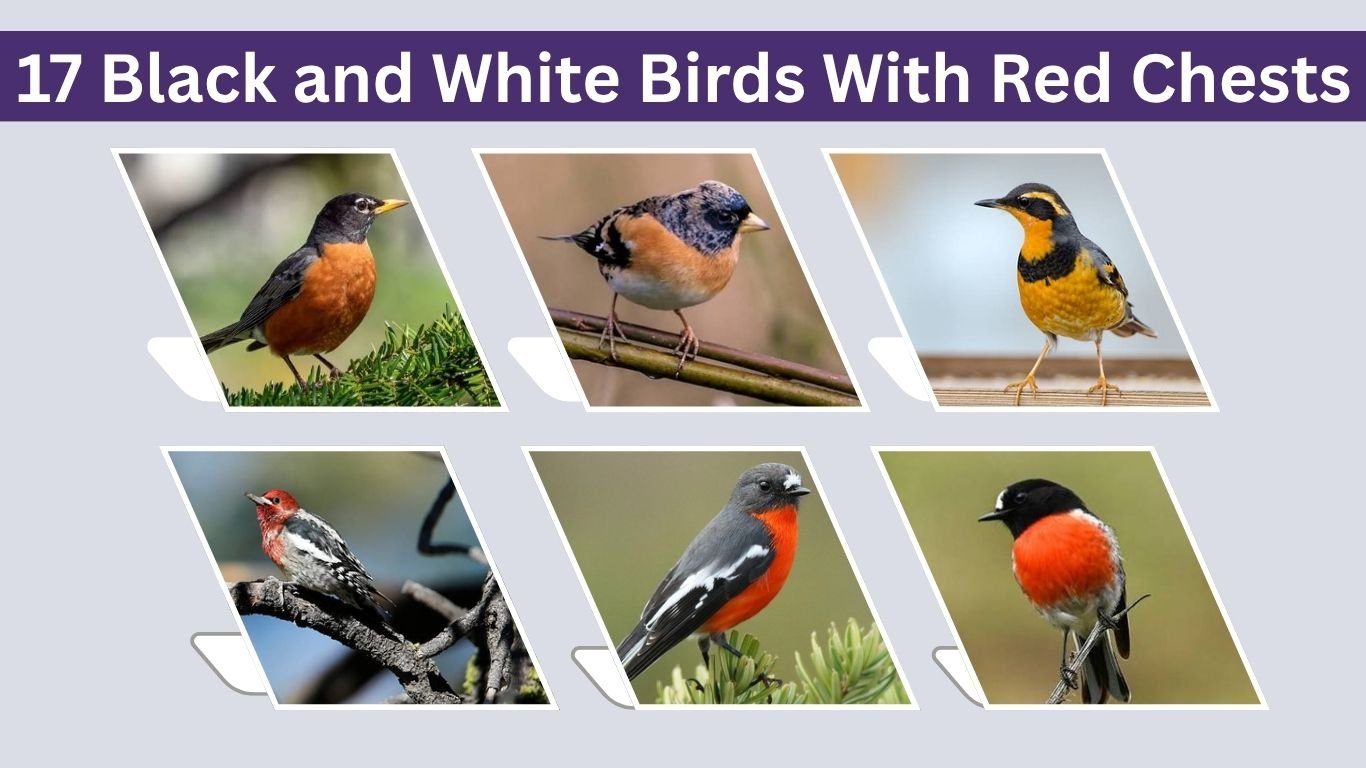
A black and white bird with a red chest is often a male Rose-breasted Grosbeak, especially when spotted in Michigan or elsewhere in eastern North America. However, several other birds display similar combinations of black, white, red, orange, or pink plumage. Possible matches include robins, sapsuckers, grosbeaks, towhees, and orioles. This guide covers 17 black and white birds with red chests, including their identifying features, male and female differences, habitats, diets, and behaviors.
1. Rose-breasted Grosbeak
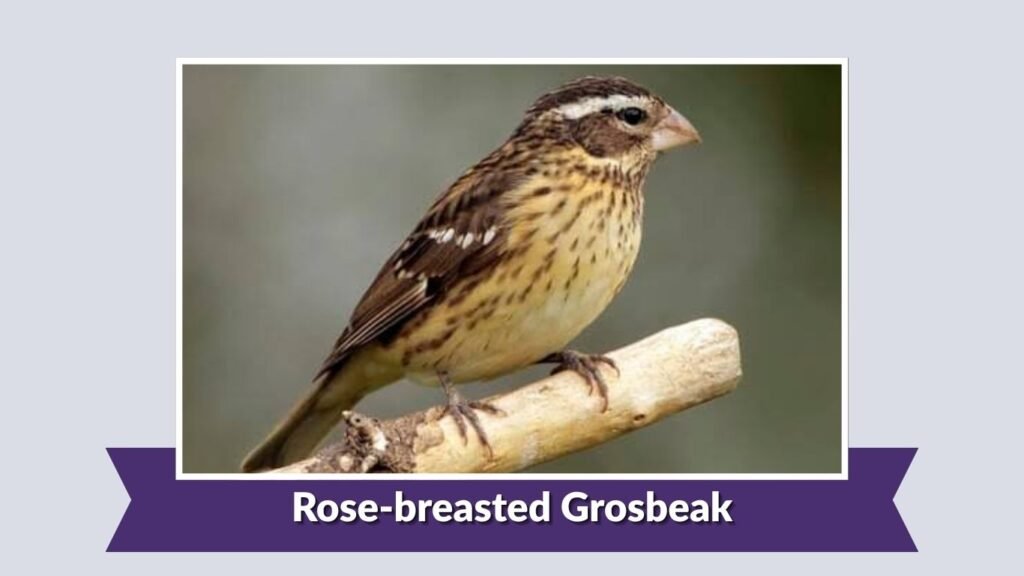
The male Rose-breasted Grosbeak is one of the clearest matches for a black and white bird with a red chest. Its triangular red breast patch, contrasting plumage, and thick seed-crushing bill make it easy to recognize. This migratory songbird is commonly seen in Michigan and other parts of eastern North America.
Identification
- Black head, back, and upper wings
- White belly and wing markings
- Bright red triangular patch on the chest
- Large, pale, cone-shaped bill
- Stocky body with a relatively short tail
Male vs. Female
The adult male has the familiar black, white, and red coloring. However, a female Rose-breasted Grosbeak does not have a red chest. She is mostly brown with bold streaks, a pale eyebrow, and yellowish coloring beneath her wings. Young males may display a mixture of brown and black feathers.
Habitat and Distribution
Rose-breasted Grosbeaks breed in deciduous and mixed forests across Michigan, Wisconsin, Minnesota, and northeastern North America. During migration, they may visit wooded parks, gardens, and backyard feeders. They spend the winter in Mexico, Central America, and northern South America.
Diet and Behavior
These birds eat seeds, berries, tree buds, beetles, caterpillars, and other insects. Their heavy bills can easily crack sunflower seeds. Both males and females sing, although the male’s rich, whistled song is heard more frequently during the breeding season.
2. Scarlet Robin
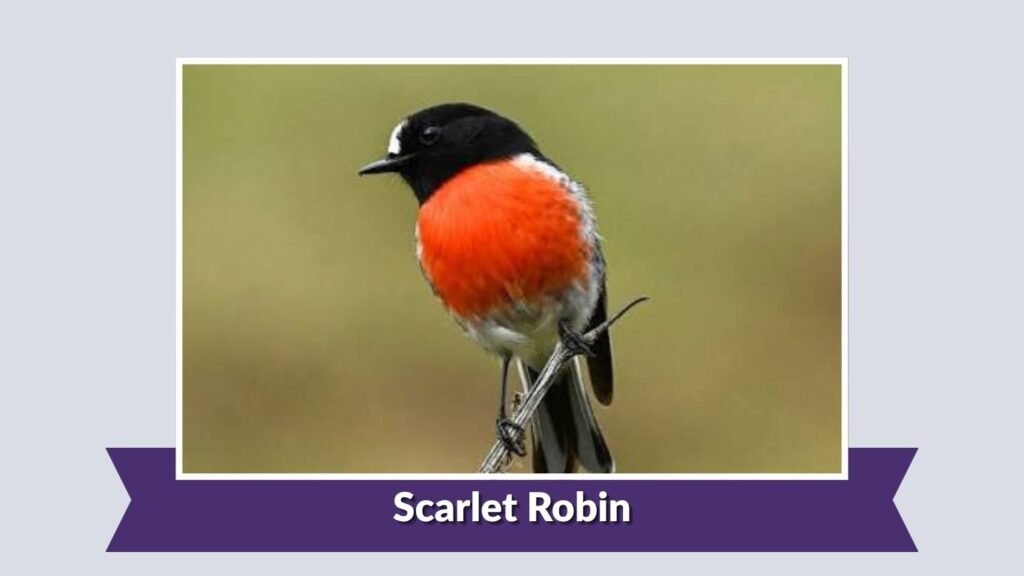
The Scarlet Robin is a small black and white bird with a bright red chest native to Australia. Adult males display bold color contrasts, while females have more subdued plumage. The species often perches in an exposed location before dropping to the ground to capture insects.
Identification
- Black head, throat, and upper body in males
- Bright scarlet-red chest
- White belly and forehead patch
- White markings on the black wings
- Small, straight bill suited for catching insects
Male vs. Female
Male Scarlet Robins have black upperparts and a vivid scarlet chest. Females are mostly grayish-brown with a softer reddish or orange patch on the breast. Juveniles are brown and streaked, lacking the sharp black, white, and red pattern of adult males.
Habitat and Distribution
Scarlet Robins inhabit open forests, woodlands, farmland edges, and lightly wooded grasslands across southeastern and southwestern Australia. They often prefer habitats containing low branches, fallen timber, and open ground where they can easily locate prey.
Diet and Hunting
The Scarlet Robin primarily eats insects, including beetles, ants, caterpillars, flies, and spiders. It usually watches from a low branch or fence post before flying down to seize prey. After feeding, it commonly returns to the same or a nearby perch.
3. Flame Robin
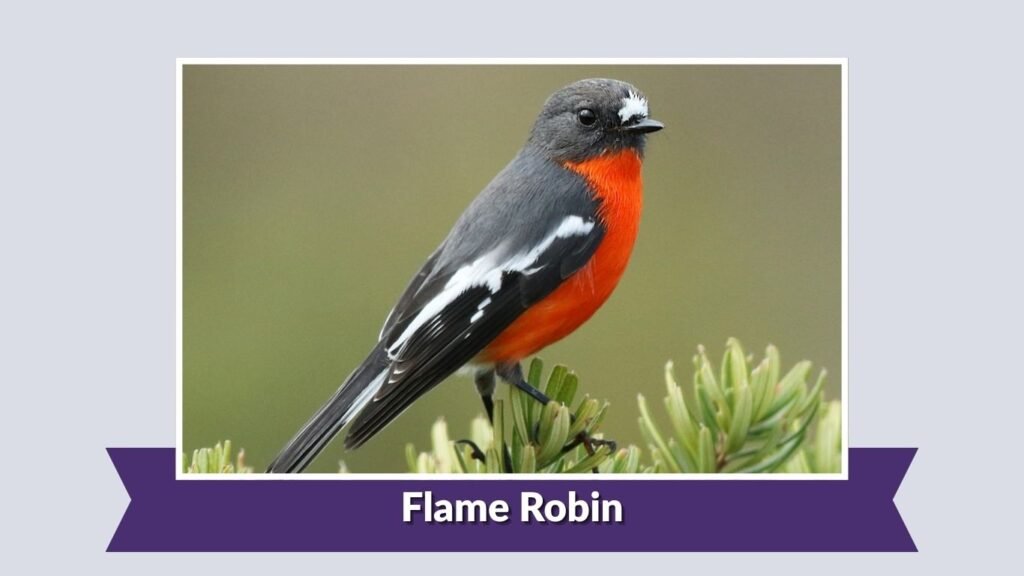
The Flame Robin is a small bird with a brilliant orange-red chest, dark upperparts, and white wing markings. Adult males can appear black and white in low light, although their backs are usually dark gray. They are among the most colorful robins found in southeastern Australia.
Identification
- Bright orange-red chest and throat in males
- Dark gray head and upperparts
- White belly beneath the colored breast
- Clear white wing stripe
- Small bill and upright posture
Male vs. Female
Male Flame Robins have vivid orange-red breasts that extend from the throat toward the belly. Females are gray-brown with a much paler orange or buff chest. Young birds are mainly brown and streaked, making them more difficult to distinguish from other small Australian robins.
Habitat and Distribution
Flame Robins occur in southeastern Australia, including Tasmania. During the breeding season, they favor cool mountain forests and wooded uplands. In colder months, many move into lower grasslands, farmland, open woodland, and coastal areas where food is more accessible.
Diet and Behavior
Flame Robins mainly consume insects, spiders, and other small invertebrates. They hunt from low perches, dropping onto the ground when prey appears. Outside the breeding season, these birds may form loose groups and forage together across open fields.
4. Red-breasted Sapsucker
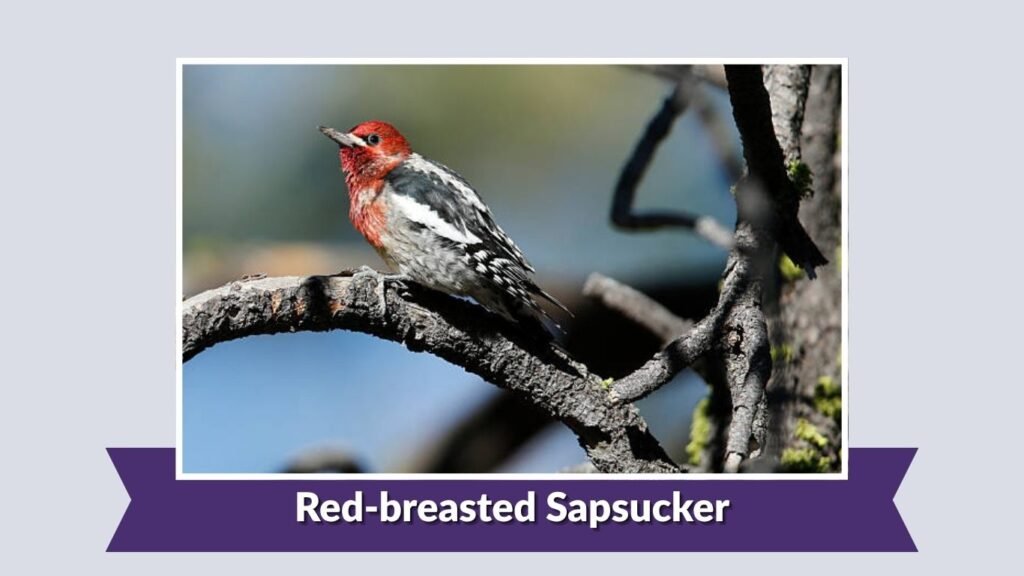
The Red-breasted Sapsucker is a medium-sized woodpecker with a red head and upper chest, black-and-white wings, and a pale belly. It is a likely identification for a black bird with a red throat and white chest seen along the Pacific Coast of North America.
Identification
- Bright red head, throat, and upper chest
- Black back with white or yellowish markings
- Large white patch on each wing
- Pale belly with darker markings
- Straight, pointed woodpecker bill
Male vs. Female
Male and female Red-breasted Sapsuckers look quite similar, with both displaying red plumage across the head and breast. Females may occasionally appear slightly duller. Juveniles are browner and more heavily patterned, with their red coloring developing as they mature.
Habitat and Distribution
These woodpeckers inhabit coniferous and mixed forests from southeastern Alaska and British Columbia to California. They may also visit orchards, parks, and suburban areas containing mature trees. Some northern populations move south during winter.
Diet and Feeding
Red-breasted Sapsuckers drill orderly rows of shallow holes in tree bark and return to drink the flowing sap. They also eat ants, beetles, other insects, berries, and fruit. Hummingbirds and other animals may feed from the sap wells they create.
5. Red-naped Sapsucker
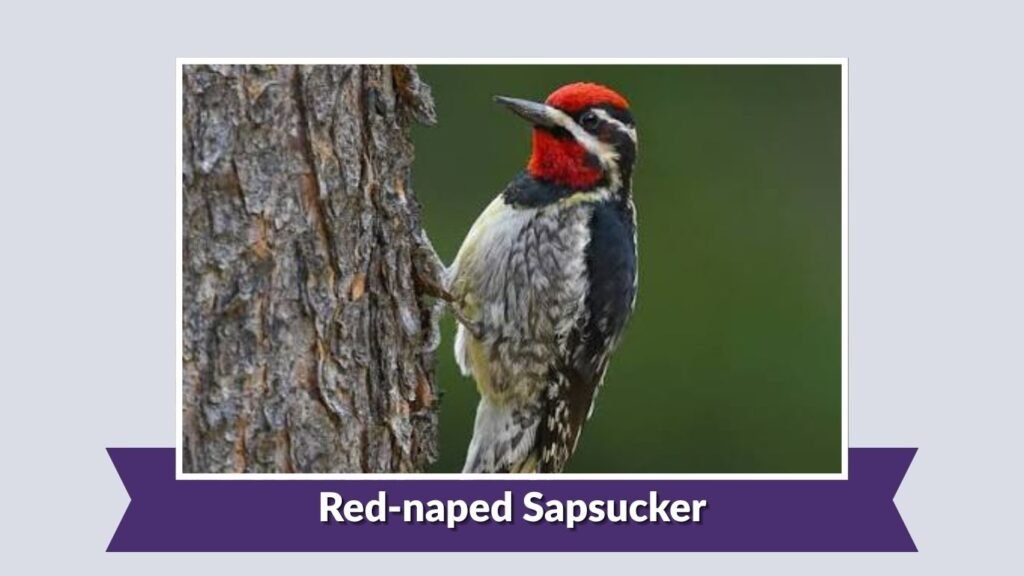
The Red-naped Sapsucker is a black, white, and red woodpecker found in western North America. Although it does not usually have a completely red chest, its red throat patch can extend toward the upper breast. It may therefore be mistaken for a black and white bird with red on its chest.
Identification
- Black-and-white patterned back and wings
- Red crown and red throat patch
- White stripe behind the bill
- Black chest band beneath the throat
- Pale belly with yellowish shading
Male vs. Female
Adult males have a fully red throat, while females generally show a white area within the red throat patch. Both sexes have a red crown and strongly patterned black-and-white wings. Juveniles appear brownish and lack the bright facial markings seen on adults.
Habitat and Distribution
Red-naped Sapsuckers breed in mountain forests, aspen groves, and mixed woodlands across the western United States and Canada. They can be found in Wyoming, Montana, Colorado, Utah, and nearby regions. During winter, many travel south into Mexico and the southwestern states.
Diet and Feeding
Like other sapsuckers, this species drills rows of small holes into living trees to access sap. It also eats insects, berries, fruit, and plant material. Aspen, willow, and birch trees are frequently used for feeding and nesting.
6. Painted Redstart
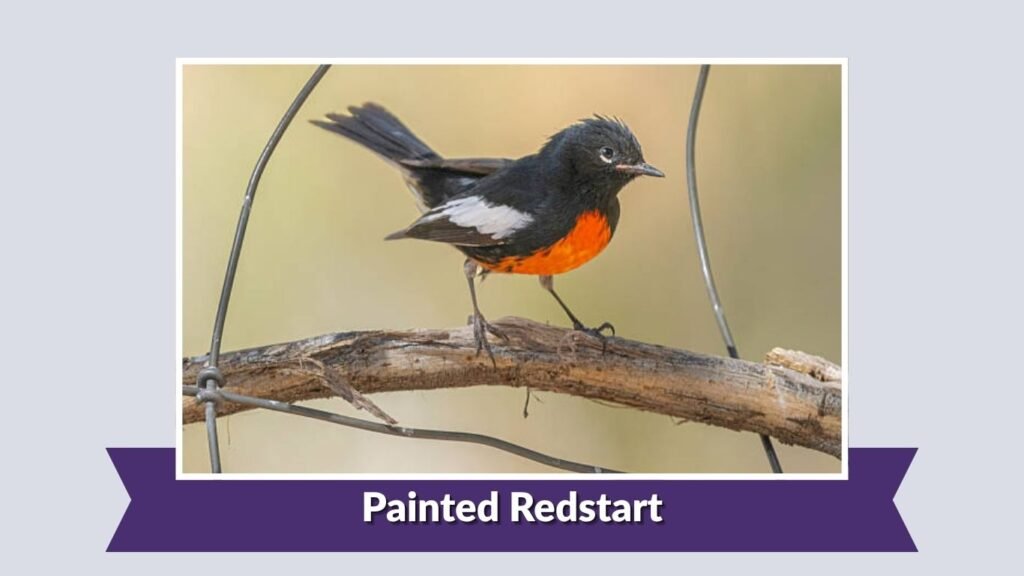
The Painted Redstart is a striking black, white, and red bird found primarily in Mexico and Central America. It has glossy black plumage, large white wing patches, and a bright red lower chest and belly. Its habit of spreading its wings and tail makes its contrasting markings highly visible.
Identification
- Mostly glossy black plumage
- Bright red lower chest and belly
- Large white patches on the wings
- White outer tail feathers
- Thin, pointed bill
Male vs. Female
Male and female Painted Redstarts have similar black, white, and red plumage. Females may occasionally look slightly duller, but the difference is difficult to notice in the field. Young birds are generally browner or grayer and develop their bold adult colors as they mature.
Habitat and Distribution
Painted Redstarts inhabit mountain forests, pine-oak woodlands, and shaded canyons. In the United States, they are most regularly seen in southern Arizona and New Mexico. Their main range extends through Mexico into parts of Central America.
Diet and Behavior
These birds primarily eat flies, moths, beetles, caterpillars, and other insects. They frequently spread and flick their wings and tail while moving through vegetation. This behavior exposes their white markings and may startle insects into movement, making the prey easier to capture.
7. Crimson-breasted Shrike
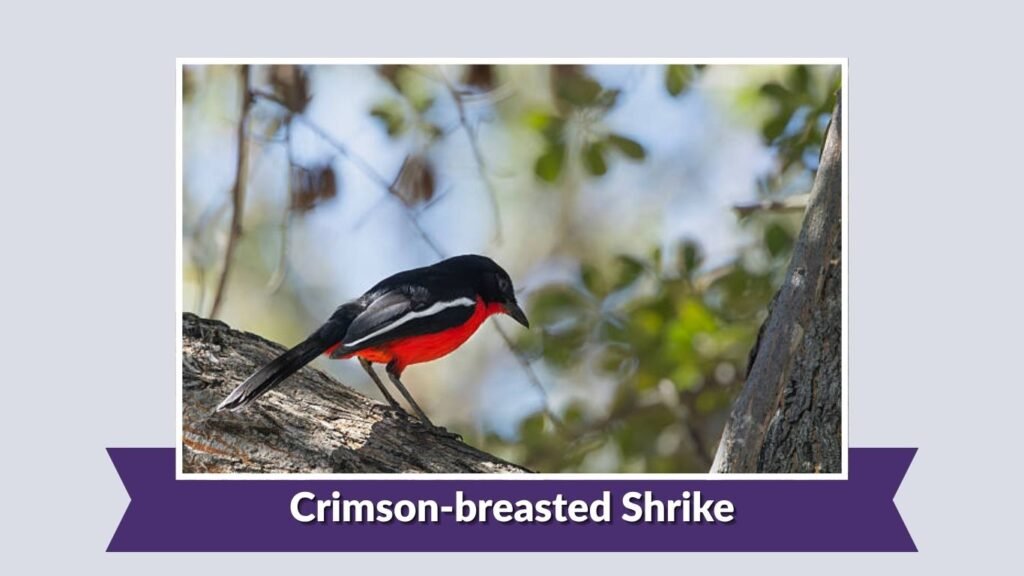
The Crimson-breasted Shrike is a bold black and white bird with a bright red chest and belly. Native to southern Africa, it is sometimes called the Crimson-breasted Gonolek. Its intense crimson underparts contrast sharply with its black upper body and white wing markings.
Identification
- Glossy black head and upperparts
- Bright crimson-red chest and belly
- Broad white stripe on each wing
- Long black tail
- Strong, slightly hooked bill
Male vs. Female
Male and female Crimson-breasted Shrikes look almost identical, making them difficult to distinguish by appearance. Both have the same dramatic black, white, and red plumage. Juveniles are duller and may have brownish upperparts with spotted or barred underparts instead of a bright red chest.
Habitat and Distribution
This species inhabits dry woodland, thorny scrub, savannas, and bushy areas across countries such as Botswana, Namibia, Zimbabwe, and South Africa. It usually remains within dense vegetation, although it may perch openly when singing or watching for food.
Diet and Hunting
Crimson-breasted Shrikes eat beetles, grasshoppers, caterpillars, ants, spiders, and small vertebrates. They search through bushes and sometimes descend to the ground to capture prey. Pairs frequently communicate using loud, ringing calls and may defend their territory together.
8. Red-breasted Chat
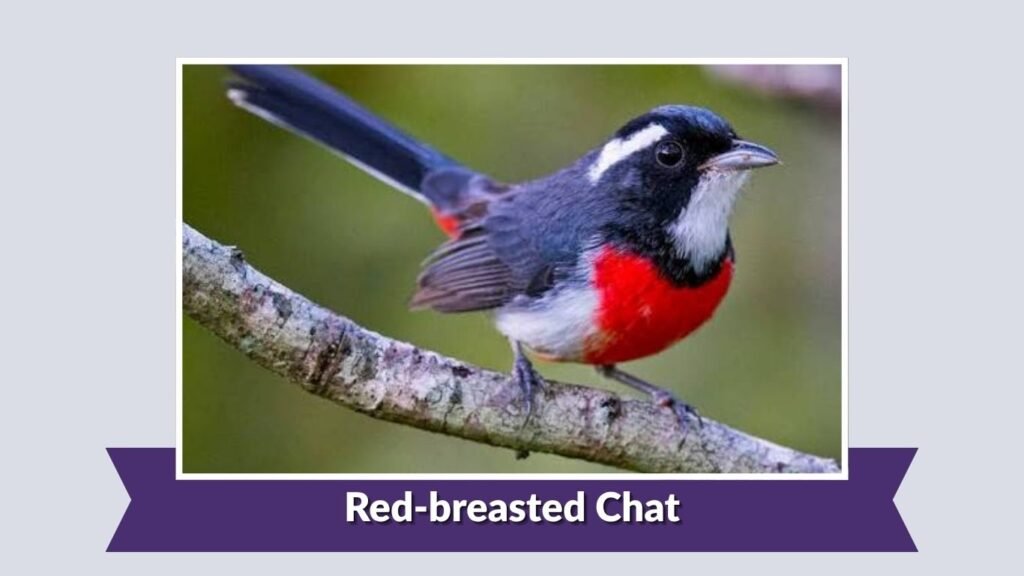
The Red-breasted Chat is a small Mexican songbird with a red chest, black head, and contrasting white facial markings. Adult males have the strongest colors, while females are less brightly marked. Despite its name, it is not a true chat but belongs to the cardinal family.
Identification
- Bright red throat, chest, and belly in males
- Black head and upperparts
- Bold white eyebrow and cheek markings
- White patches on the tail
- Short, pointed bill
Male vs. Female
Male Red-breasted Chats display a black head and vivid rosy-red underparts. Females have grayish or olive-brown upperparts with yellow or buff underparts rather than a red chest. Young birds resemble females until adult plumage develops.
Habitat and Distribution
Red-breasted Chats are native to western Mexico, where they occupy thorn forests, dry tropical woodland, dense scrub, and brushy streamsides. Their preference for thick vegetation can make them difficult to observe, even when their calls are heard nearby.
Diet and Behavior
These birds mainly eat insects, spiders, and other small invertebrates found among leaves and branches. They usually forage low in dense bushes and may flick or spread their tails while moving. During the breeding season, males sing to attract females and defend their territories.
9. Black-headed Grosbeak
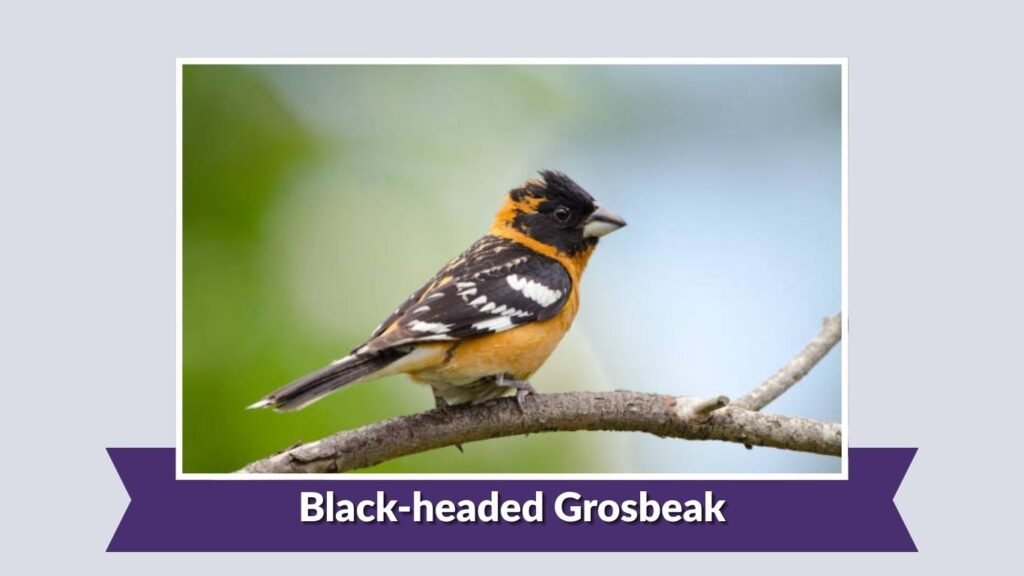
The Black-headed Grosbeak is a medium-sized songbird with a black head, black-and-white wings, and a rich orange chest. It is a common western counterpart of the Rose-breasted Grosbeak. In certain lighting, its orange breast may appear reddish, leading to confusion between the two species.
Identification
- Black head in adult males
- Orange or cinnamon-colored chest
- Black wings with large white patches
- Yellow belly
- Thick, pale, cone-shaped bill
Male vs. Female
Males have black heads, orange chests, and strongly patterned wings. Females are brown with pale eyebrows, streaked underparts, and yellowish coloring beneath their wings. Juvenile males resemble females but gradually develop darker heads and brighter orange plumage.
Habitat and Distribution
Black-headed Grosbeaks breed in western North America, including California, Arizona, Wyoming, and parts of western Canada. They inhabit deciduous woodland, forest edges, streamside vegetation, gardens, and mountain valleys. Most migrate to Mexico for the winter.
Diet and Behavior
These grosbeaks eat seeds, berries, fruit, beetles, caterpillars, and other insects. Their powerful bills allow them to crack hard seeds and crush insects. They sometimes visit backyard feeders for sunflower seeds, particularly during spring and fall migration.
10. Red-breasted Nuthatch
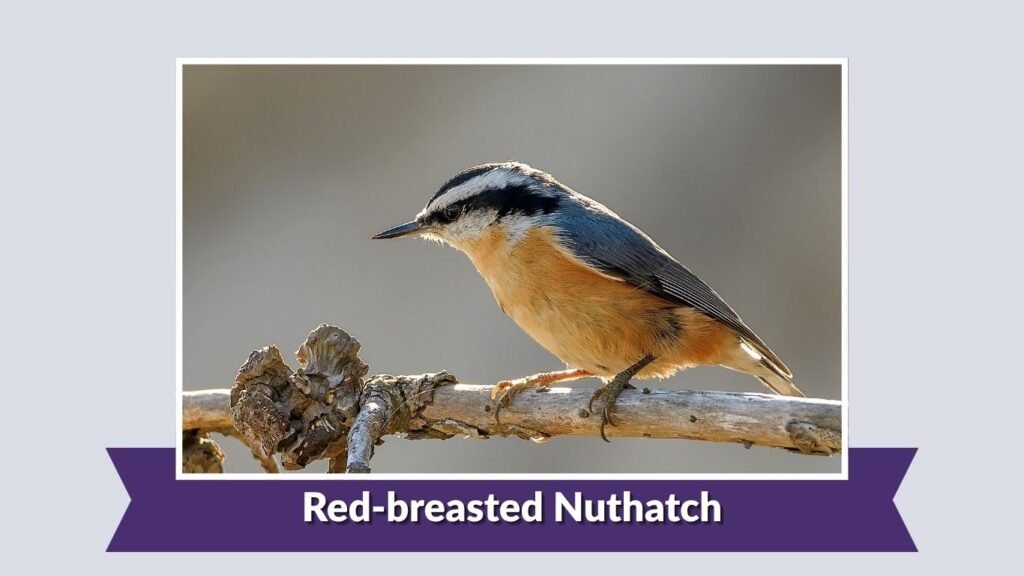
The Red-breasted Nuthatch is a small bird with a rusty-orange chest, blue-gray back, and black-and-white head pattern. Its quick movements and habit of climbing headfirst down tree trunks make it easy to recognize. It is common in coniferous forests across North America.
Identification
- Rusty-red or orange chest and belly
- Blue-gray back and wings
- Black cap and eye stripe
- White eyebrow and facial markings
- Thin, slightly upturned bill
Male vs. Female
Adult males typically have darker caps and richer reddish-orange underparts. Females have grayer caps and paler buff or orange chests. Juveniles resemble females but may appear duller and have less clearly defined head markings.
Habitat and Distribution
Red-breasted Nuthatches prefer spruce, pine, fir, and other coniferous forests. They occur across Canada and in northern states such as Michigan, Minnesota, and Wisconsin. During years of limited food, large numbers may move south and appear in backyards far beyond their usual range.
Diet and Feeding
These birds eat insects, spiders, seeds, and nuts. They commonly visit feeders containing sunflower seeds, peanuts, and suet. Red-breasted Nuthatches often wedge food into bark crevices before breaking it apart with their bills. They may also store seeds for later use.
11. Eastern Towhee
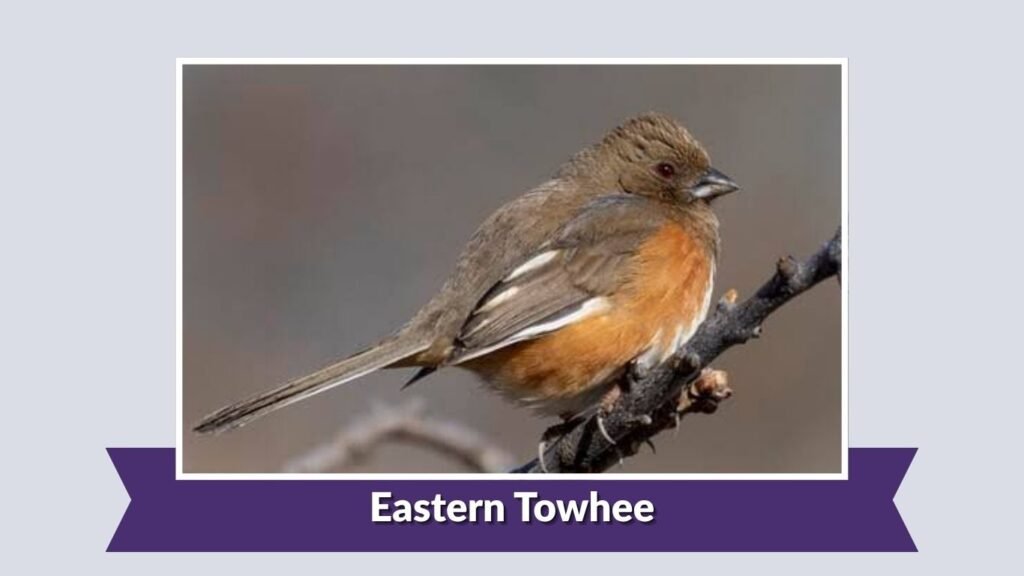
The Eastern Towhee is a large sparrow with black upperparts, a white belly, and reddish-orange sides. Although the red coloring is located along its flanks rather than directly across its chest, this bird can appear to have a red chest when viewed from the side.
Identification
- Black head, back, and tail in males
- White chest and belly
- Reddish-orange sides
- White patches on wings and tail
- Thick, dark, seed-crushing bill
Male vs. Female
Male Eastern Towhees have black upperparts, while females replace the black with warm brown. Both sexes have white underparts and reddish-orange sides. Juveniles are mostly brown and heavily streaked, lacking the clean color divisions visible on adults.
Habitat and Distribution
Eastern Towhees inhabit forest edges, overgrown fields, brushy woodland, and dense backyard vegetation. They occur throughout much of the eastern United States, including Michigan, Ohio, Georgia, Florida, and Tennessee. Northern populations usually migrate south for winter.
Diet and Behavior
These birds eat seeds, berries, beetles, caterpillars, spiders, and other small invertebrates. They search for food by jumping forward and scratching backward through fallen leaves with both feet. Eastern Towhees often remain hidden in thick vegetation despite their loud, recognizable calls.
12. Spotted Towhee
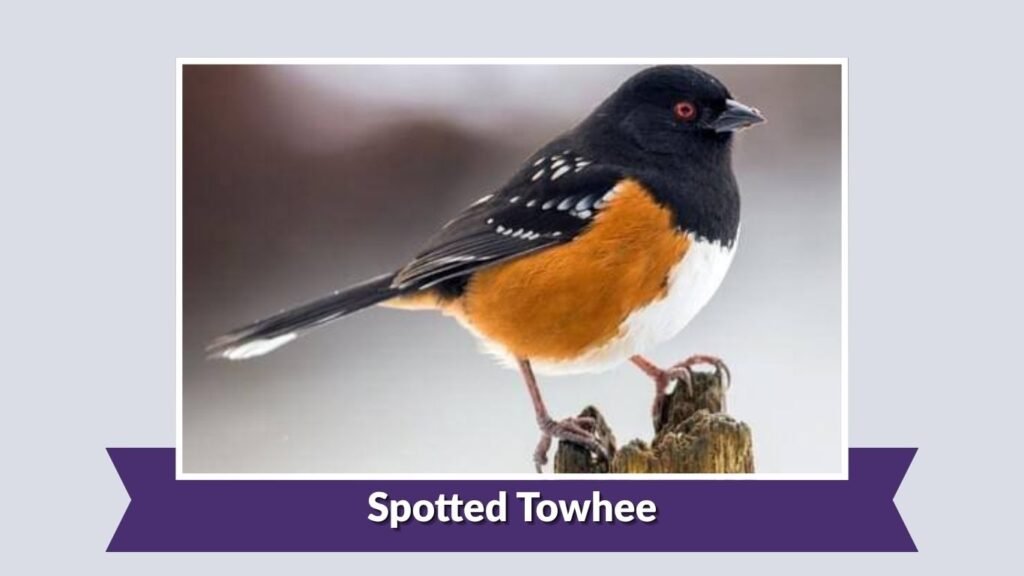
The Spotted Towhee is a black, white, and reddish-orange bird found across western North America. It resembles the Eastern Towhee but has numerous white spots across its black wings and back. The warm coloring along its sides can look like a red or orange chest from certain angles.
Identification
- Black head and upperparts in males
- Numerous white spots on wings and back
- White belly and outer tail feathers
- Reddish-orange sides
- Bright red eyes in adults
Male vs. Female
Male Spotted Towhees have glossy black upperparts, while females are generally dark gray or brownish. Both sexes display white spotting and rusty-colored flanks. Young birds have brown, streaked plumage that helps camouflage them in ground-level vegetation.
Habitat and Distribution
Spotted Towhees live in brushy woodland, chaparral, forest edges, parks, and overgrown gardens. Their range extends from western Canada through the western United States into Mexico. They are commonly found in California, Arizona, Utah, Wyoming, and the Pacific Northwest.
Diet and Behavior
Spotted Towhees consume seeds, acorns, berries, insects, spiders, and occasionally small lizards. They usually forage on the ground beneath dense shrubs. Like Eastern Towhees, they use a distinctive two-footed scratching motion to uncover food hidden beneath leaves.
13. Eurasian Bullfinch
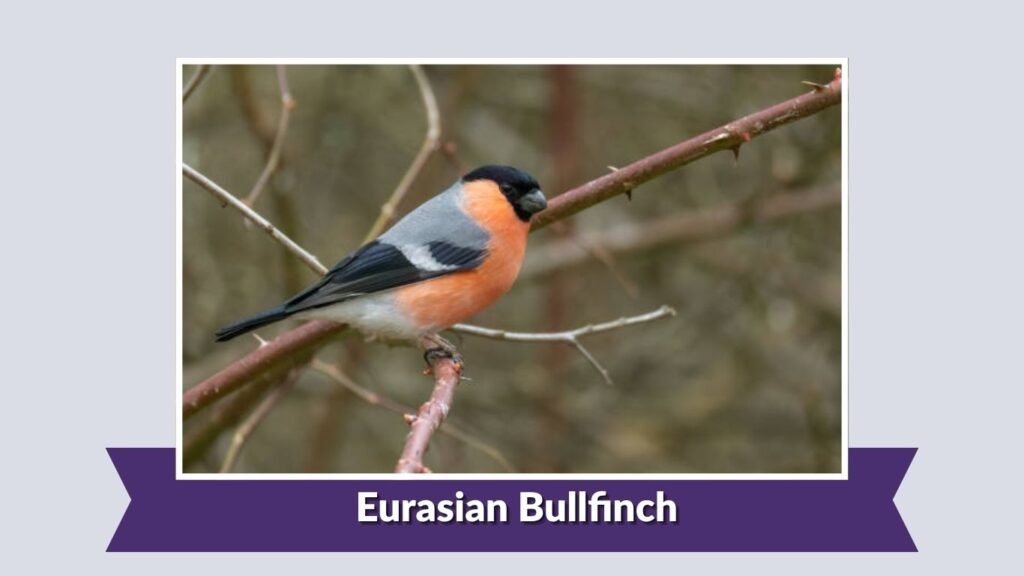
The male Eurasian Bullfinch is a compact gray, black, white, and pink-red bird. Its rosy chest, black cap, and thick bill create a distinctive appearance. Females lack the male’s bright pink-red coloring but share the same rounded shape and bold black-and-white wing pattern.
Identification
- Rose-pink or reddish chest in males
- Gray back and shoulders
- Black cap, face, wings, and tail
- Bright white rump
- Short, thick black bill
Male vs. Female
Male Eurasian Bullfinches have vivid rose-red chests and cheeks. Females display gray-brown or pinkish-brown underparts instead. Both sexes have black caps, gray backs, dark wings, and white rumps. Juveniles are brownish and initially lack the adults’ black caps.
Habitat and Distribution
Eurasian Bullfinches inhabit woodlands, hedgerows, orchards, parks, and gardens across Europe and parts of Asia. They prefer areas with dense bushes for nesting and a variety of fruiting plants. Most populations remain within the same general region throughout the year.
Diet and Behavior
These bullfinches eat seeds, berries, fruit, flower buds, and young shoots. They are particularly known for feeding on the buds of fruit trees. Eurasian Bullfinches usually move quietly in pairs or small family groups and communicate using soft, mournful whistles.
14. Varied Thrush
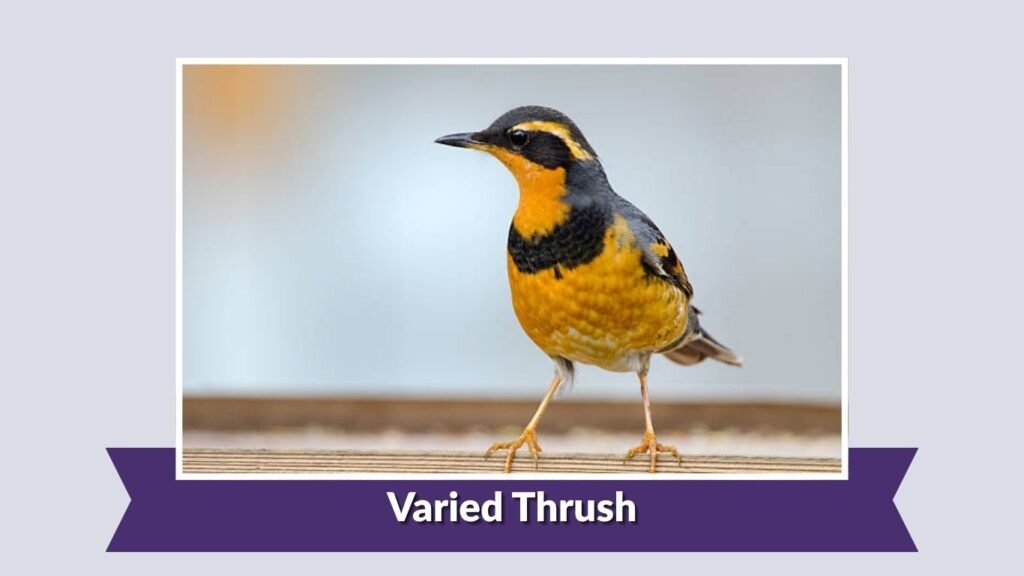
The Varied Thrush is a striking bird with an orange chest, dark head, and boldly patterned wings. Adult males have a black band across the orange breast, while females are softer gray-brown. Its contrasting colors make it a strong match for a bird with an orange chest and black-and-white wings.
Identification
- Orange throat, chest, and eyebrow
- Dark blue-gray or blackish upperparts
- Black band across the male’s chest
- Orange markings on the wings
- Long, dark legs and a pointed bill
Male vs. Female
Male Varied Thrushes have dark blue-gray backs, vivid orange underparts, and a strong black chest band. Females are grayer or brownish, with softer orange coloring and a less noticeable breast band. Juveniles are brown with pale spotting and scaling.
Habitat and Distribution
Varied Thrushes breed in moist coniferous forests from Alaska through western Canada to the Pacific Northwest. During winter, they move into lower-elevation forests, parks, gardens, and wooded suburbs. Occasional individuals wander into eastern North America.
Diet and Behavior
These thrushes eat insects, earthworms, berries, seeds, and other forest foods. They often search through fallen leaves on the ground but may move into trees when feeding on fruit. During winter, they sometimes visit backyard areas offering berries or scattered seeds.
15. Baltimore Oriole
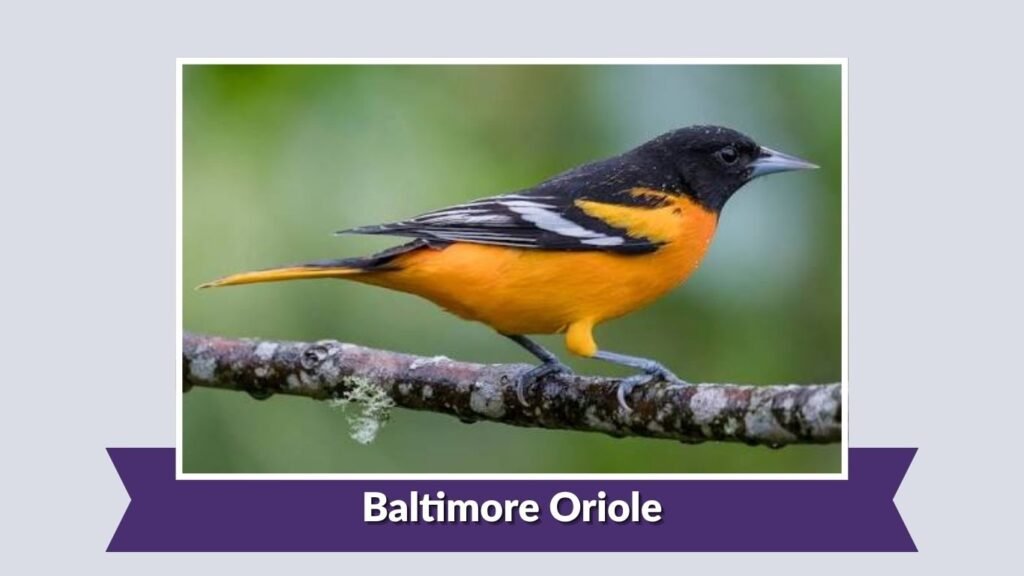
The Baltimore Oriole is a colorful black and orange bird with white wing markings. Adult males have black heads and backs with brilliant orange chests and bellies. Because orange can appear reddish in certain lighting, they may be described as black and white birds with red chests.
Identification
- Black head, throat, and back in males
- Bright orange chest and belly
- Black wings with white bars
- Orange outer tail feathers
- Long, sharply pointed bill
Male vs. Female
Adult males display the strongest black-and-orange contrast. Females are typically yellow-orange with gray-brown wings and variable amounts of dark coloring on the head. Young males resemble females and gradually develop black heads and brighter orange bodies over several years.
Habitat and Distribution
Baltimore Orioles inhabit open deciduous forests, riverbanks, parks, orchards, and suburban neighborhoods. They breed across eastern and central North America, including Michigan, Illinois, Ohio, and Minnesota. They migrate to Central America, the Caribbean, and northern South America for winter.
Diet and Feeding
Baltimore Orioles eat caterpillars, beetles, spiders, berries, flower nectar, and ripe fruit. They may visit backyard feeders offering orange halves, grape jelly, or sugar-water nectar. These birds usually forage high in tree canopies, where they search among leaves and branches.
16. Brambling
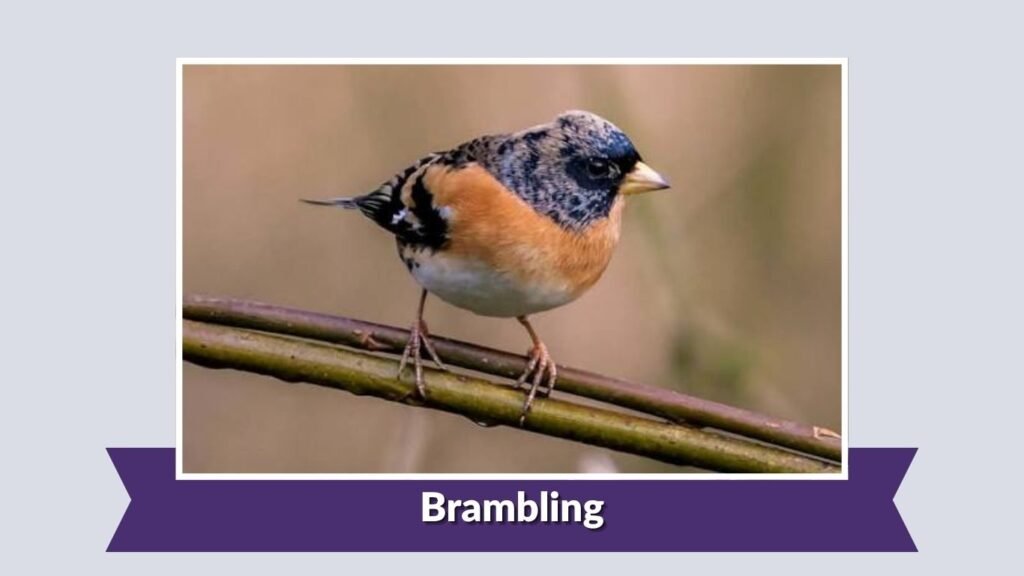
The Brambling is a small finch with a black head, orange chest, white belly, and boldly patterned wings. Breeding males show the strongest black, white, and orange contrast. Although native to Europe and Asia, Bramblings occasionally appear in North America, especially during winter.
Identification
- Black head and back in breeding males
- Orange throat and chest
- White belly and rump
- Black wings with orange and white markings
- Short, thick, cone-shaped bill
Male vs. Female
Breeding males have glossy black heads and backs with bright orange breasts. During winter, the black feathers develop pale edges, creating a mottled appearance. Females are brown with softer orange coloring, dark head stripes, and patterned wings. Juveniles generally resemble females.
Habitat and Distribution
Bramblings breed in northern birch and coniferous forests across Scandinavia, Russia, and northern Asia. During winter, they migrate south into farmland, woodland, parks, and gardens throughout Europe and Asia. Small numbers occasionally reach Alaska, Canada, and the northern United States.
Diet and Behavior
These finches eat seeds, beech nuts, berries, and insects. During winter, they may gather in enormous flocks where food is abundant. Bramblings forage both on the ground and in trees and may visit backyard feeders for sunflower seeds and other suitable foods.
17. American Robin
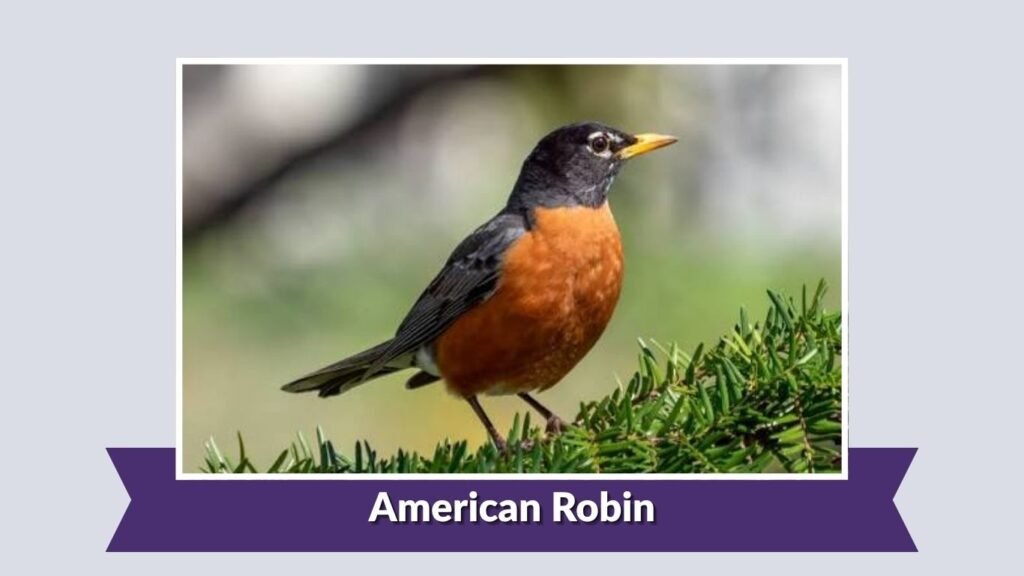
The American Robin is a familiar North American songbird with a dark gray back, orange-red chest, and small white markings. Although it is not truly black and white, its dark upperparts and pale lower belly can create that impression, especially when seen from a distance.
Identification
- Orange-red chest and belly
- Dark gray or blackish head
- Gray-brown back and wings
- White lower belly and undertail feathers
- Yellow bill with a darker tip
Male vs. Female
Male American Robins generally have darker heads and richer orange-red chests. Females are slightly paler, with gray heads and softer orange underparts. Juveniles have spotted breasts and pale markings that provide camouflage while they are still dependent on their parents.
Habitat and Distribution
American Robins occupy forests, parks, gardens, lawns, farmland, and urban neighborhoods throughout North America. They are common in Michigan, Ohio, Minnesota, and many other states. Some migrate south for winter, while others remain wherever berries and unfrozen ground are available.
Diet and Feeding
American Robins eat earthworms, beetles, caterpillars, snails, berries, and fruit. They are frequently seen running across lawns before stopping and tilting their heads to locate prey. During winter, they often form flocks and rely more heavily on berries and other fruit.