
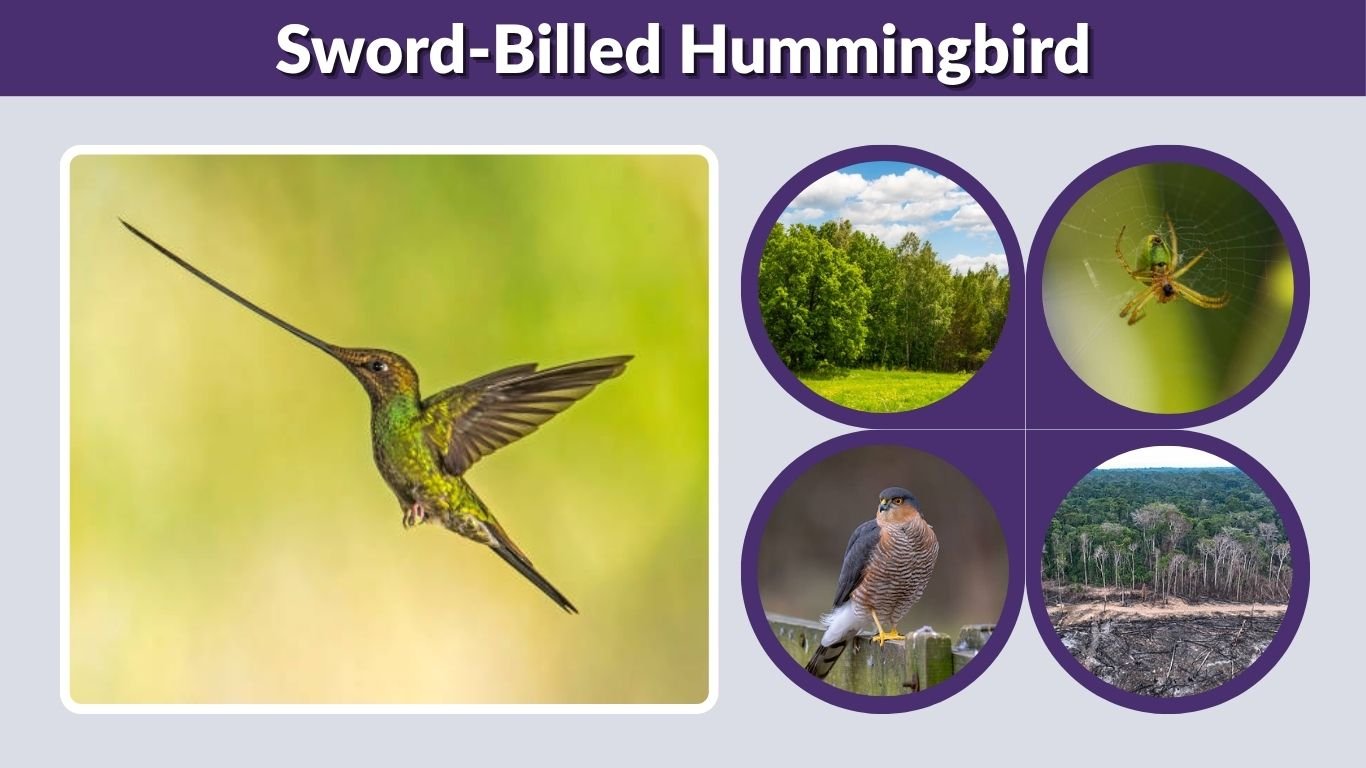
The sword-billed hummingbird is one of the most unusual hummingbirds in the world, famous for having an extraordinarily long, straight bill. Native to the high Andes of South America, this bird uses its specialized beak to reach nectar hidden deep inside long tubular flowers that many other hummingbirds cannot access. Its relationship with certain plants is a remarkable example of adaptation and pollination. Below, learn about the sword-billed hummingbird’s beak, diet, habitat, range, lifespan, behavior, reproduction, predators, and other fascinating features.
Sword-Billed Hummingbird Identification
The sword-billed hummingbird (Ensifera ensifera) is easily recognized because of its exceptionally long bill. In fact, it is generally regarded as the only bird whose bill can be longer than the rest of its body when the tail is excluded.
Adults have mostly green plumage, with slightly different coloration between males and females. Their wings are narrow and powerful, allowing them to hover precisely in front of flowers while feeding.
Appearance
Important identification features include:
- Scientific name: Ensifera ensifera
- Family: Trochilidae
- Body color: Mostly green
- Bill: Extremely long, straight, and slender
- Wings: Narrow and rapidly beating
- Tail: Forked to slightly notched
- Overall size: Relatively large for a hummingbird
- Native region: Andes of South America
The extremely long beak makes this species difficult to confuse with other hummingbirds.
Sword-Billed Hummingbird Beak
The sword-billed hummingbird’s beak is its most famous feature. The bill can reach roughly 10 centimeters (about 4 inches) in length and may be comparable to or longer than the bird’s body.
This remarkable structure allows the hummingbird to feed from flowers with extremely long corolla tubes.
Can a Sword-Billed Hummingbird Open Its Beak?
Yes. A sword-billed hummingbird can open its beak, although the movement may appear limited compared with birds that have shorter, heavier bills.
The long bill is primarily designed for reaching nectar rather than crushing or manipulating food. It also helps the bird capture tiny insects, which provide important protein.
Interestingly, the enormous bill creates challenges during grooming. Most hummingbirds can easily use their bills to preen much of their plumage, but sword-billed hummingbirds often rely heavily on their feet to scratch and clean areas that are difficult to reach with such a long beak.
Sword-Billed Hummingbird Diet
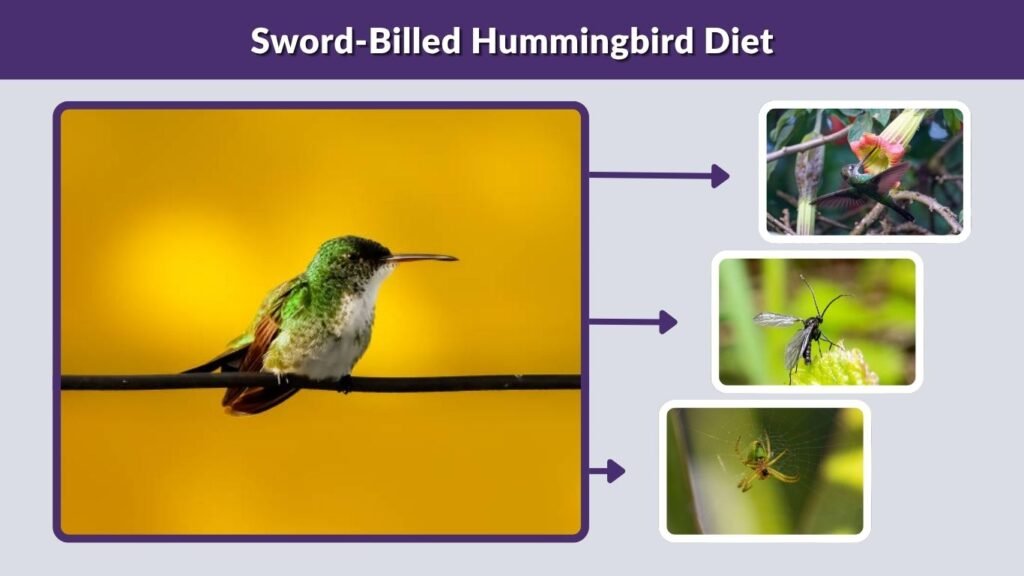
Sword-billed hummingbirds primarily eat flower nectar, but nectar is not their only food.
Their diet generally consists of:
- Nectar from long tubular flowers
- Small flying insects
- Tiny spiders and other arthropods
Nectar supplies carbohydrates and energy required for their extremely active lifestyle, while insects provide proteins, fats, minerals, and other nutrients.
Flowers Sword-Billed Hummingbirds Feed From
Their long bills give them access to flowers that shorter-billed hummingbirds cannot effectively use.
They are particularly associated with long, hanging tubular flowers such as:
- Passiflora mixta
- Other Andean passionflowers
- Long-tubed flowers in high-elevation forests
- Some trumpet-shaped flowering plants
The bird inserts its bill deep into the flower while its tongue collects nectar.
Sword-Billed Hummingbird and Passiflora Mixta
The relationship between the sword-billed hummingbird and Passiflora mixta, an Andean passionflower, is a classic example of specialization between a pollinator and a plant.
Passiflora mixta produces long floral tubes containing nectar deep inside the flower. The sword-billed hummingbird’s exceptionally long bill allows it to reach this nectar efficiently.
While feeding, the bird may contact the flower’s reproductive structures. Pollen becomes attached to its feathers and is transferred when it visits another flower.
Coevolution and Adaptation
Sword-billed hummingbirds and long-tubed Andean flowers demonstrate how animals and plants can develop highly complementary features.
Flowers with deeper nectar sources may favor hummingbirds with longer bills because those birds can access their nectar more efficiently. At the same time, birds capable of reaching these flowers gain access to food with less competition from shorter-billed species.
This specialization helps explain the sword-billed hummingbird’s extraordinary appearance.
Sword-Billed Hummingbird Tongue
Although the bill receives most of the attention, the bird’s tongue is equally important for feeding.
Like other hummingbirds, sword-billed hummingbirds have a specialized tongue capable of extending beyond the tip of the bill. When feeding, the bird places its bill into a flower and repeatedly extends and retracts its tongue to collect nectar.
The combination of an extremely long bill and specialized tongue allows it to reach food located deep within tubular flowers.
Sword-Billed Hummingbird Habitat
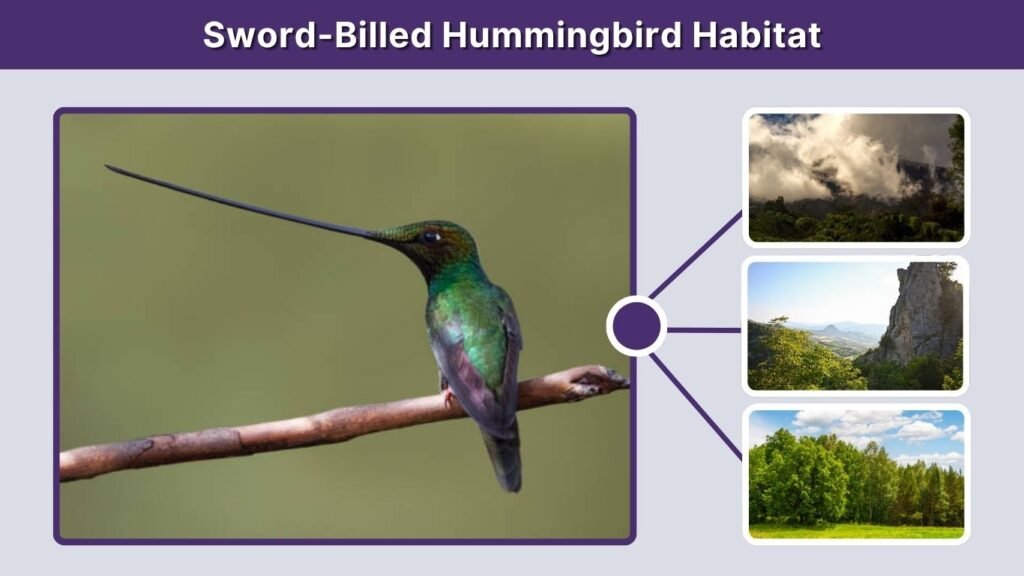
Sword-billed hummingbirds live primarily in humid montane forests and high-elevation environments of the Andes.
Common habitats include:
- Andean cloud forests
- Montane forests
- Forest edges
- Shrubby mountain slopes
- Flower-rich highland vegetation
- Gardens near suitable mountain forests
They generally occur at relatively high elevations where suitable nectar-producing plants are abundant.
Does the Sword-Billed Hummingbird Live in Rainforests?
Yes, but it is more closely associated with cool mountain and cloud forests than hot, lowland tropical rainforest.
Cloud forests receive abundant moisture and support many flowering plants, vines, shrubs, and epiphytes. These conditions provide an excellent year-round or seasonal food supply for hummingbirds.
Where Does the Sword-Billed Hummingbird Live?
The sword-billed hummingbird is native to the Andes of western South America.
Its range includes parts of countries such as:
- Venezuela
- Colombia
- Ecuador
- Peru
- Bolivia
It is especially associated with mountainous regions rather than low-elevation plains.
Sword-Billed Hummingbird in Ecuador
Ecuador is one of the best-known countries for observing this unusual bird. Its Andean cloud forests provide suitable elevations, temperatures, and flowering vegetation.
Birdwatchers may encounter sword-billed hummingbirds around flowering plants and hummingbird feeders in some mountainous areas.
Sword-Billed Hummingbird Adaptations
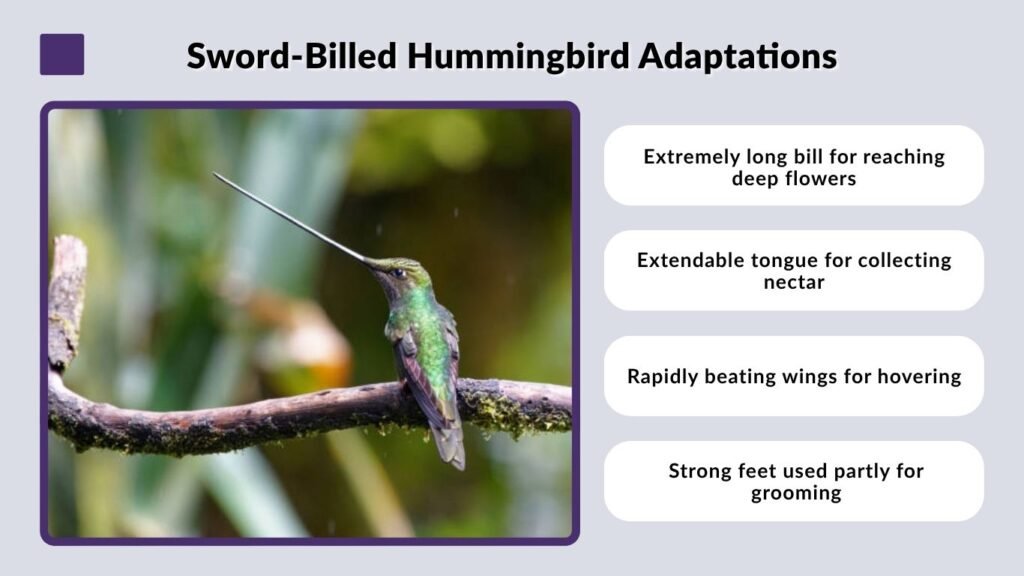
The sword-billed hummingbird has several physical and behavioral adaptations that help it survive.
Physical Adaptations
Its most important adaptations include:
- Extremely long bill for reaching deep flowers
- Extendable tongue for collecting nectar
- Rapidly beating wings for hovering
- Strong feet used partly for grooming
- Lightweight body suited to aerial feeding
- Excellent maneuverability around vegetation
Behavioral Adaptations
The bird actively searches for nectar-rich flowers and may travel between productive feeding locations.
Its ability to hover allows it to feed without landing on delicate flowers. It may also defend productive flowering areas from competing hummingbirds.
Sword-Billed Hummingbird Size
Sword-billed hummingbirds are relatively large compared with many other hummingbird species.
The bird’s total length can approach 20 centimeters (around 8 inches) when its extraordinarily long bill is included.
Its bill alone accounts for a substantial portion of this length, giving the bird a highly distinctive silhouette.
Despite its unusual proportions, it remains extremely agile in flight.
Sword-Billed Hummingbird Nest and Reproduction
Female hummingbirds generally take primary responsibility for nest building, incubation, and raising chicks.
The sword-billed hummingbird builds a small cup-shaped nest from soft plant material. Moss, fibers, and other vegetation may be incorporated into the structure.
Sword-Billed Hummingbird Eggs and Babies
Like many hummingbirds, females typically produce a very small clutch, commonly around two eggs.
Newly hatched sword-billed hummingbird chicks are tiny and dependent on their mother. The female feeds them by delivering food directly into their mouths.
As the chicks develop, their bills lengthen and eventually develop the extreme proportions characteristic of adults.
Sword-Billed Hummingbird Predators
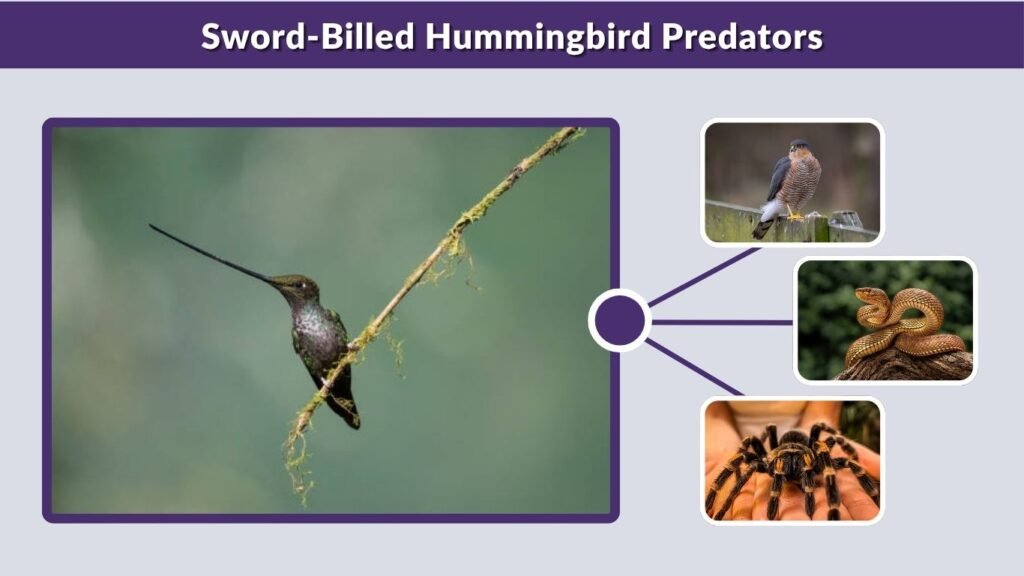
Despite their speed and agility, sword-billed hummingbirds can potentially fall prey to various predators.
Possible threats include:
- Birds of prey
- Predatory snakes
- Small mammals
- Large spiders
- Other opportunistic predators
Eggs and chicks are generally more vulnerable than healthy adult hummingbirds because they remain relatively stationary inside the nest.
Camouflaged nests and careful parental behavior help reduce these risks.
Sword-Billed Hummingbird Lifespan
The exact lifespan of wild sword-billed hummingbirds is not well documented.
Hummingbird survival varies greatly depending on food availability, weather, predators, disease, accidents, and habitat quality. Birds that survive their vulnerable early stages can potentially live for several years.
Because detailed long-term studies of this particular Andean species are limited, highly specific lifespan figures should be treated cautiously.
Sword-Billed Hummingbird Conservation Status
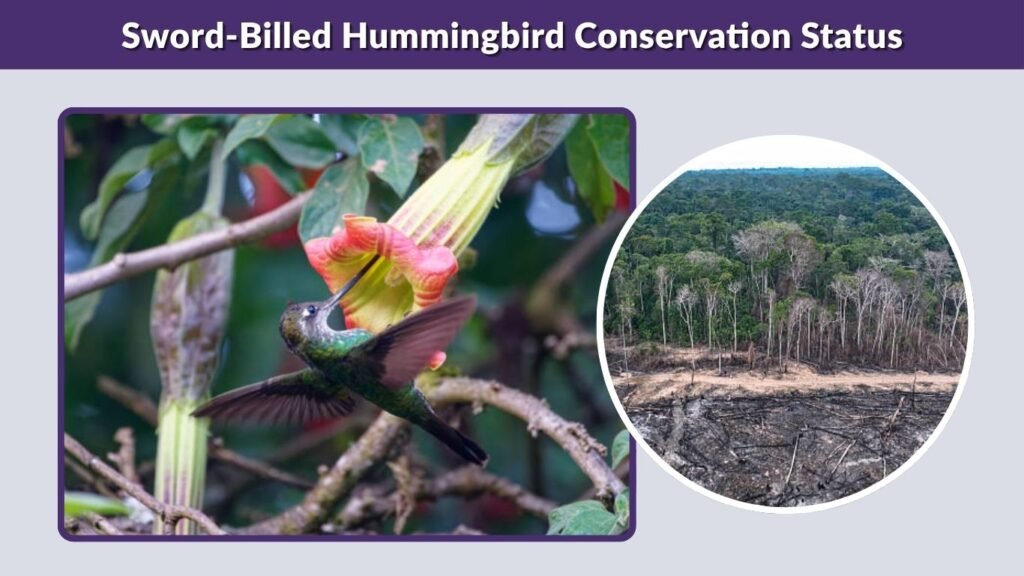
The sword-billed hummingbird is not generally considered among the world’s most critically threatened hummingbirds. However, healthy populations depend on suitable Andean forests and abundant flowering plants.
Potential long-term pressures include habitat destruction, forest fragmentation, agricultural expansion, and changes to mountain ecosystems.
Protecting cloud forests also protects the specialized flowers on which these hummingbirds depend.
Interesting Sword-Billed Hummingbird Facts
- The sword-billed hummingbird’s scientific name is Ensifera ensifera.
- Its bill may be longer than the rest of its body excluding the tail.
- It is native to the Andes of South America.
- Its diet includes both nectar and small insects.
- It specializes in feeding from unusually long tubular flowers.
- It has a close ecological relationship with several Andean passionflowers.
- Its long bill makes ordinary preening difficult.
- It frequently uses its feet to scratch and groom itself.
- It can hover in front of flowers while feeding.
- By transferring pollen between flowers, it plays an important role as a pollinator.
FAQs
Why Does the Sword-Billed Hummingbird Have Such a Long Beak?
Its long beak is an adaptation for reaching nectar deep inside long tubular flowers that shorter-billed hummingbirds have difficulty accessing.
What Does a Sword-Billed Hummingbird Eat?
It mainly consumes flower nectar but also eats tiny insects and spiders to obtain protein and other nutrients.
Where Does the Sword-Billed Hummingbird Live?
It lives in mountainous regions of the Andes, including parts of Colombia, Ecuador, Peru, Venezuela, and Bolivia.
Can a Sword-Billed Hummingbird Open Its Beak?
Yes. Although its bill is extremely long and specialized, the bird can open it to feed and capture small prey.
What Is Special About the Sword-Billed Hummingbird?
Its extraordinary bill is its defining feature. The bill allows the bird to reach nectar in exceptionally deep flowers and makes it one of the most specialized hummingbirds in the world.
