
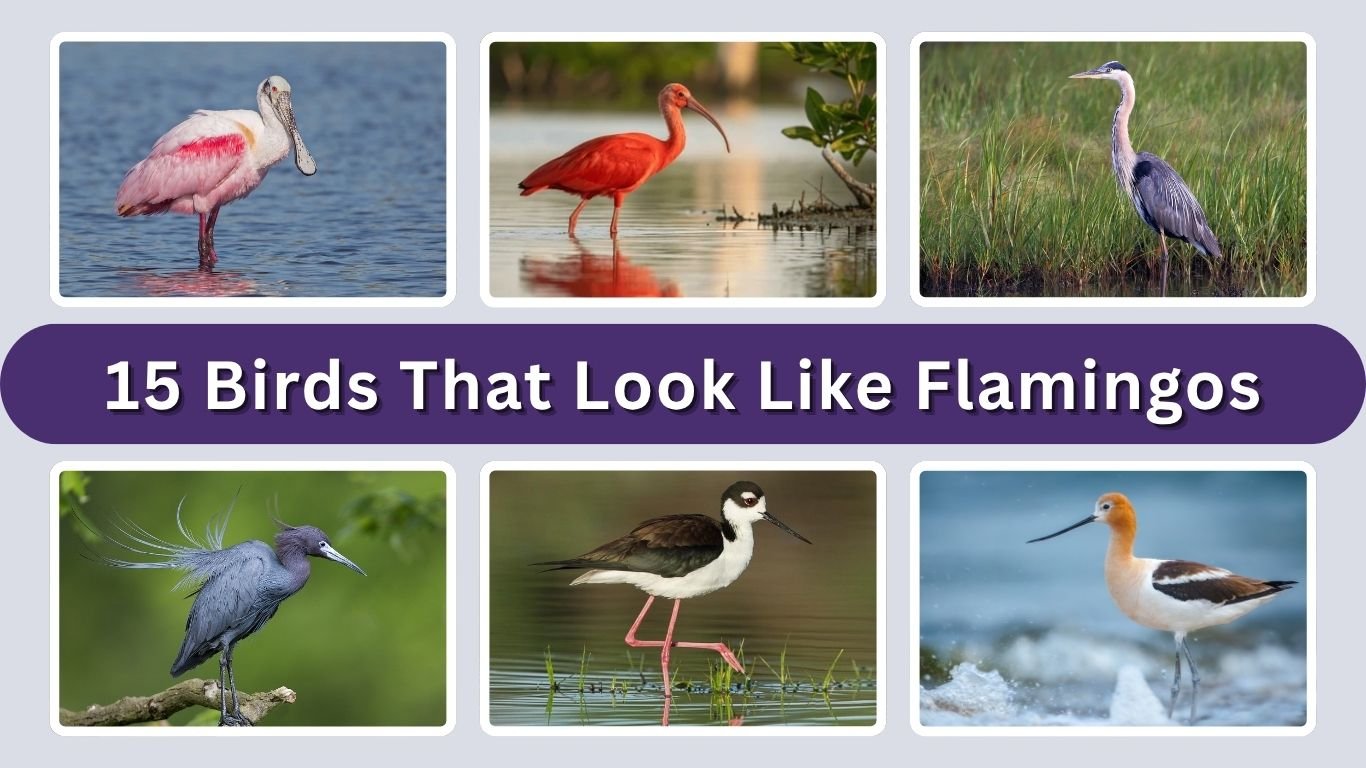
Flamingos are famous for their pink feathers, long legs, curved necks, and distinctive feeding style, but several other birds can look surprisingly similar. Some have pink plumage, while others resemble flamingos because of their tall bodies, long legs, or habit of wading through shallow water. From Roseate Spoonbills in Florida to white ibises, cranes, herons, and stilts, these flamingo-like birds can be easy to confuse at a distance. Here are 15 birds that look like flamingos and the key features that help identify them.
1. Roseate Spoonbill

The Roseate Spoonbill is one of the most recognizable birds that look like flamingos, especially because of its bright pink plumage, long legs, and habit of feeding in shallow water. Common in parts of Florida and along the Gulf Coast, this striking wading bird is often mistaken for a flamingo from a distance. However, its unusual spoon-shaped bill makes identification much easier up close.
Identification
- Color: Pale pink to deep rose-pink body with brighter wings
- Bill: Long, flat, and distinctly spoon-shaped
- Legs: Long reddish or pinkish legs
- Head: Adults have a partly bare, greenish head
- Size: About 28–34 inches tall
- Wingspan: Roughly 4 feet
- Young birds: Paler pink or mostly white with feathered heads
- Flight: Flies with its neck stretched forward and legs extended behind
Why It Looks Like a Flamingo
The Roseate Spoonbill is probably the first bird people think of when searching for a pink bird that looks like a flamingo. Both species have long legs, pink feathers, broad wings, and spend considerable time wading through shallow wetlands.
The easiest difference is the bill. Flamingos have thick, downward-curving bills, while spoonbills have long bills ending in broad, flattened tips. Spoonbills are also generally smaller than flamingos.
Habitat and Distribution
Roseate Spoonbills inhabit coastal marshes, mangrove forests, lagoons, mudflats, ponds, and other shallow wetlands. In the United States, they are particularly associated with Florida, Texas, Louisiana, and other areas along the Gulf Coast.
This makes the species one of the most likely birds that look like flamingos in Florida. They often gather with herons, egrets, and ibises in productive feeding areas.
Diet and Feeding Behavior
Roseate Spoonbills feed mainly on small aquatic animals. Their diet includes small fish, shrimp, crayfish, crabs, aquatic insects, and other invertebrates.
While feeding, the bird walks slowly through shallow water with its bill partly submerged. It sweeps its unusual bill from side to side, detecting prey by touch. When something edible contacts the sensitive bill, it quickly snaps shut. This feeding technique is very different from the filter-feeding method used by flamingos.
2. Scarlet Ibis
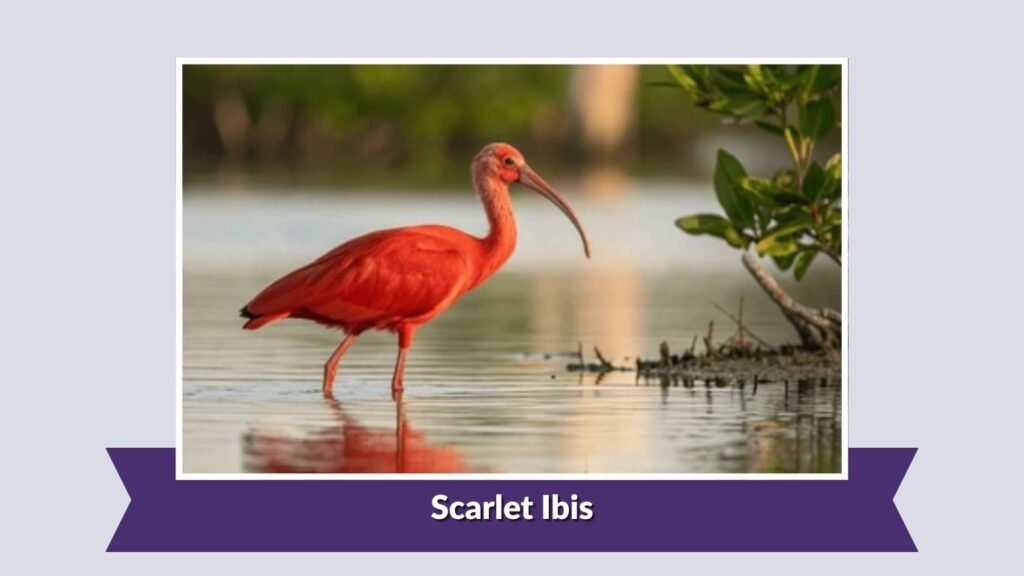
The Scarlet Ibis is a brilliant red-orange wading bird that can easily remind people of a flamingo, particularly when seen in large groups around wetlands. Its long legs, slender neck, curved bill, and vivid coloration give it a distinctly tropical appearance. Although it is not native to most of the United States, it is one of the closest visual matches among colorful long-legged waterbirds.
Identification
- Color: Bright scarlet-red over most of the body
- Bill: Long, thin, and strongly curved downward
- Legs: Long and reddish-pink
- Size: Around 22–25 inches long
- Wings: Black tips may be visible in flight
- Neck: Long and flexible
- Young birds: Brownish-gray before developing adult coloration
Why It Looks Like a Flamingo
The Scarlet Ibis resembles a flamingo because both birds have intensely colored plumage, long legs, and a strong association with shallow wetlands. From a distance, its reddish-pink body can easily create a flamingo-like impression.
The main difference is body shape and bill structure. Scarlet Ibises are smaller and slimmer, while flamingos are much taller. An ibis also has a narrow, curved probing bill rather than the thick, bent filtering bill of a flamingo.
Habitat and Distribution
Scarlet Ibises naturally inhabit tropical wetlands, mangrove swamps, mudflats, lagoons, and coastal estuaries in northern South America and nearby regions.
They spend much of their time in shallow water where food is abundant. Large groups may gather together for feeding or roosting, producing spectacular flashes of red across wetland landscapes.
Diet and Feeding Behavior
Scarlet Ibises mainly eat crustaceans, aquatic insects, mollusks, small fish, and other small wetland animals. They walk through shallow water and push their curved bills into soft mud to locate prey.
Their red coloration is influenced by pigments obtained through their diet, particularly carotenoids from crustaceans and other foods.
3. American White Ibis

The American White Ibis is a common long-legged wading bird of the southeastern United States and one of the notable white birds that look like flamingos. Adults have clean white plumage, pinkish-red legs, and a long curved bill. Their feeding posture and preference for shallow water often cause people unfamiliar with wading birds to compare them with flamingos.
Identification
- Color: Mostly white plumage
- Bill: Long, slender, and curved downward
- Bill color: Pinkish-red or orange-red
- Legs: Long and reddish
- Wing tips: Black, usually easiest to see during flight
- Size: Roughly 22–27 inches long
- Juveniles: Brown and white instead of completely white
Why It Looks Like a Flamingo
The American White Ibis shares the long-legged silhouette commonly associated with flamingos. Its pink-red legs and bill add to the resemblance, particularly when a flock is standing in shallow water.
However, the White Ibis is much smaller and lacks pink body feathers. Its narrow bill curves gently downward and is used for probing mud, whereas a flamingo has a much deeper and more specialized bill designed for filter feeding.
Habitat and Distribution
American White Ibises occur throughout much of Florida and other parts of the southeastern United States. They inhabit freshwater marshes, coastal wetlands, mangroves, mudflats, flooded lawns, ponds, and estuaries.
They are particularly familiar in Florida, making them a likely answer when someone sees a white flamingo-like bird in Florida. Groups may even forage in parks and suburban areas near suitable wetlands.
Diet and Feeding Behavior
White Ibises eat crayfish, crabs, insects, small fish, frogs, snails, and other aquatic animals.
They feed by walking slowly through shallow water or muddy ground and repeatedly inserting their curved bills below the surface. Their bills help them detect prey by touch, allowing them to forage even when the water is cloudy.
4. Wood Stork
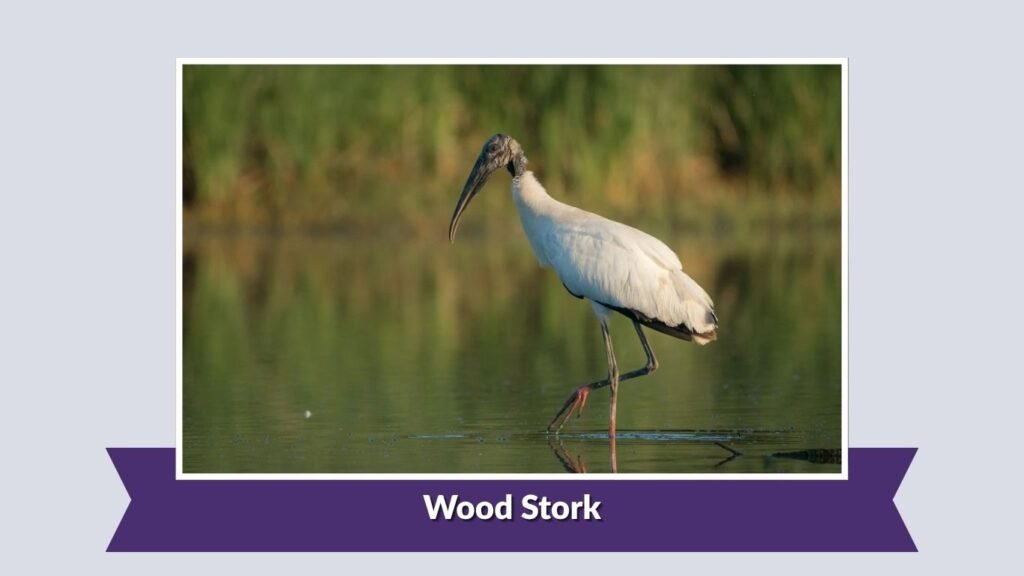
The Wood Stork is a tall white wading bird with extremely long legs and a large body, giving it a silhouette that can resemble a flamingo from far away. It is particularly familiar in Florida and other southeastern wetlands. Its white body, black flight feathers, slow movements, and habit of gathering in shallow water make it one of the more recognizable flamingo-like birds.
Identification
- Body: Large and mostly white
- Head: Dark, bald, and wrinkled in adults
- Bill: Thick, long, and slightly curved
- Legs: Long and dark gray
- Wings: Broad with black flight feathers
- Height: Roughly 3 feet tall
- Wingspan: Around 5 feet
Why It Looks Like a Flamingo
Wood Storks and flamingos are both large wetland birds with long legs and long necks. When a Wood Stork is standing at a distance, especially in bright sunlight, its mostly white body may resemble a pale or white flamingo.
Closer examination reveals major differences. Wood Storks have bald dark heads and heavy bills, while flamingos have feathered heads and strongly bent bills. Their leg and plumage colors also differ considerably.
Habitat and Distribution
Wood Storks inhabit marshes, swamps, ponds, flooded forests, mangroves, and shallow wetlands. In the United States, they are strongly associated with Florida, Georgia, South Carolina, and nearby southeastern areas.
Florida’s extensive wetland systems provide especially important habitat for feeding and nesting colonies.
Diet and Feeding Behavior
Wood Storks primarily eat fish but also consume crayfish, frogs, insects, and other aquatic animals.
They often feed with their bills partly open underwater. Instead of visually targeting each fish, they rely heavily on touch. When prey contacts the bill, it snaps shut extremely quickly.
This specialized technique works particularly well in shallow water where fish become concentrated.
5. Great Egret

The Great Egret is an elegant white bird that can sometimes be mistaken for a white flamingo because of its long neck, long legs, and graceful posture. Found throughout much of North America, it is especially common around wetlands in Florida. Its completely white plumage makes it stand out clearly against marsh vegetation and dark water.
Identification
- Plumage: Entirely white
- Bill: Long, straight, and usually yellow
- Legs: Very long and black
- Feet: Dark
- Neck: Extremely long and S-shaped
- Height: Around 3 feet
- Wingspan: About 4.5 feet
Why It Looks Like a Flamingo
A Great Egret has the same tall, narrow profile that people commonly associate with flamingos. Both species have elongated necks, very long legs, and spend much of their time walking through shallow water.
However, Great Egrets are pure white rather than pink, and their long yellow bills are straight and pointed. Flamingos have heavier, downward-curving bills and generally thicker bodies.
Habitat and Distribution
Great Egrets live around freshwater and saltwater environments, including marshes, ponds, lakeshores, rivers, tidal flats, mangroves, and estuaries.
They are among the most widespread white birds that look like flamingos in Florida, but they also occur throughout large portions of the United States and other parts of the world.
Diet and Feeding Behavior
Great Egrets are skilled visual hunters. They primarily eat fish but also capture frogs, crayfish, insects, snakes, and small aquatic animals.
Rather than sweeping or filtering the water, an egret usually stands almost motionless while watching for prey. When an animal comes within range, it rapidly thrusts its sharp bill forward.
This patient hunting technique differs greatly from the feeding strategy used by flamingos.
6. Snowy Egret
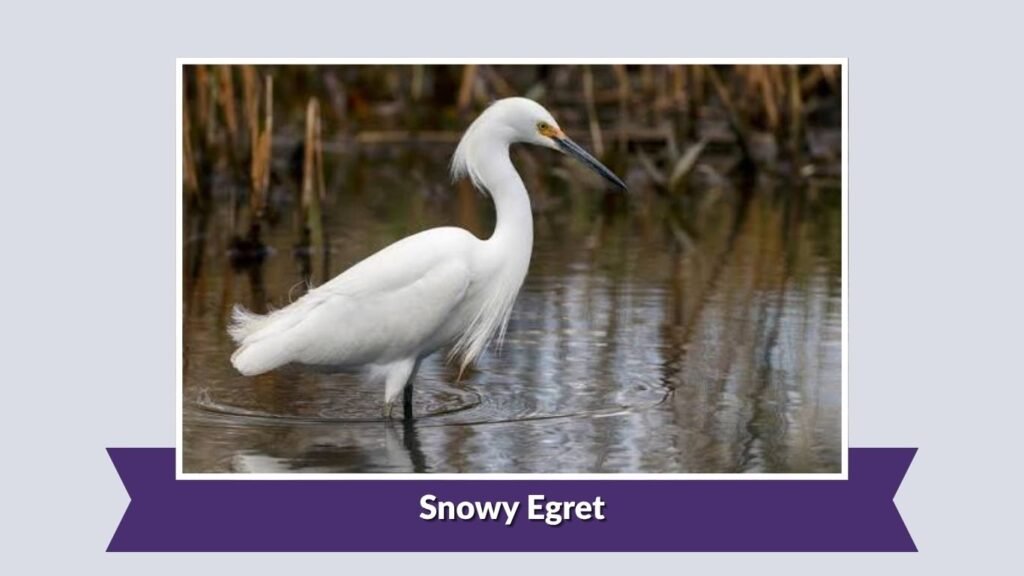
The Snowy Egret is a smaller white wading bird with long dark legs and striking yellow feet. Its slender body and graceful movements can make it resemble a miniature white flamingo, especially when viewed from a distance. Snowy Egrets are frequently seen around coastal wetlands, marshes, ponds, and estuaries, including many areas throughout Florida.
Identification
- Plumage: Bright white
- Bill: Long, thin, and black
- Legs: Long and black
- Feet: Bright yellow
- Face: Yellow skin between the bill and eyes
- Size: Around 22–27 inches long
- Breeding plumage: Delicate ornamental feathers develop on adults
Why It Looks Like a Flamingo
Like flamingos, Snowy Egrets have long legs, slender necks, and a strong preference for shallow water. Their upright posture can make them look surprisingly flamingo-like when details such as bill shape and coloration cannot be clearly seen.
The Snowy Egret is considerably smaller, completely white, and has a straight pointed bill. Its famous yellow feet are another easy way to distinguish it from flamingos.
Habitat and Distribution
Snowy Egrets inhabit coastal lagoons, salt marshes, mangrove wetlands, mudflats, ponds, lakes, and shallow streams. They occur across much of the Americas.
They are particularly common in Florida, where visitors may encounter them alongside herons, ibises, spoonbills, and other long-legged waterbirds.
Diet and Feeding Behavior
Snowy Egrets mainly eat small fish, shrimp, crayfish, aquatic insects, frogs, and other tiny animals.
Unlike Great Egrets, which often stand patiently, Snowy Egrets can be highly active hunters. They may run through shallow water, shuffle their yellow feet to disturb prey, spread their wings, or suddenly change direction while chasing fish.
Their energetic feeding behavior makes them easy to distinguish from the slower, more methodical feeding style of flamingos.
7. Great Blue Heron
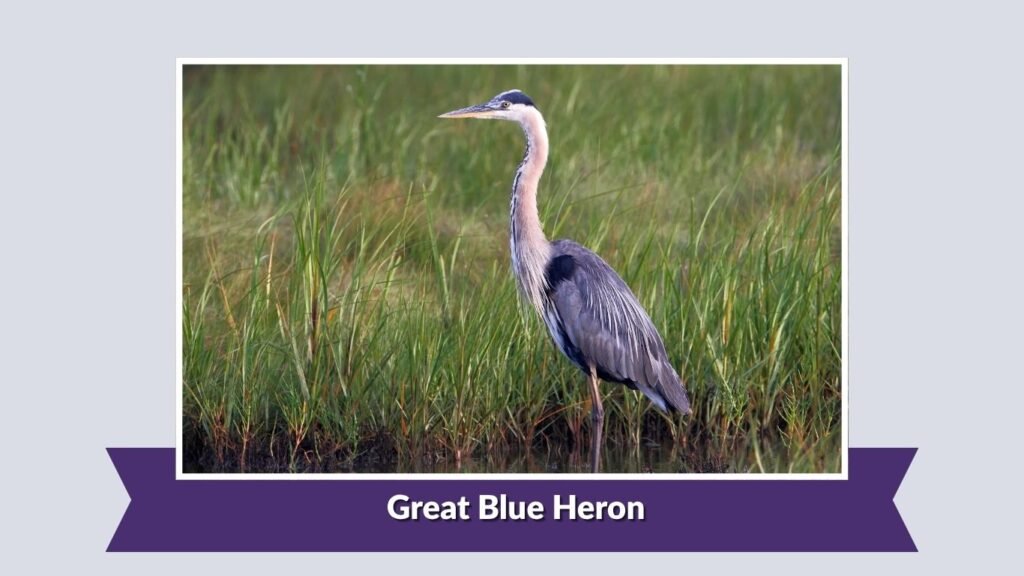
The Great Blue Heron is a tall, long-legged wading bird that can resemble a gray or blue-gray flamingo when seen from a distance. Its impressive height, elongated neck, and slow movements through shallow water create a flamingo-like silhouette. Great Blue Herons are widespread across North America and are commonly seen near lakes, rivers, marshes, ponds, and coastal wetlands.
Identification
- Color: Blue-gray body with darker flight feathers
- Head: White face with a dark stripe above the eye
- Bill: Long, straight, and yellowish
- Legs: Very long and grayish
- Neck: Long and S-shaped
- Height: About 3–4.5 feet
- Wingspan: Around 5.5–6.5 feet
- Flight: Flies with its neck folded back
Why It Looks Like a Flamingo
The Great Blue Heron is a good example of a grey bird that looks like a flamingo. Both birds are tall, have exceptionally long legs, and commonly stand in shallow water while searching for food.
The major differences are color, bill shape, and flight posture. Flamingos are usually pink or whitish-pink and have thick, bent bills. Great Blue Herons have straight, spear-like bills and gray-blue feathers. Herons also retract their necks during flight, whereas flamingos usually fly with their necks stretched straight forward.
Habitat and Distribution
Great Blue Herons occur throughout much of North and Central America. They use freshwater lakes, marshes, rivers, ponds, tidal flats, mangroves, and coastal shorelines.
They can be found from Florida to Canada and are also frequent visitors to suburban ponds and reservoirs where fish are abundant.
Diet and Feeding Behavior
Great Blue Herons primarily eat fish, but they also consume frogs, snakes, crayfish, insects, rodents, and other small animals.
They usually stand motionless or walk very slowly through shallow water. Once prey comes within reach, the heron rapidly strikes with its sharp bill. This patient hunting strategy differs from the filter-feeding behavior of flamingos.
8. Little Blue Heron
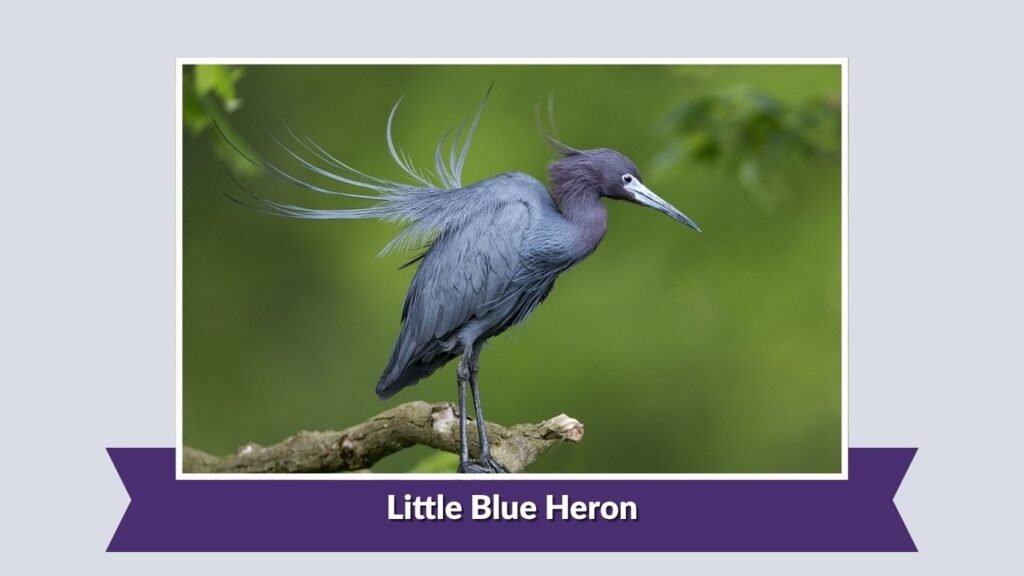
The Little Blue Heron is a slender wading bird with long legs and a graceful neck. Adults have dark slate-blue plumage, making them another possible answer when someone searches for a gray bird that looks like a flamingo. Juveniles, however, are mostly white and can resemble small white flamingo-like birds when feeding in shallow wetlands.
Identification
- Adult color: Dark slate-blue or blue-gray
- Juvenile color: Mostly white
- Bill: Long, narrow, and slightly curved downward
- Bill color: Gray-blue with a dark tip
- Legs: Long and greenish-gray
- Neck: Long and slender
- Size: Around 22–29 inches long
- Build: Slimmer than a Great Blue Heron
Why It Looks Like a Flamingo
Little Blue Herons share several physical characteristics with flamingos, including long legs, long necks, and a habit of wading through shallow water.
Adult birds may look like dark or gray flamingos from far away, while young birds can appear as miniature white flamingo-like birds.
However, the Little Blue Heron is much smaller. Its pointed bill is designed for catching individual prey, while a flamingo’s specialized bent bill is designed for filtering tiny organisms from water.
Habitat and Distribution
Little Blue Herons live around marshes, ponds, swamps, lagoons, mangroves, estuaries, and shallow coastal waters.
They are especially common throughout Florida and the southeastern United States but occur farther north during the warmer months. They are also widespread through parts of Central America, the Caribbean, and northern South America.
Diet and Feeding Behavior
Little Blue Herons feed mainly on small fish, frogs, crayfish, aquatic insects, shrimp, and other invertebrates.
They forage by slowly walking through shallow water and watching carefully for movement. Once prey is detected, they extend their necks and strike quickly with their bills.
Compared with some other egrets, Little Blue Herons typically hunt in a deliberate and patient manner.
9. Reddish Egret

The Reddish Egret is one of the most unusual flamingo-like birds found along coastal areas of the southern United States. Its reddish head and neck, long legs, and energetic movements through shallow water give it a distinctive appearance. A rare white morph also occurs, making this species capable of resembling both reddish and white long-legged wetland birds.
Identification
- Body: Slate-gray on the common dark morph
- Head and neck: Reddish or rusty colored
- White morph: Entirely white plumage
- Bill: Long and pinkish with a dark tip
- Legs: Long and dark
- Neck: Long and flexible
- Size: Around 27–32 inches long
- Behavior: Extremely active while feeding
Why It Looks Like a Flamingo
The Reddish Egret’s long legs and reddish coloration can make it look somewhat like a small, darker flamingo.
The resemblance is especially noticeable when the bird stands upright in shallow coastal water. Its pinkish bill can add to the confusion.
However, Reddish Egrets have pointed bills rather than the strongly curved bill of a flamingo. They are also much smaller and display a dramatically different hunting style.
Habitat and Distribution
Reddish Egrets are strongly associated with shallow saltwater habitats. They occur around tidal flats, coastal lagoons, bays, salt marshes, and mangrove environments.
In the United States, they are especially associated with Florida and the Gulf Coast, making them one of the more interesting flamingo-like birds in Florida.
Diet and Feeding Behavior
Reddish Egrets mainly feed on small fish and occasionally other aquatic animals.
Their feeding behavior is highly distinctive. Instead of standing still, they may run rapidly through shallow water, jump, spin, flap their wings, and suddenly change direction while chasing fish.
They sometimes spread their wings like an umbrella, creating shade that makes prey easier to see. This energetic performance separates them clearly from the slower feeding behavior of flamingos.
10. Sandhill Crane
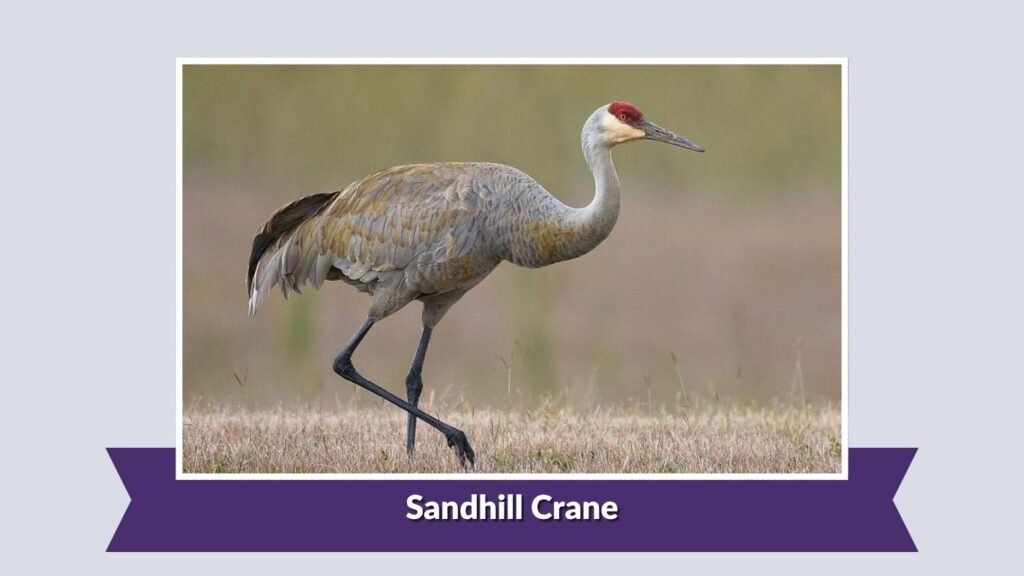
The Sandhill Crane is a tall gray bird with extraordinarily long legs and neck, giving it one of the closest flamingo-like silhouettes among North American land and wetland birds. Sandhill Cranes are particularly noticeable when standing together in open wetlands or shallow water. Their large size and graceful posture often lead observers to compare them with flamingos.
Identification
- Color: Mostly gray
- Head: Distinctive red patch on the crown
- Bill: Long, straight, and pointed
- Legs: Very long and dark
- Neck: Long and usually held straight
- Height: Approximately 3–4 feet
- Wingspan: About 5–7 feet
- Voice: Loud, rolling, trumpet-like call
Why It Looks Like a Flamingo
Sandhill Cranes and flamingos both have extremely long legs, long necks, large bodies, and an upright stance. This makes the Sandhill Crane an excellent example of a tall flamingo-like grey bird.
They can also both gather in large flocks and spend time around shallow wetlands.
However, Sandhill Cranes are gray rather than pink and have straight bills. They also fly with their necks fully extended, which is similar to flamingos but different from herons.
Habitat and Distribution
Sandhill Cranes use open wetlands, marshes, grasslands, agricultural fields, meadows, and shallow river systems.
Different populations occur throughout North America. Florida supports resident Sandhill Cranes, while enormous migratory gatherings occur in parts of the central United States.
During migration, thousands may gather at traditional staging areas before continuing their journeys.
Diet and Feeding Behavior
Sandhill Cranes are omnivores with a diverse diet. They eat seeds, grains, berries, insects, worms, snails, frogs, small reptiles, and occasionally small mammals.
They often forage by walking across open ground or shallow wetlands and probing the soil with their pointed bills.
Unlike flamingos, they do not filter microscopic food from the water. Their flexible diet allows them to use both wetland and terrestrial habitats.
11. Whooping Crane
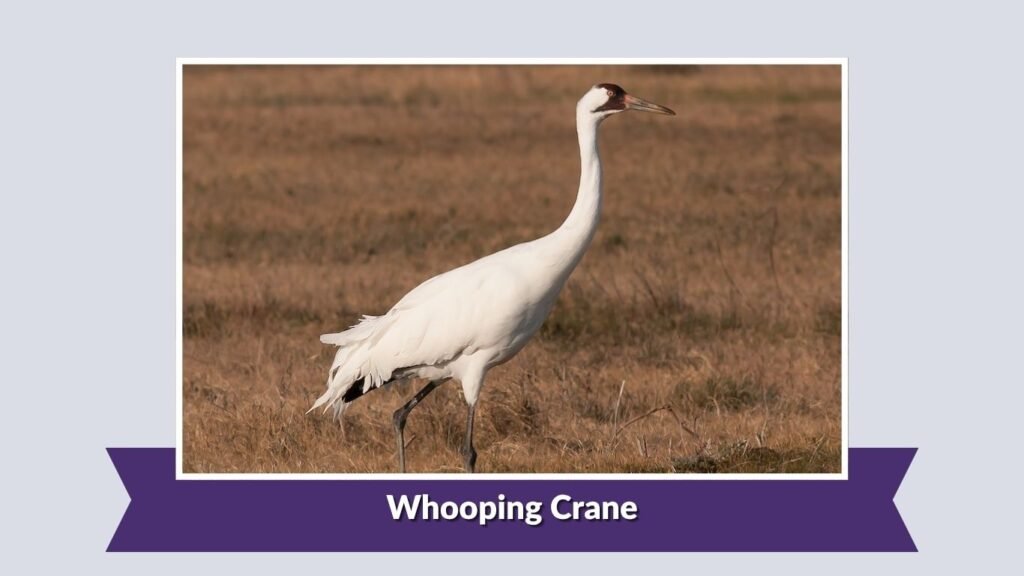
The Whooping Crane is a spectacular white bird with extremely long legs, a long neck, and a tall body. Its elegant shape can easily remind observers of a white flamingo. It is also one of North America’s rarest and most closely monitored birds, making a sighting particularly special compared with encounters involving more common herons and egrets.
Identification
- Plumage: Bright white
- Crown: Bare red skin on adults
- Bill: Long, straight, and dark
- Legs: Very long and black
- Wing tips: Black, mainly visible during flight
- Height: Around 5 feet
- Wingspan: More than 7 feet
- Flight: Neck and legs held fully extended
Why It Looks Like a Flamingo
Whooping Cranes resemble flamingos because both are very tall birds with long legs, elongated necks, broad wings, and striking pale plumage.
A Whooping Crane standing in shallow water can therefore look like an unusually large white bird that looks like a flamingo.
The easiest differences are the bill and coloration. Whooping Cranes have straight, pointed bills and mostly pure white feathers. Flamingos usually have pink coloration and thick, sharply bent bills adapted for filter feeding.
Habitat and Distribution
Whooping Cranes depend heavily on wetlands, shallow marshes, coastal areas, and nearby open landscapes. Migratory birds travel between breeding and wintering habitats and use protected stopover sites along the way.
Their limited population and specialized habitat requirements mean they are much less commonly encountered than Sandhill Cranes.
Diet and Feeding Behavior
Whooping Cranes eat a mixture of animal and plant foods. Their diet can include crabs, crayfish, insects, frogs, small fish, reptiles, berries, seeds, and plant material.
They typically forage by walking slowly through shallow wetlands or open ground and picking or probing for food with their long bills.
Unlike flamingos, Whooping Cranes target individual prey items rather than filtering large amounts of water for tiny organisms.
12. American White Pelican

The American White Pelican is a huge white waterbird that can sometimes resemble a flamingo from a distance because of its pale body, long bill, and habit of gathering around shallow water. Its extremely broad wings and impressive size make it one of North America’s most noticeable waterbirds. During flight, black wing feathers create a striking contrast with the otherwise white plumage.
Identification
- Plumage: Mostly bright white
- Wing feathers: Black flight feathers visible in flight
- Bill: Extremely long and orange-yellow
- Throat pouch: Large and expandable
- Legs: Shorter than a flamingo’s and orange in color
- Length: About 50–65 inches
- Wingspan: Roughly 8–9.5 feet
- Body: Large and heavy
Why It Looks Like a Flamingo
American White Pelicans can resemble white flamingo-like birds, especially when large groups are resting or feeding in shallow lakes and wetlands. Their white plumage, large bodies, long bills, and social behavior create some visual similarities.
However, pelicans have much shorter legs and considerably heavier bodies. Their bills are also long and straight with enormous throat pouches, while flamingos have thick, sharply bent bills adapted for filter feeding.
Habitat and Distribution
American White Pelicans occur across much of North America. They breed mainly around inland lakes and wetlands in western and central regions before many migrate south for winter.
Wintering birds can be seen in Florida, along the Gulf Coast, in California, Mexico, and around other warm coastal and inland waters.
They may also appear during migration in states such as Illinois, Wisconsin, Michigan, and Kentucky.
Diet and Feeding Behavior
American White Pelicans mainly eat fish but may also consume crayfish, amphibians, and other aquatic animals.
Unlike Brown Pelicans, they rarely plunge-dive from the air. Instead, they usually swim along the surface and dip their bills into the water.
Several birds may cooperate by swimming together and driving schools of fish toward shallow areas where they can be captured more easily.
13. Black-Necked Stilt
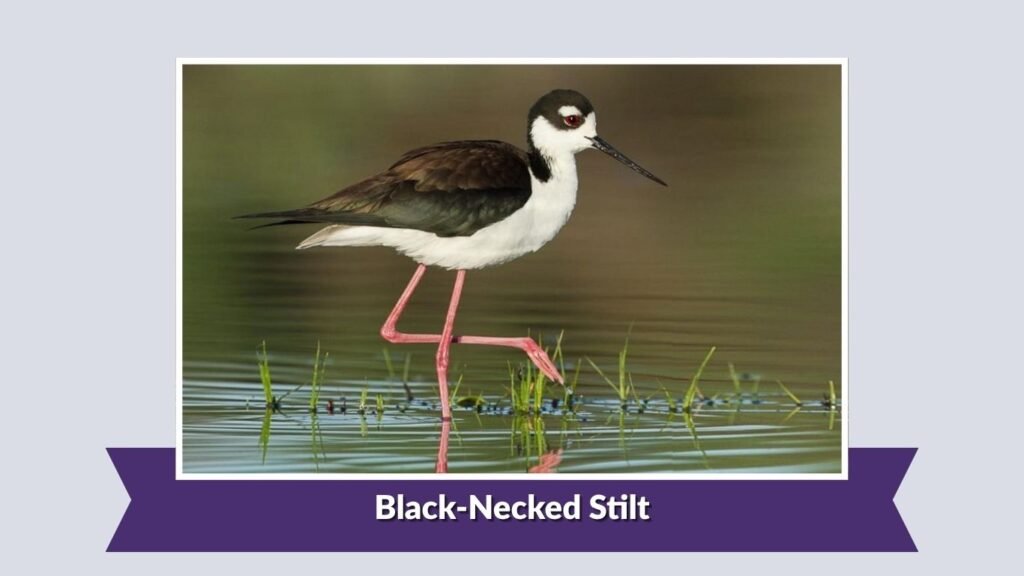
The Black-necked Stilt is a slender wetland bird with extraordinarily long pink legs. Although much smaller than a flamingo, its delicate body, long legs, and habit of wading through shallow water make it one of the most convincing miniature flamingo-like birds. Its dramatic black-and-white plumage makes identification relatively easy once viewed closely.
Identification
- Plumage: Bold black and white
- Back and wings: Mostly black
- Underparts: White
- Legs: Extremely long and bright pink
- Bill: Thin, straight, and black
- Neck: Long and slender
- Size: About 14–16 inches long
- Build: Very slim and delicate
Why It Looks Like a Flamingo
The Black-necked Stilt’s most flamingo-like feature is its extraordinarily long pink legs. Relative to body size, its legs are among the longest of any North American bird.
When standing in shallow water, its upright posture can resemble a tiny black-and-white flamingo.
Unlike flamingos, however, stilts have thin, needle-like bills and much smaller bodies. They also lack pink body feathers.
Habitat and Distribution
Black-necked Stilts inhabit shallow freshwater and saltwater environments, including marshes, ponds, mudflats, flooded fields, salt ponds, lagoons, and estuaries.
They occur through western and southern North America and are also found in Florida, the Caribbean, Central America, and parts of South America.
Their preference for open shallow water makes them relatively easy to observe when present.
Diet and Feeding Behavior
Black-necked Stilts eat aquatic insects, small crustaceans, worms, larvae, tiny fish, and other invertebrates.
They forage by walking through shallow water while picking prey from the surface or beneath the water with their narrow bills.
Unlike flamingos, they do not filter large quantities of water. Instead, they visually locate and capture individual food items.
14. American Avocet
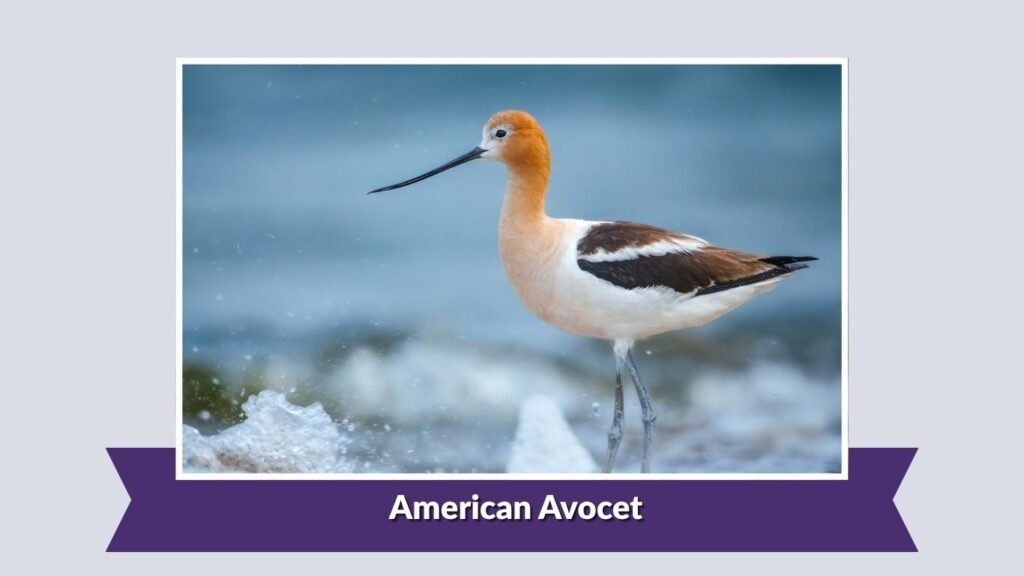
The American Avocet is another long-legged shorebird that can look surprisingly similar to a small flamingo. Its long bluish-gray legs, slender body, and unusual upturned bill give it an elegant appearance. During the breeding season, its head and neck turn rusty or peach-colored, adding warm tones that may strengthen the flamingo comparison.
Identification
- Body: Mostly black and white
- Head and neck: Rusty-orange during breeding season
- Winter head: Pale gray or white
- Bill: Long, thin, and curved upward
- Legs: Very long and bluish-gray
- Size: About 16–20 inches long
- Wings: Bold black-and-white pattern
- Body shape: Slim and graceful
Why It Looks Like a Flamingo
American Avocets resemble flamingos mainly because of their long legs and habit of feeding while wading through shallow water.
During the breeding season, the peach or rusty coloring on the head and neck can give them an even more flamingo-like appearance.
Their feeding technique also has a superficial similarity. Avocets often sweep their bills from side to side through the water, although their narrow upturned bills are dramatically different from the thick downward-curved bills of flamingos.
Habitat and Distribution
American Avocets inhabit shallow wetlands, salt ponds, mudflats, flooded grasslands, prairie ponds, and lake margins.
They are especially common in western and central North America. During migration and winter, they may travel toward coastal areas of California, Texas, Florida, Mexico, and other southern regions.
Large groups sometimes gather in shallow wetlands where food is plentiful.
Diet and Feeding Behavior
American Avocets eat aquatic insects, crustaceans, worms, larvae, and other small invertebrates.
One of their characteristic feeding techniques involves placing the slightly open bill in shallow water and sweeping it from side to side.
When the sensitive bill encounters prey, the bird quickly captures it. They may also pick insects directly from mud or the water surface.
15. Jabiru

The Jabiru is an enormous long-legged stork that can resemble a giant white flamingo when viewed from far away. It has a white body, long dark legs, an unusually long neck, and a massive black bill. Although primarily a Central and South American species, occasional sightings farther north make it an interesting addition to a list of birds with flamingo-like proportions.
Identification
- Body: Mostly white
- Head and neck: Bare and black
- Neck base: Bright red band
- Bill: Very large, thick, and black
- Legs: Long and dark
- Height: Can approach 5 feet
- Wingspan: Around 8 feet
- Build: Tall, powerful, and heavy-bodied
Why It Looks Like a Flamingo
Jabirus and flamingos share several obvious traits. Both are very tall birds with long legs, long necks, large wings, and a preference for wetlands.
A Jabiru standing in shallow water may therefore resemble a huge white bird that looks like a flamingo.
The differences become obvious at close range. Jabirus have massive straight bills, black featherless heads and necks, and a distinctive red throat band. Flamingos have feathered pinkish heads and specialized bent bills.
Habitat and Distribution
Jabirus inhabit wetlands, flooded grasslands, marshes, riverbanks, ponds, and seasonally flooded savannas.
They are primarily distributed from Mexico through Central America and into much of South America. Large wetland regions such as Brazil’s Pantanal provide especially important habitat.
Although they are not common Florida birds, rare wandering individuals have occasionally attracted attention farther north.
Diet and Feeding Behavior
Jabirus are carnivorous hunters that feed on fish, frogs, snakes, insects, mollusks, crustaceans, and other small aquatic animals.
They usually walk slowly through shallow water while searching for prey. Their enormous bills allow them to grab surprisingly large animals.
Unlike flamingos, which filter tiny organisms and algae from water, Jabirus target individual prey and swallows it whole.
FAQs
Many long-legged wading birds can be mistaken for flamingos because they share similar body shapes, colors, and wetland habitats. Pink birds such as Roseate Spoonbills are especially easy to confuse with flamingos, while white or gray species may also look similar from a distance. These frequently asked questions explain some of the most common flamingo look-alikes.
1. What Bird Looks Most Like a Flamingo?
The Roseate Spoonbill is one of the birds most commonly mistaken for a flamingo. It has bright pink plumage, long legs, and often feeds in shallow wetlands. However, its broad, spoon-shaped bill clearly separates it from a flamingo.
2. What Pink Bird Looks Like a Flamingo?
The Roseate Spoonbill is the best-known pink bird that looks like a flamingo. The Scarlet Ibis can also appear flamingo-like because of its bright reddish-pink coloration, long legs, and wetland lifestyle.
3. What White Birds Look Like Flamingos?
Several white wading birds resemble flamingos, including the American White Ibis, Great Egret, Snowy Egret, Wood Stork, Whooping Crane, and American White Pelican. Their long legs, necks, and preference for shallow water create the resemblance.
4. What Birds Look Like Flamingos in Florida?
Florida has several flamingo-like birds. Common examples include Roseate Spoonbills, American White Ibises, Great Egrets, Snowy Egrets, Wood Storks, Reddish Egrets, and Sandhill Cranes. Roseate Spoonbills are particularly easy to mistake for flamingos because of their pink feathers.
5. What Gray Bird Looks Like a Flamingo?
The Great Blue Heron is one of the most recognizable gray birds that can look like a flamingo. Sandhill Cranes and adult Little Blue Herons may also create a similar impression because of their gray coloration, long legs, and elongated necks.
