
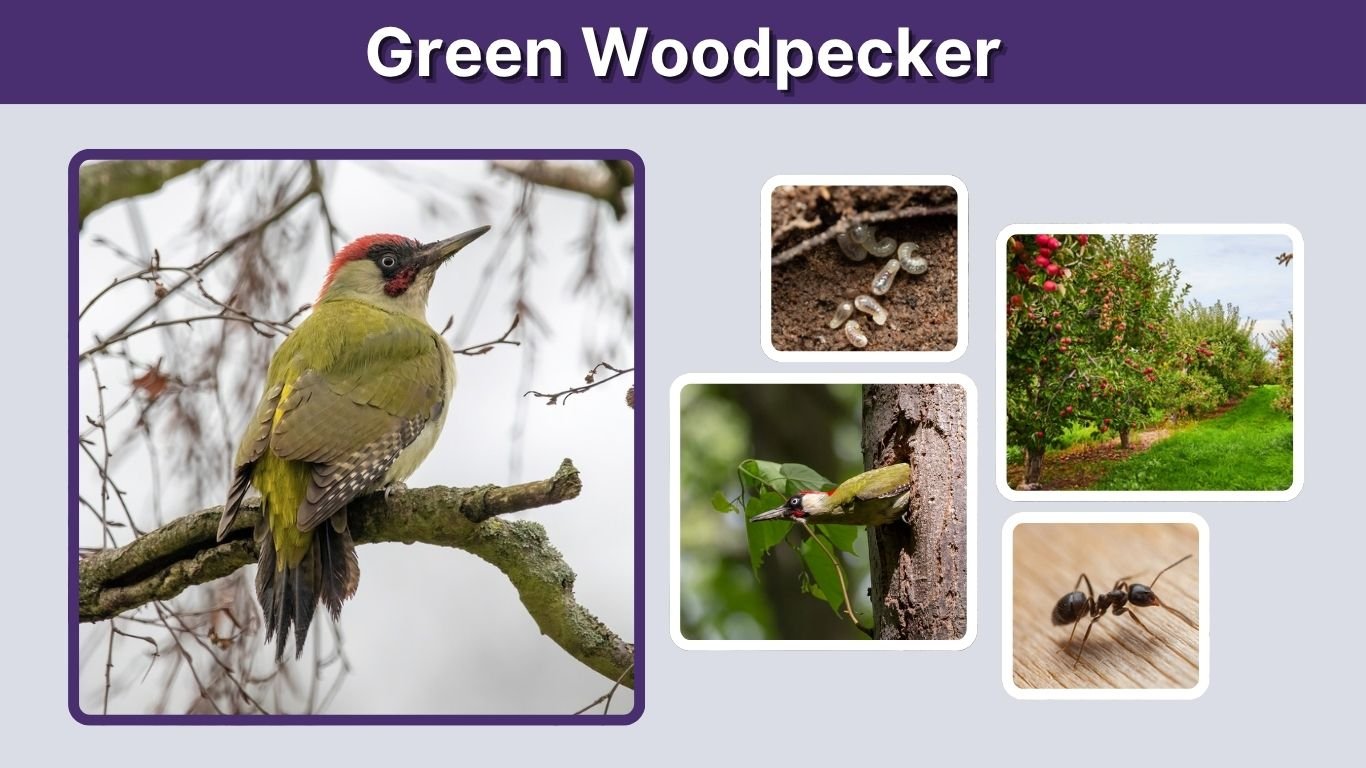
The Green Woodpecker (Picus viridis) is a striking European bird recognized by its green plumage, bright red crown, yellow rump, and unusual laughing call. Unlike many woodpeckers that spend most of their feeding time hammering tree trunks, Green Woodpeckers frequently forage on the ground for ants. Their exceptionally long, sticky tongue is perfectly adapted for reaching deep into ant nests. Common across much of England and Wales, these colorful birds inhabit woodland edges, parks, farmland, and gardens where mature trees and open grassland occur together.
What Does a Green Woodpecker Look Like?
The European Green Woodpecker is the largest woodpecker regularly breeding in Britain. Its combination of mossy-green plumage and a bright red crown makes adults relatively easy to recognize. A yellow-green rump is particularly noticeable when the bird flies away in its characteristic deeply undulating flight.
Green Woodpecker Identification
Look for these features:
- Mossy-green back and wings
- Paler greenish or grayish underparts
- Bright red crown
- Black facial mask
- Prominent moustache stripe
- Bright yellow-green rump
- Strong grayish bill
- Black-and-white barring in the wing feathers
- Deeply undulating flight
Adults often spend considerable time on lawns or short grass rather than clinging to trunks, which is unusual compared with many other woodpeckers.
How Big Is a Green Woodpecker?
The Green Woodpecker is Britain’s largest resident woodpecker species. Its wingspan can reach approximately 42 cm, giving it a noticeably larger and heavier appearance than Great Spotted and Lesser Spotted Woodpeckers.
BTO records an average weight of around 189 grams.
Despite its sturdy build, the bird flies quickly between feeding and nesting areas.
Male vs Female Green Woodpecker
Male and female Green Woodpeckers have almost identical body coloration. Both possess green plumage, a yellow rump, red crown, and black facial markings. The easiest way to determine sex is to examine the moustache stripe running beneath and behind the bill.
Male Green Woodpecker
The adult male has:
- Red crown
- Black facial mask
- Red center inside the black moustache stripe
- Green upperparts
- Yellow rump
- Pale underparts
The red moustache marking is the most reliable field sign separating an adult male from a female.
Female Green Woodpecker
The female looks very similar but has an entirely black moustache stripe without the red center found in males.
Body size alone is not a reliable way to distinguish the sexes. When the head is clearly visible, moustache coloration provides a much easier identification feature.
What Do Green Woodpeckers Eat?
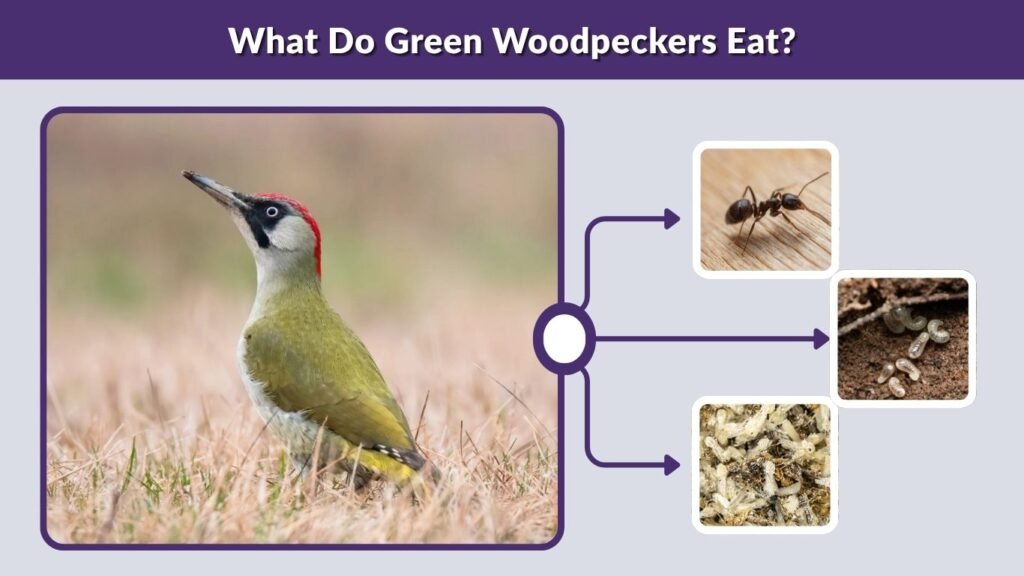
Ants dominate the Green Woodpecker’s diet. This specialization explains why the bird spends so much time walking across lawns, meadows, woodland rides, and other grassy places rather than continuously drilling tree bark.
Green Woodpecker Diet
Typical foods include:
- Adult ants
- Ant larvae
- Ant pupae
- Other small insects
- Occasional additional invertebrates
The bird probes ant nests with its bill before extending its long tongue into the tunnels. The sticky surface of the tongue helps collect ants and their larvae.
This feeding behavior means that a Green Woodpecker repeatedly visiting a lawn may actually indicate a healthy population of ants beneath the grass.
Green Woodpecker Tongue
The tongue is one of the Green Woodpecker’s most extraordinary adaptations. Ant colonies often occur deep inside underground chambers where an ordinary bird’s bill could not reach. Green Woodpeckers overcome this problem with a remarkably elongated tongue designed for probing narrow passages.
How Does the Tongue Work?
The long tongue:
- Extends far beyond the bill
- Reaches into ant tunnels
- Has a sticky surface that captures prey
- Can probe places inaccessible to the beak
- Fits around specialized structures behind the skull when retracted
Woodland Trust notes that the tongue is so long it effectively coils behind the skull when stored inside the bird’s head.
This adaptation is one of the main reasons Green Woodpeckers can specialize so heavily on ants.
Green Woodpecker Habitat and Range
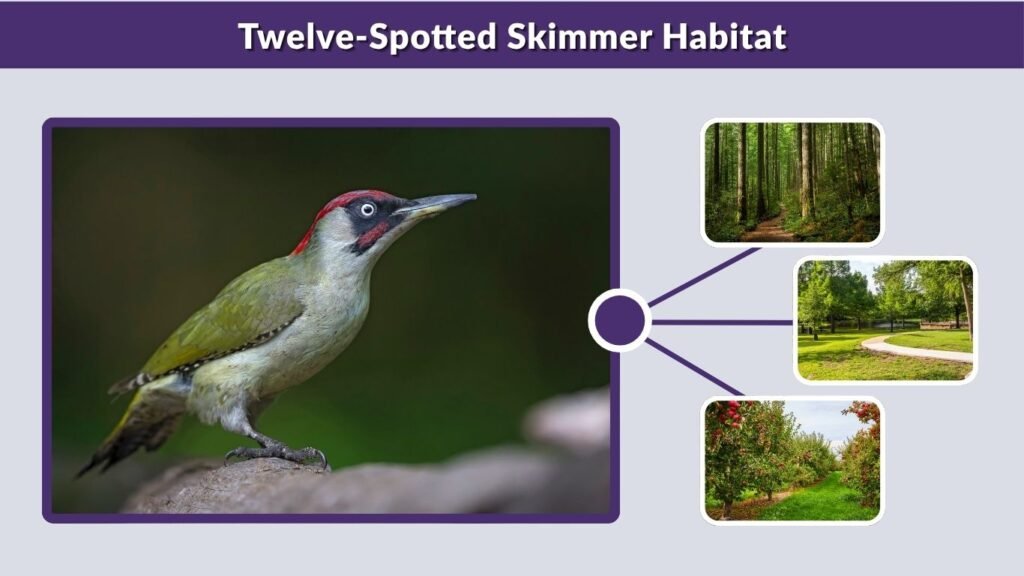
Green Woodpeckers need two important resources close together: trees for nesting and open ground for feeding. Dense woodland alone is less useful if there are few grassy areas containing ant colonies.
Where Do Green Woodpeckers Live?
Typical habitats include:
- Woodland edges
- Grassland
- Parks
- Orchards
- Farmland
- Large gardens
- Woodland clearings
- Heathland edges
They occur widely across England and Wales and in parts of Scotland, but are absent from Ireland and much of northern and northwestern Scotland.
Open grassy habitat close to mature trees provides ideal conditions because the birds can feed on ants and retreat quickly to trees for shelter and nesting.
Green Woodpecker Call and Sound
Green Woodpeckers are often heard before they are seen. Their loud, laughing call carries considerable distance and has inspired several traditional English names.
What Does a Green Woodpecker Sound Like?
The characteristic call consists of repeated loud notes that develop into a descending, laughing series.
It is commonly called a “yaffle.”
Traditional names inspired by the call include:
- Yaffle
- Yaffingale
- Laughing Betsey
- Rainfowl
BTO describes the bird’s repeated liquid calls developing into the distinctive laughing yaffle.
Do Green Woodpeckers Drum?
They can drum, but Green Woodpeckers drum much less frequently than Great Spotted Woodpeckers.
Their vocal call plays a more important role in advertising territory. When drumming does occur, it tends to be softer and less obvious than the rapid drumming associated with other British woodpeckers.
Green Woodpecker Nest and Eggs
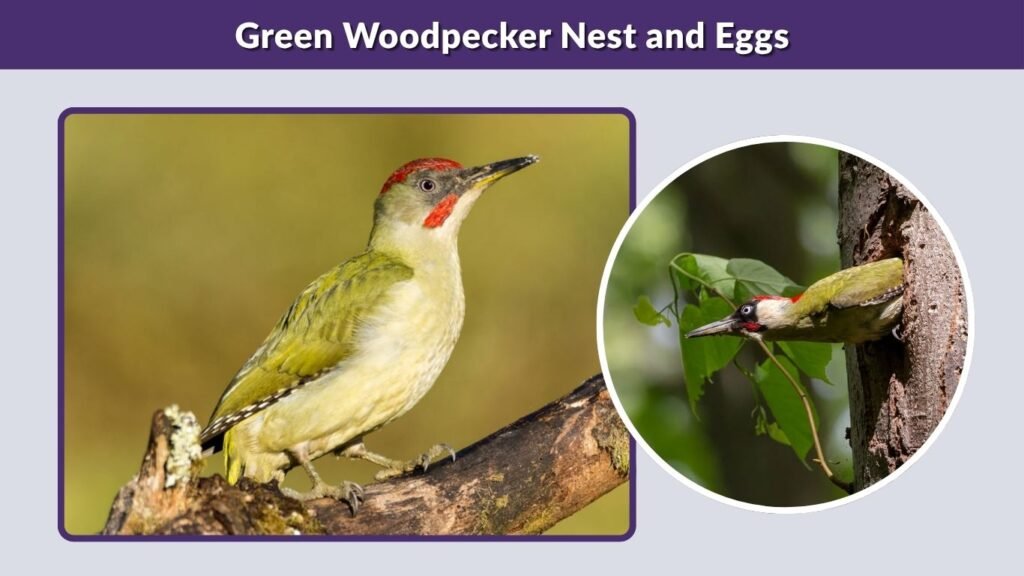
Green Woodpeckers are cavity-nesting birds. They usually excavate their own nest hole in a tree, often choosing wood that is sufficiently soft or decayed to make excavation easier.
Nesting and Breeding
Typical breeding characteristics include:
- Nest placed inside a tree cavity
- Hole excavated by the birds
- Approximately 4–6 white eggs
- Both parents involved in raising the young
- Eggs hatch after roughly three weeks
- Chicks remain in the cavity for about another three weeks
Woodland Trust reports that excavation can take several weeks before the nest is ready.
Deadwood and decaying portions of mature trees are particularly valuable because they are easier for woodpeckers to excavate.
Juvenile Green Woodpecker
Young Green Woodpeckers look considerably different from adults. Their heavily patterned plumage can sometimes cause observers to think they are seeing another species.
What Does a Juvenile Look Like?
Juveniles generally have:
- Duller green coloration
- Heavy dark spotting and streaking
- Less clearly defined facial markings
- Pale mottling across the underparts
- Red crown markings that appear less clean than adults
- Yellow-green rump
As the young bird matures, the heavily mottled juvenile plumage is replaced by the cleaner green, red, and black pattern of an adult.
European Green Woodpecker and Similar Species
The name “green woodpecker” can refer to several predominantly green woodpeckers around the world. The species found across much of Europe is specifically Picus viridis.
Other Green Woodpeckers
Related or similarly named birds include the Iberian Green Woodpecker, Japanese Green Woodpecker, and several Asian species.
The European Green Woodpecker should therefore not automatically be identified from any green-colored woodpecker seen in India, Japan, Cuba, or other regions.
Likewise, it is not a native U.S. woodpecker. North America has its own woodpecker species with very different ranges and plumage.
The Famous Green Woodpecker and Weasel Photo
A remarkable photograph showing a weasel apparently riding on the back of a flying Green Woodpecker became internationally famous. The encounter was not playful behavior—the weasel was attacking the bird.
Can Weasels Prey on Green Woodpeckers?
Weasels are opportunistic predators capable of attacking birds and other small animals. Green Woodpeckers also face threats from birds of prey and other predators.
The famous photograph became memorable because it captured an exceptionally unusual moment during an attempted predation event rather than a normal relationship between the two animals.
FAQs
What do Green Woodpeckers eat?
Their diet consists primarily of ants and their larvae. They use their long, sticky tongue to reach deep inside ant nests.
What is the difference between male and female Green Woodpeckers?
Males have a red center inside their black moustache stripe. Females have a completely black moustache without the red center.
Why is a Green Woodpecker called a yaffle?
“Yaffle” comes from the bird’s loud, laughing call. The distinctive vocalization has inspired several traditional folk names.
Are Green Woodpeckers rare in the UK?
They remain widespread across much of England and Wales and occur in parts of Scotland. BTO currently lists the species as common and Green-listed in the UK.
Where do Green Woodpeckers nest?
They nest inside cavities excavated in trees, often using softer or decaying wood. A typical clutch contains about four to six eggs.
